
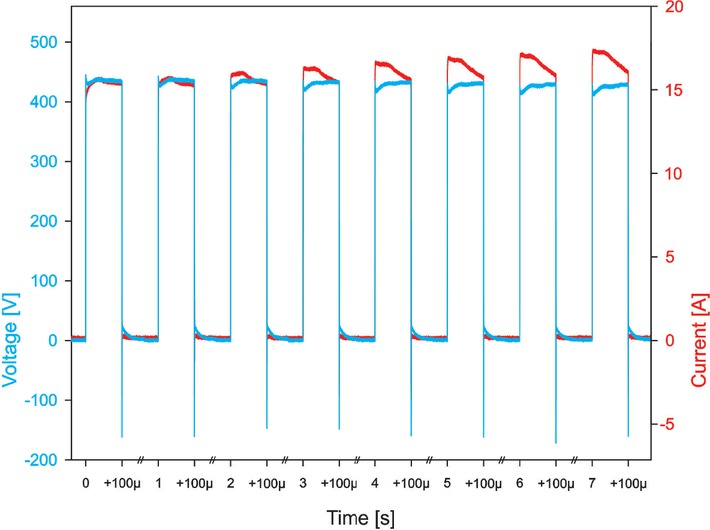
Figure 1
Application of 500 V pulses. Blue line shows voltage and red line shows current. Due to sequencing, all eight pulses are in one picture, separated by //.
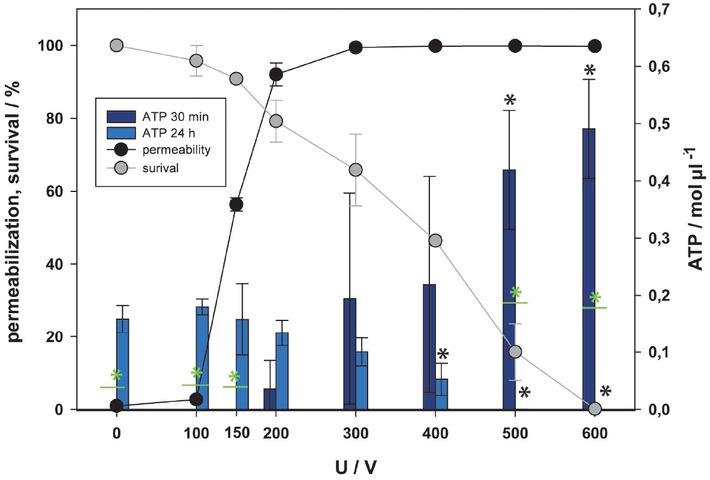
Figure 2
Release of adenosine triphosphate (ATP) as a function of electric pulse amplitude determined by fluorescent assay. Two-time points after electroporation were assessed. Permeabilization and survival curves are also presented. Black and green asterisks (*) indicate statistically significant differences between the samples at different voltages and the corresponding control at 0 V (one-way analysis of variance [ANOVA] followed by Holm-Sidak post-hoc test, (p < 0.05) and within the pair of samples at different voltages (t-test, p < 0.05), respectively).
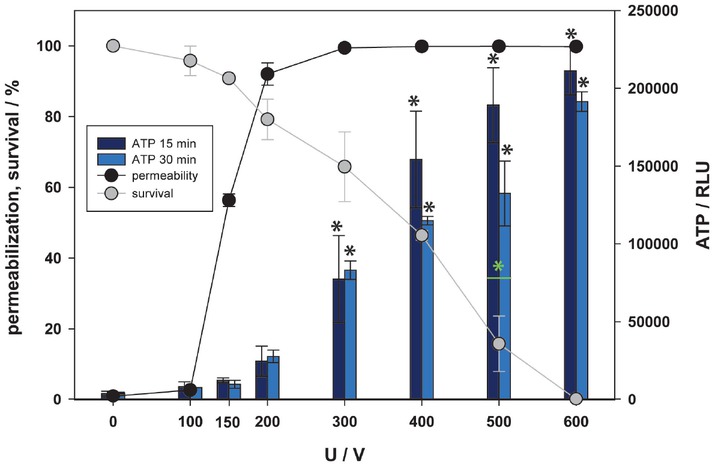
Figure 3
Release of adenosine triphosphate (ATP), as a function of electric pulse amplitude determined by luminescence assay. Two-time points after electroporation were assessed. Permeabilization and survival curves are also presented. Black and green asterisks (*) indicate statistically significant differences between the samples at different voltages and the corresponding control at 0 V (one-way analysis of variance [ANOVA] followed by Holm-Sidak post-hoc test, (p < 0.05) and within the pair of samples at different voltages (t-test, p < 0.05), respectively).
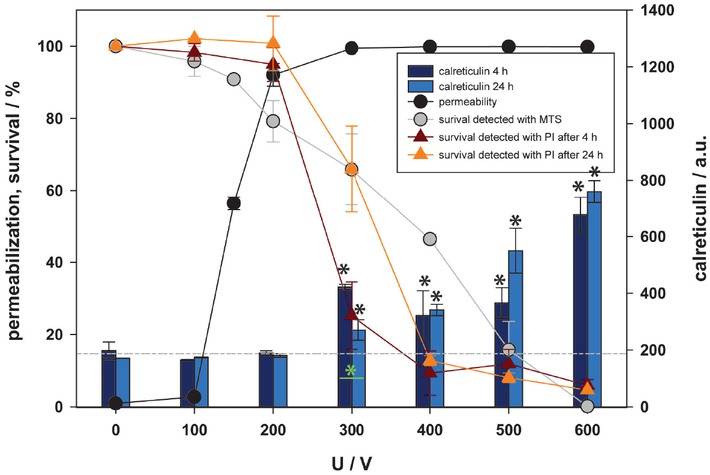
Figure 4
Externalization of calreticulin as a function of electric pulse amplitude. Two-time points after electroporation were assessed. Permeabilization and survival (MTS) curves are also presented. Survival detected by propidium iodide (PI) protocol is normalized to control and presented with red (4 hours after pulse treatment) and orange (24 hours after pulse treatment) line. Approximate baseline of calreticulin is presented with -----. Black and green asterisks (*) indicate statistically significant differences between the samples at different voltages and the corresponding control at 0 V (one-way analysis of variance [ANOVA] followed by Holm-Sidak posthoc test, (p < 0.05) and within the pair of samples at different voltages (t-test, p < 0.05), respectively).
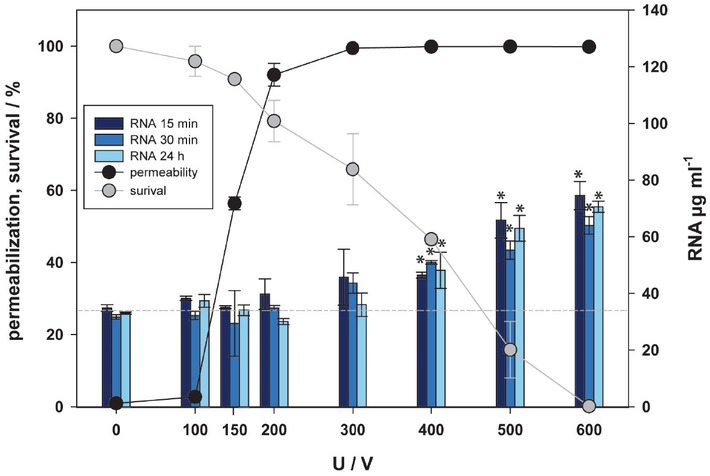
Figure 5
Release of RNA as a function of electric pulse amplitude. Three-time points after electroporation were assessed. Permeabilization and survival curves are also presented. Approximate baseline of RNA is presented with -----. Black and green asterisks (*) indicate statistically significant differences between the samples at different voltages and the corresponding control at 0 V (one-way analysis of variance [ANOVA] followed by Holm-Sidak post-hoc test, (p < 0.05) and within the pair of samples at different voltages (t-test, p < 0.05), respectively).
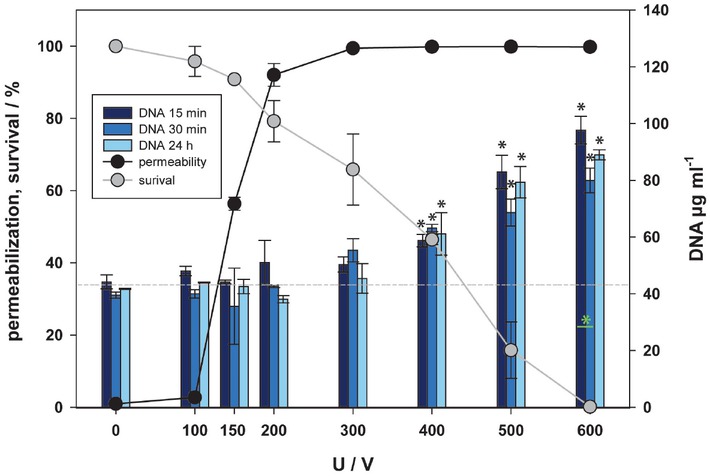
Figure 6
Release of DNA as a function of electric pulse amplitude. Three-time points after electroporation were assessed. Permeabilization and survival curves are also presented. Approximate baseline of DNA is presented with -----. Black and green asterisks (*) indicate statistically significant differences between the samples at different voltages and the corresponding control at 0 V (one-way analysis of variance [ANOVA] followed by Holm-Sidak post-hoc test, (p < 0.05) and within the pair of samples at different voltages (t-test, p < 0.05) respectively.
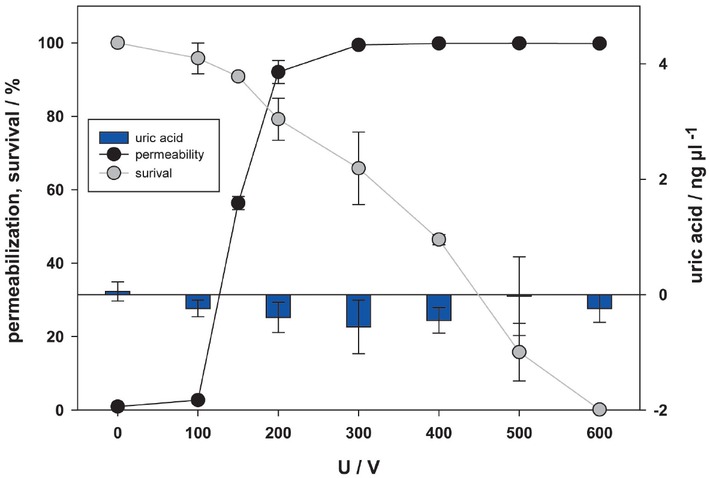
Figure 7
Release of uric acid as a function of electric pulse amplitude. Amount of uric acid was analysed 24 hours after pulse treatment in supernatant. Permeabilization and survival curves are also presented. No statistical difference was detected.
Table 1
Correlation (R) between survival and release of damage-associated molecular pattern molecules (DAMPs) after pulse treatment. Investigated time points for each molecule are presented in the bottom row. Correlation was evaluated with Pearson correlation coefficient and survival was analyzed via MTS assay 24 hours after pulse treatment
| R vs. survival (MTS) | |||||
|---|---|---|---|---|---|
| PI | -0.680 | ||||
| ATP | -0.947 (L) | -0.964 (L)/-0.864 (F) | 0.888 (F) | ||
| DNA | -0.935 | -0.919 | -0.928 | ||
| RNA | -0.909 | -0.909 | -0.919 | ||
| CRT | -0.801 | -0.946 | |||
| uric acid | NS | ||||
| time after points EP | 3 min | 15 min | 30 min | 4 h | 24 h |
Table 2
Correlation (R) between permeabilization and release of damage-associated molecular pattern molecules (DAMPs) after pulse treatment. Investigated time points for each molecule are present in the bottom row. Correlation was evaluated with Pearson correlation coefficient and permeabilization was analyzed by propidium iodide (PI) assay 3 minutes after pulse treatment
| R vs permeabilization (PI) | |||||
|---|---|---|---|---|---|
| MTS | -0.680 | ||||
| ATP | 0.704 | 0.728 (L)/0.594 (F) | -0.695 (F) | ||
| DNA | 0.571 | 0.689 | NS | ||
| RNA | 0.584 | 0.696 | NS | ||
| CRT | 0.535 | 0.556 | |||
| uric acid | NS | ||||
| time after points EP | 3 min | 15 min | 30 min | 4 h | 24 h |