
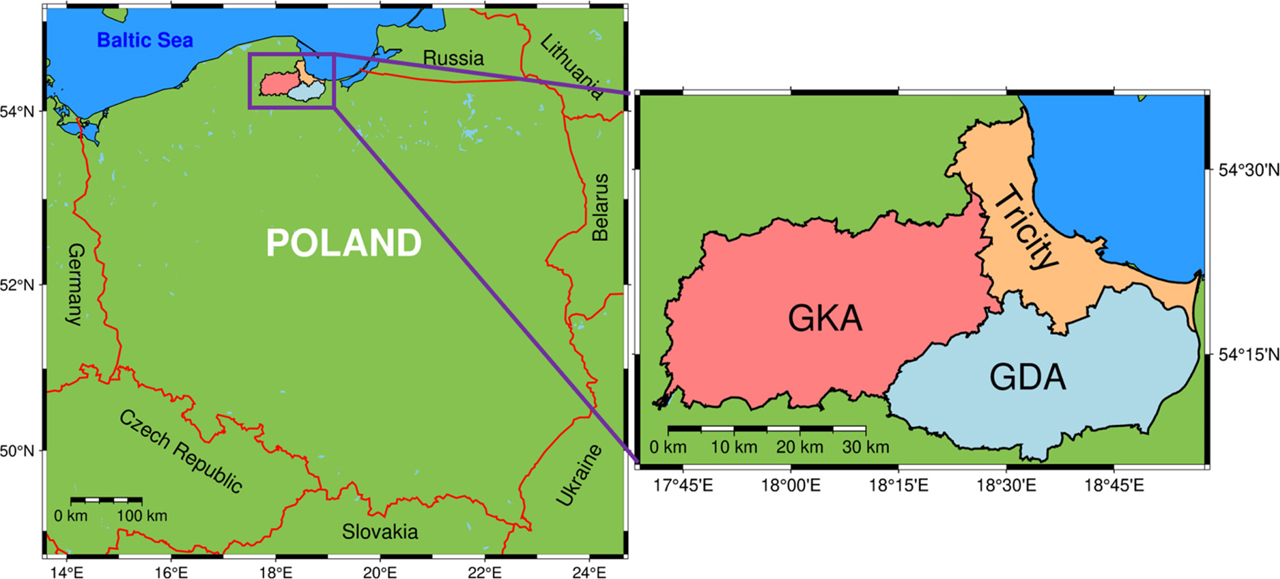
Fig. 1
Study area location.
Table 1
Summary of data used.
| Data / format | Reference years | CRS | Spatial resolution | Data provider | Explanatory variables |
|---|---|---|---|---|---|
| CORINE land Cover / vector | 2006, 2012, 2018 | ETRS89 / Poland CS92 | 25 ha | Copernicus Land Monitoring Services [CLMS 2022] | |
| BDOT10k / vector | 2018 | ETRS89 / Poland CS92 | 1:10,000 | Head Office of Geodesy and Cartography [GUGiK 2022] | Distance to roads, built-up area, protected areas |
| DTED / raster | 2004 | WGS84 | 30 m | United States Geological Survey [USGS 2022] | Slope, elevation |
| GHS POP / Grid | 2015 | World Mollweide | 250 m | Joint Research Centre (JRC), DG for Regional and Urban Policy of the European Commission [GHS-POP 2022] | Population distribution |
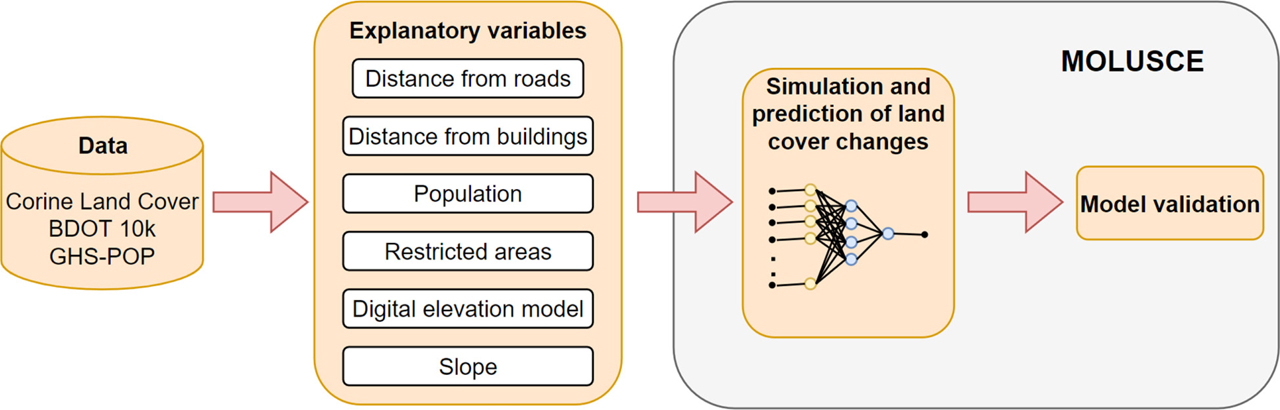
Fig. 2
Workflow scheme of land-use prediction process.
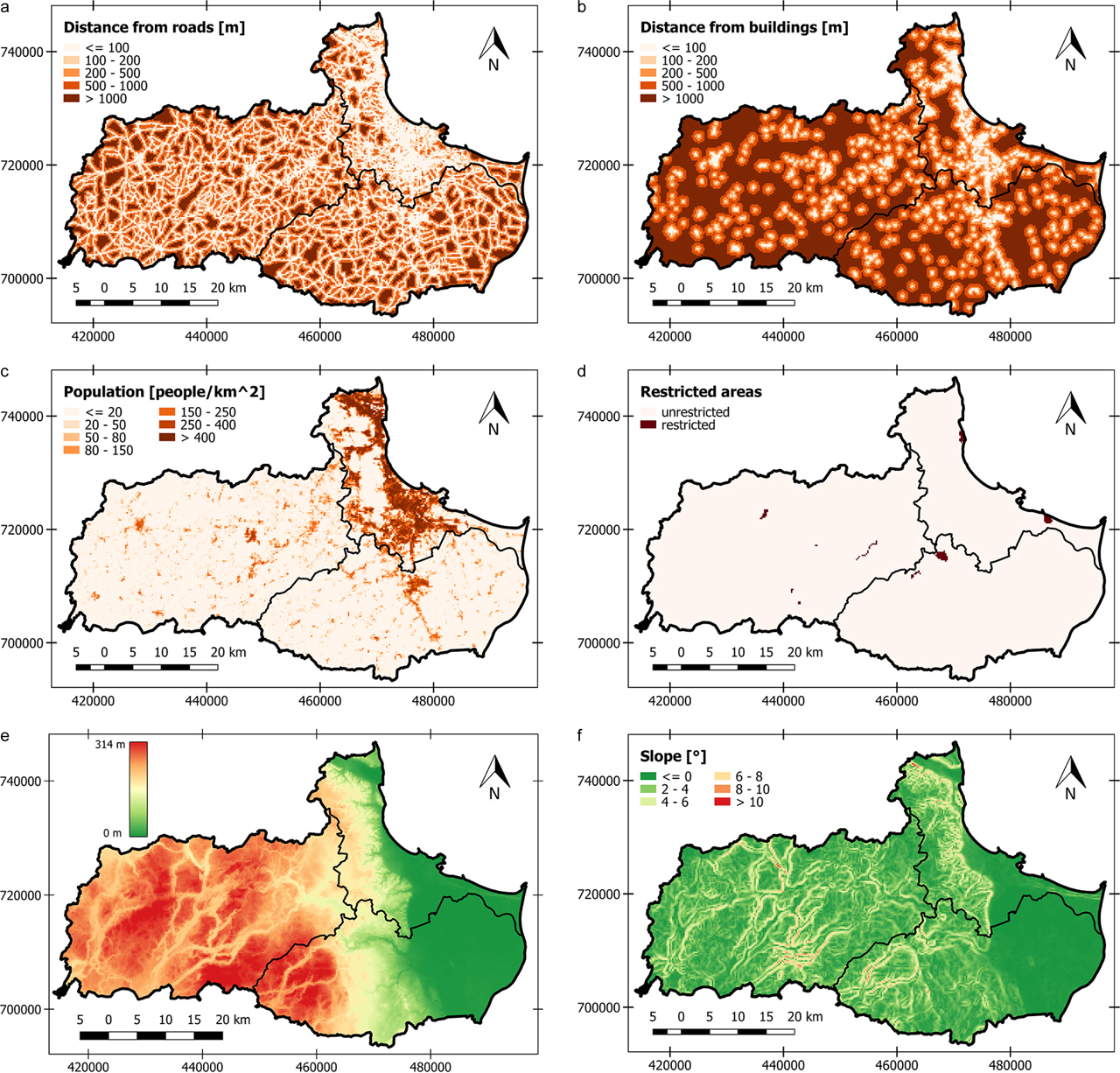
Fig. 3
Explanatory variables, raster data.
a) distance from roads; b) distance from buildings; c) population; d) restricted areas; e) Digital Elevation Model; f) slope.
Table 2
Buffer zones applied to roads and built-up area.
| Distance to roads and built-up areas [m] | Zone number |
|---|---|
| ≤ 100 | 1 |
| 100–200 | 2 |
| 200–500 | 3 |
| 500–1000 | 4 |
| > 1000 | 5 |
Table 3
Statistics of land cover changes in km2.
| Land cover class | Land cover code | 2006 | 2012 | 2018 | 2006–2012 | 2012–2018 | 2006–2018 |
|---|---|---|---|---|---|---|---|
| Artificial surfaces | 1 | 213.69 | 300.25 | 309.06 | 86.56 | 8.81 | 95.37 |
| Agricultural areas | 2 | 1405.19 | 1297.06 | 1289.38 | −108.12 | −7.69 | 115.81 |
| Forest and seminatural ecosystems | 3 | 634.56 | 655.19 | 654.12 | 20.62 | −1.06 | 19.56 |
| Wetlands | 4 | 2.56 | 3.00 | 3.00 | 0.44 | 0.00 | 0.44 |
| Water bodies | 5 | 73.31 | 73.81 | 73.75 | 0.50 | −0.06 | 0.44 |
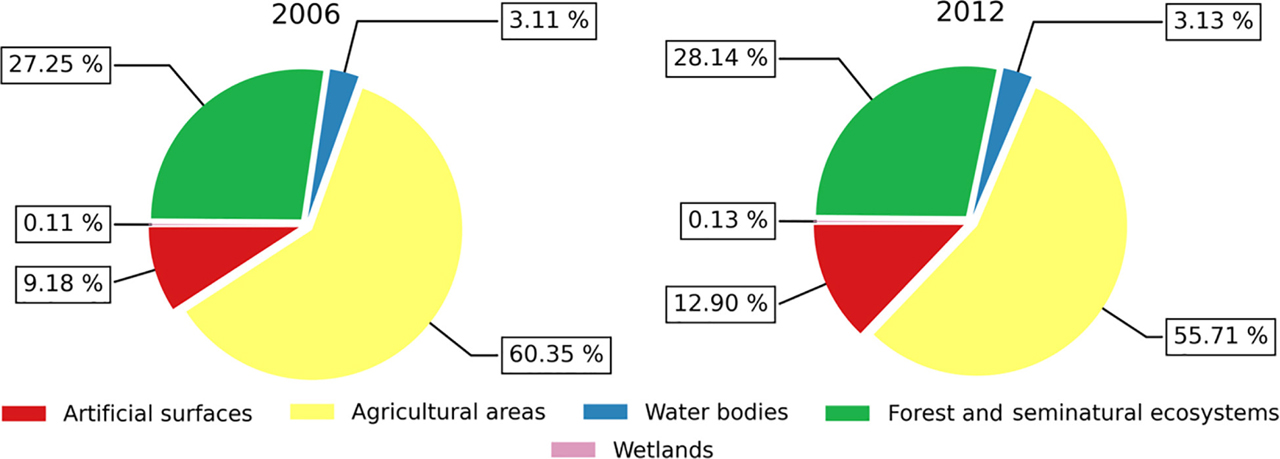
Fig. 4
Percentage of land cover categories on analysed area (2006 and 2012).
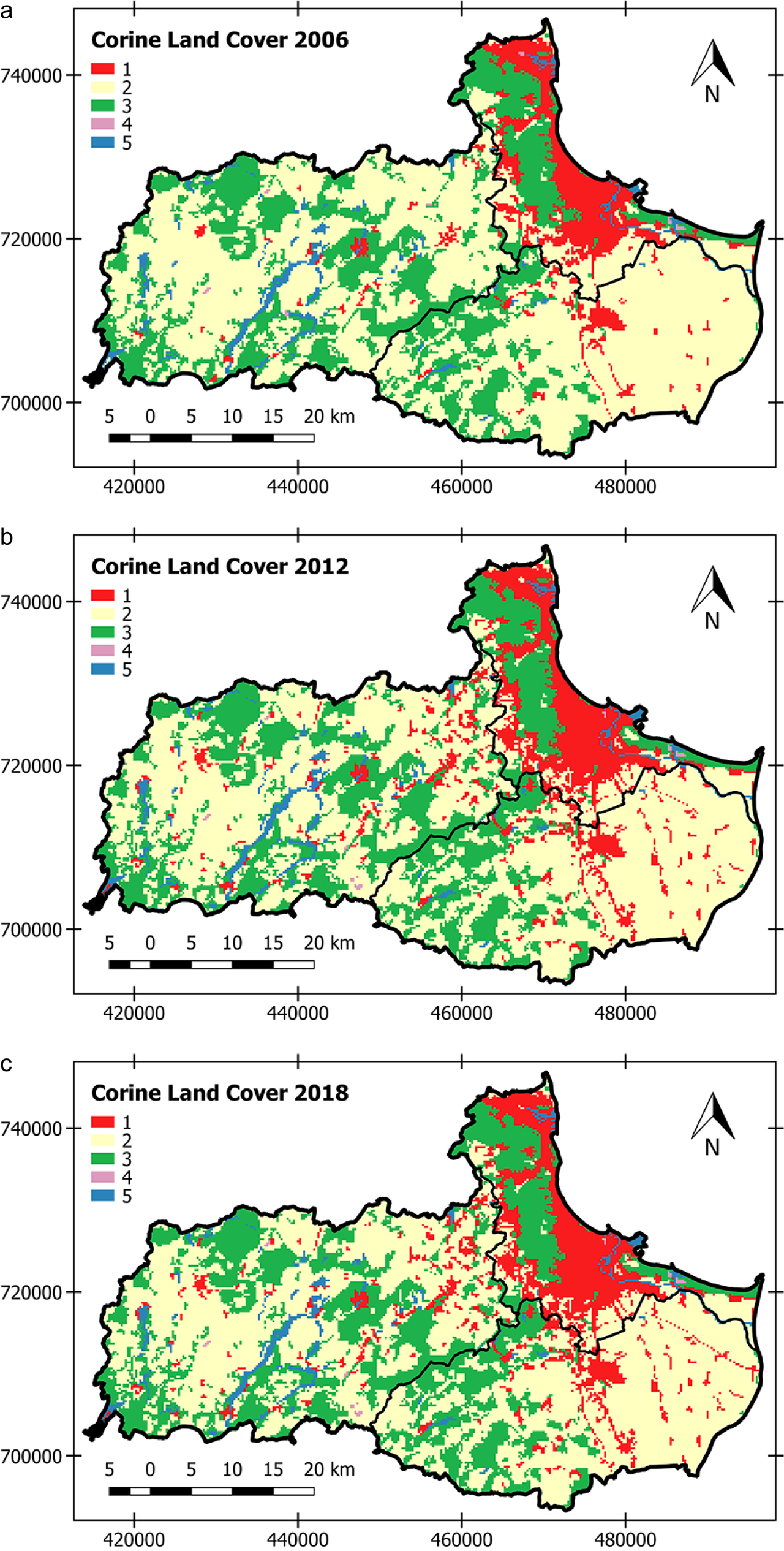
Fig. 5
CLC maps.
(a) 2006; (b) 2012; (c) 2018. LULC types: 1 – Artificial surfaces; 2 – Agricultural areas; 3 – Forest and seminatural ecosystems; 4 – Wetlands; 5 – Water bodies.
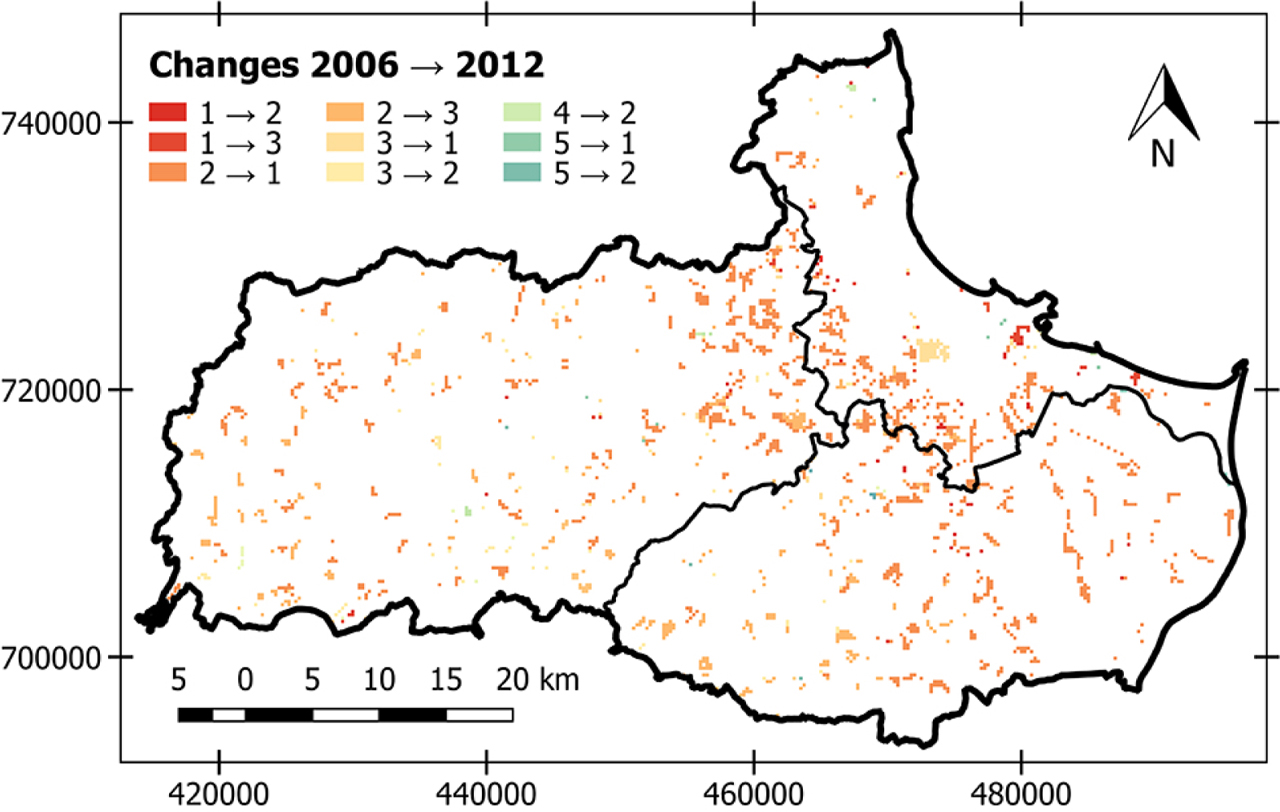
Fig. 6
Change map between land use in 2006 and 2012.
LULC types: 1 – Artificial surfaces; 2 – Agricultural areas; 3 – Forest and seminatural ecosystems; 4 – Wetlands; 5 – Water bodies.
Table 4
Correlation values between explanatory variables.
| Names of variables | Slope | Distance to buildings | Restricted areas | Distance to roads | Population | Elevation |
|---|---|---|---|---|---|---|
| Slope | – | −0.04 | 0.01 | −0.00 | −0.00 | 0.35 |
| Distance to buildings | – | 0.02 | 0.30 | −0.40 | 0.21 | |
| Restricted areas | – | 0.03 | −0.02 | −0.02 | ||
| Distance to roads | – | −0.30 | 0.10 | |||
| Population | – | −0.29 | ||||
| Elevation | – |
Table 5
Transition matrix between CLC 2006 and 2012.
| Land cover | Artificial | Agricultural | Forest, seminatural ecosystems | Wetlands | Water |
|---|---|---|---|---|---|
| Artificial | 0.9782 | 0.01 | 0.01 | 0.00 | 0.00 |
| Agricultural | 0.06 | 0.92 | 0.02 | 0.00 | 0.00 |
| Forest, seminatural ecosystems | 0.01 | 0.01 | 0.98 | 0.00 | 0.00 |
| Wetlands | 0.00 | 0.17 | 0.22 | 0.61 | 0.00 |
| Water | 0.01 | 0.01 | 0.00 | 0.00 | 0.98 |
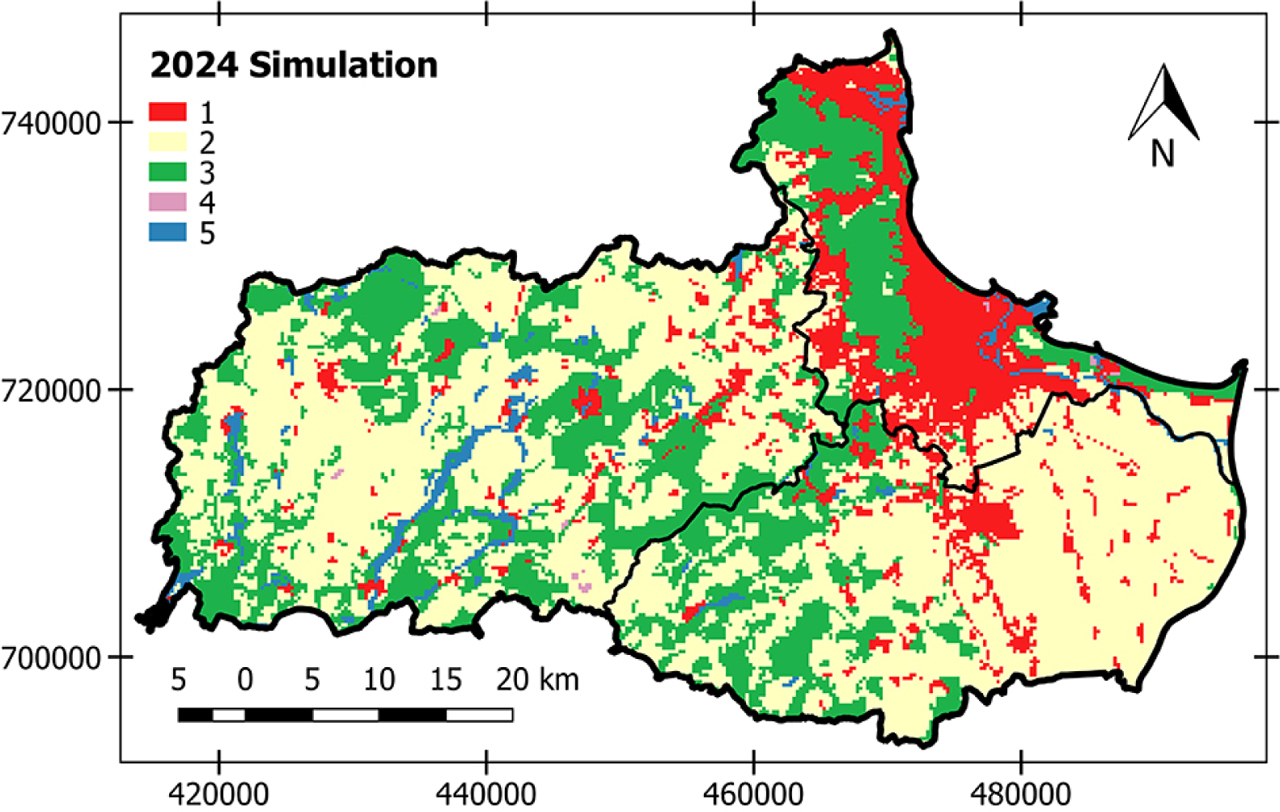
Fig. 7
Predicted land use in 2024.
LULC types: 1 – Artificial surfaces; 2 – Agricultural areas; 3 – Forest and seminatural ecosystems; 4 – Wetlands; 5 – Water bodies.
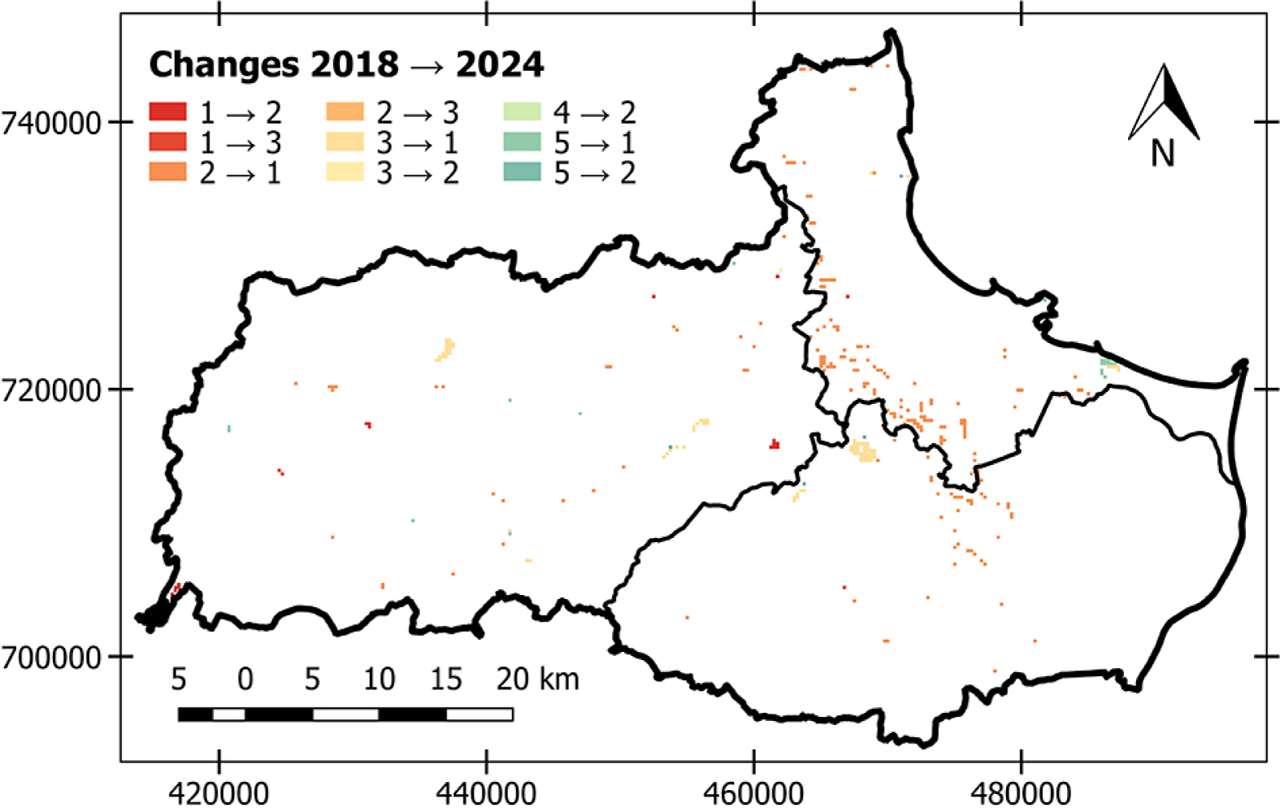
Fig. 8
Spatial distribution of land cover changes.
LULC types: 1 – Artificial surfaces; 2 – Agricultural areas; 3 – Forest and seminatural ecosystems; 4 – Wetlands; 5 – Water bodies.