
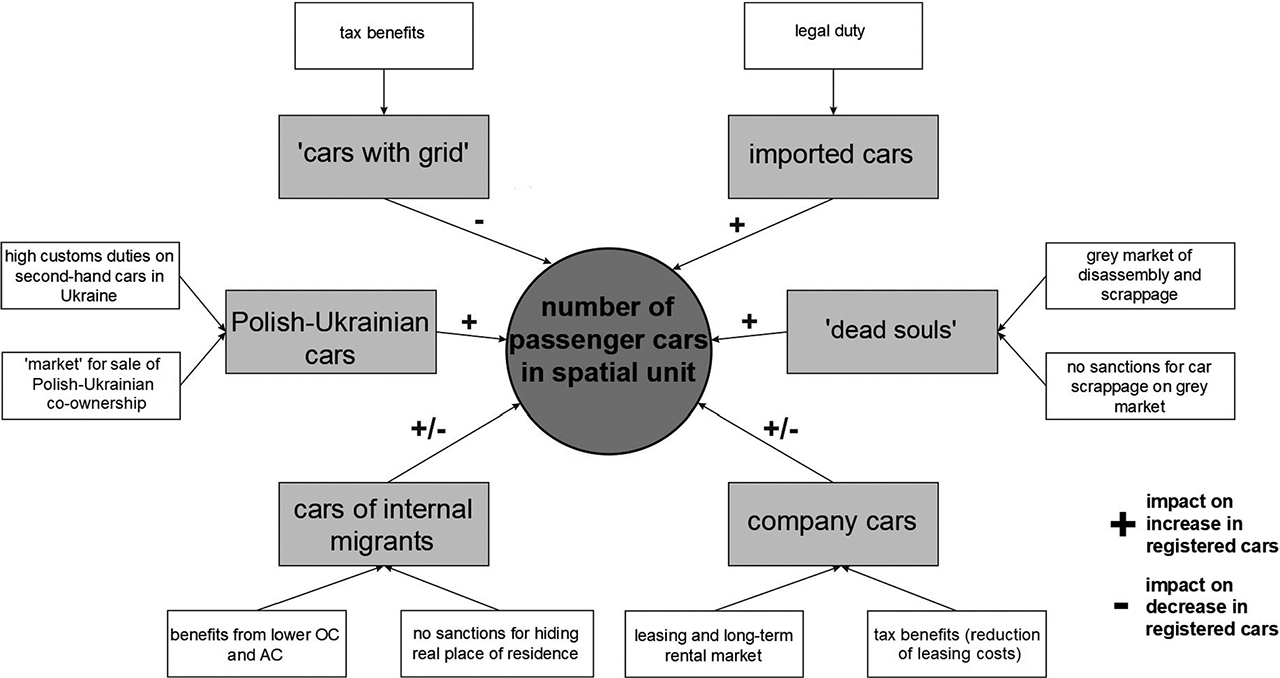
Fig. 1
Impact of the shortcomings of motorisation statistics and their causes on the number of passenger cars registered in a given territorial unit.
AC – autocasco comprehensive insurance, OC – liability car insurance.
Source: own study.
Table 1
Authorities responsible for collecting and sharing motorisation statistics in Poland.
| Period | Place of vehicle registration | Vehicle register | Source of GUS data |
|---|---|---|---|
| Until 1990 | Commune office | Province (n = 49) | WEP |
| 1990–1998 | Rejon* office | Province (n = 49) | WEP |
| 1999–2001 | District office | Province (n = 16) | WEP |
| 2002–2003 | District office | Province (n = 16) | District databases |
| 2004–2008 | District office | Central (version 1.0) | District databases |
| 2008–2017 | District office | Central (version 1.0) | CEP ver. 1.0 |
| Since November 2017 | District office | Central (version 2.0) | CEP ver. 2.0 |
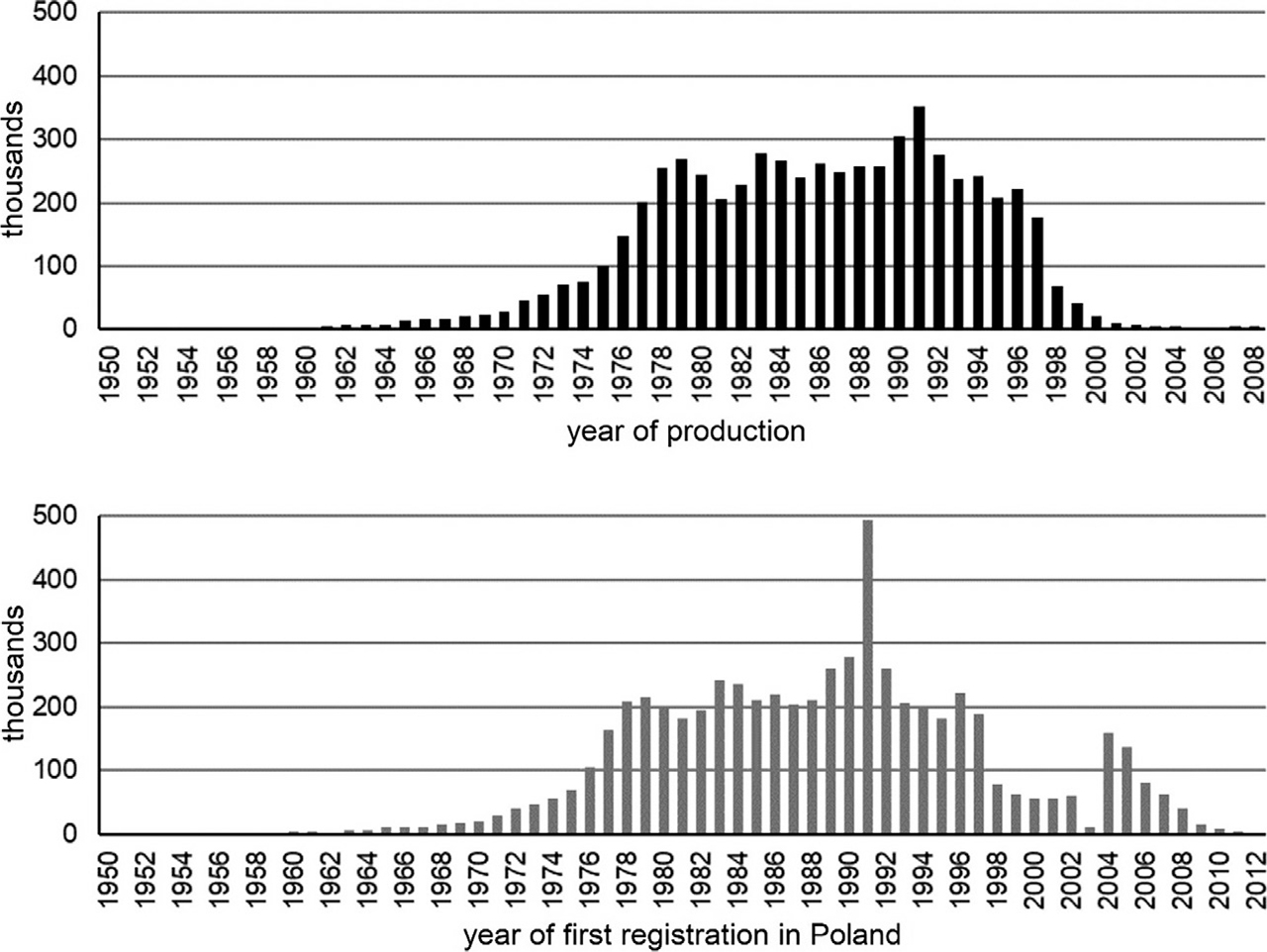
Fig. 2
End-of-life vehicles by their years of production and first registration in Poland (as at 31 December 2018).
Source: authors’ own elaboration based on CEP data.
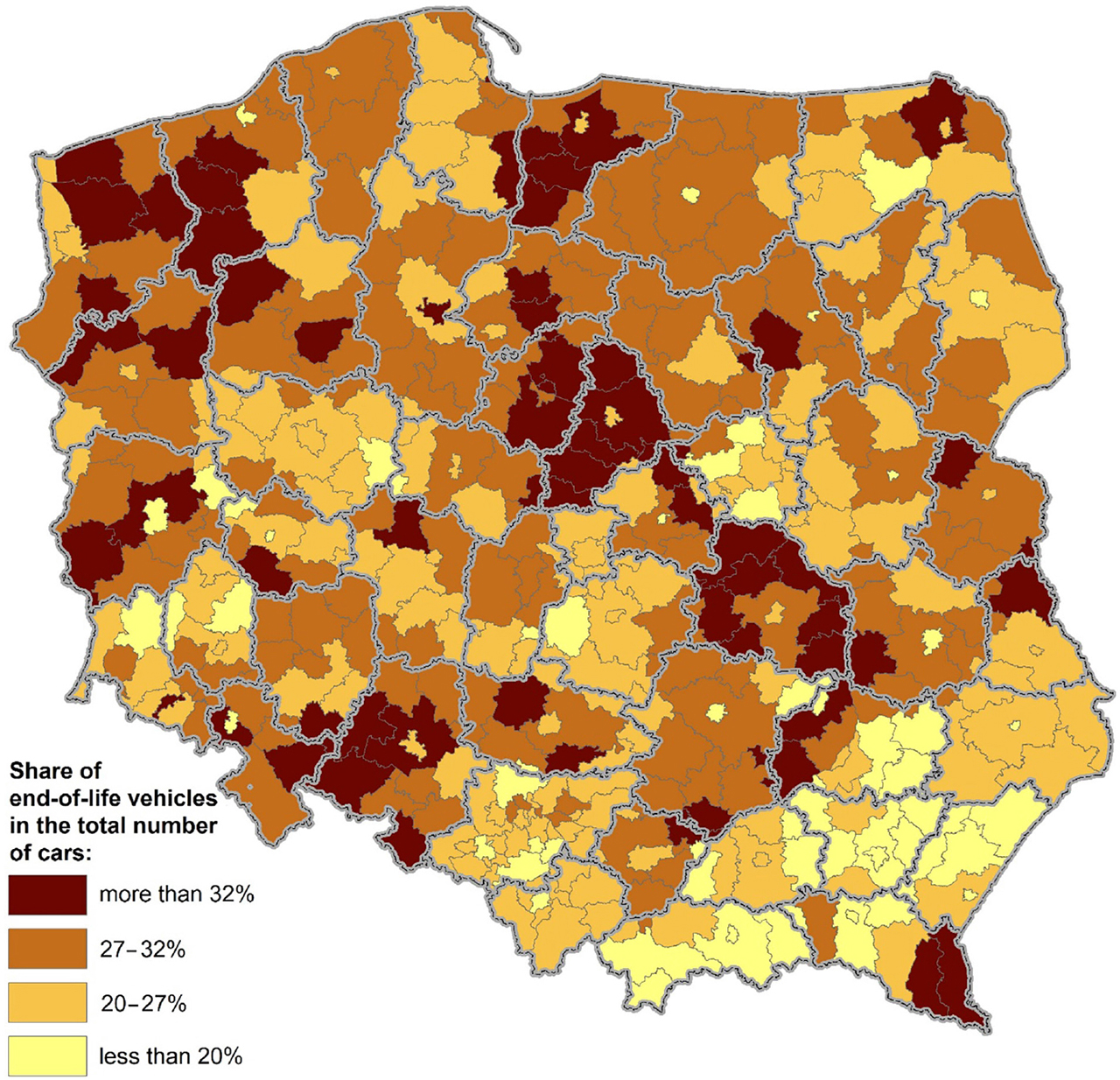
Fig. 3
Spatial distribution of end-of-life cars in Polish districts (as at 31 December 2018), in line with the country’s former administrative division into 49 provinces (1975–1998).
Source: authors’ own elaboration based on CEP data.
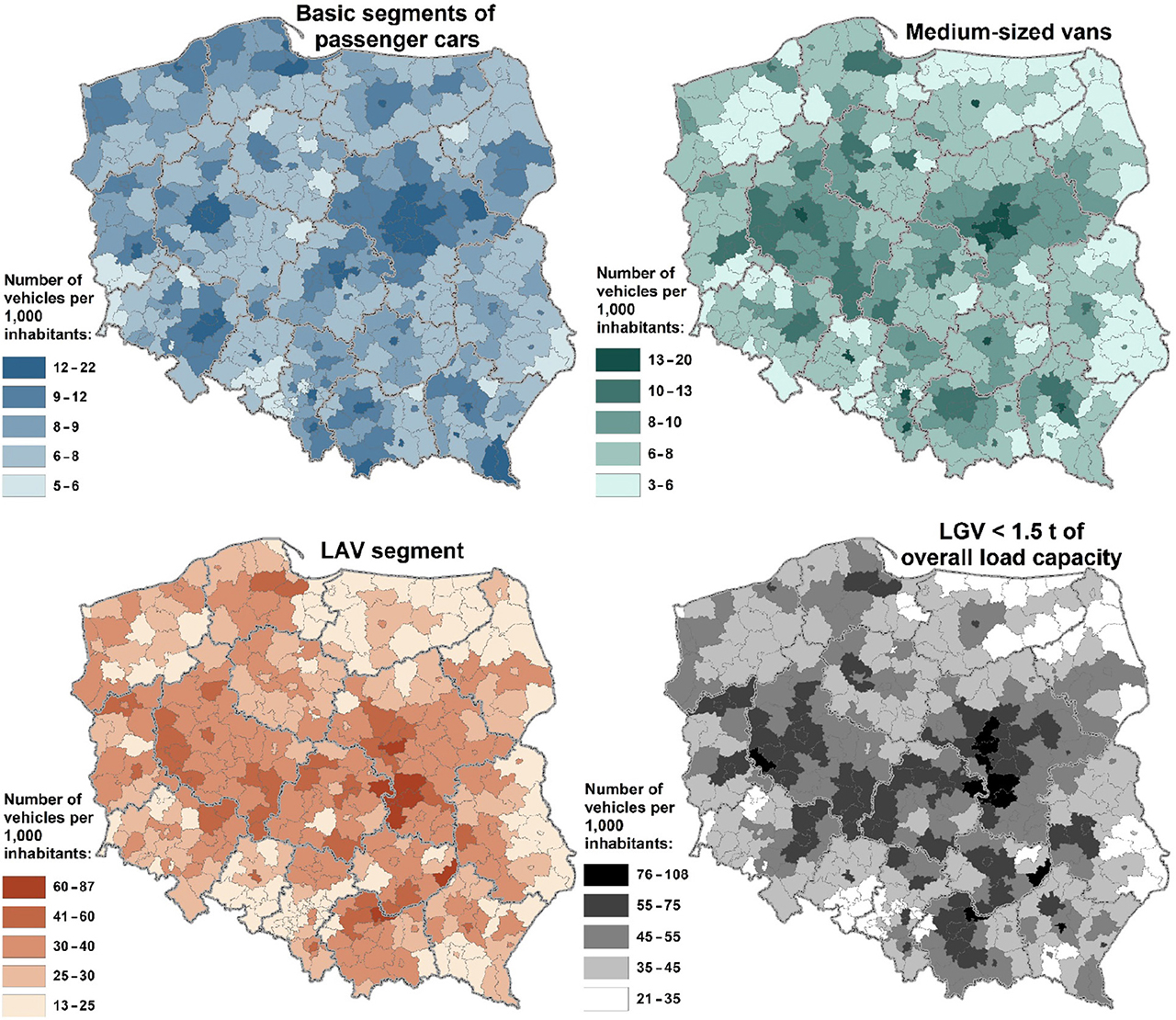
Fig. 4
Spatial distribution of LGVs (permissible load capacity <1.5 tonnes) in Poland by three selected groups (as at 31 December 2018).
LGV – large goods vehicles.
Source: authors’ own elaboration based on CEP data.
Table 2
Correlation coefficients between the number of LGVs (permissible load capacity <1.5 tonnes) per 1,000 inhabitants by their segments and selected socio-economic features.
Table 3
The 15 cities and communes in Poland with the largest number of company cars.
| No. | City/commune | Number of passenger cars registered by | Number of passenger cars per 1,000 inhabitants | |||
|---|---|---|---|---|---|---|
| natural persons | business entities | natural persons | business entities | Total | ||
| 1 | Warsaw | 591,643 | 424,988 | 337 | 242 | 578 |
| 2 | Poznań | 192,088 | 96,411 | 356 | 179 | 535 |
| 3 | Wrocław | 223,571 | 89,406 | 350 | 140 | 490 |
| 4 | Krakow | 269,860 | 88,201 | 352 | 115 | 467 |
| 5 | Katowice | 101,949 | 59,623 | 343 | 201 | 544 |
| 6 | Gdańsk | 148,380 | 46,056 | 320 | 99 | 419 |
| 7 | Łódź | 241,237 | 43,812 | 348 | 63 | 411 |
| 8 | Szczecin | 134,205 | 27,073 | 332 | 67 | 399 |
| 9 | Rzeszów | 67,972 | 24,474 | 359 | 129 | 489 |
| 10 | Lublin | 122,279 | 24,424 | 359 | 72 | 431 |
| 11 | Gdynia | 83,067 | 24,194 | 337 | 98 | 435 |
| 12 | Kampinos | 2,261 | 21,456 | 527 | 4,998 | 5,525 |
| 13 | Bydgoszcz | 114,726 | 21,438 | 325 | 61 | 385 |
| 14 | Bielsko-Biała | 67,901 | 20,150 | 395 | 117 | 512 |
| 15 | Opole | 48,270 | 16,671 | 377 | 130 | 507 |
[i] Source: authors’ own elaboration based on CEP data.
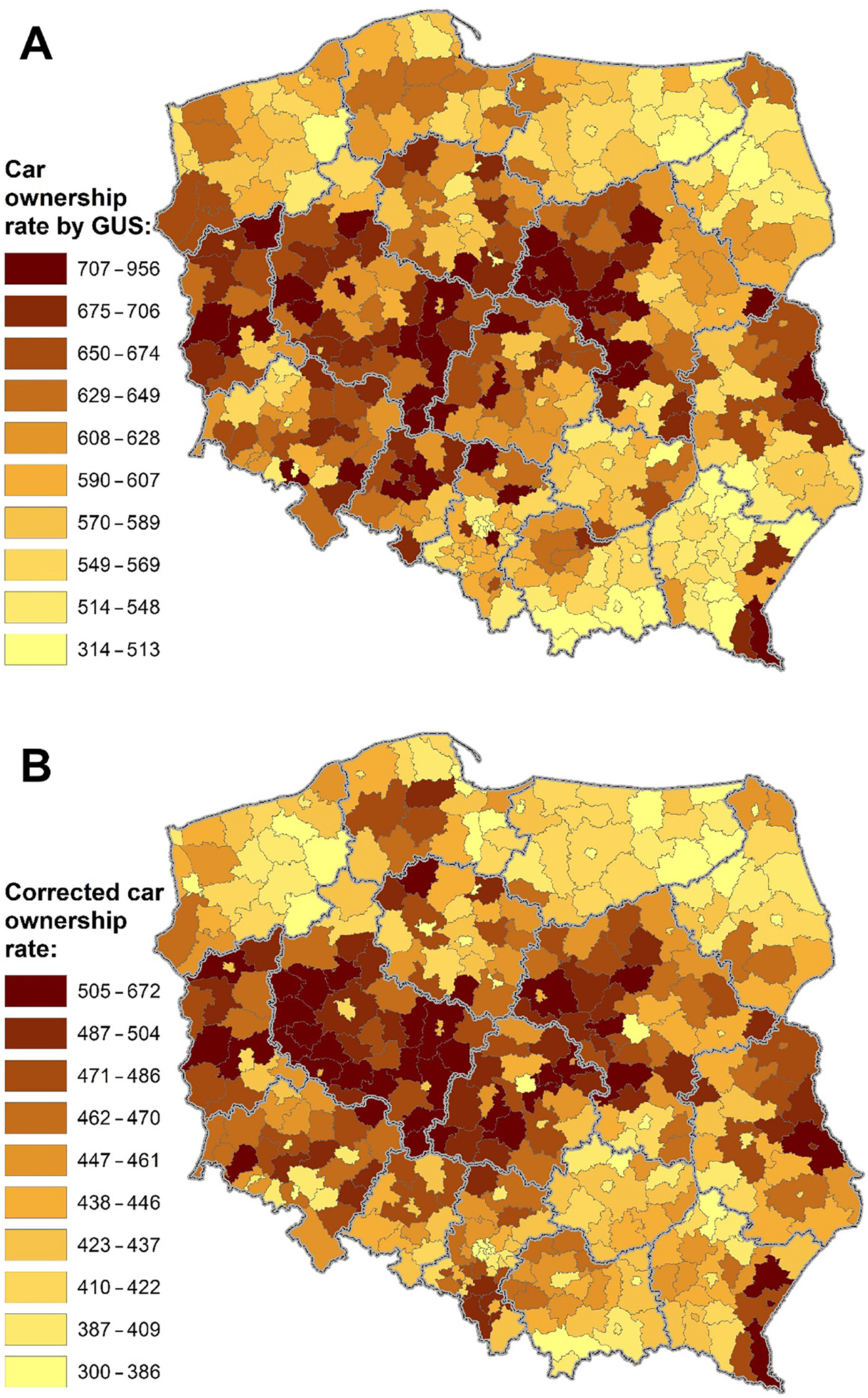
Fig. 5
Spatial distribution of car ownership rate values in Poland, in line with data from GUS (A) and CEP, as corrected by the authors (B) (31 December 2018).
Source: authors’ own elaboration based on GUS and CEP data.
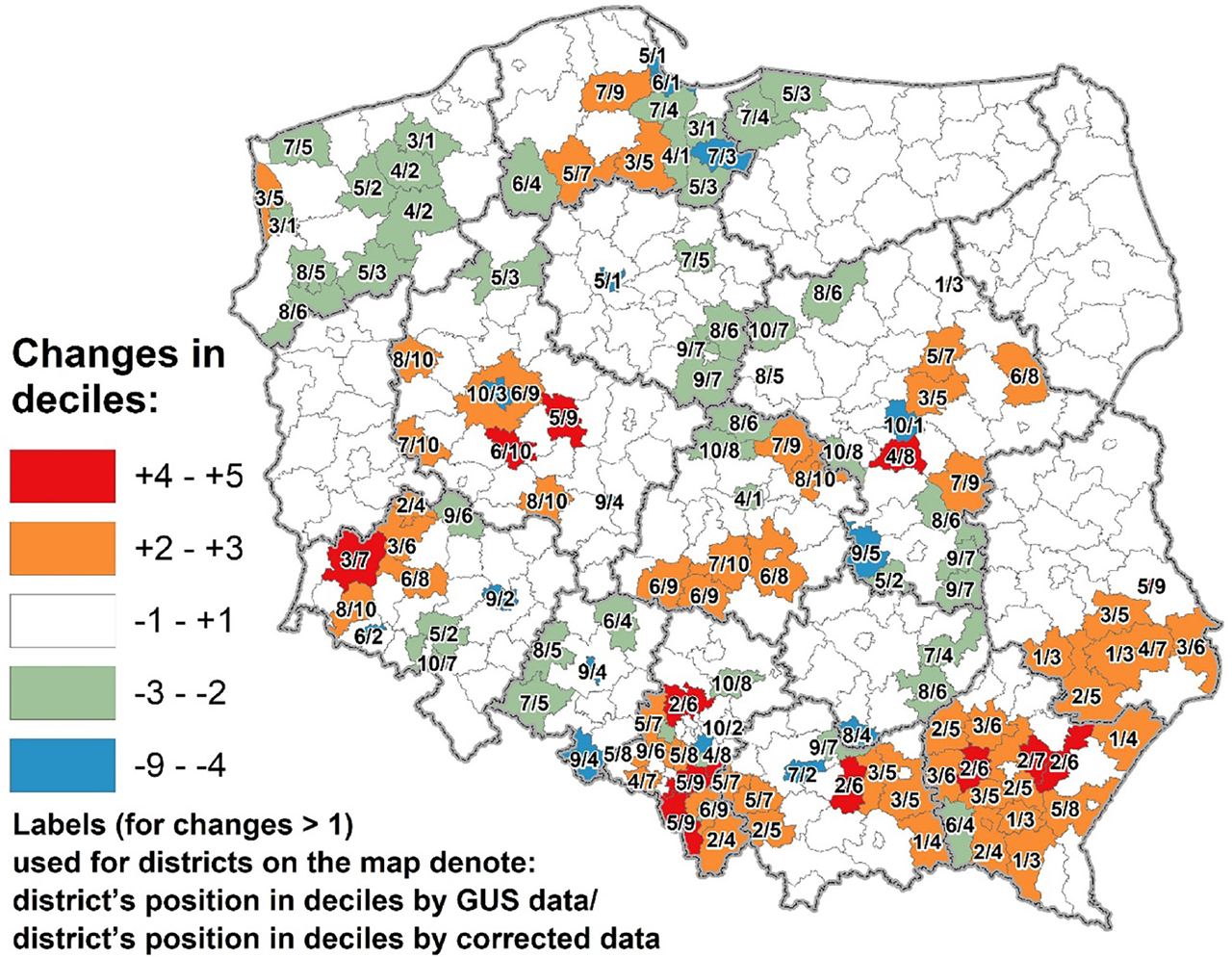
Fig. 6
Collation of the spatial distribution of car ownership rate values in Poland, in line with GUS and CEP data, following the authors’ correction (31 December 2018).
GUS – Statistics Poland; CEP – Central Vehicle Register.
Source: authors’ own elaboration based on GUS and CEP data.