
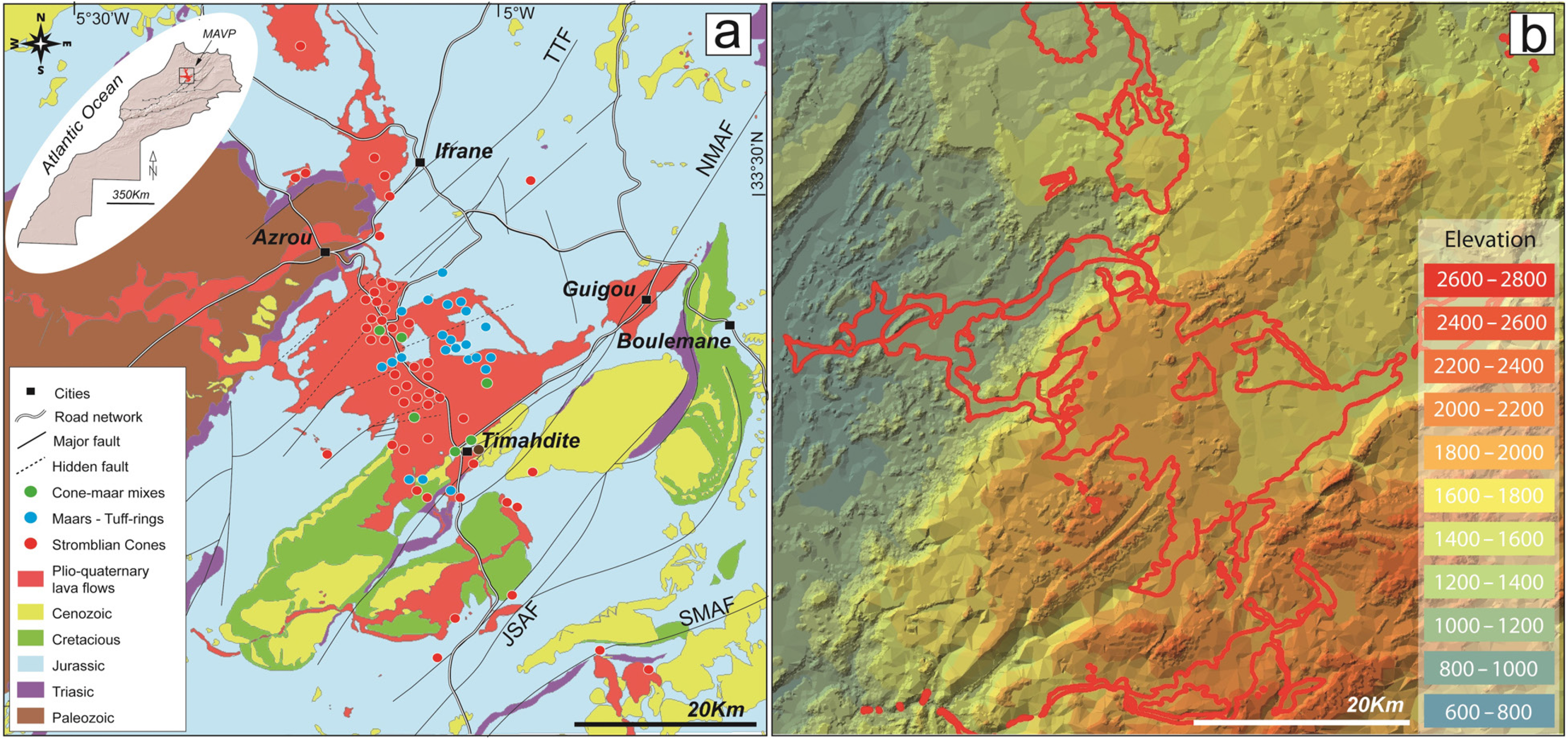
Fig. 1
Study area.
a) Geographical location and geological map of the study area. Most of volcanoes and lava flow units erupted from the Azrou-Timahdite plateau. These volcanoes strung along into two trails: the main cones dominated central trail and smaller eastern maars dominated trail that concentrates on the Azrou-Timahdite plateau. Major faults abbreviation: TTF: Tizi-n-Tretten Fault; NMAF: North Middle-Atlas Fault; JSAF: Jbel Sidi Ali Fault; SMAF: South Middle-Atlas Fault. MAVP: Middle-Atlas volcanic province.
b) Coloured digital elevation model of the Middle-Atlas, showing the topographic framework of the study area. Heights are in metres above sea level.
Table 1
Classification table of cones according to their eruptive landform, height, width, elongation index, and the geographic location.
| Name | Eruptive landform | Height (m) | Width (m) | Elongation index | Location (WGS) |
|---|---|---|---|---|---|
| Tabourit | craterless | 200 | 1100–2000 | 1.81 | 33.181090, −5.251647 |
| Bekrite | 120 | 1400–1500 | 1.07 | 33.064061, −5.241821 | |
| Outgui | 120 | 1000–1200 | 1.20 | 33.644252, −5.246676 | |
| Si Mghid | 100 | 450–550 | 1.22 | 33.196662, −5.260765 | |
| El koudiat | 90 | 1100–1200 | 1.09 | 33.531257, −5.156566 | |
| Ariana | 80 | 700–1000 | 1.42 | 33.519565, −5.242534 | |
| Ain Kahla | 78 | 400–500 | 1.25 | 33.229431, −5.218468 | |
| Rabouba | 72 | 450–500 | 1.11 | 33.240984, −5.132338 | |
| Tichout Tazoug | 70 | 650–700 | 1.07 | 33.347645, −5.161858 | |
| Tamarakoit | 65 | 350–400 | 1.14 | 33.061960, −5.066542 | |
| Sidi Said | 63 | 450–800 | 1.77 | 33.262311, −5.053953 | |
| Tamahrart | 60 | 600–700 | 1.16 | 33.512481, −5.252448 | |
| Lougnina | 60 | 1000–1100 | 1.10 | 33.011541, −4.832307 | |
| Talsast | 60 | 600–700 | 1.16 | 33.229551, −5.276386 | |
| Mijmouane | 33 | 450–600 | 1.33 | 33.387091, −5.167786 | |
| Jbel Hebri | ring-shaped | 220 | 1200–1300 | 1.08 | 33.313252, −5.136189 |
| Am Larays | 200 | 1000–1400 | 1.40 | 33.034140, −4.890189 | |
| Chédifate | 167 | 2000–2500 | 1.25 | 33.313252, −5.136189 | |
| Sidi Ali | 75 | 650–700 | 1.07 | 33.313252, −5.136189 | |
| Jbel Habri | horseshoe-shaped | 100 | 1200–1300 | 1.08 | 33.385425, −5.154080 |
| Ouaouseenfacht | 100 | 1200–1600 | 1.33 | 33.596260, −4.686587 | |
| Selrhert | 70–90 | 450–750 | 1.66 | 33.178465, −4.995152 | |
| Ich Ouarrok | 85 | 1000–1300 | 1.30 | 33.404557, −5.150691 | |
| Bouahcine | 65 | 750–800 | 1.06 | 33.322261, −5.095985 | |
| Boutjatiout | 62 | 700–800 | 1.14 | 33.309686, −5.091728 | |
| Sidi Boundouh | 60 | 900–1000 | 1.11 | 33.239289, −5.075849 | |
| Taissaouit | 57 | 750–800 | 1.06 | 33.318892, −5.110387 | |
| Tichinouine | 45 | 450–1000 | 2.22 | 33.309686, −5.091728 | |
| Boutaguarouine | nested (8) | 155 | 2500–4000 | – | 33.284479, −5.093798 |
Table 2
Classification table of maars associated to tuff-rings according to their eruptive landform, depth, crater’s width, elongation index, and the geographic location.
| Name | Eruptive landform | Depth (m) | Crater width (m) | Elongation index | Location (WGS) |
|---|---|---|---|---|---|
| Michlifène | deep maar/tuff-ring | 120 | 800 | 1.00 | 33.413500, −5.079369 |
| Lechmine N Ait Lhaj | 110 | 850 | 1.00 | 33.382723, −5.070212 | |
| Lechmine N Kettan | 070–100 | 1000–1100 | 1.10 | 33.378136, −5.125830 | |
| Lechmine Bou Itguel | 90 | 1300 | 1.00 | 33.202695, −5.117515 | |
| Lechmine N Rhelline | shallow maar/tuff-ring | 40 | 650 | 1.00 | 33.315974, −5.024742 |
| Tafraout | 30 | 0800–1000 | 1.25 | 33.522731, −4.691432 | |
| Lechmine Tajine | 30 | 0800–1100 | 1.35 | 33.327478, −5.019378 | |
| Lechmine Chker Allah | 30 | 700–800 | 1.14 | 33.205212, −5.102474 | |
| Tuna – Tit Ougmar | maars complex | 35–40 | 500–900 | – | 33.322102, −5.136088 |
| Boulbalrathene | 20–50 | 0500–1200 | – | 33.343615, −5.063990 |
Table 3
Classification table of eruptive mixes according to their eruptive landforms, elevation’s difference, width, and the geographic location.
| Name | Eruptive landforms | Elevation difference | Width (m) | Location (WGS) |
|---|---|---|---|---|
| West Hebri | cone → maar/tuff-ring | 65 | 800 | 33.357214, −5.151767 |
| Msaarab Sud | maar/tuff-ring → cone | 75 | 500 | 33.234592, −5.037232 |
| Lechmine Izgarn | 200 | 400–2500 | 33.264304, −5.105774 | |
| Timahdite | 100 | 800–1100 | 33.230974, −5.066730 | |
| Tahabrit | maar/tuff-ring → nested cones (3) | 180 | 2600 | 33.347028, −5.127267 |
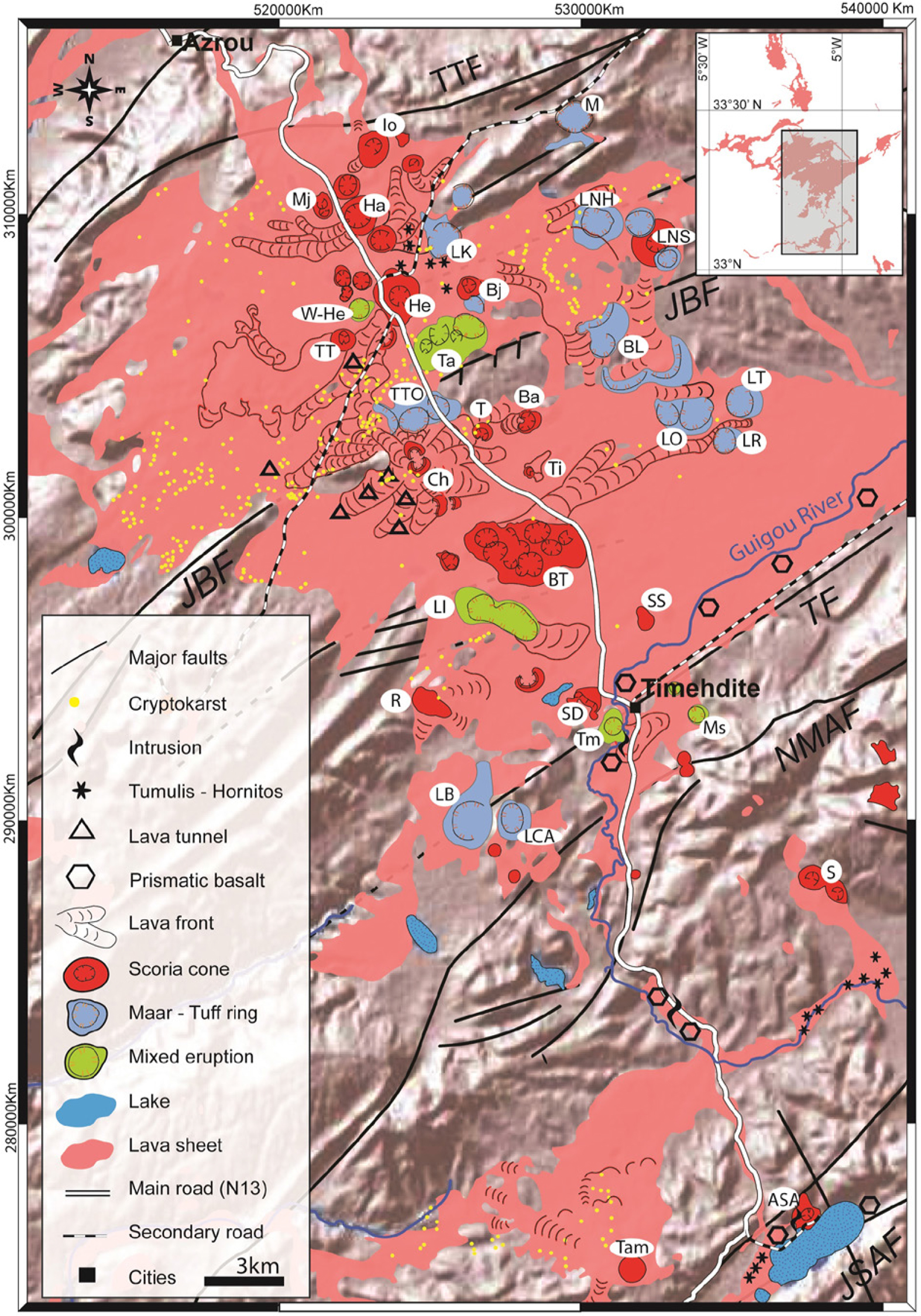
Fig. 2
Map of the main volcanic features on both tabular and folded domain of the central Middle-Atlas domain.
Volcanic device abbreviations: AK – Ain Kahla, Ba – Bou Ahsine, Bj – Boutjatiout, BL – Boulbalrhatène, BT – Boutaguarouine, Ch – Chedifate, Ha – Habri, He – Hebri, Io – Ich Ouarrok, LB – LechmineBou Itguel, LBS – Lechmine Ben Said, LCA – Lechmine Chker Allah, LI – Lechmine Izgarn, LK – Lechmine-n-Kettane maar, NHL – Lechmine-Naït-Lhaj maar, LO – Lechmine Ouannou, LR – Lechmine N Rhelline, LT – Lechmine Tajine, M – Michlifène, Mj – Mijmouane, Ms – Msaarab south, RA – Rabouba, S – Selrhert, SA – Sidi Ali, SD – Sidi Boundouh, SS – Sidi Said, T – Taissaouit, Ta – Tahabrit, Tam – Tamarakoit, Ti – Tichinouine, Tim – Timahdite, TT – Tichout Tazouggaght, TTO – Touna-Tit Ougmar, W-He – West Hebri.
Fault name abbreviations: TTF – Tizi-n-Tretten Fault, JBF – Jbel Irhoud-Boulbalrhatene Fault, TF – Timahdite, NMAF – North Middle-Atlas Fault, JSAF – Jbel Sidi Ali Fault.
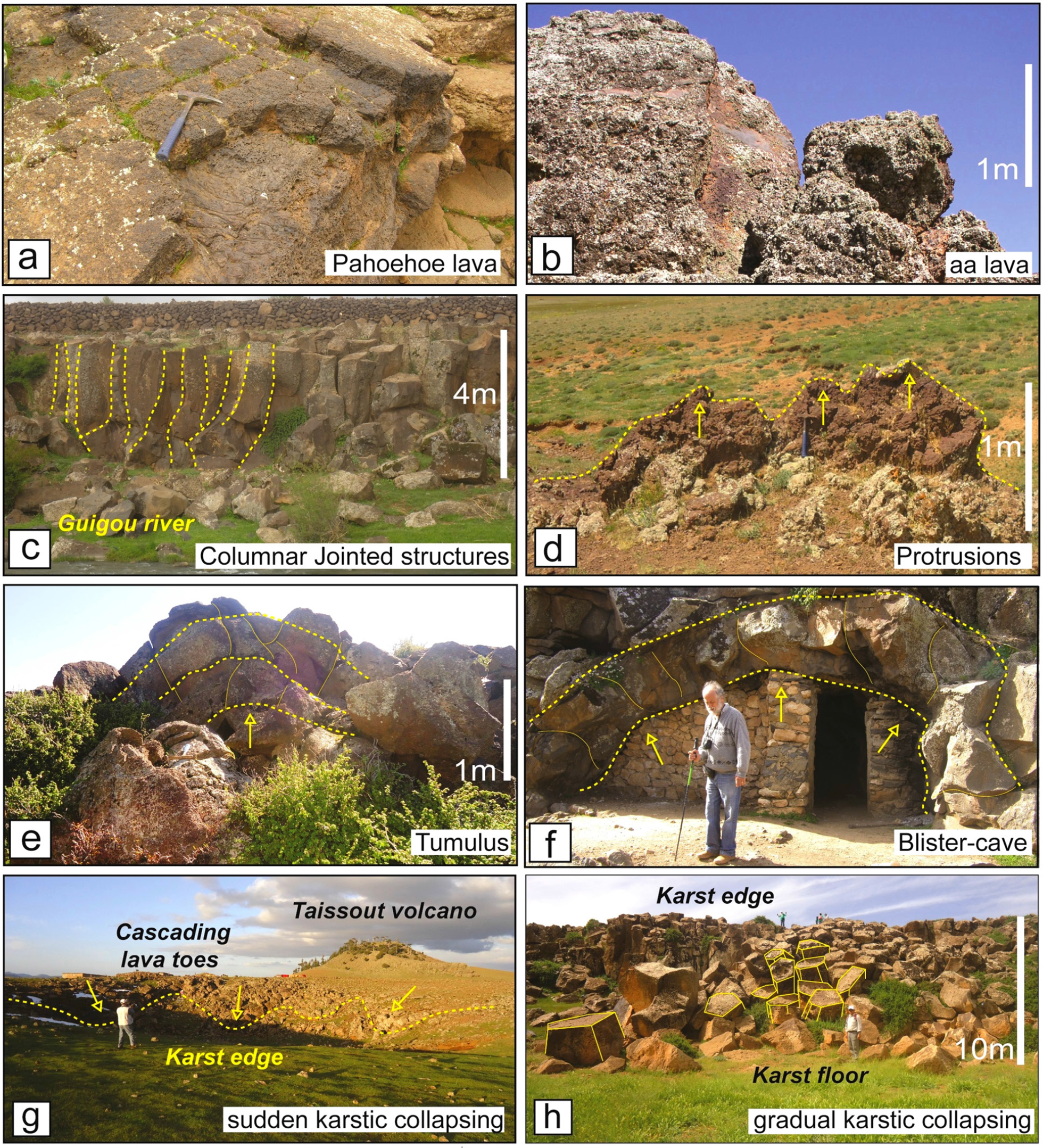
Fig. 3
Main eruptive landforms and structures of lava flow units.
a) The smooth degassed surface of fluid pahoehoe lava near the Taïssaouite volcano.
b) The rough scoriaceous aa surface of viscous lava tongue emitted from the base of the Taissousit volcano.
c) Columnar jointed structure outcrops beside Oued Guigou on the south-eastern side of the Timahdite volcano.
d) Fluid uprising lava intrusion emerging from an opened crack at the Aguelmam Sidi Ali volcano edge.
e) Tumulus structure west of the Aguelmam Sidi Ali volcano.
f) Blister-Cave that formed below the advancing Aghbalou Abarchan lava unit, which has about 5 m in width and 2 m in height.
g) Photo of an advancing pahoehoe lava toes that cascade over karstic slopes simultaneously with a sudden collapsing near the north-western Taissout volcano; there are superb folded and wrinkled lava screes covering the karstic floor.
h) Photo of a steady karstic collapsing at the eastern edge to Aguelmame Sidi Ali Lake; the inward tilting of the columnar basalt on the inner slope result from a long but continuous carbonate dissolution subsidence.
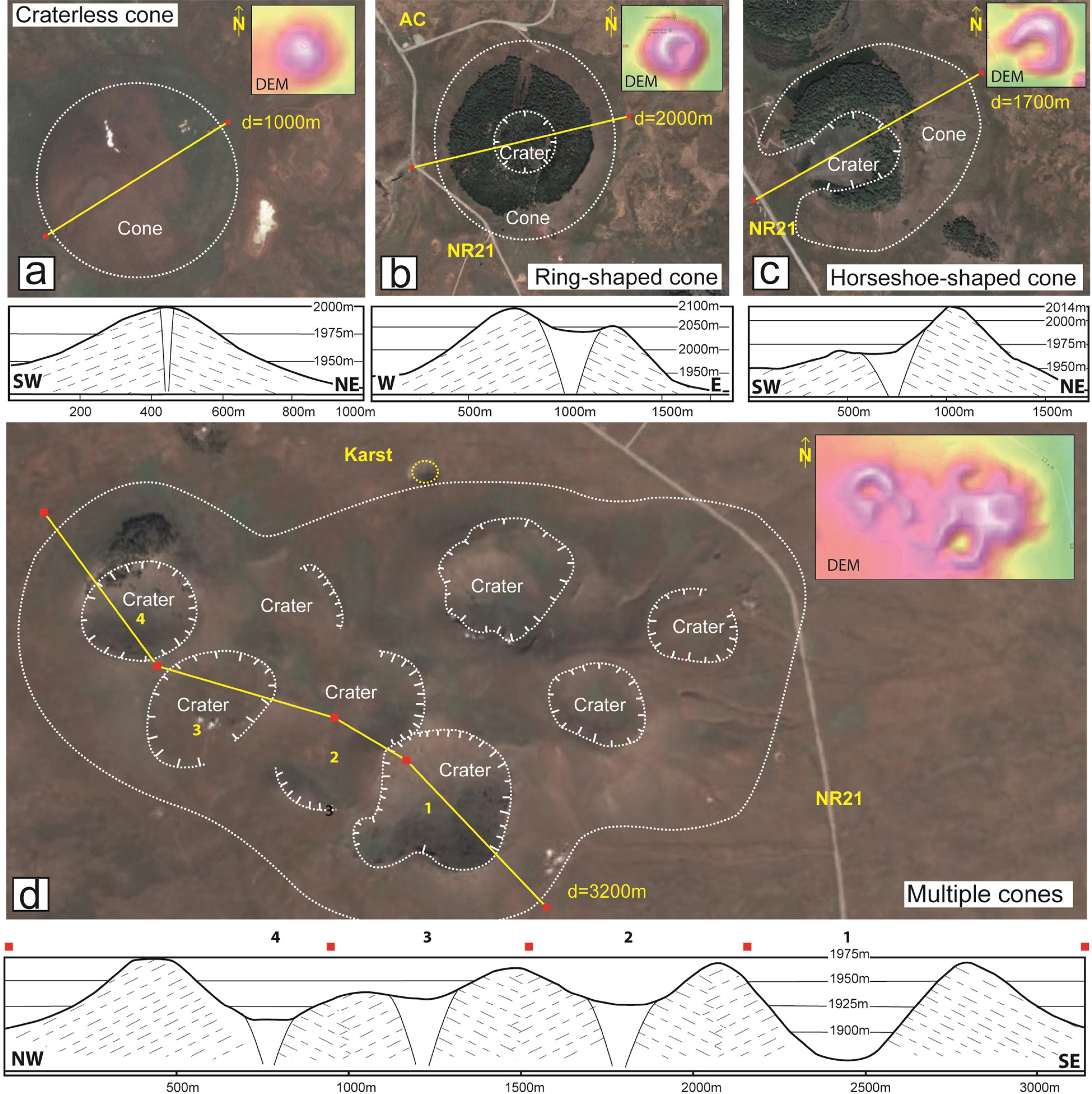
Fig. 4
Morphology, shape, and crater outlines of cones sketched on Google satellite images jointed to the digital elevation overview and the cross-section sketch. DEM – Digital Elevation Model; NR21 – national roadway no. 21.
a) Tizzout Tazouggart craterless cone.
b) Jbel Hebri cone with a bowl-shaped crater; the famous ski station occurs at the northern steep slope. AC: Accommodation centre.
c) Jbel Habri elongated horseshoe-shaped cone with an opened crater toward the national road.
d) The multiple cones of Boutagrouine are formed of eight volcanic devices arranged along NW-SE and NE-SW oriented lineaments; the Karst occurring in the northern slope may be stuck easily into the local pseudo quadratic tectonic network system.
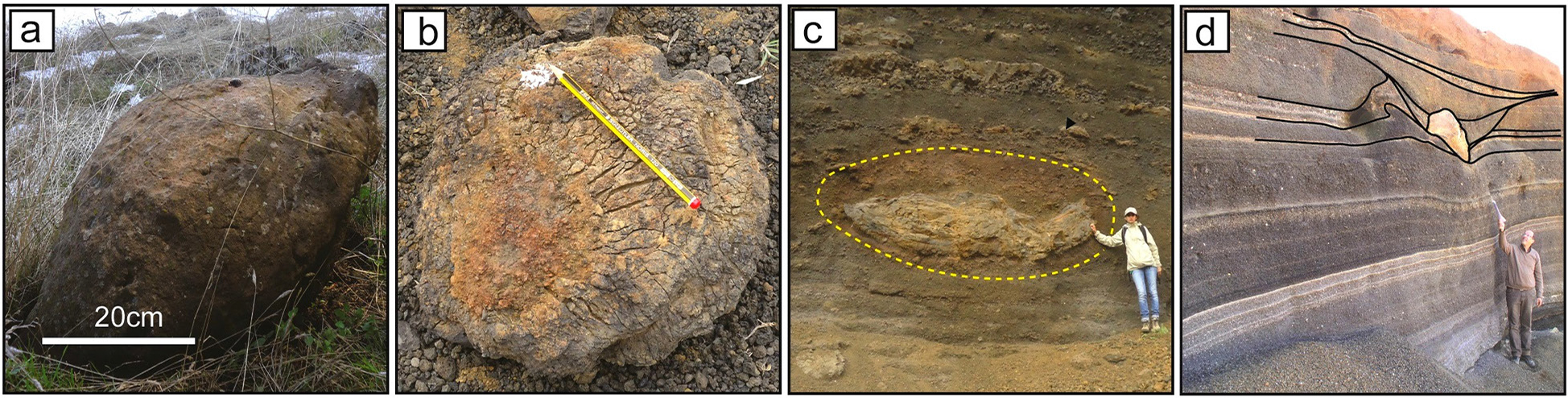
Fig. 5
Eruptive deposits from Strombolian cones.
a) Spindle-bomb occurring on the northern flank of Jbel Habri.
b) Bread-crust bomb occurring at the Strombolian base of west Hebri volcano.
c) Proximal reddish and coarse facies outcrops from the north-eastern quarry of the Timahdite volcano; the centre of the photo uncovers a large cowpat-bomb, developing an oxidation aureole over surrounding deposits.
d) Distal facies outcrops at the quarry on the eastern flank of Boutagrouine volcanic complex; interstratified ash levels attested the coexistence of both Strombolian and phreatomagmatic dynamics during the eruption.
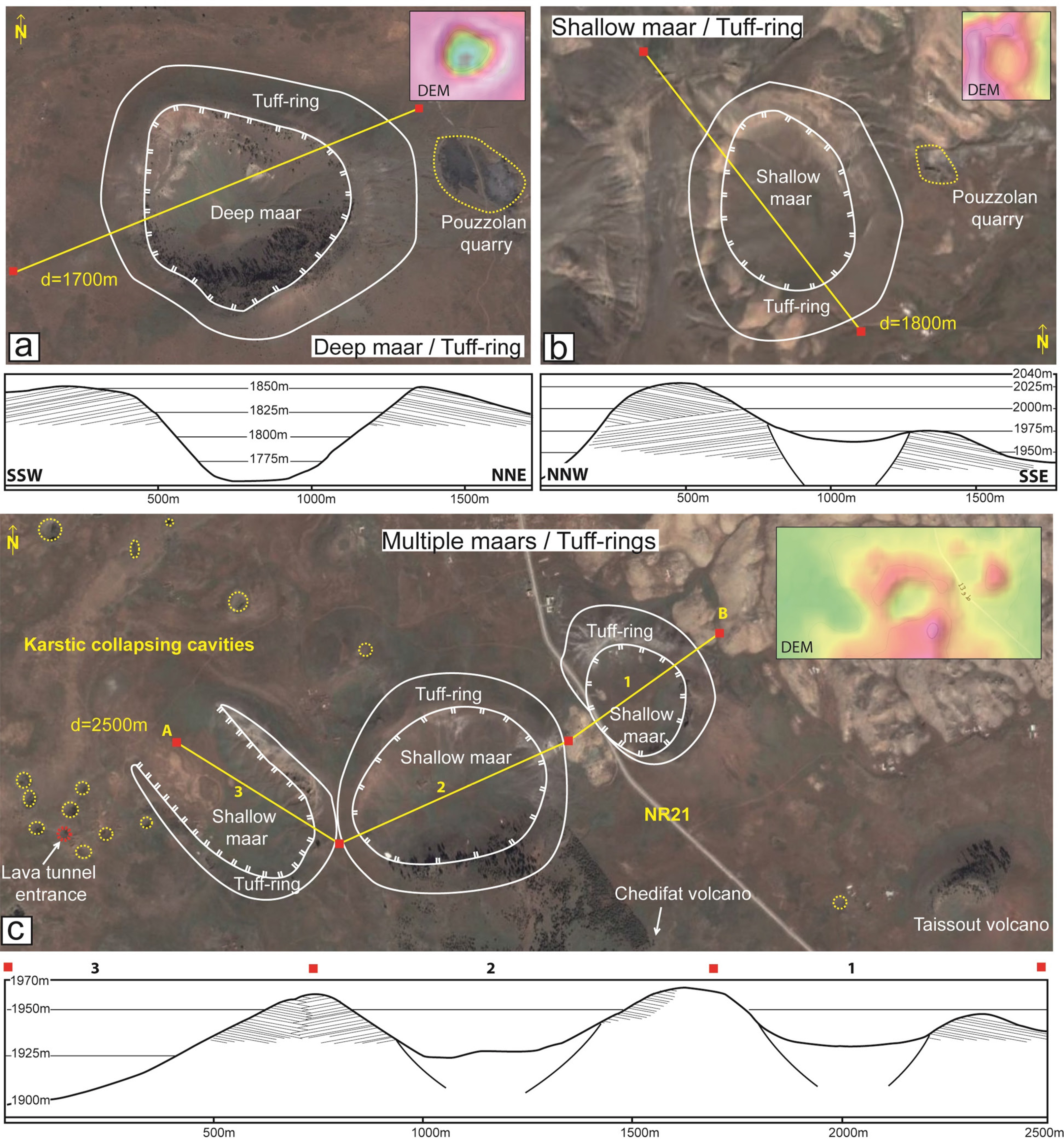
Fig. 6
Morphology, shape, and crater outlines of maars surrounded by tuff-rings sketched on Google satellite images jointed to the digital elevation overview and the cross-section sketch. DEM – Digital Elevation Model; NR21 – national roadway no. 21.
a) Deep maar of Lechmine N’ait l Haj.
b) The elongated shallow maar of Cheker Allah.
c) The Touna (eastern maar) – Tit Ougmar (central and western maar) complex. Many karstic cavities occur west of this volcanic complex and overlay some local tectonic lineament.
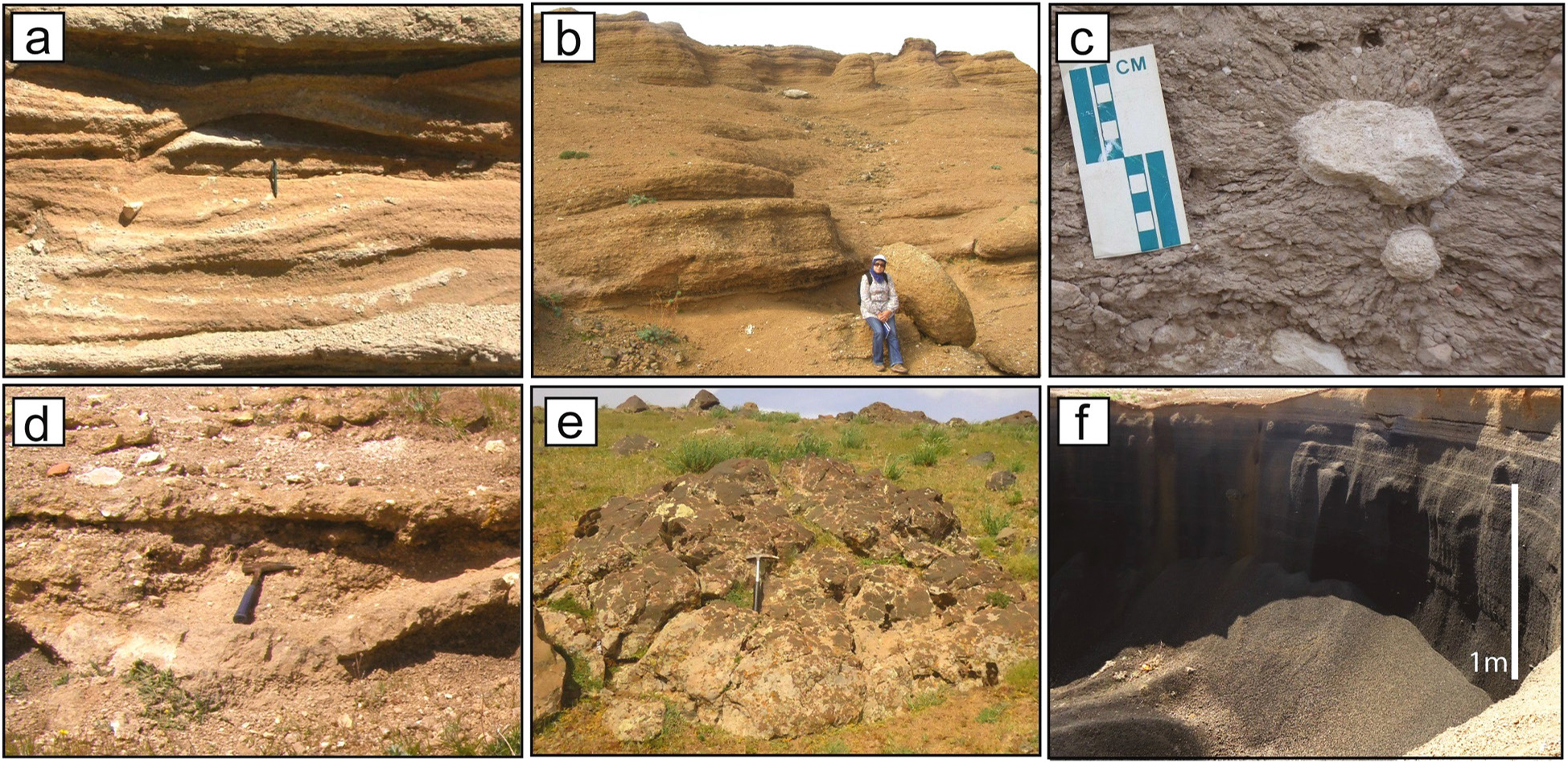
Fig. 7
Phreatomagmatic eruptive products
a) Southern base-surge outcrop from the Timahdite volcano showing a small-scale dune and anti-dune sedimentary figures including some lapilli lenses.
b) Thick peperite layers from the phreatomagmatic deposits exposed in the Lechmine-Naït-Lhaj maar northern flank; they consist of alternating thick ash-dominated levels with coarser lapilli falls.
c) Stone suns structures exposed in phreatomagmatic deposits at the north-western base of the Timahdite volcano.
d) Bomb-sag structure distorting the phreatomagmatic deposit bedding at the north-eastern side of the Timahdite volcano.
e) Cauliflower bomb of 1,5 m diameter occurs in the northern part of west Hebri Maar.
f) Finely-bedded lapilli fall is representing the distal wind-driven facies at the base slope of the eastern flank of Lechmine N’ait Lhaj maar.
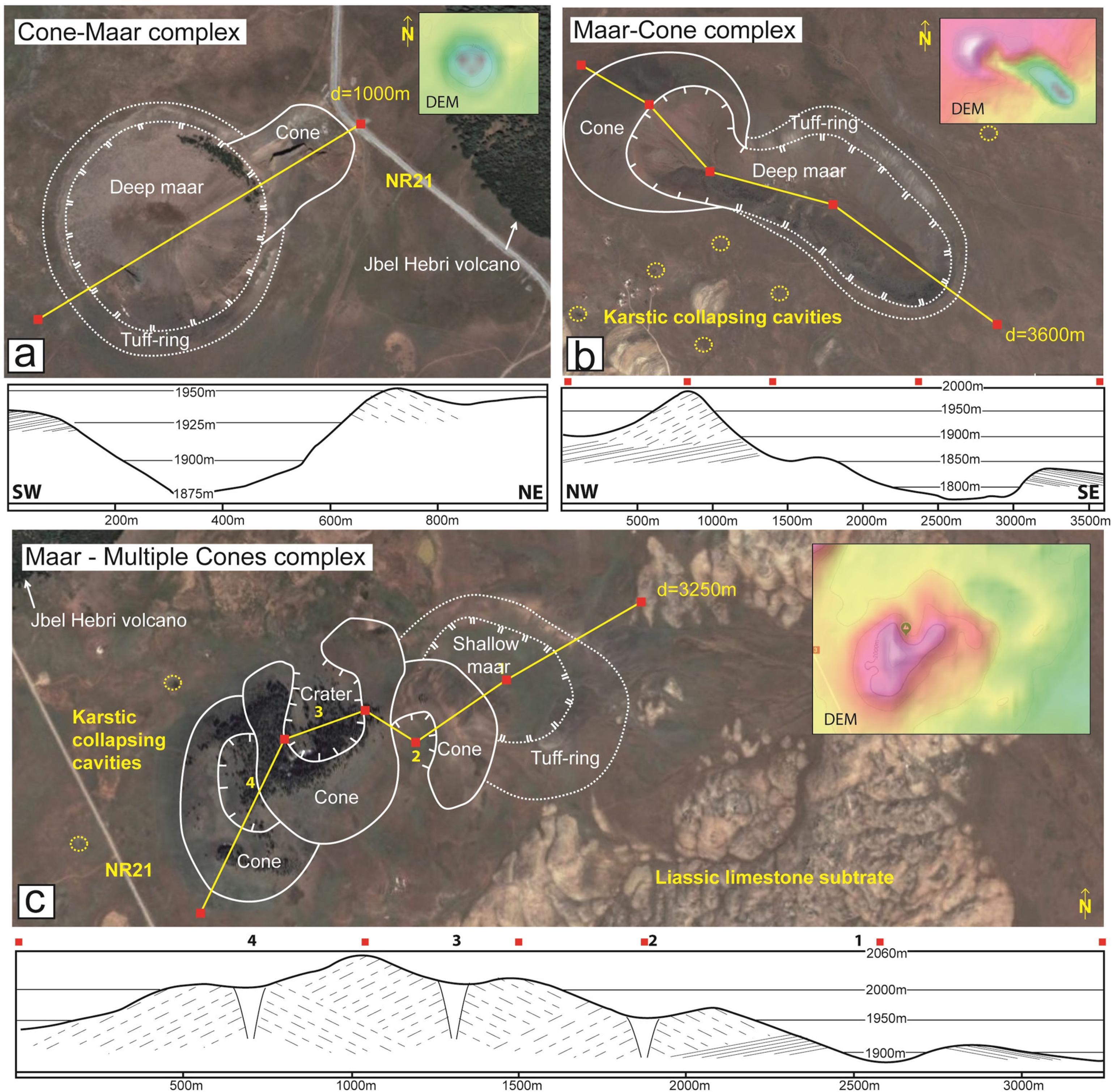
Fig. 8
Morphology, shape, and crater outline of cone-maar mixes sketched on Google satellite images jointed to the digital elevation model overview the cross-section sketch. DEM – Digital Elevation Model; NR21 – national roadway no. 21.
a) The cone-maar mixe west of Jbel Hebri; the initial cone cut in its south-western part by a late maar collapsing.
b) The elongated Izgarn mixed volcano; the initial maar is covered in the north-western part by a scoria cone, which emitted a large lava flow.
c) The Tahabrit volcanic complex; two cones followed the initial maar setting during the first eruptive phase; the second stage consists of the growth of the highest cone with a northward opened crater during a huge lava flow emission.
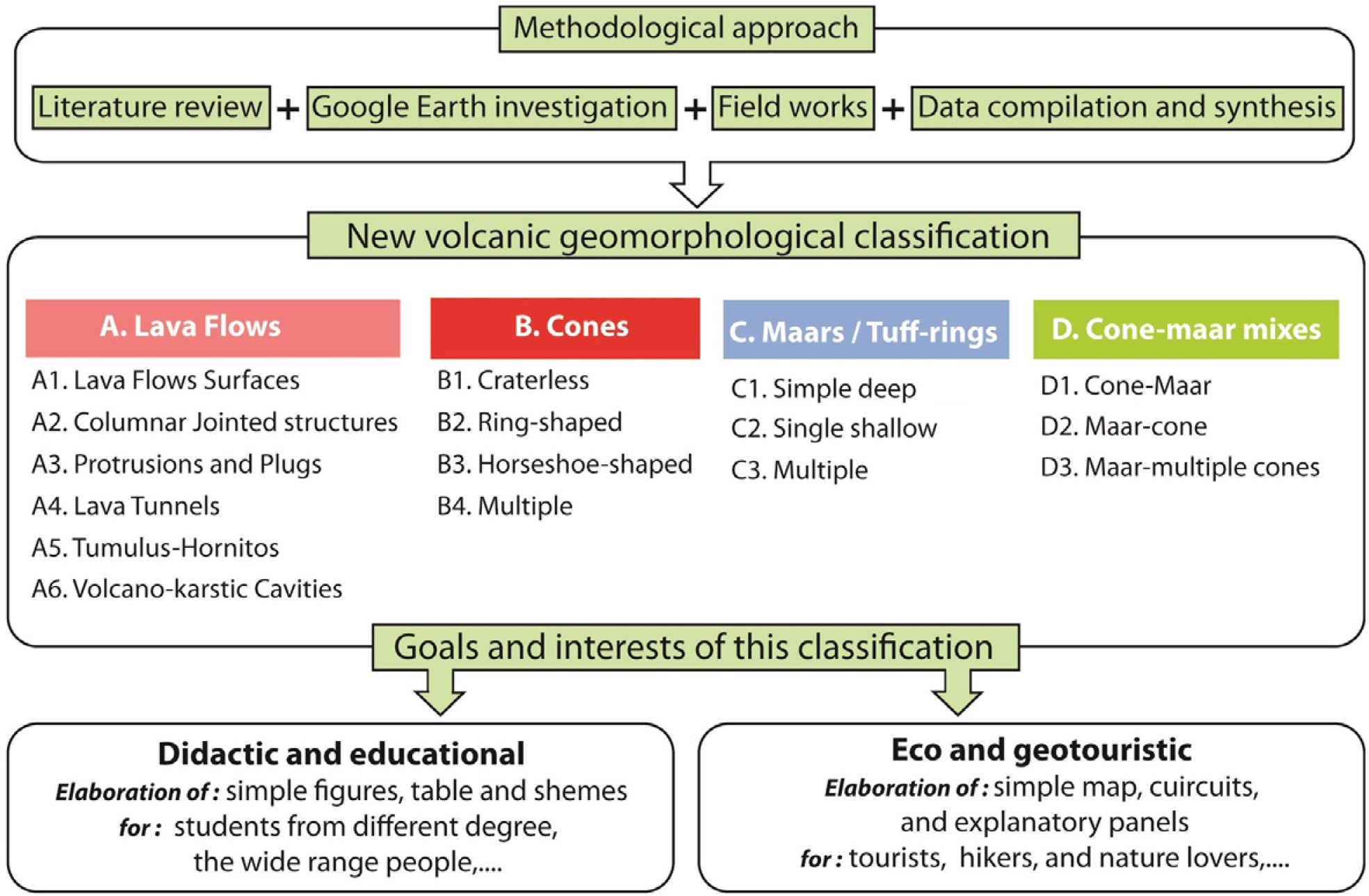
Fig. 9
Flow chart of used methodology.
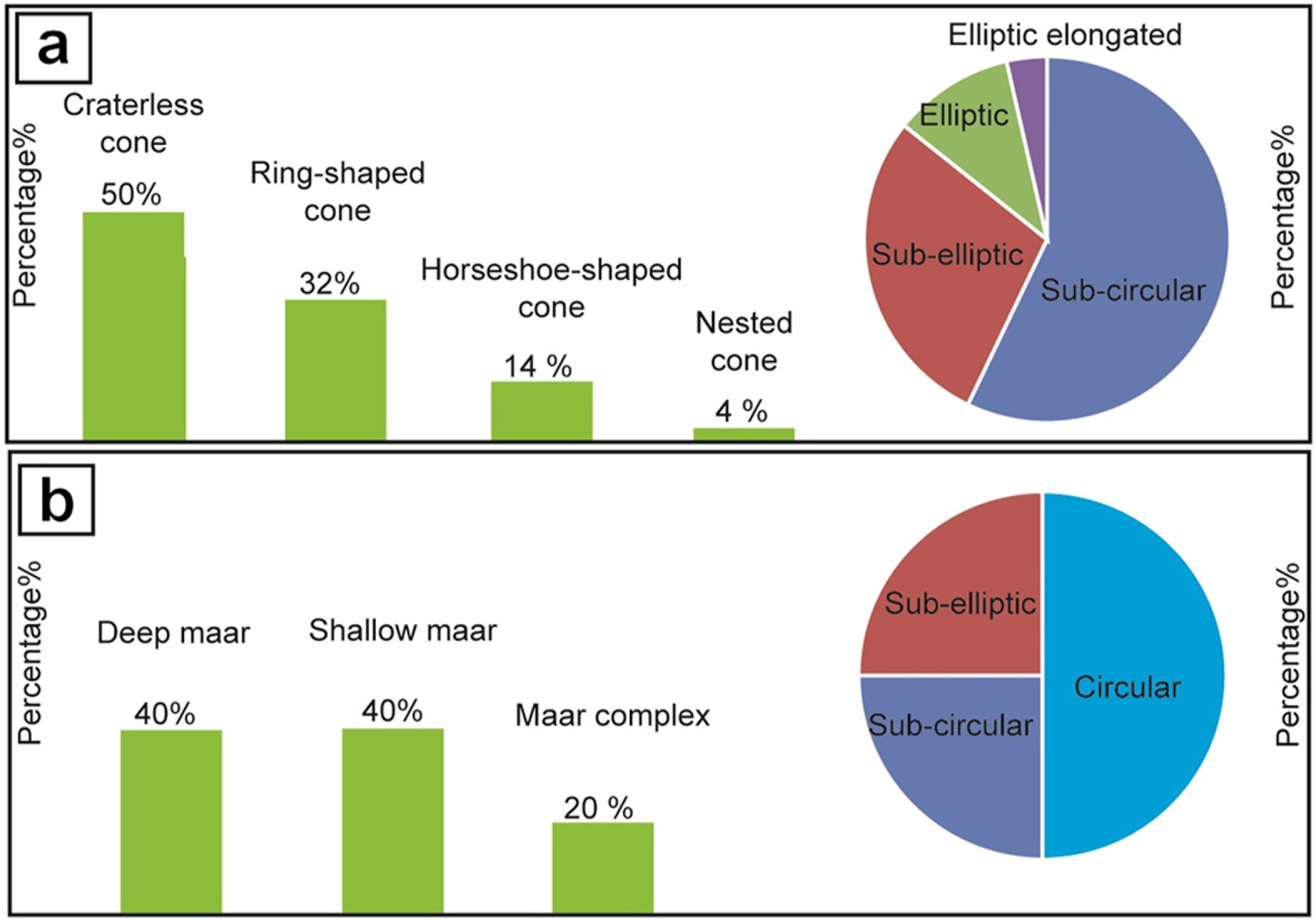
Fig. 10
Morphological classification of cones (a) and maars (b).