
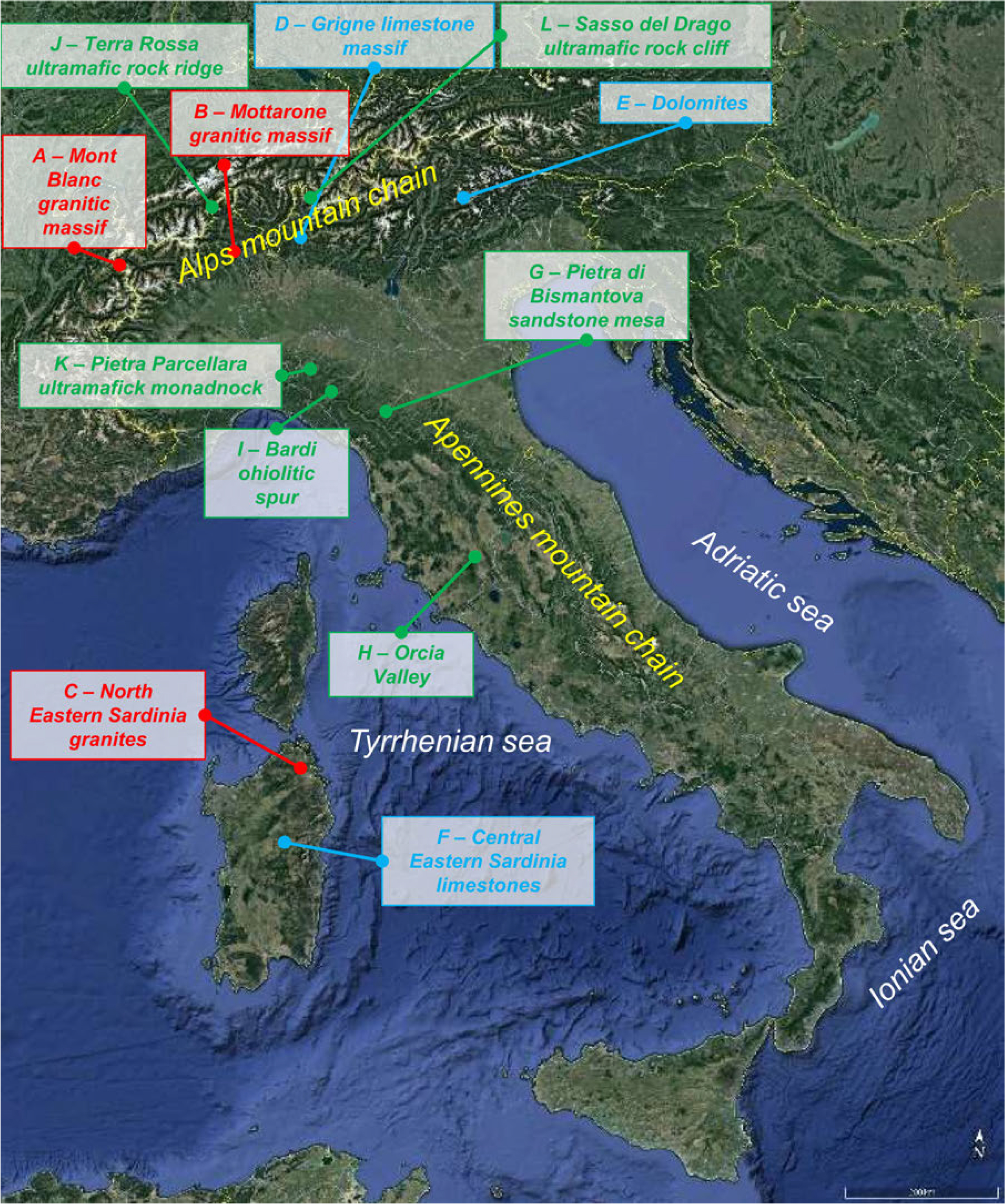
Fig. 1
Location of the selected landscapes in the Italian context (the background image is courtesy of Google Earth).
Table 1
Summary of the analysed features of the proposed study areas.
| Code | Study case | Italian Region | Mountain range/region | Other form of official recognition and protection | Geosites Catalogues | Lithology/ies | Geomorphological features | Outdoor activities | Other relevant values | ||
|---|---|---|---|---|---|---|---|---|---|---|---|
| Primary processes | Secondary processes | Landscape features | |||||||||
| A | Mont Blanc Massif | Aosta Valley | Western Italian Alps | Espace Mont Blanc, SIC IT1204010 | ISPRA | Granites | Glacial & gravity action | Chemical weathering | Steep slopes | Climbing | Cultural: transboundary area and alpinism history |
| B | Mottarone Massif | Piedmont | Western Italian Alps | Regione Piemonte (for other aspects) | Granites | Chemical weathering | Water action | Residual relief with tors and inselbergs | Climbing | Cultural and socio-economic: cave and mines | |
| C | Gallura | Sardinia | North Eastern Sardinia | Regional protection on some specific sites | ISPRA | Granites | Chemical weathering | Water runoff, gravity | Residual reliefs with inselbergs, tors, rounded blocks and tafonis | Climbing, canyoning | Cultural, archaeological, socio-economic: quarries |
| D | Grigne Massif | Lombardy | Central Italian Prealps | Regional Park of the Grigne | ISPRA, Regione Lombardia | Limestones | Karst | Glacial | Glacio-karstic ipo- and epi-landforms | Climbing, speleology | Cultural: Leonardo Da Vinci artistic works, tradition of climbing |
| E | Dolomites | Trentino-Alto Adige | Eastern Italian Alps | UNESCO World Heritage List | / | Dolomites | Gravity | Cryoclastism, glacial | Towers and scree slopes | Climbing | Cultural: painting, photography, poetry, history of Alpinism; socio-economic: tourism |
| F | Supramonte | Sardinia | Central Eastern Sardinia | Regional protection on some specific sites | ISPRA | Limestones, dolostones | Karst | Gravity, fluvio-karst | Hypogeum and surface karstic landforms | Climbing, speleology, canyoning | cultural, archaelogical, socio-economic |
| G | Pietra di Bismantova mesa | Emilia Romagna | Northern Apennines | National Park of the Tuscan-Emilia Apennine | ISPRA, Emilia Romagna Region | Sandstone | Selected erosion & gravity | Weaathering | Mesa, landslides | Climbing | Cultural: Dante Alighieri's description, history of Alpinism; Archaeological: Bronze Age and early Iron Age settlements; Ecologic support role: endemic species |
| H | Orcia Valley | Tuscany | Central Apennines | UNESCOW World Heritage List | ISPRA (not Radicofani case) | Shales | Water runoff | Gravity | Calanchi, shallow landslides | Cultural: Radicofani Castle; Ecologic support role: endemic species | |
| I | Bardi ophiolitic spur | Emilia Romagna | Northern Apennines | ISPRA, Emilia Romagna Region | Basalts and red jaspers | Differential erosion | Gravity | Steep slopes | Cultural: Bardi Medieval Castle; Ecologic support role: endemic species | ||
| J | Terra Rossa | Piedmont | Western Italian Alps | Veglia Devero Natural Park | / | Serpentinite | Chemical weathering | Gravity | Residual ridges | Alpinism | |
| K | Pietra Parcellara | Emilia Romagna | Northern Apennines | Regional Natural Reserve | ISPRA, Emilia Romagna Region | Serpentinite | Differential erosion | Gravity | Monadnocks/Residual ridges | Ecologic support role: endemic species | |
| L | Sasso del Drago | Lombardia | Central Italian Alps | Serpentinite | Differential erosion | Rocky cliff | Climbing | ||||
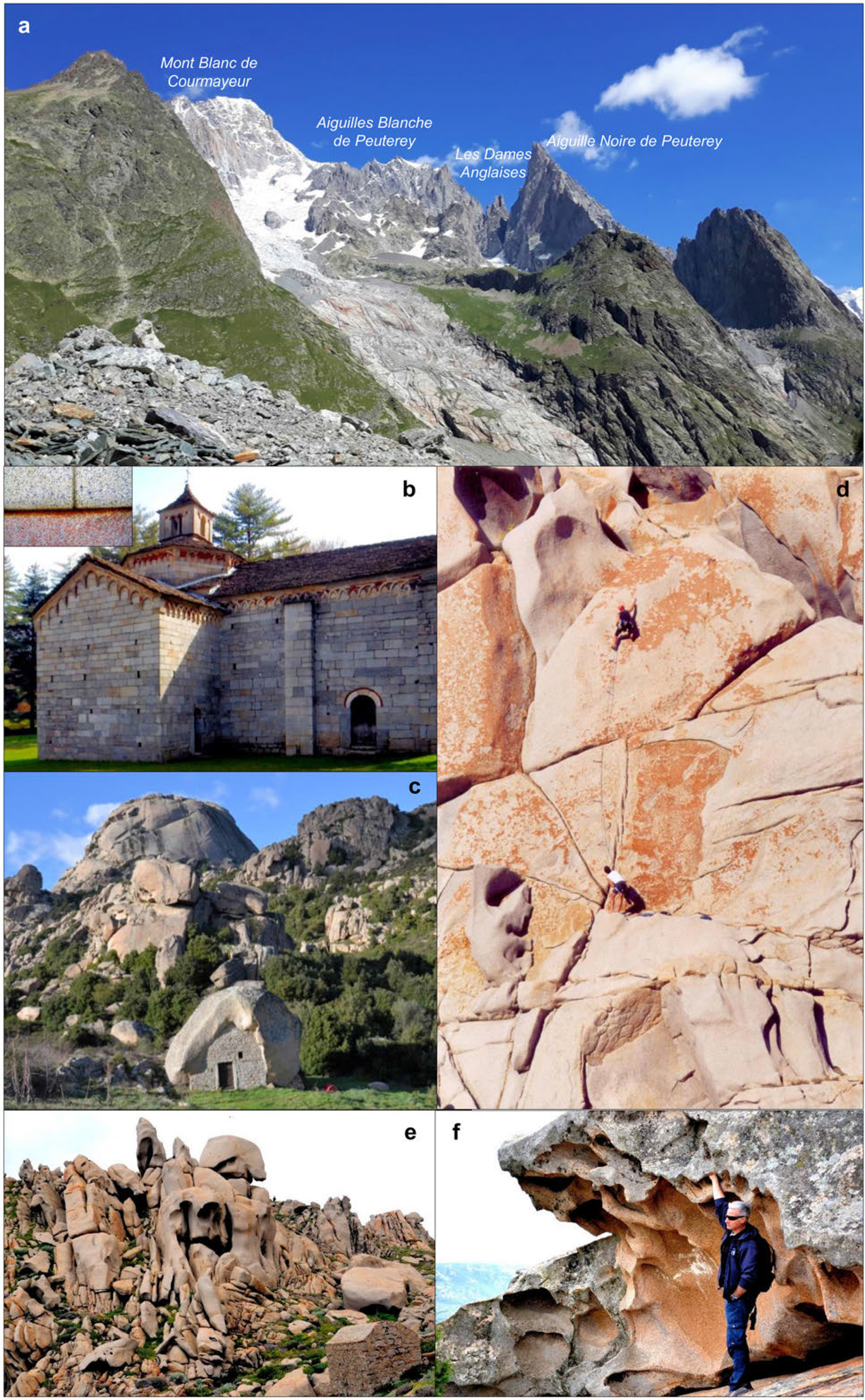
Fig. 2
Comparison among Italian granites landscapes characteristic of the Alpine areas and of the Sardinia island. a) View on the Mont Blanc Massif (case study A, Fig. 1) taken from the debris covered surface of the Miage Glacier in the Veny Valley, b) San Giovanni Battista Church (V century B.C.) in the Montorfano village (Verbano-Cusio-Ossola province) and a detail of pink and white granites extracted in the surrounding areas and used also for buildings in Milan city centre (e.g. San Carlo al Corso Vittorio Emanuele), c) the inselberg of Mount Pulchiana with, in the foreground, a tafone used as a shelter (Aggius, North Eastern Sardinia) (case study C, Fig. 1), d) climbing on the granitic walls and tafonis of Capo Testa (North Eastern Sardinia) (case study C, Fig. 1), e) columns and blocks defined by erosion along the net of fractures in the granite of Capo Testa (Gallura, North-eastern Sardinia), f) a big tafone in the area of the Bear of Palau where, inside the most hidden cavities, the granite is altered by hydrolysis.
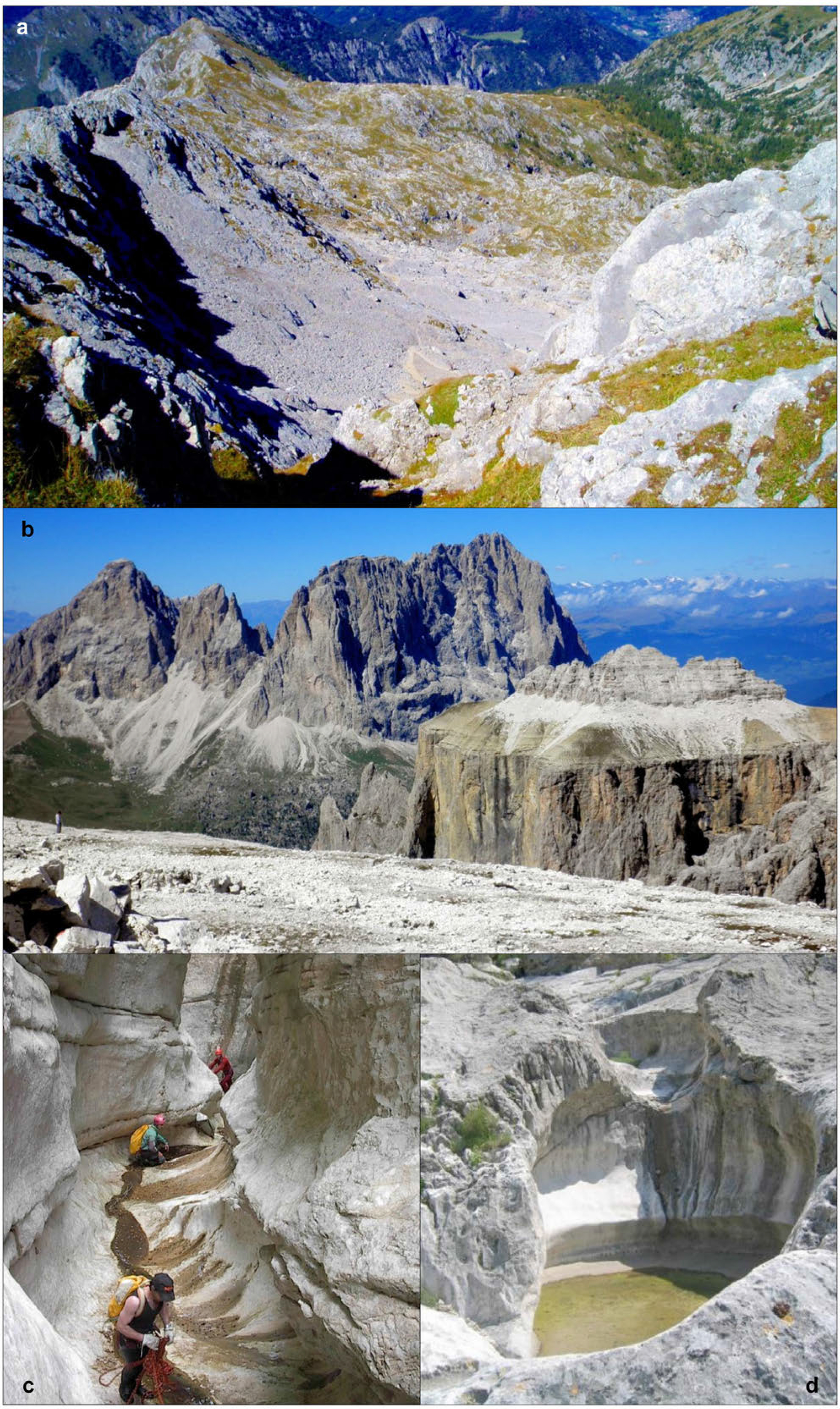
Fig. 3
Selection of Italian limestone and dolostones landscapes in Alps and in Sardinia island.
a) Moncodeno karst landscape (case study D, Fig. 1), towards North, taken from the Brioschi Hut on the Northern Grigna (2399 m a.s.l.) (Central Italian Prealps), b) panoramic view of Sasso Lungo Group (Val Gardena, Dolomites, Eastern Italian Alps) (case study E, Fig. 1), c) canyoning down the Flumineddu river (Supramonte, Central Eastern Sardinia) (case study F, Fig. 1), d) Erosional landform down the Doronè canyon and stream (Supramonte, Central Eastern Sardinia) (case study F, Fig. 1).
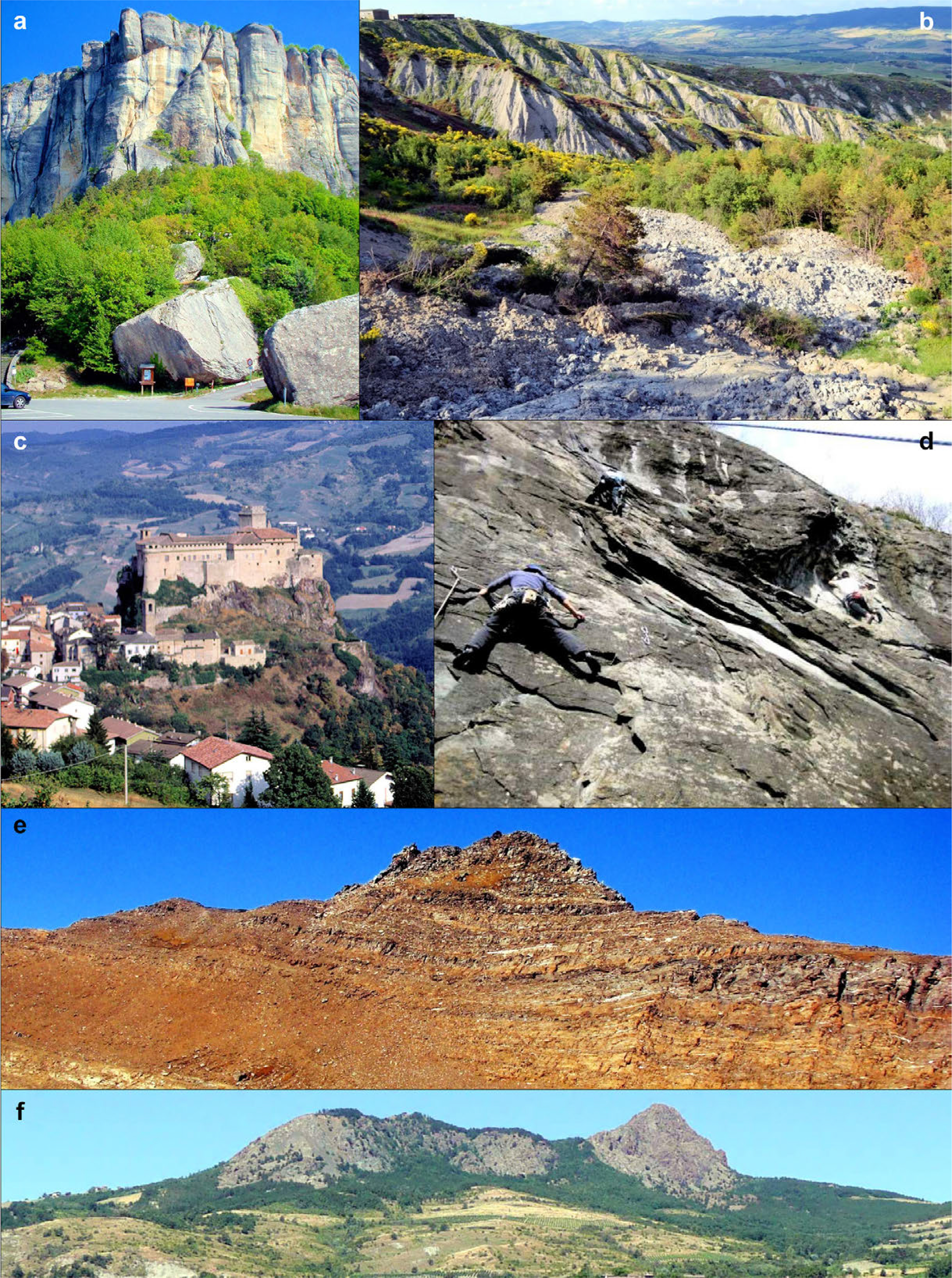
Fig. 4
Sandstones, clay and ophiolites Italian landscapes in Apennines and Alps.
a) Northern slope of Pietra di Bismantova rock slab (case study G, Fig. 1), b) calanchi and shallow landslides characterizing the surrounding of Radicofani in the Orcia Valley (case study H, Fig. 1), c) Bardi castle (Parma Apennines) build on ophiolite outcrop (case study I, Fig. 1), d) “Sasso del Drago” climbing wall (case study L; Fig. 1), e) Punta Terra Rossa (or Waserhorn) from Bocchetta d’Aurona/Kaltawasser Gletcher (Verbano-Cusio-Ossola Province, Western Italian Alps; photo courtesy of E. Zanoletti) (case study J, Fig. 1), f) Pietra Parcellara (Trebbia Valley, Northern Apennines) (case study K, Fig. 1).