
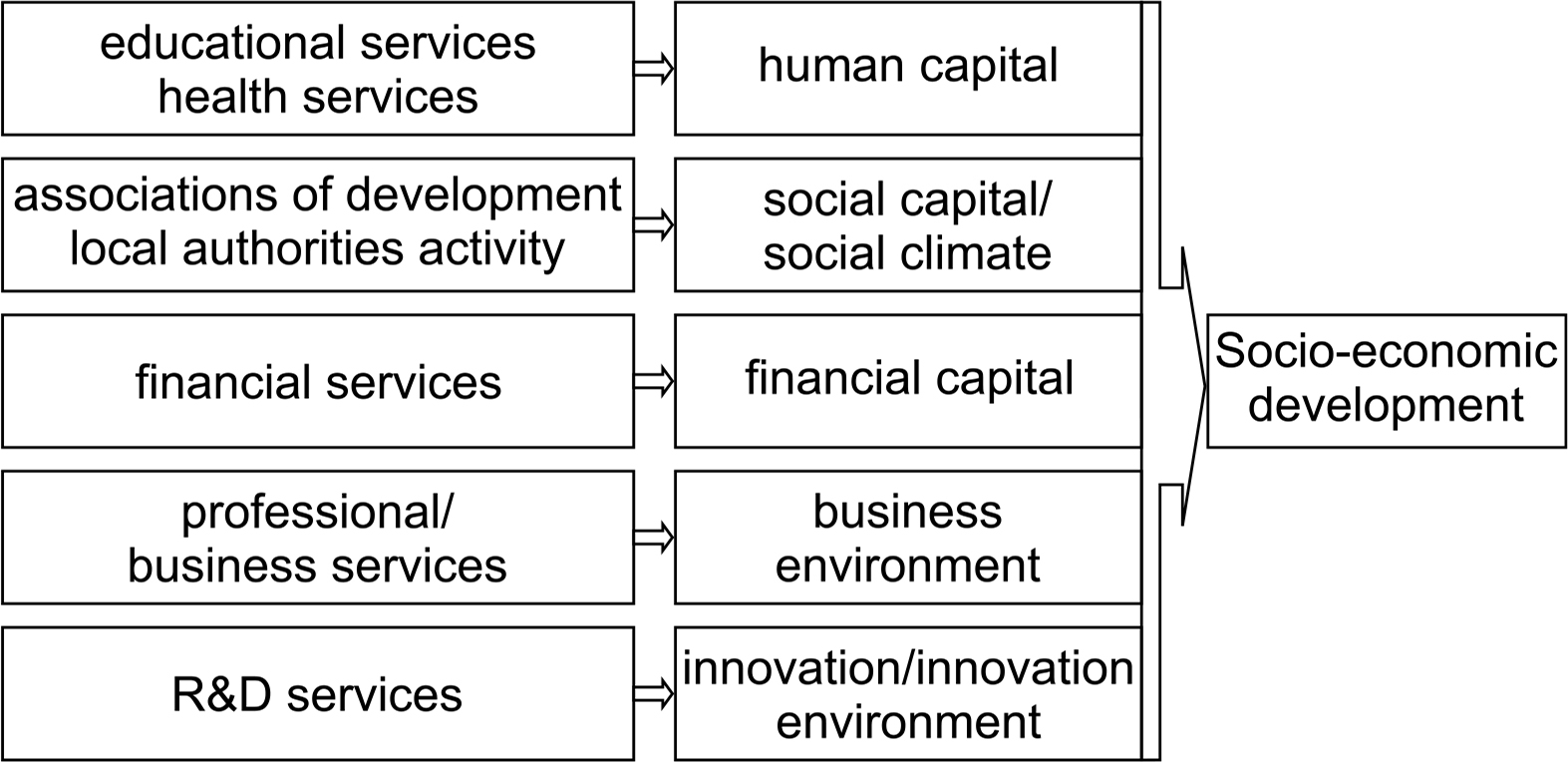
Fig. 1
Model of the impact of modern services on socio-economic development.
Source: own study.
Table 1
Indicators of the level of development of modern services.
| Type of services | Indicators – input services | Indicators – output services (development factors) |
|---|---|---|
| Education | Educational services | Human capital I |
| Percentage of economically active teachers | Indicator of professional activity | |
| Education expenditure in % of GDP | Percentage of persons with university degree | |
| Scholarisation index | Percentage of economically active engineers and scientists | |
| Percentage of students of technical faculties | ||
| Percentage of people over 25 years of age participating in education (LL) | ||
| Percentage of employees in the sector: Education | ||
| Percentage of people using e-learning | ||
| Medicine | Health services | Human capital II |
| Medical staff in 100,000 residents | Average life expectancy by f/m | |
| Health care expenses per capita (Euro) | The number of years lived in health by f/m | |
| The percentage of employees in the sector: Health care and social welfare | ||
| Research and development | Research and development services | Innovativeness |
| GERD – total expenditure on R&D per capita (Euro) | Share of turnover from innovation | |
| BERD – expenditure of enterprises on R&D per capita (Euro) | Percentage of innovative enterprises | |
| Percentage of economically active people working in R&D | Patents per 1 million inhabitants | |
| Finance | Financial services | Financial capital |
| Percentage of employees in the sector: Financial intermediation | Gross value added per 1 employee in enterprises | |
| No. of credit institutions per 1,000 businesses | Investments per 1 employee in enterprises | |
| The percentage of employees in credit institutions | ||
| Business services | Professional services | Business-conducive environment |
| Percentage of ICT sector employees | The percentage of newly hired employees in general employment | |
| Percentage of employees in professional services (section M) | Number of business entities per 1,000 inhabitants |
[i] Source: own study.
Table 2
Countries with the highest and lowest levels of development of selected modern services.
| Educational services | Health services | Research and development services | Financial services | Business services | |
|---|---|---|---|---|---|
| The highest level of development | Sweden Denmark Finland | Sweden Austria Germany | Denmark Sweden Finland Austria | Luxembourg | Sweden Finland United Kingdom |
| The lowest level of development | Slovakia Romania Bulgaria | Hungary Romania Poland | Poland Cyprus Bulgaria Romania | Slovakia Estonia Lithuania Romania | Slovakia Poland Lithuania Romania |
[i] Source: own study based on data from the Eurostat database.
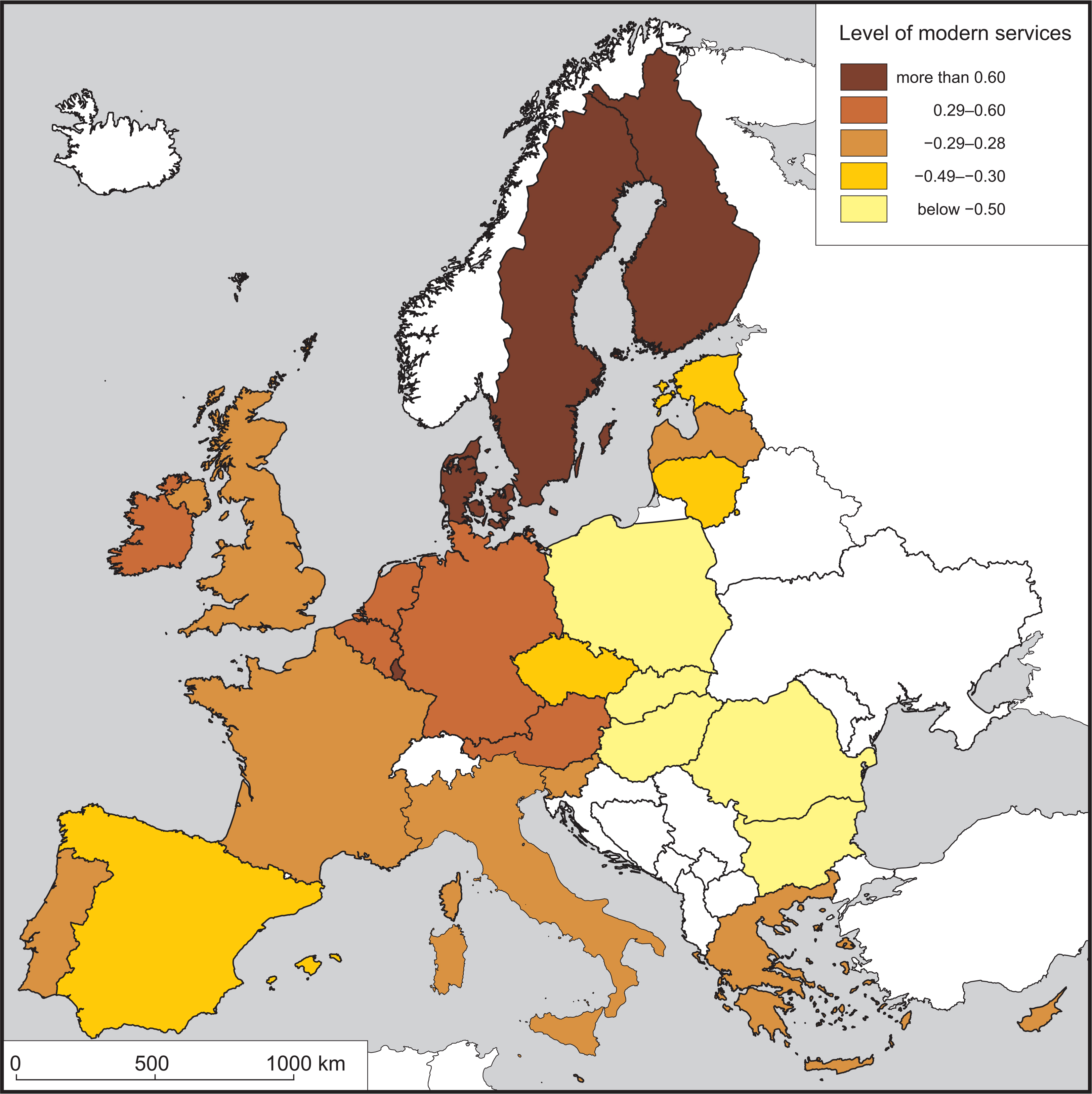
Fig. 2
The level of development of modern services in the EU member states in 2014.
Source: own study based on data from the Eurostat database.
Table 3
The correlation coefficients between the level of development of modern services and development factors and the level of socio-economic development.
| Modern services | Correlation coefficient between services and: | Growth factors | Correlation coefficient between factors of GDP per capita | Level of socio-economic development |
| Educational services | 0.80 | Human capital | 0.64 | |
| Health services | 0.46 | 0.42 | ||
| Financial services | 0.49 | Financial capital | 0.75 | |
| Business services | 0.62 | Business environment | 0.48 | |
| R&D Services | 0.82 | Innovative environment | 0.74 |
[i] Source: own study based on data from the Eurostat database.