
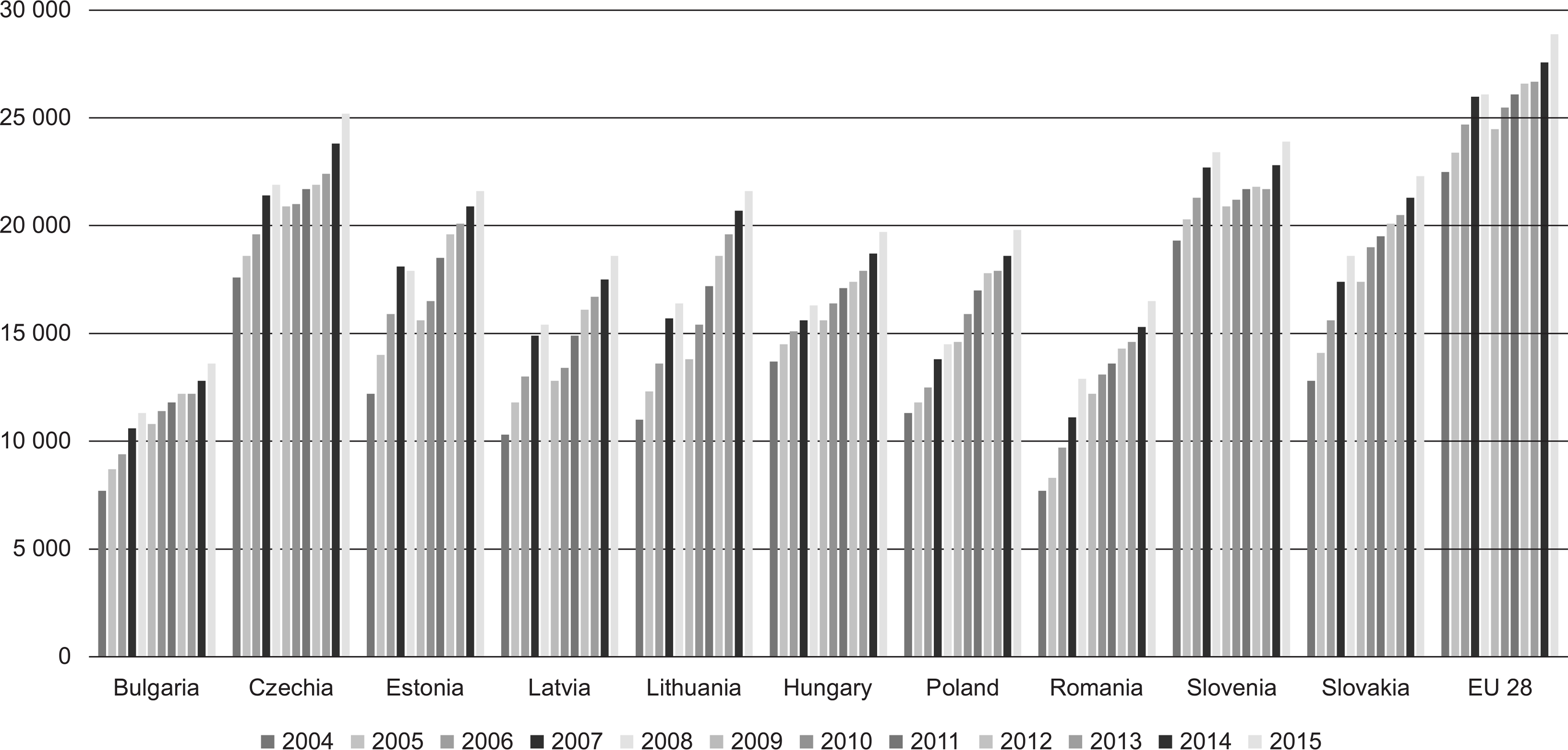
Fig. 1
GDP per capita in PPS in CEECs and in EU 28, 2004–2015.
Source: own calculations based on Eurostat (2017).
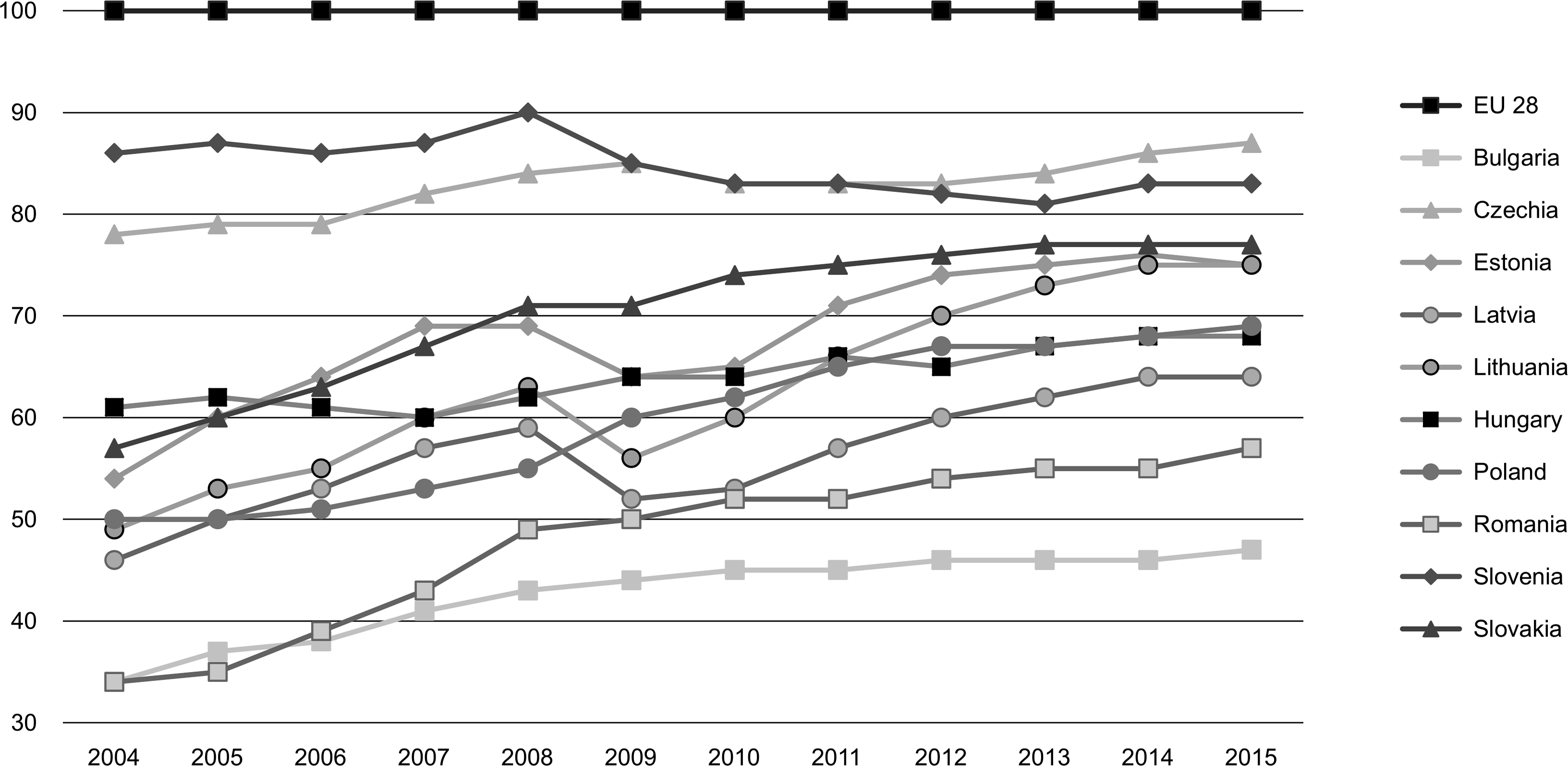
Fig. 2
GDP per capita in PPS in CEECs as percentage of the EU average, 2004–2015.
Source: calculation based on Eurostat (2017).
Table 1
The structure of Cohesion policy budget by thematic objectives in CEECs 2007–2013 (% from budget of Member States allocated to selected aims, based on annual implementation report 2013).
| Thematic objectives/Member State | PL | HU | RO | CZ | SK | BG | LT | LV | SI | EE | CEECs |
|---|---|---|---|---|---|---|---|---|---|---|---|
| Transport, Energy & IT | 47 | 36 | 26 | 37 | 37 | 30 | 36 | 33 | 29 | 23 | 38 |
| Environment | 10 | 17 | 24 | 11 | 13 | 26 | 15 | 16 | 24 | 22 | 15 |
| Social issues | 10 | 16 | 10 | 10 | 21 | 10 | 14 | 19 | 9 | 21 | 12 |
| Innovation & RTD | 14 | 6 | 6 | 17 | 11 | 5 | 14 | 15 | 19 | 19 | 12 |
| Capacity building | 3 | 4 | 18 | 4 | 4 | 12 | 4 | 3 | 3 | 2 | 6 |
| Human capital | 7 | 4 | 3 | 8 | 5 | 6 | 6 | 3 | 5 | 3 | 6 |
| Other SME and business support | 5 | 10 | 3 | 4 | 3 | 6 | 4 | 2 | 5 | 5 | 5 |
| Culture, heritage and tourism | 3 | 4 | 2 | 5 | 3 | 2 | 3 | 1 | 5 | 5 | 3 |
| Urban and territorial dimension | 2 | 3 | 8 | 4 | 3 | 3 | 5 | 8 | 1 | 0 | 3 |
| Total (100%) | 100 | 100 | 100 | 100 | 100 | 100 | 100 | 100 | 100 | 100 | 100 |
| Total (in billion EUR) | 63.9 | 28.6 | 23.6 | 21 | 11.8 | 7.4 | 6.7 | 4.3 | 4.3 | 3.3 | 174.9 |
[i] Note. Some of the thematic objectives are aggregated:
[ii] Transport, Energy & IT = Rail + Road + Other transport + Energy + IT services and infrastructure
[iii] Social issues = Labour market + Social Inclusion + Social infrastructure
[iv] Source: own calculations based on European Commission (2017a).
Table 2
The structure (% from budget of Member State) of the Cohesion policy budget by thematic objectives in CEECs 2014–2020, based on finances planned).
| Thematic objectives/Member state | PL | CZ | RO | HU | SK | HR | BG | LT | LV | EE | SI | CEECs |
|---|---|---|---|---|---|---|---|---|---|---|---|---|
| Network infrastructures in transport, energy & ICT | 35 | 32 | 31 | 19 | 29 | 19 | 20 | 21 | 31 | 14 | 11 | 29 |
| Climate & Environment | 21 | 23 | 33 | 27 | 25 | 33 | 38 | 27 | 25 | 21 | 24 | 25 |
| Education & Employment | 13 | 14 | 14 | 22 | 12 | 13 | 12 | 20 | 14 | 19 | 17 | 14 |
| Research & Innovation | 11 | 14 | 4 | 10 | 17 | 8 | 7 | 10 | 11 | 22 | 15 | 11 |
| Social inclusion | 8 | 8 | 8 | 9 | 9 | 8 | 9 | 8 | 10 | 10 | 7 | 8 |
| Competitiveness of SMEs | 9 | 5 | 3 | 9 | 3 | 12 | 8 | 8 | 7 | 7 | 19 | 7 |
| Technical assistance | 3 | 3 | 3 | 1 | 4 | 4 | 4 | 3 | 2 | 3 | 4 | 3 |
| Efficient public administration | 0 | 1 | 3 | 3 | 2 | 2 | 3 | 2 | 0 | 3 | 2 | 2 |
| Total (100%) | 100 | 100 | 100 | 100 | 100 | 100 | 100 | 100 | 100 | 100 | 100 | 100 |
| Total (billion EUR) | 90.0 | 28.7 | 27.4 | 25.3 | 17.7 | 9.8 | 8.6 | 7.8 | 5.1 | 4.9 | 3.7 | 229.1 |
[i] Note: Some of the thematic objectives are aggregated:
[ii] Climate & Environment = Climate Change Adaptation & Risk Prevention + Environment Protection & Resource Efficiency + Low-Carbon Economy,
[iii] Education & Employment = Educational & vocational Training + Sustainable & Quality Employment,
[iv] Network Infrastructures in Transport and Energy & ICT = Network Infrastructures in Transport and Energy + Information & Communication Technologies.
[v] Source: own calculations based on European Commission (2017b).
Table 3
Development indicators under examination
| Selected (mutually uncorrelated) | Unselected (correlated) |
|---|---|
| gross fixed capital formation (GFCF); employment (EMP); participation in education and training (PET); gross expenditure on research and development of the business enterprise sector (GERB); gross expenditure on research and development of the non-business enterprise sector (GERN)* | gross domestic product; productivity of labour; compensation of employees; population size; age dependency ration; median age of population; education levels attained; employment in R&D; human resources in science and technology |
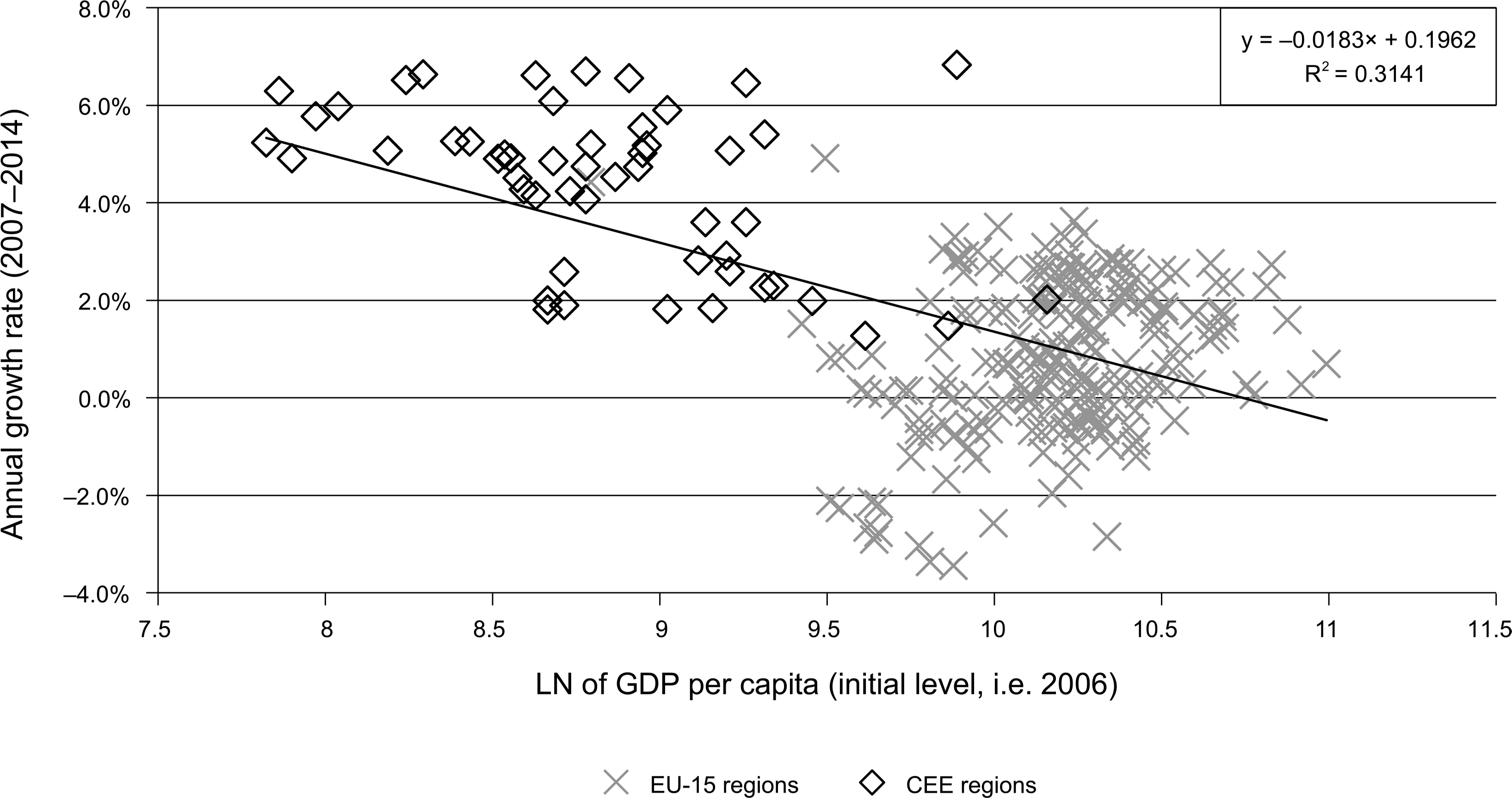
Fig. 3
Beta-convergence of EU regions (2007–2014).
Note: 272 regions, i.e. without the outliers of Inner London - West and Luxembourg.
Source: own calculations based on Eurostat (2017).
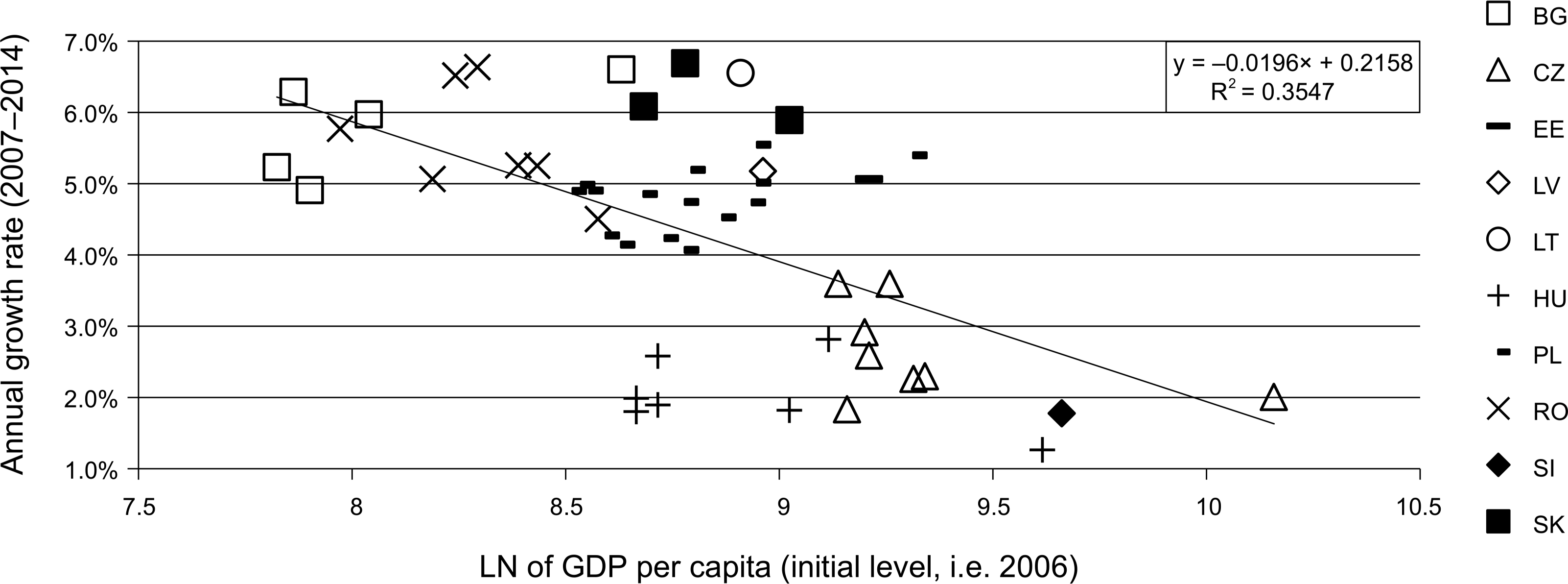
Fig. 4
Beta-convergence of CEE regions (2007–2014).
Note: 51 regions, i.e. without outliers of Bratislava and Bucuresti – Ilfov.
Source: own calculations based on Eurostat (2017).
Table 4
Correlations between the expenditures of EU Cohesion policy and development indicators across CEE regions.
| GFCF | EMP | PET | GERB | GERN | |
|---|---|---|---|---|---|
| EEUCP | 0.008 | 0.227 | 0.001 | 0.544** | 0.224 |
Notes:
Source: own calculations based on DG REGIO (2017) and Eurostat (2017).
Table 5
Mean values of clustered groups in relation to the CEE average (in %; CEE = 100).
| No. of regions | GFCF | EMP | PET | GERB | GERN | EEUCP | |
|---|---|---|---|---|---|---|---|
| Group 1 | 21 | 108.8 | 73.9 | 93.1 | 57.2 | 97.6 | 80.0 |
| Group 2 | 13 | 237.8 | 182.9 | 13.7 | 113.7 | 123.8 | 101.9 |
| Group 3 | 14 | –41.2 | 62.2 | 190.5 | 151.4 | 81.4 | 128.3 |
[i] Source: own calculations based on DC REGIO (2017) and Eurostat (2017).
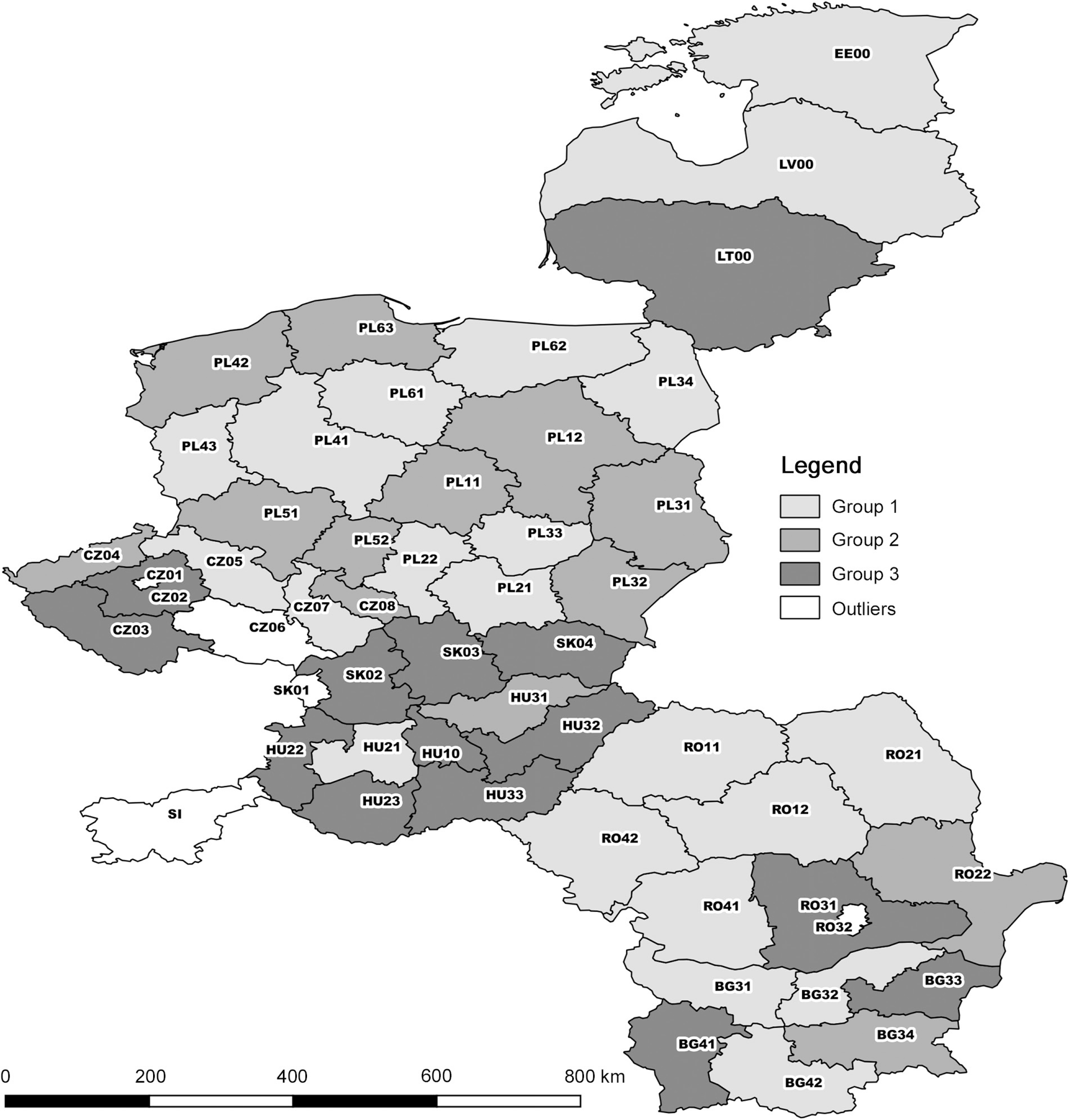
Fig. 5
K-means clustering of CEE regions.
Source: own calculations based on Eurostat (2017).
Table 6
Correlations between EU funding and development indicators in groups of CEE regions
| GFCF | EMP | PET | GERB | GERN | ||
|---|---|---|---|---|---|---|
| Group 1 | EEUCP | 0.165 | –0.009 | –0.051 | 0.664** | 0.471* |
| Group 2 | EEUCP | 0.418 | 0.319 | 0.204 | 0.692** | 0.275* |
| Group 3 | EEUCP | 0.218 | 0.490 | –0.057 | 0.103** | –0.064* |
Notes:
Source: own calculations based on DC REGIO (2017) and Eurostat (2017).