
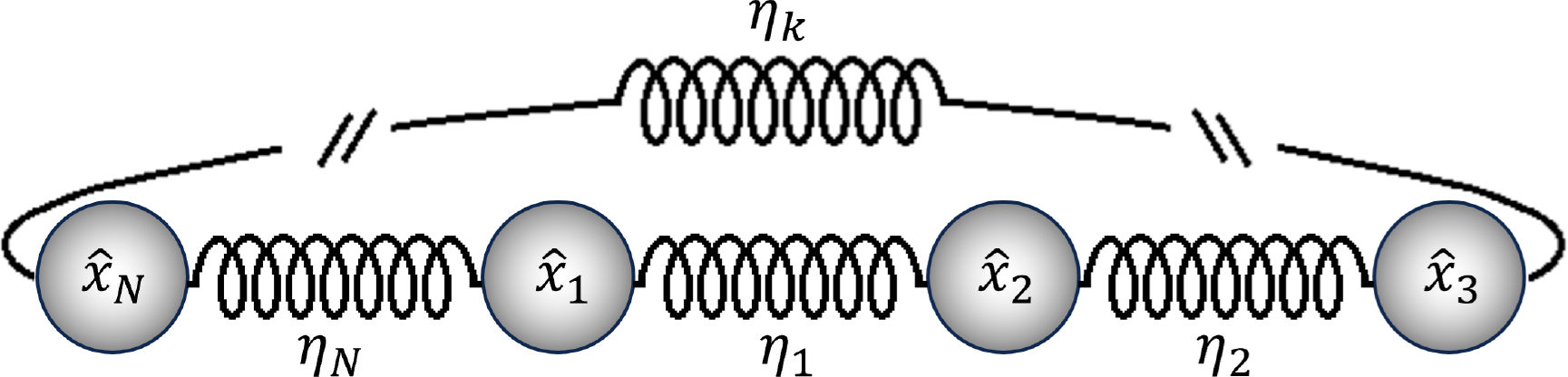
Figure 1.
A model of N harmonic oscillators connected with nearest neighbor coupling, ηk, arranged as a 1-dimensional linear ring, where k ∈ {1, …, N}.
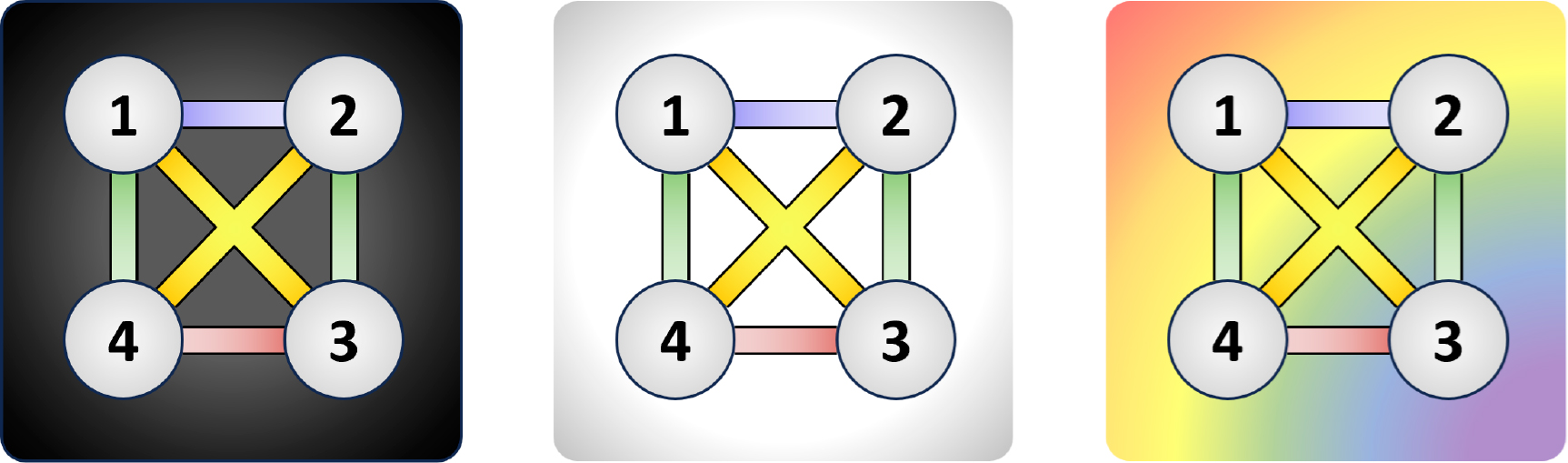
Figure 2.
A pictorial representation of N = 4 oscillators arranged in a ring configuration embedded in a shared-Closed (non-existent noise), Markovian (white noise), and non-Markovian (colored noise) environment, respectively. We use different colored lines connecting oscillator i and j to represent unique entanglement dynamics or logarithmic negativity 𝒩i,j (τ). 𝒩1,2 (τ) is Blue, and 𝒩3,4 (τ) is Red. If the entanglement dynamics are identical within an oscillator pair, we use the same colored lines. 𝒩1,3 (τ) = 𝒩2,4 (τ) are colored Yellow and 𝒩2,3 (τ) = 𝒩1,4 (τ) are colored Green.
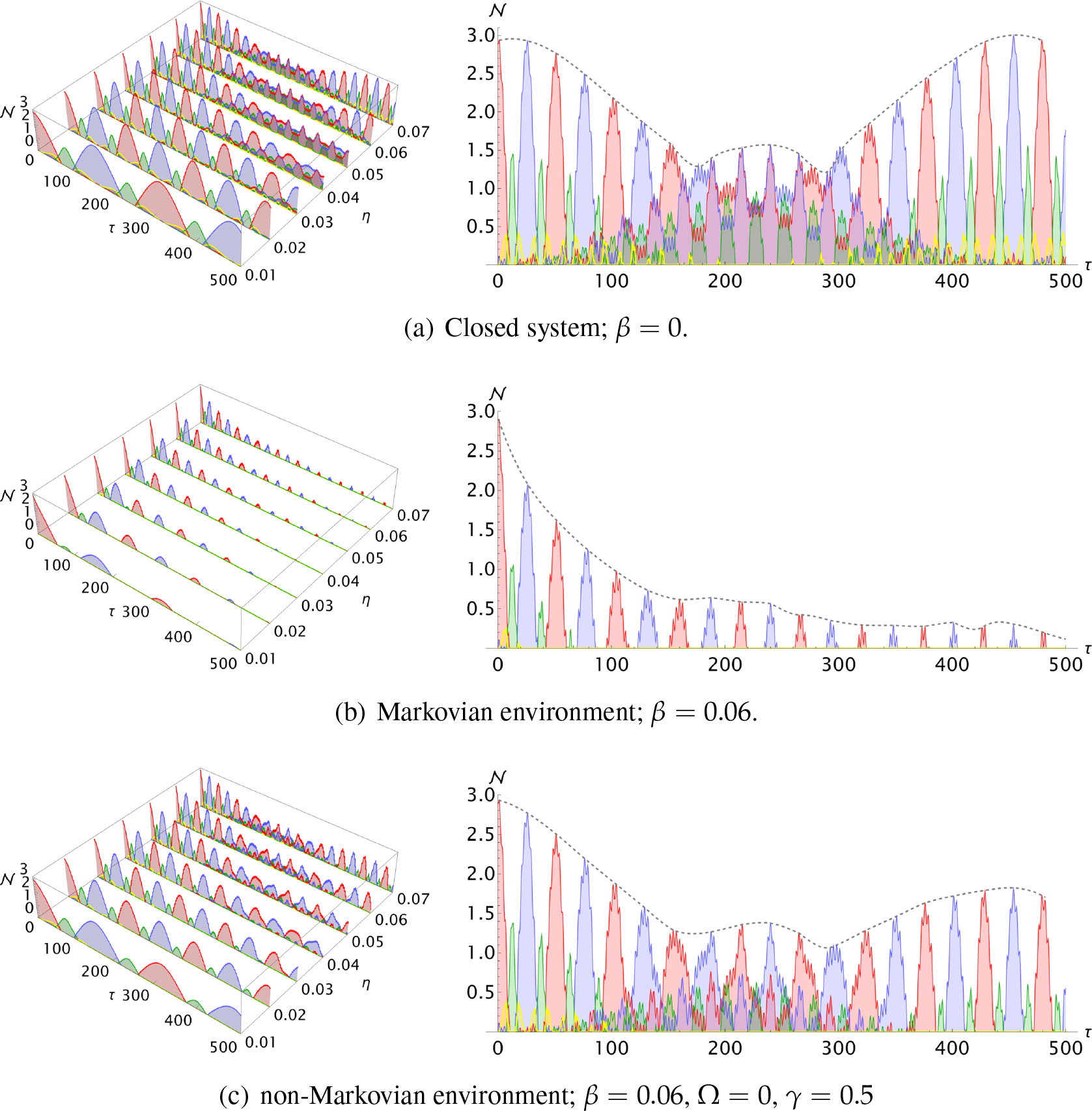
Figure 3.
Entanglement dynamics in different environments η is varied. For all plots ω = 1. 𝒩1,2 (τ) is Blue, and 𝒩3,4 (τ) is Red. 𝒩1,3 (τ) = 𝒩2,4 (τ) are colored Yellow and 𝒩2,3 (τ) = 𝒩1,4 (τ) are colored Green. Left side shows η dependence for 0.01 ≤ η ≤ 0.07. Right side is only for η = 0.07 and the dashed Gray line approximates an enveloping function following the relative maximums of 𝒩1,2 (τ) and 𝒩3,4 (τ).
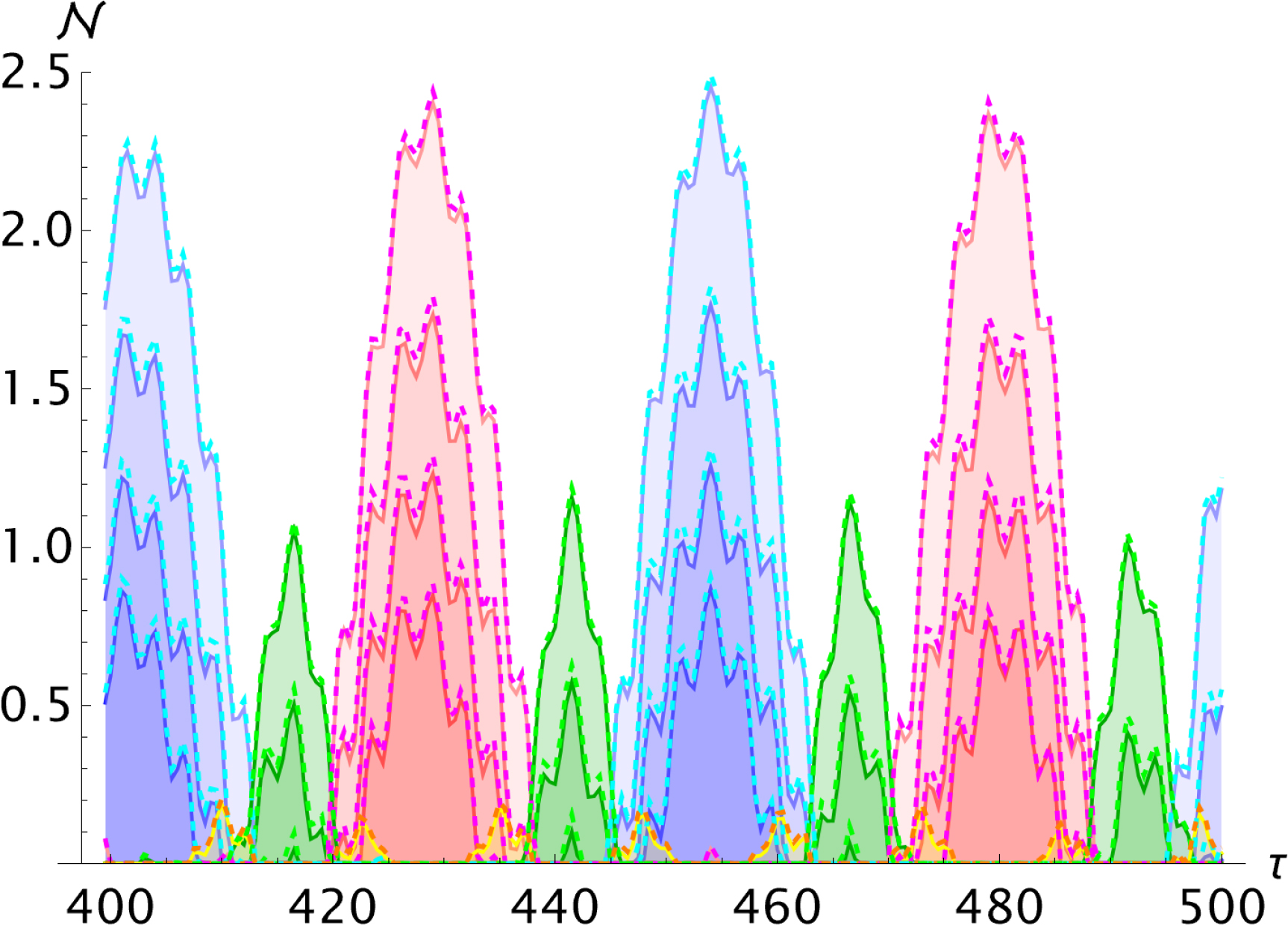
Figure 4.
Entanglement dynamics in different environments as β varies while η = 0.07, ω = 1. Solid lines colored Blue, Red, Yellow and Green correspond to 𝒩1,2(τ), 𝒩3,4(τ), 𝒩1,3(τ) = 𝒩2,4(τ), and 𝒩2,3(τ) = 𝒩1,4(τ), respectively in a Markovian environment. Dashed lines colored Cyan, Magenta, Orange and Lime Green correspond to 𝒩1,2(τ), 𝒩3,4(τ), 𝒩1,3(τ) = 𝒩2,4 (τ), and 𝒩1,4(τ) = 𝒩2,3(τ), respectively in a non-Markovian environment. Larger to smaller peaks correspond to βM = {0.01, …, 0.04} with increments of 0.01 or βNM = {0.03, …,0.12} with increments of 0.03 and Ω = 0, γ = 0.5.
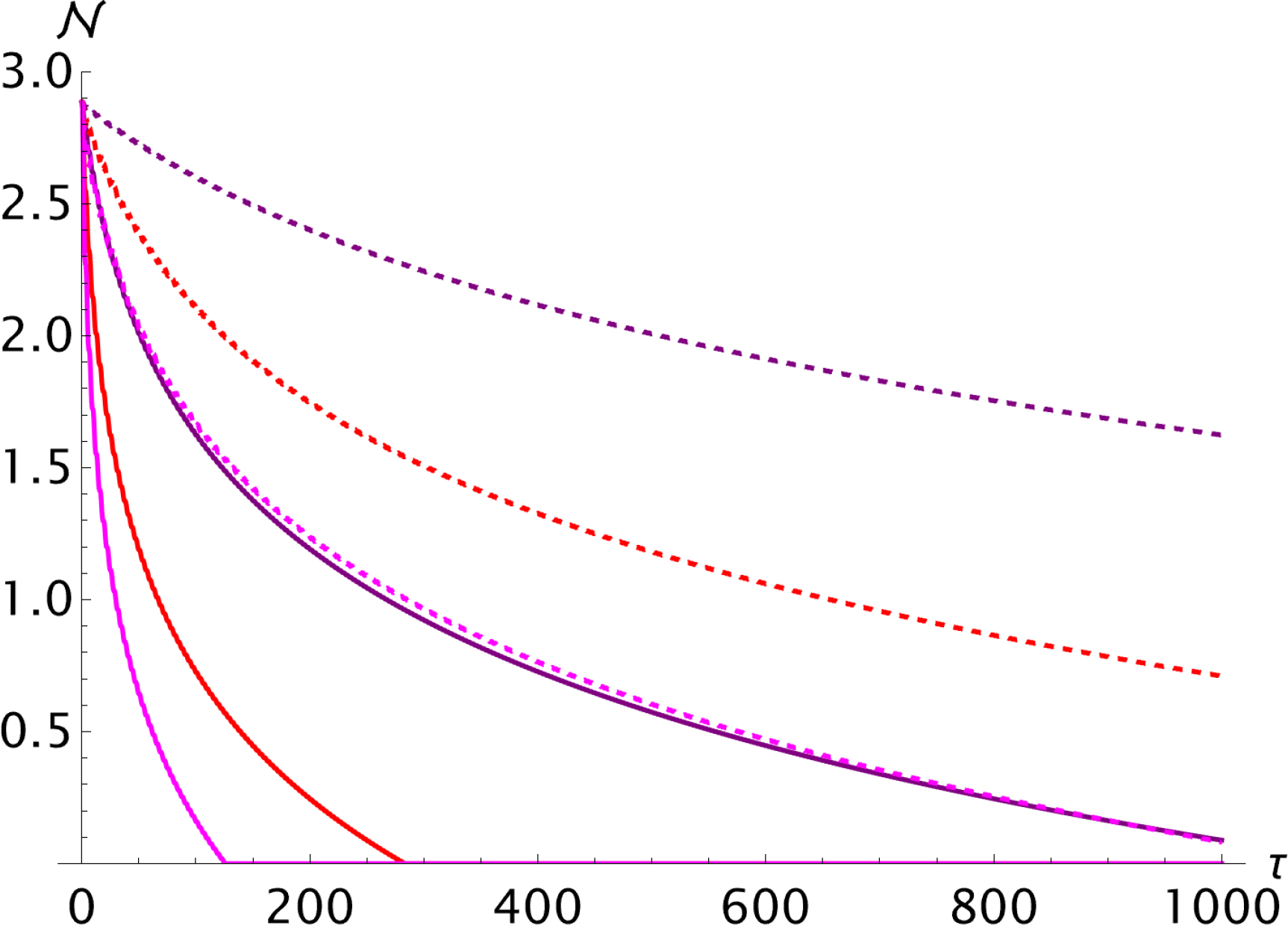
Figure 5.
Comparison of entanglement preservation within oscillator pair 3,4 in different environments. 𝒩3,4 (τ)|Markovian are solid lines while 𝒩3,4 (τ) |non–Markovian are dashed lines. For dashed lines, Ω = 0 and γ = 0.5. For either dashed or solid lines, η = 0, ω = 1 and the colors Dark Purple, Red, and Magenta corresponds to β = {0.04,0.08,0.12}.
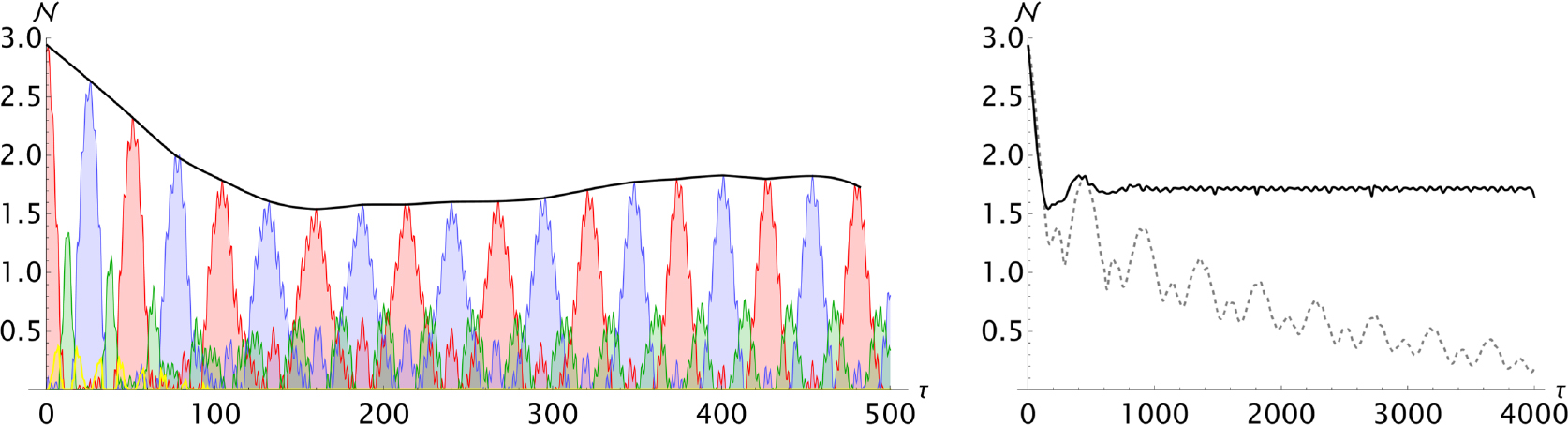
Figure 6.
Entanglement dynamics in a non-Markovian environment involving resonance. For both plots, η = 0.07, β = 0.06, ω = Ω = 1, γ = 0.5. Left plot shows the resonance case where 𝒩1,2 (τ) is Blue, and 𝒩3,4 (τ) is Red. 𝒩1,3 (τ) = 𝒩2,4(τ) are colored Yellow and 𝒩2,3 (τ) = 𝒩1,4 (τ) are colored Green. Right plot shows an extended simulation of the enveloping functions for the resonance/non-resonance cases which are shown as a solid Black line and a dashed Gray line, respectively. Note, the dashed Gray line originates/continues from Figure 3c.
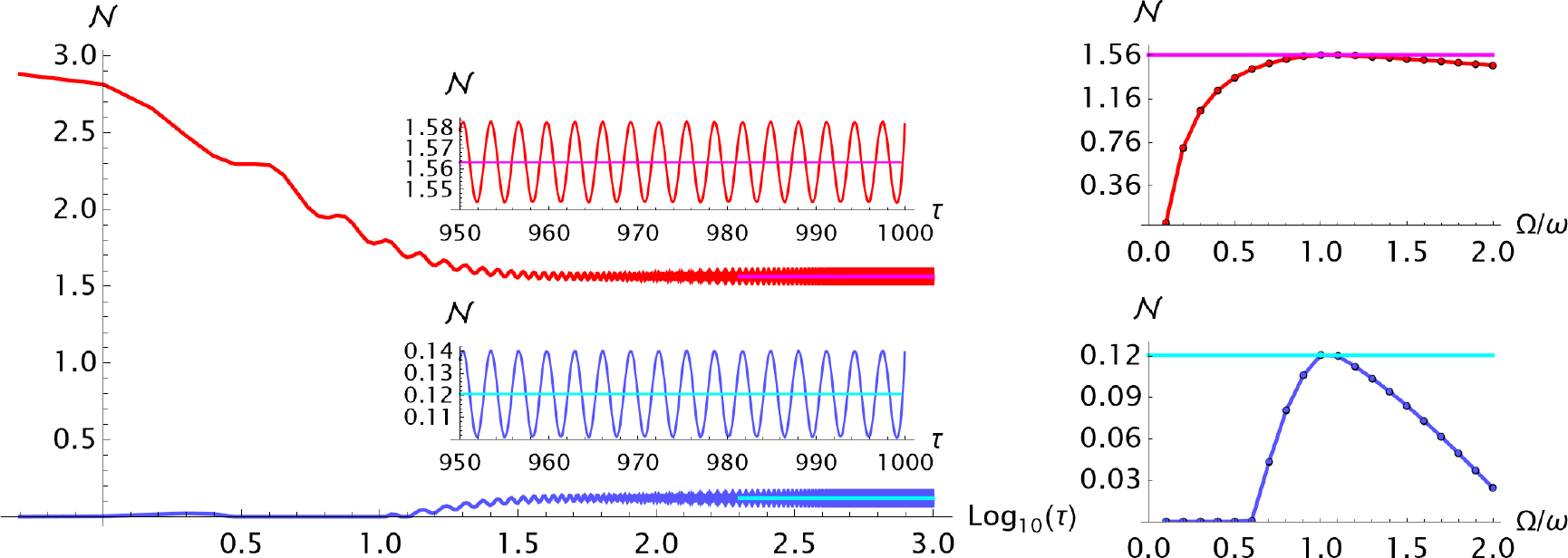
Figure 7.
Entanglement dynamics in a non-Markovian environment for oscillator pair 3,4 and pair 1,2 at resonance and non-resonance. Entanglement within all other pairwise combinations are effectively zero. For all plots shown, η = 0, β = 0.30, ω = 1, and γ = 0.5. Left plot has Ω/ω = 1 and shows 𝒩1,2 (τ) as Blue, and 𝒩3,4(τ) as Red‥ Solid Cyan and Magenta lines are the average values of 𝒩1,2(τ) and 𝒩3,4(τ) for τ = {200,…, 1000}, respectively. Zoomed plots within the left plot for τ = {950,…, 1000} reveal that both 𝒩1,2 (τ) and 𝒩3,4 (τ) behave sinusoidally in the long time limit. Right plots shows the average values at saturation of 𝒩1,2 (τ) and 𝒩3,4 (τ) as Blue and Red dots. The Blue and Red lines that join the dots approximate functions with a maximum occurring when Ω/ω = 1 and are highlighted in Cyan and Magenta.
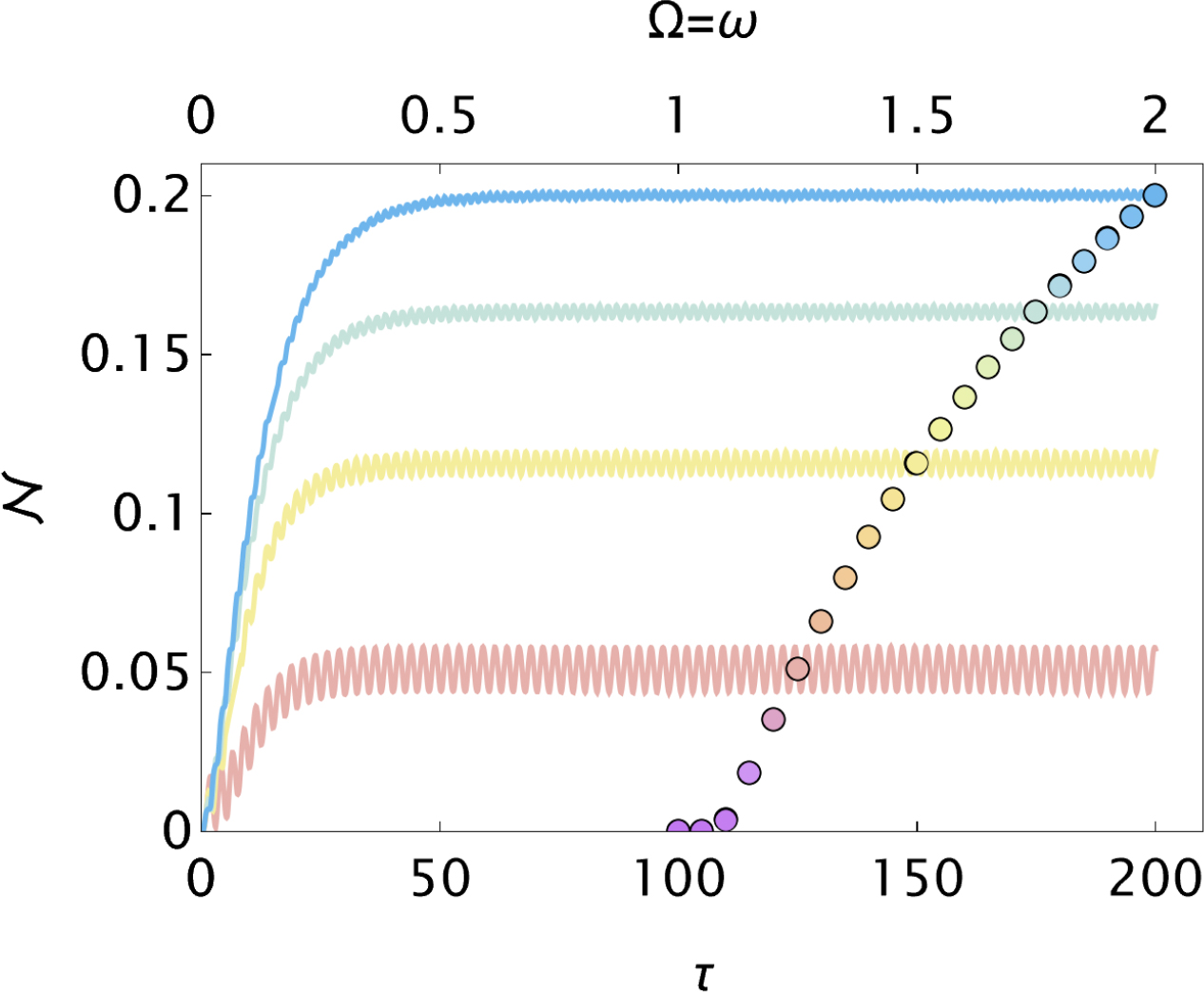
Figure 8.
Entanglement generation within all pairwise oscillator combinations 𝒩i,j (τ), where i ≠ j ∈ {1, …,4} with η = 0, β = 0.30, γ = 0.5, and Ω = ω. 𝒩i,j(τ) is shown as pastel colored lines of Pink, Yellow, Green, and Blue and correspond to Ωsub = {1.25,1.5,1.75,2}. Pastel colored dots correspond to the average value of 𝒩i,j (τ) for the duration τ = {50, …,200 } with different values of Ω = {1, …,2 } incremented at 0.05.
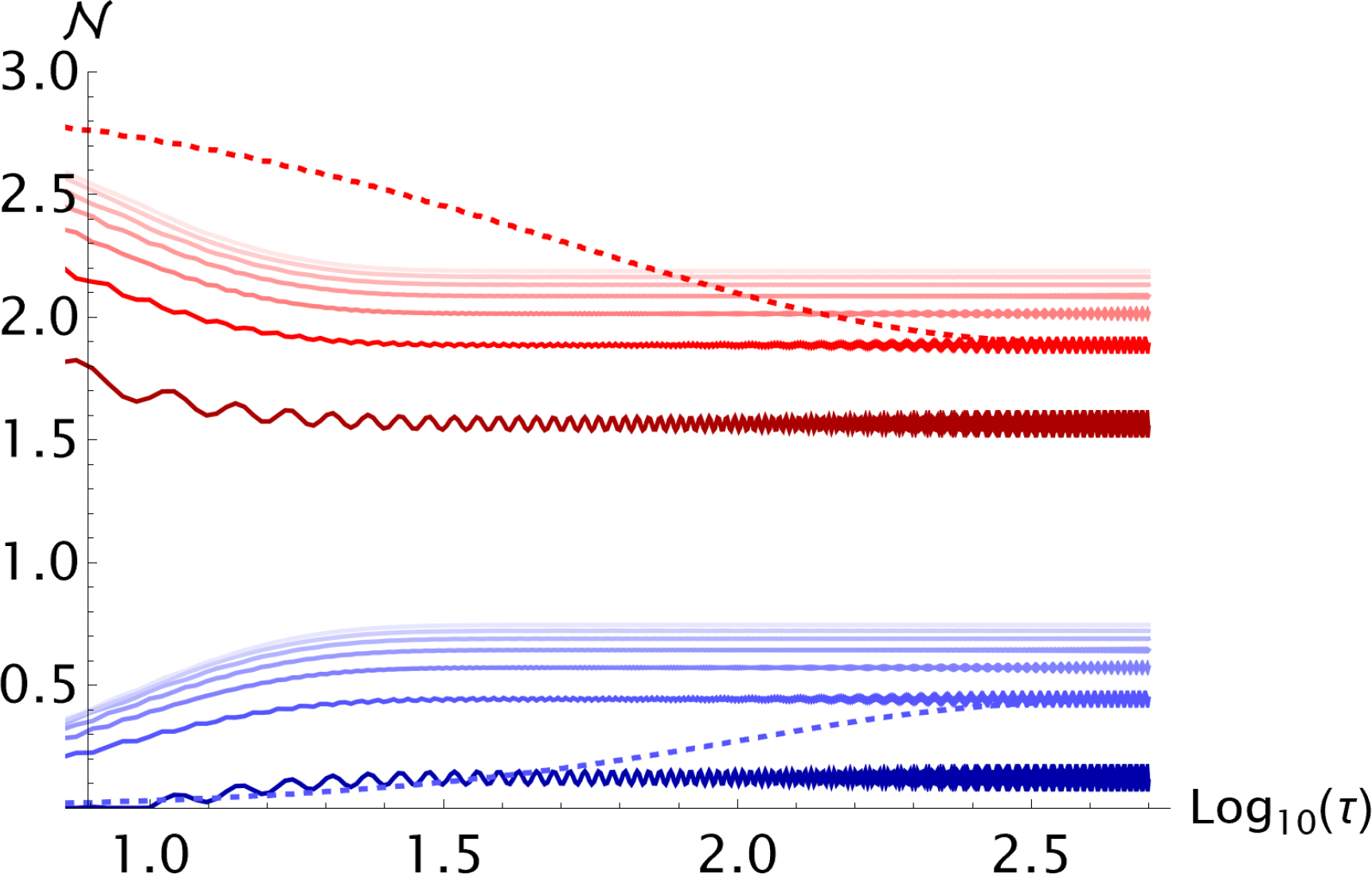
Figure 9.
Entanglement dynamics for 𝒩1,2(τ)|Ω and 𝒩3,4( τ)|Ω using βopt|Ω, where Ω = ω = {1,…, 8} with increments of 1, which correspond to a Dark Blue to a faded Light Blue and a Dark Red to a faded Light Red, respectively. 𝒩1,2 (τ)|Ω=2 and 𝒩3,4 (τ)|Ω=2 using β = 0.30 are shown as overlaid Blue and Red dashed curves overlaid. Remaining parameters used are η = 0 and γ = 0.5.
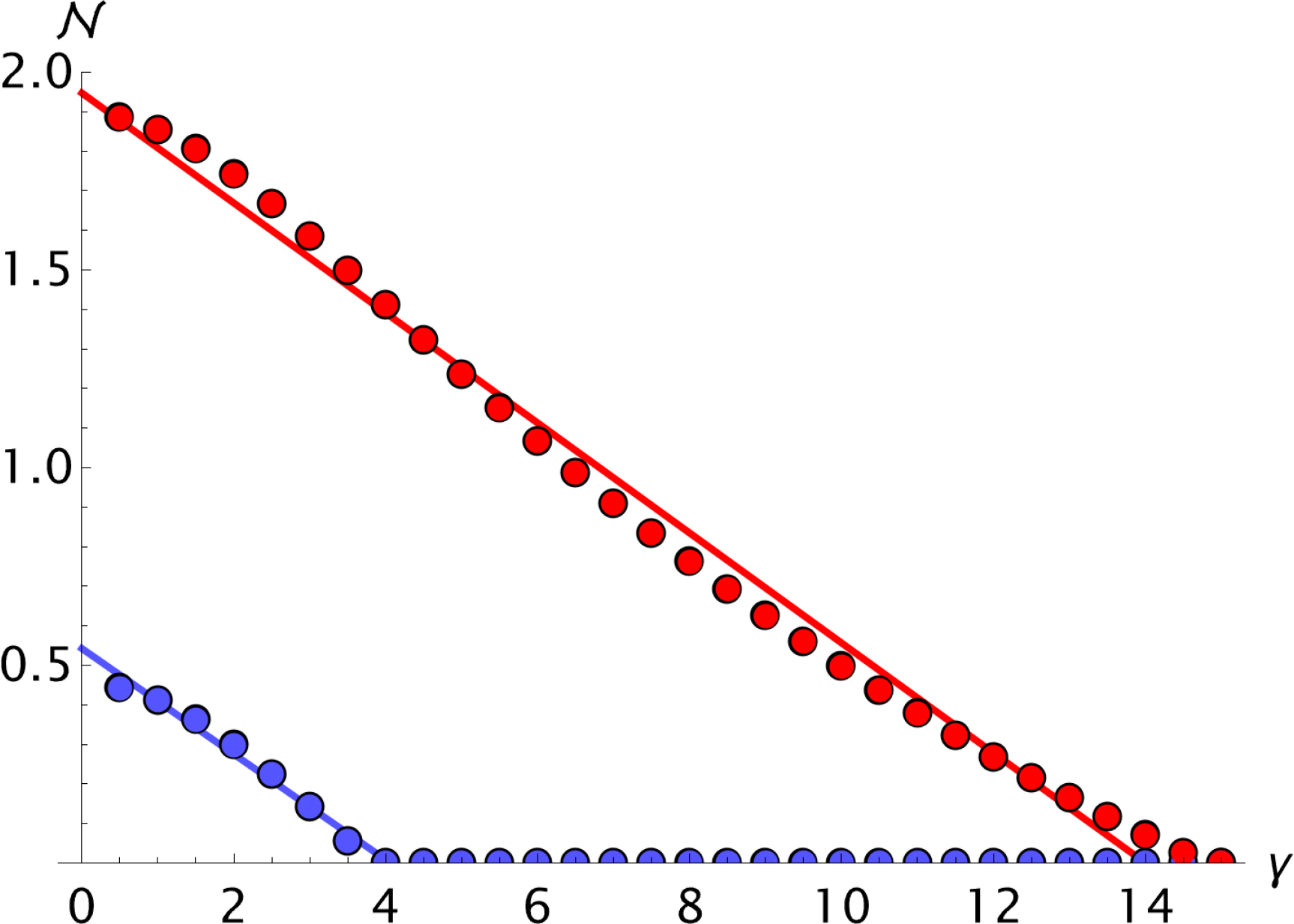
Figure 10.
Entanglement saturation value within oscillator pair 1,2 and 3,4 during τ = {0, …1000} as a function of γ = {0.5, …, 15} incremented with 0.5. Blue dots are for oscillator pair 1,2 and Red dots are for oscillator pair 3,4 and their linearly fitted functions are shown as Blue and Red lines. Resonance is maintained, Ω = ω = 2, η = 0, and β = 0.30.
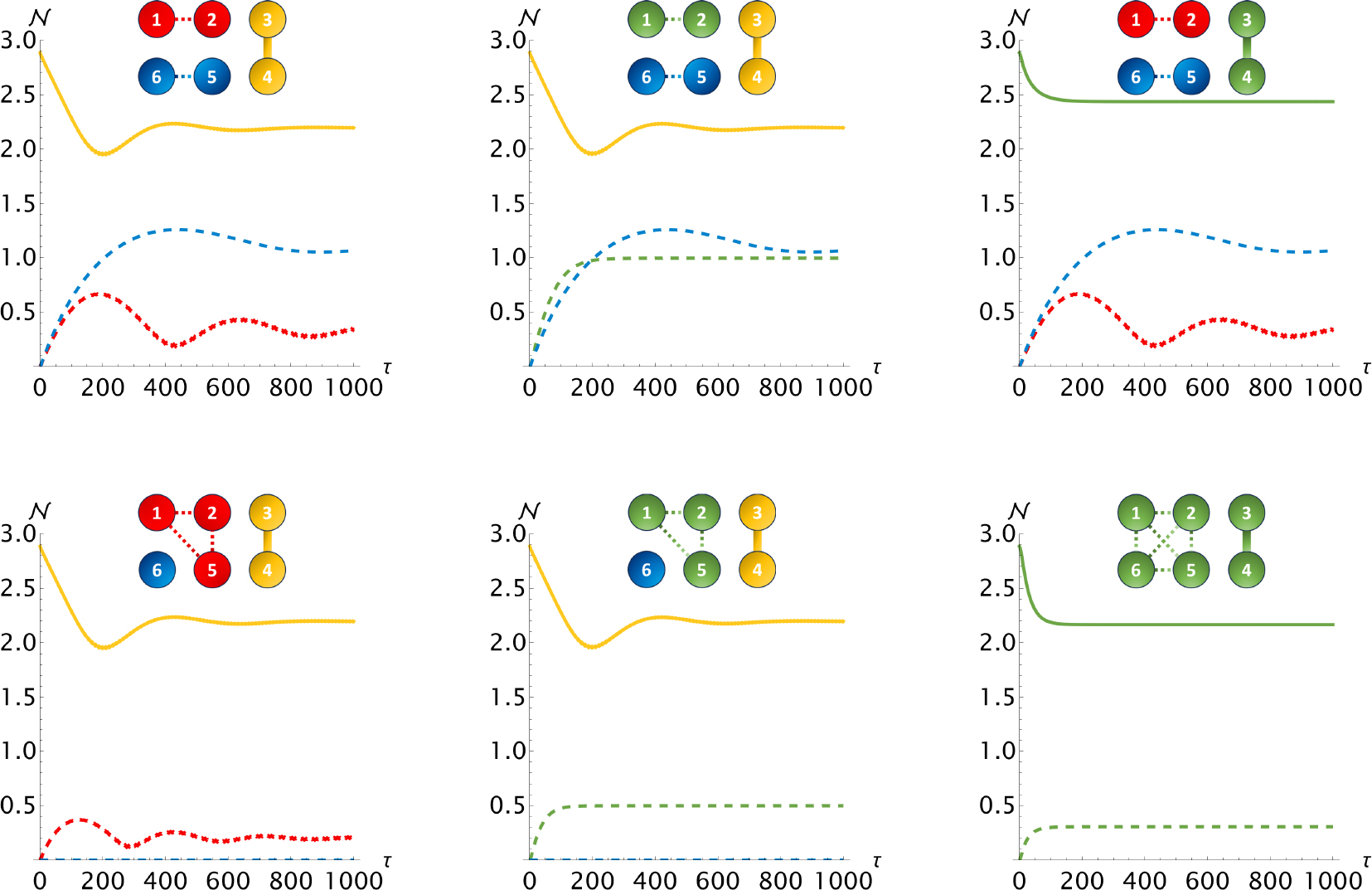
Figure 11.
Six different entanglement network configurations each involving N = 6 oscillators are depicted as colored circles. The colors Red, Yellow, Green, and Blue are unrelated to all previous Figures. They instead correspond to the system oscillator frequencies ω = {2,3,4,5}. A solid line linking a pair of oscillators means entanglement was initially set within them at τ = 0, i.e., solid Green or Yellow line between oscillators 3 and 4. Dotted lines linking a pair of oscillators means entanglement was not present within them initially but generates within them later, τ > 0. A stand alone oscillator means that entanglement is neither generated or initialized involving that oscillator with any other one for τ ≥ 0, i.e., oscillator 6. The corresponding entanglement dynamics for each network configuration are shown below with solid or dashed lines, which means that entanglement was either initialized or generated within them. The parameters used in all plots are η = 0, β = 0.30, Ω = 4, and γ = 0.5.