Have a personal or library account? Click to login
Simple Ways of Preparing Qudit Dicke States Cover
Open Access
|Mar 2026

Figures & Tables

Figure 1.

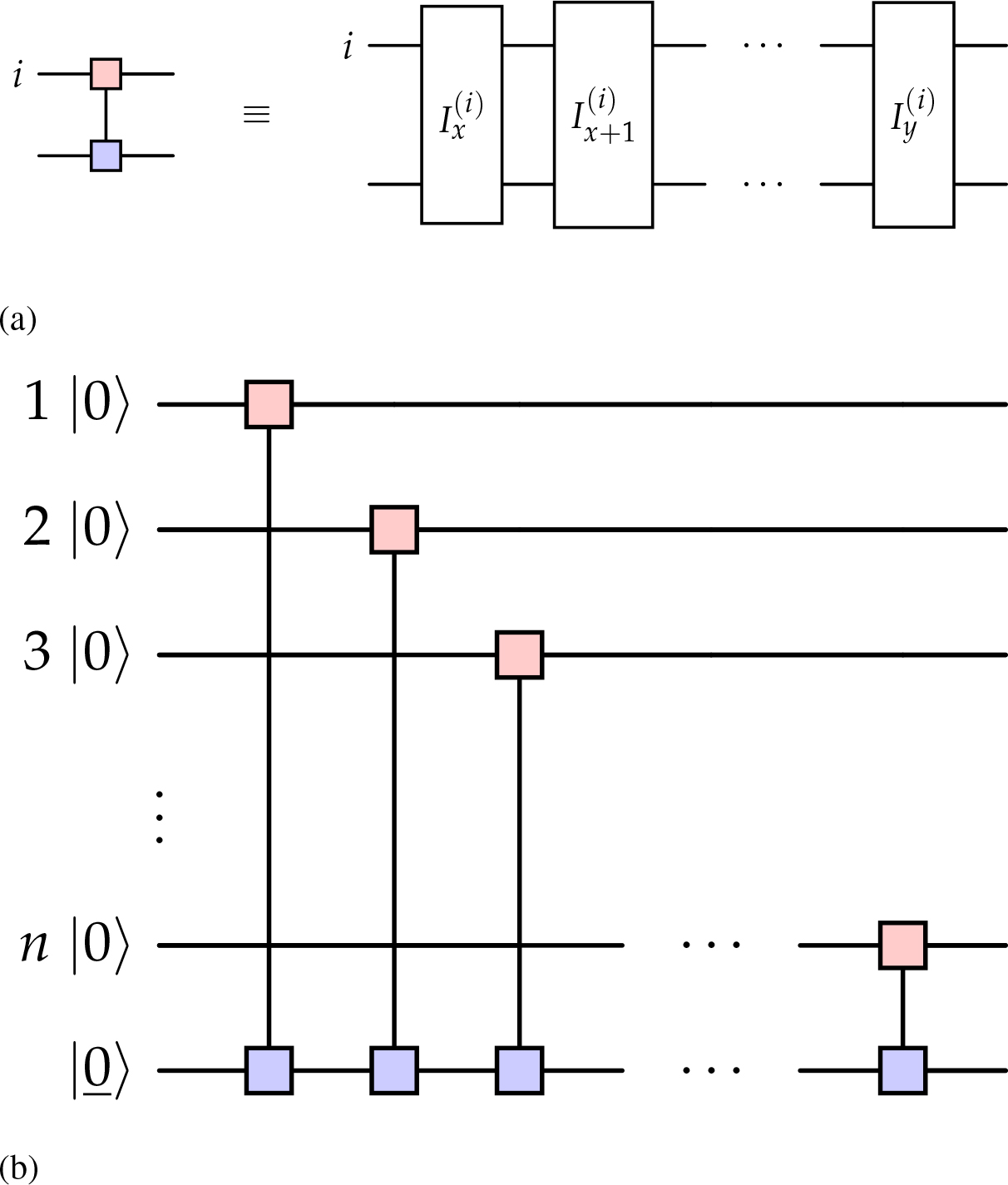
Circuit diagram for Il(i){\rm{I}}_l^{(i)} defined in (13), (14).

Figure 2.

Circuit diagram for preparing the state |Dn,k(s)〉|D_{n,k}^{(s)}\rangle  sequentially (11) (a) Ui=Π↶lIl(i){U_i} = {\mathop \Pi \limits^ _l}I_l^{(i)}, with x = max(0, 2s(i – n – 1) + k) and y = min(2si – 1, k – 1); (b) Π↶iUi|0_〉|0〉⊗n{\mathop \Pi \limits^ _i}{U_i}|\rangle |0{\rangle ^{ \otimes n}}.
Circuit diagram for preparing the state |Dn,k(s)〉|D_{n,k}^{(s)}\rangle sequentially (11) (a) Ui=Π↶lIl(i){U_i} = {\mathop \Pi \limits^ _l}I_l^{(i)}, with x = max(0, 2s(i – n – 1) + k) and y = min(2si – 1, k – 1); (b) Π↶iUi|0_〉|0〉⊗n{\mathop \Pi \limits^ _i}{U_i}|\rangle |0{\rangle ^{ \otimes n}}.

Figure 3.

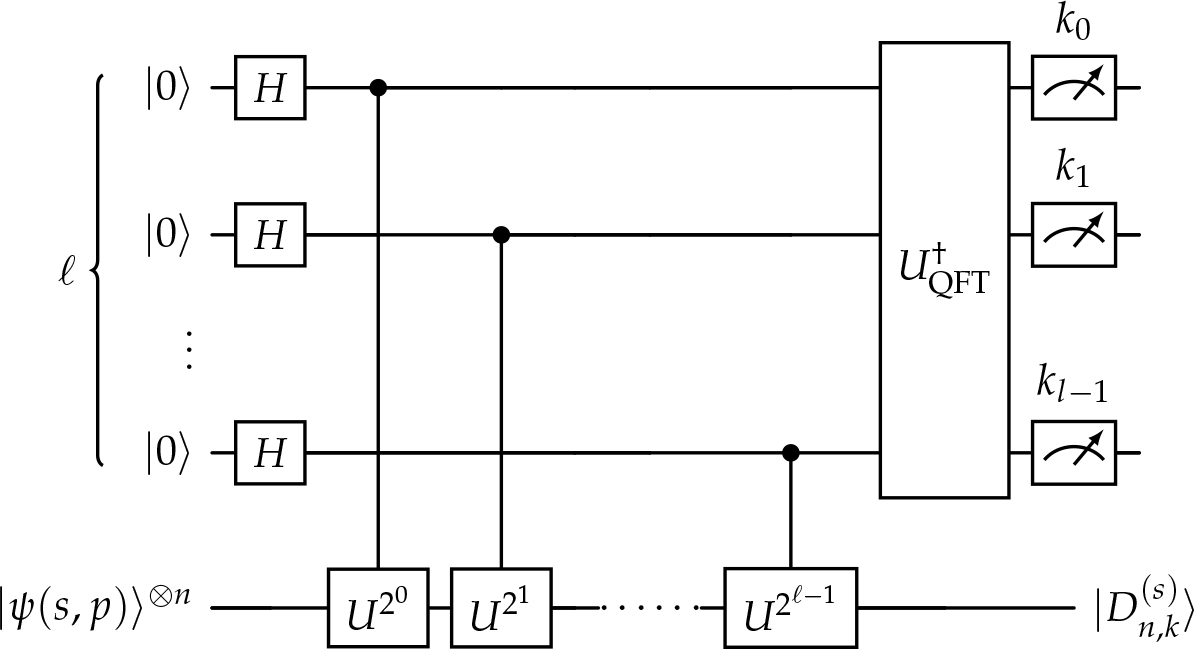
Circuit diagram for preparing the state |Dn,k(s)〉|D_{n,k}^{(s)}\rangle  in log depth using the standard QPE algorithm. All ancilla wires are qubits. The initial state of the bottom wire is (24), and U is defined in (27).
Circuit diagram for preparing the state |Dn,k(s)〉|D_{n,k}^{(s)}\rangle in log depth using the standard QPE algorithm. All ancilla wires are qubits. The initial state of the bottom wire is (24), and U is defined in (27).

Figure 4.

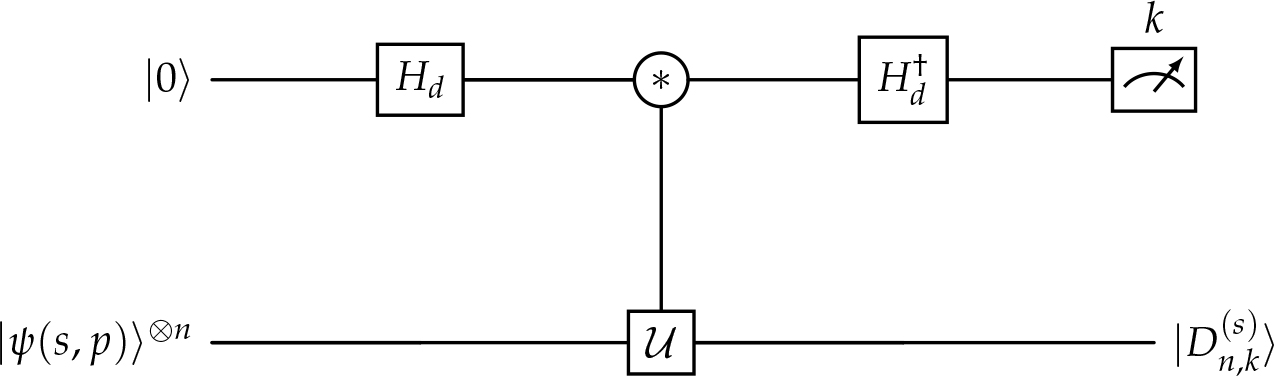
Circuit diagram for preparing the state |Dn,k(s)〉|D_{n,k}^{(s)}\rangle  in constant depth using the Hadamard test. The top wire is a qudit of dimension d = 2sn + 1. The initial state of the bottom wire is (24), and 𝒰 is defined in (35).
Circuit diagram for preparing the state |Dn,k(s)〉|D_{n,k}^{(s)}\rangle in constant depth using the Hadamard test. The top wire is a qudit of dimension d = 2sn + 1. The initial state of the bottom wire is (24), and 𝒰 is defined in (35).

Figure 5.

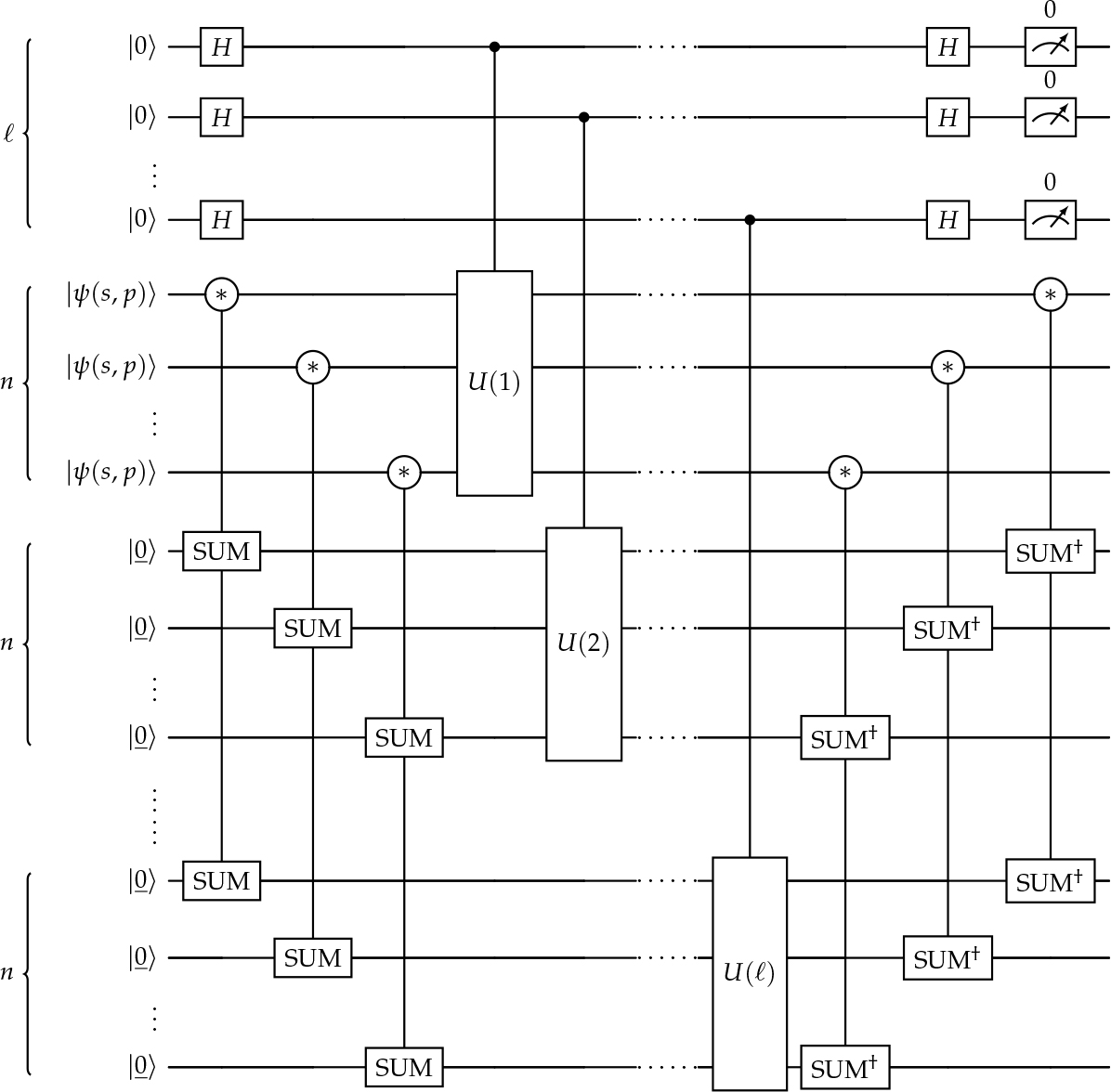
Circuit diagram for preparing the state |Dn,k(s)〉|D_{n,k}^{(s)}\rangle , which can be implemented in constant depth. The top ℓ wires are qubits, while all other wires are qudits of dimension 2s + 1. The state |ψ(s, p)〉 is given by (23), and U(x) is defined in (38).
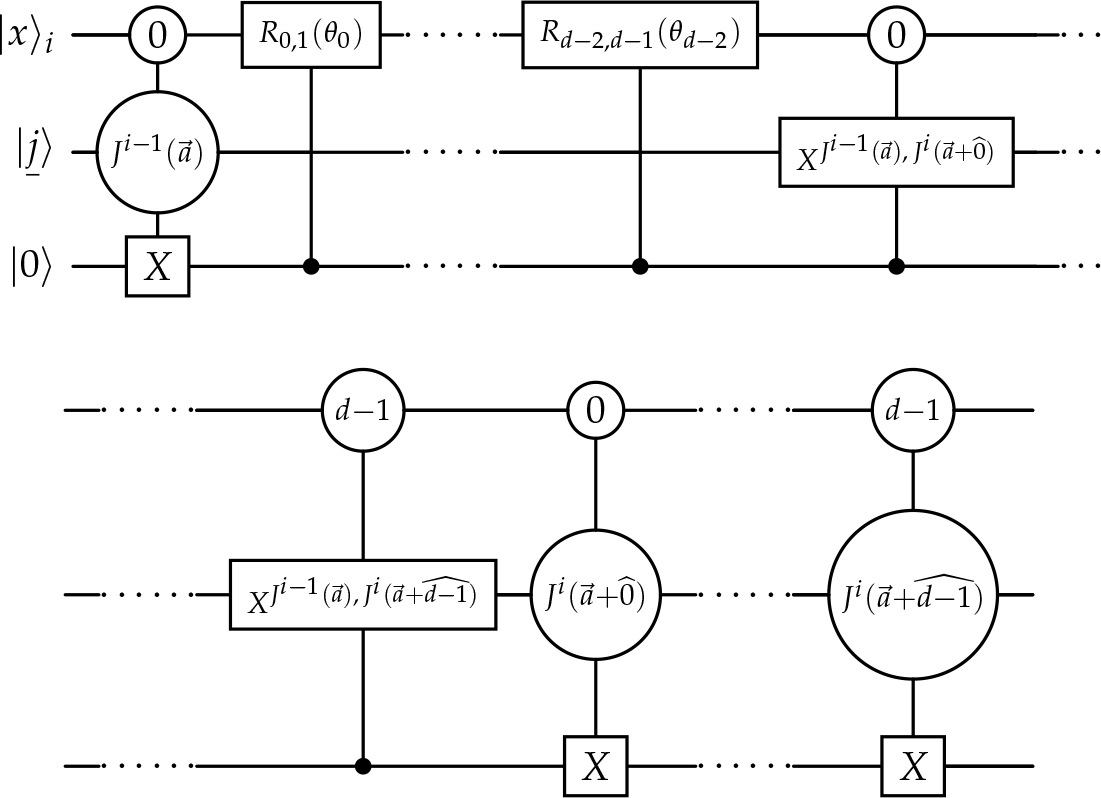

Figure 6.

Circuit diagram for IJi−1(a→)(i)I_{{J^{i - 1}}(\vec a)}^{(i)}.

Figure 7.

Circuit diagram for preparing the state |Dn(k→)〉\left| {{D^n}(\vec k)} \right\rangle  in log depth using the standard QPE algorithm. All ancilla wires are qubits. The initial state of the bottom wire is (66), and U(i) is defined in (69).
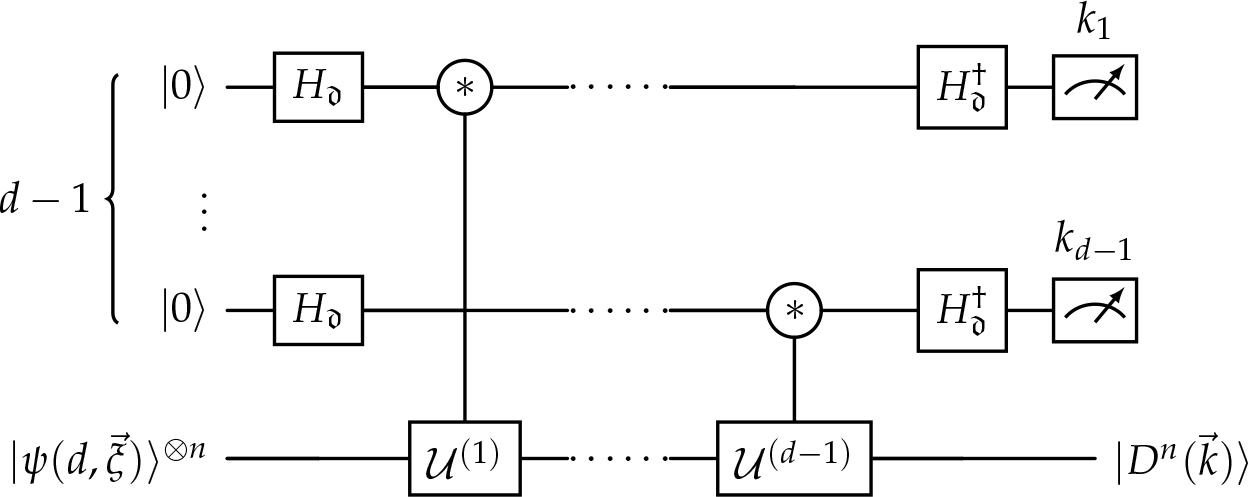
Circuit diagram for preparing the state |Dn(k→)〉\left| {{D^n}(\vec k)} \right\rangle in log depth using the standard QPE algorithm. All ancilla wires are qubits. The initial state of the bottom wire is (66), and U(i) is defined in (69).

Figure 8.

Circuit diagram for preparing the state |Dn(k→)〉\left| {{D^n}(\vec k)} \right\rangle  in constant depth using Hadamard tests. All ancilla wires are qudits of dimension 𝔡 = n + 1. The initial state of the bottom wire is (66), and 𝒰(i) is defined in (76).
Circuit diagram for preparing the state |Dn(k→)〉\left| {{D^n}(\vec k)} \right\rangle in constant depth using Hadamard tests. All ancilla wires are qudits of dimension 𝔡 = n + 1. The initial state of the bottom wire is (66), and 𝒰(i) is defined in (76).

Figure 9.

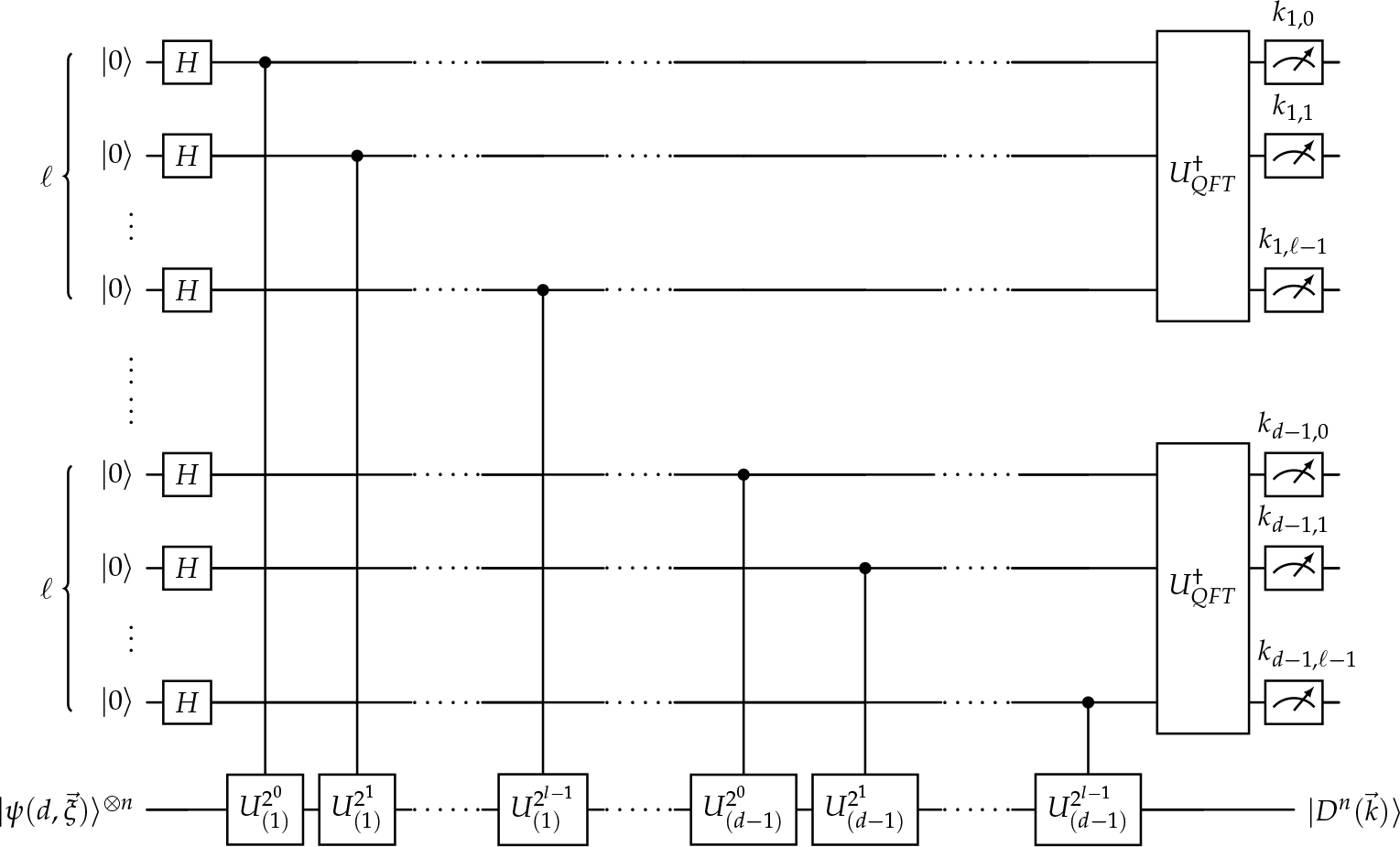
(a) Circuit diagram for preparing the state |Dn(k→)〉\left| {{D^n}(\vec k)} \right\rangle  in constant depth. Each of the top (d – 1) wires represent ℓ qubits, while each of the other wires represent n qudits of dimension d. F is a fan-out gate. (b) Decomposition of the U˜i(x){{\tilde U}^i}(x) sub-circuit, where Ui(x) is defined in (79).
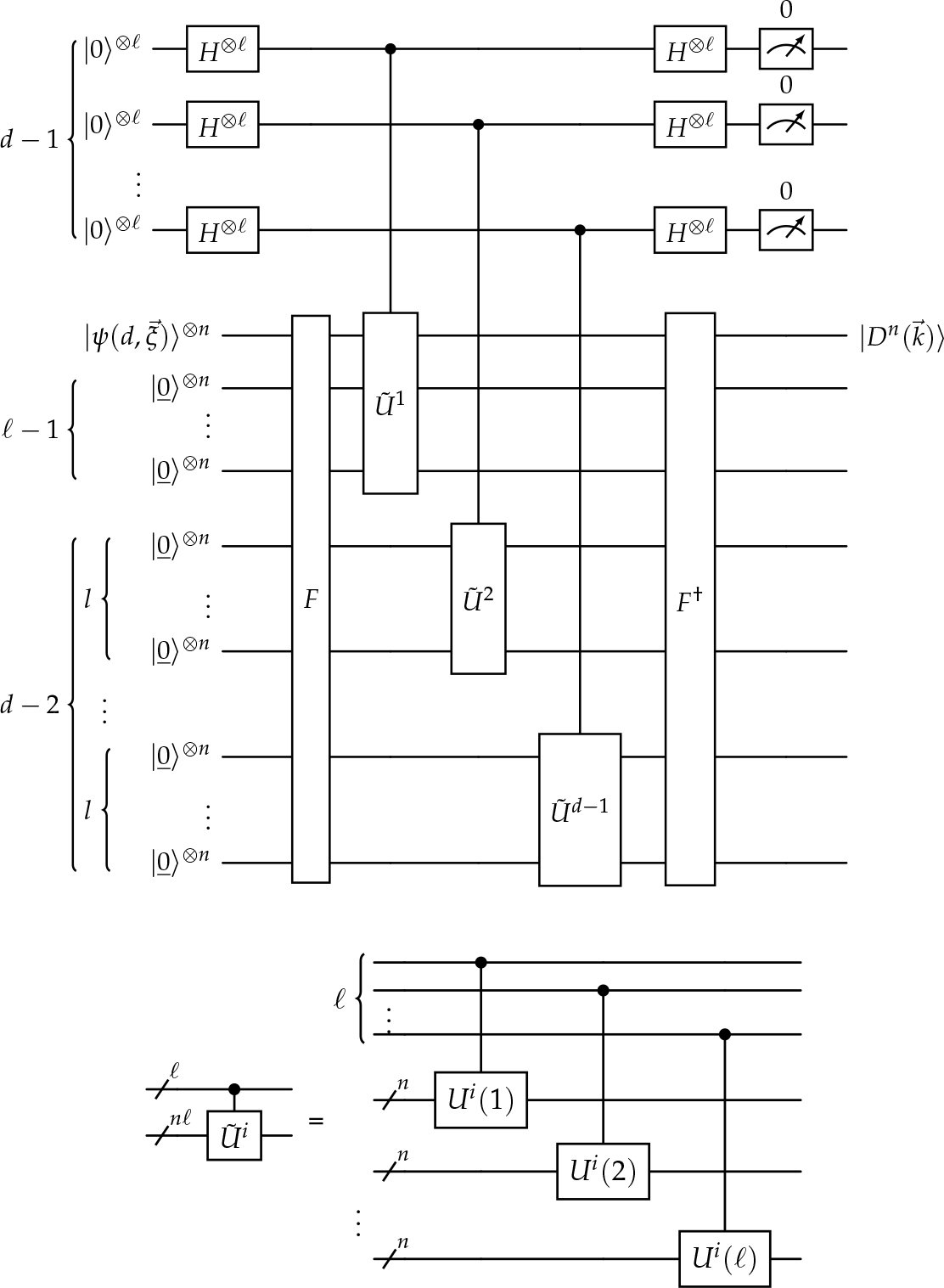
(a) Circuit diagram for preparing the state |Dn(k→)〉\left| {{D^n}(\vec k)} \right\rangle in constant depth. Each of the top (d – 1) wires represent ℓ qubits, while each of the other wires represent n qudits of dimension d. F is a fan-out gate. (b) Decomposition of the U˜i(x){{\tilde U}^i}(x) sub-circuit, where Ui(x) is defined in (79).

Summary of our results and comparison with previous work_ Note that we report here worst-case values, corresponding to k ∼ sn and k→∼(n/d,…,n/d)\vec k \sim (n/d, \ldots ,n/d) for |Dn,k(s)〉|D_{n,k}^{(s)}\rangle and |Dn(k→)〉|{D^n}(\vec k)\rangle , respectively; see the respective sections for more comprehensive discussions_

Dicke stateReferenceDepthAncillas [Dimension]Repetitions
SU(2) spin-s |Dn,k(s)|D_{n,k}^{(s)}\rangle NRR [22]𝒪(skn)01
Result 1𝒪(skn)1 [k + 1]1
Result 2𝒪 (log(sn))𝒪(log(sn) + n) [2]O(sn){\cal O}(\sqrt {sn} )
Result 3𝒪(1)𝒪(n) [2sn + 1]O(sn){\cal O}(\sqrt {sn} )
Result 4𝒪(1)𝒪(log(sn)) [2], 𝒪(n log(sn)) [2s + 1]O(sn){\cal O}(\sqrt {sn} )
SU(d) |Dn(k)|{D^n}(\vec k)\rangle NR [23]𝒪(nd)01
LCG [9]𝒪(log n)𝒪(n log n + log d) [2]𝒪(1)
Result 5𝒪((n/d)d)1 [2], 1[𝒪((n/d)d)]1
Result 6𝒪(d log n)𝒪(d log n + n) [2]𝒪(n(d−1)/2)
Result 7𝒪(d)𝒪(n + d) [n + 1]𝒪(n(d−1)/2)
Result 8𝒪(1)𝒪(d log n) [2], 𝒪(nd log n) [d]𝒪(n(d−1)/2)
DOI: https://doi.org/10.2478/qic-2025-0036 | Journal eISSN: 3106-0544 | Journal ISSN: 1533-7146
Language: English
Page range: 668 - 686
Submitted on: Aug 1, 2025
|
Accepted on: Sep 29, 2025
|
Published on: Mar 9, 2026
In partnership with: Paradigm Publishing Services
Publication frequency: 1 issue per year

© 2026 Noah B. Kerzner, Federico Galeazzi, Rafael I. Nepomechie, published by Cerebration Science Publishing Co., Limited
This work is licensed under the Creative Commons Attribution-NonCommercial-NoDerivatives 4.0 License.