
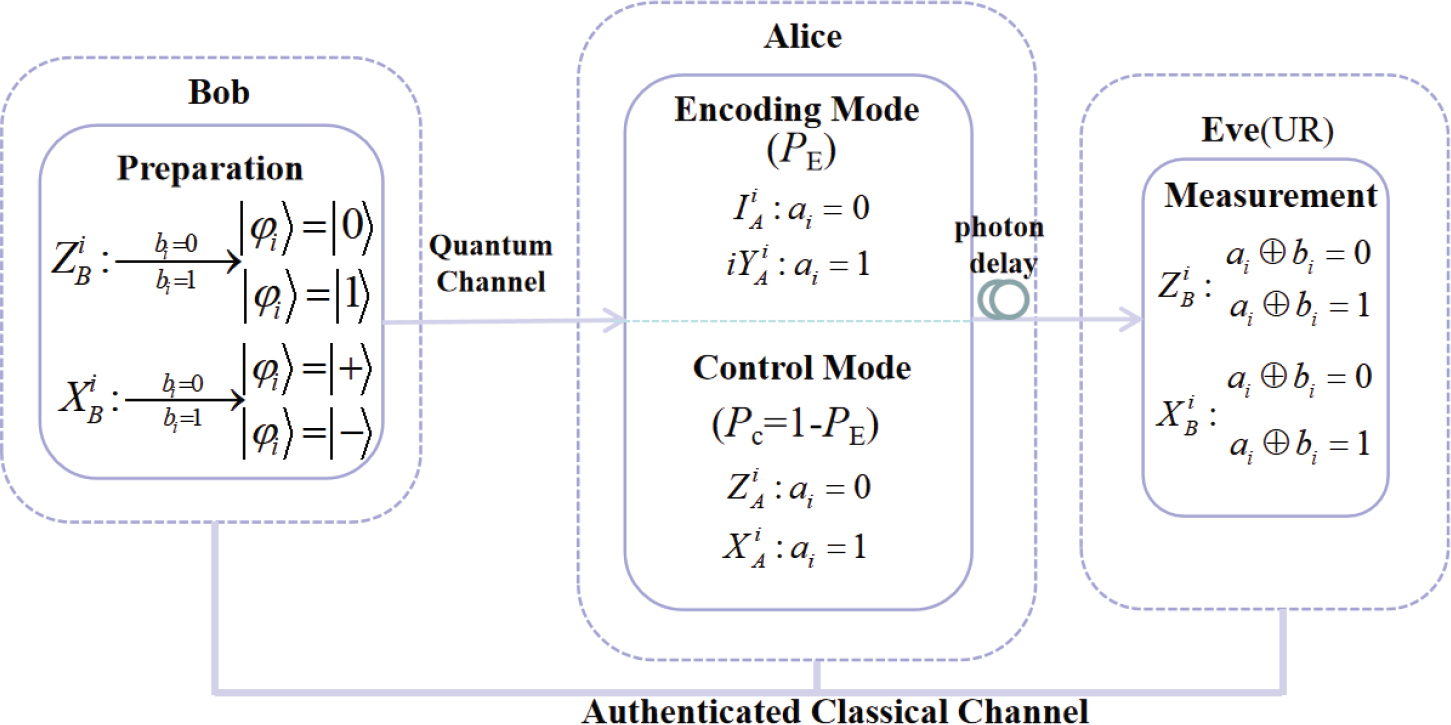
Figure 1.
Schematic illustration of the UR-DQKD Classic.
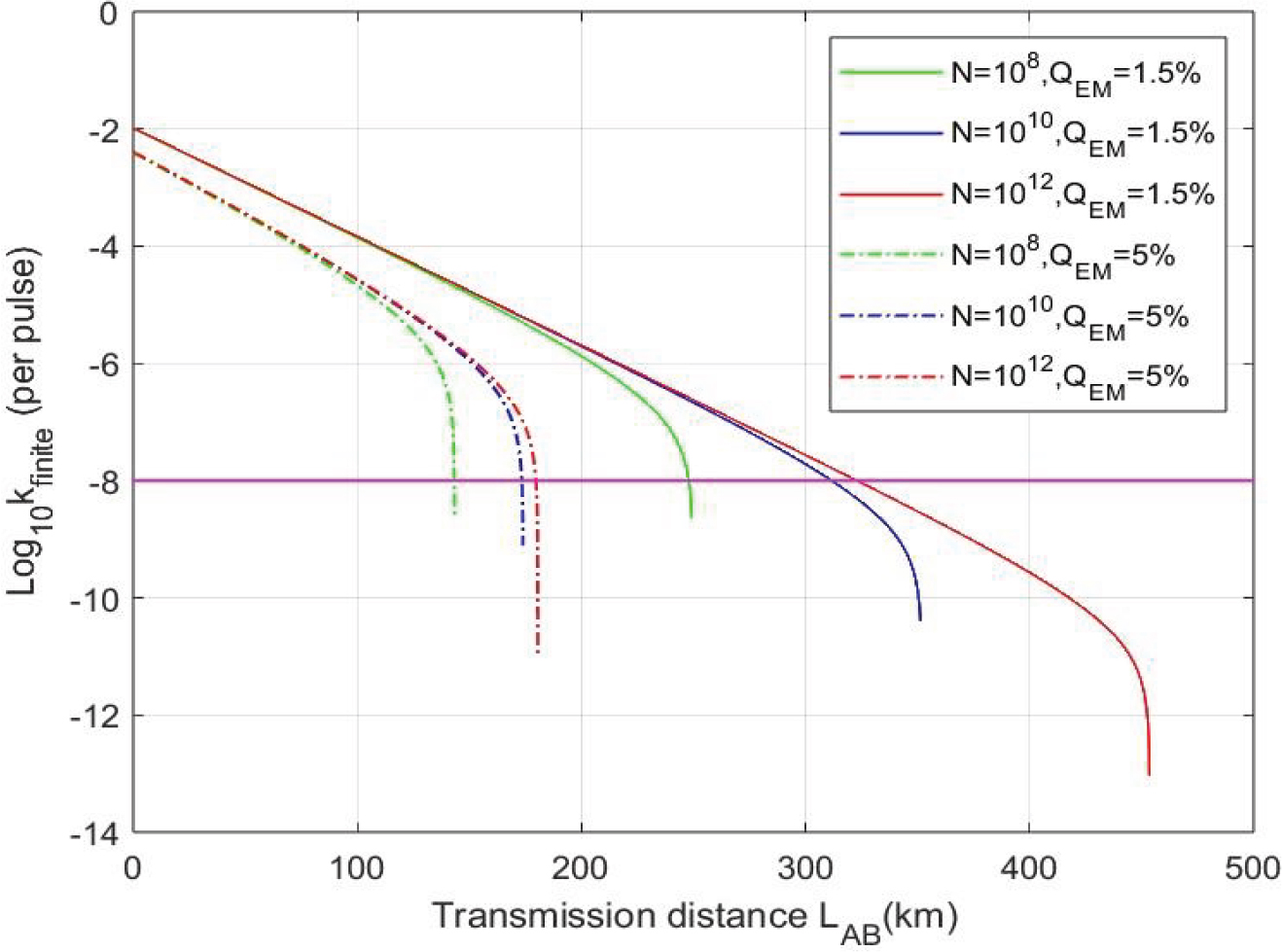
Figure 2.
As a function of the transmission distance LAB between Alice and Bob. We simulate the lower bounds of the finite-key-rate Kfinite in three cases: (N =108) green-solid-line, (N =1010) blue-solid-line, and (N = 1012) red-solid-line, QEM = 1.5%, ηE = 14.5%; (N = 108) green-dash-dotted-line, (N = 1010) blue-dash-dotted-line, and (N = 1012) red-dash-dotted-line, QEM = 5%, ηE = 14.5%.
Table 1.
Experimental parameters of today’s QKD technology.
| β(dB/km) | QEM | ϒ0 | ηE | fEC | εPE |
|---|---|---|---|---|---|
| 0.2 | 1.5%∽5% | 8 × 10⁻⁸ | 14.5% ∽ 45% | 1.15 | 10−8 |
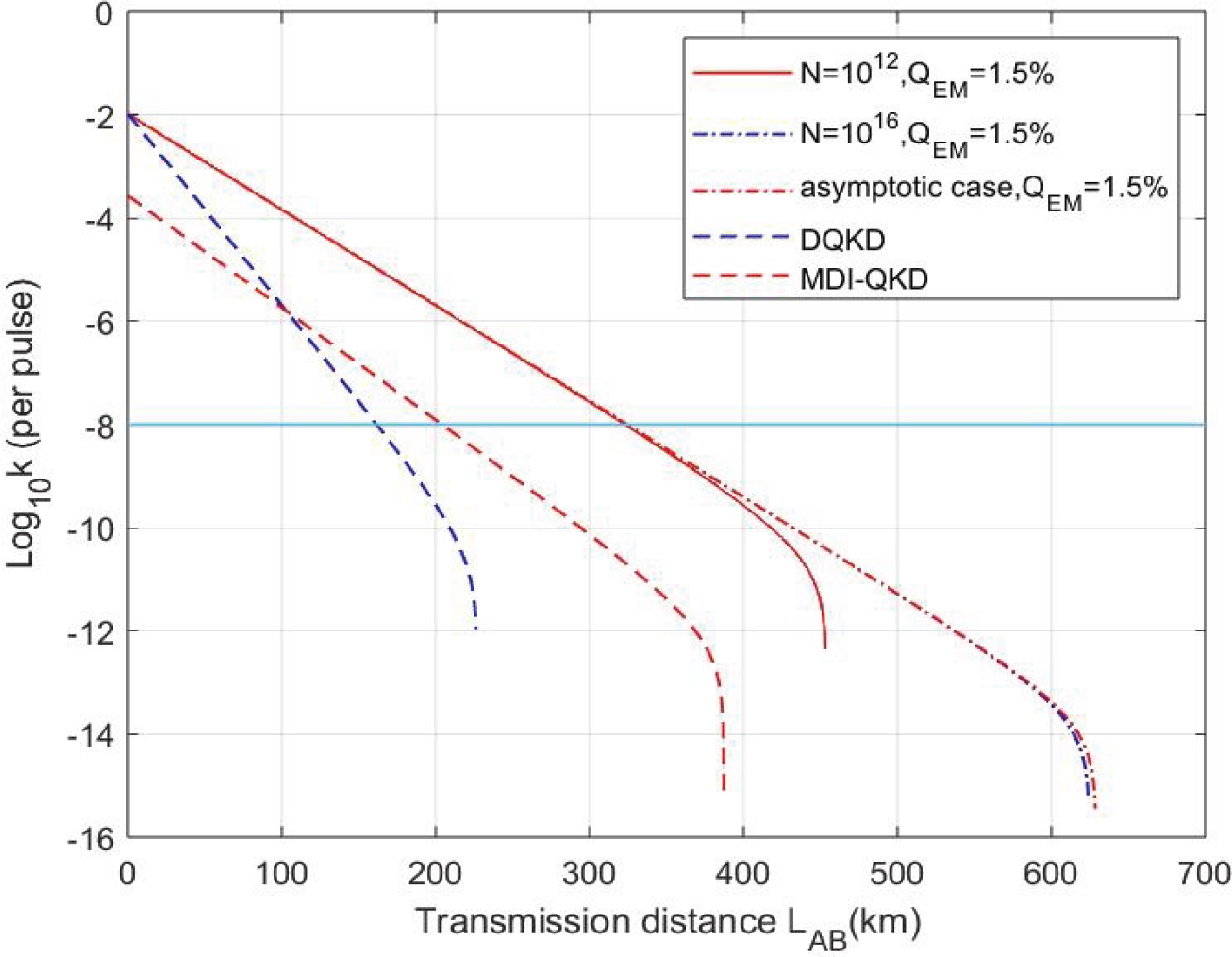
Figure 3.
As a function of the transmission distance LAB between Alice and Bob. We take a brief comparison of the performance of the UR-DQKD with that of the current DQKD such as the LM05 [15] and the MDIQKD [32].