
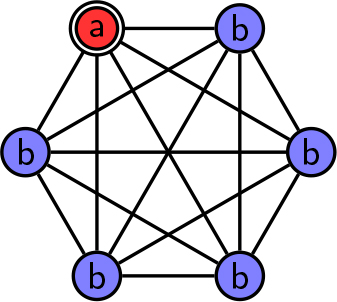
Figure 1.
A complete graph of N = 6 vertices. A vertex is marked, as indicated by a double circle. In the search algorithm, vertices that evolve identically have the same label and color.
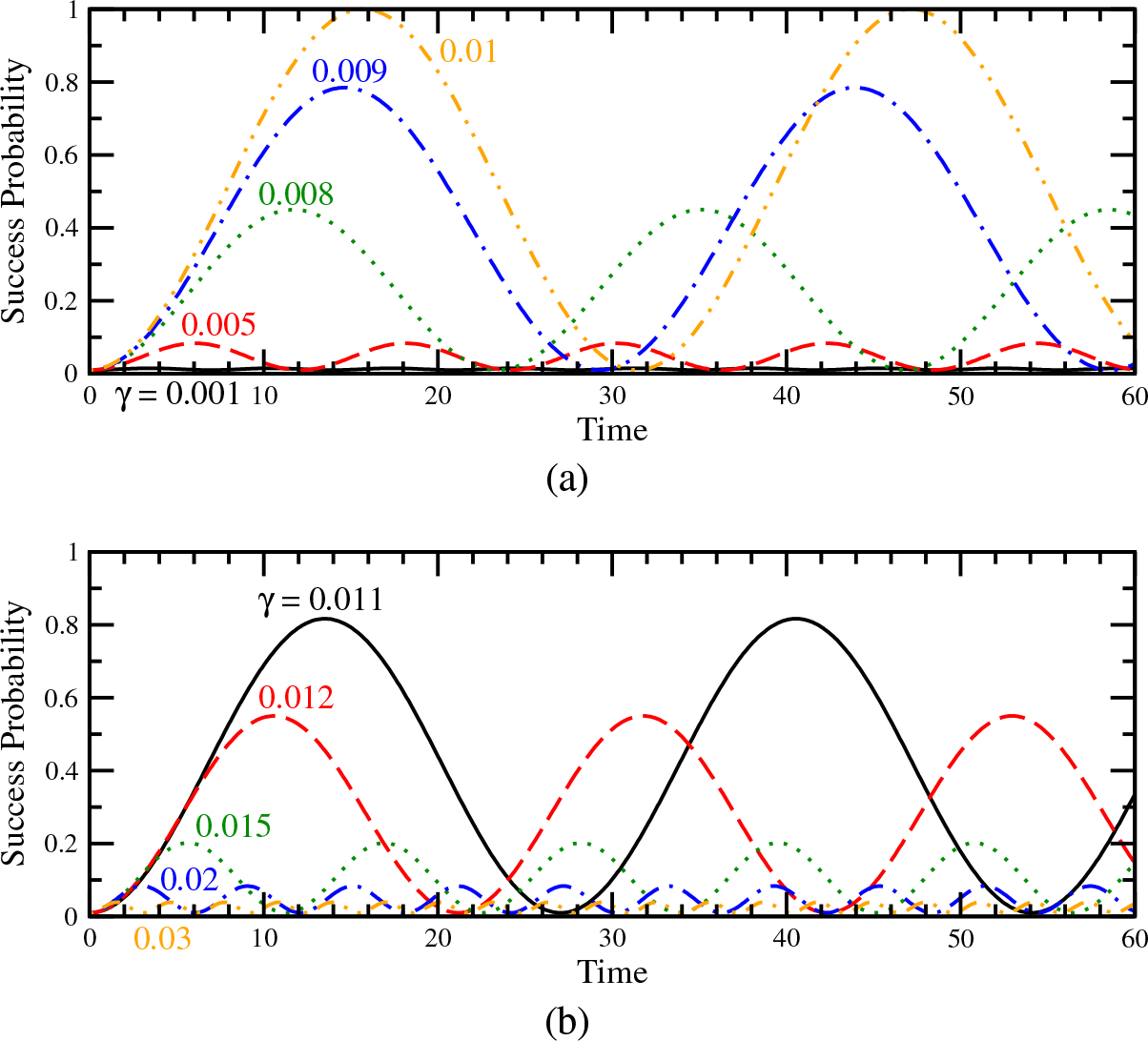
Figure 2.
Success probability versus time for (linear) quantum search on the complete graph with N = 100 vertices and various jumping rates. In (a), the solid black curve is γ = 0.001, the dashed red curve is γ = 0.005, the dotted green curve is γ = 0.008, the dot-dashed blue curve is γ = 0.009, and the dot-dot-dashed orange curve is γ = 0.01. In (b), the solid black curve is γ = 0.011, the dashed red curve is γ = 0.012, the dotted green curve is γ = 0.015, the dot-dashed blue curve is γ = 0.02, and the dot-dot-dashed orange curve is γ = 0.03.
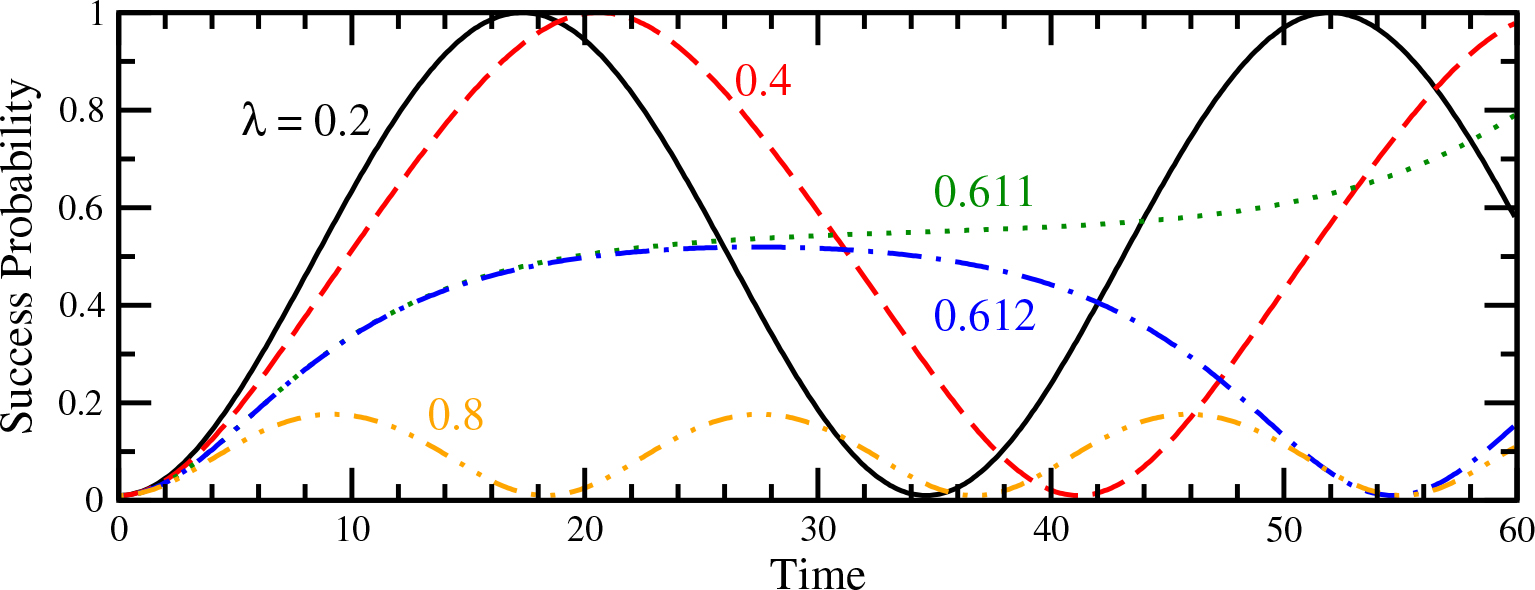
Figure 3.
Success probability versus time for nonlinear quantum search on the complete graph with N = 100 vertices, λ = (2 – λ)/2N, and various values of λ. The solid black curve is γ = 0.2, the dashed red curve is λ = 0.6, the dotted green curve is λ = 0.611, the dot-dashed blue curve is λ = 0.612, and the dot-dot-dashed orange curve is λ = 0.8.
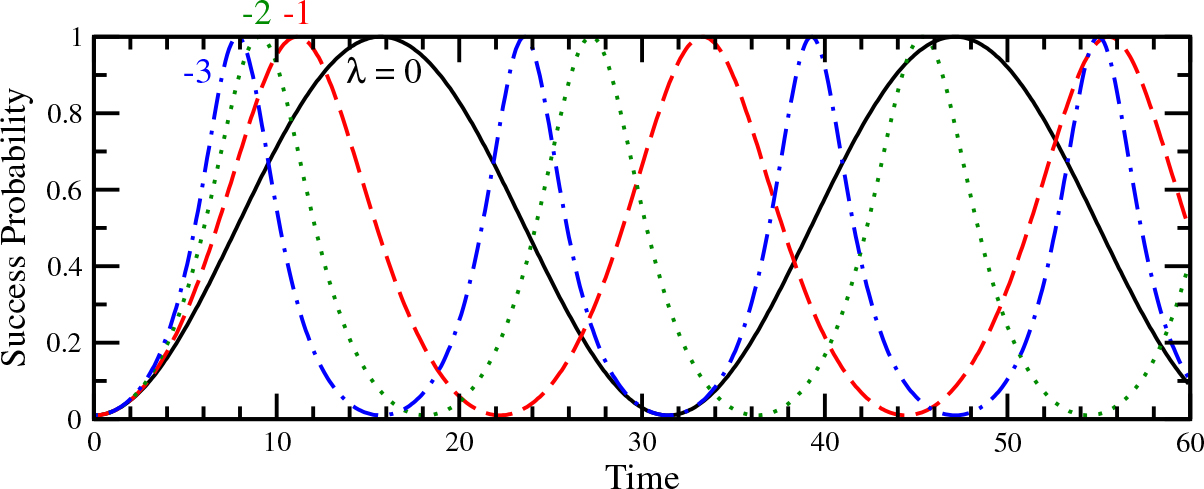
Figure 4.
Success probability versus time for nonlinear quantum search on the complete graph with N = 100 vertices, γ = γc(t), and various values of λ. The solid black curve is λ = 0, the dashed red curve is λ = –1, the dotted green curve is λ = –2, and the dot-dashed blue curve is λ = –3.