
Table 1.
Elements-distinctions duality between the two dual logics.
| Logic ℘(U) of subsets of U | Logic of partitions Π(U) on U | |
|---|---|---|
| Its/Dits | Elements of subsets | Distinctions of partitions |
| P.O. | Inclusion of subsets | Inclusion of ditsets |
| Join | Union of subsets | Union of ditsets |
| Meet | Subset of common elements | Ditset of common dits |
| Impl. | S ⊃ T = U iff S ⊆ T | σ ⇒ π = 1U iff σ ≾ π |
| Top | Subset U with all elements | Partition 1U with all distinctions |
| Bottom | Subset ∅ with no elements | Partition 0U with no distinctions |
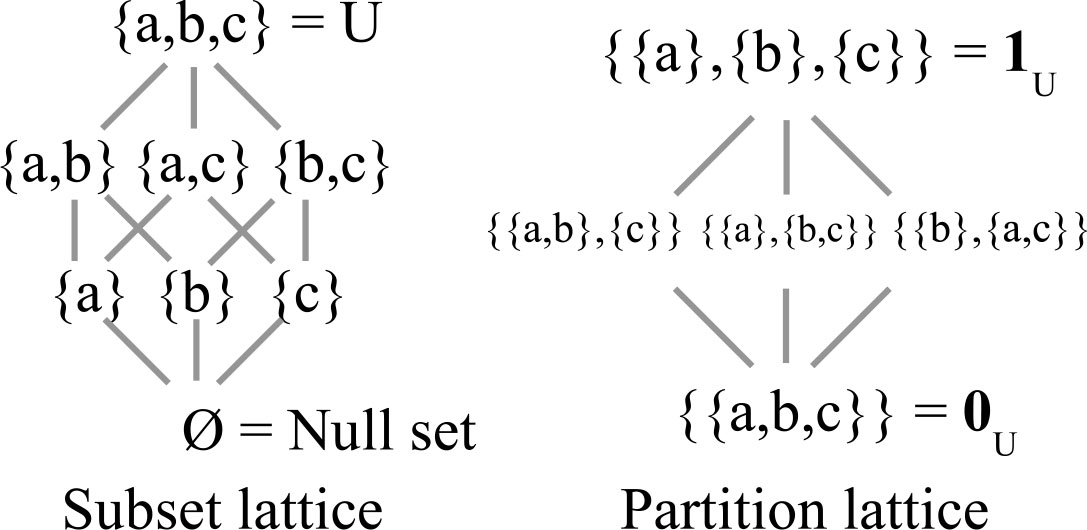
Figure 1.
The lattices of the dual subsets and partitions.
Table 2.
Duality of quantitative subsets and partitions.
| Logical Probability Theory | Logical Information Theory | |
|---|---|---|
| Outcomes | Elements of S | Distinctions of π |
| Events | Subsets S ⊆ U | Ditsets dit(π) ⊆ U × U |
| Probs. p | Pr(S) = ∑ui∈S pi | h(π) = ∑(ui, uk)∈dit(π) pipk |
| Interpretation | 1-draw prob. of S-element | 2-draw prob. of π-distinction |
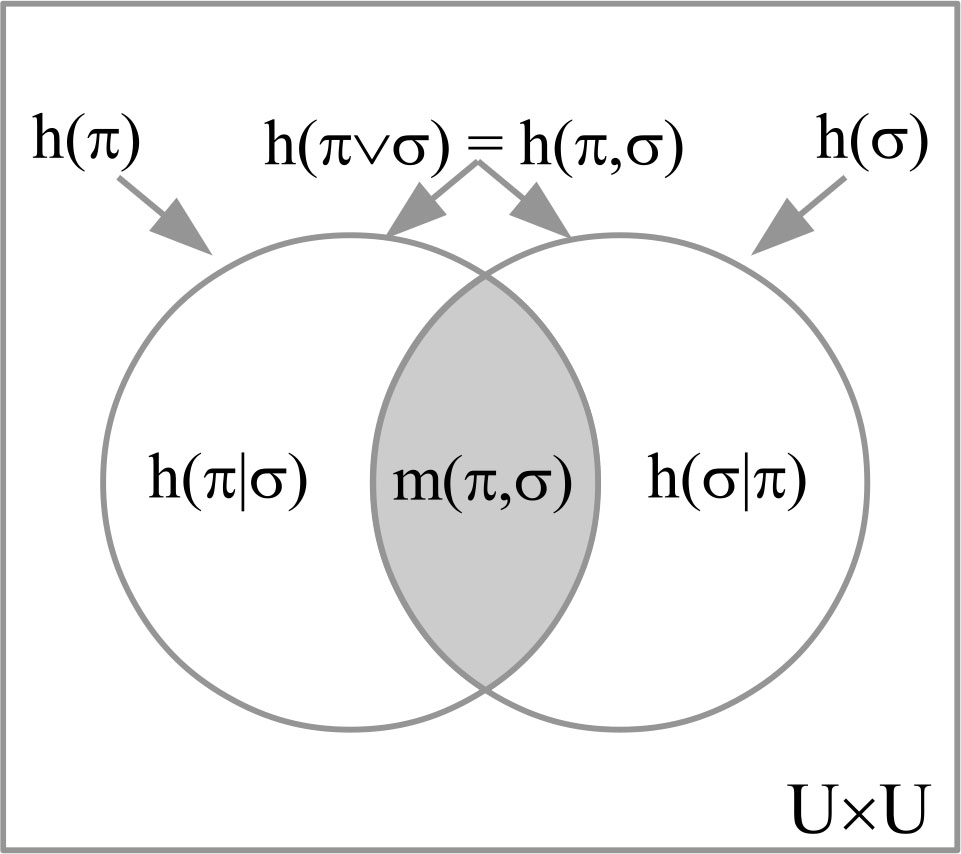
Figure 2.
Venn diagram for compound logical entropies.
Table 3.
The dit-bit transform from logical entropy to Shannon entropy.
| The Dit-Bit Transform: | |
| h(p) = | ∑ipi(1 − pi) |
| H(p) = | ∑ipi log(1/pi) |
| h(X, Y) = | ∑x,y p (x, y) [1 − p(x, y)] |
| H(X, Y) = | |
| h(X|Y) = | ∑x,y p (x, y) [(1 − p(x, y) − (1 − p(y))] |
| H(X|Y) = | |
| m(X, Y) | ∑x,y p(x,y) [[1 − p(x)] + [1 − p(y)] − [1 − p(x,y)]] |
| I(X, Y) |
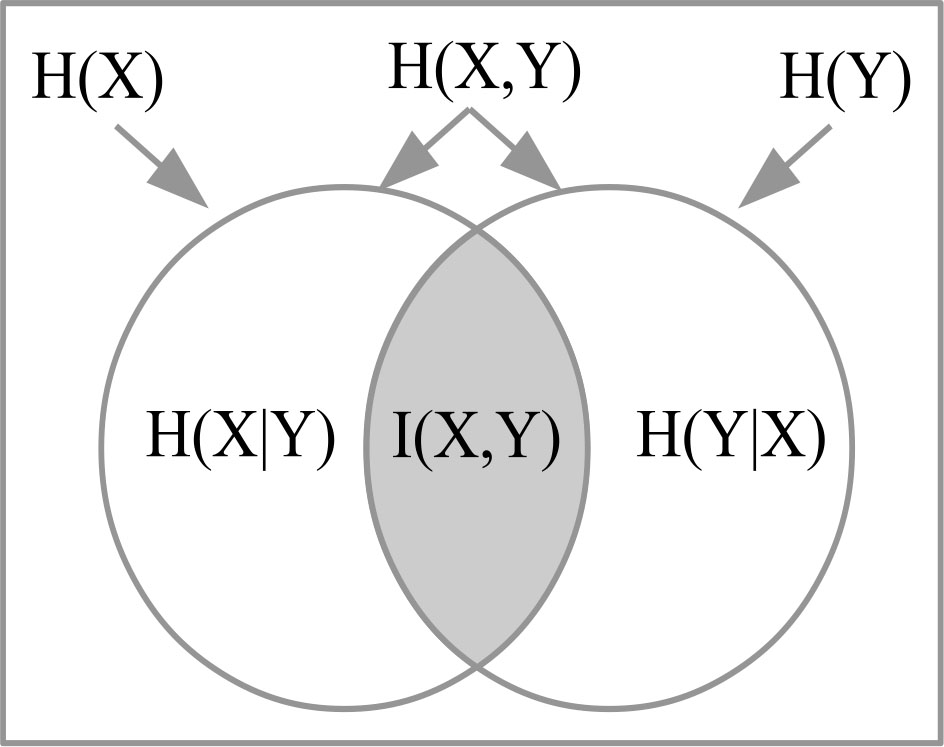
Figure 3.
Venn diagram “mnemonic” for compound Shannon entropies.
Table 4.
Dictionary translating set partitions into density matrices.
| Set concept with probabilities | Set level density matrix concept |
|---|---|
| Partition π with point probs. p | Density matrix |
| Point probabilities {p1, ..., pn} | Value of diagonal entries of ρ(π) |
| Trivial indits (ui, ui) of π | Diagonal entries of ρ(π) |
| Non-trivial indits of π | Non-zero off-diagonal entries of ρ(π) |
| Dits of π | Zero entries of ρ(π) |
| Sum Pr(Bj) = ∑ui∈ Bj pi | Trace tr[PBjρ(π)] |
| Block probabilities Pr(Bj) in π | Eigenvalues ≠ 0 of ρ(π) |
| Block prob. 1 of U in 0U = {U} | Non-zero eigenvalue of 1 for ρ(0U) |
Table 5.
Linearization dictionary to translate set concepts into corresponding vector space concepts.
| Set concept | Vector-space concept |
|---|---|
| Subset S ⊆ U | Subspace [S] ⊆ V |
| Partition {f−1(r)}r∈f(U) | DSD {Vr}r∈f(U) |
| Disjoint union U = ⊎r∈f(U) f−1(r) | Direct sum V = ⊕r∈f(U)Vr |
| Numerical attribute f : U → ℝ | Observable F ui = f(ui)ui |
| f ↾ S = rS | F ui = rui |
| Constant set S of f | Eigenvector ui of F |
| Value r on constant set S | Eigenvalue r of eigenvector ui |
| Characteristic fcn. χS : U → {0, 1} | Projection operator P[S]ui = χS (ui)ui |
| ∑r∈f(U) χf−1 (r) = χU | ∑r∈f(U) Pr = I : V → V |
| Spectral Decomp. f = ∑r∈f(U) rχf−1(r) | Spectral Decomp. F = ∑r∈f(U) rPr |
| Set of r-constant sets ℘(f−1(r)) | Eigenspace Vr of r-eigenvectors |
| Direct product U × U | Tensor product V ⊗ V |
Table 6.
Yoga of Linearization without probabilities case.
| Logical entropy | Quantum logical entropy |
|---|---|
| U = {u1, ..., un} | ON basis U for Hilbert space V |
| f, g :U → ℝ | Commuting F , G : V → V |
| {r}r∈f(U), {S}s∈g(U) | Eigenvalues of F and G |
| π = {f−1(r)}r∈f(U), σ = {g−1(S)}s∈g(U) | DSDs of eigenspaces of F , G |
| Dits of π : (ui, uk), f(ui) ≠ f(uk) | Qudits F : ui ⊗ uk, f(ui) ≠ f(uk) |
| Dits of σ : (ui, uk), g(ui) ≠ g(uk) | Qudits G: ui ⊗ uk, g(ui) ≠ g(uk) |
| Ditset of π: dit(π) | [qudit(F)]: Subspace generated in V ⊗ V |
| Ditset of σ: dit(σ) | [qudit(G)]: Subspace generated in V ⊗ V |
| Join: dit(π) ∪ dit(σ) ⊆ U × U | [qudit(F) ∪ qudit(G)] ⊆ V ⊗ V |
| Difference: dit(π) − dit(σ) ⊆ U × U | [qudit(F) − qudit(G)] ⊆ V ⊗ V |
| Mutual: dit(π) ∩ dit(σ) ⊆ U × U | [qudit(F) ∩ qudit(G)] ⊆ V ⊗ V |
Table 7.
Logical entropy + Linearization = quantum logical entropy.
| Logical entropy | Quantum logical entropy |
|---|---|
| ρ(0U) = ρ(U) = ρ(U)2 | Pure state ρ(ψ) = ρ(ψ)2 |
| p × p on U × U | ρ(ψ) ⊗ ρ(ψ) on V ⊗ V |
| h(0U) = 1 − tr[ρ(0U)2] = 0 | h(ρ(ψ)) = 1 − tr[ρ(ψ)2] = 0 |
| π = f−1, h(π) = p × p(dit(π)) | h(F : ψ) = tr[P[qudit(F)]ρ (ψ) ⊗ ρ(ψ)] |
| h(π, σ) = p × p(dit(π) ∪ dit(σ)) | tr [P[qudit(F)∪qudit(G)]ρ(ψ) ⊗ ρ(ψ)] |
| h(π|σ) = p × p(dit(π) − dit(σ)) | tr [P[qudit(F)−qudit(G)]ρ(ψ) ⊗ ρ(ψ)] |
| m(π σ) = p × p(dit(π) ∩ dit(σ)) | tr [P[qudit(F)∩qudit(G)]ρ(ψ) ⊗ ρ(ψ)] |
| h (π) = h (π|σ) + m(π, σ) | h(F : ψ) = h(F|G : ψ) + m(F, G : ψ) |
| ρ(π) = ρ̂(0U) = ∑r∈f(U) Prρ(0U)P r | ρ̂(ψ) = ∑r∈f(U) Prρ(ψ)Pr |
| h(π) = 1 − tr [ρ(π)2] | h(F : ψ) = 1 − tr[ρ̂(ψ)2] |
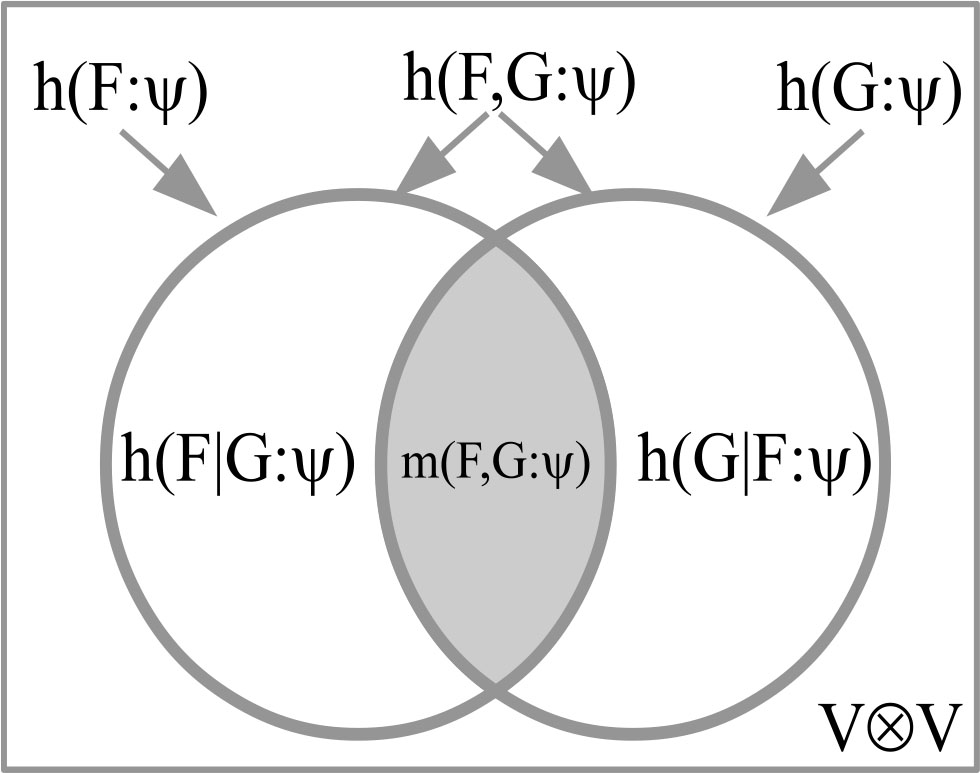
Figure 4.
Venn diagram relationships for quantum logical entropy.