
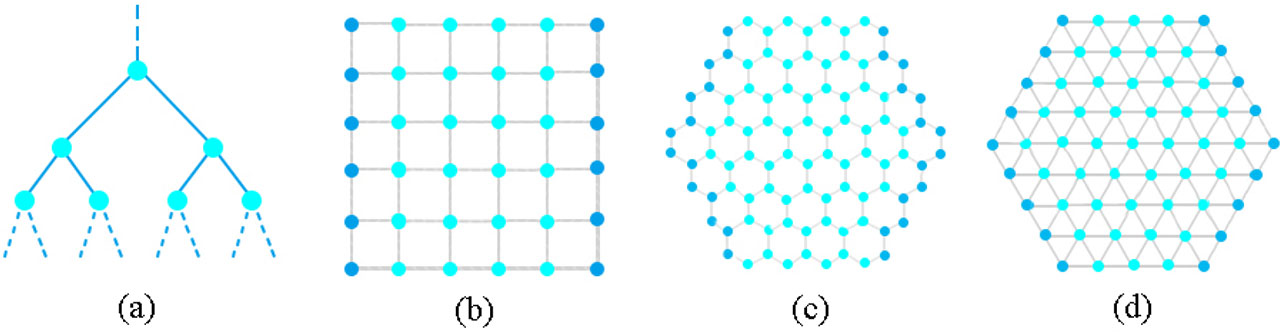
Figure 1.
Four examples of regular networks. (a) Bethe lattice. (b) Square lattice. (c) Honeycomb lattice. (d) Triangular lattice.
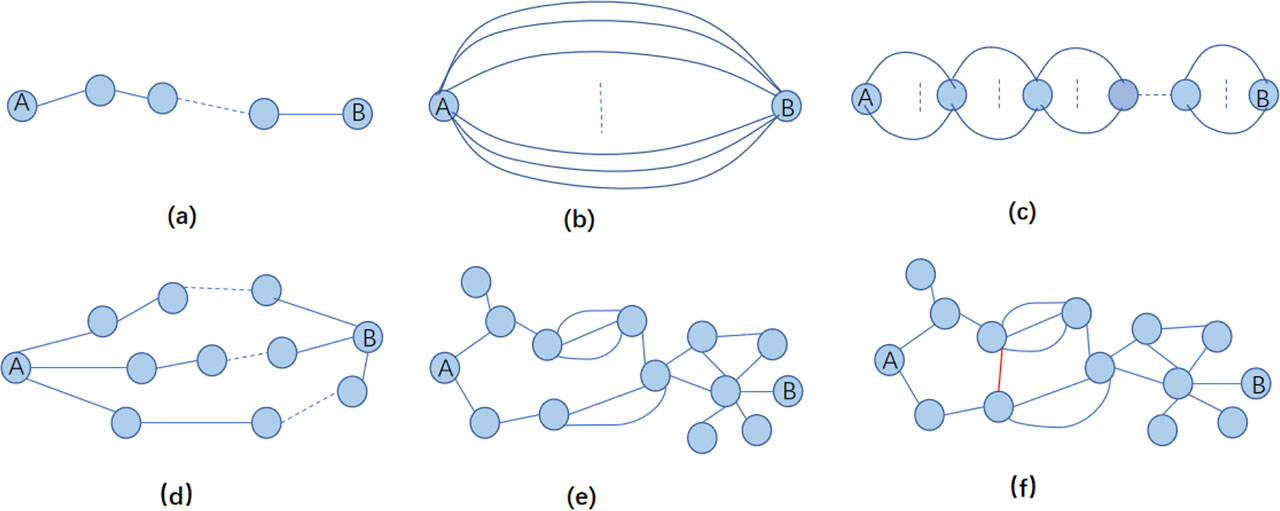
Figure 2.
Different QN topologies between A and B. (a) Simple series QN. (b) Simple parallel QN. (c) Parallel-then-series QN. (d) Series-then-parallel QN. (e) Series-parallel QN. (f) General QN.
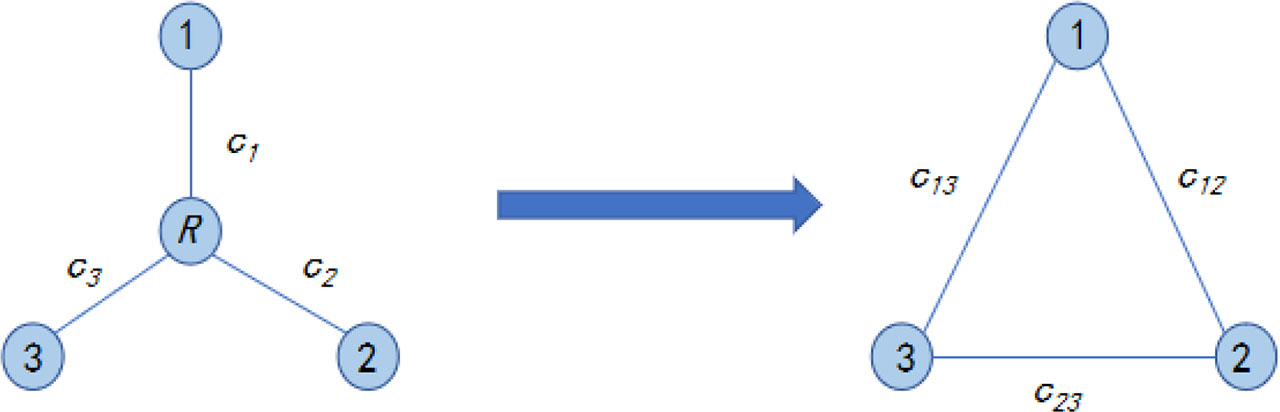
Figure 3.
SM transform. The left network becomes the right one after removing node R through the SM transform.

Figure 4.
Process of the entanglement transmission on a butterfly network. (a) The initial butterfly network. (b) The butterfly network after removing node 1 through SM transform. (c) The butterfly network after removing nodes 2 and 3 in Fig. (b). (d) The butterfly network after removing node 4 in Fig. (c) through SM transform. (e) The butterfly network after removing node 5 in Fig. (d) by performing series-parallel operations. Here, links with varying line colors denote the weights of the connections, which correspond to the degree of concurrence between the two nodes.
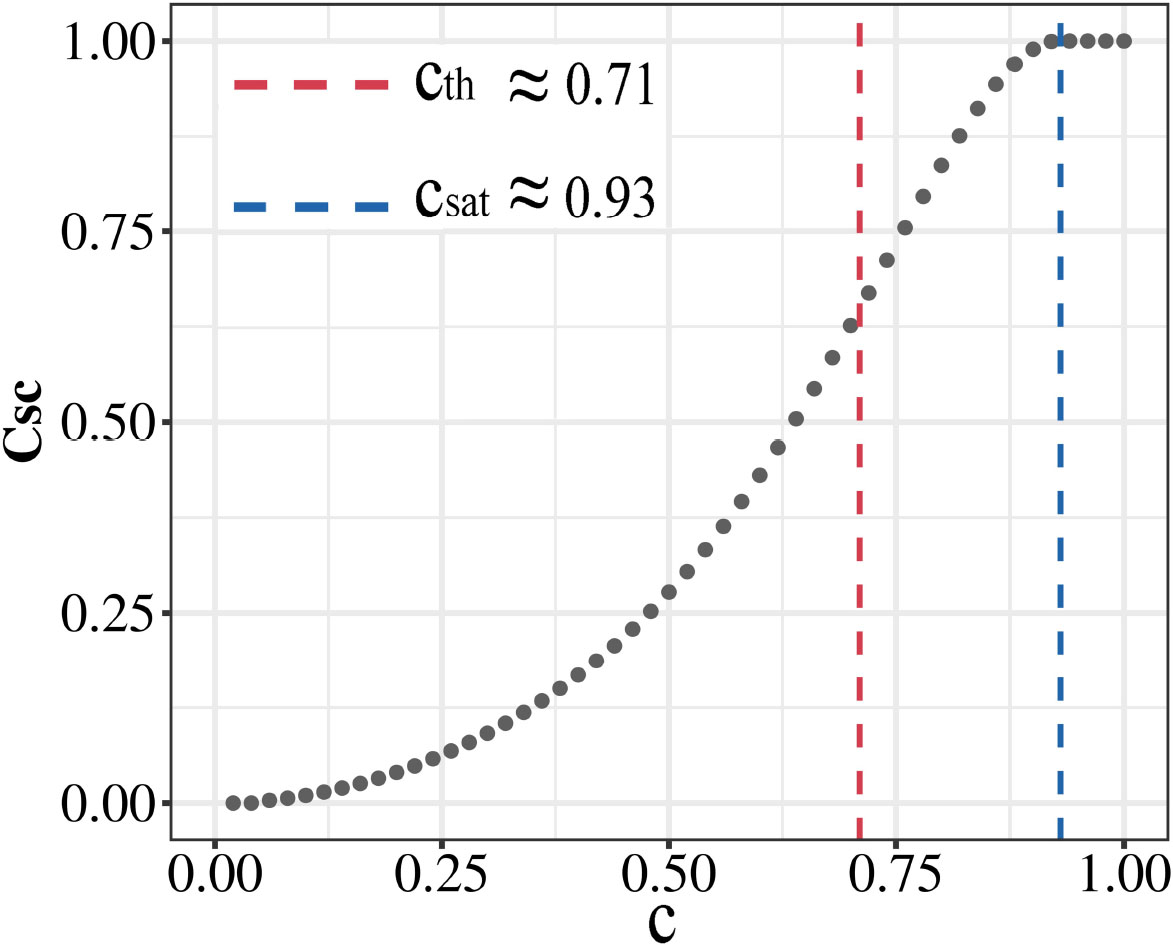
Figure 5.
The scatter plot of c and CSC in the butterfly network under the ConPT. The black scatter plot represents the relationship graph between c and CSC, the red dashed line is the entanglement percolation threshold cth and the blue dashed line is the saturation point csat under the concurrence percolation.
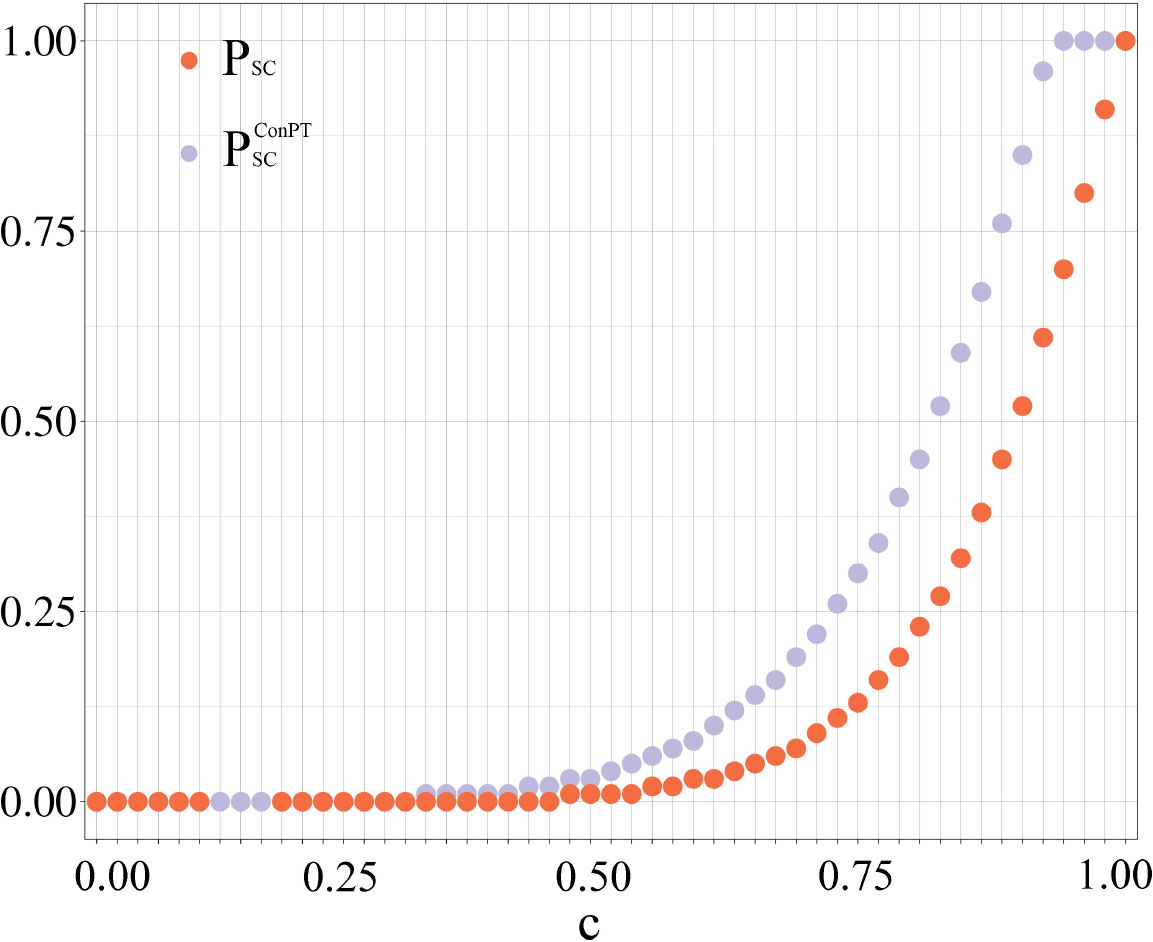
Figure 6.
Comparison of and PSC in the butterfly network. The orange scatter plot represents the relationship graph between c and PSC, the purple scatter plot also represents the relationship graph between c and .
Table 3.
| c | CSC | PSC | |||
|---|---|---|---|---|---|
| 0.66 | 0.543678214 | 0.0013 | 0.0598251 | 7.1932 | 0.160706 |
| 0.68 | 0.584345788 | 0.0006 | 0.0733271 | 9.1772 | 0.188495 |
| 0.70 | 0.626347348 | 0.0004 | 0.0895879 | 10.3325 | 0.220455 |
| 0.72 | 0.668926005 | −0.0005 | 0.108726 | 11.7100 | 0.256671 |
| 0.74 | 0.711917832 | −0.00038694 | 0.131535 | 13.6725 | 0.297737 |
| 0.76 | 0.754400424 | −0.0014 | 0.158477 | 15.3625 | 0.343585 |
| 0.78 | 0.796496077 | −0.0021 | 0.190103 | 17.7075 | 0.395356 |
| 0.92 | 0.99929325 | −0.0069 | 0.605555 | 20.2300 | 0.962410 |
| 0.94 | 1 | −0.0094 | 0.699814 | 9.1200 | 1 |
| 0.96 | 1 | −0.0094 | 0.802165 | −35.4075 | 1 |

Figure 7.
Parallel-then-series QN network.
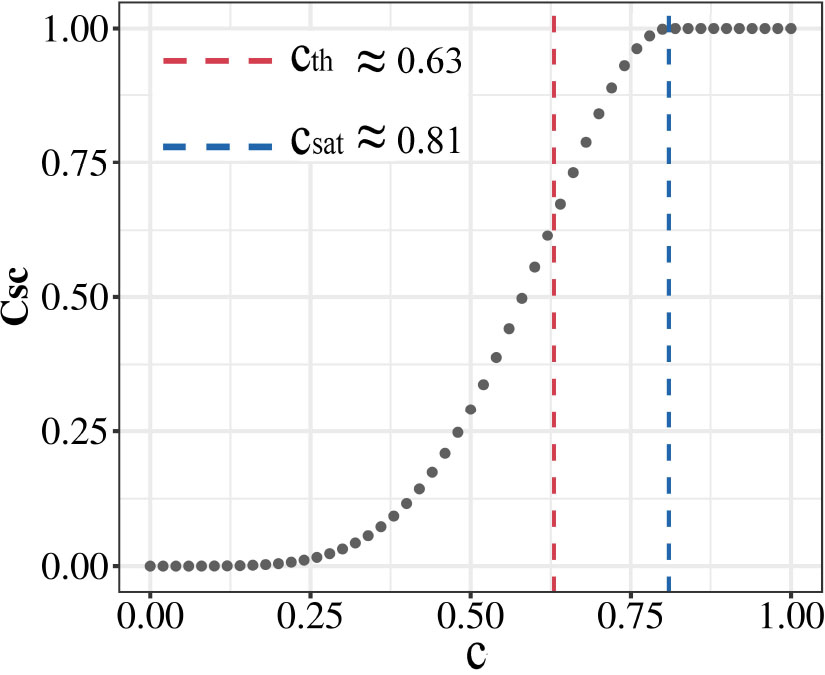
Figure 8.
The scatter plot of c and CSC in the parallel-then-series network under conditions ki = 3 and i = 5. The black scatter plot represents the relationship graph between c and CSC, the red dashed line is the entanglement percolation threshold cth and the blue dashed line is the saturation point csat under the concurrence percolation.
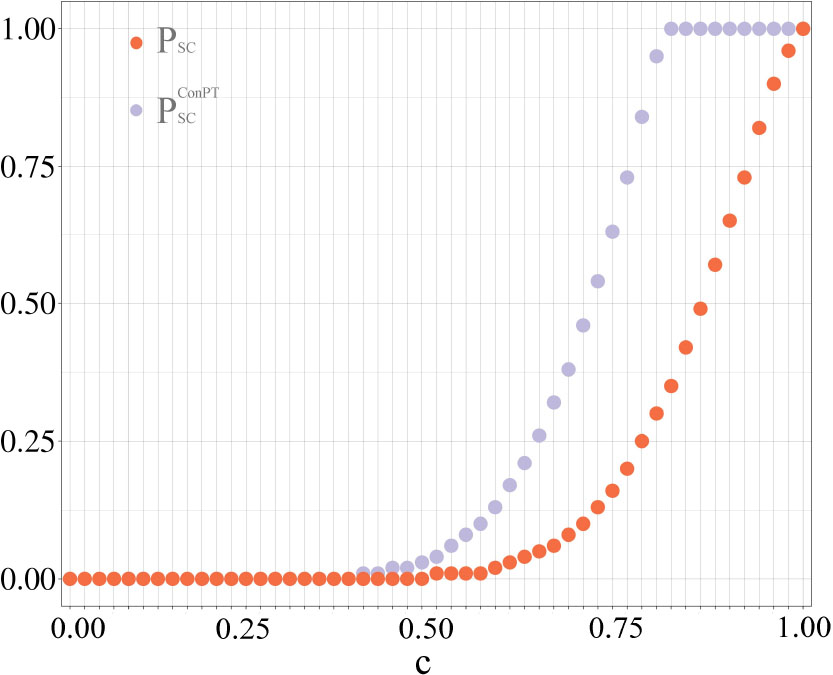
Figure 9.
Comparison of and PSC in the parallel-then-series network under conditions ki = 3 and i = 5. The orange scatter plot represents the relationship graph between c and PSC, the purple scatter plot also represents the relationship graph between c and .
Table 4.
The data supporting the Figure 8 and the Figure 9 for the parallel-then-series network under conditions ki = 3 and i = 5.
| c | CSC | PSC | |||
|---|---|---|---|---|---|
| 0.60 | 0.5551 | 2.8157 | 0.0277 | 4.6301 | 0.168216 |
| 0.62 | 0.6142 | 0.4345 | 0.0369 | 5.6487 | 0.210849 |
| 0.64 | 0.6734 | −2.2899 | 0.0487 | 6.7974 | 0.260721 |
| 0.66 | 0.7317 | −5.3403 | 0.0634 | 8.0677 | 0.318373 |
| 0.68 | 0.7878 | −8.6893 | 0.0816 | 9.4416 | 0.384068 |
| 0.70 | 0.8405 | −12.2992 | 0.1039 | 10.89 | 0.458188 |
| 0.72 | 0.8882 | −16.1206 | 0.1308 | 12.3698 | 0.540542 |
| 0.74 | 0.9294 | −20.0926 | 0.163 | 13.821 | 0.630925 |
| 0.76 | 0.9627 | −24.1425 | 0.201 | 15.1645 | 0.729428 |
| 0.78 | 0.9863 | −28.1861 | 0.2452 | 16.298 | 0.835038 |
| 0.80 | 0.9986 | −32.1289 | 0.2962 | 17.0934 | 0.947103 |
| 0.82 | 1 | −36.1567 | 0.3541 | 17.3919 | 1 |
| 0.84 | 1 | −40.1238 | 0.4189 | 16.9994 | 1 |
| 0.92 | 1 | −55.7857 | 0.7331 | 2.745 | 1 |
| 0.94 | 1 | −59.7285 | 0.8166 | −6.4183 | 1 |
| 0.96 | 1 | −63.6713 | 0.895 | −20.064 | 1 |