
Introduction
Asthma is a chronic inflammatory disorder of the airway in which many cells and cellular elements play an important role, resulting in hyperresponsiveness of the airway, which explains most of the symptomatology of the asthma (1). The asthma control and severity staging are usually assessed by subjective measures, including clinical assessment and quality of life questionnaires and objective measures such as spirometry, peak expiratory flow rate and bronchoprovocation testing (2, 3). Asthma is frequently characterised by airway inflammation rich in eosinophils. Airway eosinophilia is associated with exacerbations and likely plays a role in airway remodelling (4). Eosinophils are involved in the development of asthma exacerbation. Recent studies have suggested that sputum and blood eosinophil counts are important factors for predicting asthma exacerbation (5). A high blood eosinophil count is a risk factor for increased future asthma exacerbations (6). In patients with mild to moderate asthma, as well as patients with more severe asthma, blood eosinophils had the highest accuracy in the identification of sputum eosinophilia (7). Blood eosinophils and fractional exhaled nitric oxide (FeNO) levels may indicate severe asthmatics with >1 exacerbation in the previous year, whereas high sputum eosinophilia appears to identify patients with frequent exacerbations (8). Sputum eosinophils are associated with both asthma severity and level of asthma control. By effectively treating sputum eosinophilia, the number of asthma exacerbations can be significantly reduced compared with managing asthma based on symptoms and lung function (9–11). In this study, we aimed to evaluate the relationship between asthma severity and inflammatory biomarkers. As limited data exist correlating clinical symptoms and functional parameters with biomarkers of airway inflammation, this study was undertaken to assess the correlation between sputum and peripheral eosinophil counts and asthma severity (12).
Materials and methods
This was a prospective observational study, conducted at Rajarajeswari Medical College and Hospital, Bangalore, for about 18 months. The procedures were performed in accordance with relevant laws, and institutional guidelines were approved by the appropriate institutional committee. Ethical clearance was taken from the Institutional Ethics Committee. All asthmatic patients between 18 years of age and 65 years of age referred to our centre were evaluated using a detailed questionnaire, including history and physical examination. Asthmatic patients excluded were pregnant and lactating women, smokers, patients with generalised skin disease, cardiac, neuromuscular diseases, chronic obstructive pulmonary disease (COPD) and any other respiratory diseases like acute and chronic infections, bronchiectasis, etc. A total of 100 patients were enrolled after inclusion and exclusion criteria.
All patients were evaluated through a detailed history and routine blood investigations. An induced sputum sample was collected from all patients at the time of outpatient visit or before the initiation of any medications in case of admitted patients. For sputum cytology, sputum induction was performed using hypertonic saline (NaCl 3%) aerosolized by nebulizer for three periods of 5 min. The patient was made to cough sputum into a plastic container. Fresh sputum sample was homogenised with dithiothreitol (DTT). The sample was agitated and kept at room temperature for 30–60 min, after which it was centrifuged. Slides were prepared and stained with haematoxylin and eosin and Giemsa stains. The eosinophil count was presented as a percentage of total count as it has better accuracy than the absolute count. Blood eosinophil count in the laboratory was determined using an automated analyser. The absolute eosinophil count (AEC) was determined by multiplying the percentage of eosinophils with the total leucocyte count. Patients were prescribed controller and reliever as per the global initiative for asthma (GINA) guidelines (2). Accordingly, patients were divided into controlled and poorly controlled categories based on the asthma control test (ACT) score. Asthma control test score >19 was taken as controlled and <19 as poorly controlled, and this was correlated with FeNO.
Data analysis
The data were collected and compiled in MS Excel and analysis was done. Data were analysed using SPSS (IBM SPSS Statistics for Windows, Version 26.0, Armonk, NY, USA: IBM Corp. Released 2019).
Qualitative variables were expressed as frequency and percentages, and quantitative variables were expressed as mean and standard deviation.
The correlation of sputum eosinophil count and peripheral eosinophil count with severity of asthma was analysed using tests of significance, such as Pearson’s chi-squared test and Fisher’s exact test, and the correlation coefficient was reported together with standard error of the estimate.
Results
A total of 100 patients who attended our hospital were subjected to the following parameters, of whom 30 were inpatients and 70 were outpatients.The 100 patients analysed included 57 male and 43 female. Male patients had significantly better asthma control than female patients (66% vs 34%). The mean duration of illness in both groups was statistically insignificant. The mean age at the time of presentation was 31–50 years. (Table 1).
Table 1.
Frequency distribution of patients according to age and gender
| Characteristic | Category | N(%) |
|---|---|---|
| Gender | Male | 57 (57.0) |
| Female | 43 (43.0) | |
| Age (years) | Mean ± SD | 43.8 ± 14.65 |
| 18–30 | 19 (19.0) | |
| 31–40 | 23 (23.0) | |
| 41–50 | 25 (25.0) | |
| 51–60 | 19 (19.0) | |
| 61–70 | 14 (14.0) |
Most of the patients had wheezing as the main complaint followed by shortness of breath and cough (Figure 1).
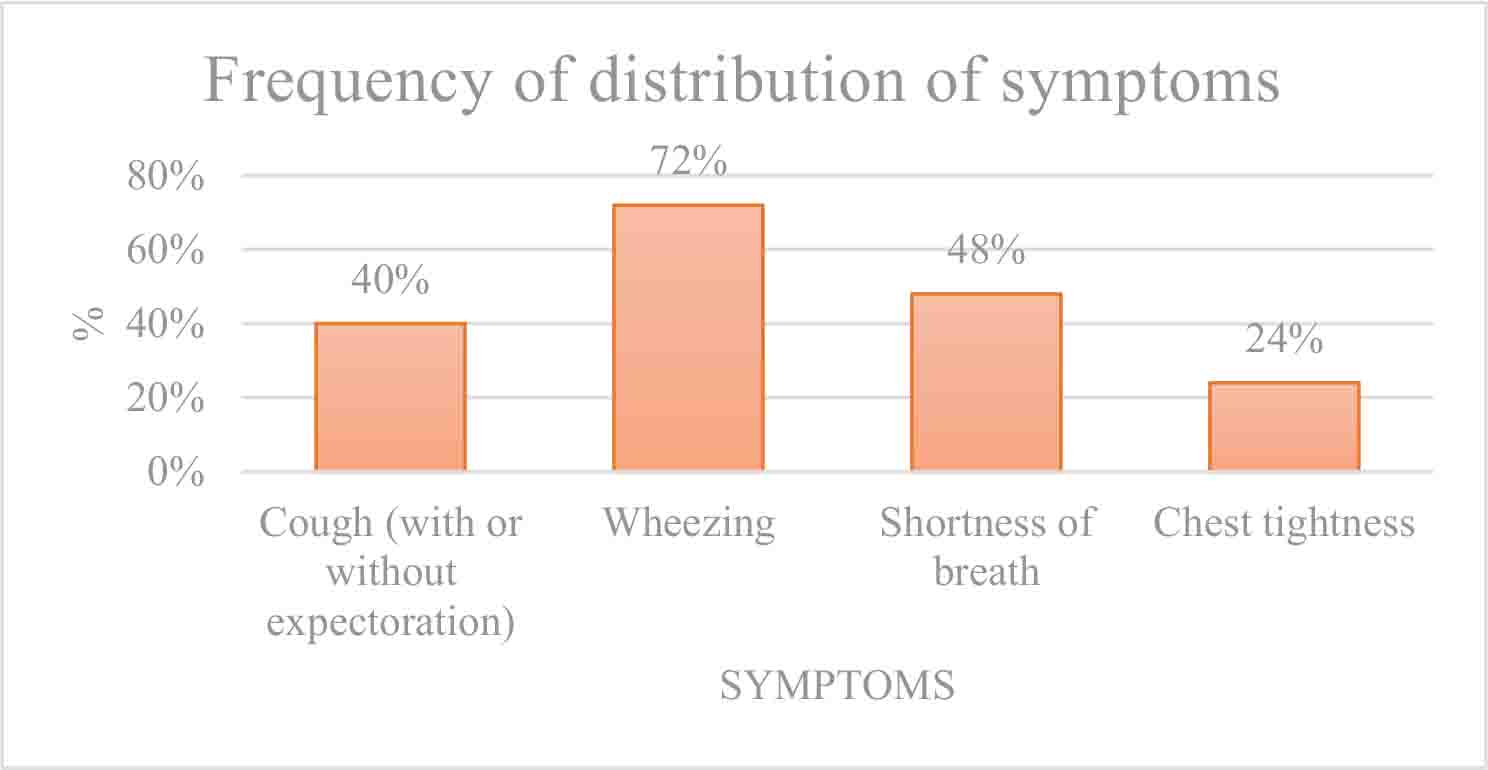
Figure 1.
Frequency distribution of patients according to symptoms.
All patients were assessed with pulmonary function tests such as spirometry, FeNO, along with the Asthma Control Questionnaire (ACQ), in which, 50% of the patients had a FEV1 between 50% and 79%. Of them, 34% had a FEV1 between 30% and 49% and 16% had FEV1 of >80%. The mean FEV1 was 64% ± 5.59 SD. Of the patients, 49% had FeNO levels >50 ppb, 44% had intermediate FeNO levels (25–50 ppb) and 7% of them had low FeNO levels (<25 ppb). According to ACQ, 46% of the patients had well-controlled asthma, 24% of them had partially controlled asthma and 30% of them had uncontrolled asthma.
In this study, 63% of the patients had sputum eosinophil count >3% and 77% of the study subjects had an AEC of >350. (Figure 2).
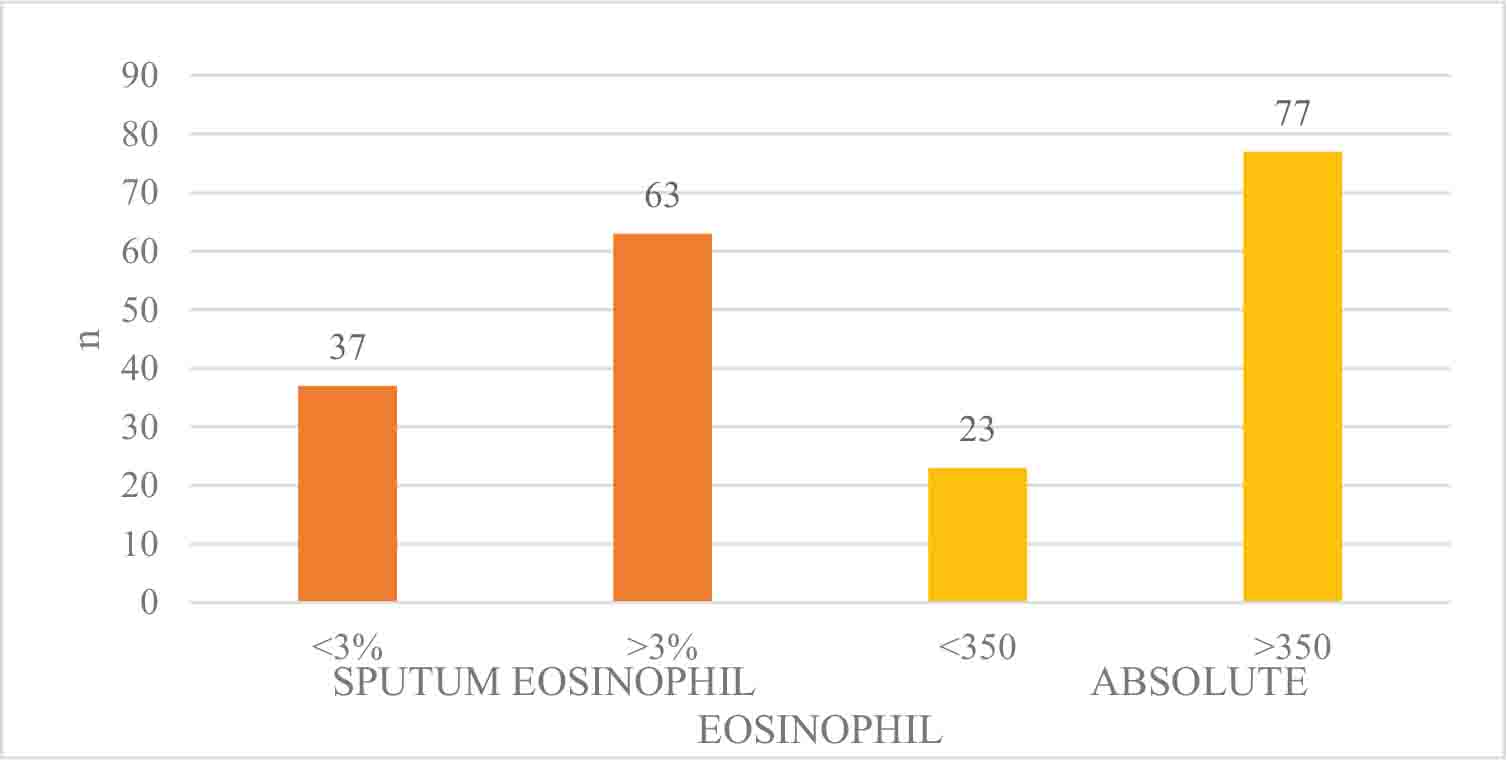
Figure 2.
Frequency distribution of patients according to sputum eosinophil and AEC. AEC, absolute eosinophil count.
There was a significant correlation between AEC and sputum eosinophilia with P value 0.007 (<0.01) (Table 2).
Table 2.
Correlation between AEC and sputum eosinophils
| AEC | Sputum eosinophilia | |||
|---|---|---|---|---|
| Spearman’s rho AEC | AEC | Correlation coefficient | 1 | 0.270 |
| Sig. (two-tailed) | . | 0.007** | ||
| N | 100 | 100 | ||
| Sputum eosinophilia | Correlation coefficient | 0.270 | 1 | |
| Sig. (two-tailed) | 0.007** | . | ||
| N | 100 | 100 |
There was a significant correlation between symptoms and AEC with P value 0.001 and sputum eosinophils with P value 0.001 (Table 3).
Discussion
Asthma is a heterogeneous chronic airway disorder characterised by variable airflow obstruction and airway hyperresponsiveness. Numerous methods for evaluating airway inflammation have been described in the literature. Non-invasive biomarkers such as blood eosinophils, sputum eosinophils and FeNO have emerged as safe, convenient and reliable tools for monitoring disease activity, particularly in patients with moderate to severe asthma (13–16).
In the present study, 57% of participants were male and 43% were female. A significant association was observed between gender and asthma severity, with females exhibiting a higher proportion of severe disease. However, no significant association was identified between gender and either blood or sputum eosinophil counts.
Wheezing was the most common symptom, followed by shortness of breath, cough and chest tightness. A family history of asthma was present in 60% of patients, and a significant association was observed between symptom duration and asthma severity. Nakagome and Nagata (4) demonstrated that eosinophils play a pivotal role in asthma exacerbations, supporting the biological plausibility of our findings.
In our study, 30% of patients with sputum eosinophilia had moderate to severe asthma, with sputum eosinophil levels >3% more frequently observed in severe persistent asthma. These findings are consistent with earlier studies demonstrating a relationship between sputum eosinophils and asthma severity (9–11). However, no clear dose–response relationship was identified across all severity categories, suggesting that sputum eosinophilia represents a distinct inflammatory phenotype that may be present across all severities of asthma.
Elevated AECs (>350 cells/μL) were predominantly observed in patients with moderate to severe asthma, although a substantial proportion of severe asthmatics demonstrated normal eosinophil levels. A statistically significant correlation between peripheral AEC and sputum eosinophil percentage was observed, supporting the use of blood eosinophils as a surrogate marker of airway eosinophilia (14).
Studies in uncontrolled asthma populations had shown that blood eosinophils and FeNO correlate reasonably well with sputum eosinophilia, though neither marker alone is sufficient for accurate phenotyping (15,16). A larger diagnostic study further demonstrated that the combined use of blood eosinophils and FeNO significantly improved diagnostic accuracy for eosinophilic asthma compared with either marker alone (17).
Beyond diagnosis, biomarkers have important prognostic and therapeutic implications. Elevated blood eosinophil counts and FeNO levels are associated with increased exacerbation risk and predict better response to type 2 biologic therapies, including anti-IL-5 and anti-IL-4/IL-13 agents (17, 18). Despite these advances, induced sputum analysis remains the gold standard for defining eosinophilic airway inflammation, with sputum eosinophils ≥2%–3% serving as the benchmark for eosinophilic asthma (19). A multimodal approach integrating clinical assessment and multiple biomarkers is, therefore, essential for accurate phenotyping and optimal asthma management.
Conclusion
The present study was conducted to correlate induced sputum eosinophil and AECs in assessing the clinical severity of bronchial asthma. In our study, 100 asthmatics were selected; out of them, 34% patients had severe asthma, 50% patients had moderate asthma and 16% patients had mild asthma. In our study, prevalence of asthma was more in middle age group with male predominance. We also found a significant correlation between sputum eosinophilia and AEC with ACQ, and there was a significant correlation of induced sputum eosinophil and AEC.
Sputum and blood eosinophil counts are simple, inexpensive markers that directly reflect airway inflammation and help identify steroid-responsive asthma endotypes. Although sputum eosinophilia is a useful, non-invasive measure, sputum induction requires specialised facilities and many patients cannot produce adequate samples, limiting its routine clinical use.
Strengths
Evaluated simple, inexpensive and clinically relevant biomarkers for assessing asthma severity.
Provided objective correlation between airway (sputum) and systemic (peripheral blood) eosinophilic inflammation.
Findings applicable to routine clinical practice, especially in resource-limited settings.
Limitations
Cross-sectional, single-centre design limits causal inference and generalisability.
Sputum induction and analysis may not be feasible in all patients.
Eosinophil counts may be influenced by prior corticosteroid therapy.
Notes
[5] Ethical approval
Ethical approval was obtained and documented as per institutional guidelines. (Rajarajeswari Medical College and Hospital, dated 16/01/2021 with reference number: RRMCH-IEC/140/2020-21).
[6] Contributed by Authors’ Contribution
All authors contributed to the conception and design of the study, data acquisition, data analysis and interpretation, and manuscript drafting and revision. All authors approved the final version of the manuscript.
[7] Informed Consent Statement
Written informed consent was obtained from all study participants prior to enrolment in the study.
[8] Conflicts of interest Conflict of interest
The authors declare no conflict of interest.