
Table 1.
Main characteristics of the 3 patients
| Patient 1 | Patient 2 | Patient 3 | |
|---|---|---|---|
| Age/sex | 68 / F | 33 / M | 30 / M |
| Smoking | Former smoker 20 PY | No | No |
| Exposure | No | No | No |
| Associated disease | Hypertension, Dyslipidemia | Lichen planus | No |
| Clinical | Dyspnea Dry cough | Dyspnea intermittent productive cough. | Dyspnea |
| Spirometry/FEV 1 (l/%) | Severe obstruction/0,74 (40%) | Severe fixed obstruction/0,58 (14,1%) | Severe obstruction/1,8 (42%) |
| FEV1/FVC (%) | 45% | 32,89% | 58,13% |
| FVC (l/%) | 1,64 (74%) | 1,64 (33,5%) | 3,12 (61%) |
| TLC(l/%) | MD | 8,85 (128,3%) | 8,11 (114%) |
| RV(l/%) | MD | 7,12 (398,2%) | 4,98 (281%) |
| DLCO (%) | 65% | 32,4% | 77% |
| 6MWT | significant oxygen desaturation – final SpO2 90% | significant oxygen desaturation - final SpO2 88% after 2 minutes | significant oxygen desaturation - final SpO2 88% |
Table 2.
Summary of diagnostic investigations.
| Patient 1 | Patient 2 | Patient 3 | |
|---|---|---|---|
| HR–CT | Mosaic attenuation Air trapping | Mosaic attenuation Air trapping | Increased lucency, predominantly in the basal regions |
| BAL | Macrophages – 58,85% Lymphocytes – 29,3% Granulocytes – 11,6% Neutrophil – 11,1% Eosinophils – 0,5% Epithelial cells – 29% Tumor cells – No | No | No |
| Lung Biopsy | No | No | Yes |
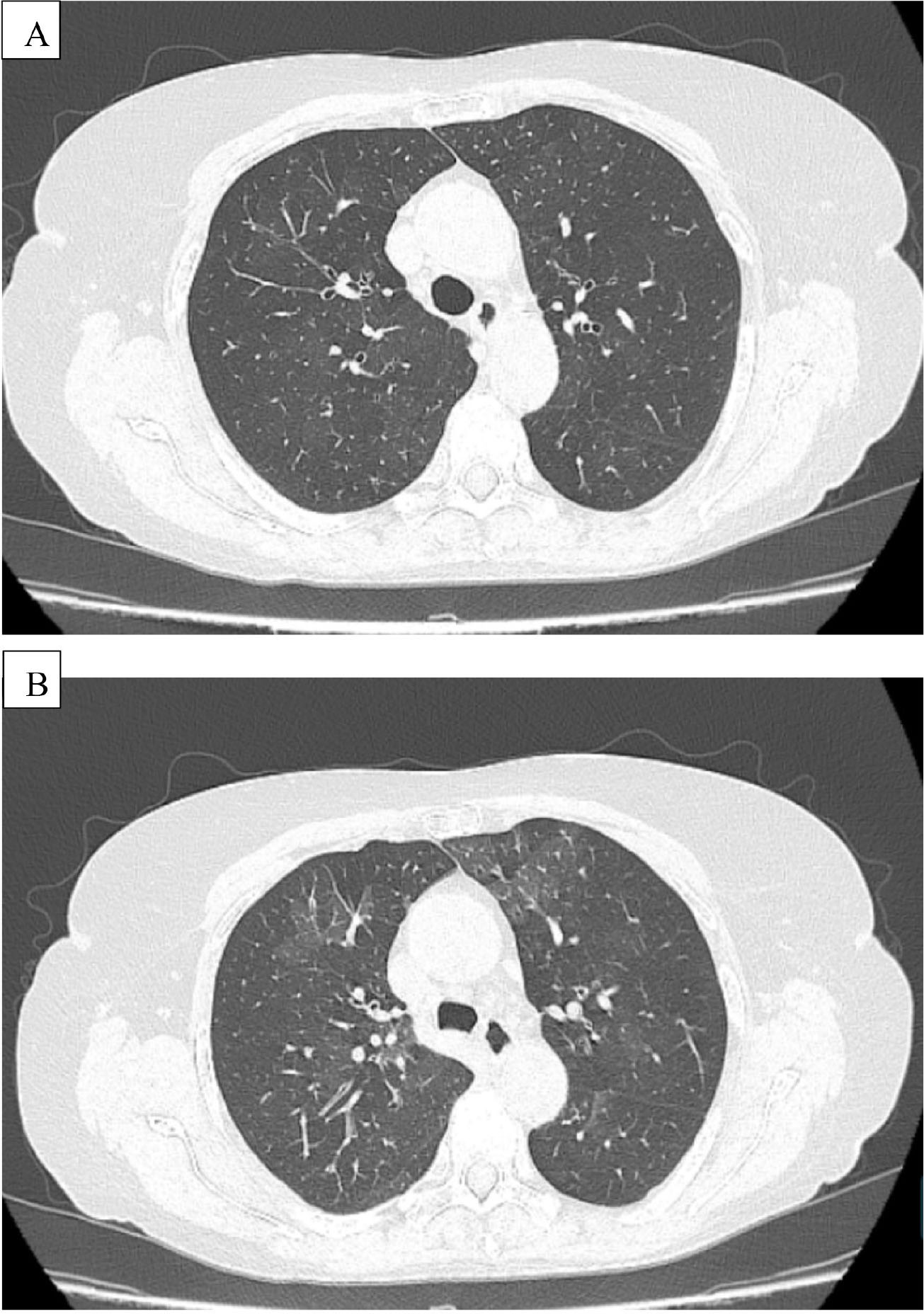
Figure 1.
HRCT - Bilateral diffused mosaic attenuation patterns representing air trapping and normal parenchyma more pronounced on expiration (B) than on inspiration (A).
Table 3.
Evolution of the symptoms, respiratory function and 6MWT after one month of treatment
| Patient 1- after 1 month | Patient 2 – after 2 months | Patient 3 – after one year | |
|---|---|---|---|
| Clinical | Improvement of exercitional dyspnea, Cough remission | Dyspnea intermittent productive cough. | Improvement of exercitional dyspnea |
| Spirometry/FEV1 (l) | Improved 0,85l | No improvement 0,55l | No improvement 1,51 |
| FEV1/FVC (%) | No improvement 42,9% | No improvement 29,94% | No improvement 50,38% |
| FVC (l) | Improved 1,97 | No improvement 1,64 | No improvement 2,99 |
| TLC(l) | MD | Improved 7,91 | No improvement 8 |
| RV(l) | MD | Improved 5,53l | No improvement 5 |
| DLCO (%) | Improved 71% | No improvement 30,2% | No improvement 75% |
| TM6M | Improved – no desaturation | Worse | Improved – important desaturation but with final SpO2>90% |
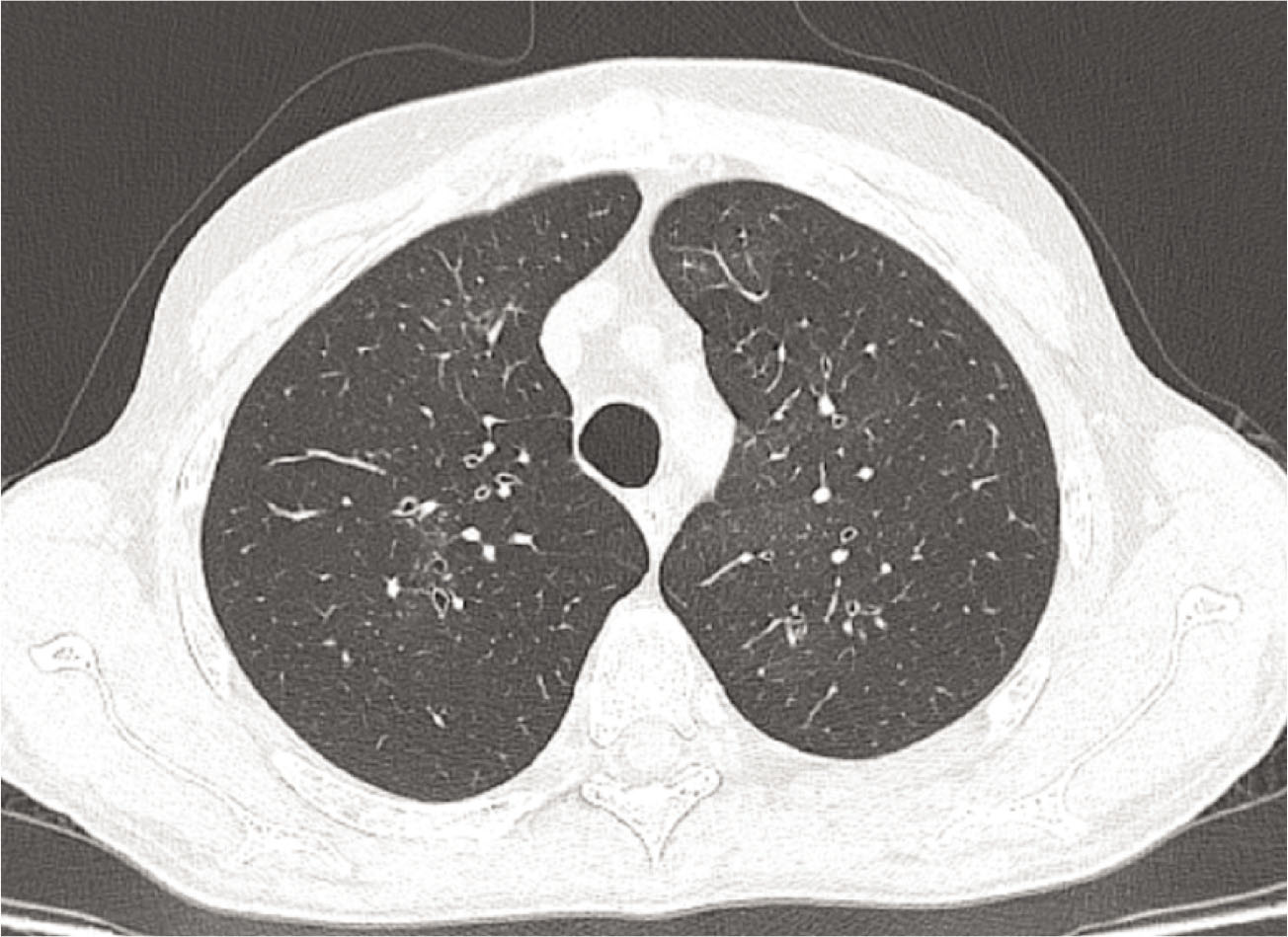
Figure 2.
HRCT - Bilateral diffused mosaic attenuation patterns representing air trapping and bronchiectasis.
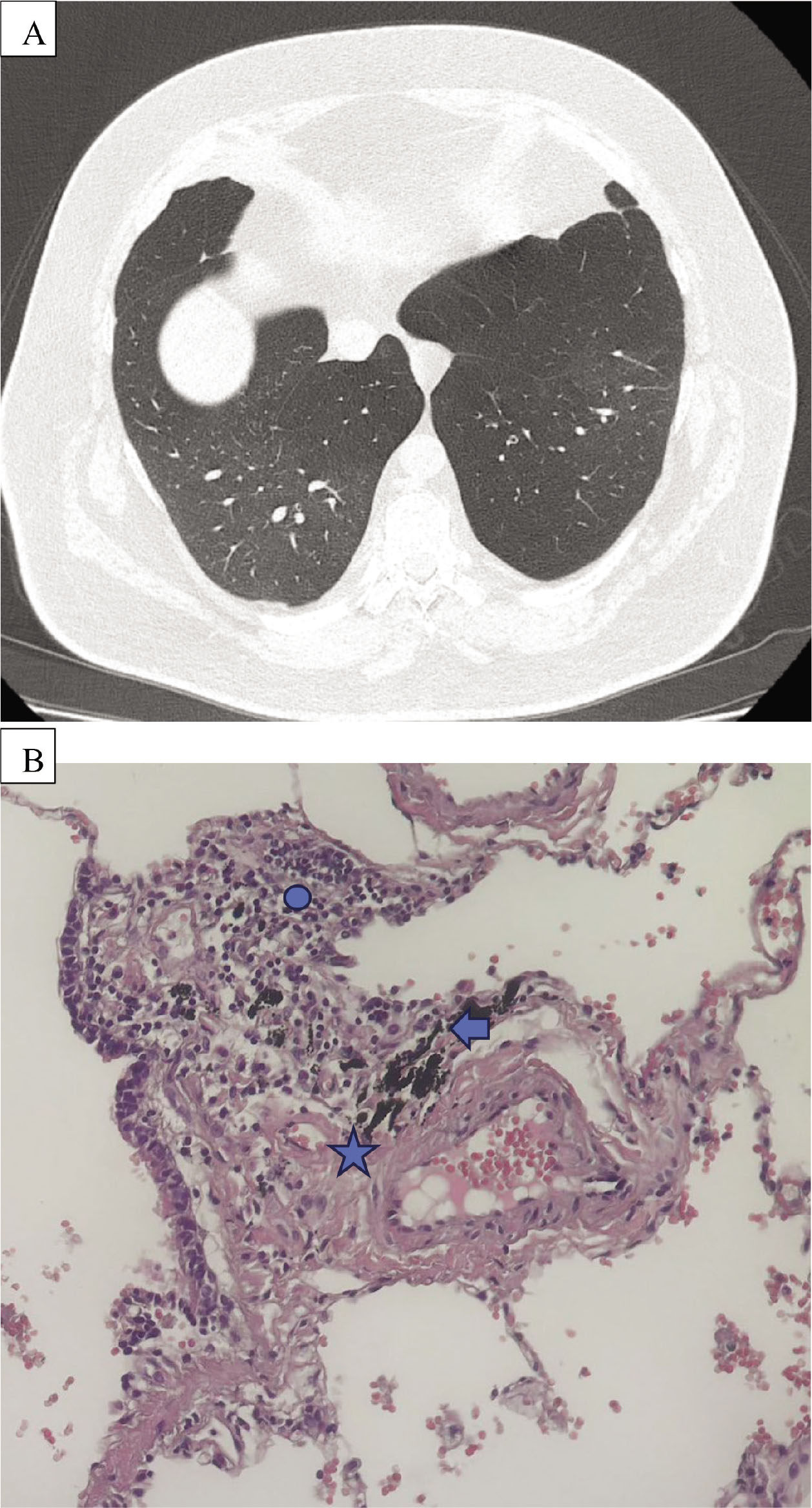
Figure 3A.
(A) High-resolution chest CT demonstrated bilateral areas of increased lucency, predominantly in the basal regions. (B) Lung-biopsy specimens of a bronchiole (haematoxylin-eosin staining) - bronchiolar wall is thickened by fibrosis ( ), lymphocytic inflammation (
 ) and anthracitic pigment deposits (
 ). CT, computer tomography.