
Introduction
Solitary fibrous tumours (SFTs) belong to the group of fibroblastic mesenchymal neoplasms, with the first case described in the early 20th century. Historically, the term hemangiopericytoma was used for pericytic tumours that shared morphologic features with SFTs; as clinicopathological similarities became more evident, these lesions were reclassified under a single pathological entity. Their occurrence is sporadic, with an estimated incidence of approximately 1–2 cases per million people. According to the WHO Classification of Soft Tissue and Bone Tumours, SFTs are divided into central nervous system (CNS) and non-CNS types. Within the thoracic cavity, pulmonary localisation is exceptionally rare, with only a handful of cases reported in the literature (1). Since SFTs tend to grow slowly, most patients remain asymptomatic for long periods. Histologically, they exhibit spindle cells arranged in a ‘patternless’ architecture, often accompanied by aberrant vasculature, a pattern present in other tumours. Diagnosis is confirmed by characteristic immunohistochemical markers (2). As histologic appearance does not always correlate with clinical behaviour, increasing emphasis has been placed on updated risk-stratification models that complement the traditional benign/malignant distinction. According to the WHO, metastatic risk in SFTs is assessed using the modified Demicco score, which incorporates: patient age (>55 years); mitotic count per 10 high-power fields; tumour size in centimetres; and the presence of necrosis. Based on these parameters, tumours are categorised into risk groups. Although distinguishing benign from malignant SFTs remains challenging, most cases carry a favourable short- and long-term prognosis. Currently, no consensus management guideline exists, and the limited evidence-based results in significant variability in therapeutic decision-making (3, 4). The present case underscores the heterogeneity of pulmonary tumours and highlights the role of predictive models such as the modified Demicco score in guiding therapeutic strategies, while emphasising the importance of placing the patient at the centre of clinical decision-making, carefully considering comorbidities and adopting a multidisciplinary approach.
Case presentation
We report the case of a 75-year-old female, a former smoker (10 pack-years, quit > 20 years), with no known allergies or occupational exposures and a complex cardiometabolic and systemic medical history. Her comorbidities included chronic obstructive pulmonary disease (COPD) GOLD II, Group B; grade II arterial hypertension with very high cardiovascular risk; insulin-treated type 2 Diabetes Mellitus; mild tricuspid regurgitation; bilateral internal carotid atheromatosis; supraventricular extrasystolic arrhythmia; chronic venous disease (CEAP C2); lumbar dextroconvex scoliosis; thoracolumbar spondylarthrosis; bilateral coxarthrosis; uncomplicated umbilical hernia; hypertriglyceridemia; grade I obesity; and mild multifactorial normocytic normochromic anaemia (inflammatory, folate and B12 deficiency).
She presented with a persistent dry cough, exertional dyspnoea, fatigue and asthenia. A recent hospitalisation for a lower respiratory tract infection included a native thoracic CT scan (Figure 1) that revealed a large, well-circumscribed left upper-lobe mass (lingular segment), measuring approximately 85 × 64 mm. Additional findings were right lower-lobe consolidative–atelectatic changes with ground-glass opacities, suggestive of infection and a minimal right posterior basal pleural effusion. Empirical antibiotic therapy was initiated, and the patient was referred to our pulmonology department for further evaluation.
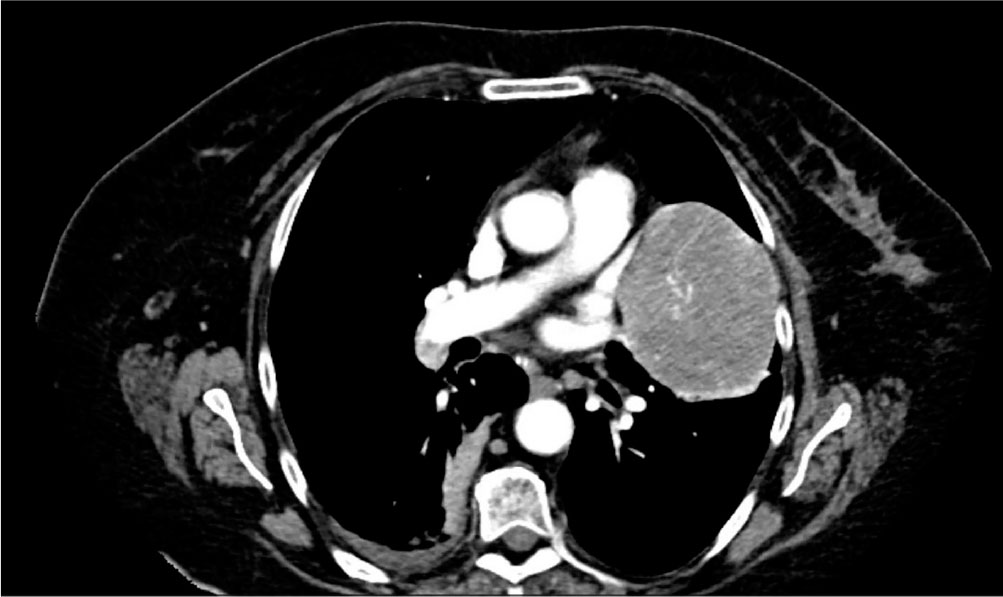
Figure 1.
Contrast-enhanced thoracic CT, transverse section, demonstrating the left upper lobe (lingular) pulmonary mass with well-defined margins. Minimal right pleural effusion and adjacent parenchymal changes consistent with LID pneumonia are also noted. CT, computed tomography.
On admission, the patient was afebrile, hemodynamically stable, with a BMI of 34 kg/m2, blood pressure 128/74 mmHg, heart rate 94 bpm and oxygen saturation of 95% on room air. Pulmonary examination showed mildly decreased vesicular breath sounds over the left upper lobe and slight basal crackles in the right lower lung field, without wheezes or rhonchi. Laboratory tests indicated a mild leucocytosis consistent with recent pneumonia, preserved renal and hepatic function, mild multifactorial anaemia and metabolic abnormalities attributable to her cardiometabolic comorbidities. Pulmonary function tests demonstrated mixed ventilatory impairment (mild restriction, mild central obstruction and marked peripheral obstruction) without a bronchodilator response. Flexible bronchoscopy revealed a slightly narrowed and right-deviated trachea and mild secretions in the right bronchial tree, with no endobronchial lesions. As the lesion was not accessible biomicroscopically, the patient was referred for CT-guided biopsy.A CT-guided core needle biopsy (Figure 2) obtained three 20-mm tissue fragments without complications, and post-procedure radiography excluded pneumothorax. Histopathology showed a hypercellular spindle-cell proliferation with relatively monomorphic hyperchromatic nuclei and a low mitotic index (<5 mitoses/2 mm2). Immunohistochemistry demonstrated diffuse CD34 positivity and focal but strong nuclear signal transducer and activator of transcription 6 (STAT6) expression, with negative pan-cytokeratin [AE1/AE3] (CK-AE1/3) and SRY-related HMG-box 10 (SOX10), confirming a SFTs. During hospitalisation, she received targeted treatment to resolve pneumonia and her comorbidities, including intravenous ceftriaxone, inhaled bronchodilator–corticosterid therapy, mucoregulators, hepatoprotective agents, analgesics, antitussives, probiotics, vitamin supplementation, gastroprotection, aerosol therapy and respiratory physiotherapy, with favourable clinical evolution.
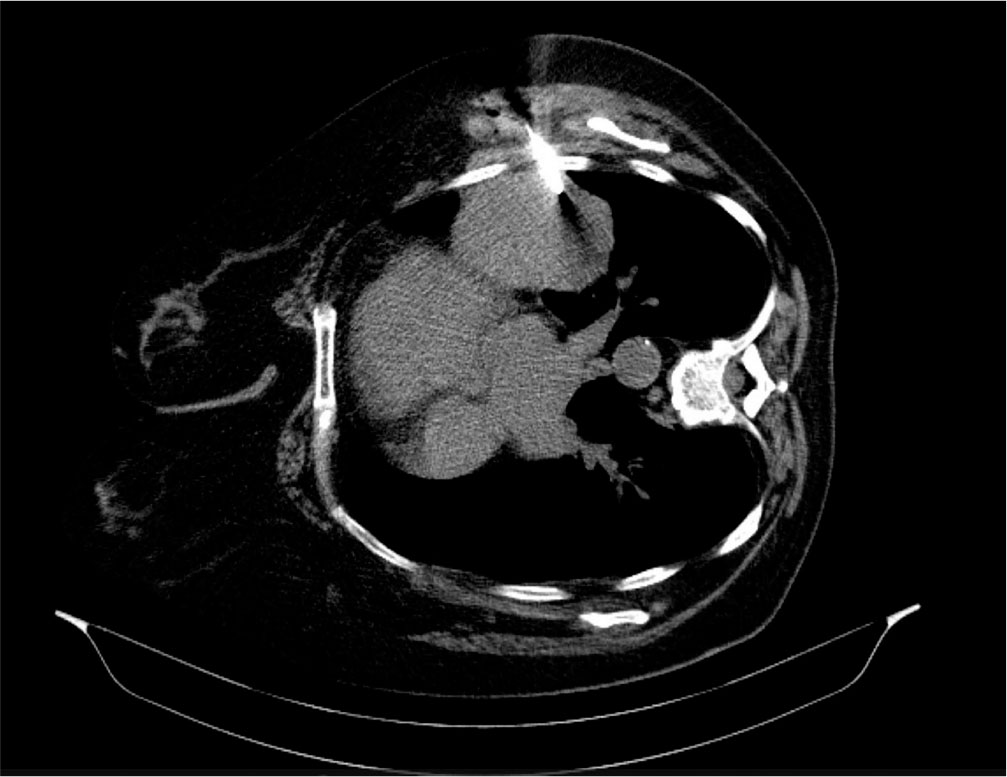
Figure 2.
CT-guided biopsy of the left upper lobe mass in lateral decubitus. Transverse section CT image demonstrating positioning of the biopsy needle within the pulmonary mass in the lingula. CT, computed tomography.
Management strategy: The tumour was classified as Low Metastatic Risk (three points) based on the Modified Demicco (mDemicco) score. Given this indolent prognosis and considering the patient’s extensive cardiometabolic comorbidities and high surgical risk, the multidisciplinary thoracic team, in collaboration with the patient and family, adopted a strategy of watchful waiting.
Discussion
SFTs have been increasingly documented across a wide range of anatomic locations – including the peritoneum, parotid gland, paranasal sinuses, orbit, skin and intracranial compartments, supporting their derivation from ubiquitous mesenchymal rather than mesothelial cells. Although SFTs may arise virtually anywhere, intrapulmonary involvement remains distinctly uncommon. Pulmonary SFTs represent <2% of all soft-tissue tumours, and the available evidence is largely limited to small retrospective cohorts and isolated case reports. Several mechanisms have been proposed to explain their development within the lung parenchyma: The anatomical continuity between subpleural mesenchyme and interlobular septa, and the presence of resident fibroblasts within submesothelial stromal layers of normal pulmonary tissue (3).
Histologically, these tumours typically show a proliferation of ovoid to spindle-shaped cells arranged in a patternless architecture, with alternating hypocellular and hypercellular areas and a prominent staghorn-like vasculature. Additional histologic variants have been described, such as myxoid SFTs, fat-forming SFTs and lesions resembling giant cell angiofibroma. This morphology overlaps with other spindle-cell neoplasms. Differential diagnosis of other spindle-cell neoplasms includes fibrosarcoma, leiomyosarcoma, malignant peripheral nerve sheath tumour (MPNST), metastatic spindle-cell lesions and schwannoma (3).
However, these entities typically display distinct immunophenotypic profiles, such as smooth muscle marker positivity in leiomyosarcoma (desmin, smooth muscle actin (SMA) and h-caldesmon), while schwannoma and MPNST show neural differentiation with soluble in 100% saturated ammonium sulfate protein (S100) positivity and/or SOX10 positivity. Higher mitotic activity and cytologic atypia are often demonstrated in fibrosarcoma and metastatic disease. The absence of epithelial (CK-AE1/3) and neural crest (SOX10) markers further excluded alternative spindle-cell tumours, allowing for a definitive diagnosis (4).
The diagnosis of SFTs is confirmed through immunohistochemical and molecular features, particularly CD34 expression and strong nuclear STAT6 positivity, the latter serving as a surrogate marker for the pathognomonic NAB2–STAT6 fusion detected by molecular assays. STAT6 positivity is also expressed in malignant cases, where CD34 expression is lost in those instances. In a series of 52 SFTs, nuclear STAT6 expression was identified in 51 cases (98%), while absent in histologic mimickers, underscoring its high specificity. Importantly, STAT6 retains diagnostic value even in fusion-negative tumours, making it especially useful in CD34-negative or histologically ambiguous cases. Although no STAT-directed therapies are currently approved, constitutive activation of the STAT pathway in SFTs has been proposed as a therapeutic vulnerability, particularly in unresectable, recurrent, or malignant disease. Preclinical and early translational studies demonstrate that direct STAT3 inhibition can attenuate tumour progression and improve survival, and several structurally related compounds remain under investigation (3–5).
SFTs typically have an indolent onset and slow growth, with most patients remaining asymptomatic for long periods. When symptoms do occur, they are usually related to compressive effects on adjacent lung parenchyma or bronchi, leading to chest tightness, dyspnoea, or intermittent cough. Paraneoplastic manifestations, such as Doege–Potter syndrome, Pierre–Marie–Bamberger syndrome, arthralgia, or weight loss, have also been described. In the present case, the tumour was identified incidentally during the evaluation of an acute right lower-lobe pneumonia, underscoring the silent nature of SFTs even at substantial sizes. Several studies report that respiratory symptoms commonly emerge only when the lesion exceeds approximately 10 cm in diameter (6, 7).
Histopathologic parameters associated with malignant behaviour include hypercellularity, nuclear pleomorphism, infiltrative growth, tumour necrosis, and an elevated mitotic index, none of which were identified in our case. Given the often insidious nature of malignant transformation in SFTs, current WHO guidance recommends the use of validated risk-stratification models to inform therapeutic decisions. The modified Demicco scoring system (Table 1), which incorporates four variables, remains the most widely applied. Based on the cumulative score, tumours are categorised into low-, intermediate- or high-risk groups for metastatic potential (Table 2). In the present case, the absence of necrosis and a low mitotic index place the patient within the low-risk category, with an estimated metastatic risk of 0%–5% at 10 years (3, 8). In our patient, we opted for a ‘watchful waiting’ strategy after multidisciplinary review, given the low metastatic risk estimated by the modified Demicco score. This approach is supported by published cohorts showing very low rates of metastatic progression, approximately 0%–5% during long-term follow-up and the overall disease-free survival rate of 95% in benign cases at 10-year follow-up, supporting less aggressive management in this subgroup (8, 9).
Table 1.
mDemicco score adapted from Demicco et al. (8).
| Variables | Cutoff/Category | Score (Points) |
|---|---|---|
| Age (years> | ≥55 | 1 |
| <55 | 0 | |
| Tumour size (cm) | <5.0 | 0 |
| 5.0 to <10.0 | 1 | |
| 10.0 to <15.0 | 2 | |
| ≥15.0 | 3 | |
| Mitotic count (/10 HPFs) | 0 | 0 |
| 1–3 | 1 | |
| ≥4 | 2 | |
| Tumour necrosis | ≥10% (Present) | 1 |
| <10% (Absent) | 0 |
Table 2.
mDemicco score, risk category adapted from Demicco EG et al. (8).
| Total mDemicco Score | Risk Category | Estimated Metastatic Risk |
|---|---|---|
| 0–3 | Low Risk | Very Low (≈0%–5% at 10 years) |
| 4–5 | Intermediate Risk | Moderate (≈10%–15% at 10 years) |
| 6–7 | High Risk | Substantial (≥50% at 5 years) |
In parallel, there is growing recognition that management should be individualised in the absence of standardised guidelines. In elderly patients with COPD, diabetes, obesity and cardiovascular disease, thoracic surgery is associated with a significantly increased risk of postoperative pulmonary and cardiovascular complications, prolonged hospitalisation, and mortality, especially in COPD patients. When it comes to imagistic surveillance, the recommendation is based on low-cohort studies, using CT every 6 months for the first 2 years, then yearly for at least 10 years. Although complete surgical resection is typically considered the standard of care, long-term data show that even tumours classified as low-risk can be safely monitored, with low recurrence and metastasis rates (10, 11).
Conclusions
The mass was definitively diagnosed as a SFTs, supported by strong nuclear STAT6 expression, reflecting the NAB2:STAT6 fusion and diffuse CD34 positivity. Given the balance between her indolent tumour biology and her fragile cardiometabolic status, periodic imaging and clinical follow-up were deemed the most appropriate, patient-centred management plan.
Acknowledgements
The authors would like to thank all medical staff involved in the diagnosis and management of the patient.
Abbreviations
- CD34
cluster of differentiation 34
- CEAP
CEAP is an acronym for the four components used in the classification: clinical, etiological, anatomical, pathophysiological
- CK-AE1/3
pan-cytokeratin [AE1/AE3]
- COPD
chronic obstructive pulmonary disease
- S100
soluble in 100% saturated ammonium sulfatesulphate protein
- SMA
smooth muscle actin
- SOX10
SRY-related HMG-box 10
- STAT6
signal transducer and activator of transcription 6
Notes
[2] Contributed by Authors’ contributions
Conceptualization and patient management: [G.F.B.] and [R.M.R]; Data collection: [G.F.B.]; Literature review: [G.F.B.] and [R.M.R.]; Writing—original draft: [G.F.B.]; Writing—review & editing: [G.F.B.], [R.M.R] and [D.A.T]; Supervision: [D.A.T]. All authors approved the final manuscript.
[3] Conflicts of interest Conflict of interest
The authors declare no conflict of interest.
[4] Informed consent statement
Informed consent was obtained from the patient.
[5] Data availability statement
Available from the corresponding author upon request.