
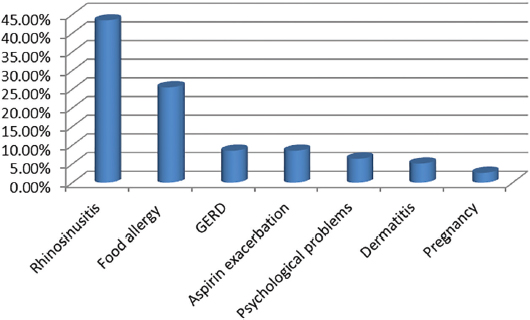
Figure 1.
Distribution of Comorbidities among patients with bronchial asthma.
Table 1.
Baseline clinicodemographic data of the studied patients
| Variable | n = 200 n (%)/mean ± SD median (IQR) |
|---|---|
| Age (years) | 35.5 ± 12.9 37 (25.5:45) |
| Age group | 110 (55) |
| <40 | 84 (42) |
| 40−<60 | 6 (3) |
| ≥60 | |
| Gender | 144 (72) |
| Female | 56 (28) |
| Male | |
| Smoking | 20 (10) |
| BMI (kg/m2) | 23.4 ± 4.4 22.6 (20.1:25.8) |
| Classification of BMI | 10 (5) |
| Underweight (<18) | 140 (70) |
| Average (18-25) | 48 (24) |
| Obese (>25) | 2 (1) |
| Morbid obesity (>40) | |
| Exposure | |
| Allergen | 24 (12) |
| Air pollution | 162 (81) |
| Investigations | |
| FEV1< 60% | 48 (24) |
| FEV1 | 2.4 ± 0.6 2.4 (2:2.9) |
| FEV1 percent: | 74.7 ± 16.5 76 (64.3:86.8) |
| FVC | 3 ± 0.7 3.1 (2.6:3.4) |
| FEV1/FVC ratio | 79.8 ± 14.6 82 (68.3:91) |
| High blood eosinophilia | 54 (27) |
| >1 severe A.E./year: | 12 (6) |
Table 2.
Association between asthma severity and key clinicodemographic variables
| Variable | Mild (n = 38, 19%) | Moderate (n = 146, 73%) | Severe (n = 16, 8%) | P value |
|---|---|---|---|---|
| Age group <40/40–59/≥60 | 28/10/0 | 72/70/4 | 10/4/2 | 0.01* |
| Female, n (%) | 20 (52.6) | 110 (75.3) | 14 (87.5) | 0.007* |
| DM, n (%) | 0 | 7 (4.8) | 4 (25) | 0.004* |
| HTN, n (%) | 1 (2.6) | 10 (6.8) | 4 (25) | 0.02* |
| Air pollution exposure, n (%) | 21 (55.3) | 128 (87.7) | 13 (81.3) | <0.001* |
| FEV1<60%, n (%) | 2 (5.3) | 34 (23.3) | 12 (75) | <0.001* |
| FEV1 (L) | 2.8 ± 0.4 | 2.4 ± 0.6 | 1.9 ± 0.5 | <0.001* |
| FEV1% predicted | 82.8 ± 13.3 | 73.8 ± 16 | 63.5 ± 19.6 | <0.001* |
| FVC (L) | 3.2 ± 0.4 | 3.0 ± 0.8 | 2.7 ± 0.4 | 0.003* |
| FEV1/FVC ratio | 89.4 ± 11 | 78.7 ± 14.1 | 67.1 ± 14.1 | <0.001* |
| High blood eosinophilia, n (%) | 8 (21.1) | 36 (24.7) | 10 (62.5) | 0.003* |
| ≥2 severe exacerbations/year, n (%) | 4 (10.5) | 5 (3.4) | 3 (18.8) | 0.03* |
Table 3.
Logistic regression analysis of predictors of severe asthma
| Variables | Univariate analysis | Multivariable analysis | ||||
|---|---|---|---|---|---|---|
| Un adjusted OR | 95% CI | P value | Adjusted OR | 95% CI | P value | |
| Age group | ||||||
| <40 | 1 | 0.2:1.7 | 0.26 | - | - | - |
| 40−60 | 0.5 | 0.8:30.8 | 0.08 | |||
| >60 | 5 | |||||
| Gender | 0.6:13.2 | 0.17 | - | - | - | |
| Female | 2.9 | |||||
| Male | 1 | |||||
| BMI (kg/m2) | 0.97 | 0.9:1.1 | 0.61 | - | - | - |
| DM | 8.4 | 2.2:32.9 | 0.002* | 4.2 | 0.8:21.5 | 0.09 |
| Disease duration | 1.02 | 0.97:1.1 | 0.51 | - | - | - |
| Allergen | 1.1 | 0.2:4.9 | 0.95 | - | - | - |
| Air pollution | 1.02 | 0.3:3.8 | 0.98 | - | - | - |
| FEV1<60% | 12.3 | 3.8:40.5 | <0.001* | 22.5 | 2.7:189.4 | 0.004* |
| FEV1 percent | 0.96 | 0.9:99 | 0.006* | 1.1 | 1.03:1.2 | 0.006* |
| FVC | 0.45 | 0.2:1 | 0.053 | 0.19 | 0.04:0.9 | 0.03* |
| FEV1/FVC ratio | 0.93 | 0.9:0.97 | 0.001* | 0.91 | 0.9:0.98 | 0.006* |
| Blood eosinophilia | 3.4 | 1.2:9.6 | 0.02* | 3.7 | 0.99:13.8 | 0.053 |
Table 4.
Final predictors of severe asthma
| Variable | Adjusted OR | 95% CI | P value |
|---|---|---|---|
| FEV1< 60%: | 22.7 | 2.9:179.4 | 0.003* |
| FEV1/FVC ratio | 0.91 | 0.9:0.97 | 0.004* |
| FEV1 percent | 1.1 | 1.03:1.2 | 0.006* |
| FVC | 0.19 | 0.05:0.8 | 0.03* |
Table 5.
Association between asthma control and key clinicodemographic variables
| Variable | Controlled (n = 70) | Uncontrolled (n = 130) | P value |
|---|---|---|---|
| SABA overuse | 0 | 18 (13.8%) | 0.001* |
| GERD | 12 (17.1%) | 8 (6.2%) | 0.01* |
| Allergen exposure | 4 (5.7%) | 20 (15.4%) | 0.045* |
| FEV1< 60% | 8 (11.4%) | 40 (30.8%) | 0.002* |
| FEV1 (L) | 2.6 ± 0.6 | 2.3 ± 0.6 | <0.001* |
| FEV1% predicted | 79.9 ± 16.5 | 71.9 ± 15.9 | <0.001* |
| FVC (L) | 3.1 ± 0.5 | 3.0 ± 0.8 | 0.03* |
| FEV1/FVC ratio | 84.5 ± 13.7 | 77.2 ± 14.5 | 0.002* |
| ≥2 severe | 0 | 12 (9.2%) | 0.009* |
| exacerbations/year |
Table 6.
Logistic regression analysis of predictors of uncontrolled asthma
| Variable | Univariate analysis | Multivariable analysis | ||||
|---|---|---|---|---|---|---|
| Un adjusted OR | 95% CI | P value | Adjusted OR | 95% CI | P value | |
| Age group | ||||||
| <40 | 1 | |||||
| ≥40 | 0.8 | 0.4:1.4 | 0.46 | - | - | - |
| Gender | ||||||
| Female | 1 | |||||
| Male | 0.96 | 0.5:1.8 | 0.9 | - | - | - |
| Smoking | 1.3 | 0.5:3.5 | 0.62 | - | - | - |
| BMI (kg/m2) | 0.99 | 0.9:1.1 | 0.7 | - | - | - |
| DM | 5.8 | 0.7:45.9 | 0.1 | 3.6 | 0.4:30.5 | 0.24 |
| HTN | 2.3 | 0.7:8.3 | 0.22 | - | - | - |
| Disease duration | 0.99 | 0.97:1 | 0.73 | - | - | - |
| Inadequate ICS | 3.5 | 0.8:15.9 | 0.11 | 1.5 | 0.3:8.6 | 0.62 |
| Non-prescribed ICS | 1.1 | 0.5:2.3 | 0.8 | - | - | - |
| Allergen | 3 | 0.98:9.2 | 0.054 | 4.5 | 1.3:15.8 | 0.02* |
| Air pollution | 0.83 | 0.4:1.8 | 0.62 | - | - | - |
| Occurrence of exacerbations | 0.93 | 0.5:1.9 | 0.83 | - | - | - |
| FEV1< 60% | 3.4 | 1.5:7.9 | 0.003* | 1.8 | 0.6:5.4 | 0.32 |
| FEV1 | 0.45 | 0.3:0.7 | 0.002* | 0.58 | 0.3:1.1 | 0.09 |
| FEV1 percent | 0.97 | 0.95:0.99 | 0.001 | 1 | 0.9:1.03 | 0.94 |
| FVC | 0.81 | 0.5:1.2 | 0.33 | - | - | - |
| FEV1/FVC ratio | 0.96 | 0.9:0.99 | 0.001* | 0.99 | 0.96:1.03 | 0.7 |
| Blood eosinophilia | 0.94 | 0.5:1.8 | 0.86 | - | - | - |
Table 7.
Final predictors of uncontrolled asthma
| Variable | Adjusted OR | 95% CI | P value |
|---|---|---|---|
| Allergen | 5.1 | 1.5:17.3 | 0.01* |
| FEV1 | 0.55 | 0.3:0.99 | 0.047* |
Table 8.
Agreement between GINA, ACT and ACQ scores classifications
| Variable | GINA score | Kappa | P value | |
|---|---|---|---|---|
| Controlled | Uncontrolled | |||
| ACT score | ||||
| Controlled | 44 (62.9) | 14 (10.8) | ||
| Uncontrolled | 26 (37.1) | 116 (89.2) | 0.54 | <0.001* |
| ACQ score | ||||
| Controlled | 48 (68.6) | 12 (9.2) | ||
| Uncontrolled | 22 (31.4) | 118 (90.8) | 0.61 | <0.001* |
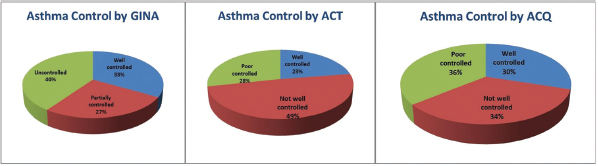
Figure 2.
Control of asthma among the studied patients by GINA score, ACT and ACQ.
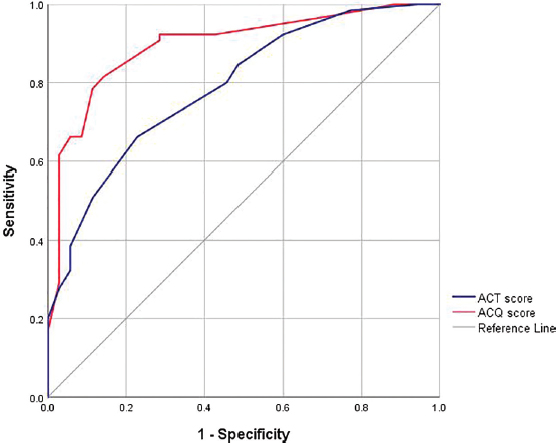
Figure 3.
ROC curve of diagnostic performance of ACT, ACQ scores in prediction of uncontrolled asthma.
Table 9.
Diagnostic performance of ACT and ACQ scores in the prediction of uncontrolled asthma according to GINA classification
| Variable | AUC (%) | 95% CI | P value | Cutoff point | Sensitivity (%) | Specificity (%) | PPV (%) | NPV (%) | Accuracy (%) |
|---|---|---|---|---|---|---|---|---|---|
| ACT | 79 | 0.7:0.9 | <0.001* | 18.5 | 66.2 | 77.1 | 84.3 | 55.1 | 70 |
| ACQ | 89.6 | 0.9:0.94 | <0.001* | 0.9 | 81.5 | 85.7 | 91.4 | 71.4 | 83 |