
Introduction
Asthma is a prevalent chronic respiratory condition that affects an estimated 300 million people globally (1). Bronchial asthma is a heterogeneous clinical syndrome influenced by multiple interacting factors, including both genetic predisposition and environmental exposures (2).
Asthma severity can be retrospectively assessed based on the level of treatment required to achieve symptom control and prevent exacerbations, in accordance with the global initiative for asthma (GINA) (3) guidelines. Asthma is classified into three categories of severity: mild, moderate and severe. Severe asthma is defined as asthma that remains uncontrolled despite adherence to maximal optimised therapy and treatment of contributory factors, or that worsens when high-dose treatment is reduced.
Achieving asthma control is the focus of all recently developed asthma treatment guidelines. Overall asthma control consists of two domains. One is achieving day-to-day (or current) asthma control, indicated by the absence of asthma symptoms, minimal reliever use, normal activity levels and lung function values close to normal. The second domain is to minimise future risk to the patient by ensuring the absence of asthma exacerbations, the prevention of accelerated decline in lung function over time and no side-effects from medications (4). Asthma control requires early diagnosis and regular followup to ensure appropriate case management. Inhaled corticosteroids (ICS) are the cornerstone of therapy (5). While pharmacological treatment is essential, addressing modifiable risk factors also plays a critical role in achieving optimal control. Asthma control is a dynamic process that can be influenced by both short-term and long-term factors (6).
According to the GINA (1) guidelines, the level of asthma control is classified into three categories: controlled, partly controlled and uncontrolled. Uncontrolled asthma is defined by persistent symptoms, frequent exacerbations and impaired pulmonary function - specifically, a forced expiratory volume in one second (FEV1) <80% of the predicted value or personal best. Patients who achieve well-controlled asthma not only lower the risk of exacerbations but also reduce the burden of comorbid conditions. Multiple scoring systems are used to assess asthma control, including the asthma control test (ACT), asthma control questionnaire (ACQ) and the recently released asthma impairment and risk questionnaire (AIRQ) (7).
This study aimed to identify the risk factors and predictors of severe asthma, and those of uncontrolled asthma, and to compare the results of the ACT and the ACQ with GINA guidelines in detecting uncontrolled asthma.
Patients and methods
Study design
This observational cross-sectional study was conducted on 200 asthma patients, recruited from the outpatient pulmonary clinic at Chest Department in Sohag University Hospital between February 2024 and January 2025.
Sample size calculation
A sample size of 200 patients was prespecified to ensure adequate precision for estimating key outcomes and to support multivariable modelling. Based on an expected prevalence of uncontrolled asthma of ~65%, a two-sided 95% confidence interval with a margin of error of ±7% requires approximately 179 patients (calculated as n = Z2 × p × (1−p)/d2 = 1.962 × 0.65 × 0.35/0.072 ≈ 178).
Inclusion criteria
Patients aged over 18 years with a confirmed diagnosis of asthma were included in the study. The diagnosis of asthma was established based on clinical symptoms and in accordance with the GINA (3) guidelines. Asthma control was classified into three categories: well-controlled, partly controlled and uncontrolled, according to the GINA criteria.
Exclusion criteria
Individuals with underlying conditions, such as other chronic lung diseases (COPD, bronchiectasis or other chronic lung diseases), cardiovascular disease or other chronic illnesses, were excluded.
All consecutive eligible patients attending the clinic were invited, minimising selection bias and enhancing internal validity.
Ethical consideration
Approval for this study was obtained from the Faculty Research Ethics Committee (Approval N.Soh-Med-23-10- 015MS). Written informed consent was obtained from all participants before enrollment.
Data collection
Baseline clinicodemographic data were collected from outpatient consultations, including:
➢ Demographics: including age, sex, body mass index (BMI) and smoking history
➢ Comorbidities: Detailed information on comorbidities was obtained, with specific attention to diabetes mellitus (DM), hypertension (HTN), gastroesophageal reflux disease (GERD), chronic rhinosinusitis, food allergy and dermatitis.
➢ Environmental exposures: Environmental exposure history was assessed, focusing on allergen exposure and exposure to air pollution.
➢ Medication history: Medication history was documented, including ICS use and dosage, short-acting β2-agonist (SABA) use, systemic steroid use and assess the adherence to prescribed treatment regimens.
➢ Treatment adherence: Adherence to controller medication was assessed at baseline and follow-up using a structured questionnaire documenting dosage frequency, inhaler technique and reasons for missed doses. Patients were classified as adherent if they used ≥80% of prescribed doses, a threshold supported by previous adherence research and GINA recommendations (3).
➢ Disease-related data: Disease-related information was also recorded, such as the duration of asthma, history and frequency of exacerbations, and any previous hospitalisations due to asthma.
➢ Laboratory assessment: Laboratory assessment included measurement of peripheral blood eosinophil count, with high eosinophilia defined as ≥300 cells/μL (8).
Pulmonary function testing
Spirometry was performed according to American Thoracic Society/European Respiratory Society (ATS/ERS) guidelines (9, 10). The recorded parameters included the FEV1, forced vital capacity (FVC), the FEV1/FVC ratio and the percentage of predicted FEV1 (FEV1% pred).
Diagnostic criteria for asthma (spirometric)
A diagnosis of asthma was confirmed when patients demonstrated variable expiratory airflow limitation, defined by a post-bronchodilator increase in FEV1 of ≥12% and ≥200 mL from baseline, as recommended by GINA (3). FEV1 is used to grade the severity of airflow limitation. Low FEV1 was defined as <60% of predicted, which reflects severe impairment of lung function.
Severity classification
For disease severity, patients were classified retrospectively based on prescribed treatment steps required to achieve symptom control and prevent exacerbations, following GINA 2024 recommendations: mild asthma (Steps 1-2), moderate asthma (Step 3), and severe asthma (Steps 4-5). Asthma severity was therefore classified as mild, moderate or severe according to the minimum effective GINA treatment step needed for sustained control.
Asthma control assessment
Asthma control was evaluated using three complementary approaches:
GINA symptom control tool (3):
• assessed four items over the previous 4 weeks:
• Daytime symptoms more than twice per week
• Nighttime waking due to asthma
• Reliever (SABA) use more than twice per week
• Activity limitation due to asthma
• Control was classified as: Well controlled: 0 (yes) responses, Partly controlled: 1-2 (yes) responses, Uncontrolled: 3-4 (yes) responses
(ACT (9):
• A validated 5-item patient-reported questionnaire assessing symptoms, activity limitation, use of rescue medication and overall control in the last 4 weeks.
• Each item scored on a 1-5 scale; total score 5-25.
• Control categories: Well controlled: ≥20, Not well controlled: 16-19, Poorly controlled: ≤15
(ACQ (10):
• A 7-item validated tool assessing symptoms, rescue bronchodilator use and FEV1.
• Each item scored 0 (well controlled) to 6 (extremely poorly controlled).
• Final score is the mean of all items.
• Control categories: Well controlled: ≤0.75, Intermediate: 0.76-1.49, Uncontrolled: ≥1.50
Agreement analysis
Agreement between GINA-defined control and the patient- reported tools (ACT and ACQ) was assessed using Cohen’s kappa (κ) statistic to evaluate concordance.
At the 6-month follow-up, data were collected on drug utilisation, GINA symptom control, ACT scores and ACQ-5 scores.
Statistical analysis
Data were analysed using Statistical Package for the Social Sciences (SPSS) version 26. Normality was tested with the Shapiro-Wilk test. Quantitative data were expressed as mean ± SD or median (IQR), and qualitative data as frequencies and percentages. Group comparisons were performed using Chi-squared/Fisher’s exact tests for categorical variables, and Mann-Whitney U or Kruskal- Wallis tests for non-parametric quantitative data. Logistic regression (univariate and multivariable) identified predictors of uncontrolled and severe asthma, with variables at P ≤ 0.2 included and backward LR applied (removal at P = 0.1). Statistical significance was set at P < 0.05.
Results
Baseline clinicodemographic characteristics
Among 200 asthma patients (mean age 35.5 years), the majority were young (<40 years, 55%) and female (72%). Chronic rhinosinusitis was the most frequent comorbidity (51%), followed by food allergy (30%) and GERD (10%), as shown in Figure 1. Obesity affected nearly one-quarter, and 24% had severe lung function impairment (FEV1<60%) as shown in Table 1. These findings highlight the dominance of upper airway disease and obesity as key contributors, stressing the importance of routine spirometry and multidisciplinary care to improve outcomes.
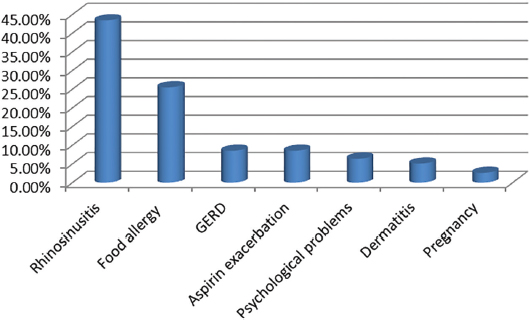
Figure 1.
Distribution of Comorbidities among patients with bronchial asthma.
Table 1.
Baseline clinicodemographic data of the studied patients
| Variable | n = 200 n (%)/mean ± SD median (IQR) |
|---|---|
| Age (years) | 35.5 ± 12.9 37 (25.5:45) |
| Age group | 110 (55) |
| <40 | 84 (42) |
| 40−<60 | 6 (3) |
| ≥60 | |
| Gender | 144 (72) |
| Female | 56 (28) |
| Male | |
| Smoking | 20 (10) |
| BMI (kg/m2) | 23.4 ± 4.4 22.6 (20.1:25.8) |
| Classification of BMI | 10 (5) |
| Underweight (<18) | 140 (70) |
| Average (18-25) | 48 (24) |
| Obese (>25) | 2 (1) |
| Morbid obesity (>40) | |
| Exposure | |
| Allergen | 24 (12) |
| Air pollution | 162 (81) |
| Investigations | |
| FEV1< 60% | 48 (24) |
| FEV1 | 2.4 ± 0.6 2.4 (2:2.9) |
| FEV1 percent: | 74.7 ± 16.5 76 (64.3:86.8) |
| FVC | 3 ± 0.7 3.1 (2.6:3.4) |
| FEV1/FVC ratio | 79.8 ± 14.6 82 (68.3:91) |
| High blood eosinophilia | 54 (27) |
| >1 severe A.E./year: | 12 (6) |
Characteristics of patients with severe asthma
The severity of asthma was classified retrospectively from prescribed treatment according to GINA-based treatment step. In this cohort, most patients had moderate asthma (73%), while 7.9% had severe disease. Severe asthma clustered in females (87.5%) and older adults (≥60 years), and was strongly linked to air pollution (81.3%), diabetes, HTN (25% each), and marked lung function decline (FEV1<60% in 75%). High eosinophilia (62.5%) and frequent exacerbations further characterised severe cases, as shown in Table 2. BMI and disease duration were not significantly associated. These findings highlight the importance of recognising comorbidities, addressing pollution and monitoring lung function and eosinophilic inflammation in high-risk patients.
Table 2.
Association between asthma severity and key clinicodemographic variables
| Variable | Mild (n = 38, 19%) | Moderate (n = 146, 73%) | Severe (n = 16, 8%) | P value |
|---|---|---|---|---|
| Age group <40/40–59/≥60 | 28/10/0 | 72/70/4 | 10/4/2 | 0.01* |
| Female, n (%) | 20 (52.6) | 110 (75.3) | 14 (87.5) | 0.007* |
| DM, n (%) | 0 | 7 (4.8) | 4 (25) | 0.004* |
| HTN, n (%) | 1 (2.6) | 10 (6.8) | 4 (25) | 0.02* |
| Air pollution exposure, n (%) | 21 (55.3) | 128 (87.7) | 13 (81.3) | <0.001* |
| FEV1<60%, n (%) | 2 (5.3) | 34 (23.3) | 12 (75) | <0.001* |
| FEV1 (L) | 2.8 ± 0.4 | 2.4 ± 0.6 | 1.9 ± 0.5 | <0.001* |
| FEV1% predicted | 82.8 ± 13.3 | 73.8 ± 16 | 63.5 ± 19.6 | <0.001* |
| FVC (L) | 3.2 ± 0.4 | 3.0 ± 0.8 | 2.7 ± 0.4 | 0.003* |
| FEV1/FVC ratio | 89.4 ± 11 | 78.7 ± 14.1 | 67.1 ± 14.1 | <0.001* |
| High blood eosinophilia, n (%) | 8 (21.1) | 36 (24.7) | 10 (62.5) | 0.003* |
| ≥2 severe exacerbations/year, n (%) | 4 (10.5) | 5 (3.4) | 3 (18.8) | 0.03* |
Predictors of severe asthma
Univariate analysis linked diabetes, eosinophilia and reduced lung function to severe asthma as in Table 3, but in multivariable models, lung function emerged as the key predictor. Patients with FEV1<60% had a sharply higher risk of severe disease (adjusted odds ratio (OR) ≈22, P < 0.01), underscoring impaired lung function as the strongest independent determinant, as shown in Table 4.
Table 3.
Logistic regression analysis of predictors of severe asthma
| Variables | Univariate analysis | Multivariable analysis | ||||
|---|---|---|---|---|---|---|
| Un adjusted OR | 95% CI | P value | Adjusted OR | 95% CI | P value | |
| Age group | ||||||
| <40 | 1 | 0.2:1.7 | 0.26 | - | - | - |
| 40−60 | 0.5 | 0.8:30.8 | 0.08 | |||
| >60 | 5 | |||||
| Gender | 0.6:13.2 | 0.17 | - | - | - | |
| Female | 2.9 | |||||
| Male | 1 | |||||
| BMI (kg/m2) | 0.97 | 0.9:1.1 | 0.61 | - | - | - |
| DM | 8.4 | 2.2:32.9 | 0.002* | 4.2 | 0.8:21.5 | 0.09 |
| Disease duration | 1.02 | 0.97:1.1 | 0.51 | - | - | - |
| Allergen | 1.1 | 0.2:4.9 | 0.95 | - | - | - |
| Air pollution | 1.02 | 0.3:3.8 | 0.98 | - | - | - |
| FEV1<60% | 12.3 | 3.8:40.5 | <0.001* | 22.5 | 2.7:189.4 | 0.004* |
| FEV1 percent | 0.96 | 0.9:99 | 0.006* | 1.1 | 1.03:1.2 | 0.006* |
| FVC | 0.45 | 0.2:1 | 0.053 | 0.19 | 0.04:0.9 | 0.03* |
| FEV1/FVC ratio | 0.93 | 0.9:0.97 | 0.001* | 0.91 | 0.9:0.98 | 0.006* |
| Blood eosinophilia | 3.4 | 1.2:9.6 | 0.02* | 3.7 | 0.99:13.8 | 0.053 |
Management of asthma control
In this study, the majority of patients were receiving asthma controller therapy. Most patients were prescribed ICS based regimens either as monotherapy or in combination therapy, aimed at alleviating symptoms and minimising the risk of exacerbations. Treatment steps were tailored according to the GINA guidelines.
Risk factors of uncontrolled asthma
In this study, patients with partly controlled and uncontrolled asthma, as defined by the GINA guideline, were grouped under the category of ‘uncontrolled asthma’. Out of 200 asthma patients, 35% had controlled asthma and 65% were uncontrolled. Demographics (age, sex, BMI, smoking, disease duration) showed no significant differences. However, uncontrolled asthma was associated with high SABA use (13.8%), poor adherence (6.1%), inadequate ICS (12%), GERD (17.1%), and allergen exposure (15.4%). These patients also showed worse lung function (FEV1<60% in 30.8%) and were the only group to experience recurrent severe exacerbations, as shown in Table 5. These factors were further analysed to determine independent predictors of poor asthma control.
Table 5.
Association between asthma control and key clinicodemographic variables
| Variable | Controlled (n = 70) | Uncontrolled (n = 130) | P value |
|---|---|---|---|
| SABA overuse | 0 | 18 (13.8%) | 0.001* |
| GERD | 12 (17.1%) | 8 (6.2%) | 0.01* |
| Allergen exposure | 4 (5.7%) | 20 (15.4%) | 0.045* |
| FEV1< 60% | 8 (11.4%) | 40 (30.8%) | 0.002* |
| FEV1 (L) | 2.6 ± 0.6 | 2.3 ± 0.6 | <0.001* |
| FEV1% predicted | 79.9 ± 16.5 | 71.9 ± 15.9 | <0.001* |
| FVC (L) | 3.1 ± 0.5 | 3.0 ± 0.8 | 0.03* |
| FEV1/FVC ratio | 84.5 ± 13.7 | 77.2 ± 14.5 | 0.002* |
| ≥2 severe | 0 | 12 (9.2%) | 0.009* |
| exacerbations/year |
Predictors of poor controlled asthma
Univariate analysis identified several factors linked with uncontrolled asthma, including steroid use, allergen exposure and impaired lung function Table 6. Multivariable regression narrowed these down, with allergen exposure (OR 5.1, P = 0.01) and reduced FEV1 (OR 0.55, P = 0.047) emerging as the strongest independent predictors, as shown in Table 7. Clinically, this highlights the need for allergen avoidance strategies and routine spirometry in asthma management.
Table 6.
Logistic regression analysis of predictors of uncontrolled asthma
| Variable | Univariate analysis | Multivariable analysis | ||||
|---|---|---|---|---|---|---|
| Un adjusted OR | 95% CI | P value | Adjusted OR | 95% CI | P value | |
| Age group | ||||||
| <40 | 1 | |||||
| ≥40 | 0.8 | 0.4:1.4 | 0.46 | - | - | - |
| Gender | ||||||
| Female | 1 | |||||
| Male | 0.96 | 0.5:1.8 | 0.9 | - | - | - |
| Smoking | 1.3 | 0.5:3.5 | 0.62 | - | - | - |
| BMI (kg/m2) | 0.99 | 0.9:1.1 | 0.7 | - | - | - |
| DM | 5.8 | 0.7:45.9 | 0.1 | 3.6 | 0.4:30.5 | 0.24 |
| HTN | 2.3 | 0.7:8.3 | 0.22 | - | - | - |
| Disease duration | 0.99 | 0.97:1 | 0.73 | - | - | - |
| Inadequate ICS | 3.5 | 0.8:15.9 | 0.11 | 1.5 | 0.3:8.6 | 0.62 |
| Non-prescribed ICS | 1.1 | 0.5:2.3 | 0.8 | - | - | - |
| Allergen | 3 | 0.98:9.2 | 0.054 | 4.5 | 1.3:15.8 | 0.02* |
| Air pollution | 0.83 | 0.4:1.8 | 0.62 | - | - | - |
| Occurrence of exacerbations | 0.93 | 0.5:1.9 | 0.83 | - | - | - |
| FEV1< 60% | 3.4 | 1.5:7.9 | 0.003* | 1.8 | 0.6:5.4 | 0.32 |
| FEV1 | 0.45 | 0.3:0.7 | 0.002* | 0.58 | 0.3:1.1 | 0.09 |
| FEV1 percent | 0.97 | 0.95:0.99 | 0.001 | 1 | 0.9:1.03 | 0.94 |
| FVC | 0.81 | 0.5:1.2 | 0.33 | - | - | - |
| FEV1/FVC ratio | 0.96 | 0.9:0.99 | 0.001* | 0.99 | 0.96:1.03 | 0.7 |
| Blood eosinophilia | 0.94 | 0.5:1.8 | 0.86 | - | - | - |
Agreement between GINA, ACT and ACQ scores
Agreement analysis showed moderate concordance between GINA and both ACT (κ = 0.54, P < 0.001) and ACQ (κ = 0.61, P < 0.001), with ACQ demonstrating slightly better alignment. Clinically, this suggests ACQ may more accurately reflect GINA-defined asthma control than ACT, as shown in Table 8.
Diagnostic performance of ACT and ACQ for uncontrolled asthma
The ROC curve analysis revealed that both instruments have good discriminatory power in predicting uncontrolled asthma, with ACQ outperforming ACT, as shown in Figure 3. ACQ (area under the curve [AUC] = 0.896, sensitivity 81.5%, specificity 85.7%) was superior to ACT (AUC = 0.79, sensitivity 66.2%, specificity 77.1%). The higher sensitivity and specificity values indicate that ACQ is more reliable for both detecting patients with poor control and excluding those with adequate control, as shown in Table 9.
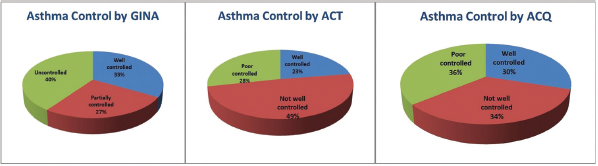
Figure 2.
Control of asthma among the studied patients by GINA score, ACT and ACQ.
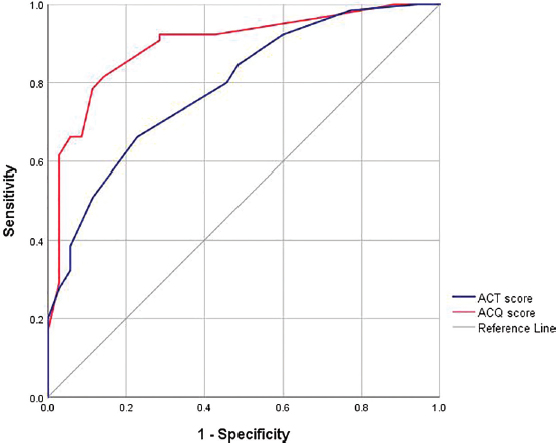
Figure 3.
ROC curve of diagnostic performance of ACT, ACQ scores in prediction of uncontrolled asthma.
Table 9.
Diagnostic performance of ACT and ACQ scores in the prediction of uncontrolled asthma according to GINA classification
| Variable | AUC (%) | 95% CI | P value | Cutoff point | Sensitivity (%) | Specificity (%) | PPV (%) | NPV (%) | Accuracy (%) |
|---|---|---|---|---|---|---|---|---|---|
| ACT | 79 | 0.7:0.9 | <0.001* | 18.5 | 66.2 | 77.1 | 84.3 | 55.1 | 70 |
| ACQ | 89.6 | 0.9:0.94 | <0.001* | 0.9 | 81.5 | 85.7 | 91.4 | 71.4 | 83 |
Discussion
In this study, we explored the determinants of asthma severity and asthma control, as well as the diagnostic performance of different control assessment tools (GINA, ACT, ACQ). Our findings highlighted important clinical and epidemiological insights with significant implications for asthma management. Regarding the baseline clinicodemographic characteristics in this study cohort, our age distribution, with 55% of patients under 40 years, aligns with CDC data showing the highest asthma prevalence in adults aged 18-44 years (11). Similarly, the predominance of females (72%) is consistent with national trends and widely attributed to hormonal and immunologic factors (12). The predominance of female participants reflects the real clinic population and known epidemiological trends, but this imbalance may limit generalisability to male-dominant populations. Obesity was observed in almost one-quarter (24%) of patients, similar to Egyptian and regional data, and confirms the well-established contribution of obesity to worse asthma control (13).
Our cohort demonstrated substantial fixed airway obstruction, with 24% exhibiting FEV1<60% and an average FEV1 of 74.7% predicted a pattern consistent with irreversible airway changes. This observation aligns with the GINA 2024 update, which emphasizes that lung function may not closely correlate with symptoms but remains essential for risk stratification (1). Moreover, a 2025 longitudinal study in The Lancet Respiratory Medicine shows that lung function trajectories are largely set early in life, indicating that many of our patients may have had suboptimal asthma control from a young age (14).
Blood eosinophilia (27%) was also notable, aligning with recent phenotyping studies that identified eosinophilic asthma as a distinct endotype with therapeutic implications (15).
Asthma is a heterogeneous condition in which severity reflects symptoms alongside lung function, comorbidities and environmental factors. In our cohort, greater severity was linked to reduced lung function, relevant comorbidities and environmental exposures, with severe cases being older, more often female and more likely to have diabetes or HTN. Impaired lung function emerged as the strongest predictor of severe asthma in our cohort. This aligns with previous evidence: a longterm cohort from Northern Sweden reported that low baseline FEV1 (<80% predicted) increased the risk of developing severe asthma (16). Similarly, in adult-onset asthma, lower FEV1/FVC ratios predicted progression to severe disease (OR ≈ 1.6 per 10% decline; OR ≈ 3.9 when <95% predicted (17).
In our cohort, diabetes and HTN were significantly associated with severe asthma, consistent with evidence that metabolic comorbidities contribute to poorer asthma outcomes. A nationwide Korean cohort found that patients with severe asthma had greater cardiovascular and metabolic disease burdens than those with non-severe asthma (18). Similarly, metabolic dysfunction such as insulin resistance, hyperglycaemia and obesity has been shown to increase asthma incidence, severity and exacerbation risk (19). This underscores the need for routine screening and management of diabetes and HTN in asthma care.
In our cohort, severe asthma was strongly associated with air pollution exposure, consistent with reports such as the French EGEA study linking long-term O3 and PM10 exposure to poor asthma control (20). Biomass smoke, which contributes to both indoor and outdoor air pollution, is included within this exposure. Therefore, assessing environmental exposures and advising patients on pollution avoidance may help reduce severity. Severe asthma was also more common in females and older adults, consistent with evidence of higher risk in women, especially those over 60 (21). Clinically, this underscores the need for closer monitoring and tailored care in this group.
Asthma control requires a combination of appropriate medication, attention to comorbidities, treatment adherence and environmental modification. In this 6-month follow-up of 200 patients, high SABA use, GERD, allergen exposure, reduced lung function and frequent exacerbations were all associated with poor symptom control.
These findings align with recent evidence showing the adverse impact of SABA overuse on asthma outcomes, including higher risks of exacerbations and mortality (22, 23). Similarly, the association between GERD and uncontrolled asthma has been widely reported, as reflux can exacerbate airway inflammation and worsen symptom perception (24). Although air pollution and comorbidities such as GERD, obesity and allergic rhinitis were evaluated, they did not remain significant in multivariable models, likely reflecting limited power and collinearity. Allergen exposure continues to be a recognised contributor to uncontrolled asthma, with recent reviews confirming that targeted avoidance improves outcomes in sensitised patients (25). Recent evidence supports this; a 2023 review showed that home allergen avoidance improves asthma control, consistent with our emphasis on managing exposure (26).
After adjustment, allergen exposure and lower FEV1 remained independent predictors, underscoring the combined environmental and physiological contributors to asthma. These findings are consistent with Fielding et al. (27), who showed that sensitisation and reduced lung function heighten the risk of poor outcomes. This supports a multifactorial nature of asthma that includes allergen reduction, closer lungfunction monitoring and adherence reinforcement, in line with current GINA recommendations (28).
The GINA guidelines emphasise routine assessment of asthma control using validated tools such as ACT and ACQ (29). In our study, both ACT and ACQ showed moderate agreement with GINA classifications, with ACQ demonstrating stronger concordance. This aligns with Thomas et al. (30) who reported moderate ACT-GINA correlations (24), and with Olaguibel et al. who found that ACQ aligned more closely with GINA-defined control, supporting our observation of its superior concordance (32). More recent data from Arismendi et al. (31) also confirm the reliability of ACT under updated GINA-2023 criteria. These findings are consistent with prior work showing stronger alignment of ACQ with guidelinebased control, while confirming ACT as a practical, reliable tool for routine use (30, 31).
The superior performance of ACQ compared with ACT may be explained by its more detailed structure and inclusion of an objective airflow limitation component (FEV1), which aligns closely with GINA’s emphasis on risk assessment. In contrast, ACT relies entirely on subjective symptom recall, which may vary by patient literacy and perception. The diagnostic metrics in our ROC analysis further support this interpretation, as ACQ demonstrated higher sensitivity, specificity, and overall accuracy (AUC 0.896 vs 0.79 for ACT).
Clinically, ACT may be most suitable for primary care due to its simplicity, whereas ACQ can provide a more precise assessment in specialised or research.
Conclusion
Our study highlights the multifactorial nature of asthma severity and control, emphasising the roles of demographic factors, comorbidities, lung function impairment and environmental exposures. Asthma severity is influenced by age, sex, comorbidities, lung function and environmental exposures, while poor control is linked to SABA overuse, GERD, allergens and reduced FEV1. Both ACT and ACQ are useful tools, though ACQ aligns more closely with GINA, whereas ACT remains practical for routine care. These findings support a personalised, multidimensional approach to asthma management.
Strengths and limitations
This study provides real-world evidence from the population in Upper Egypt, exploring the predictors of asthma severity and poor control. It is among the few studies to compare three major control assessment tools (GINA, ACT and ACQ) within the same cohort. The use of standardised GINA 2024 criteria, validated control questionnaires and objective spirometry data enhances the validity and reliability of findings. By integrating clinical, environmental and functional factors, the study offers a comprehensive and practical understanding of asthma behaviour and management in routine care. However, this study has several limitations; its single-centre design and gender imbalance may limit generalisability. Some unmeasured confounders could also have influenced the results. In addition, the use of questionnaire-based tools introduces potential recall bias, and the absence of extended longitudinal follow-up restricts our ability to assess longterm outcomes. Future multicentre longitudinal studies are needed to confirm these findings and explore additional biomarkers of asthma control.
Acknowledgements
The authors thank the staff of Sohag University Hospital for their support during data collection and patient evaluation.
Notes
[14] Funding
The authors received no specific grant from any funding agency in the public, commercial, or not-for-profit sectors for this research.
[15] Conflicts of interest Conflict of interest disclosure
No conflict of interest of any kind.
[16] Conflicts of interest Competing interests
The authors declare that they have no competing interests.
[17] Authorship statement
All authors contributed equally to this work.
[18] Data availability statement
Data are available upon request.
[19] Ethical approval statement
Ethical approval was obtained from the Faculty Research Ethics Committee (Approval N.Soh-Med-23-10-015MS).
[20] Patient consent statement
All patients were informed about the research aims and approved to participate and signed informed written consent.
[21] Permission to reproduce material from other sources
NA.
Abbreviations
- ACQ
asthma control questionnaire
- ACT
asthma control test
- AIRQ
asthma impairment and risk questionnaire
- ATS
American Thoracic Society
- AUC
area under the curve
- BMI
body mass index
- CI
confidence interval
- COPD
chronic obstructive pulmonary disease
- DM
diabetes mellitus
- ERS
European Respiratory Society
- FEV1%pred
percent predicted forced expiratory volume in one second
- FEV1
forced expiratory volume in one second
- FEV1/FVC
ratio of forced expiratory volume in one second to forced vital capacity
- FVC
forced vital capacity
- GERD
gastroesophageal reflux disease
- GINA
global initiative for asthma
- ICS
inhaled corticosteroids
- IQR
interquartile range
- LLN
lower limit of normal
- MCID
minimal clinically important difference
- NAEPP
national asthma education and prevention program
- O3
ozone
- OR
odds ratio
- PM10
particulate matter ≤
- 10 μm; ROC
receiver operating characteristic
- SABA
short-acting β
- 2-agonist; SD
standard deviation
- SPSS
statistical package for the social sciences
- WHO
world health organization.