
Introduction
Angiosarcoma is a rare and aggressive malignant vascular tumour originating in the endothelium of the blood and lymphatic vessels, with possible localisation in any part of the body, but more frequently in the cephalic extremity. It accounts for <2% of all sarcomas (1). Metastasis of angiosarcoma is common in about half of diagnosed cases, being predominantly in the lungs, with primary tumours being rare at this stage (2). Thus, initial clinical manifestations may present as non-specific respiratory tract symptoms (dyspnoea, cough, haemoptysis).
Case report
We present the case of a 74-year-old male patient, nonsmoker, vaccinated against SARS-COV-2, no drug allergies or environmental factors, no occupational exposure to respiratory toxins, with a medical history of high blood pressure, heart attack, ischaemic heart disease, minor valvular abnormalities, two episodes of ischaemic stroke with sequelae tremor in the upper limbs and generalised epilepsy under treatment. Anamnestically, he reports the onset of symptoms 3 weeks ago, with whooping cough and haemoptysis after discharge from the oral-maxillofacial surgery service, where he was hospitalised for the treatment of dental infectious outbreaks; he was totally edentulous at the time of presentation. The patient presented with an episode of hypoxemia objectified at home 2 weeks ago, with a minimum SpO2 value of 90% in room air and chronic left shoulder pain, which had worsened over the past 2 months.
Physical examination revealed pale skin, grade I obesity with abdominal distribution (body mass index (BMI) 30.42 kg/m2), functional impotence in the left upper limb, with significant limitation of movement in all planes, slightly kyphotic thorax, present vesicular murmur bilaterally, slightly diminished right basally, rhonchi in the lower half of the right lung and right internal supraclavicular formation, firm to palpation, painless, fixed in the deep planes, approximately 5 cm in diameter and without swallowing difficulties.
Clinically, aspiration pneumonia was initially suspected in connection with multiple dental extractions, but a proliferative process could not be excluded (Figure 1).
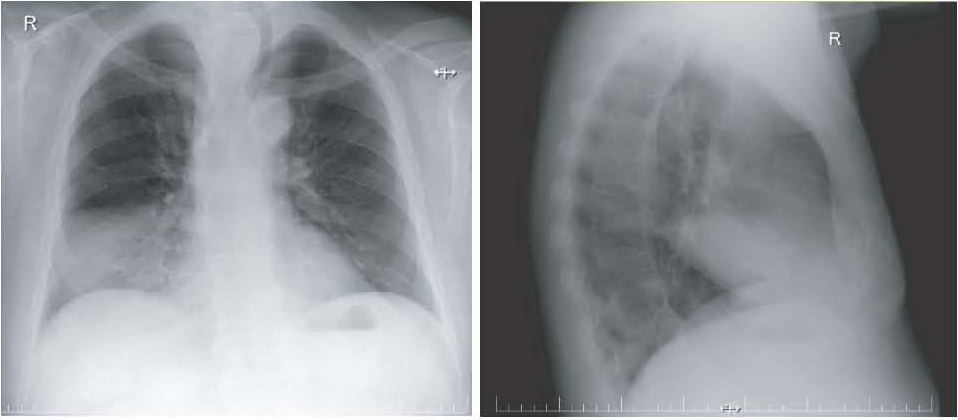
Figure 1:
Chest radiograph postero-anterior view (PA) and right lateral view (LLR) incidence: cervical formation with mass effect on the trachea, lung condensation located in the middle lobe.
Mild inflammatory syndrome was identified, with procalcitonin within normal limits and elevated D-dimer. AngioCT examination ruled out pulmonary thromboembolism, but revealed a cervico-mediastinal anterior paratracheal right formation with tissue structure, with postcontrast peripheral iodophilia and mass effect on the structures, pulmonary condensation at the middle lobe, without air bronchogram, plaqued on the pleura, associated with changes in ‘ground glass’ both at the middle lobe and right lower lobe with suggestive aspect of alveolar haemorrhage in the clinical context presented. We also identified osteolytic lesions associated with fracture at the scapula body and left coracoid bone, in the absence of thoracic trauma (Figure 2).
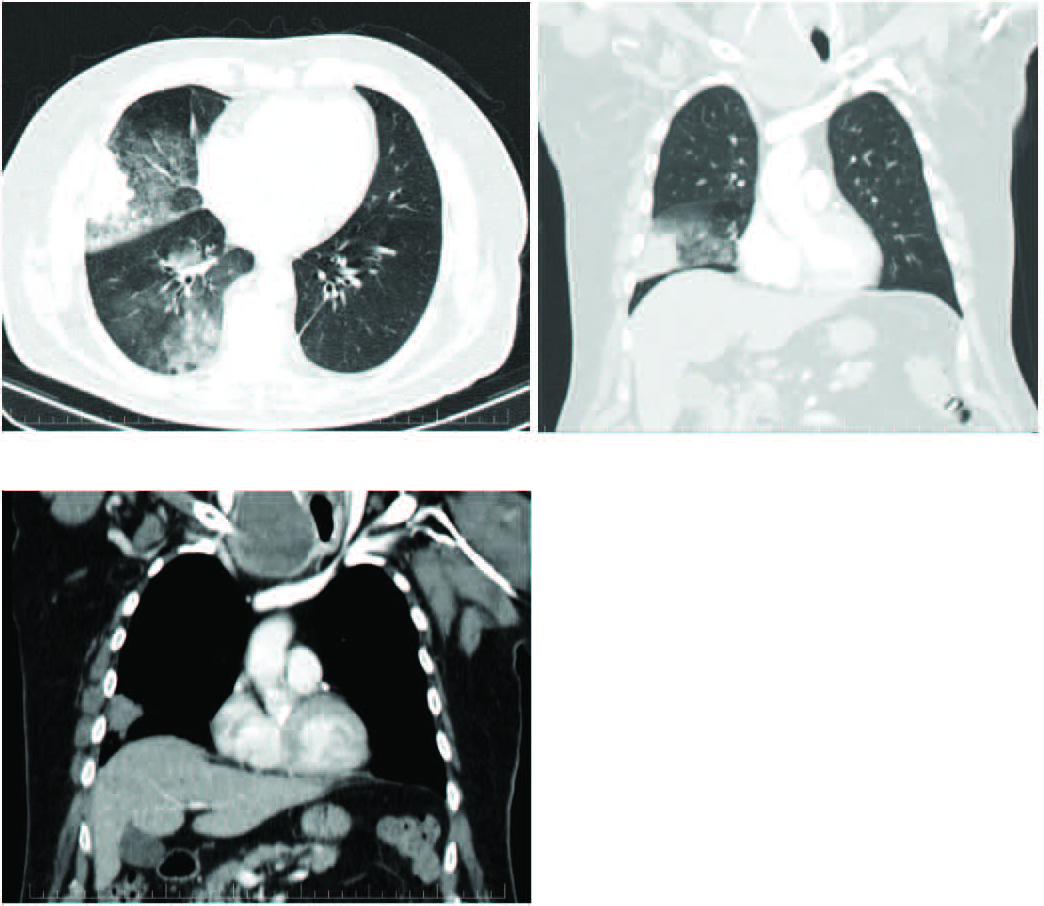
Figure 2:
Chest computed tomography: pulmonary condensation of the middle lobe, surrounded with ground glass opacity both at the middle lobe and right lower lobe.
Fibrobronchoscopy showed no evidence of endobronchial lesions, only bleeding and clots from the middle lobar bronchi and contralateral haemorrhagic secretions, probably aspirated. In this context, ‘blind’ transbronchial biopsy of the middle lobe is avoided. For the differential diagnosis of alveolar haemorrhagic syndrome, pANCA and cANCA are performed, with negative results. Mycologic examination of the bronchial aspirate identifies the presence of Itraconazole-sensitive Candida glabrata. In the absence of an endobronchially or ultrasonographically accessible pulmonary lesion, an ultrasonographic biopsy of the right upper cervico-mediastinal formation is performed after an interventional radiology consultation, which temporises the biopsy of the left scapular lesion (Figure 3).
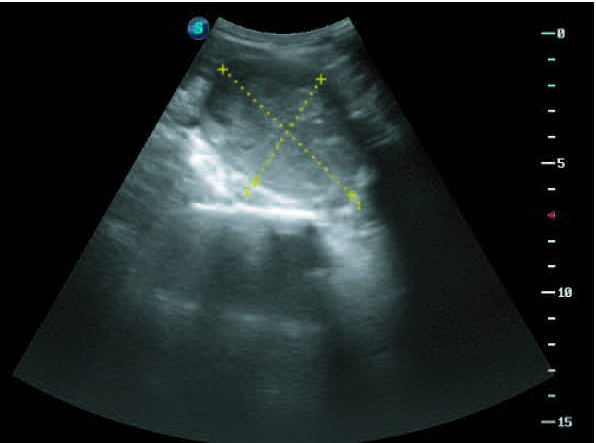
Figure 3:
Ultrasonography of the cervico-mediastinal mass: hypoechoic structure with oval shape and well-defined margins.
Imaging monitoring reveals atelectatic changes in the middle lobe.
Under intravenous antibiotic treatment with third-generation Cephalosporins and Lincosamide, antifungal, haemostatic, intravenous corticoid in low doses, gastric and hepatic protector, the patient’s general condition remained good, and haemoptysis was reduced quantitatively but persisted, with pain in the scapular region and functional impotence of the left upper limb in this context. The patient was discharged pending histopathologic results. He was readmitted by emergency 3 weeks after discharge, with a worsened general condition manifesting as shortness of breath, persistent haemoptysis, altered physical performance, severe anaemia (Hb 4.8 g/dL) with repeated transfusion requirements and hypoxemic (SpO2 88% in room air). Thoracic-pleuro-pulmonary radiography in postero-anterior view showed the presence of a small right pleural effusion associated with known right basal atelectasis (Figure 4).
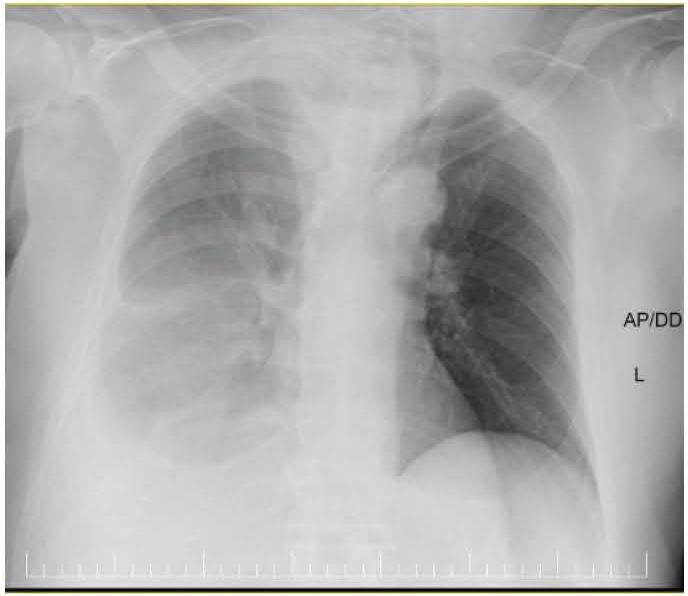
Figure 4:
Chest radiograph: right pleural effusion.
Due to the worsening tendency of dyspnoea, the patient was monitored ultrasonographically, with the identification of a growing right pleural effusion in large quantity. A right thoracocentesis was performed at the bed, with evacuation of 1000 mL of intensely haemorrhagic fluid. A small-medium remaining collection was seen, as an intense haemorrhagic exudate (haematocrit 21.9%), without signs of malignancy on cytologic examination. The histopathologic findings from the cervical formation suggestive for angiosarcoma were obtained. Due to the massive necrosis, biopsy from another localisation or excision of the formation was recommended. The patient was transferred to the Oncologic Institute for further evaluation and treatment and was admitted to the ICU. Subsequently, angiosarcoma was confirmed from guided CT biopsy of the left scapular lesion. The patient died approximately 2 weeks after transfer to the Oncology ward.
Discussion
We present a case of persistent haemoptysis in a patient with an initial suspicion of bronchopneumonia, in whom extrapulmonary angiosarcoma with two localisations was identified, the cervico-mediastinal and left scapular bone, but without confirmation of pulmonary lesion, the source of haemoptysis. It could not be specified whether the lesions detected represent the primary tumour or its metastasis. Because of the risk of massive haemoptysis, transbronchial invasive procedures were avoided. Subsequently, the appearance of haemothorax supports the aggressive course with haemorrhagic complications of an angiosarcoma with parenchymal lung localisation. The general condition of the patient did not allow further invasive investigations.
D-dimer are degradation products of fibrin, a protein involved in blood coagulation. They are used as indicators of coagulation processes; elevated levels suggest systemic activation of haemostasis and fibrinolysis. Angiosarcoma, due to its vascular origin, can lead to activation of the coagulation system with clot formation and their degradation, leading to elevated D-dimer levels (3). This has been associated with shorter survival, a higher risk of mortality (4) and increased risk of metastasis (5).
The particularity of the case is the masked ‘pseudopneumonic’ onset in connection with repeated surgeries in the oral- maxillofacial sphere in a patient with painful symptoms and supraclavicular formation, neglected by the patient and unidentified at previous medical examinations. The time from presentation to death was approximately 2 months.
The most common risk factors are chronic lymphoedema and a history of radiotherapy (6), which were not identified in this case. It is diagnosed at a higher rate in older Caucasian men, often postmortem (7). The oncological treatment varies depending on the localisation and stage; in advanced or metastatic forms options include chemotherapy with doxorubicin and paclitaxel, as well as immunotherapy (8).
Conclusions
Haemoptysis is an unpatognomonic symptom, common in pulmonary pathology, often raising multiple problems 3. of differential diagnosis, involving complex examinations (imaging, bronchoscopic), for which oncologic pathology is one of the main causes. Angiosarcoma is a rare malignancy and all the more so, because of its pulmonary localisation. 4. For this reason, diagnosis can be difficult. Even in the presence of histopathologic confirmation, the course is aggressive, the prognosis poor and the therapeutic options limited (9).
Notes
[1] Conflicts of interest Conflict of interest
The authors declare there is no conflict of interest.
[2] Informed consent statement
Informed consent was obtained from the subjects involved in the study.
[3] Funding
This study did not receive any funding.