
Introduction
Worsening symptoms leading to additional medication are signs of asthma exacerbation. Most patients with asthma in outpatient clinics have uncontrolled asthma (1), which is a risk factor for exacerbation. Several triggers for asthma exacerbation include exposure to allergens, viral infections, bacterial infections, occupational dust exposure, drugs and air pollution (2). The prevalence of viral infections in adult asthma exacerbations was reported to be between 34% and 76% (3, 4). Amongst respiratory viruses, rhinovirus (RV) is responsible for approximately 36.8% of virus-induced asthma exacerbations (5).
Susceptibility to viral infection is related to epithelial fragility and disruption of the airway epithelial barrier. The damaged functional integrity of the barrier allows environmental pollutants and viruses to penetrate the epithelium easily (6). The attack of respiratory viruses stimulates the innate immune response, leading to the exacerbation of asthma. Viral infection triggers the production of cytokines, including thymic stromal lymphopoietin (TSLP), interleukin (IL)-25, IL-33 and granulocyte-macrophage colony-stimulating factor (GM-CSF), through the activation of toll-like receptors. These innate cytokines activate the role of immunomodulatory dendritic cells. The adaptive immune response to viral infection begins with T cell activation by antigen-presenting cells (APCs) and the interaction of cytokines, chemokines and mediators that produce asthmatic inflammation (7). Several studies have reported defective interferon responses in the epithelial cells of the airway in patients with asthma and viral infections. Lower interferon production facilitates the expansion of the virus to the lower airway and increases the severity of asthma exacerbation (8).
IL-33 is a pleiotropic cytokine belonging to the IL-1 family that plays an important role in many inflammatory processes. In studies with animals and humans infected with respiratory viruses, there is generally an increase in IL-33 and T helper 2 (Th2) inflammation, which is characterised by the increased production of IL-13 cytokines (IL-33/IL-13 axis) (3, 9, 10). Recent studies have reported that IL-33 regulates pulmonary neutrophilic inflammation (11, 12). The deficiency of the IL-33/suppression of tumorigenicity 2 (ST2) axis in the murine model leads to neutrophilic inflammation, as indicated by high IL-33 and low IL-13 levels (12). There is an inconsistency in the role of IL-33 in virus-induced asthma exacerbation. This study aimed to investigate the correlation between IL-33 and IL-13 expression in virus-induced asthma exacerbation.
Materials and methods
Patients and study design
A cross-sectional study of asthma exacerbation patients who visited the emergency department of Dr. Soetomo Hospital and Airlangga University Hospital was conducted for 6 months, starting in May 2019. All asthma exacerbation patients aged 18–55 years who were willing to participate in the study were included as study subjects. The inclusion criteria included all asthma severity levels and did not consider medication use. Chronic obstructive pulmonary disease (COPD), hypertensive heart failure and lung cancer patients were excluded from the study. This study’s definition of asthma exacerbation is based on the GINA guidelines. Asthma exacerbation is an episode of progressive worsening of symptoms: cough, shortness of breath and wheezing from the usual condition, which then leads to the need for additional medication (13). Mild-moderate exacerbation is characterised by shortness of breath, speaking fluently, no agitation, increased respiratory rate, no accessory breathing muscle in use, peripheral oxygen saturation (room air) 90%–95%, Peak Expiratory Flow (PEF) >50% predicted. Severe exacerbation is characterised by shortness of breath, interrupted speech, agitation, signs of accessory muscle use and peripheral oxygen saturation (room air) <90%, PEF <50% predicted (13).
Patients with asthma exacerbations were treated according to the Global Initiative for Asthma (GINA) guideline. This study received ethical approval from the Dr. Soetomo Hospital (1182/KEPK/V/2019) and Airlangga University Hospital (134/KEH/2019) ethics committee, following the Helsinki Declaration. Written informed consent was obtained from all study subjects.
Cytokine testing and viral detection
Approximately 5 mL of peripheral blood was drawn using a blood collection tube. The collected blood samples were then stored at −80°C. Serum levels of IL-33 and IL-13 were analysed using enzyme-linked immunosorbent assay (ELISA) using a Human ELISA kit (Cat No. E-EL-H2402, Cat No. E-EL-H0104, Elabscience Biotech Inc. (Houston, Texas, USA)) according to the manufacturer’s protocol with a sensitivity of 9.3 pg/mL. IL-33 and IL-13 serum were examined in the Clinical Pathology Laboratory of Dr. Soetomo Hospital. Nasal swab samples were collected from study subjects and then analysed for virus detection. Virus detection was conducted using the xTAG Respiratory Virus Panel Fast V2/LUMINEX (Synlab) (Munich, Germany) at the Institute for Tropical Diseases, Universitas Airlangga.
Statistical analysis
Data were presented as the mean with standard deviation (SD). Levels of IL-33, IL-13 and respiratory viruses were analysed using the Mann–Whitney test analysis on data that is not normally distributed. The relationship between IL-33 and IL-13 levels in viral asthma exacerbations was determined using the Spearman test, with P < 0.05 as significant.
Results
Patient characteristics
During the 6-month study period, 52 patients with asthma exacerbation were suitable; three of them refused to participate, resulting in 49 patients being study subjects. There are more female subjects than male subjects (71.4%). The mean ages of patients with virus-positive and virus-negative asthma exacerbations were not significantly different. The majority of subjects (79.6%) were non-smokers, 69.4% had uncontrolled asthma, 30.6% had partially controlled asthma and no patients had controlled asthma. Asthma medication history was inhaled corticosteroid (ICS)/long acting beta-2-agonist (LABA) (42.8%), short-acting beta agonist (SABA) using pressurized metereddose inhalers (pMDI) (75.5%), oral xanthine (aminophylline) (18.4%). Hypertension, diabetes mellitus, gastroesophageal reflux disease (GERD) and a history of allergy were comorbidities recorded in this study (Table 1).
Table 1.
Characteristics of the research subject
| Variable | Virus-positive (n = 15) | Virus-negative (n = 34) | P-value |
|---|---|---|---|
| Age (years) | 37.33 ± 15.76 | 45.91 ± 12.48 | 0.067 |
| Gender | 0.174 | ||
| Male | 2 | 13 | |
| Female | 13 | 22 | |
| Smoking | 0.145 | ||
| Yes | 1 | 9 | |
| No | 14 | 25 | |
| History of allergy | 0.652 | ||
| Yes | 14 | 29 | |
| No | 1 | 5 | |
| Duration of asthma (years) | 0.538 | ||
| <20 | 8 | 7 | |
| >20 | 14 | 20 | |
| Asthma control | |||
| Partially controlled | 5 | 10 | 30.6% |
| Uncontrolled | 10 | 24 | 69.4% |
| Comorbidities | |||
| DM | 7 | 1 | |
| Hypertension | 3 | 1 | |
| GERD | 1 | 0 | |
Profile of respiratory viruses related to exacerbation
Nasal swab samples from 49 study subjects were examined using xTAG Respiratory Virus Panel Fast V2/LUMINEX. Approximately one-third (15 subjects, 30.6%) of the samples were infected with a respiratory virus. The respiratory viruses detected were predominantly RV (80%), followed by a coronavirus and one patient with double viral infections (coronavirus and RV) (Table 2).
Viral infection and severity of asthma exacerbation
Viral infection leads to varying degrees of exacerbation severity. The statistical chi-square test showed no significant difference in exacerbation severity between virus-positive asthma exacerbation and virus-negative asthma exacerbation (P = 0.053) (Table 3).
Serum IL-33 and viral infection
The IL-33 serum level of virus-positive study subjects was 30.01 ± 20.85 pg/mL, whereas the result in virus-negative subjects was 19.28 ± 15.11 pg/mL. The Mann–Whitney analysis test for IL-33 serum level in virus-positive subjects presented P = 0.032 (Figure 1).
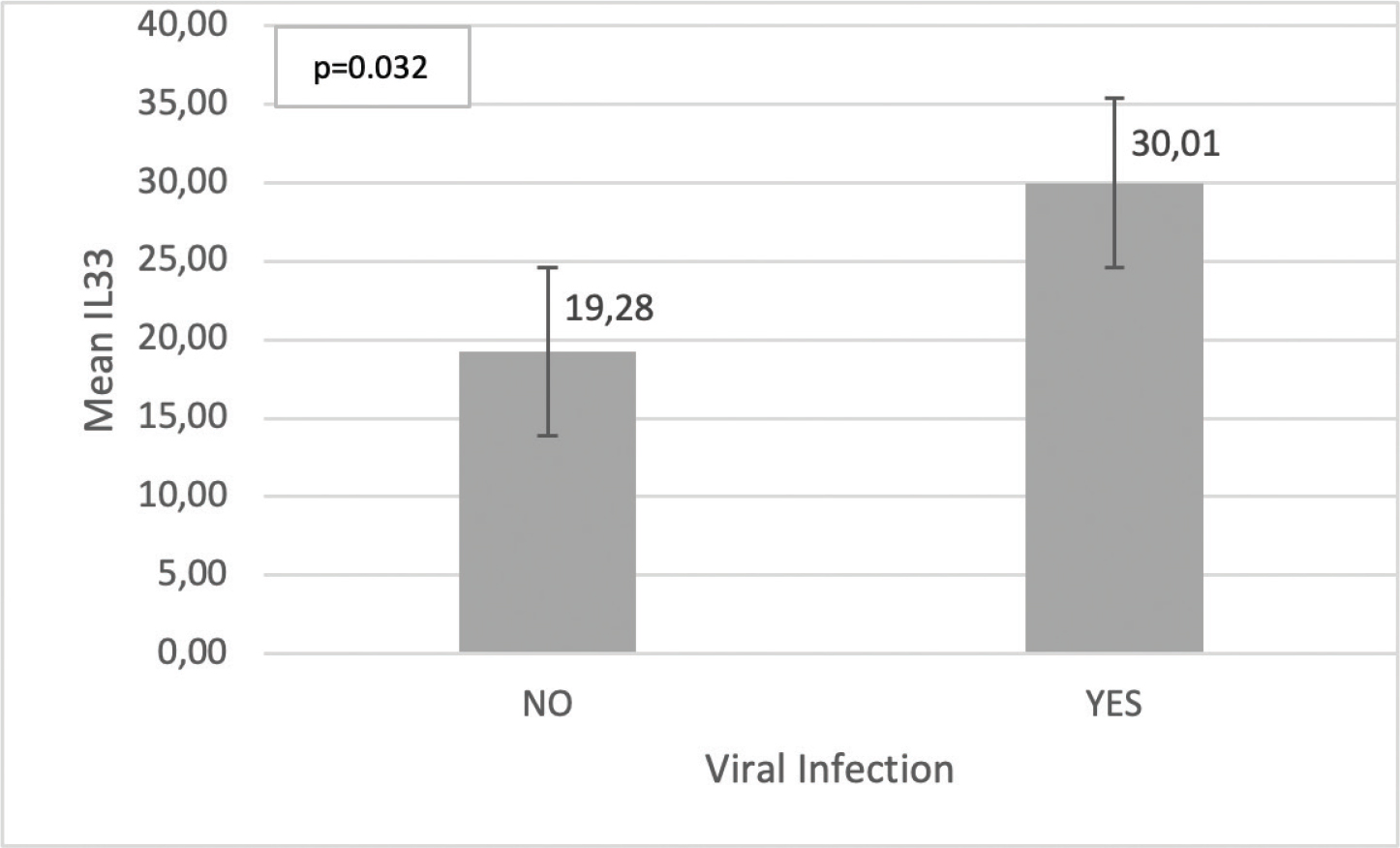
Figure 1.
Serum level of IL-33 and viral infection. IL, interleukin.
Serum IL-13 and viral infection
The IL-13 serum level of virus-positive study subjects was 27.19 ± 36.86 pg/mL, whereas the result in virus-negative subjects was 34.10 ± 40.33 pg/mL. The Mann–Whitney test for IL-13 serum level in virus-positive subjects presented P = 0.588 (Figure 2).
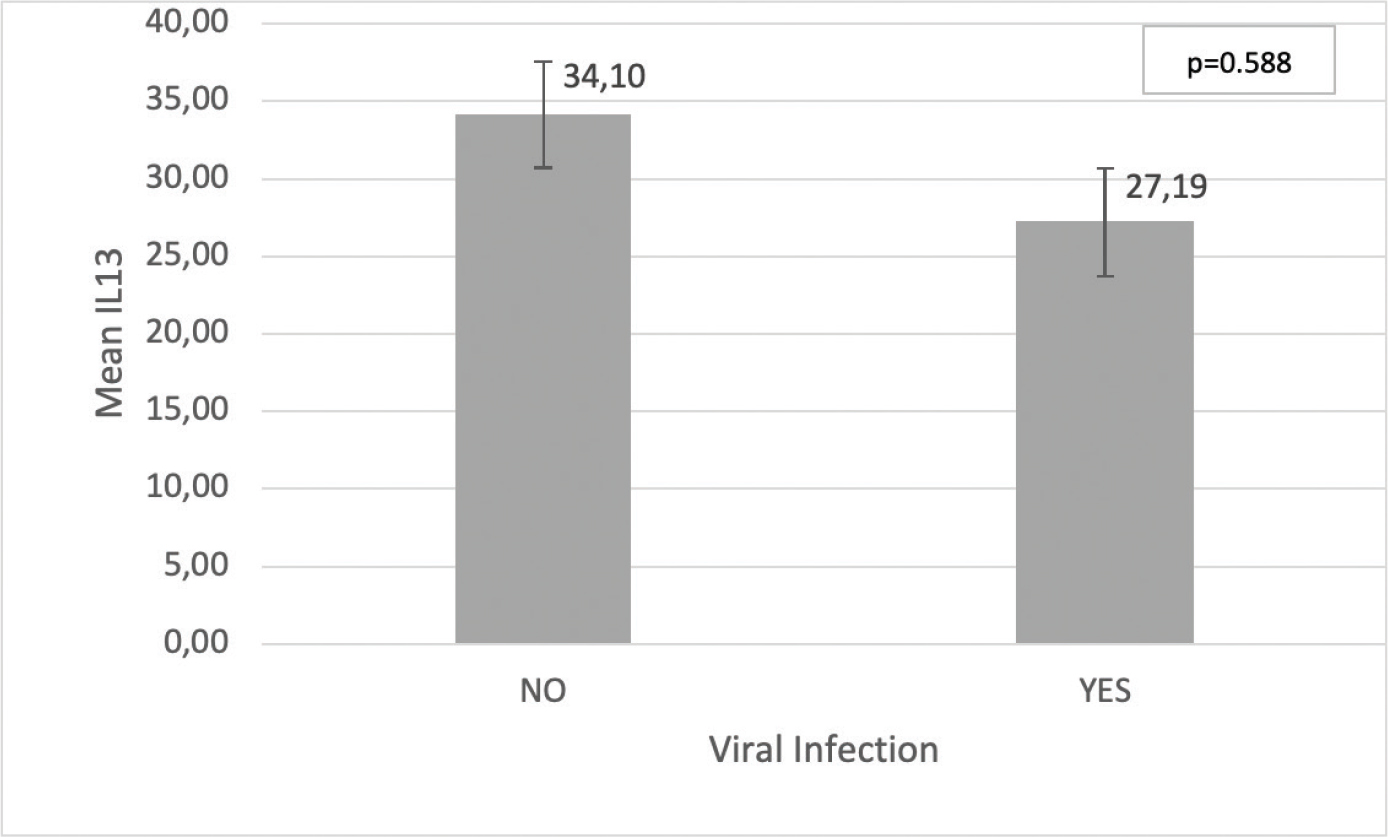
Figure 2.
Serum level of IL-13 and viral infection. IL, interleukin.
Association between IL-33 and IL-13 expression and viral infection
There was no relationship between IL-33 and IL-13 expression in virus-positive subjects (P = 0.463) (Figure 3A). Likewise, there was no relationship between IL-33 and IL-13 (P = 0.926) in virus-negative subjects (Figure 3B).
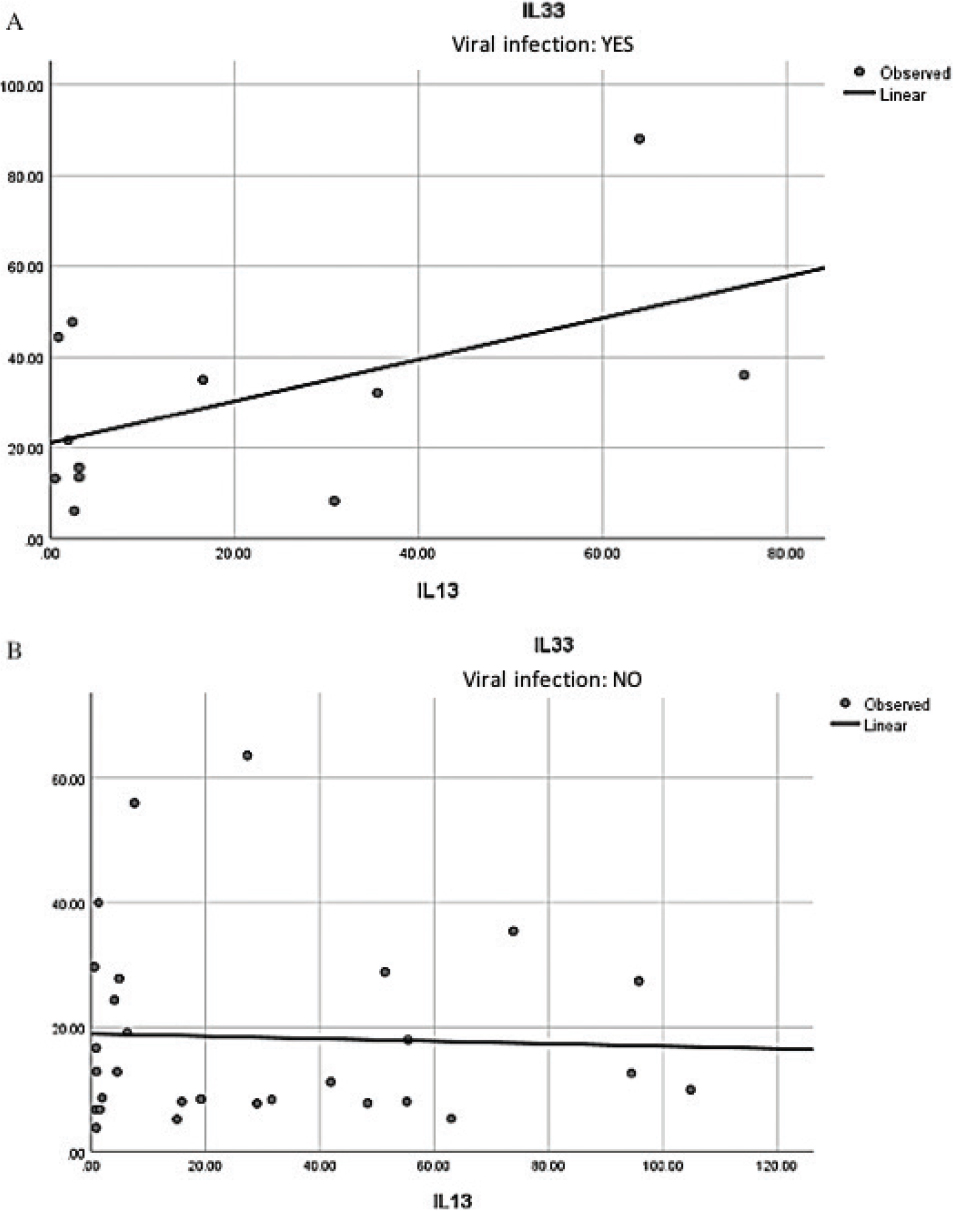
Figure 3.
(A and B) Association of IL-33 and IL-13 with viral infection. IL, interleukin.
Discussion
Previously published studies were marked by the IL-33/IL-13 axis, whereas in this study, there was no evidence of IL-13 secretion, although there was IL-33 secretion (9, 10). Serum IL-33 levels were significantly increased in virus-positive subjects with asthma exacerbation compared with those in virus-negative subjects (Figure 1). This outcome confirmed that respiratory viral infections, especially those caused by RVs, play a role in raising IL-33 production, as seen in several previous studies (9, 12). IL-33 is an alarming cytokine that signals cell and tissue damage and promotes type 2 and neutrophilic airway inflammation (12, 14). In this study, a higher IL-33 was found in virus-positive asthma exacerbation patients, with no difference in IL-13 value compared to virus-negative asthma exacerbation patients (Figures 3A and 3B). Several factors may cause this lack of correlation, including differences in baseline asthma severity, or medication may have influenced the cytokine levels observed. A study by Ma et al. (12) in murine models showed neutrophilic allergic airway inflammation, and a study by Curren et al. (15) in mice also showed neutrophilic inflammation in the early challenge with RV.
IL-33 is a pleomorphic cytokine of the IL-1 family that exerts biological effects by binding to IL-1RL1/ST2 (14). The binding of IL-33 to IL-1RL1 induces a transduction signal, resulting in different inflammatory responses depending on the cell type. No increase in the serum IL-13 level in this study was possibly caused by the inability of IL-33 to induce ST2 expression in IL-33-activated dendritic cells (DCs), as reported in the Rank et al.’s (16) study.
Recent studies have reported that the interaction of IL-33 with ST2 can lead to neutrophilic inflammation in animal models (11, 12). In a study by Ma et al. (12), murine models sensitised to house dust mite (HDM) and lipopolysaccharide (LPS) displayed neutrophilic airway inflammation. In mice sensitised with HDM and LPS, the level of mature form IL-33 in bronchoalveolar lavage (BAL) was significantly higher than in mice sensitised with LPS. However, pulmonary IL-13 levels were not different between mice sensitised to HDM LPS and LPS. Furthermore, it was also proven that neutrophilic airway inflammation occurred in mice with IL-33 deficiency and/or ST2, which were sensitised to HDM and LPS (12). In ST2-deficient mice, neutrophil counts increased within 24 hr after bleomycin therapy (17). In the ozone-exposed lung injury model, neutrophilic inflammation developed despite lacking IL-33/ST2 signalling (18). The mechanism by which the IL-33/ST2 axis regulates neutrophilic airway inflammation is still largely unknown. One mechanism suggests that the IL-33/ST2 axis regulates the expression of the C-X-C Motif Chemokine Receptor (CXCR2) on the surface of neutrophils, thereby affecting neutrophilic chemotaxis (19). The study by Ma et al. (12) reported increased secretion of neutrophilic chemokine keratinocyte-derived cytokine (KC) in macrophages and epithelial cells in the absence of IL-33 or ST2. Therefore, IL-33/ST2 deficiency can partly explain neutrophilic inflammation (10). In this study, IL-13 levels were not higher in viruspositive asthma exacerbations than in virus-negative patients (Figure 2). Perhaps IL-33 is no longer in an active state because of biological inactivation that interferes with receptor binding, which leads to no increase in IL-13 production along with high-level IL-33 serum in virus-positive subjects. IL-33 released during cellular rupture in an active form (reduced) is rapidly oxidised and becomes biologically inactive (20). Cohen et al. (21) verified that IL-33 was detected in active (reduced) and inactive (disulfide-bonded) forms in moderatesevere asthmatic sputum. IL-33 is rapidly inactivated within 1 hr of release in the extracellular environment through cysteine oxidation to form disulphide bridges that reduce ST2-dependent activity (21).
In children and adults, viral infections play a role in asthma exacerbations, and up to 60% of asthma exacerbations in adults are related to upper respiratory tract infections (22). Viral pathogens can cause a spectrum of mild to severe to fatal asthma. The severity of RV infection is influenced by age, male gender and reduced lung function (23). In an observational study by Liao et al. (3), several points were highlighted: the mean age of the subjects was 48.7 years old, respiratory syncytial virus (RSV), RV and human coronavirus (hCoV) were the most common causes of asthma exacerbations, and no difference was found in the exacerbation severity between the virus-positive and virus-negative subjects. In this study, the mean age was 43.7 years, and viral infections did not lead to more severe exacerbations than virus-negative subjects (Table 3). The study by Berjgerrad et al. showed that viral infections provoke more severe exacerbations than non-viral infections (24).
Acute RV infection heightens several inflammatory cells, including neutrophils, lymphocytes and eosinophils, in the nasal and bronchial mucosa (25). The airway inflammation patterns are correlated with hyperresponsiveness, chest symptoms and reduced lung function (11). In addition, viral asthma exacerbations were accompanied by an increase in neutrophil sputum airway inflammation associated with the severity of airway obstruction (4).
The limitation of this observational study is that only serum IL-33 and IL-13 levels were measured in patients with asthma exacerbations. Differences in baseline asthma severity or medication may have influenced the observed cytokine levels. ST2 level was not measured. Therefore, confirming whether IL-33/ST2 deficiency is present is impossible. There are no data on eosinophils, peripheral circulation neutrophil counts, fractional exhaled nitric oxide (FeNO), or differential sputum counts, which hinders the conclusion of whether Th2 inflammation is high or low. The relatively small number of samples may have affected the statistical analysis results. However, in this study, it was shown that respiratory viral infection increased IL-33 levels.
Conclusion
Data from subjects with virus-positive asthma exacerbation illustrated a higher level of serum IL-33 compared to virusnegative subjects. No distinction was seen in serum IL-13 levels between the groups. There is no correlation between IL-33 and IL-13 in asthma exacerbation due to virus infection.