
1. Introduction
Terahertz (THz) waves (0.1–10 THz) [1], which integrate the unique merits of penetrating non-polar materials [2], causing no ionization damage [3], enabling molecular spectral fingerprinting [4,5], and possessing ultra-broadband characteristics [6], have demonstrated pivotal application potential in diverse fields such as public security hazard screening [2], non-invasive biomedical diagnosis [7,8], industrial package defect detection [9], and 6G ultra-large bandwidth communications [10–12]. Two decades ago, the lack of room-temperature THz detectors constrained the development of modern THz systems [1]. However, two-dimensional (2D) materials, represented by graphene [13,14], black phosphorus (BP) [15,16], and transition metal dichalcogenides (TMDs) [17,18], endowed with unique electronic band structures, excellent optoelectronic properties, and atomically ultra-thin geometries, have provided novel insights for the realization of high-performance room-temperature THz detection. THz detectors based on diverse detection mechanisms of 2D materials have subsequently emerged [19,20]. Compared with conventional commercial detectors, 2D material-based THz detectors still have certain limitations, such as the low response speed (millisecond scale) of TMDs and the environmental instability of BP. Nevertheless, feasible solutions to these drawbacks have been developed: the response speed of TMDs can be enhanced through material optimization and structural design [21,22], and the environmental stability of BP can be improved via doping engineering [23].
Compared with traditional semiconductor materials such as Si and Ge, as well as other 2D materials including TMDs and BP, graphene is more suitable for the fabrication of terahertz (THz) detectors. First, the zero bandgap characteristic: in contrast to the narrow bandgaps of Si, TMDs, BP, and other materials [24,25], graphene’s zero bandgap better matches the energy range of THz waves and is thus well-suited for broad-spectrum THz detection. Second, ultrahigh carrier mobility: TMDs suffer from low carrier mobility [26] and more severe interfacial defects [27], while black phosphorus (BP) exhibits inferior environmental stability [28]. By comparison, graphene demonstrates prominent advantages in terms of its ultrahigh carrier mobility and externally tunable absorption rate [29], which endow graphene-based THz detectors with superior response speed and sensitivity over their counterparts based on other 2D materials. Third, excellent tunability and composability: graphene’s carrier concentration and bandgap can be dynamically modulated by gate voltage, enabling the optimization of detector performance to an optimal operational state. Its intrinsic 2D planar structure facilitates the construction of vertical heterostructures with other functional materials [30], and its ultra-thin thickness of 0.34 nm for a single layer [31] endows it with exceptional compatibility with various substrates, including silicon-based and flexible substrates.
Owing to the aforementioned advantages, a diverse array of graphene-based detectors has been successively developed [32–36], and their operational spectral ranges are not limited to the THz band alone. Examples include room-temperature broadband detectors operating in the ultraviolet-to-far-infrared spectral range [32], self-powered narrowband ultraviolet detectors [33], room-temperature pyroelectric bolometers for the mid-infrared band [34], room-temperature field-effect transistor (FET) detectors for the THz band [35], and metamaterial-enhanced high-speed detectors with a bandwidth of up to 500 GHz operating in the near-infrared to mid-infrared band [36].
Admittedly, graphene itself has inherent drawbacks. First, its low optical absorption coefficient results in a weak photoresponse, and optical absorption enhancement is typically achieved by integrating THz antennas [37,38]. Second, the zero bandgap characteristic gives rise to large dark current, short carrier lifetime, and low signal-to-noise ratio (SNR) [39]. Dark current can be suppressed by applying a vertical gate voltage, and carrier lifetime can be extended through heterostructure construction. Furthermore, the adoption of the photothermoelectric (PTE) and plasma wave rectification (PWR) effect reduces the sensitivity to carrier lifetime and indirectly enhances the photoresponse of the devices. In 2021, Liu et al. systematically reviewed the research progress of graphene-based THz detectors [40], elucidating the pivotal role of graphene’s two-dimensional optoelectronic properties in breaking through the limitations of conventional THz detection and detailing the performance discrepancies of devices with distinct operating mechanisms and fabrication processes.
This review first elaborates on the electrical, optical, and thermal properties of graphene. In terms of electrical properties, it focuses on the ultrahigh carrier mobility and low quantum capacitance of graphene. In terms of optical properties, it mainly discusses the variation of the real part of optical conductivity across different spectral bands (reflected in the absorption rate) and the compatibility between plasma resonance and terahertz (THz) waves. In terms of thermal properties, it addresses the matching between graphene and the PTE effect in the THz band. Subsequently, it illustrates the key performance metrics for evaluating THz detectors. Next, starting from the response mechanism of graphene to THz waves, it categorically elaborates on the working principles, structures, and applications of detectors based on different mechanisms. Finally, it analyzes the current preparation methods and limitations of graphene, and prospects the promoting effect of band structure engineering, multi-mechanism synergy, and wafer-level integration technology on the development of high-sensitivity and broadband THz detectors.
2. Properties of graphene
2.1. Electronic properties of graphene
Graphene is a 2D honeycomb crystalline material formed by carbon atoms tightly arranged in sp2 hybridized orbitals, and its structure can be viewed as a separate atomic layer stripped from graphite [41,42]. Each carbon atom forms strong -bonds with three neighboring atoms (Figure 1a), creating a hexagonal symmetric planar lattice with a bond length of approximately 0.142 nm. This highly ordered arrangement confers exceptional mechanical strength (Young’s modulus ∼1 TPa) and stability [43].
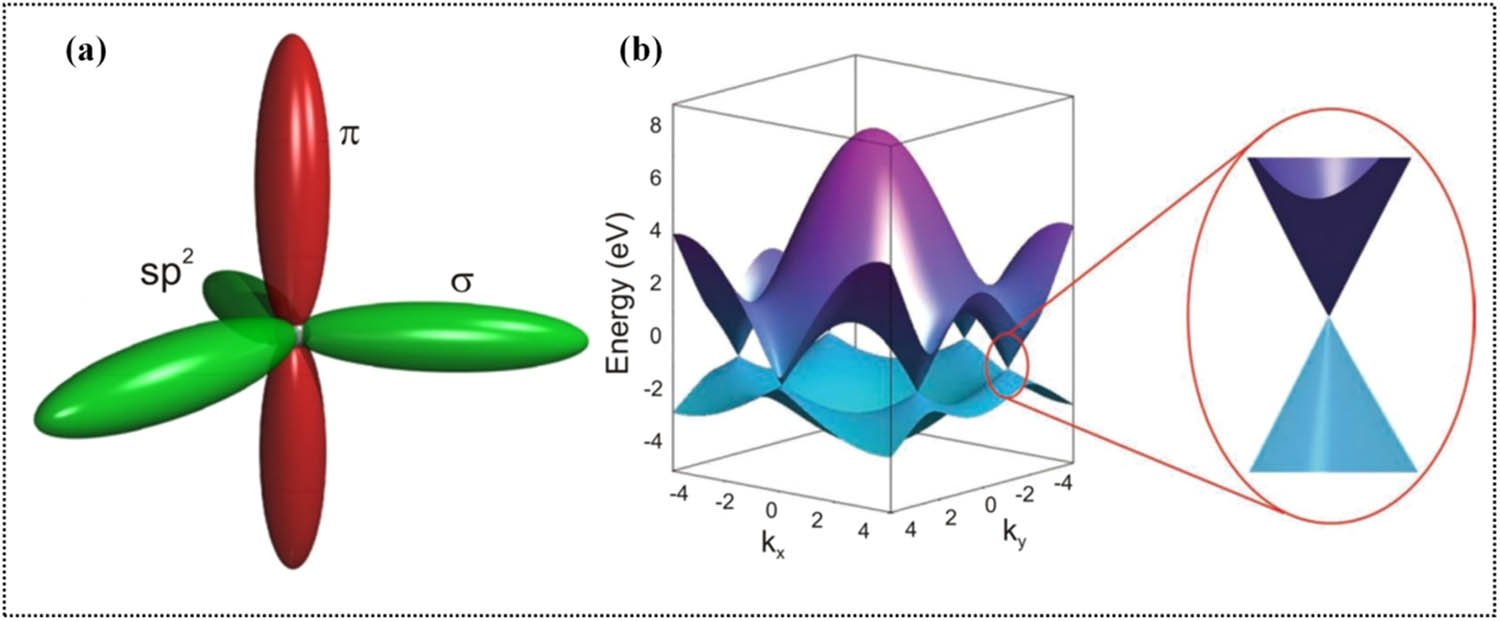
Figure 1
(a) Schematic of the - and -orbital electrons in a single carbon atom of graphene [41]; (b) band structure of graphene in a honeycomb lattice. The enlarged picture shows energy bands close to one of the Dirac points [41].
Source: data from Rogalski A et al.
Unhybridized π-orbital electrons are perpendicular to the graphene plane, forming a delocalized π-bond network. This endows graphene with extremely high carrier mobility (the theoretical electron mobility at room temperature can reach 105 cm2/V s), enabling ultrafast response in the terahertz (THz) band (on the picosecond scale). For suspended graphene at low temperatures (<20 K) with the Fermi level (E F) tuned close to the Dirac point, carriers can undergo ballistic transport with a mean free path exceeding 2 μm and minimal scattering loss [44]. Under this condition, the measured carrier mobility can approach 200,000 cm2/V s, and device size becomes the primary limiting factor for carrier transport. However, under room-temperature conditions in practical device configurations, graphene is usually supported on a substrate (e.g., SiO2). Scattering from substrate phonons, charged impurities, and defects is significantly enhanced, thereby drastically reducing both mobility (dropping to approximately 40,000 cm2/V s on SiO2 substrates [45]) and mean free path. This distinction is crucial for the design of graphene-based THz detectors: ballistic transport enables ultrafast operation, while in most practical applications, the achievable performance is constrained by diffusive transport.
Graphene’s unique zero-bandgap energy band structure forms a conical dispersion relation at the Dirac point in momentum space (Figure 1b), resulting in electrons behaving as massless relativistic particles (Dirac fermions) in the low-energy state, with a Fermi velocity as high as v F ≈ 106 m/s (approximately 1/300 of the speed of light). Furthermore, the zero bandgap eliminates the low-energy photon absorption threshold caused by bandgap limitations in traditional semiconductors, ensuring efficient absorption of terahertz photons (with energy as low as 0.4 meV).
The gapless linear dispersion of graphene enables dynamic modulation of the Fermi level (E F) via gate voltage [46–48] and adjustment of carrier concentration [49] n. In such gate-controlled devices, the total capacitance (Cₜₒₜₐₗ) is determined by the series combination of the geometric capacitance (C gₑₒₘ) of the gate dielectric layer and the quantum capacitance (C Q) of graphene itself, with the relationship expressed as follows [50]:
The quantum capacitance originates from the finite density of states near the Dirac point and follows the relationship C Q ∝ n, which may be significantly lower than the geometric capacitance in conventional semiconductors. In standard devices with thick gate oxide layers (e.g., SiO2), C gₑₒₘ is usually the limiting factor, resulting in Cₜₒₜₐₗ ≈ C gₑₒₘ. However, near the Dirac point where C Q is minimized, C Q may become the dominant factor limiting the total capacitance, thereby affecting gate efficiency and charge modulation speed. This effect is particularly pronounced in devices with thin high-k dielectric layers or in electrochemical gating configurations, where large geometric capacitance can be achieved, making quantum capacitance the main component of the measured capacitance [51]. Collectively, these characteristics enable ultrafast charge response under electric fields, which is conducive to realizing high-speed terahertz detection.
2.2. Optical properties of graphene
Graphene, endowed with a unique electronic structure, exhibits ultra-broadband electromagnetic wave absorption capabilities spanning from the ultraviolet (UV) to terahertz (THz) regimes. Its optical absorption rate varies significantly across different wavelength bands [29] (as shown in Figure 2a). This phenomenon essentially results from the relative scale variation between the photon energy ℏω (where ℏ is the reduced Planck constant and ω is the photon angular frequency) and the characteristic energies of graphene’s electronic system [52,53]. The characteristic energies of graphene’s electronic system include the chemical potential µ, thermal energy k B T, and carrier scattering energy ℏΓ (where k B is the Boltzmann constant, T is temperature, and Γ is the scattering rate).
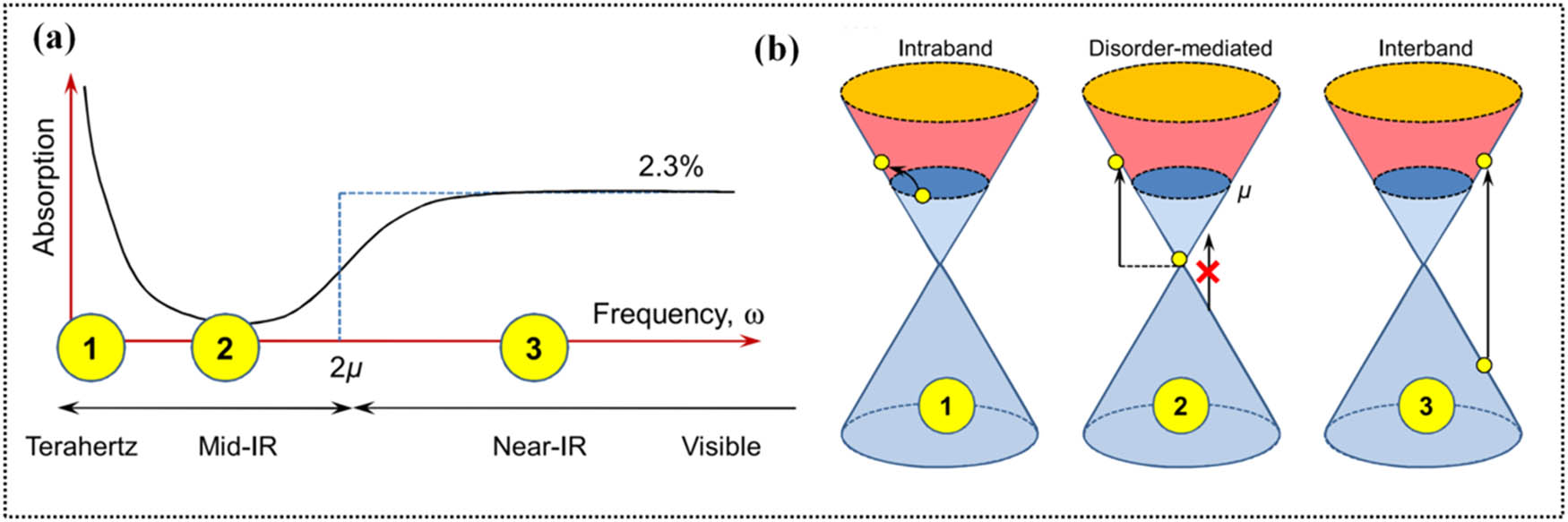
Figure 2
(a) Illustration of a typical absorption spectrum of doped graphene [29] and (b) Illustration of the various optical transition processes [29].
Source: data from Low T et al.
The near-infrared (NIR)–visible spectral range constitutes the core region embodying graphene’s optical universality. The absorption rate 2.3% (where is the fine-structure constant) and the universal optical conductivity (with e denoting the electron charge and the reduced Planck constant) [54] predicted by the ideal model have been accurately validated by experiments. For example, single-layer graphene on an SiO2 substrate exhibits an absorption rate of (2.3 ± 0.2) % in the 0.5–1.2 eV spectral range, corresponding to an optical conductivity of (6.1 ± 0.6) × 10−5 S, with good repeatability among different samples [53]. Suspended single-layer graphene also demonstrates an absorption rate of ∼2.3% in the visible region, satisfying the transmittance formula with negligible reflectance (<0.1%), and the measured optical conductivity is in high agreement with theoretical predictions for massless Dirac fermions [54]. This universality originates from the chiral resonance of interband transitions, wherein photon absorption generates particle–antiparticle pairs. Unaffected by the detailed band structure of graphene, this phenomenon represents an intrinsic property of two-dimensional massless Dirac fermions [55,56]. Even in graphite (with interlayer coupling), the optical conductivity of each graphene layer remains close to in the low-energy NIR range of 0.1–0.6 eV, further confirming the robustness of such universality [57]. A slight increase in absorption rate may occur only when the photon energy exceeds 2.5 eV (near-UV region), due to deviations from the linear dispersion relation near the Dirac point. However, no significant deviations have been observed within the core range of 0.5–1.2 eV.
The mid-infrared band serves as a turning point for the optical universality of graphene, where temperature and doping emerge as the core regulatory factors. At room temperature (300 K), although the photon energy (e.g., 0.3 eV = 300 meV) is higher than k B T (26 meV), thermal excitation still induces partial electrons to be excited to high-energy states, altering the occupation of the Fermi-Dirac distribution. Thermal excitation and the non-zero chemical potential (µ) induced by doping collectively induce the state blocking effect [53], which impedes photon-induced interband transitions. Intraband transitions then become a non-negligible supplement, and a schematic diagram of the energy band transitions is shown in Figure 2b. The total conductivity needs to superimpose these two contributions [58], and at this point, the optical conductivity can be simply modified by considering the Fermi-Dirac distribution as [53]:
When ≫ 2 µ and k B T, the optical conductivity recovers to its universal value (e.g., 0.5 eV). According to Ref. [53], highly doped samples (e.g., μ = 100 meV) exhibit a significant decrease in absorption rate in the 0.2–0.4 eV range, while lightly doped samples (e.g., μ = 0 meV) show only a slight reduction. This directly demonstrates that doping enhances the state-blocking effect and weakens interband transitions.
The terahertz (THz) band exhibits the greatest discrepancy between graphene’s optical properties and the ideal model, where Drude-type intraband transitions dominate absolutely [59] and are strongly regulated by gate voltage, temperature, and many-body effects (electron–electron and electron–phonon coupling). Studies on gate-controlled graphene have shown that prominent Drude-type conductivity exists in this band [52]. As ω → 0, σᵢₙₜᵣₐ → σ dc = 4 ∼ 100 e2/4ℏ, where σ dc is the direct current conductivity. The Drude peak is narrow and confined to the low-frequency range of the THz band. Under low-frequency and high-doping conditions (e.g., ω < 30 THz, EF > 0.1 eV [60]), the optical conductivity can be modified as [29]:
where is the momentum relaxation time. The regulation of Drude conductivity by gate voltage (V g) is essentially realized by modifying the n , n 0 is the residual carrier concentration C g is the gate capacitance, and V CNP is the gate voltage corresponding to the charge neutrality point [61]), while the varies with n. This further influences the number of carriers participating in intraband transitions. Ultimately, the intensity of the Drude component increases with the enhancement of gate voltage.In addition, many-body interactions cause to increase with frequency, resulting in conductivity higher than the Lorentzian distribution predicted by the ideal Drude model [52]. Furthermore, the spatial inhomogeneity of the local Fermi energy in graphene on SiO2 substrates broadens the interband transition threshold, exacerbating deviations from the ideal model [52,62]. This synergistic regulatory characteristic endows graphene’s optical response in the THz regime with tunability, providing an experimental foundation for device applications such as THz modulators and detectors.
Graphene plasmon oscillations are collective excitation behaviors of 2D massless Dirac fermions, with core characteristics of strong electromagnetic localization and wide-range electrical tunability. Operating in the terahertz to mid-infrared band, they exhibit a dispersion relation of ωₚₗ ∝ q (where ωₚₗ is the plasmon resonance frequency and q is the wave vector), and the optical localization volume can be 106 times smaller than the diffraction limit [29]. Under high-doping conditions, below the optical phonon frequency (≈0.2 eV), graphene plasmons can simultaneously possess low loss and strong localization [63]. Through microstrip array engineering, strong absorption of >13% can be achieved at room temperature, which is significantly superior to the characteristic of traditional 2D electron gas that requires low temperature (4.2 K) for observation [64]. Patterned nanodisk arrays can further realize 100% light absorption via the critical coupling effect, laying the foundation for the miniaturization and high efficiency of infrared optoelectronic devices [65]. The graphene plasmon wavelength (λₚ = 260 nm) is 40 times smaller or even more than the incident light wavelength (e.g., λₐᵢᵣ = 9.7 μm) [66], and the propagation loss is significantly lower than that of traditional metal surface plasmons, providing possibilities for the realization of ultra-small optical interconnection devices and on-chip photonic circuits.
The core advantage of graphene plasmons lies in their versatile multi-dimensional tunability, enabling performance customization through the dual pathways of “electrical tuning” and “structural tuning”. In terms of electrical tuning, different gating technologies provide a wide range of adjustability for carrier concentration. Electrolyte gating, with its ultra-high capacitance (≈3.2 μF/cm2) associated with a sub-1 nm Debye length (λ D), can tune n up to 4 × 1014 cm−2 (electron/hole bipolarity) [67]. Ionic gel gating, on the other hand, can stably achieve a carrier concentration of 1.5 × 1013 cm−2. By shifting the Fermi level (E F), it directly modulates the plasmon resonance frequency (ωₚ), exhibiting the characteristic law of Dirac fermions as [64] ωₚ ∝ E F 1/2 ∝ n 1/4. Regarding structural tuning, the microstrip width (w) in Ref. [64] and the nanodisk array parameters in Ref. [65] are key variables. When w decreases from 4 μm to 1 μm, the plasmon resonance frequency blue-shifts from 3 THz to 6 THz, following the scaling relationship [64] ωₚ ∝ w −1/4. For nanodisk arrays (diameter: 60 nm, lattice spacing: 72–120 nm), 100% light absorption can only be achieved through the critical coupling condition of “matching the single-disk absorption cross-section with the area of a single unit cell”, with additional non-structural conditions such as total internal reflection (TIR) and intermediate dielectric cladding layers [65]. This synergistic mechanism of “electrical + structural tuning” allows graphene plasmons to adapt to the spectral requirements of multiple scenarios, including terahertz communications and infrared sensing.
It is worth noting that the damping effect is the core factor limiting the upper performance limit of graphene plasmonic devices. In the mid-infrared band (4–15 μm), its loss mechanisms and modulation laws are closely related to substrate properties, structural dimensions, and energy matching relationships [68]. At this point, the damping of graphene plasmons mainly stems from three pathways. First, intrinsic optical phonon emission: when the plasmon energy exceeds ≈0.2 eV, it decays into quasiparticle pairs via phonon emission, with the lifetime plummeting to below 20 fs and a propagation length of ≈200 nm. Second, edge scattering of nanostructures (the damping rate is inversely proportional to the effective width Wₑ), where narrow-band devices exhibit prominent loss. Third, polar phonon coupling with substrates: polar substrates such as SiO2 form a hybrid mode due to surface polar phonons ( = 806 cm−1, = 1,168 cm−1), with a longer lifetime only near the phonon energy, while non-polar substrates such as diamond-like carbon (DLC) exhibit more stable damping (dominated by edge/bulk scattering). Furthermore, when increased doping causes the plasmon resonance frequency to cross the optical phonon energy threshold, the resonance linewidth broadens significantly, which further exacerbates the loss.
Therefore, the design of infrared devices requires balancing strong localization, broad tunability, and low damping through substrate optimization, dimensional matching, and avoidance of phonon damping bands. For the terahertz band, however, graphene plasmons exhibit lower intrinsic damping, stemming from the fact that the plasmon energy in the terahertz band is far lower than the optical phonon energy and the surface polar phonon energy of substrates, and micron-scale structures are mostly adopted in devices to attenuate edge scattering. Thus, the design needs to focus on optimizing non-edge scattering (e.g., improving graphene quality), the selection of substrates is more flexible, and it is easier to achieve a balance between low loss and broad tunability.
2.3. Thermal properties of graphene
Graphene exhibits exceptional thermal conductivity, reaching up to 5,300 W/m K at room temperature, which surpasses that of copper and diamond [69]. This extraordinary property stems from its ideal two-dimensional crystal structure, where light-weight carbon atoms are linked by strong sp2-hybridized carbon bonds, providing a low-loss pathway for efficient phonon transport. In addition, Ref. [70] notes that the phonon mean free path is approximately 775 nm at room temperature, and the lattice anharmonicity is weak (evidenced by the small Grüneisen parameter), which significantly suppresses inter-phonon scattering and enables highly efficient phonon-mediated heat transfer. In contrast, the contribution of electrons to thermal conductivity is extremely low (accounting for <1% at room temperature), primarily because electron thermal conductivity is limited by its electrical transport characteristics. Therefore, the ultra-high thermal conductivity of graphene is essentially determined by its excellent phonon transport rather than electron contribution [70]. Moreover, studies have shown that the high thermal conductivity of graphene is dominated by acoustic phonons rather than optical phonons [71,72].
The energy transfer from electrons to the lattice relies primarily on electron–phonon scattering, which can be further divided into electron-optical phonon scattering and electron-acoustic phonon scattering. Among them, although electron-optical phonon scattering involves phonon emission, it has a relatively high energy threshold (≈0.2 eV), with a relaxation time typically on the order of hundreds of femtoseconds [47,73,74]. In contrast, electron-acoustic phonon scattering has an extremely low energy threshold. Moreover, due to the small energy and weak coupling of acoustic phonons, its relaxation time is usually several picoseconds [47,74–76]. Therefore, in the terahertz band, since the energy of photoexcited electrons is less than 0.2 eV, electron-optical phonon scattering is suppressed [47], and electron-acoustic phonon scattering dominates the energy transfer process. Meanwhile, electrons rapidly reach quasi-thermal equilibrium via ultrafast electron–electron scattering (∼20 fs) [77], creating a time difference with the relatively slow electron-acoustic phonon scattering. This time difference results in the electron temperature being much higher than the lattice temperature. Additionally, the low energy exchange efficiency between electrons and the lattice ensures the stability of the thermal gradient. This process provides the driving force for the directional transport of carriers in the PTE effect, and net current is more likely to be generated, especially in asymmetric structures.
The thermoelectric voltage output by the PTE effect is not only related to the temperature gradient, but also associated with the Seebeck coefficient (S xx ). In its pristine state, graphene exhibits a relatively low S xx (ranging from 5.4 to 50 μV/K) [78]. The sign of S xx undergoes a reversal at the Dirac point, when away from the Dirac point, |S xx | . Therefore, the modulation of S xx can be achieved by adjusting the carrier concentration n, and also by means of gate voltage tuning and interface engineering. Moreover, the PTE effect leverages the difference in Seebeck coefficient (), and employing a dual-gate structure to enhance this difference is also an effective approach [46]. High carrier mobility and low contact resistance, in turn, reduce the transport loss of hot carriers, ensuring the efficient output of thermoelectric voltage. Furthermore, the ultrafast response endowed by weak electron–phonon coupling and the advantage of low dark current at room temperature further align with the practical requirements of application scenarios such as terahertz communications and imaging, rendering it an ideal material for THz detection based on the PTE principle.
3. Key performance metrics for evaluating terahertz detectors
The performance metrics of photodetectors mainly include responsivity, noise-equivalent power, response time, and specific detectivity, etc. [79]. These metrics are also applicable to terahertz detectors, serving as the core parameters for evaluating their detection capability, applicable scenarios, and technical advantages. A detailed description of the basic concepts and formulas of detectors is provided in Ref. [79], and thus will not be elaborated on herein. This article focuses on the factors influencing these metrics and the strategies for their enhancement.
3.1. Responsivity (R)
Responsivity reflects the photoelectric conversion capability of a detector, which can be expressed as voltage responsivity R V (V/W) or current responsivity R I (A/W). Typically, the responsivity of detectors fabricated solely relying on graphene itself is not ideal [80,81], and additional approaches are required to improve the responsivity. The improvement of responsivity originates from the synergistic effect of enhanced light absorption and increased collection efficiency of photogenerated carriers. The key parameters affecting responsivity mainly include resistance parameters (graphene resistance between electrodes (R G) plus metal–graphene contact resistance (R S)), light absorption coefficient (), photoelectric conversion factors (such as and ), photoconductive gain (G, the effective collection ratio of photogenerated carriers), and the number of graphene layers (K) [82–84]. In addition, G is correlated with parameters, including carrier lifetime and carrier transport time (the transit time of carriers across electrodes). Its intrinsic property is essentially associated with carrier mobility μ.
The α can be enhanced through special structures. For instance, the interaction length between light and graphene can be extended via optical waveguides [61,85,86] and optical resonant cavities [87], thereby improving the responsivity. The localized electromagnetic field can be strengthened using optical antennas [46,47] and metal micro-nano structures [82,88] to boost the light-graphene coupling efficiency. There are also various methods to improve carrier collection efficiency. Examples include shortening the electrode spacing to reduce the τ tr, suppressing electron–hole recombination and extending the τ R via heterojunctions [89,90], using higher-quality graphene to increase μ, optimizing interface engineering to reduce the R S, and regulating the E F to enhance n, all of which are common approaches to improve carrier collection efficiency.
For terahertz detectors, few researchers fabricate devices using waveguide structures. The reasons are as follows: terahertz waves have relatively long wavelengths, necessitating large-sized waveguides; moreover, terahertz waves in waveguides tend to excite high-order modes or leaky modes, resulting in low coupling efficiency, and the scattering loss at waveguide edges is significant [91–93]. Although resonant cavities exhibit excellent performance in specific scenarios (such as high-resolution spectroscopy), their narrowband characteristics, manufacturing complexity, and temperature sensitivity limit their practical applications. Although heterojunctions formed by graphene and materials such as MoS2 and Bi2Te3 [89,90] can suppress carrier recombination, these materials generally do not operate in the terahertz band. Taking comprehensive considerations, antenna and metal array structures have become the primary means to enhance light absorption in graphene terahertz detectors due to their advantages including broadband response, low noise, and easy integration.
3.2. Noise equivalent power
Noise equivalent power (NEP) refers to the minimum optical power that a detector can resolve, i.e., the incident optical power when the SNR = 1. The normalized NEP has a unit of , which is used to eliminate the influence of bandwidth and facilitate unified comparison among different detectors. The magnitude of NEP is jointly determined by the detector’s inherent characteristics, noise sources, and external operating conditions. Common noise sources include thermal noise (N t), 1/f noise (N 1/f), generation-recombination noise (N g-r), and shot noise (N s) [47,94]. A larger photosensitive area (S A) will introduce more background radiation and thermal noise [95], thus requiring a trade-off between S A and detection performance. Low operating temperature can reduce the NEP, which is also the reason why some detectors employ measurements under low-temperature conditions [96]. A wider detection signal bandwidth will lead to a higher total noise level, so bandwidth compression is necessary for weak signal detection [97].
3.3. Response time (τ)
Response time reflects the speed at which a detector captures transient signals, usually consisting of rise time () and fall time (). Its physical essence is directly related to the generation, transport, and relaxation processes of carriers. The influencing parameters vary significantly across different response mechanisms. For instance, τ in the PC effect is jointly determined by carrier lifetime () and carrier transport time () [98]. The τ of the PTE effect is regulated by thermal diffusion time, resulting in a response speed slightly slower than that of the photoconductive (PC) mechanism [40]. In the PWR effect, τ is dominated by the plasmon polariton relaxation time, which can be tuned via doping and gate voltage. The response speed can be enhanced through multiple approaches, such as doping [99] to shorten , constructing heterojunctions to accelerate electron–hole pair separation [30], reducing electrode spacing, minimizing R S, improving graphene quality, and lowering temperature to mitigate phonon scattering.
3.4. Detectivity (D) and specific detectivity (D*)
D is the reciprocal of NEP. D* is a normalized form of d with respect to the photosensitive area (S A) and bandwidth (), serving as a core metric for evaluating the weak signal detection capability of photodetectors. All performance parameters that can affect responsivity and NEP are also capable of influencing D and D*. The utilization of these two metrics is attributed to several reasons. First, D offers greater intuitiveness due to the logic that higher values correspond to superior performance. Second, while NEP is defined under the condition of SNR = 1, D is not subject to this constraint. Third, NEP primarily characterizes noise properties and its unit incorporates bandwidth-related parameters, making bandwidth consideration necessary in certain application scenarios. As an early performance metric for photodetectors, D has been widely adopted in relevant research and applications.
3.5. Quantum efficiency (QE)
QE is categorized into external quantum efficiency (EQE, accounting for losses) and internal quantum efficiency (IQE, excluding losses). Specifically, EQE describes the proportion of incident photons that are collected by electrodes and converted into electrical signals, while IQE refers to the fraction of absorbed photons that are transformed into separable and transportable photogenerated carriers. In some cases, QE is also incorporated into the formula for responsivity [83]. For practical applications and cross-device performance benchmarking, EQE serves as the more commonly used core metric. By contrast, IQE is predominantly applied to the underlying performance evaluation of material systems or interface designs.
Improving IQE requires a focus on intrinsic material modification. This can be achieved through defect passivation processes (e.g., h-BN encapsulation) to extend carrier lifetime [100], as well as constructing heterojunctions to implement band engineering for optimizing carrier separation [101]. Enhancing EQE, however, demands full-link collaborative optimization: on one hand, light absorption efficiency can be boosted by integrating structural designs such as metal plasmonic antennas and Fabry–Pérot (F–P) optical resonators [87,102]. On the other hand, low contact resistance schemes should be adopted to improve carrier collection efficiency. Meanwhile, IQE needs to be optimized synchronously to realize a leap in the overall performance of the device.
4. Classification and applications of graphene terahertz detectors
The operating mechanisms of graphene-based terahertz detectors include the photovoltaic (PV), photothermoelectric (PTE), plasma wave rectification (PWR), photoconductive (PC), and bolometric (BM) effects. In addition to classifying the detectors by their operating mechanisms, this chapter focuses on the dominance of the PV and PTE effects in asymmetric-structured detectors, such as those with asymmetric metal contacts or dual independent gates.
4.1. The photovoltaic effect and its difference from the photothermoelectric effect
In graphene terahertz detectors, the photocurrent generated by the PV effect originates from the spatial separation of photoexcited electron–hole pairs. The PTE effect refers to the generation of an electromotive force via the Seebeck effect, which is induced by the formation of a temperature gradient from the rise in electron temperature following light absorption (V PTE = ∆S xx ·∆T, where ∆T denotes the temperature difference [103]). In asymmetric structure detectors, these two effects usually coexist, and their relative contributions need to be evaluated based on measurement results.
Graphene terahertz detectors with asymmetric structures are mainly classified into two categories: dual-gate modulated detectors and asymmetric contact detectors. For dual-gate modulated detectors, studies by Song et al. [104] have demonstrated that the photocurrents generated by the two effects exhibit distinct characteristics, as shown in Figure 3. During the monotonic variation of gate voltage (or chemical potential μ), multiple sign reversals of the photocurrent are a prominent characteristic of the PTE effect (Figure 3a–c), while a single sign reversal of the photocurrent is a prominent characteristic of the PV effect (Figure 3b–d). This is because a positive bias voltage causes an upward shift of the Fermi level (E F) in graphene (n-type doping), resulting in a negative S xx . Conversely, p-type doping is achieved, with S xx being positive. The relationship between S xx and gate voltage V g can be described by the Mott formula [103]:
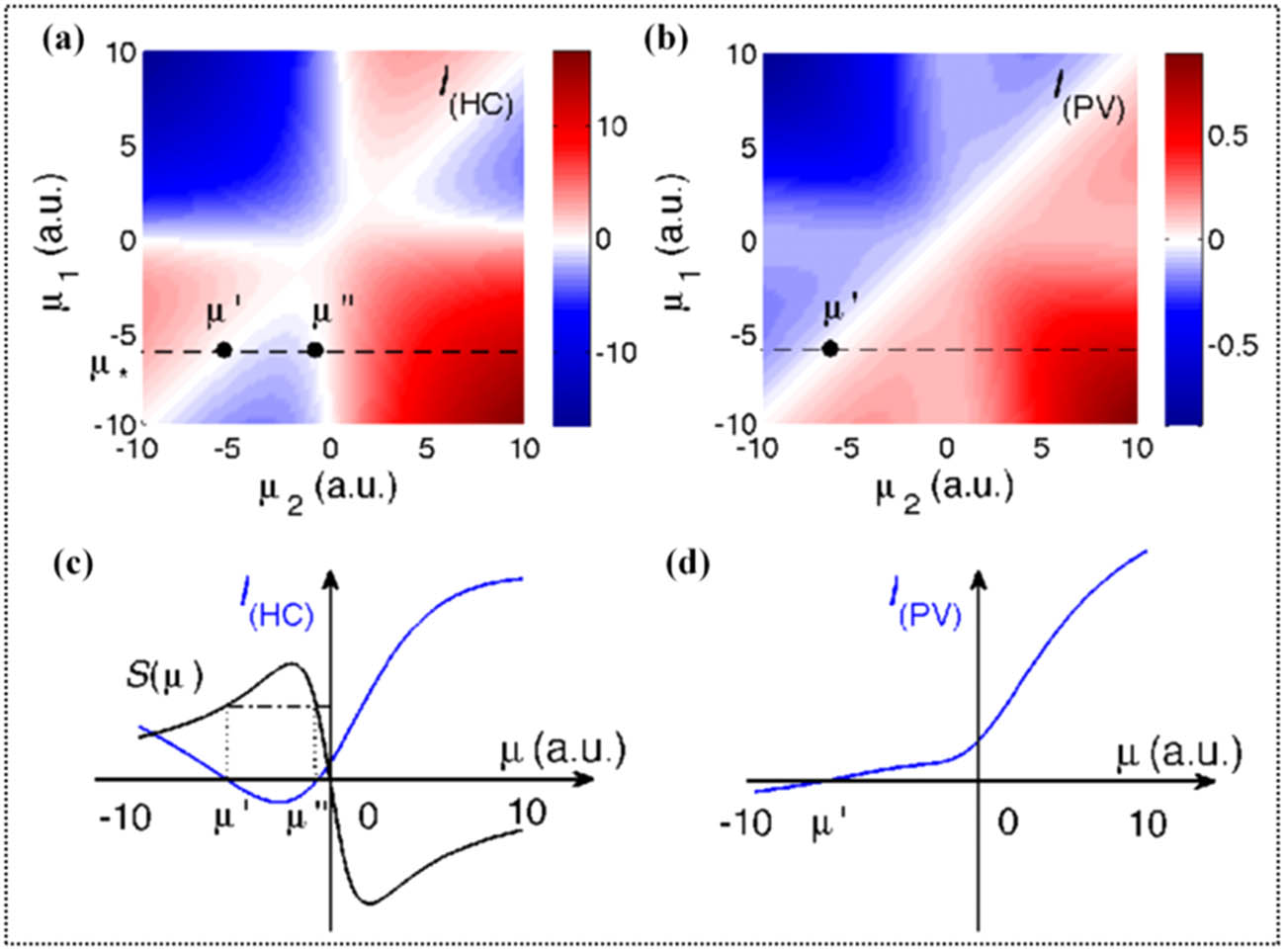
Figure 3
Photocurrent dependence on chemical potentials μ 1 and μ 2 in a dual-gated device [104]: (a) hot carrier-dominated regime (PTE mechanism) (b) PV-dominated regime, (c) current and Seebeck coefficient profiles at the black dashed line in (a), and (d) current profile at the black dashed line in (b).
Source: data from Song J C et al.
Here, R denotes the device resistance. For asymmetric contact devices, the Fermi level cannot be tuned, and thus variations in photoresponse are typically observed by applying a gate voltage [105,106]. The PV effect is identified by the absence of photocurrent sign reversal, whereas the PTE effect is characterized by the occurrence of such a reversal.
In 2016, Degl’Innocenti et al. [105] reported a graphene terahertz detector based on the PV effect. The device consists of a monolayer graphene film grown via chemical vapor deposition (CVD) integrated with a bowtie antenna featuring asymmetric contacts (palladium (Pd) and titanium (Ti) contacts), as shown in Figure 4a. The Pd arm induces p-type doping in graphene, while the Ti arm introduces n-type doping, which forms a p–n–n⁺ asymmetric doping structure in graphene and generates a built-in electric field at the metal–graphene junctions. Figure 4b demonstrates that the photocurrent sign remains unchanged with the variation of gate voltage polarity, confirming the PV effect. Furthermore, the magnitude of the photocurrent is modulated by the gate voltage, and the detector yields a high photocurrent when the gate voltage is in the range of 80–110 V. At 2 THz, the detector exhibits a photocurrent responsivity R I of approximately 34 μA/W and an NEP of about 150 nW/Hz1/2. Figure 4c presents the THz imaging of a leaf acquired with this detector: the leaf images become progressively sharper as the gate voltage is tuned from 0 to 110 V.
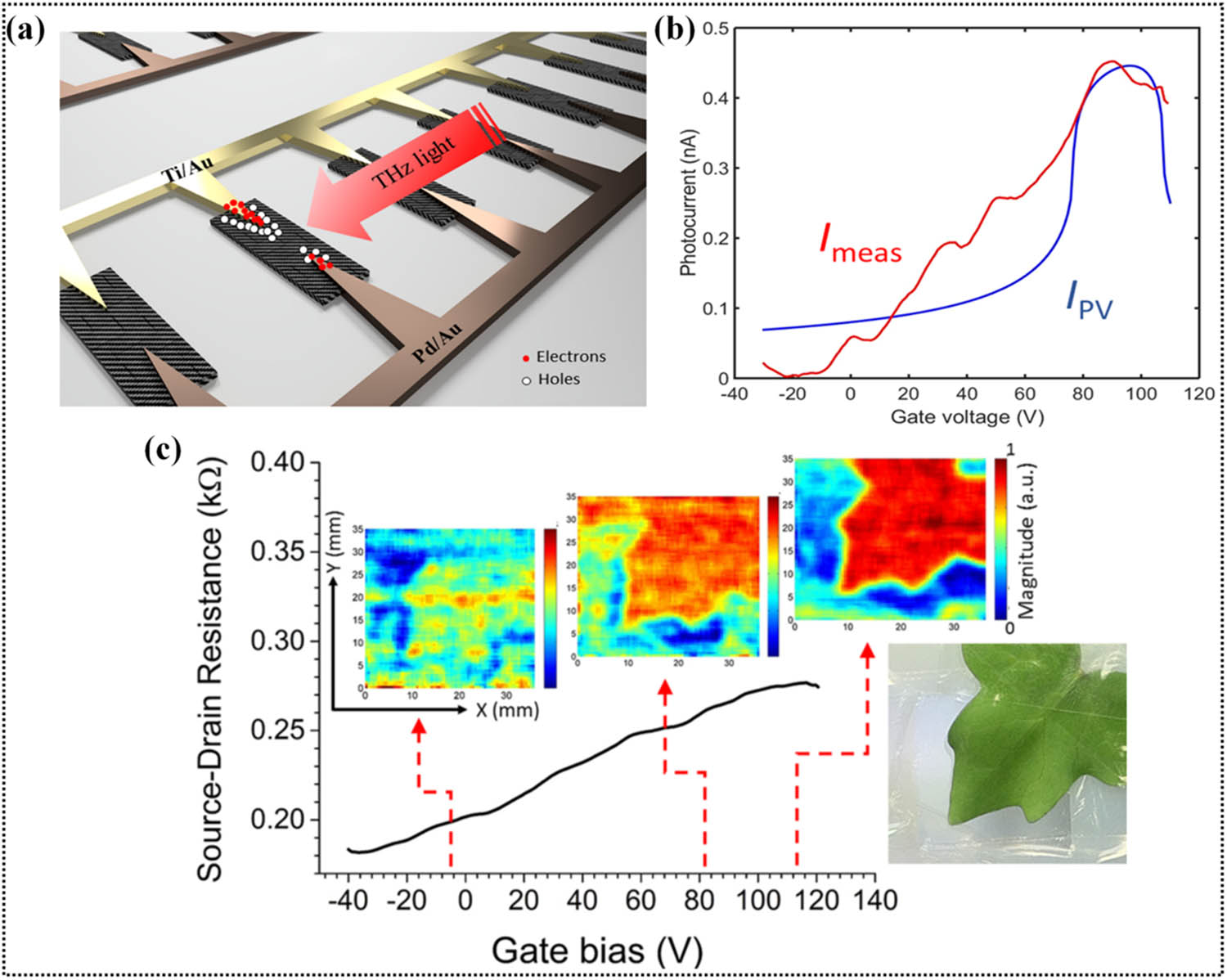
Figure 4
(a) Schematic of a graphene terahertz detector integrated with an interdigitated bowtie antenna, (b) calculated photovoltaic current, I PV, blue trace, and measured photocurrent, I meas, red trace; (c) correlation curves of source-drain resistance versus gate voltage and THz images of the leaf under different gate voltages [105].
Source: data from Degl'Innocenti R et al.
Graphene terahertz detectors based on the PV effect are scarce. The core reason lies in the fact that the PV effect relies on interband transitions to generate separable electron–hole pairs, while graphene is dominated by intraband transitions in the terahertz band. The key to realizing the PV effect is a strong built-in electric field and a large number of photogenerated carriers. The reason why Degl et al. could achieve this is attributed to the stable p–n–n⁺ doping and the plasma resonance coupling of the antennas. Furthermore, enhanced phonon scattering at room temperature attenuates the PV effect.
4.2. Photothermoelectric effect
Owing to the compatibility between graphene-based terahertz detectors and the PTE effect, a large number of researchers have developed photodetectors based on the PTE effect. At present, the approach to improving the performance of such detectors is to optimize each link in the chain process in accordance with the PTE effect’s sequence of “light absorption, thermal conversion, temperature gradient formation, electrical signal output via the Seebeck effect”.
In 2014, Cai et al. [106] deposited asymmetric contact electrodes (Cr and Au) on both ends of graphene prepared by mechanical exfoliation to form a ΔS xx . At 2.52 THz, the voltage responsivity R V > 10 V/W, the NEP < 1.1 nW/Hz1/2, and the τ ranged from 10.5 to 110 ps. In 2015, Tong et al. [107] also adopted asymmetric contact electrodes (Pd and Cr) and utilized metal antennas to enhance light absorption (Figure 5a). However, their device exhibited an R V < 4.9 V/W, the main reason for which lies in the impedance mismatch between the antenna and the graphene device. The formula for the reflection coefficient (ρ) can be expressed as follows [108]:
where Z S is the source impedance (antenna) and Z L is the load impedance (graphene device). Substituting the antenna impedance (∼50 Ω) and load impedance (∼1,800 Ω) into the formula yields ρ ≈ 0.94. From the reflected power formula: P out = P in (where P in is the incident power), it can be inferred that 88% of the optical power is lost. Additionally, the resonant frequency of the antenna is 2.1 THz, while the actual operating frequency is 1.9 THz, which further reduces the optical coupling efficiency.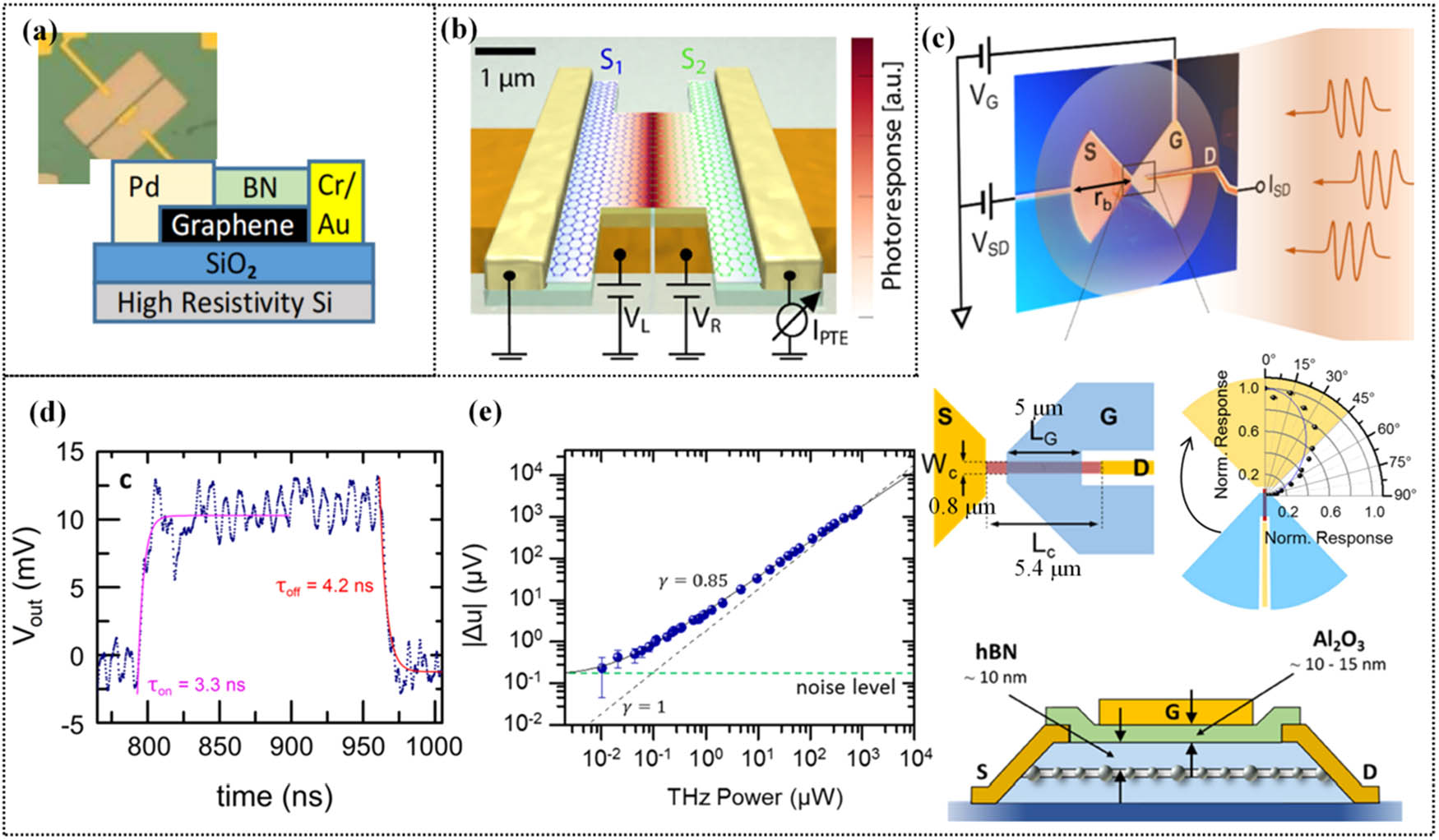
Figure 5
(a) Schematic diagram of the device structure, the inset at the top left shows a microscopic image of the metal antenna. [107] (b) Schematic diagram of the device, comprising a bottom antenna, a middle graphene/hBN structure with an H-shaped channel, and top source-drain electrodes [46]; (c) schematic diagrams of the device structure (top view + tangential view) and polar plot of the photoresponse, where 0° means the antenna axis is parallel to the light polarization direction [47]; (d) response time curve [47]; and (e) absolute value of the photovoltage as a function of incident power plotted in a log–log coordinate system (V g = 0.36 V) [47].
Source: data from Tong J et al., Castilla S et al., Viti L et al.
Compared with asymmetric contact electrodes with weak adjustability, dual-gate devices offer greater advantages. In 2019, Castilla et al. [46] fabricated a dual-gate modulated H-shaped graphene device (Figure 5b), which was integrated with a pair of dipole antennas with a gap of only 100 nm or 200 nm that also served as the dual-gates, thereby achieving the precise overlap between the field-enhanced region and the photosensitive region of the p–n junction. The narrow channel of the H-shaped graphene reduces thermal diffusion and enhances the temperature gradient . The detector with an antenna gap of 100 nm achieved an NEP of 80 pW/Hz1/2 and an ultrahigh R V of 105 V/W at room temperature, with an operating frequency range of 1.8–4.2 THz, a response time τ of less than 30 ns, and a dynamic response range of 0.1–100 μW. The sensitivity of this detector was enhanced by 2–4 orders of magnitude compared with other PTE-based graphene THz detectors of the same period, marking a significant milestone in this research field. In 2020, Viti et al. [47] reported a single-gate device integrated with an asymmetric bowtie antenna (Figure 5c), whose detection mechanism is dominated by the PTE effect with the PWR effect as an auxiliary. This device exhibited an NEP < 160 pW/Hz1/2 and a maximum R V of 49 V/W at room temperature, with a response time τ < 3.3 ns. Its response speed and dynamic response range (0.01 μW to 1 mW) were improved by two orders of magnitude compared with the previous work of Castilla et al. [46] (Figure 5d and e). However, the polarization dependence and narrow-band resonance at 3 THz introduced by the bowtie antenna are also non-negligible. Only when the electric field direction of the terahertz radiation is parallel to the long axis of the antenna can the radiation be efficiently coupled into the device and excite plasmon resonance.
In the same year, Viti et al. [109] fabricated a dual-gate device integrated with a coplanar stripline (CPS) and incorporating a low-pass filter (Figure 6a and b) to address parasitic losses and signal crosstalk in high-frequency detection, where the dual-gates also acted as linear dipole antennas. The CPS transmission line eliminates the need for a ground plane, and its 2-μm gap design effectively reduces parasitic capacitance, maintaining low-loss transmission even at 3.4 THz (S 21 = −3.5 dB characterizes the signal transmission efficiency, with values closer to 0 indicating lower transmission loss). Meanwhile, the low-pass filter with a cutoff frequency of approximately 300 GHz diverts signals through a 500-aF lumped capacitor, efficiently isolating the antenna from the readout circuit. This prevents reverse leakage of terahertz signals and high-frequency noise crosstalk, ensuring signal integrity. The synergistic effect of these structures endows the device with an ultrafast rise time response of 890 ps and a bandwidth of 180 MHz.
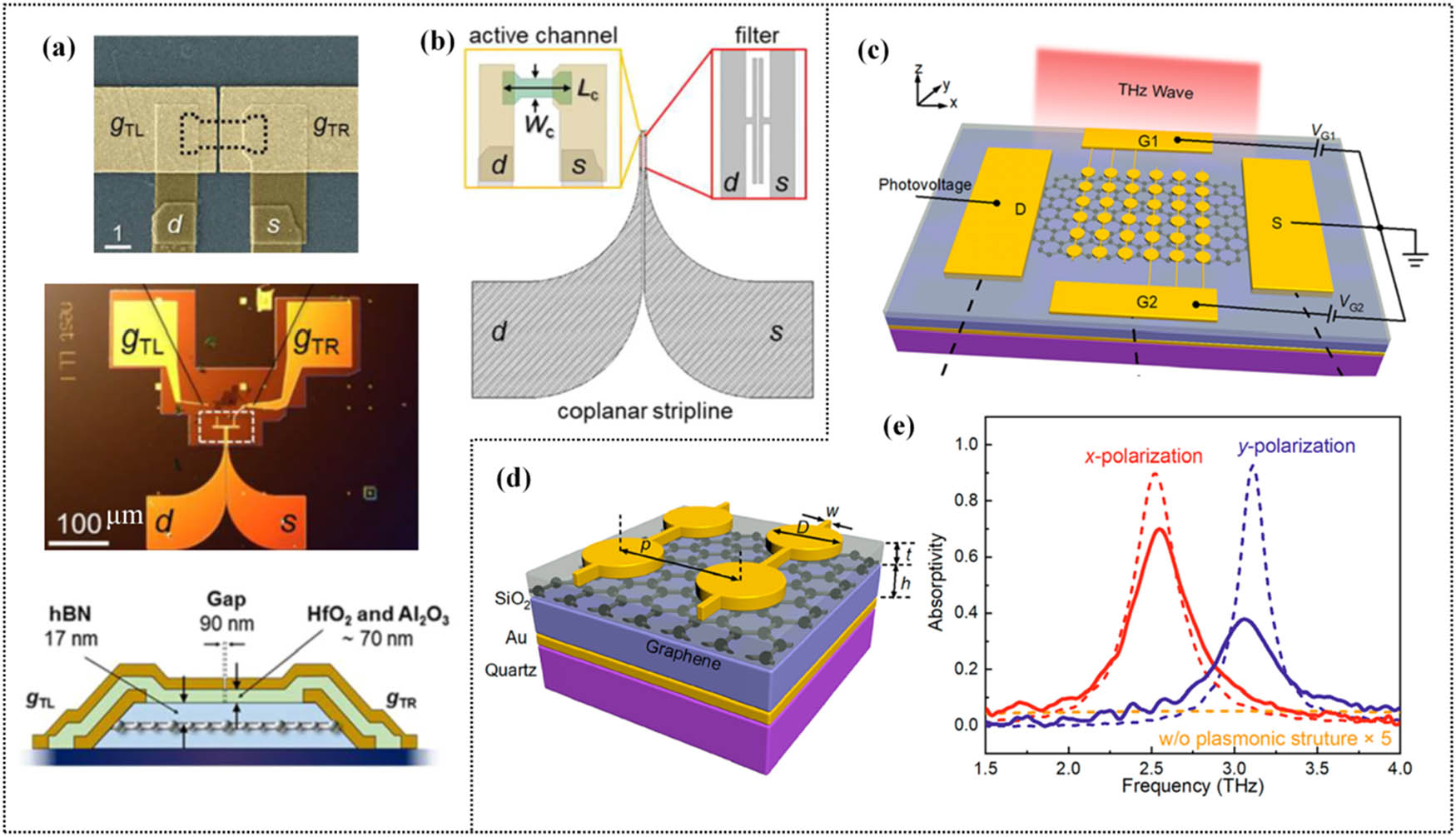
Figure 6
Schematic diagram of (a) the device structure (top view + cross-sectional view) [109]; (b) the CPS structure; the inset shows the graphene shape and filter structure, which reduces contact resistance compared with the rectangular graphene shape. [109] (c) Schematic diagrams of the device structure and wiring [48]; (d) cross-sectional view of the device [48]; (e) simulated (dashed lines) and measured (solid lines) terahertz absorption spectra of the microcavity under x-polarization (red), y-polarization (blue), and no MM (yellow) conditions. [48].
Source: data from Viti L et al., Chen M et al.
In 2022, Asgari et al. [110] adopted CVD-grown graphene based on the work of Viti et al. [109], which facilitates the fabrication of large-area devices. However, this came at the cost of degraded response time (5 ns) and noise performance (NEP = 1 nW/Hz1/2), leading to an order of magnitude reduction in the device’s overall performance compared with the previous work. In the same year, Chen et al. [48] proposed a metamaterial (MM)-graphene monolithic hybrid terahertz detector (Figure 6c and d), which integrates three functions of terahertz detection, wavelength selection, and polarization identification. Without the need for external filters or polarizers, the detector achieves dual-frequency orthogonal polarization response at 2.52 THz (x-polarization) and 3.11 THz (y-polarization) (Figure 6e), providing a novel solution for compact and multifunctional terahertz sensing and imaging systems. The F–P resonant cavity formed between the gold intercalation layer and the dual-gates also contributes to the enhancement of light absorption, and this design concept offers an important reference for the development of subsequent devices. Although the device exhibits a relatively low voltage responsivity (3.16 V/W) and a slow response time (τ ≈ 25 μs at the 3 dB bandwidth), these drawbacks stem from its ultra-long source-drain spacing of 600 μm. Its NEP of 9.3 nW/Hz1/2 represents the optimal value among PTE-based graphene THz detectors integrated with metamaterials at the same period.
In terms of applications, Chen et al. [48] explored the capabilities of two-color imaging and polarization imaging. For circular particle samples containing naphthoquinone (with a characteristic absorption peak at 2.57 THz) and copper oxalate (with a characteristic absorption peak at 3.39 THz; Figure 7a), complementary imaging was achieved by rotating the device by 90° (Figure 7d). For the T-shaped metamaterial structure samples (Figure 7b–e), under 2.52-THz circularly polarized light (transmission-mode imaging), the device output a clear “T” shape (Figure 7f), which stems from the matching between the detector’s intrinsic polarization selectivity and the local polarization response of the sample.
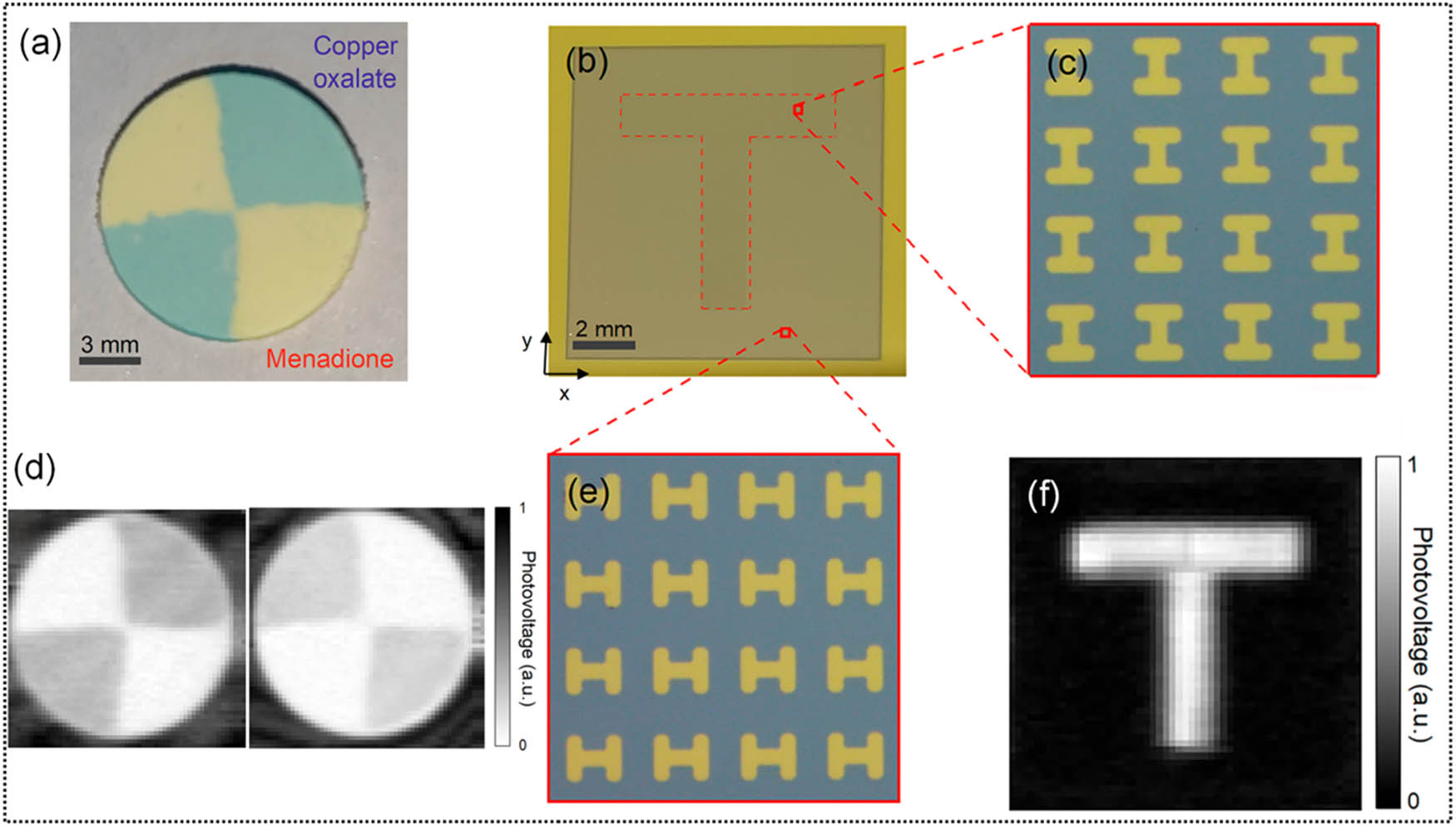
Figure 7
(a) Optical image of the pellet sample [48]; (b) optical image of a T-shaped metamaterial structure [48], (c) enlarged view of T-shaped internal structure [48], (d) diagram of the detection results of the device on the pellet sample [48], (e) enlarged view of T-shaped external structure [48], and (f) diagram of the device’s imaging of the T-shaped metamaterial structure [48].
Source: data from Chen M et al.
In 2023, Titova et al. [111] for the first time deeply integrated bandgap engineering with the PTE effect, achieving high-performance terahertz detection based on a bilayer graphene (BLG) device with a triple-gate structure (two top gates + one back gate; Figure 8a). Furthermore, this study demonstrates that the PTE effect dominates at low temperature (25 K), while the RSM effect (the non-resonant mode of plasma waves) prevails at room temperature. The device induces a bandgap (<25 meV) via a back gate and, at the same time, modulates the carrier concentration and type through dual top gates to construct a lateral p–n junction. Its performance at low temperatures is comparable to that of commercial superconducting detectors: the device achieves a maximum R V of 50.5 kV/W at 0.13 THz, with a minimum NEP of approximately 36 fW/Hz1/2 (Figure 8b). Notably, at room temperature, the NEP is approximately 160 pW/Hz1/2. This study systematically elucidates the universal mechanism by which the band gap synergistically enhances the PTE effect through enhancing (Figure 8c), reducing the electronic thermal conductivity () and the hot carrier energy relaxation rate (). It breaks through the long-standing bottlenecks of weak response and high noise in traditional graphene PTE detectors, and paves a new path for the performance optimization of graphene terahertz detectors based on the PTE effect: engineering an appropriate band gap in graphene.
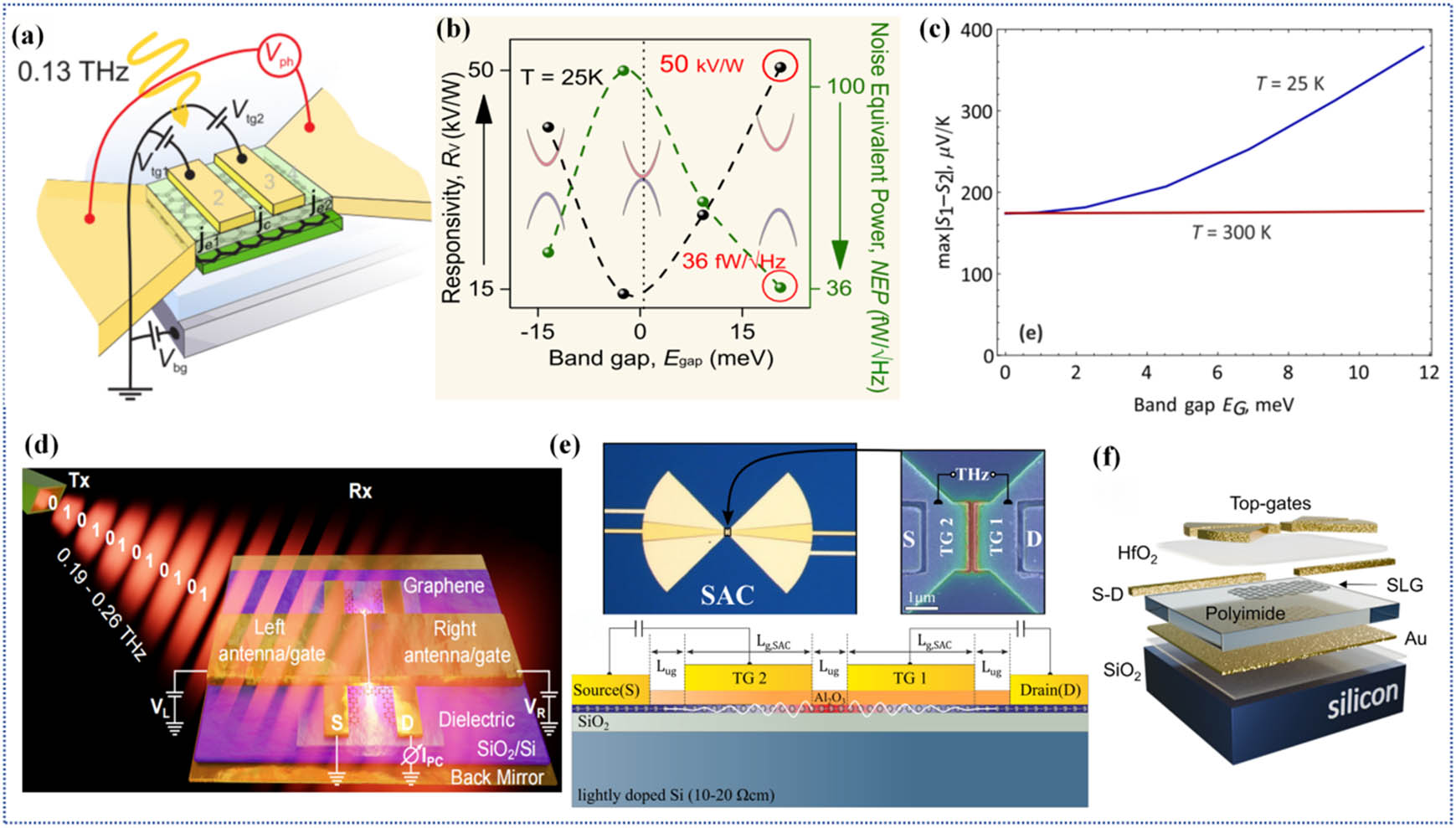
Figure 8
(a) Schematic diagrams of the device structure and wiring [111]; (b) curves of responsivity and NEP at different band gaps under 0.13 THz irradiation (25 K) [111]; (c) curves of the difference in Seebeck coefficient at different band gaps and temperatures (25 and 300 K) [111]; (d) schematic diagrams of the device structure and wiring [112]; (e) schematic diagram of the device structure (top view + tangential view) [113]; (f) schematic diagram of the device structure (a Salisbury screen composed of Au + Polyimide + SLG). [114].
Source: data from Titova E et al., Soundarapandian K P et al., Ludwig F et al., Viti L et al.
In 2024, Soundarapandian et al. [112] proposed a graphene direct receiver based on the PTE effect for the requirements of 6 G sub-terahertz (0.19–0.26 THz) wireless communications (Figure 8d), which adopts a “dual-gate/dipole antenna + back mirror” structure with a resonant cavity formed between the back mirror and the dual gates. The device based on mechanically exfoliated graphene achieves a R V of up to 30 V/W and a NEP of 58 pW/Hz1/2, with a maximum data transmission rate of 3 Gbps over a transmission distance of 0.5 m, and the rate still reaches 0.5 Gbps at a distance of 2.5 m. This study, for the first time, realizes the practical integration of the graphene PTE effect with sub-terahertz direct communications, and the receiver features a much simpler design compared with conventional electrical/optical receivers.
In the same year, Ludwig et al. [113] designed a symmetric antenna-coupled (SAC) structure based on a CVD-graphene FET (Figure 8e). At 0.4 THz, the SAC device achieves an R V of up to 63 V/W and a NEP of 114 pW/Hz1/2. This device set a new performance record for CVD-graphene terahertz detectors in terms of NEP. In 2025, to address the core contradiction between absorption enhancement and thermoelectric performance degradation in large-area graphene detectors, Viti et al. [114] proposed a p–n junction terahertz detector with an antenna-integrated graphene Salisbury screen (AgSS) structure (Figure 8f). Operating at 2.86 THz, the device exhibits an R V > 40 V/W, an NEP < 300 pW/Hz1/2, a τ < 5 ns, and a dynamic range exceeding four orders of magnitude (0.01 μW ∼ 1 mW). The improved comprehensive performance of CVD-graphene terahertz detectors has marked a significant step forward in their commercialization process.
As a classic operating mechanism for graphene terahertz detectors, the PTE effect establishes its fundamental position in the field of THz detection by virtue of advantages such as stable operation at room temperature, broadband response, and simple fabrication process. However, noise performance limitations dominated by thermal noise (e.g., relatively high NEP) and moderate response speed at the picosecond scale have become core bottlenecks restricting its application in high-end scenarios such as weak signal detection and high-speed communications. To overcome this limitation, researchers have also conducted explorations into non-thermal physical mechanisms. Graphene field-effect transistor (GFETs) detectors based on the PWR effect effectively avoid the thermodynamic limitations of PTE, achieving qualitative improvements in key performances such as noise suppression and response speed, while also facing respective technical challenges and application boundaries.
4.3. Plasma wave rectification
The response mechanism of conventional FET terahertz detectors takes the Dyakonov–Shur (DS) theory as the core framework, which is essentially the nonlinear rectification effect of plasma waves in the two-dimensional electron fluid. Its physical nature can be fully depicted by the hydrodynamic equations and continuity equations [115]. This theory clarifies that the device operating mode is determined by two key dimensionless parameters: the product of the radiation angular frequency and the carrier momentum relaxation time (), and the relative magnitude of the gate length in the channel (L) to the plasma wave decay length (s , where denotes the plasma wave velocity, U o = V g – V th is the voltage swing (V th for threshold voltage), and m is the effective electron mass). Based on these parameters, the operating modes are categorized into two types: non-resonant and resonant modes.
The non-resonant mode dominates at room temperature (), where plasmonic oscillations fail to form stable standing waves due to heavy damping, and the device is equivalent to an RC transmission line. This mode is also reported as the resistive self-mixing (RSM) effect, which arises from the synergistic effect between the vertical THz electric field (modulating the carrier density of the two-dimensional sheet) and its longitudinal component (dragging charge carriers) [111]. In the short-gate regime (), the rectification process occurs uniformly across the entire channel, corresponding to the “resistive mixer” operating state. In the long-gate regime (), the rectification process is confined within the “leakage length” near the source electrode [116], and the photogenerated voltage obeys the general formula [115]:
where U a denotes the amplitude of the alternating current voltage induced by incident radiation between the source and the gate. This formula indicates that the photogenerated voltage only varies by a factor of three with the increase in . In practical applications, the photogenerated voltage must be corrected for the load effect of the readout circuit, which is expressed as , where R CH is the channel resistance, and Z L is the load impedance. The response magnitude can be directly predicted from the DC transfer characteristics [35].The resonant mode can only be achieved under low-temperature conditions (), with its core being plasma wave rectification enhanced by resonance. In the short-gate regime (L < s ), plasma waves reflect between the source and drain to form standing waves, turning the channel into a plasmonic oscillation resonator. The fundamental resonant frequency satisfies the relation [115]: , which is tunable via gate voltage. The response function exhibits sharp oscillating peaks, and the quality factor is determined by the ratio s /L. In the long-gate regime (L ≫ s ), plasma waves attenuate before reaching the drain electrode, resulting in the alternating current being confined only to the region adjacent to the source, and the resonant characteristics are thus weakened.
The resonant mode of conventional FETs typically requires a low-temperature environment [117,118], since carrier scattering in semiconductors is enhanced at room temperature, making it difficult to satisfy the condition of > 1 and thus leading to heavily damped plasmonic oscillations [116]. Graphene FETs, by virtue of their unique intrinsic properties including high carrier mobility, zero band gap, and weak electron–phonon scattering, can meet the resonant condition of > 1 even at room temperature [119]. Their nonlinear rectification mechanism is consistent with that of conventional FETs: terahertz radiation modulates both the carrier concentration (n) and drift velocity (v) in the graphene channel simultaneously, and the coupling of the alternating current components of these two physical quantities generates a direct current (j DC = e < n 1(t)v 1(t) > [116], where n 1(t) and v 1(t) represent the modulated components of n and v, respectively), thereby forming a photogenerated voltage. In the non-resonant mode, the photogenerated voltage follows the core relationship of [35] (where denotes the channel conductivity). In addition, the ambipolar transport characteristic of graphene causes the carrier type to switch from electrons to holes when the gate voltage crosses the charge neutrality point (CNP), which leads to an abrupt sign change in the photoelectric response – this stands as a signature response feature of graphene terahertz detectors [120].
In 2012, Vicarelli et al. [35] fabricated a graphene-based FET terahertz detector operating at room temperature using a log-periodic circular-tooth antenna (see Figure 9a). At 0.3 THz, the R V reached up to 150 mV/W, with a minimum NEP of approximately 30 nW/Hz1/2. The variation trend of responsivity with gate voltage (V g) was in good agreement with the prediction of the diffusion transport model (). A sudden sign change of the response signal occurred when crossing the CNP, which is consistent with the ambipolar charge transport characteristic of graphene. The device worked in a broadband overdamped regime, directly confirming the dominant position of the non-resonant mode.
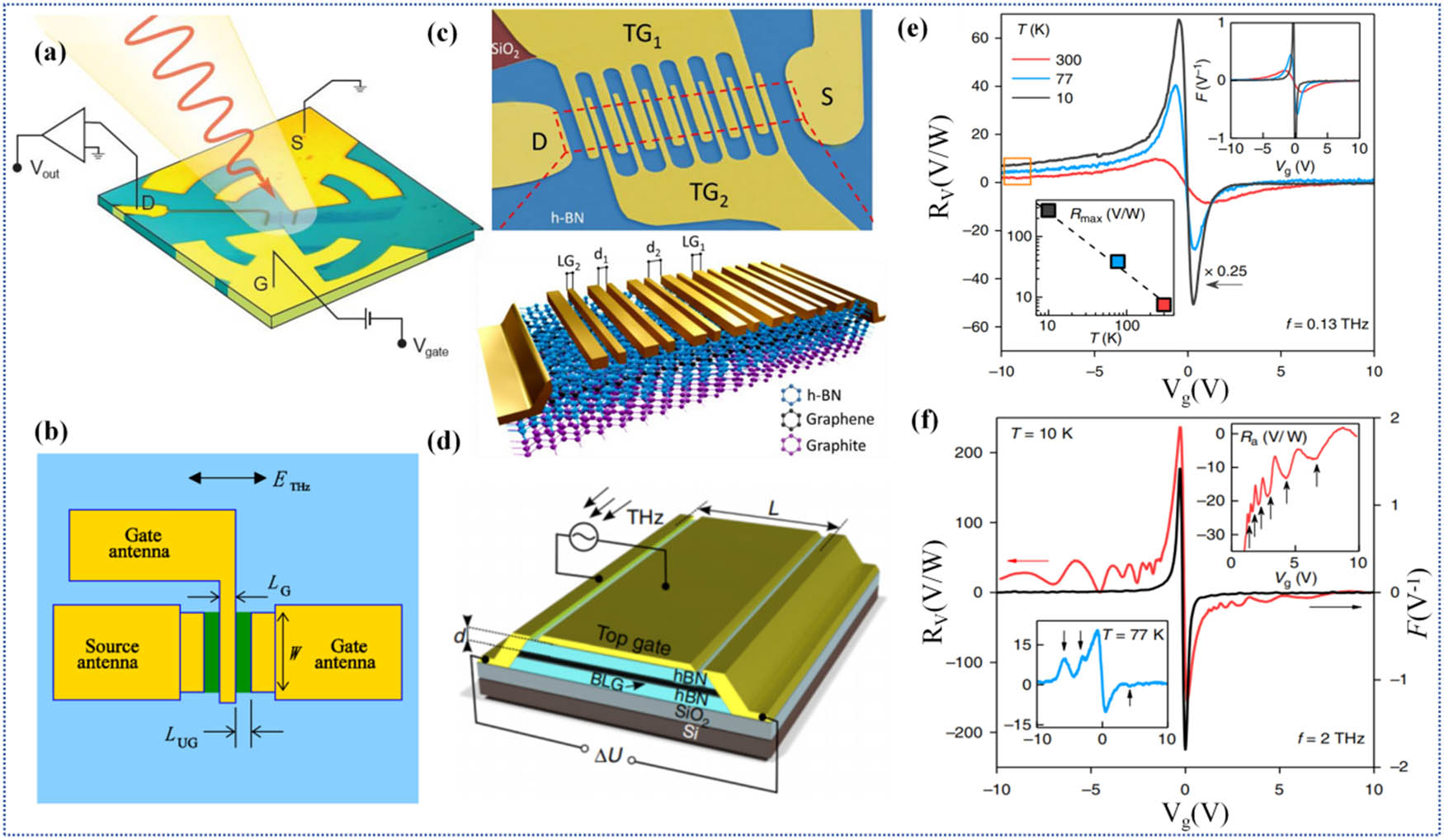
Figure 9
(a) Schematic diagrams of the device structure and wiring [35], (b) schematic diagram of the device structure (top view) [121], (c) schematic diagram of the device structure (top view + cross-sectional view) [120], (d) schematic cross-sectional view of the device, where L denotes the source-drain distance [102]. (e) Responsivity curves under different gate voltages and temperatures upon 0.13 THz irradiation. The upper inset shows the variation of the field-effect factor F with V g, and the lower inset depicts the variation of the maximum responsivity R max with temperature. [102] (f) Responsivity curves (red) and field-effect factor F curves (black) under different gate voltages upon 2 THz irradiation. The upper inset displays the magnified region of the photovoltage under electron doping, with the resonance peak indicated by black arrows, and the lower inset presents the resonant responsivity curve at liquid nitrogen temperature [102].
Source: data from Vicarelli L et al., Qin H et al., Delgado-Notario J A et al., Bandurin D A et al.
In 2017, Qin et al. [121] reported a room-temperature terahertz detector based on a bilayer graphene FET (Figure 9b). At 0.33 THz, the detector achieved an R V of 30 V/W and an NEP of 51 pW/Hz1/2. After terahertz waves were coupled into the channel via the antenna, they modulated both carrier concentration and drift velocity simultaneously, generating a direct current signal through nonlinear rectification. The response conformed to the GFET self-mixing model without frequency resonance peaks. In 2022, Delgado-Notario et al. [120] reported an asymmetric dual-grating-gate GFET (Figure 9c). The device exhibited a quality factor Q = ∼ 0.75 < 1, operating in the overdamped non-resonant mode at 0.3 THz. Abrupt n–p (p–n) or n+ –n (p+ –p) junctions were formed by biasing the dual-grating top gates and the graphite back gate, which enhanced the inhomogeneity of the plasmonic near-field and improved the rectified signal by one order of magnitude. At a temperature of 4.5 K, the current responsivity R I reached 0.216 A/W with a minimum NEP of 0.81 pW/Hz1/2. At room temperature, the R I was 1.9 mA/W and the NEP was 0.67 nW/Hz1/2. Resistive self-mixing under the overdamped non-resonant mode serves as a broadband detection mechanism capable of room-temperature operation, yet its responsivity and NEP are relatively not particularly outstanding.
PWR under the resonant mode represents a breakthrough for graphene-based FET terahertz detectors. In 2018, Bandurin et al. [102] conducted a study focusing on high-mobility BLG field-effect transistors as the core component (Figure 9d), realizing plasmon-assisted resonant detection in the terahertz band. However, the study failed to overcome the temperature limitation, and the resonant mode still required low-temperature conditions (10–77 K). Terahertz radiation was focused onto the hexagonal boron nitride (hBN)–encapsulated graphene channel via a broadband bowtie antenna. After exciting plasma waves, the channel acted as a F–P plasmonic cavity, enabling the reflection of plasma waves at the source and drain terminals. Resonance enhancement occurs when the condition L = (2k + 1)/4 is satisfied (where k is the mode number and is the plasmon wavelength), and the plasma waves are then rectified into a DC photogenerated voltage through a nonlinear mechanism associated with the FET factor F = . The device exhibited dual response modes. At low frequencies (e.g., 0.13 THz) or in the overdamped state, it showed a non-resonant broadband response with a quality factor (Q = 0.2–0.7), relying on resistive self-mixing and photothermoelectric rectification at the p–n junctions of contact regions. The response reached its maximum near the CNP with a polarity reversal (Figure 9e). At high frequencies (e.g., 2 THz) or in the underdamped state, it presented a resonant narrowband response with (Q = 4–11), where plasmon resonance further amplified the rectification efficiency. The mode number k showed a linear relationship with the gate voltage and could be tuned by gate voltage. The detector achieved a maximum responsivity of 240 V/W and a minimum NEP of 0.2 pW/Hz1/2 at 2 THz, though these performance metrics were obtained under the 10 K condition (Figure 9f).
However, in 2024, Caridad et al. [119] achieved the first room-temperature plasmon-assisted resonant terahertz detection based on a high-mobility single-layer graphene short-channel dual-gate field-effect transistor (Figure 10a). Its response mechanism is centered on the nonlinear rectification of plasma waves in accordance with the DS theory. Thanks to the high carrier mobility (>60,000 cm2/(V s)) and low carrier momentum relaxation time ( ≈ 0.23 ps) of single-layer graphene, plasma waves reflect between the source and drain under high-frequency terahertz radiation, realizing room-temperature resonance enhancement. The device’s response mode is dominated by the incident frequency. At 0.3 THz (Q ≈ 0.5 < 1), it exhibits a non-resonant broadband response, following the relation (where V TG is the top-gate voltage). The response presents an antisymmetric curve with polarity reversal at the CNP, and the room-temperature responsivity at this frequency reaches ∼0.29 A/W after correction for coupling efficiency. At high frequencies (2.5–4.7 THz, Q ≫ 1), it shows a resonant narrowband response characterized by gate-voltage-dependent periodic oscillation peaks. The number of resonant modes N satisfies N ∝ ω|V TG | −1/4, with a plasmon wavelength ranging from 600 nm to 2.1 μm and a radiation compression ratio as high as 110. Experiments confirmed that the characteristics of this resonant oscillation (gate-voltage-dependent periodic fluctuations) persist from low temperature (10 K) to room temperature (300 K); Figure 10b). This study breaks through the limitation that the resonance of traditional FETs and early graphene devices relies on low temperatures, laying a foundation for room-temperature frequency-tunable terahertz detectors.
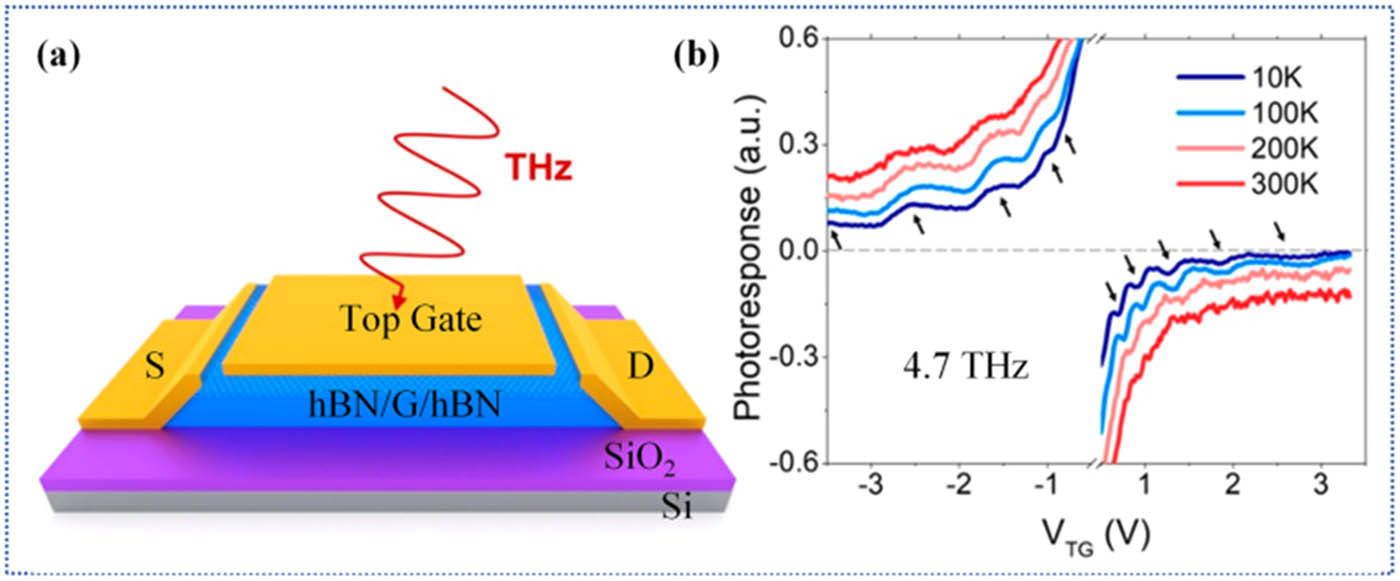
Figure 10
(a) Schematic diagram of the device structure [119], (b) photoresponse curves under different gate voltages and temperatures upon 4.7 THz irradiation, with black arrows indicating the resonance peaks [119].
Source: data from Caridad J M et al.
4.4. Photoconductive and bolometric effect
The zero-bandgap characteristic of graphene leads to an extremely short carrier lifetime (on the picosecond scale) and rapid recombination of photogenerated electron–hole pairs [73], which is inconsistent with the requirements of the traditional photoconductive (PC) effect, such as sufficient photogenerated carriers and long carrier lifetime. Consequently, the PC effect is rarely employed in graphene-based terahertz detectors. In the terahertz band (intraband transitions), detectable photoconductive responses usually require the assistance of hot carriers. Tuning the Fermi level of graphene also helps the photoconductive response. When the Fermi level (E F) deviates from the Dirac point, the contribution of intraband transitions is significantly enhanced, with more electrons excited to the conduction band or holes filled in the valence band, thereby increasing the photoconductive response.
In 2018, Liu et al. [122] reported a room-temperature graphene terahertz detector based on the hot-carrier-assisted PC effect (Figure 11a). Sub-terahertz photons (0.16–0.6 meV) are absorbed by free carriers in graphene via intraband transitions to form hot carriers. Owing to the temperature difference between hot carriers and the lattice, as well as the concentrated in-plane electric field at the antenna gap, hot carrier diffusion induces a temperature gradient, which further generates a potential well through the Seebeck effect (Figure 12b). This potential well drives the injection of additional electrons from the metal electrodes into the graphene channel, altering the carrier concentration and thereby triggering a change in conductivity. At room temperature, the device achieves a responsivity of 400 V/W with an NEP < 0.5 nW/Hz1/2. From 125 to 260 K, the direct current–voltage (I–V) curve of the device shows no significant variation (Figure 12c), and the temperature coefficient of resistance (TCR) remains at a low level of ∼0.04 Ω/K, indicating that the bolometer (BM) effect does not dominate. The photovoltage exhibits a linear relationship with the incident terahertz power (Figure 12d), and the photovoltage is zero at zero bias, demonstrating that the PTE effect is not dominant.
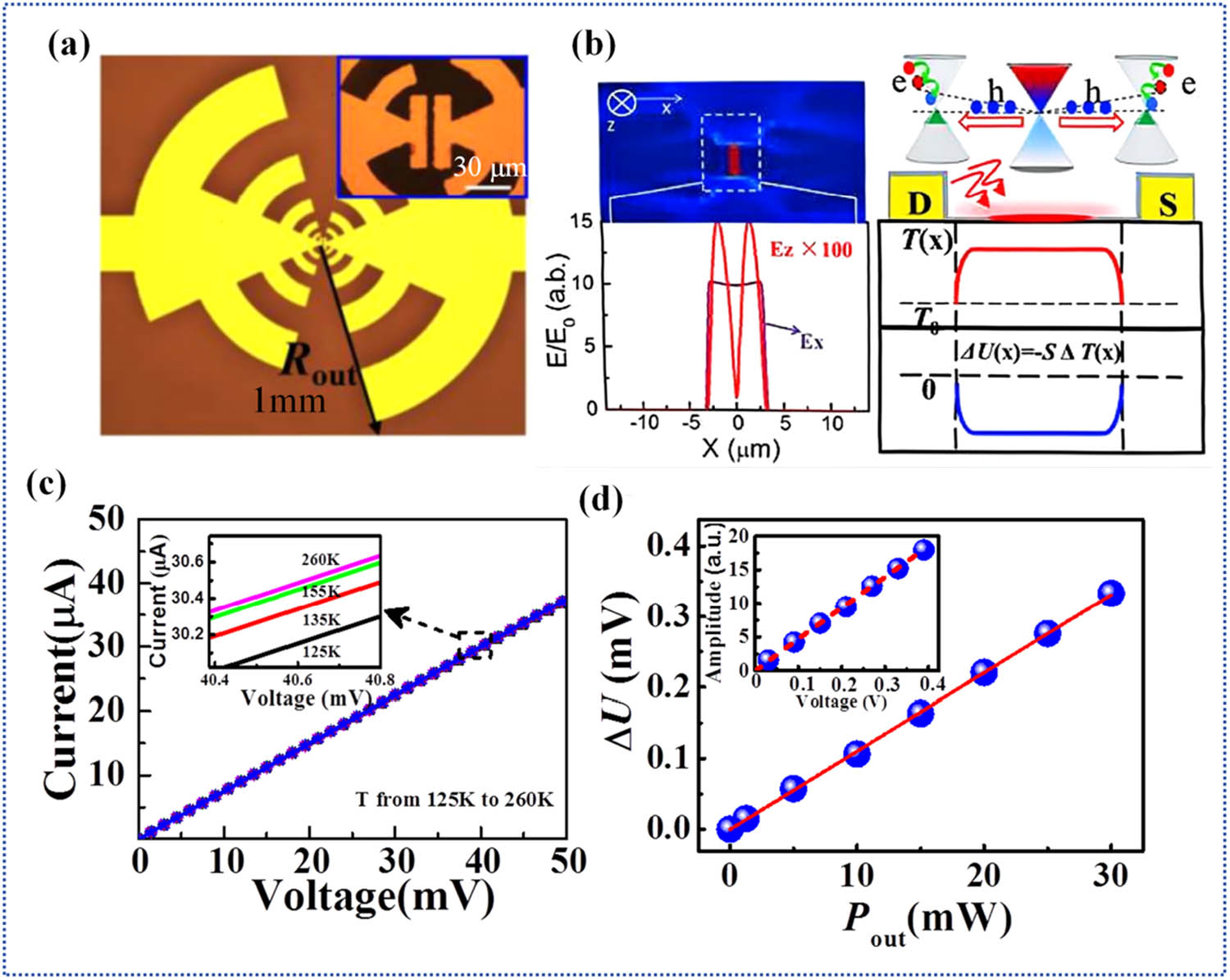
Figure 11
(a) Microscopic image of the detector integrated with a log-periodic antenna. The inset shows the photosensitive region (channel area: 300 μm2) located in the antenna gap [122]. (b) Left side, the antenna-coupled incident electric field E x /E z onto the active channel, with E x component being two orders of magnitude larger. Right-side, the resulting photoconductive process enabled by the well-like built-in potential ∆U(x), which follows the change of carrier temperature ∆T(x): ∆U(x) ∼ S∆T(x) ∝ σ|E x | 2 [122]. (c) I–V characteristics of the device at different temperatures [122]. (d) Relationship curves between photovoltage ∆U and output power P out upon 0.04 THz irradiation with a bias voltage U of 0.4 V. Inset shows the photovoltage ∆U as a function of the bias voltage, with the red line representing the fitting result [122].
Source: data from Liu C et al.
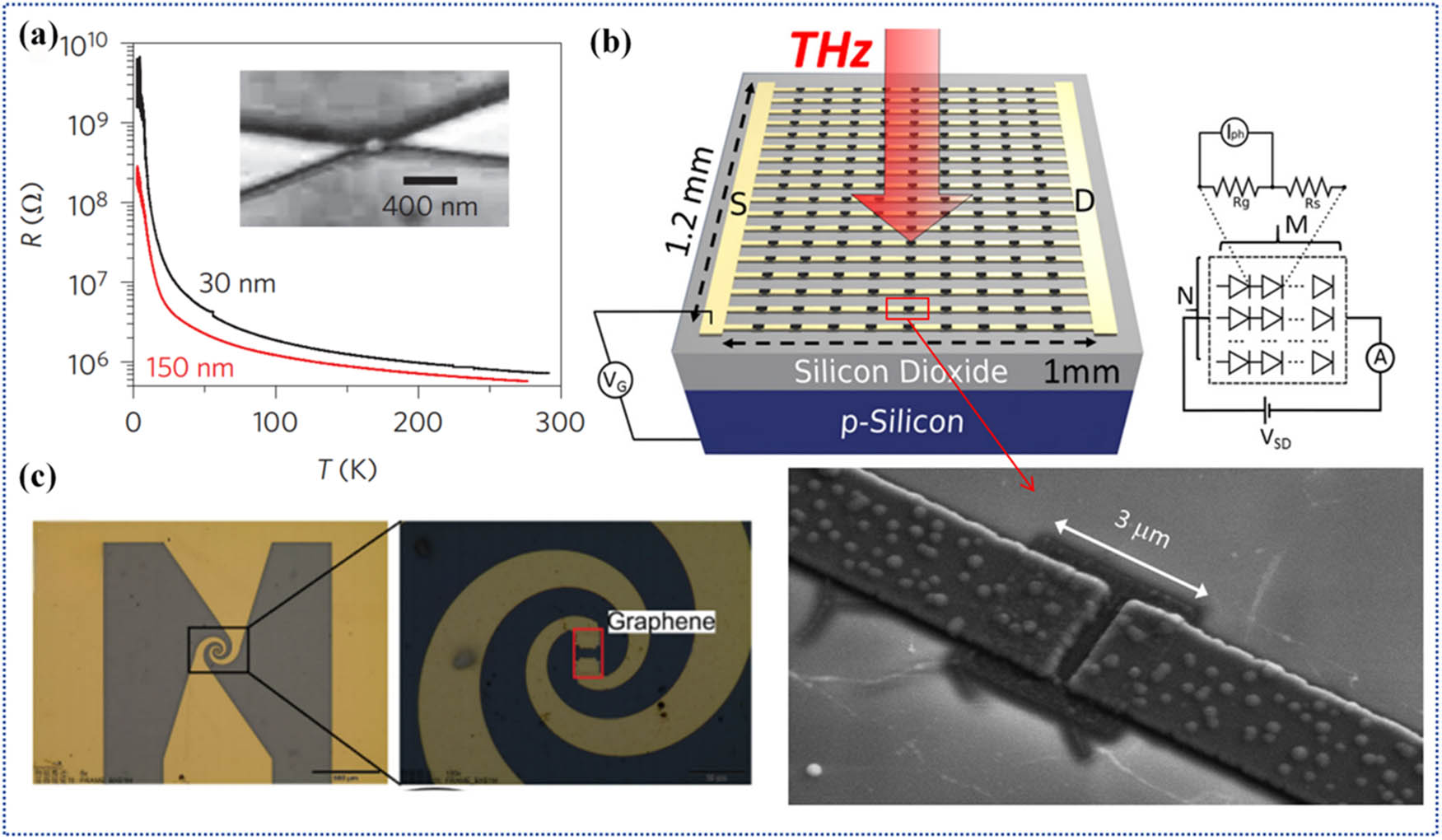
Figure 12
(a) Relationship between resistance and temperature for two quantum dots with different diameters at a DC voltage V DC = 5 mV. The inset shows the scanning electron microscopy (SEM) image of the quantum dots [123]. (b) Schematic diagrams of the basic device array and its electronic circuit, with the SEM image of the unit device shown below [124]. (c) Image of the graphene-based thermal noise-readout bolometer [125].
Source: data from EI Fatimy A et al., Degl’Innocenti R et al., Miao W et al.
The core of the BM effect lies in the change in material transport conductivity induced by heating from incident photons. Bolometers are precisely based on this characteristic: they absorb incident radiation (dP) to cause a temperature rise (dT) of the photosensitive material, which leads to a change in its conductivity and is macroscopically manifested as a resistance variation, thereby realizing the measurement of electromagnetic radiation power. Two key parameters [126] of bolometers are thermal resistance (R h = dT/dP) and heat capacity (C h), which jointly determine the response time . Graphene exhibits a low C h due to its small volume and low density of states per unit area. Meanwhile, because of its small Fermi surface, the efficiency of electron cooling via acoustic phonons is relatively low, and cooling via optical phonons requires a high electron temperature (k B T e > 0.2 eV), resulting in a relatively high R h [127]. Improving response speed requires resolving the contradiction between low C h and high R h. Even though high R h brings a significant ΔT, the TCR parameter still matters. Additionally, strong noise at room temperature restricts its operation to low-temperature environments.
Thermal conductivity is inversely proportional to R h (with geometric parameters fixed), including phonon thermal conductivity (k ph) and electronic thermal conductivity (k e). The contribution of k e to the total thermal conductivity is relatively weak. When the Fermi level (E F) is far from the Dirac point, k e increases (<10%) [128], which reduces R h and is unfavorable for the sensitivity of the BM response. Graphene has an extremely high in-plane thermal conductivity, causing heat to dissipate quickly. Using a suspended structure can effectively weaken the thermal coupling between graphene phonons and substrate phonons, thereby avoiding the substrate’s interference with the dynamics of photoexcited carriers and the carrier cooling effect mediated by polar phonons, while also significantly suppressing substrate-dominated thermal dissipation and reducing the device’s effective heat capacity, thus enhancing the response speed and detection sensitivity of terahertz devices [69,129,130].
In 2016, El Fatimy et al. [123] reported a high-performance terahertz bolometer based on epitaxial graphene quantum dots (QDs) on a SiC substrate. Graphene itself possesses the characteristics of low electronic heat capacity and weak electron–phonon coupling, leading to a significant change in electron temperature upon light absorption. After patterning the epitaxial graphene on the SiC substrate into QDs via nanofabrication, the quantum confinement effect induces a band gap, endowing its resistance with an extremely strong temperature dependence (the TCR of 30 nm-diameter QDs reaches as high as ∼430 MΩ/K at 6 K, as shown in Figure 12a). At 2.5 K, the terahertz detector based on 30 nm QDs achieves a R V of up to 5 × 10¹⁰ V/W, which is five orders of magnitude higher than that of traditional graphene detectors of the same type, with a minimum NEP of 0.2 fW/Hz1/2 and a response time < 2.5 ns. Its performance far surpasses that of commercial cooled bolometers of the same period. Moreover, the detector features a wide operating range and maintains excellent performance even at 77 K (liquid nitrogen temperature). Despite its outstanding low-temperature performance, the detector fails to operate at room temperature.
In 2017, Degl’Innocenti et al. [124] reported a room-temperature terahertz detector based on a plasmonic antenna array (Figure 12b). The antenna elements are connected through graphene regions with submicron gaps and encapsulated by an Al2O3 layer deposited via atomic layer deposition (ALD). The antennas not only act as plasma resonant components to achieve electric field enhancement but also serve as electrodes to collect photocurrent. Experiments employed 2 and 2.7 THz quantum cascade lasers as light sources, and the test results showed that the detector’s maximum responsivity reaches 2 mA/W, an order of magnitude higher than that of previous graphene detectors of the same type. However, the responsivity of this device is lower than that of detectors based on other mechanisms (e.g., PTE, PWR), and the noise of BM effect-based devices at room temperature is non-negligible (1/f noise and thermal noise). At room temperature, the noise of graphene is dominated by low-frequency 1/f noise and thermal noise (Johnson noise), while shot noise and generation-recombination noise make secondary contributions and are easily masked [131–134]. The noise caused by graphene’s zero-bandgap characteristic is unavoidable, but “high noise” is a relative disadvantage compared to the low-frequency performance of traditional materials, rather than an absolute drawback.
In 2018, Miao et al. [125] reported a graphene terahertz hot–electron bolometer integrated with a log-spiral antenna (Figure 12c), adopting Johnson noise readout technology. Terahertz radiation is coupled to the graphene region via the antenna, triggering a change in electron temperature; the detection of terahertz radiation intensity is then realized by measuring the variation in Johnson noise power. The device exhibits high coupling efficiency within the range of 0.3–1.6 THz, with an NEP of 5.6 pW/Hz1/2 at 3 K. The length of graphene has a negligible effect on NEP, while the thermal diffusion of contact pads caused by electron diffusion exerts a significant impact on NEP. Superconducting contact pads can effectively enhance the performance of thermoelectric detectors. Building on the 2018 study, Nb superconducting material was used as electrodes in 2021 to suppress electron diffusion heat loss through the Andreev reflection effect [135]. Meanwhile, BLG with high carrier density was selected, whose impedance is significantly lower than that of single-layer graphene, optimizing antenna impedance matching and improving optical coupling efficiency. The optical NEP of the device showed no obvious improvement, but the electrical NEP was reduced to 15 fW/Hz1/2, with a wide dynamic range of 47 dB (input power: 1 pW ∼ 10 nW) and an optical coupling efficiency of 92%.
In 2023, Miao et al. [136] further reported a terahertz detector based on a superconductor-graphene-superconductor (SGS) Josephson junction. Taking a BLG microbridge as the sensitive core, the device constructs an SGS structure with superconducting Nb electrodes, breaking through the limitation of weak resistance-temperature dependence of traditional graphene detectors by virtue of the proximity Josephson coupling effect. It achieves efficient radiation coupling in the 1.4 THz band, and its operating mechanism is as follows: after terahertz radiation is absorbed by the BLG microbridge, the weak electron–phonon coupling characteristic leads to a significant increase in electron temperature, which in turn suppresses the proximity Josephson coupling strength, resulting in remarkable changes in Josephson current and dynamic impedance. Finally, low-noise current readout is realized via a direct current superconducting quantum interference device (dc SQUID). Compared with their previous hot–electron bolometers, the performance of this detector has achieved a leapfrog improvement. Within the temperature range of 0.1–0.6 K, the optical NEP is as low as 0.25–0.5 fW/Hz1/2, and the sensitivity is improved by 5–6 orders of magnitude. Meanwhile, due to the suppression of electron diffusion heat loss, the device response time is shortened to 1.3 ns. Its core advantage lies in combining the fast thermal response of graphene with the high-sensitivity conversion of superconducting Josephson junctions and the ultra-low-noise readout of SQUID, effectively avoiding performance limitations caused by graphene’s intrinsic noise. This further verifies the great potential of graphene-superconductor heterogeneous integration in noise suppression and performance enhancement.
5. Challenges and future directions
Current graphene terahertz detectors face two primary challenges: (1) difficulties in achieving large-area, uniform graphene synthesis, and (2) limitations inherent to graphene’s zero-bandgap electronic structure. Unlike traditional semiconductors, the absence of a bandgap prevents current shut-off via gate voltage, generating high dark current that degrades SNR and sensitivity. This is particularly critical in the terahertz regime, where dark current noise often obscures faint terahertz signals, limiting detection capabilities.
Achieving large-area uniform graphene synthesis faces significant challenges due to inherent limitations in mainstream methods. Mechanical exfoliation produces high-quality monolayers but yields micron-scale, irregular flakes with poor reproducibility, preventing scaling [42]. CVD enables larger-area growth via metal-catalyzed hydrocarbon decomposition, yet random nucleation creates grain boundaries that degrade carrier mobility. Substrate-graphene thermal expansion mismatches induce wrinkles/strain, while transfer processes introduce cracks and polymer residues from etching/stress, further impairing performance [137]. Epitaxial growth on SiC (>1,200°C through Si sublimation) suffers from non-uniform nucleation at substrate steps and strong interfacial coupling that distorts bands and scatters charges, yielding sub-theoretical mobility plus non-destructive transfer difficulties [138]. Liquid-phase exfoliation and reduction-oxidation methods improve yield but compromise structural integrity with high defect densities and poor electrical properties [139,140].
Current research prioritizes optimizing CVD and SiC epitaxial methods for their scalability in producing high-mobility, low-defect graphene. Banszerus et al. [141] achieved RT mobility of 350,000 cm2/V s on copper substrates via improved CVD transfer techniques like direct van der Waals exfoliation, rivaling mechanical exfoliation. De Fazio et al. [142] attained 70,000 cm2/V s (RT) and 120,000 cm2/V s (cryogenic) mobility in CVD graphene through post-transfer thermal annealing, achieving <5% intra-wafer variation for wafer-scale uniformity. For SiC epitaxy, Han et al. [143] developed thermal shock annealing (TSA) with 103°C/s ramp rates, growing epitaxial graphene in 10 s while reducing energy use 1,000-fold and improving flatness 8× versus conventional methods. Zhao et al. [144] pioneered semiconducting epitaxial graphene (EG) with a 0.6 eV bandgap via quasi-equilibrium annealing, exhibiting 5,500 cm2/V s RT mobility-10× higher than traditional 2D semiconductors. This bandgap-engineered graphene constitutes a breakthrough, mitigating fundamental limitations like dark current and low on/off ratios while enabling terahertz devices and quantum computing applications.
To address the issues of high dark current and low on-off ratio in graphene terahertz detectors caused by its zero band gap, synergistic optimization can be implemented from multiple dimensions, including material design, device structure, and external regulation. Material approaches include constructing heterostructures (e.g., boron nitride [145] or lithium-intercalated interfaces [146]) that leverage built-in electric fields for carrier separation, or utilizing bandgap-opened BLG [147] or SiC EG. Though current band-engineered gaps remain suboptimal for terahertz detection, future advances may enable their application. For device structure, dual-gate regulation can be adopted to form p–n junction barriers for suppressing dark current, or metal nanostructures can be integrated to enhance terahertz absorption or SNR. External modulation employs cryogenic operation (reducing thermal noise), optical gating (dynamic carrier control) [148], and lock-in amplification (weak-signal extraction). Future breakthroughs will rely on new mechanisms such as topological insulator heterojunctions and plasmon–photon coupling devices. Through multi-scale regulation of energy bands, light fields, and thermodynamics, it will promote the development of high-sensitivity, low-noise, room-temperature terahertz detection technology (Table 1).
Table 1
Performance parameters of the graphene terahertz photodetectors reported in this article
| Mechanism | Manufacturing method | Working frequency | Working temperature | NEP | Responsivity | Response time | Ref. |
|---|---|---|---|---|---|---|---|
| PV | CVD | 2 THz | RT | 150 nW/Hz1/2 | 34 μA/W | — | [105] |
| PTE | ME | 2.52 THz | RT | <1.1 nW/Hz1/2 | >10 V/W | 10.5–110 ps | [106] |
| ME | 2.1 THz | RT | 1.7 nW/Hz1/2 | 4.9 V/W | — | [107] | |
| ME | 1.8–4.2 THz | RT | 80 pW/Hz1/2 | 105 V/W | <30 ns | [46] | |
| ME | 3 THz | RT | <160 pW/Hz1/2 | 49 V/W | <3.3 ns | [47] | |
| ME | 3.4 THz | RT | 120 pW/Hz1/2 | 50 V/W | 890 ps | [109] | |
| CVD | 2.8 THz | RT | 1 nW/Hz1/2 | >3 V/W | 5 ns | [110] | |
| CVD | 2.52/3.11 THz | RT | 9.3 nW/Hz1/2 (2.52 THz) | 3.16/2.39 V/W | 25 μs | [48] | |
| ME | 0.13 THz | 25 K | 36 fW/Hz1/2 | 50 kV/W | — | [111] | |
| ME | 0.19–0.26 THz | RT | 58 pW/Hz1/2 | 30 V/W | <0.83 ns | [112] | |
| CVD | 0.4 THz | RT | 114 pW/Hz1/2 | 63 V/W | — | [113] | |
| CVD | 2.86 THz | RT | <300 pW/Hz1/2 | >40 V/W | <5 ns | [114] | |
| PWR | ME | 0.3 THz | RT | 30 nW/Hz1/2 | 150 mV/W | — | [35] |
| SiC EG | 0.33 THz | RT | 51 pW/Hz1/2 | 30 V/W | — | [121] | |
| ME | 0.3 THz | 4.5 K/RT | 0.81 pW/Hz1/2/0.67 nW/Hz1/2 | 0.216 A/W/1.9 mA/W | — | [120] | |
| ME | 2 THz | 10 K | 0.2 pW/Hz1/2 | 240 V/W | — | [102] | |
| ME | 0.3 THz | 10 K | — | 0.29 A/W | — | [119] | |
| PC | CVD | 0.02–0.15 THz | RT | 0.5 nW/Hz1/2 | 400 V/W | 2 μs | [122] |
| BM | SiC EG | 0.7–4 THz | 2.5 K | 0.2 fW/Hz1/2 | 5 1010V/W | <2.5 ns | [123] |
| CVD | 2/2.7 THz | RT | — | 2 mA/W | — | [124] | |
| SiC EG | 0.3–1.6 THz | 3 K | 5.6 pW/Hz1/2 | — | — | [125] | |
| SiC EG | 0.3–1.6 THz | 0.3 K | 15 fW/Hz1/2 | — | — | [135] | |
| SiC EG | 1.4 THz | 0.1–0.6 K | 0.25–0.5 fW/Hz1/2 | — | — | [136] |
Source: data from Degl’Innocenti R et al., Cai X et al., Tong J et al., Castilla S et al., Viti L et al., Viti L et al., Asgari M et al., Chen M et al., Titova E et al., Soundarapandian K P et al., Ludwig F et al., Viti L et al., Vicarelli L et al., Qin H et al., Delgado-Notario J A et al., Bandurin D A et al., Caridad J M et al., Liu C et al., EI Fatimy A et al., Degl’Innocenti R et al., Miao W et al., Miao W et al., Miao W et al.
6. Conclusions
Graphene, by virtue of its ultrahigh carrier mobility, broadband response, and tunable plasma properties, provides a revolutionary platform for breaking through the performance bottlenecks of traditional terahertz detectors. This article systematically summarizes the working mechanisms of graphene terahertz detectors and, with room-temperature operation, high responsivity, and low noise as the core evaluation criteria, elaborates on the performance merits and demerits of such detectors based on different mechanisms. In the future, with the advancement of synthesis technologies for high-quality large-area graphene and the gradual improvement of band engineering, combined with state-of-the-art micro/nano fabrication technologies, graphene-based terahertz detectors are expected to achieve substantial progress in commercial applications. High-performance room-temperature-operated graphene terahertz detectors will offer novel solutions for low-power-consumption, high-speed, and broadband detection, and further accelerate the industrialization of terahertz technology applications in key fields, including non-destructive testing, high-speed communication, biomedicine, and security inspection.
Funding information
Authors state no funding involved.
Author contributions
Deshuai Meng(First Author): Paper Writing and Revision. Pu Zhang: Data arrangement and format standardization. Yang Cao(Corresponding Author): Paper Review and Suggestions.
Conflict of interest statement
Authors state no conflict of interest.