
1. Introduction
Nitrile butadiene rubber (NBR), a copolymer of acrylonitrile (ACN) and butadiene, is a cornerstone material in industries requiring oil, fuel, and chemical resistance, such as automotive sealing systems, oilfield equipment, and industrial hoses [1,2]. However, the residual carbon–carbon double bonds (C═C) in its backbone render NBR susceptible to oxidative degradation, ozone attack, and thermal instability, limiting its performance in aggressive environments [3,4]. To address these limitations, hydrogenation of NBR to produce hydrogenated NBR (HNBR) has emerged as a critical industrial process, effectively saturating C═C bonds to enhance thermo-oxidative stability and mechanical durability [5,6,7]. Despite these advancements, HNBR retains polar nitrile (–C≡N) groups, which, while contributing to oil resistance, impose trade-offs in low-temperature flexibility and processability.
At present, the hydrogenation process of carbon–carbon double bonds in nitrile rubber has become increasingly mature. The commonly used methods mainly include homogeneous hydrogenation of precious metals and heterogeneous hydrogenation [8,9,10]. The typical method of heterogeneous hydrogenation is to dissolve the polymer in a suitable solvent and then bring the polymer solution in contact with a heterogeneous catalyst in a hydrogen atmosphere. The operation is relatively simple, but the high viscosity of the polymer solution and the steric hindering of the polymer chains cause limited contact between the polymer solution and the catalyst, resulting in severe mass transfer resistance to the hydrogenation reaction rate in the heterogeneous system [11]. Because the hydrogenated polymer molecules occupy the catalytic active centers, the reactivity of the catalyst in the heterogeneous system gradually decays as the reaction proceeds. Homogeneous systems have higher selectivity and reactivity, but there are difficulties in scalability, ligand stability, and catalyst recovery [12,13]. Despite the advancements in NBR hydrogenation, several critical industrial limitations persist in traditional processes. First, the functional inflexibility of current methods, which focus almost exclusively on the selective reduction of C═C bonds while leaving the polar nitrile (–C≡N) groups intact, restricts the ability to fine-tune the balance between oil resistance and low-temperature flexibility. Second, mass transfer limitations and catalyst recovery remain significant hurdles; the high viscosity of polymer solutions in heterogeneous systems hinders catalytic efficiency, while homogeneous systems suffer from high costs associated with noble metal recovery and ligand stability. Most critically, the risk of irreversible gelation (cross-linking) during the reaction poses a constant threat to product processability, as side reactions involving macromolecular chains can lead to undesirable network formation, effectively negating the performance benefits of hydrogenation.
Regarding the nitrile group, changes in ACN content can change the properties of NBR due to its polarity. Increased polarity due to the presence of more nitrile bonds will have an effect on the rubber’s ability to interact with other polar or nonpolar polymers. NBR with higher ACN content will have improved processability, oil/fuel resistance, air/gas permeability, tensile strength, and abrasion resistance, while NBR with lower ACN content will have improved compression set, resilience, hysteresis, and low temperature flexibility [14]. Nowadays, the reaction in which a large amount of small molecule nitriles are reduced to amines has been reported [15,16,17], but the selective hydrogenation of nitriles in polymers remains a formidable challenge.
Rhodium hydrogenation complexes have reignited our interest in selective polymer modification. Yoshida et al. demonstrated that RhH[P(i-Pr)3]3 exhibits outstanding activity and universality in multiple fields due to its unique electronic structure and steric effect of the ligand, including water–gas transfer reactions [18,19] and photochemical dehydrogenation of alcohols [20,21]. Meanwhile, the Wilkinson catalyst (RhCl(PPh3)3) [22] has been widely used in olefin hydrogenation in nitrile rubber, although its inability to reduce nitrile limits its application. Based on these insights, our team hypothesized that a well-designed Rh hydride complex could bridge this gap, simultaneously hydrogenating the C═C and C≡N groups while inhibiting cross-linking.
Prior to this, we have already explored the reactions of hydrogenation of carbon–carbon double bonds in styrene butadiene rubber [23] and nitrile groups in HNBR. An effective catalyst, RhH[P(i-Pr)3]3, has been screened, selected, and proven to successfully hydrogenate the nitrile group in HNBR. After adding a certain amount of TPP or other additives, the gel formation was significantly reduced and controlled. However, if the same catalyst is used in the NBR hydrogenation system, that is, to hydrogenate both nitrile and olefin groups simultaneously, it will bring huge benefits to the industry. In this article, we continued to use RhH[P(i-Pr)3]3 as the catalyst for the tandem hydrogenation of NBR and studied its reaction effect under various reaction conditions. Notably, triphenylphosphine (TPP) was identified as a critical additive to terminate nitrile hydrogenation selectively, mitigating gelation while preserving olefin reduction activity – a phenomenon attributed to ligand exchange dynamics. This work unlocks pathways to engineer HNBR variants with tunable ACN content, balancing oil resistance, low-temperature performance, and processability for next-generation elastomers.
2. Experimental method
2.1. Materials
Solid and liquid reagents, Rhodium(Ⅲ) chloride hydrate (38.5wt% Rh), triisopropylphosphine (P(i-Pr)3, 98%), tetrahydrofuran (THF, >99.9%), TPP (99%), and Na/Hg amalgam (5%) were purchased from Sigma-Aldrich, NBR (Lanxess, Perbunan T3435). And Nitrogen (N2, Ultra High Purity 5.0), Argon (Ar, Ultra High Purity 5.0), and hydrogen (H2, Ultra High Purity 5.0) were procured from Praxair. Before the experiment, sodium tablets must be added to THF and refluxed to remove water.
2.2. Apparatus
A Parr 4560 Mini Benchtop Reactor (300 mL) equipped with a Parr 4842 Controller; a Thermo Nicolet 6700 Fourier transform infrared (FTIR) spectroscopy operated using OMNIC software; a Bruker 300 MHz Nuclear Magnetic Resonance equipped with a QNP Probe device was employed for chemical structure analyses; a vacuum Atmospheres Company (VAC) HE493 Dri-Train glove box; and VAC Nexus One glove box were used.
2.3. Preparation and characterization of RhH[P(i-Pr)3]3
We improved the synthesis method of Butler [26] and successfully obtained the required catalyst as follows: (1) A mixture of RhCl3·3H2O (0.98 g, 4 mmol) and P(i-Pr)3 (1.6 mL, 8 mmol) was stirred in 35 mL THF for 20 h at room temperature. A brown solid residue was then obtained by concentration under vacuum; (2) THF (35 mL), P(i-Pr)3 (1.0 mL, 5 mmol), and 1% Na/Hg (40 g) were added sequentially to the brown solid. The mixture was stirred at room temperature for 20 h. The filtered reaction solution was dried under high vacuum (0.001 mm Hg) to remove excess P(i-Pr)3; and (3) Recrystallization of the resulting dark brown solid residue from pentane containing free P(i-Pr)3 (0.5 mL) gave RhH[P(i-Pr)3]3 as yellow crystals (1.4 g, 60%).
The gas for degassing was changed from nitrogen to argon. In the previous experiments, N3 was used for degassing before introducing the catalyst solution into the system. The catalyst RhH[P(i-Pr)3]3 could form RhH3[P(i-Pr)3]3 in the presence of H2; however, if there is any N3 present, it will continuously create a dinitrogen compound RhH(N3)[P(i-Pr)3]3, followed by other reactions if conditions permit. RhH[P(i-Pr)3]3 was characterized by FTIR spectroscopy.
As seen in Figure 1, there are very strongly defined peaks in the 2,800–3,000 cm−1 region. These peaks are characteristic of the C–H bond in any alkanes, similar to those in the Rh hydrido catalyst’s ligand, P(i-Pr)3. The small peak at 1,980–1,986 cm−1 is the Rh–H bond. There are numerous studies to support this claim, and some literature also shows that the characteristic peak of Rh–H bond also appears at 2,000–2,050 cm−1 [25,26,27,28,29,30,31]. The 1,300–1,500 cm−1 peaks are due to C–H bending. These signals are caused by the planar bending of the bond in 3D space and are caused once again by the ligands attached to the catalyst. There is a noticeable P–H bend in the 1,100–1,200 cm−1 range, a second C–H bending peak around 900 cm−1, and finally, a couple of peaks in the 650–700 cm−1 range related to the P–C bond of the ligand.
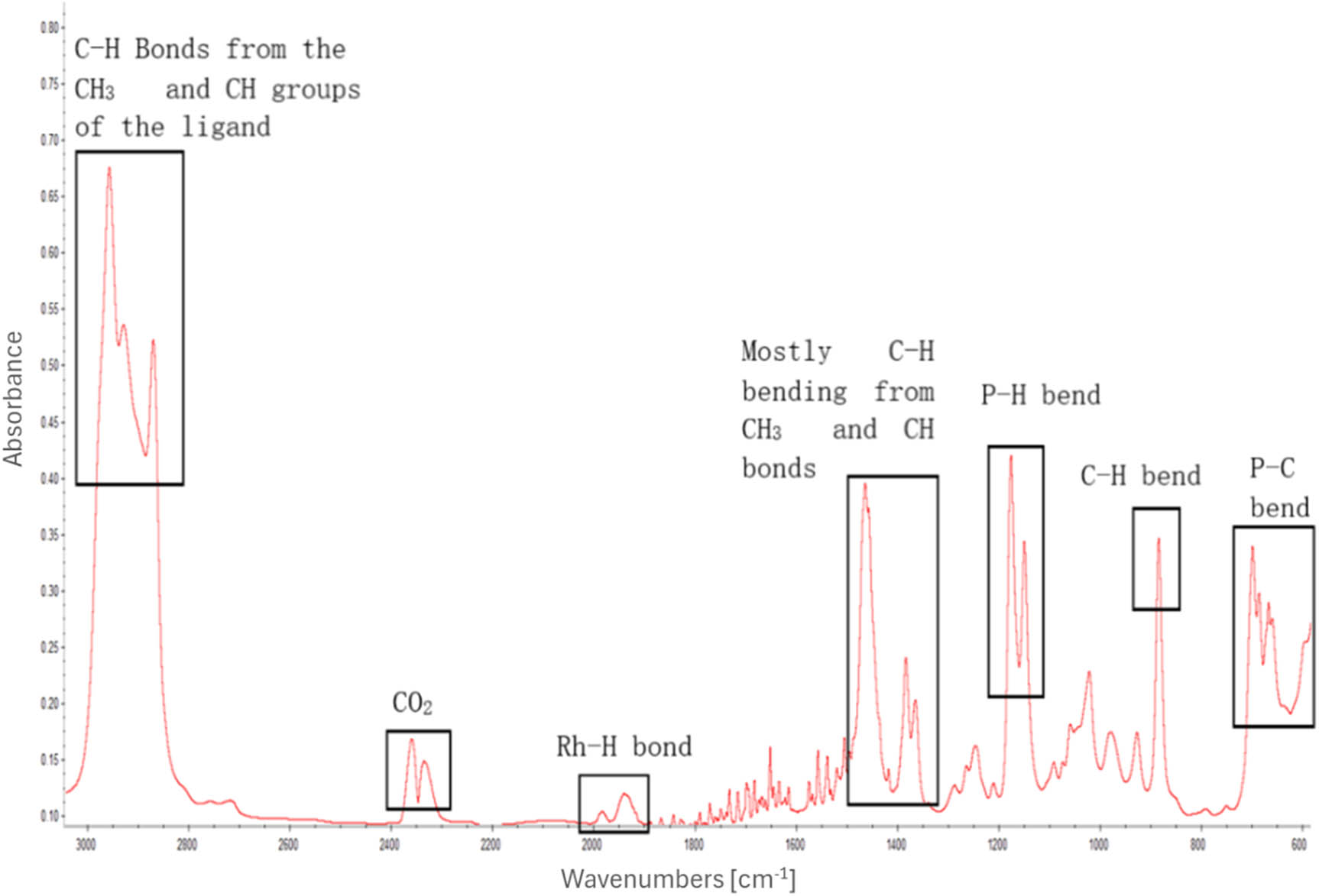
Figure 1
FTIR spectrum of RhH[P(i-Pr)3]3.
Source: Author’s contribution.
2.4. Hydrogenation and characterization of NBR nitrile groups
NBR solution (2.5 wt% in THF) was loaded into a 300 mL Parr reactor. After assembly, the reactor was leak-tested with 100 psig H2 and purged multiple times to ensure an oxygen-free environment. The mixture was heated under constant stirring (250 rpm). Upon reaching the target temperature, a designated amount of RhH[P(i-Pr)3]3 catalyst was prepared in an Argon glove box and injected into the reactor via a gas-tight syringe. The system was then pressurized to the desired value (500–1,000 psig H2). The degree of hydrogenation was determined using FTIR. Samples were cast onto NaCl disks and analyzed. In the NBR system, the absorbance at 723 cm−1 (representing saturated –(CH2) x –) remained stable and was thus utilized as an internal standard. The ratio of the nitrile peak height (2,236 cm−1) to the 723 cm−1 peak height was monitored over time to calculate the conversion, with an estimated error of less than 5%. Gel formation was assessed by passing 5–10 mL of the post-reaction solution through a 0.45 µm syringe filter; a successful passage indicated a gel-free product.
FTIR determined the conversion of carbon–carbon double bonds (hydrogenation degree) of NBR. In the FTIR analysis, the sample solution was cast onto a sodium chloride crystal disk. The NaCl disk was dried, and a polymer film was formed on it before it was ready for FTIR analysis. The degree of hydrogenation was calculated from the FTIR spectra according to the peak strength. IR spectra were collected using a Bio-Rad Excalibur 300MXPC spectrometer or a Thermo Scientific Nicolet 6700 spectrometer. Without undergoing any hydrogenation of carbon–carbon double bonds, the content of C≡N in both HNBR and NBR is approximately 40%, which remains unchanged during the olefinic hydrogenation experiments. The calculation for C═C hydrogenation is as follows:
A723 = absorbance at 723 cm−1,
A970 = absorbance at 970 cm−1,
A2236 = absorbance at 2,236 cm−1,
K(723) = 0.255, a constant specific to this peak,
K(970) = 2.3, a constant specific to this peak,
3. Results and discussion
3.1. Activity testing
We have investigated the hydrogenation capacity of the prepared catalyst for NBR nitrile from the aspects of catalyst dosage, temperature, pressure, and so on.
As shown in Figure 2, the reaction rate increases with catalyst loading, reaching near-complete nitrile reduction within 4 h at a 1.2 mL loading. However, higher catalyst concentrations significantly exacerbate gelation. This is likely due to the high local concentration of reactive intermediates and radicals generated during rapid C≡N and C═C bond cleavage, which facilitates chain entanglement and irreversible cross-linking [30].
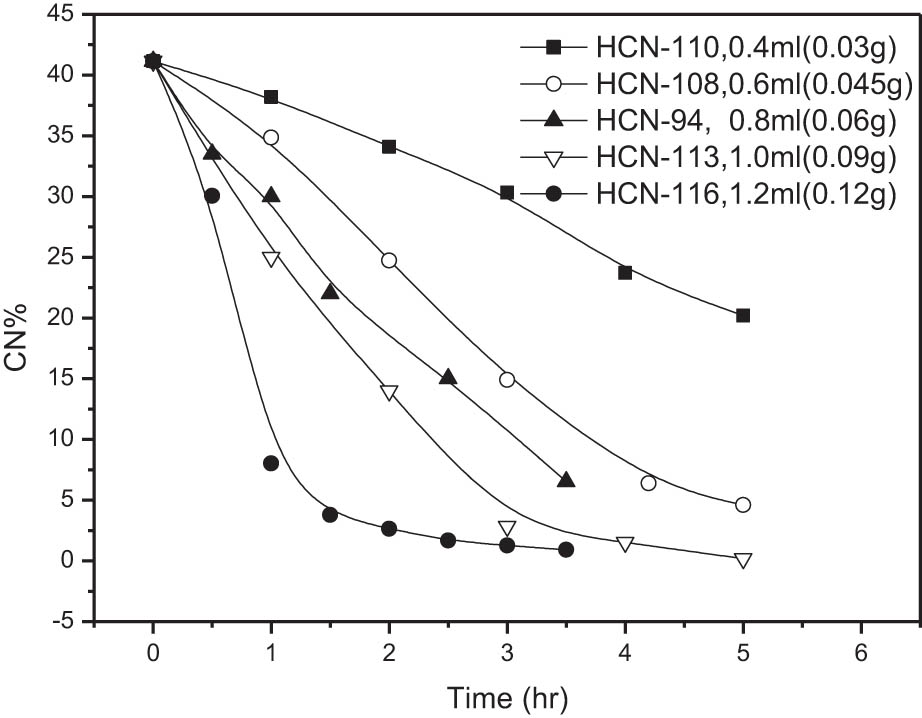
Figure 2
Effect of catalyst loading on hydrogenation of C≡Ns in NBR. (*: 0.8 mL catalyst solution [0.06 g catalyst, 0.1 mmol Rh], 100 mL 2.5 wt% NBR in THF, 60°C, 500 psig H2. **: the letters and numbers in the picture have no special meaning and only represent the experiment batch number).
Source: Author’s contribution.
Temperature effects (Figure 3) demonstrate that catalytic activity is markedly enhanced between 5 and 100°C due to increased molecular mobility. At 100°C, nitrile content drops to 20% within 2 h, but rapid gelation limits further conversion. Above this threshold, the system reaches a gel point too quickly for quantitative analysis, suggesting that high thermal energy accelerates intermolecular side reactions.
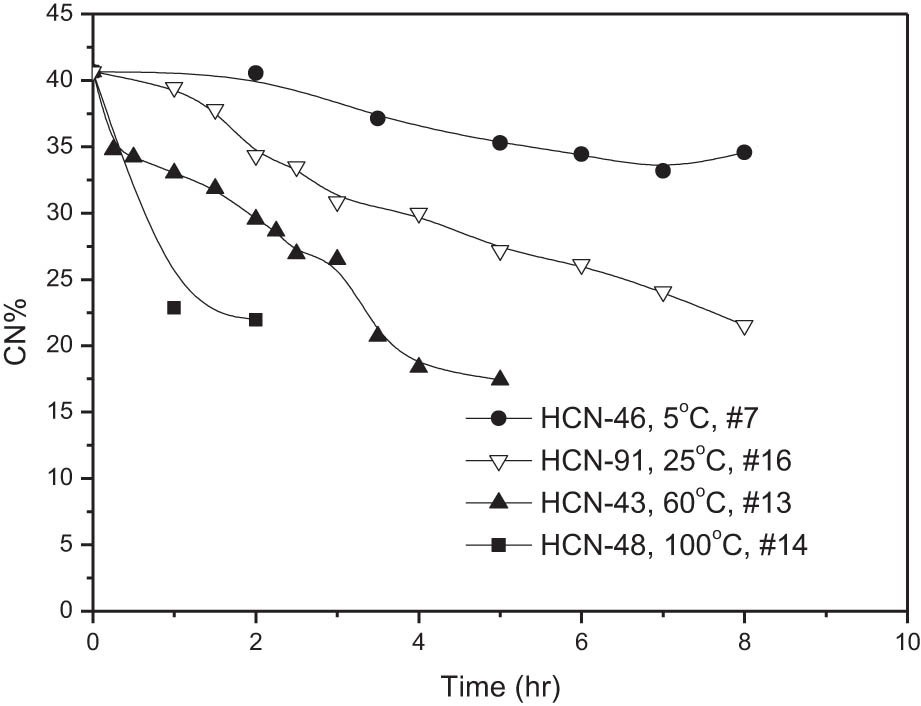
Figure 3
Effect of temperature on hydrogenation of C≡Ns in NBR. (*: 0.8 mL catalyst solution [0.06 g catalyst, 0.1 mmol Rh], 100 mL 2.5 wt% NBR in THF, 500 psig H2. **: the letters and numbers in the picture have no special meaning and only represent the experiment batch number).
Source: Author’s contribution.
Similarly, increasing hydrogen pressure from 100 to 500 psig significantly improves performance (Figure 4) by elevating the hydrogen concentration at the catalytically active sites. Beyond 500 psig, the rate increases plateaus, suggesting that the reaction transitions into a regime controlled by catalyst mass transfer within the viscous polymer matrix. Furthermore, increasing the polymer concentration beyond 2.5 wt% was found to induce severe cross-linking due to the higher probability of chain collisions during the conversion of nitrile groups.
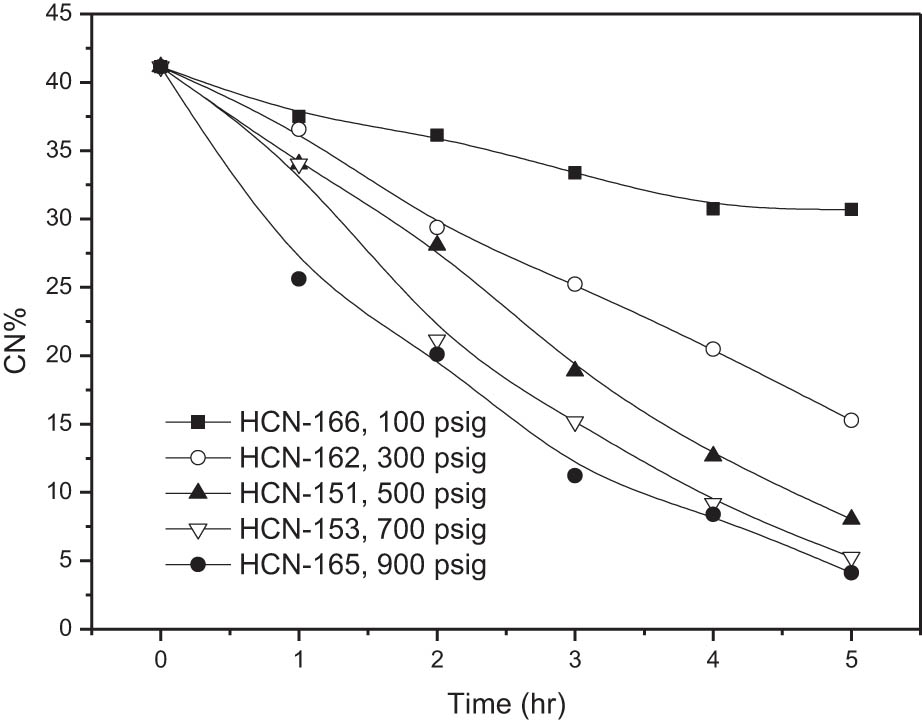
Figure 4
Effect of H2 pressure on hydrogenation of C≡Ns in NBR. (*: 0.8 mL catalyst solution [0.06 g catalyst, 0.1 mmol Rh], 100 mL NBR in THF [2.5 wt%], 60°C. **: the letters and numbers in the picture have no special meaning and only represent the experiment batch number).
Source: Author’s contribution.
Semi-quantitative kinetic analysis revealed that the reaction rate exhibits a strong dependence on both temperature and H2 pressure. The observed stabilization of the reaction rate at higher pressures (Figure 4) suggests a transition from a reaction-controlled regime toward a diffusion-controlled or site-saturation regime. Additionally, while the temperature effects (Figure 3) align with Arrhenius trends, a rigorous kinetic modeling is complicated by the tandem competition between nitrile and olefinic substrates for the Rh center, as well as the dynamic changes in local viscosity as hydrogenation and minor cross-linking progress. These factors point toward a complex, mass-transfer-limited kinetic environment.
3.2. Tandem hydrogenation of nitrile and olefinic groups in NBR and the preliminary study of the reaction mechanism
The RhH[P(i−Pr)3]3 catalyst demonstrates significant potential for the simultaneous reduction of nitrile and olefinic groups in NBR. As shown in Figure 5, the system successfully reduces nitrile content from 40% to below 10% while achieving >90% hydrogenation of C═C bonds within 5 h. This dual functionality is highly valuable for engineering NBR variants with tunable ACN content, allowing for a better balance between oil resistance and low-temperature processability.
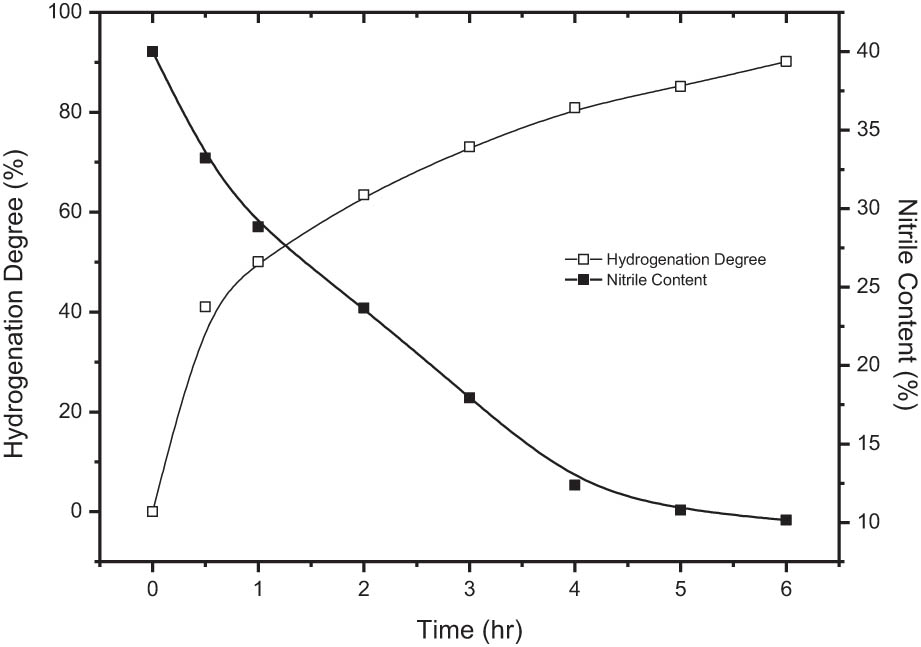
Figure 5
Tandem hydrogenation of C═Cs and C≡Ns in NBR. (*: 0.8 mL catalyst solution [0.06 g catalyst, 0.1 mmol Rh], 100 mL NBR in THF [2.5 wt%], 60°C, 500 psig H2.).
Source: Author’s contribution.
A possible reaction mechanism shown in Figure 6 is proposed for the first time in this study for the tandem hydrogenation of nitriles (1) and olefins (2) in NBR. Hydrogenation is performed under 500 psig at 60°C using tris(triisopropylphosphine)hydrido-rhodium(i). It is not entirely certain as to which reaction occurs; this seems to be a plausible mechanism.
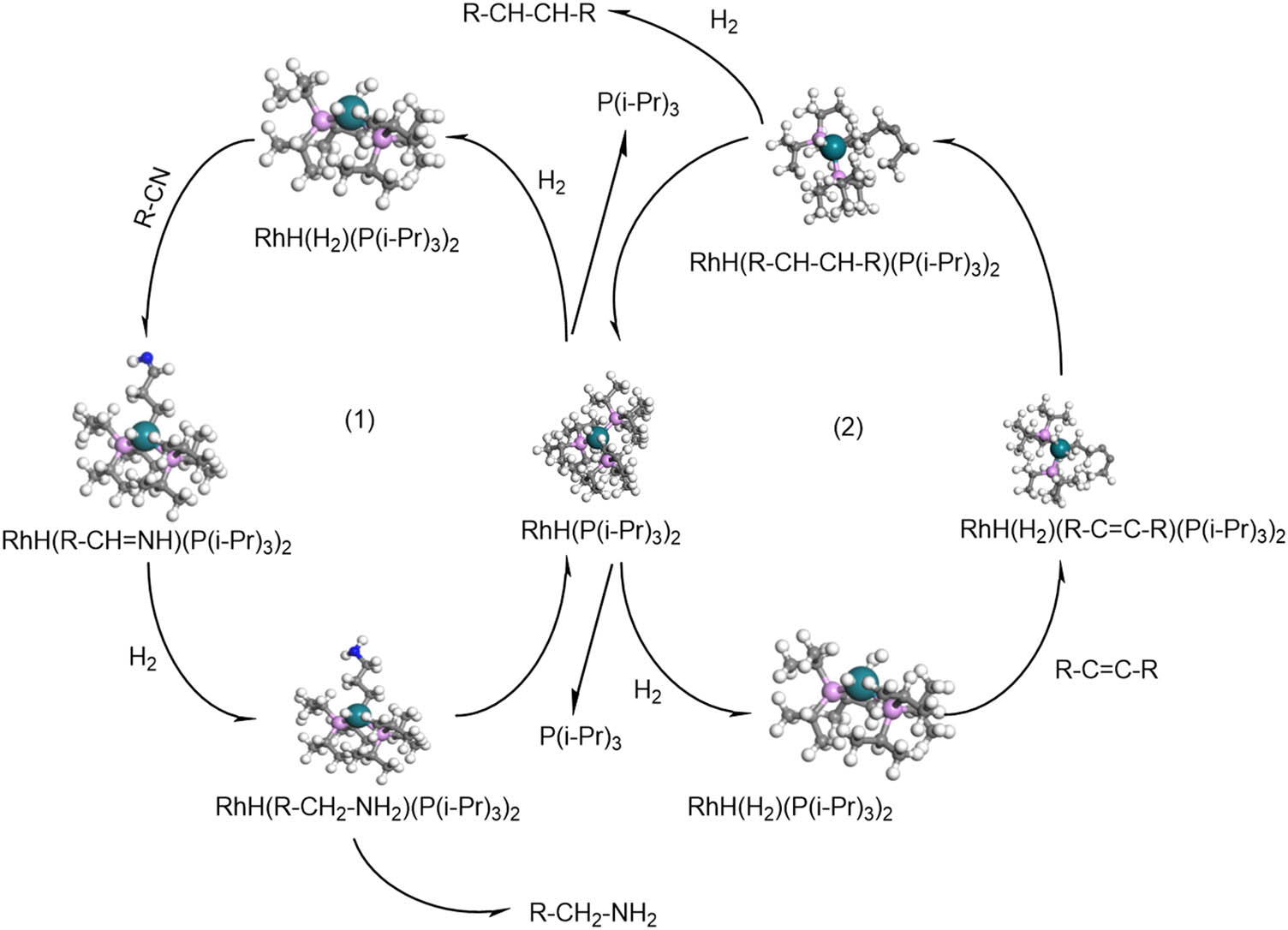
Figure 6
Possible mechanism for tandem hydrogenation of nitrile and olefinic groups in NBR.
Source: Author’s contribution.
The unique dual reactivity is inherently linked to the electronic environment of the rhodium center. Unlike standard hydrogenation catalysts, the strong σ-donating ability of triisopropylphosphine ligands renders the Rh center highly nucleophilic. This electron-rich state facilitates π-backdonation to the nitrile C≡N triple bond, effectively lowering its bond order and allowing for hydrogenation under mild conditions. Structurally, the steric bulk of the phosphine ligands ensures the formation of coordinatively unsaturated intermediates, which is crucial for interacting with macromolecular substrates like NBR.
Wilkinson’s catalyst is a widely studied catalyst known to selectively hydrogenate olefins in NBR. The catalyst being used in the present study, tris(triisopropylphosphine)-hydridorhodium(i), has been shown to hydrogenate both the nitrile groups and olefins of NBR, and thus the mechanism has been split into two parts. Part 2, as labeled in Figure 6, displays the hydrogenation of olefins. It is believed that hydrogenation due to this catalyst is very similar to the mechanism proposed by Parent et al. [31], as shown in Figure 7.
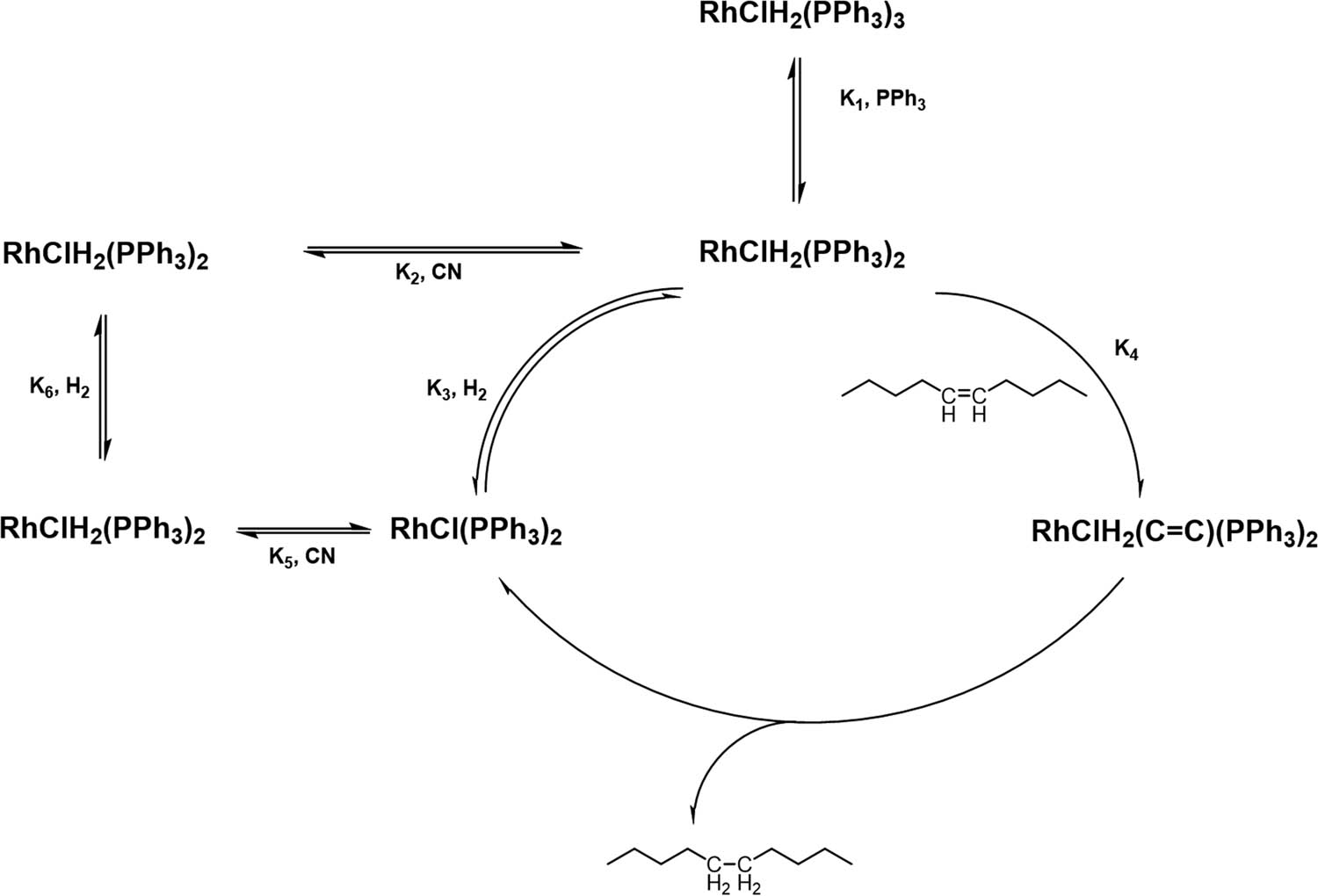
Figure 7
Mechanism for olefin hydrogenation using Wilkinson’s catalyst.
Source: Author’s contribution.
The synthesis of the catalytic cycle is supported by literature precedents regarding Rh-hydride species. The initial addition of hydrogen to form a five-member catalyst complex has been reported by Yoshida et al. [19]. Similar five-membered complexes, featuring either chlorine or hydrogen atoms, have been documented by Butler et al. [24] and Parent et al. [31] under conditions comparable to our study. These findings substantiate the existence of the proposed intermediates and suggest that the mechanism, while complex due to the macromolecular nature of NBR, follows a logically consistent path rooted in coordination chemistry.
3.3. Gel mechanism and selection of anti-gel reagents
Visible gel formation appears to be an inherent challenge during the reduction of nitriles in diene-based polymers like NBR. Systematic experiments confirm that gelation occurs exclusively when the rubber, hydrogen, and catalyst are present simultaneously, indicating that cross-linking is inextricably linked to the nitrile reduction process. Notably, in the absence of nitrile reduction, other factors such as exposure to air or high temperatures do not initiate cross-linking. The risk of severe gel formation increases significantly as the C≡N content drops below a critical threshold of 30%.
To modulate the rapid reaction rate and mitigate gelation, several additives were evaluated (Table 1). While acetic acid, ethanol, and chlorobenzene, MCB terminated the catalytic activity immediately, they failed to prevent visible gel or polymer coagulation. Furthermore, experimental trials with radical scavengers like 2,2,6,6-tetramethylpiperidin-1-oxyl revealed only a marginal impact on gel suppression despite a notable reduction in overall catalytic activity. This observation critically suggests that radical-mediated degradation pathways are not the primary contributors to network formation at 100°C. Instead, the accelerated gelation is likely attributed to the increased collision frequency and subsequent condensation of highly reactive imine intermediates (R–CH═NHR). These intermediates, which are inherently generated during the stepwise reduction of nitriles, possess high thermal sensitivity and readily undergo intermolecular coupling. As the reaction proceeds, these species facilitate the formation of branched or cross-linked structures through nucleophilic condensation, a process that is significantly exacerbated once the temperature or intermediate concentration exceeds a critical threshold.
Table 1
Summary of additives for gel formation reduction
| Hydrogenation of C≡N | Hydrogenation of C═C | Gel formation | |
|---|---|---|---|
| Acetic acid | Terminated | Terminated | Rubber coagulated |
| Ethanol | Terminated | Terminated | Visible gel |
| Chlorobenzene, MCB | Terminated | Terminated | Visible gel |
| Methyl ethyl ketone | Slower | Slower | Visible gel |
| 2,2,6,6-Tetramethylpiperidin-1-oxyl | Slower | Slower | Visible gel |
| TPP | Terminated | Not terminated | No visible gel |
Source: Author’s contribution.
TPP was identified as an effective additive that selectively terminates nitrile hydrogenation while preserving olefin reduction activity, resulting in a gel-free product. This phenomenon is attributed to a ligand exchange process where TPP displaces P(i-Pr)3 ligands to establish a new coordination equilibrium. While in situ spectroscopic characterization remains challenging under high-pressure and high-viscosity conditions, this hypothesis is consistent with literature precedents [31,32] suggesting the formation of sterically demanding complexes such as RhH(PPh3)4. This bulkier complex likely exhibits a significantly higher activation barrier for nitrile reduction compared to olefinic bonds, thereby preventing the accumulation of the reactive intermediates responsible for cross-linking. Although this equilibrium model explains the current observations, future investigation is required to further clarify the mechanism. Potential contributing factors to gelation include the generation of radicals during C≡N cleavage that interact with polymer chains, as well as the possible role of P(i-Pr)3 ligands in promoting cross-linking reactions.
Actually, adding TPP into the system makes it very difficult to calculate the content of nitrile groups due to the two peaks generated by TPP besides the peak of the methyl group at 723 cm−1 in FTIR spectrum (shown in Figure 8). As a result, in order to determine if hydrogenation of C═Cs is really terminated or not, the peak height of 970 cm−1 (═CH2) and 723 cm−1 (–CH3) were compared. The ratio of [970]/[723] decreases from 4.58 to 1.94 after 6 h, which means C═Cs continue to be reduced to C–C after addition of TPP.
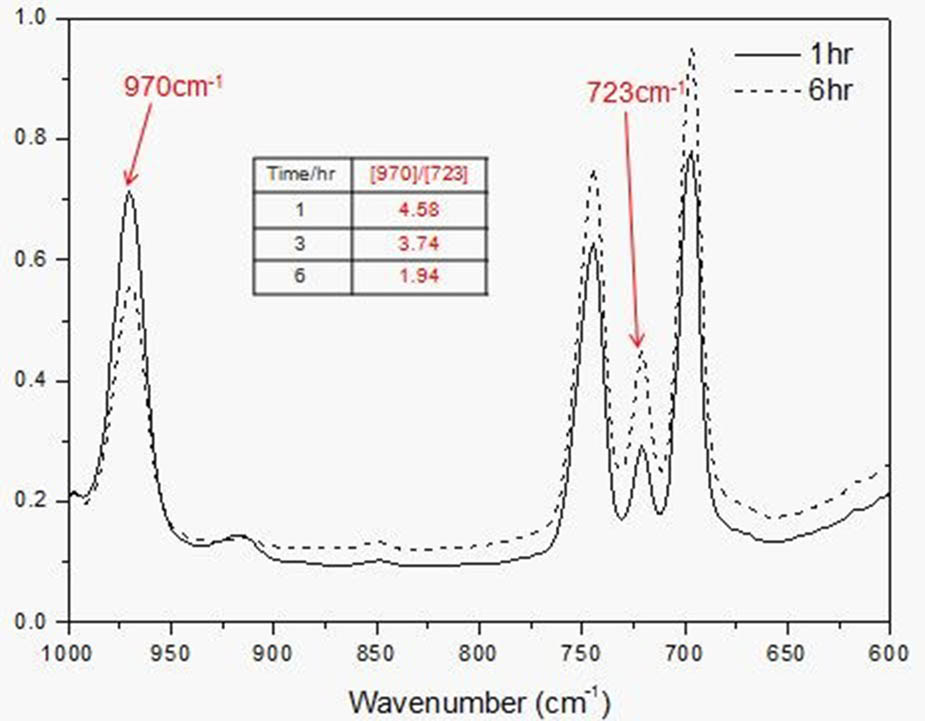
Figure 8
FTIR spectrum of hydrogenation of C≡Ns in NBR with TPP.
Source: Author’s contribution.
3.4. Characterization
The tandem conversion of NBR is monitored by FTIR as shown in Figure 9. During the reaction, the characteristic peaks for –C≡N (2,236 cm−1) and olefinic groups (920–1,000 cm−1) significantly diminish, while the peak at 723 cm−1 increases, marking the saturation of the polymer backbone. Concurrently, the emergence of signals at 3,200–3,400 cm−1 confirms the selective conversion of nitriles to primary amines. Notably, no spectroscopic evidence of secondary or tertiary amines – frequently reported as by-products in literature – was observed. At final conversion, the olefinic content is reduced by over 95% and nitrile content to approximately 10%, demonstrating that the catalyst is highly effective for the simultaneous saturation and polar modification of the NBR matrix without forming undesirable side products.
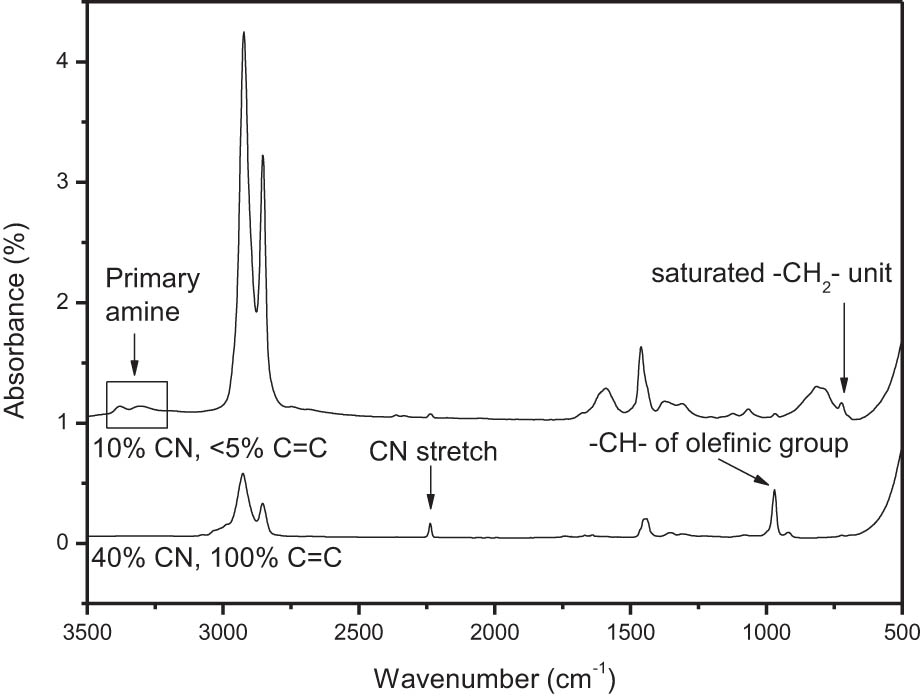
Figure 9
FTIR spectra of hydrogenation of nitrile and olefinic groups in NBR.
Source: Author’s contribution.
4. Conclusion
In this study, the tandem hydrogenation of nitrile group and olefinic groups in NBR has been investigated, and it has been shown that RhH[P(i-Pr)3]3 is a very effective catalyst. This is the first report of the development and establishment of a catalytic system that is able to conduct tandem hydrogenation of both nitrile groups and olefinic groups in butadiene rubbers (macromolecules) without visible gel formation. The nitrile content can be reduced from 40% to less than 10% and the olefinic groups have been reduced from 100% to lower than 5% at the same time, and it takes less than 5 h under relatively mild conditions (60°C and 500 psig H2). The nitrile groups have been converted to primary amines. A possible mechanism for tandem hydrogenation has also been proposed for the first time. Gel formation issues exist during the regular procedure, and temperature and catalyst concentration seem to aggravate gel formation. The causes for gel formation during nitrile reduction have been investigated, and a potential mechanism was also proposed. Some additives have been tested, and some of them are found to be able to slow down or terminate the gel formation, among which TPP is the most effective one.
Acknowledgments
We thank all the co-authors for their contributions to this study.
Funding information
We are grateful to the support received from the Shandong Provincial Natural Science Foundation for Young Scholars (Grant No.: ZR2025MS762) and the Shandong Provincial Natural Science Foundation Joint Fund (Grant No.: ZR2024LFG002).
Conflicts of interest statement
Authors state no conflict of interest.
Data availability statement
Data are provided within the manuscript files.