

Figure 1.
Proposed topology. LGU, level generation unit; PGU, polarity generation unit.
Table 1.
Switching sequence of proposed RSSS MLI.
| State | S1 | S2 | … | Sn | T1 | T2 | T3 | T4 | Vdc |
|---|---|---|---|---|---|---|---|---|---|
| 1 | 0 | 0 | … | 0 | 0/1 | 1/0 | 0/1 | 1/0 | 0 |
| 2 | 1 | 0 | … | 0 | 1 | 0 | 1 | 0 | +1 |
| 3 | 1 | 0 | … | 0 | 0 | 1 | 0 | 1 | −1 |
| 4 | 0 | 1 | … | 0 | 1 | 0 | 1 | 0 | +2 |
| 5 | 0 | 1 | … | 0 | 0 | 1 | 0 | 1 | −2 |
| 6 | 0 | 0 | … | 0 | 1 | 0 | 1 | 0 | +3 |
| 7 | 0 | 0 | … | 0 | 0 | 1 | 0 | 1 | −3 |
| ⋮ | ⋮ | ⋮ | … | ⋮ | ⋮ | ⋮ | ⋮ | ⋮ | ⋮ |
| ⋮ | ⋮ | ⋮ | … | ⋮ | ⋮ | ⋮ | ⋮ | ⋮ | ⋮ |
| Nlevel − 1 | 0 | 0 | … | 1 | 1 | 1 | 0 | 0 | +n |
| Nlevel | 0 | 0 | … | 1 | 0 | 0 | 1 | 1 | −n |
Table 2.
Comparison of proposed RSSS MLI with recently developed MLI topologies.
| MLI topologies | Nsw | NDC | TSV |
|---|---|---|---|
| CHB MLI Najjar et al. (2016) | |||
| MLI1 Oskuee et al. (2015) | |||
| MLI2 Babaei et al. (2014a) | |||
| MLI3 Lee et al. (2018) | |||
| MLI4 Hsieh et al. (2016) | |||
| MLI5 Jayabalan et al. (2017) | |||
| MLI6 Babaei et al. (2014b) | |||
| Proposed RSSS MLI |
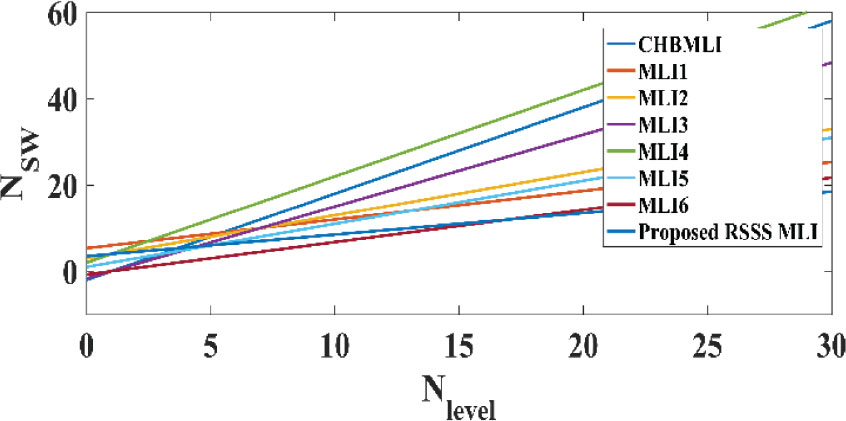
Figure 2.
Number of switches against number of levels. CHB MLI, cascaded H-bridge multilevel inverter; MLI, multilevel inverters; RSSS, reduced switch single source.
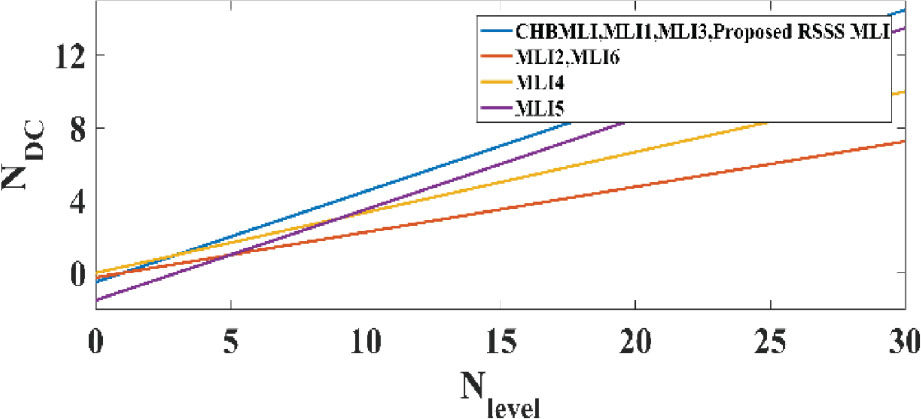
Figure 3.
Number of DC voltage source against number of levels. CHB MLI, cascaded H-bridge multilevel inverter; MLI, multilevel inverters; RSSS, reduced switch single source.
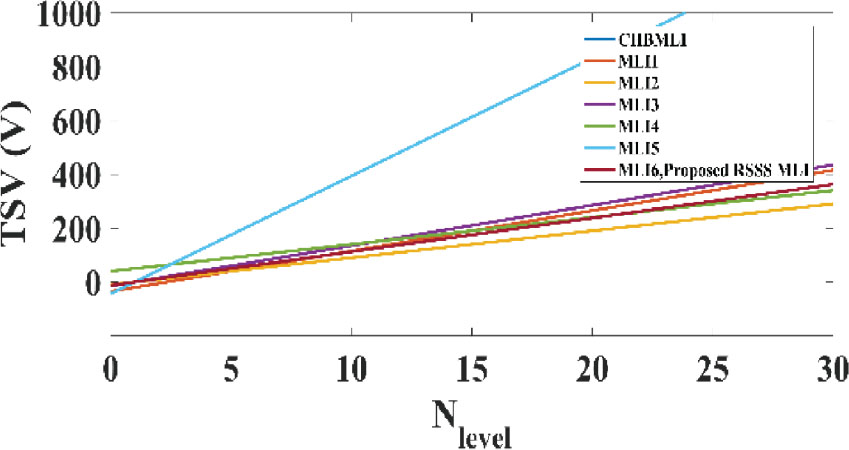
Figure 4.
Value of TSV against number of levels. CHB MLI, cascaded H-bridge multilevel inverter; MLI, multilevel inverters; RSSS, reduced switch single source; TSV, total standing voltage.
Table 3.
Comparison of proposed RSSS MLI with recently developed MLI topologies between 2022 and 2025.
| Ref. | Topology | No. of levels | Switch count | DC sources | Control/modulation | THD (%) | Efficiency (%) | Remarks |
|---|---|---|---|---|---|---|---|---|
| Goel et al. (2022) | Single DC-source 13-level MLI | 13 | 10 | 1 | Fundamental switching | ∼8–10 | ∼95 | Reduced device count but limited scalability |
| Kubendran et al. (2022) | Reduced-switch cascaded MLI | 9–17 | 12 | Multiple | Nearest level control | ∼9–12 | ∼94 | Suitable for EV applications but requires multiple sources |
| Jena et al. (2024) | Transformer-less switched-capacitor MLI | 9 | 12 | 1 | PWM-based control | 16.48 | ∼94 | Self-balancing capacitors but higher THD without filtering |
| Saravanan et al. (2024) | Reduced-device 31-level inverter | 31 | 12 | Multiple | SPWM | <8 | ∼95 | Higher number of levels but increased circuit complexity |
| Mohanty et al. (2025) | Reduced-switch asymmetrical MLI | 9–13 | 10–12 | Multiple | PSO-optimised controller | ∼7–9 | ∼95 | Designed for DC microgrid applications |
| Awadelseed et al. (2026) | Switched-capacitor ANPC inverter | 9 | 10–12 | 1 | Optimised modulation | ∼5–7 | 96.9 | High efficiency but uses capacitor balancing circuitry |
| Proposed RSSS MLI | This work | 9 | 8 | 1 | GA-SHE | ≈10.86 | ≈95 | Reduced switch count with GA-based harmonic elimination |
Table 4.
Comparison of performance of proposed RSSS MLI and recently developed MLI topologies.
| Topology | Output levels | Power switches | DC sources | Diodes/capacitors | Voltage gain | TSV | Control technique | THD (%) | Remarks |
|---|---|---|---|---|---|---|---|---|---|
| CHB MLI Najjar et al. (2016) | 9 | 16 | 4 | 0 | High | High | PWM/SHE | 8–12 | Modular but high switch count |
| MLI1 Oskuee et al. (2015) | 9 | 12 | 4 | 2 | Medium | Medium | PWM | 9–13 | Moderate complexity |
| MLI2 Babaei et al. (2014) | 9 | 10 | 3 | 2 | Medium | Medium | PWM | 10–14 | Multiple DC sources |
| MLI3 Lee et al. (2018) | 9 | 12 | 4 | 2 | Medium | High | SPWM | 9–12 | Higher voltage stress |
| MLI4 Hsieh et al. (2016) | 9 | 10 | 4 | 2 | Medium | High | PWM | 10–13 | Increased circuit complexity |
| MLI5 Jayabalan et al. (2017) | 9 | 10 | 3 | 2 | Medium | High | SPWM | 9–12 | Higher TSV |
| MLI6 Babaei et al. (2014) | 9 | 10 | 3 | 0 | Medium | Medium | PWM | 9–13 | Reduced device count |
| Reduced Switched-Capacitor MLI Hosseinzadeh et al. (2022) | 9 | 10–12 | Multiple | Capacitors | High | Medium | PWM | <10 | Requires capacitor voltage balancing |
| Reduced-switch cascaded MLI Kubendran et al. (2022) | 9–17 | 12 | Multiple | 0 | Medium | Medium | Nearest Level Control | 9–12 | Requires multiple sources |
| Generalised Multisource Inverter Hosseinzadeh et al. (2024) | 9–13 | 12 | Multiple | Capacitors | High | Medium | Model predictive control | <8 | High control complexity |
| Multi-Source MLI Espinosa et al. (2025) | 9 | 10–12 | Multiple | Capacitors | High | Medium | PWM | <10 | Flexible multi-source operation |
| Proposed RSSS MLI | 9 | 8 | Single source | None | High | Low | GA-SHE | 10.86 | Reduced switch count and simplified control |
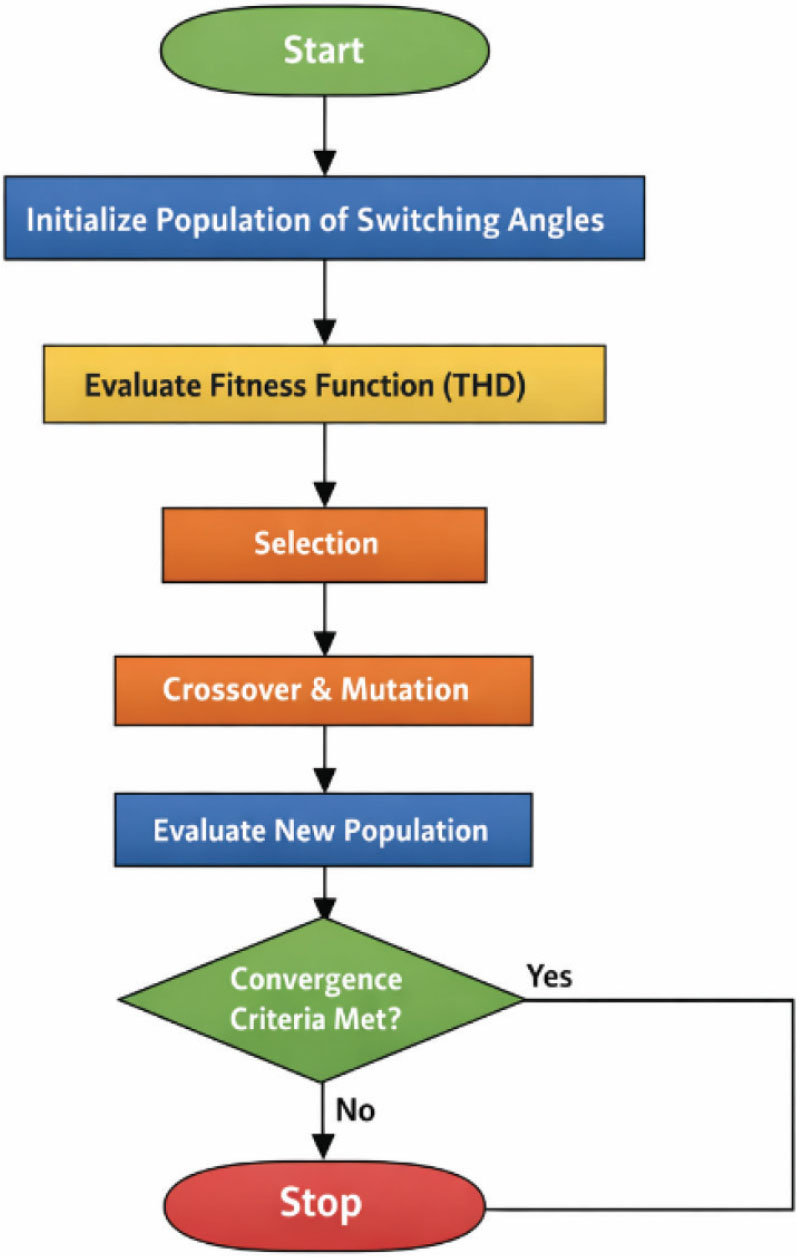
Figure 5.
Flowchart of GA for harmonic elimination. GA, genetic algorithm; THD, total harmonic distortion.
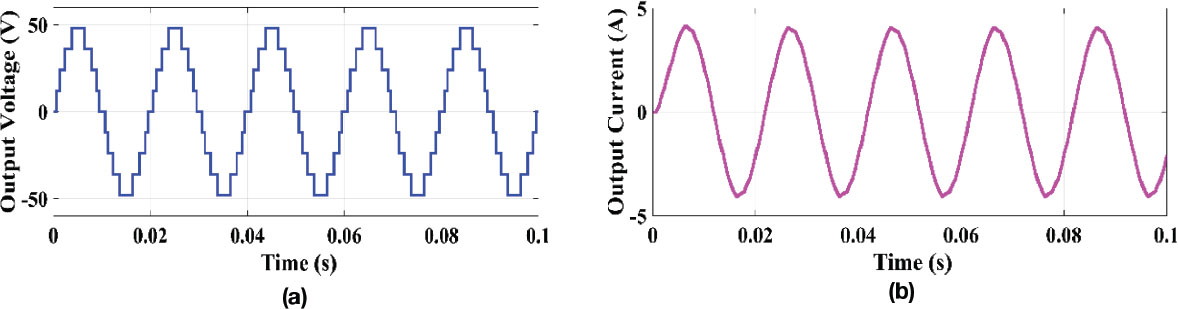
Figure 6.
(a) Output voltage of nine-level RSSS MLI using RL-load. (b) Output current of nine-level RSSS MLI using RL-load. MLIs, multilevel inverters; RL, resistive–inductive load; RSSS, reduced switch single source.

Figure 7.
(a) Variations of switching angles with modulation index. (b) Variations of THD with modulation index. THD, total harmonic distortion.
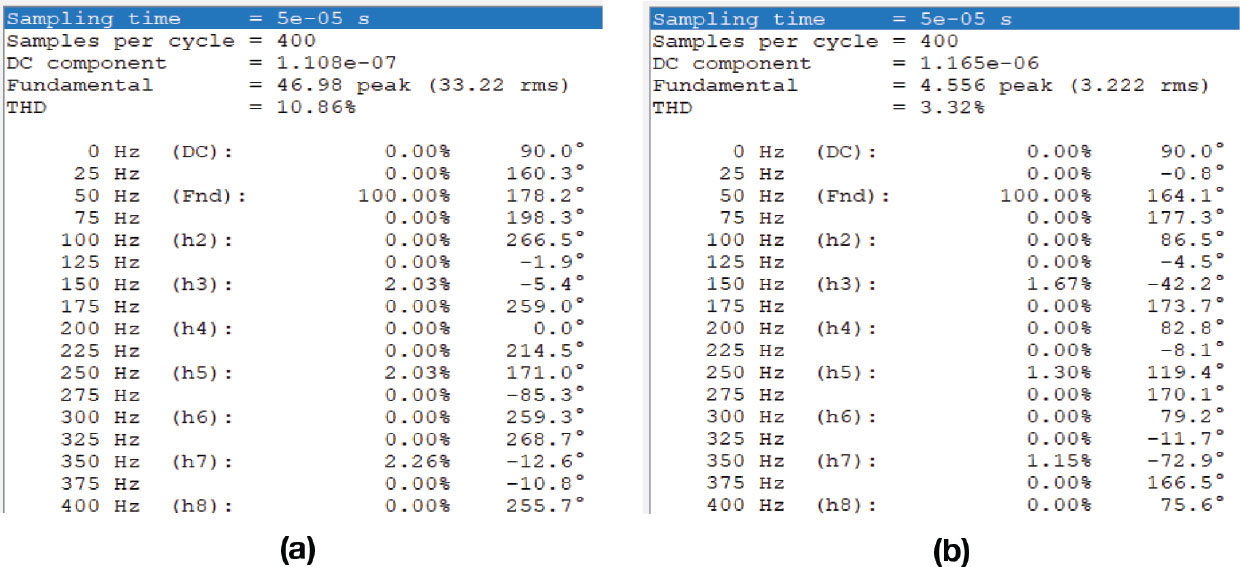
Figure 8.
(a) THD analysis of output voltage of nine-level RSSS MLI. (b) THD analysis of output current of nine level RSSS MLI. MLI, multilevel inverter; RSSS, reduced switch single source; THD, total harmonic distortion.
Table 6.
Variation of switching angles with modulation index.
| Modulation index | θ1 | θ2 | θ3 | θ4 |
|---|---|---|---|---|
| 1.000 | 8.4389 | 19.2314 | 36.1245 | 57.3176 |
| 0.950 | 9.1926 | 19.5797 | 36.4326 | 58.9095 |
| 0.925 | 9.9500 | 20.0029 | 37.2343 | 59.1851 |
| 0.900 | 10.4054 | 20.4507 | 38.0021 | 59.4559 |
| 0.850 | 11.4501 | 21.2809 | 38.9241 | 60.0872 |
| 0.825 | 12.0383 | 21.5013 | 39.5321 | 60.4146 |
| 0.800 | 13.4202 | 22.5694 | 39.8726 | 61.2269 |
| 0.750 | 14.3501 | 22.8389 | 40.2547 | 62.0705 |
| 0.725 | 14.8955 | 23.4178 | 40.9432 | 62.0796 |
| 0.700 | 15.2552 | 24.3045 | 41.3125 | 62.7213 |
| 0.650 | 16.1434 | 24.9320 | 41.7658 | 63.2394 |
| 0.625 | 16.6702 | 25.6596 | 42.4325 | 64.1026 |
| 0.600 | 17.0195 | 26.4618 | 42.8654 | 64.6620 |
Table 7.
Variations of THD with modulation index.
| Modulation index | Output voltage THD (%) | Output current THD (%) |
|---|---|---|
| 1 | 9.64 | 3.08 |
| 0.950 | 10.86 | 3.32 |
| 0.925 | 11.53 | 4.09 |
| 0.900 | 12.77 | 4.33 |
| 0.850 | 12.48 | 5.20 |
| 0.825 | 12.42 | 4.61 |
| 0.800 | 12.25 | 4.15 |
| 0.750 | 12.92 | 3.94 |
| 0.725 | 13.77 | 4.44 |
| 0.700 | 14.61 | 5.02 |
| 0.650 | 17.68 | 5.88 |
| 0.625 | 19.57 | 5.92 |
| 0.600 | 18.36 | 6.53 |
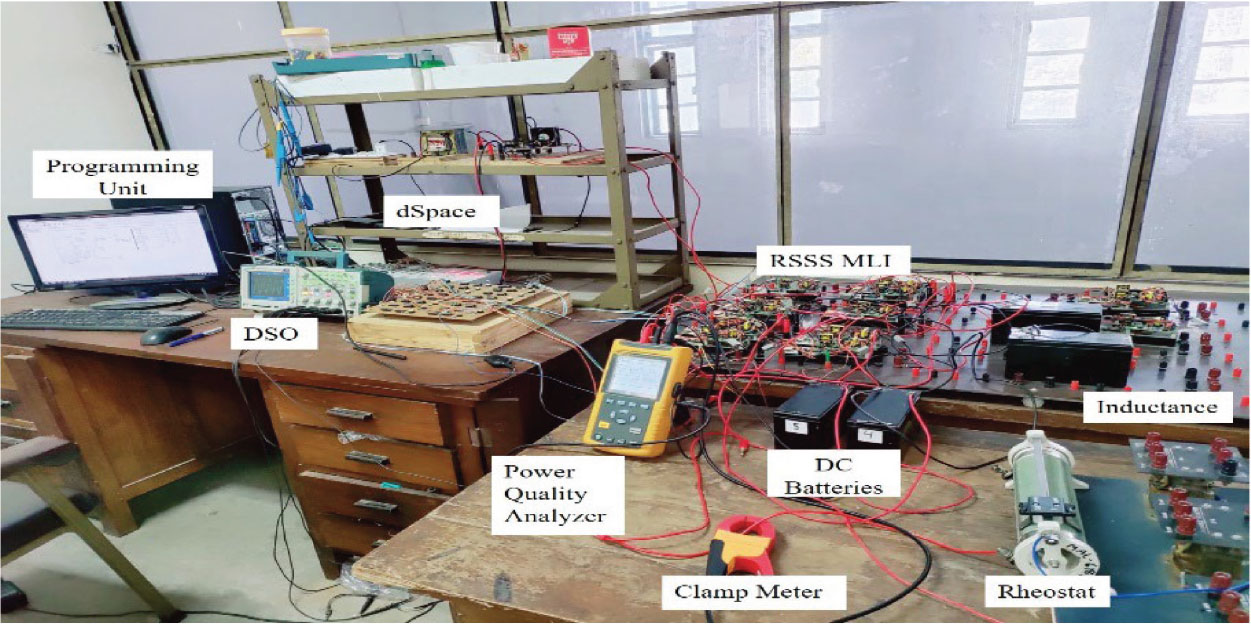
Figure 9.
Hardware setup of proposed work. MLI, multilevel inverter; RSSS, reduced switch single source.

Figure 10.
(a) Output voltage without load. (b) THD analysis without load. THD, total harmonic distortion.

Figure 11.
(a) Output voltage with R-load. (b) Output power with R-load. R-load, resistive load.
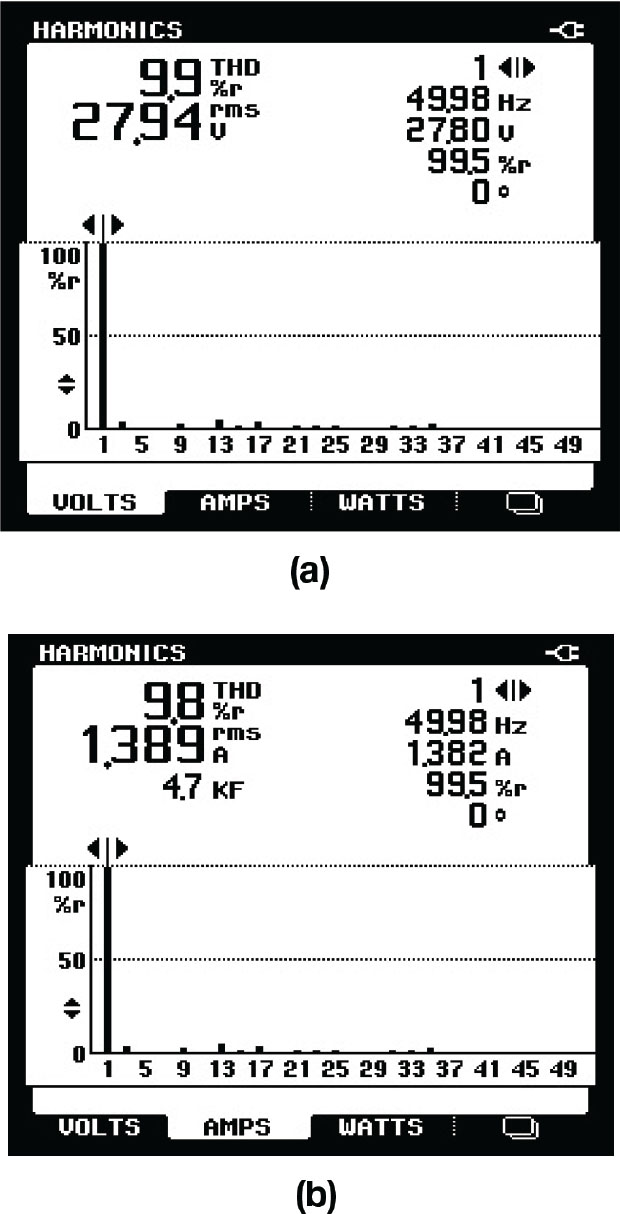
Figure 12.
(a) THD analysis of output voltage with R-load. (b) THD analysis of output current with R-load. R-load, resistive load; THD, total harmonic distortion.
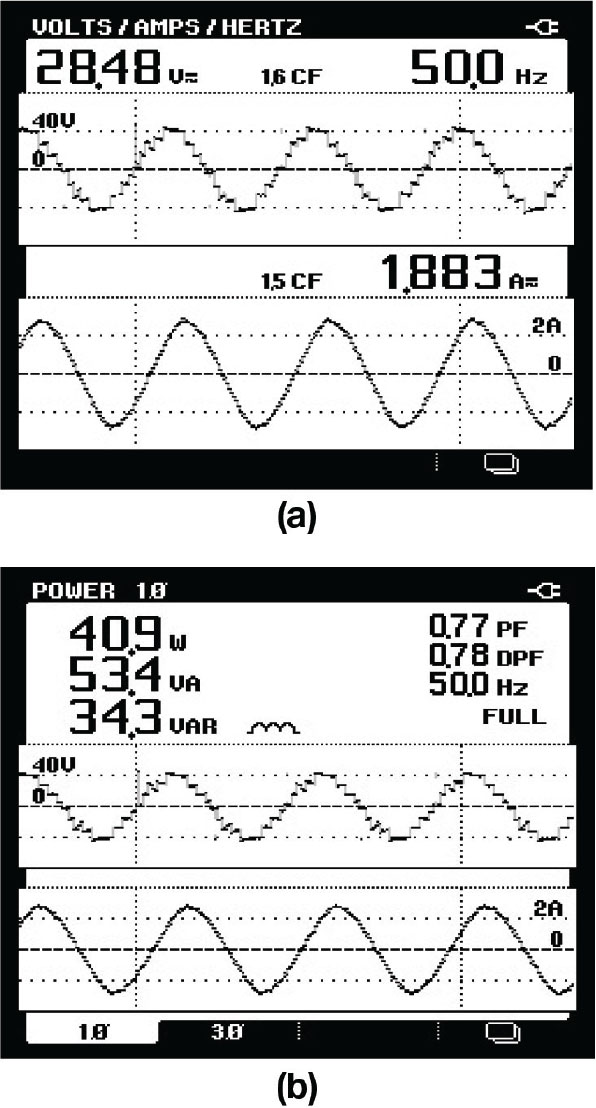
Figure 13.
(a) Output voltage with RL-load. (b) Output power with RL-load. RL-load, resistive–inductive load.

Figure 14.
(a) THD analysis of output voltage with RL-load. (b) THD analysis of output current with RL-load. RL-load, resistive–inductive load; THD, total harmonic distortion.