
Table 1.
Comparison of different algorithms for analysis of filtering characteristics
| Control algorithm | Year of publication | Robustness | Convergence capability | Control flexibility | Power loss | Cost | LC coupling | Filtering process |
|---|---|---|---|---|---|---|---|---|
| ALMS | 2018 | ✓ | × | - | - | - | × | Active |
| KHLMS | 2019 | ✓ | ✓ | --- | --- | -- | × | Active |
| DRL | 2020 | ✓ | ✓ | --- | -- | -- | × | Active |
| Delta-Bar-Delta NN | 2020 | ✓ | ✓ | -- | -- | -- | × | Active |
| SLMS | 2021 | ✓ | ✓ | --- | -- | -- | × | Active |
| ADALINE-LMS | 2021 | ✓ | × | - | - | - | × | Active |
| DL | 2022 | ✓ | ✓ | -- | - | -- | × | Active |
| DBLN | 2023 | ✓ | ✓ | --- | - | -- | ✓ | Hybrid |
[ii] ALMS, adaptive least mean square; DBLN, deep belief learning network; DL, deep learning; DRL, deep recurrent learning principles are proposed for the purpose of active filtering. No author has attempted to employ such a technique for hybrid filtering. The above literature review has been motivated by the author to suggest a DBLN technique-based LC-supported DSTATCOM to provide the behaviour for better convergence characteristics, better control capability, low power loss, less cost and better shunt compensation.

Figure 1.
Circuit connection of the DBLN based DSTATCOM. DBLN, deep belief learning network; DSTATCOM, distributed static compensator; VSC, voltage source converter.

Figure 2.
Circuit connection of the DBLN-based LC supported. DBLN, deep belief learning network; DSTATCOM, distributed static compensator; VSC, voltage source converter.

Figure 3.
P3W Voltage Source Inverter-based DSTATCOM. DSTATCOM, distributed static compensator.

Figure 4.
Stability analysis of LC filter by using Bode plot.

Figure 5.
Overall DBLN control algorithm of DSTATCOM. DBLN, deep belief learning network; DSTATCOM, distributed static compensator.

Figure 6.
Flow chart for finding the tuned weight to improve the shunt compensation using DBLN technique. DBLN, deep belief learning network.
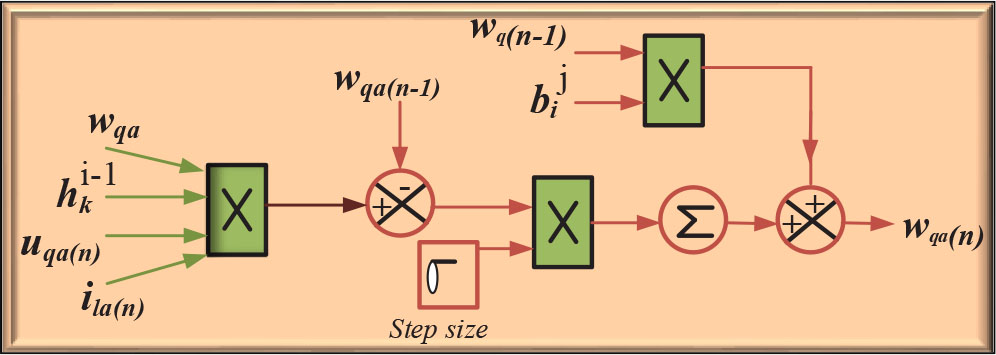
Figure 7.
Learning mechanism using DBLN for the extraction of reactive part for a-phase. DBLN, deep belief learning network.

Figure 8.
(a) System performance for DSTATCOM based on DBLN, (b). THD of the load current for DSTATCOM based under DBLN, (c). THD of the source current for DSTATCOM based on DBLN, (d). Source side power factor p.f of the phase-a, (e). Load side power factor of the phase-a. DBLN, deep belief learning network; DSTATCOM, distributed static compensator; THD, total harmonic distortions.
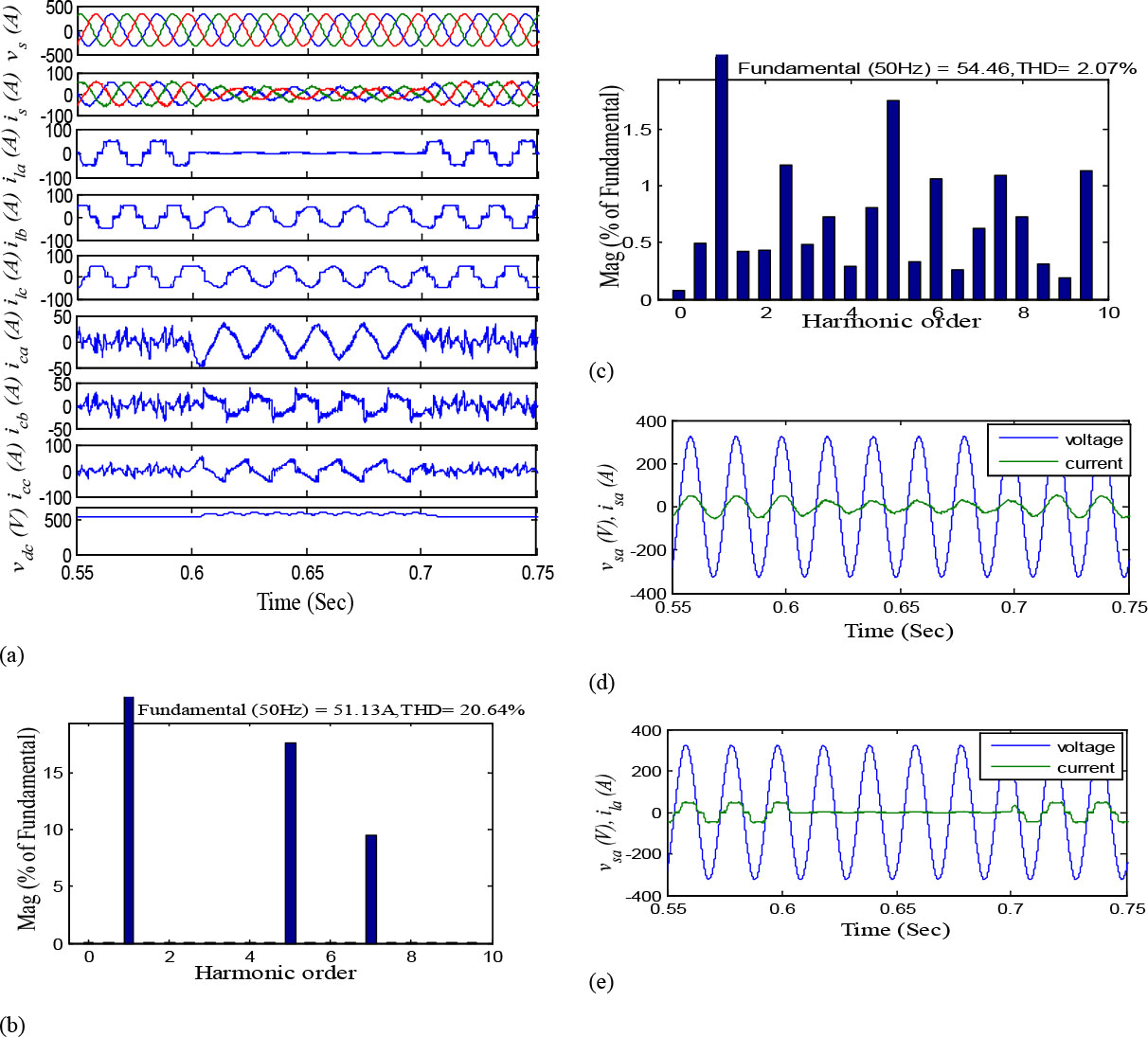
Figure 9.
(a) System performance for LC supported DSTATCOM based on DBLN, (b). THD of the load current for LC supported DSTATCOM based under DBLN, (c). THD of the source current for LC supported DSTATCOM based under DBLN, (d). Source side power factor of the phase-a, (e). Load side power factor of the phase-a. DBLN, deep belief learning network; DSTATCOM, distributed static compensator; THD, total harmonic distortions.
Table 2.
Comparative performance evaluation of different types of DSTATCOM.
| Performance parameter | ALMS based DSTATCOM | DBLN based DSTATCOM | DBLN based LC supported DSTATCOM |
|---|---|---|---|
| is (A), %THD | 55.88, 4.56 | 55.46, 4.07 | 54.46, 2.07 |
| vs (V), %THD | 321.4, 2.54 | 321.4, 2.23 | 321, 1.42 |
| il (A), %THD | 42.96, 18.96 | 51.13, 20.64 | 51.13, 20.64 |
| Power factor | 0.94 | 0.97 | 0.99 |
| vdc (V) | 680 | 671.6 | 605.6 |

Figure 10.
Experimental setup of the DBLN-based LC-supported DSTATCOM. DBLN, deep belief learning network; DSTATCOM, distributed static compensator.

Figure 11.
Experimental waveform of source current, compensator current and load current using DBLN mechanism under (a) constant loading, (b) diversity loading. DBLN, deep belief learning network.
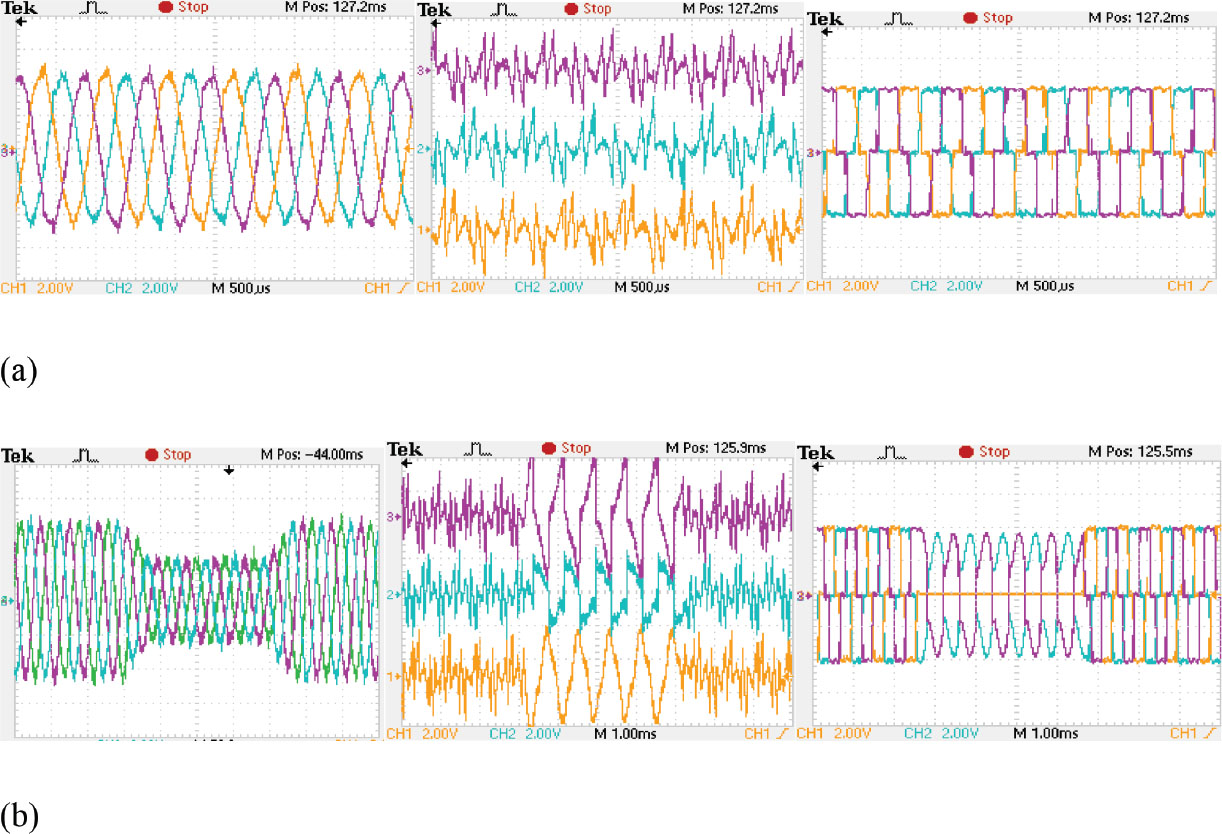
Figure 12.
Experimental results of source current, current of compensator and current of using DBLN controlled LC coupled DSTATCOM for (a). Constant loading, (b) diversity loading. DBLN, deep belief learning network; DSTATCOM, distributed static compensator.
Table 3.
Simulation/experimental parameters for proposed configuration.
| Symbol | Definition | Value |
|---|---|---|
| vs | 3-phase source voltage | 230 V/phase |
| fs | Frequency | 50 Hz |
| Rs | Source resistance | 0.5 Ω |
| Ls | Source inductance | 2 mH |
| Lf | Passive filter inductance | 0.5 mH |
| Cf | Passive filter capacitance | 10 μF |
| Kpr | AC proportional controller | 0.2 |
| Cdc | Capacitor | 2,000 μF |
| Kpa | DC proportional controller | 0.01 |
| Kia | DC integral controller | 0.05 |
| vdc (ref) | DC link voltage | 650 V |
| Rc | VSC resistance | 0.25 Ω |
| Lc | VSC inductance | 1.5 mH |
| Kir | AC integral controller | 1.1 |