
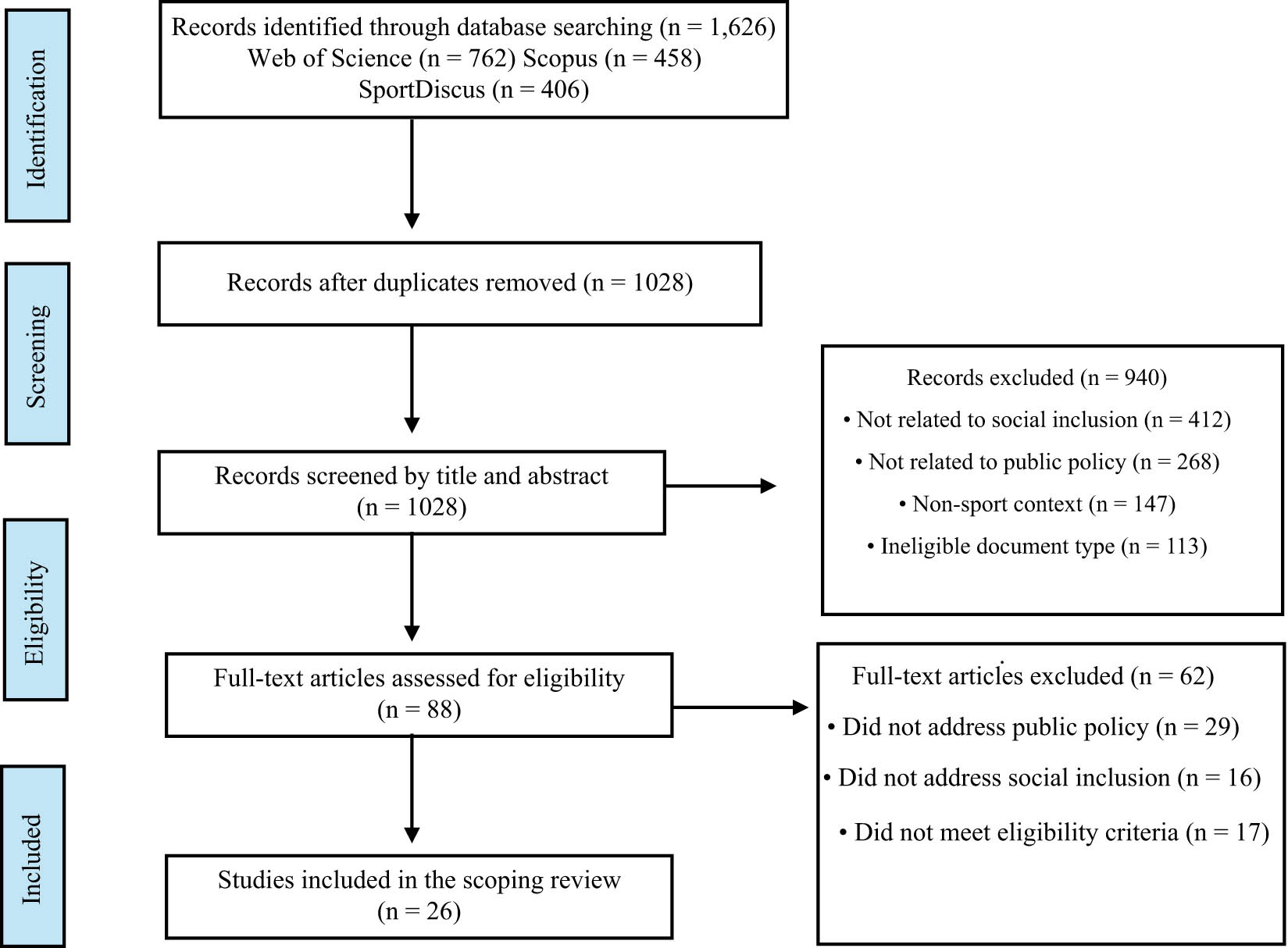
Figure 1
PRISMA flow diagram of the study selection process.
Table 1
Distribution of studies by country.
| x | Number of articles | Authors |
|---|---|---|
| Argentina | 1 | Garton et al. (2021) |
| Belgium | 2 | Corthouts et al. (2020); Vandermeerschen et al. (2013) |
| Czech Republic | 1 | Kudlacek et al. (2012) |
| France | 2 | Schut & Collinet (2014); Verdot & Schut (2012) |
| Germany | 1 | Ahrens et al. (2022) |
| Hungary | 1 | Perényi (2020) |
| Indonesia | 1 | Rustandi et al. (2021) |
| Ireland | 1 | Masdeu et al. (2022) |
| Italy | 1 | Ricatti et al. (2022) |
| Philippines | 1 | Guinto (2021) |
| Poland | 1 | Czupich (2020) |
| Serbia | 1 | Tubić & Đorđić (2012) |
| Sweden | 2 | Ekholm & Dahlstedt (2022); Bjärsholm & Norberg (2021) |
| Switzerland | 1 | Morgan & Parker (2021) |
| United Kingdom | 6 | Bekker et al. (2023); White & McArdle (2022); Piggott & Matthews (2021); Spracklen et al. (2014); Kelly (2013); Tacon (2007) |
| United States | 3 | Giles (2014); Wilson et al. (2022); Russell et al. (2016) |
Table 2
Characteristics of the included studies.
| Author (Year) | Country | Study objective | Design | Population/Context | Main finding | Thematic category |
|---|---|---|---|---|---|---|
| Bekker et al. (2023) | United Kingdom | To analyze leadership and equity in sport policies | Descriptive | Sport organizations | Inclusive leadership is essential for promoting equity | Challenges in the implementation of inclusive sport policies |
| Ekholm & Dahlstedt (2022) | Sweden | To evaluate sport as a tool for social inclusion | Mixed-method | Migrant youth | Sport facilitates contextualized social integration | Sport and social inclusion |
| Masdeu et al. (2022) | Ireland | To examine inclusion in martial arts | Mixed-method | Sport practitioners | There is interest in inclusion, but training is insufficient | Sport and social inclusion |
| Giles (2014) | United States | To analyze sport as a development policy tool | Review | Scientific literature | Sport promotes social development and inclusion | Sport public policies and social development |
| Ahrens et al. (2022) | Germany | To analyze physical activity policies | Descriptive | European adults | Public policies influence healthy behaviors | Sport, health, and social well-being |
| Wilson et al. (2022) | United States | To evaluate equity policies in sport | Mixed-method | Campus recreation staff (n = 254) | Equity was widely endorsed, but gaps remained between departmental values, written policies, and perceived practices | Challenges in the implementation of inclusive sport policies |
| White & McArdle (2022) | United Kingdom | To analyze gender policy implementation | Review | Policy documents | Structural inequalities persist | Challenges in the implementation of inclusive sport policies |
| Bjärsholm & Norberg (2021) | Sweden | To analyze sport governance | Descriptive | Sport clubs | Sport contributes to social development | Sport public policies and social development |
| Garton et al. (2021) | Argentina | To analyze the professionalization of women’s football | Ethnographic | Football players | Structural inequalities persist | Challenges in the implementation of inclusive sport policies |
| Ricatti et al. (2022) | Italy | To examine sport, social inclusion, and assimilation in Prato | Qualitative | Migrant communities and local sport-policy actors in Prato | Inclusion-oriented policy was often constrained at grassroots level by assimilationist practices | Sport and social inclusion |
| Rustandi et al. (2021) | Indonesia | To review international sport policies | Review | Scientific studies | Policies determine sport inclusion | Sport public policies and social development |
| Morgan & Parker (2021) | Switzerland | To analyze youth sport programs | Review | Youth populations | Sport promotes social development | Sport and social inclusion |
| Corthouts et al. (2020) | Belgium | To analyze inclusion in sport clubs | Quantitative | Sport clubs | Sport promotes social inclusion | Sport and social inclusion |
| Czupich (2020) | Poland | To evaluate the social impact of sport | Mixed-method | Sport clubs | Sport improves social well-being | Sport, health, and social well-being |
| Piggott & Matthews (2021) | United Kingdom | To analyze sport governance | Qualitative | Two English national governing bodies of sport | Formal governance structures reproduced gendered power relations; top-down reforms alone were insufficient | Challenges in the implementation of inclusive sport policies |
| Schut & Collinet (2014) | France | To analyze youth sport policies | Review | Documents | Lack of institutional coordination | Challenges in the implementation of inclusive sport policies |
| Russell et al. (2016) | United States | To evaluate physical activity programs | Review | Youth populations | Sport improves public health | Sport, health, and social well-being |
| Verdot & Schut (2012) | France | To analyze youth sport policies | Mixed-method | French Juvenile Justice System: 300 centers and 26 interviews | Inclusion effects were conditional on specific material and human resources | Sport and social inclusion |
| Spracklen et al. (2014) | United Kingdom | To analyze sport and social identity | Mixed-method | Migrants | Sport strengthens social identity | Sport and social inclusion |
| Vandermeerschen et al. (2013) | Belgium | To analyze inequalities in participation | Quantitative | Children | Socioeconomic barriers exist | Challenges in the implementation of inclusive sport policies |
| Kudlacek et al. (2012) | Czech Republic | To evaluate sport policies | Mixed-method | Experts | Lack of national strategy | Challenges in the implementation of inclusive sport policies |
| Kelly (2013) | United Kingdom | To evaluate sport and social prevention | Mixed-method | Youth populations | Sport reduces risk behaviors | Sport, health, and social well-being |
| Tubić & Đorđić ( 2012 ) | Serbia | To evaluate inclusion in physical education | Review | Inclusive physical education in Vojvodina | Implementation faced multiple challenges and required stronger professional and system support | Sport and social inclusion |
| Tacon (2007) | United Kingdom | To evaluate sport programs | Review | Sport programs | Lack of impact evaluation | Challenges in the implementation of inclusive sport policies |
| Perényi (2020) | Hungary | To analyze sport participation | Quantitative | General population | Policies influence participation | Sport public policies and social development |
| Guinto (2021) | Philippines | To evaluate sport as social policy | Qualitative | Communities | Sport contributes to social development | Sport public policies and social development |
Table 3
Methodological profile and interpretive strength of the included evidence.
| Design | n (%) | Main contribution | Relative strength | Main interpretive limitation | Effect-size implications |
|---|---|---|---|---|---|
| Review | 8 (30.8%) | Secondary synthesis of policies, programs, or prior evidence | Broad mapping of existing knowledge | Dependent on the quality and heterogeneity of underlying studies; no direct causal estimate from the source itself | Not directly comparable across the corpus |
| Mixed-method | 8 (30.8%) | Integration of contextual and quantitative/structured information | Triangulation of mechanisms and observed patterns | Heterogeneous outcome definitions and integration strategies limit comparability and causal inference | May report quantitative estimates, but not in a standardized form across studies |
| Quantitative | 3 (11.5%) | Measurement of participation, inequalities, or policy-related associations | Provides measurable empirical relationships | No study was classified as experimental in the extraction matrix; observational evidence cannot establish causality | Potentially estimable within studies, but not suitable for pooled comparison here |
| Descriptive | 3 (11.5%) | Description of policy environments, organizations, or population patterns | Useful for system-level characterization | Limited capacity to test causal mechanisms or intervention effectiveness | Generally not designed around standardized effect estimates |
| Qualitative | 3 (11.5%) | Experiences, perceptions, meanings, and implementation processes | High contextual depth and mechanism identification | Context-specific findings and limited statistical generalizability | Effect sizes are not applicable |
| Ethnographic | 1 (3.8%) | In-depth analysis of structural and gender-related processes | Rich contextual understanding of inequality and practice | Single/context-specific evidence with no causal effect estimate | Effect sizes are not applicable |