
1. Introduction
For the purposes of this review, sport policy is understood as the set of public goals, policy instruments, governance arrangements, resource decisions and implementation relationships through which governments and partner organizations shape sport systems and pursue both sport-specific and wider social objectives. This framing links public policy and sport management, as the realization of policy goals is dependent not only on formal government decisions but also on the organizations and networks that implement them. A recent systematic review of sport policy research found that the field has increasingly focused on governance, organizations, policy formulation, and implementation, while policy evaluation is relatively underdeveloped (Ouyang et al., 2023). Thus, the existence of an inclusive policy objective does not necessarily mean that inclusion has been achieved in practice.
Participation in sport has been associated with psychological and social benefits, especially for children and adolescents (Eime et al., 2013), but more recent research warns against assuming these benefits are automatic or uniform across populations. A systematic mixed-studies review of public sport policies found qualified success in promoting participation but limited evidence of success among hard-to-reach groups, concluding that sport should be considered a complementary component within broader policy systems (Volf et al., 2022). Likewise, an integrative review of 124 studies on diversity and inclusion management in sport organizations revealed limited attention to the management of inclusion and a marked Anglo-Saxon bias in the evidence base (Næss 2023). These findings support a more conditional interpretation of social inclusion, whereby social inclusion is contingent upon organizational practices, access, governance and context, rather than being an inevitable consequence of sport participation.
Thus, from a sport-management perspective, the translation of public objectives into social outcomes is as much an implementation problem as it is a policy-design problem. Sport policies influence participation through facilities, removing financial barriers, partnerships, capacity building, and public promotion. The effectiveness of these actions varies by context, and evidence is less conclusive for underserved populations. Thus, local and national policies are better understood as facilitating or constraining conditions for inclusion rather than direct causes of social change. In this perspective, policy analysis is concerned with capacity, intersectoral coordination, resource continuity, accountability, and local delivery structures 2.
At the normative level, international and national policy documents point to the increasing institutional recognition of sport on social agendas. Access to sport is recognized as a basic right by the International Charter of Physical Education, Physical Activity and Sport of UNESCO, which also points to inclusion, equality and non-discrimination (UNESCO, 2015). In Colombia, the National Policy on Sport, Recreation and Physical Activity 2023–2030 considers sport as a social right and relates it to territorial development and equity (Ministerio del Deporte de Colombia, 2023), and the National Development Plan 2022–2026 includes sport as part of broader goals for social well-being and community development (Departamento Nacional de Planeación, 2023). The documents set out policy commitments and normative goals, but they should not in themselves be taken as empirical evidence that the desired social outcomes have been achieved.
Thus, empirical testing is important to distinguish policy aspiration from proven social impact. Recent sport policy evidence shows that policy outcomes are influenced by context and implementation, and that systematic evaluation is still uneven (Volf et al., 2022; Ouyang et al., 2023). Similarly, critical work in the sport-for-development field has warned that general claims of social benefit may outpace the methodological rigor of the evidence base (Coalter, 2017; Whitley et al., 2019). These concerns support a scoping approach that maps not only reported benefits but also methodological designs, implementation conditions, and the limits of what the evidence can reasonably establish.
The present study, therefore, sought to conduct a scoping review of the international scientific literature to map and critically characterize the relationship between sport, social inclusion and public policy, to identify the main strategies and thematic dimensions addressed, to characterize the methodological profile and interpretive strength of the available evidence, and to identify persistent gaps that should guide future research and policy evaluation.
2. Methods
2.1. Study Design
This scoping review was conducted in accordance with the PRISMA Extension for Scoping Reviews (PRISMA-ScR) guidelines (Tricco et al., 2018). The review protocol was prospectively registered in the Open Science Framework (OSF) to ensure transparency, reproducibility, and methodological consistency. The complete protocol is publicly available at: https://osf.io/tc7ue/overview.
2.2. Search Strategy
A systematic search of the scientific literature was conducted in the Web of Science Core Collection, Scopus, and SportDiscus (EBSCOhost) databases, selected due to their broad coverage in sport sciences, social sciences, and public policy research. The search strategy was developed by combining terms related to three main concepts: sport, social inclusion, and public policy, using keywords and Boolean operators (AND, OR), adapted to the syntax of each database. The search equations were applied to the title, abstract, and keyword fields to maximize search sensitivity and identify relevant studies.
Peer-reviewed scientific articles published between January 2007 and December 2023, in English or Spanish, were eligible. The choice of 2007 as the lower boundary was retained because that year represented an important stage in the institutional consolidation of sport as an explicit public-policy and development concern: the European Commission published its first comprehensive White Paper on Sport, and the United Nations Secretary-General issued the report Sport for Development and Peace: Progress and Prospects (European Commission, 2007; United Nations, Secretary-General, 2007). The primary database search was conducted between January and March 2024. In February 2026, the original search strings were rerun using the same publication-date restriction (2007–2023) to identify records from the prespecified eligibility period that might have been indexed after the primary search. Publications from 2024 onward remained outside the protocol-defined eligibility window and were therefore not considered for inclusion. No additional eligible studies were added through this verification step; consequently, the final sample remained 26 studies. The February 2026 rerun was thus a verification of coverage within the original eligibility period rather than an extension of the review timeframe. The complete search strategies used for each database are presented in Supplementary Table S1.
2.3. Eligibility Criteria
Predefined eligibility criteria were established to ensure the relevance and consistency of the studies included in the review. Peer-reviewed scientific articles published between January 2007 and December 2023, in English or Spanish, were included if they explicitly addressed the relationship between sport or physical activity, social inclusion, and public policy. Studies employing qualitative, quantitative, or mixed-method approaches that analyzed policies, programs, or interventions in social contexts were considered eligible. Additionally, studies were required to provide empirical evidence or substantive analysis regarding the role of sport as a tool for social inclusion within the framework of public policy actions or initiatives.
Studies were excluded if they focused exclusively on sport performance without relevance to social inclusion or public policy, clinical research addressing only physiological outcomes without a social dimension, non-peer-reviewed documents (such as editorials, letters, or commentaries), duplicate publications, and studies for which the full text was not available. These criteria ensured the inclusion of literature relevant and aligned with the objective of the review.
2.4. Study Selection Process
The study selection process was conducted following the PRISMA-ScR guidelines (Tricco et al., 2018) and was carried out in several stages. Initially, 1,626 records were identified through searches in the Web of Science Core Collection, Scopus, and SportDiscus databases. Subsequently, 598 duplicate records were removed, resulting in a total of 1,028 unique studies for the screening phase.
In the next stage, the titles and abstracts of these records were reviewed, and those that did not meet the predefined eligibility criteria were excluded. As a result, 88 articles were selected for full-text assessment. These studies were examined in detail to verify their relevance to the review objective, and those that did not directly address the relationship between sport, social inclusion, and public policy, or that did not provide relevant empirical evidence, were excluded. Finally, a total of 26 studies met all inclusion criteria and were incorporated into the qualitative synthesis. The complete process of identification, screening, eligibility, and inclusion of studies is presented in the PRISMA flow diagram (Figure 1). At title-and-abstract screening, 940 records were excluded: 412 were not related to social inclusion, 268 did not address public policy, 147 were outside a sport context, and 113 were ineligible document types; these categories sum to the total number excluded at this stage.
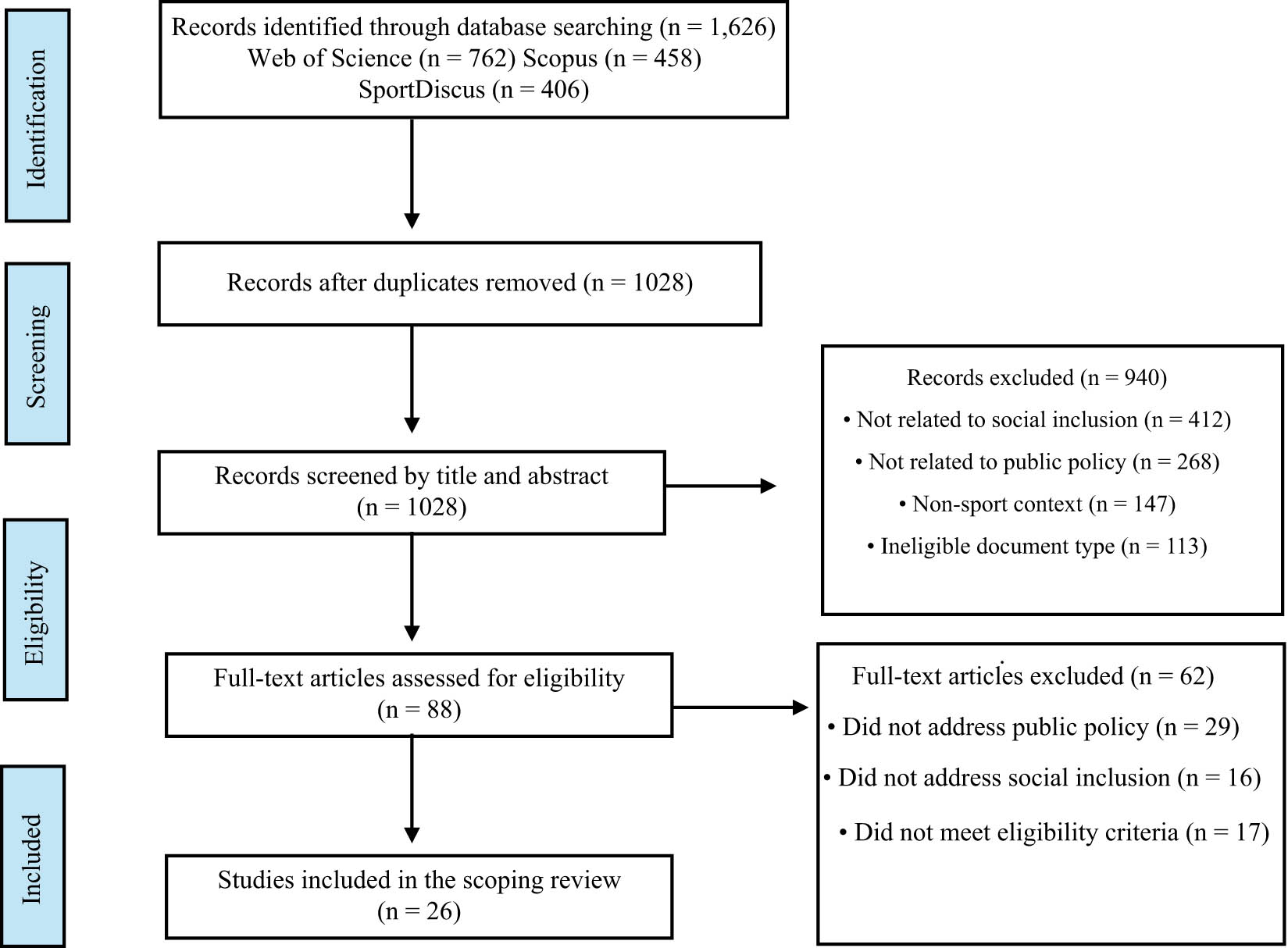
Figure 1
PRISMA flow diagram of the study selection process.
2.5. Data Extraction and Synthesis
Once the included studies were defined, systematic data charting was conducted using an analysis matrix specifically designed for this review to organize and compare the main characteristics and findings of each source. The following variables were charted: author(s) and year of publication, country or geographical context, study objective, methodological design, population or unit of analysis, type of sport policy or program addressed, specific social or policy-related outcome domain, main reported finding, and methodological characteristics relevant to interpretation. Where applicable, attention was also given to whether quantitative estimates or effect sizes were reported in a manner that allowed meaningful comparison across studies.
Subsequently, a descriptive thematic analysis was conducted to synthesize the charted data and identify patterns, trends, and common areas across the studies. Studies were grouped into thematic categories according to their objectives, populations, methodological designs, and reported outcomes. In addition to thematic mapping, the synthesis explicitly distinguished between evidence describing mechanisms or participant experiences, evidence reporting associations, and evidence capable of supporting stronger causal interpretations. Given the heterogeneity of populations, designs, outcome definitions, and reporting metrics, no pooled effect estimate was calculated.
2.6. Assessment of the Strength and Limitations of the Evidence
Critical appraisal is an optional component of scoping reviews under PRISMA-ScR (Tricco et al., 2018). Because the objective of this review includes characterizing what the available literature can reasonably support, an evidence-strength characterization was incorporated without assigning a single numerical quality score across heterogeneous study designs. Each source was interpreted according to its methodological design, whether it represented primary or secondary evidence, the specificity of the reported outcomes, the availability of quantitative estimates when applicable, and the degree to which the design could support causal inference. This information was used to calibrate the language of the synthesis and to avoid equating evidence of association, experience, or implementation processes with demonstrated population-level societal impact.
3. Results
3.1. General Characteristics of the Included Studies
The 26 studies included in this review were published between 2007 and 2023 and represented 16 countries. European settings accounted for most of the evidence (n = 20), followed by the Americas (n = 4) and Asia (n = 2). The United Kingdom contributed the largest number of studies (n = 6), followed by the United States (n = 3); Belgium, France, and Sweden contributed two studies each, while the remaining countries contributed one study each. This distribution indicates a geographically concentrated evidence base and limited representation from Africa, Latin America, and large parts of Asia.
The methodological profile was heterogeneous. Reviews represented 8 of the 26 sources (30.8%), mixed-method studies 8 (30.8%), quantitative studies 3 (11.5%), descriptive studies 3 (11.5%), qualitative studies 3 (11.5%), and one study used an ethnographic design (3.8%). No study in the extraction matrix was classified as randomized or quasi-experimental. Thus, although the corpus provides substantial contextual and implementation-oriented information, only a limited proportion of the evidence is positioned to estimate the magnitude of associations, and the overall design profile does not support strong causal claims about the societal effects of sport.
Table 1 presents the corrected distribution of the 26 included studies by country. The country counts and author entries were cross-checked against Table 2 so that both tables refer to the same set of included sources. The corresponding reference-list entries were also reconciled against the 26 studies in Table 2, and records not belonging to the final included set were removed.
Table 1
Distribution of studies by country.
| x | Number of articles | Authors |
|---|---|---|
| Argentina | 1 | Garton et al. (2021) |
| Belgium | 2 | Corthouts et al. (2020); Vandermeerschen et al. (2013) |
| Czech Republic | 1 | Kudlacek et al. (2012) |
| France | 2 | Schut & Collinet (2014); Verdot & Schut (2012) |
| Germany | 1 | Ahrens et al. (2022) |
| Hungary | 1 | Perényi (2020) |
| Indonesia | 1 | Rustandi et al. (2021) |
| Ireland | 1 | Masdeu et al. (2022) |
| Italy | 1 | Ricatti et al. (2022) |
| Philippines | 1 | Guinto (2021) |
| Poland | 1 | Czupich (2020) |
| Serbia | 1 | Tubić & Đorđić (2012) |
| Sweden | 2 | Ekholm & Dahlstedt (2022); Bjärsholm & Norberg (2021) |
| Switzerland | 1 | Morgan & Parker (2021) |
| United Kingdom | 6 | Bekker et al. (2023); White & McArdle (2022); Piggott & Matthews (2021); Spracklen et al. (2014); Kelly (2013); Tacon (2007) |
| United States | 3 | Giles (2014); Wilson et al. (2022); Russell et al. (2016) |
Table 2
Characteristics of the included studies.
| Author (Year) | Country | Study objective | Design | Population/Context | Main finding | Thematic category |
|---|---|---|---|---|---|---|
| Bekker et al. (2023) | United Kingdom | To analyze leadership and equity in sport policies | Descriptive | Sport organizations | Inclusive leadership is essential for promoting equity | Challenges in the implementation of inclusive sport policies |
| Ekholm & Dahlstedt (2022) | Sweden | To evaluate sport as a tool for social inclusion | Mixed-method | Migrant youth | Sport facilitates contextualized social integration | Sport and social inclusion |
| Masdeu et al. (2022) | Ireland | To examine inclusion in martial arts | Mixed-method | Sport practitioners | There is interest in inclusion, but training is insufficient | Sport and social inclusion |
| Giles (2014) | United States | To analyze sport as a development policy tool | Review | Scientific literature | Sport promotes social development and inclusion | Sport public policies and social development |
| Ahrens et al. (2022) | Germany | To analyze physical activity policies | Descriptive | European adults | Public policies influence healthy behaviors | Sport, health, and social well-being |
| Wilson et al. (2022) | United States | To evaluate equity policies in sport | Mixed-method | Campus recreation staff (n = 254) | Equity was widely endorsed, but gaps remained between departmental values, written policies, and perceived practices | Challenges in the implementation of inclusive sport policies |
| White & McArdle (2022) | United Kingdom | To analyze gender policy implementation | Review | Policy documents | Structural inequalities persist | Challenges in the implementation of inclusive sport policies |
| Bjärsholm & Norberg (2021) | Sweden | To analyze sport governance | Descriptive | Sport clubs | Sport contributes to social development | Sport public policies and social development |
| Garton et al. (2021) | Argentina | To analyze the professionalization of women’s football | Ethnographic | Football players | Structural inequalities persist | Challenges in the implementation of inclusive sport policies |
| Ricatti et al. (2022) | Italy | To examine sport, social inclusion, and assimilation in Prato | Qualitative | Migrant communities and local sport-policy actors in Prato | Inclusion-oriented policy was often constrained at grassroots level by assimilationist practices | Sport and social inclusion |
| Rustandi et al. (2021) | Indonesia | To review international sport policies | Review | Scientific studies | Policies determine sport inclusion | Sport public policies and social development |
| Morgan & Parker (2021) | Switzerland | To analyze youth sport programs | Review | Youth populations | Sport promotes social development | Sport and social inclusion |
| Corthouts et al. (2020) | Belgium | To analyze inclusion in sport clubs | Quantitative | Sport clubs | Sport promotes social inclusion | Sport and social inclusion |
| Czupich (2020) | Poland | To evaluate the social impact of sport | Mixed-method | Sport clubs | Sport improves social well-being | Sport, health, and social well-being |
| Piggott & Matthews (2021) | United Kingdom | To analyze sport governance | Qualitative | Two English national governing bodies of sport | Formal governance structures reproduced gendered power relations; top-down reforms alone were insufficient | Challenges in the implementation of inclusive sport policies |
| Schut & Collinet (2014) | France | To analyze youth sport policies | Review | Documents | Lack of institutional coordination | Challenges in the implementation of inclusive sport policies |
| Russell et al. (2016) | United States | To evaluate physical activity programs | Review | Youth populations | Sport improves public health | Sport, health, and social well-being |
| Verdot & Schut (2012) | France | To analyze youth sport policies | Mixed-method | French Juvenile Justice System: 300 centers and 26 interviews | Inclusion effects were conditional on specific material and human resources | Sport and social inclusion |
| Spracklen et al. (2014) | United Kingdom | To analyze sport and social identity | Mixed-method | Migrants | Sport strengthens social identity | Sport and social inclusion |
| Vandermeerschen et al. (2013) | Belgium | To analyze inequalities in participation | Quantitative | Children | Socioeconomic barriers exist | Challenges in the implementation of inclusive sport policies |
| Kudlacek et al. (2012) | Czech Republic | To evaluate sport policies | Mixed-method | Experts | Lack of national strategy | Challenges in the implementation of inclusive sport policies |
| Kelly (2013) | United Kingdom | To evaluate sport and social prevention | Mixed-method | Youth populations | Sport reduces risk behaviors | Sport, health, and social well-being |
| Tubić & Đorđić ( 2012 ) | Serbia | To evaluate inclusion in physical education | Review | Inclusive physical education in Vojvodina | Implementation faced multiple challenges and required stronger professional and system support | Sport and social inclusion |
| Tacon (2007) | United Kingdom | To evaluate sport programs | Review | Sport programs | Lack of impact evaluation | Challenges in the implementation of inclusive sport policies |
| Perényi (2020) | Hungary | To analyze sport participation | Quantitative | General population | Policies influence participation | Sport public policies and social development |
| Guinto (2021) | Philippines | To evaluate sport as social policy | Qualitative | Communities | Sport contributes to social development | Sport public policies and social development |
3.2. Thematic Synthesis of the Included Studies
The thematic analysis identified four dimensions across the 26 included studies: challenges in the implementation of inclusive sport policies (n = 9; 34.6%), sport and social inclusion (n = 8; 30.8%), sport public policies and social development (n = 5; 19.2%), and sport, health, and social well-being (n = 4; 15.4%). These categories summarize the dominant focus of each study rather than mutually exclusive effects, because several sources addressed more than one social or policy-related mechanism.
3.3. Strength and Limitations of the Available Evidence
Across the corpus, the available evidence was stronger for describing experiences, mechanisms, policy contexts, and implementation barriers than for quantifying the magnitude of social outcomes. Eight sources were reviews and eight employed mixed-method approaches, whereas only three were explicitly classified as quantitative studies. Qualitative, ethnographic, descriptive, and review-based evidence provided valuable contextual and interpretive insights but did not yield directly comparable effect estimates. Even among quantitative and mixed-method studies, substantial heterogeneity in populations, outcome definitions, and analytical approaches precluded meaningful cross-study comparisons of effect magnitude. Sample size was likewise not a uniform indicator across the corpus, as several studies examined organizations, policy documents, programs, or previously published evidence rather than fixed participant cohorts. Therefore, the lack of standardized social outcomes and comparable effect estimates should be understood as an important characteristic and limitation of the current evidence base rather than as evidence of an absence of effect. Table 3 summarizes the methodological profile, relative interpretive strength, main limitations, and implications for effect-size interpretation across the included studies.
Table 3
Methodological profile and interpretive strength of the included evidence.
| Design | n (%) | Main contribution | Relative strength | Main interpretive limitation | Effect-size implications |
|---|---|---|---|---|---|
| Review | 8 (30.8%) | Secondary synthesis of policies, programs, or prior evidence | Broad mapping of existing knowledge | Dependent on the quality and heterogeneity of underlying studies; no direct causal estimate from the source itself | Not directly comparable across the corpus |
| Mixed-method | 8 (30.8%) | Integration of contextual and quantitative/structured information | Triangulation of mechanisms and observed patterns | Heterogeneous outcome definitions and integration strategies limit comparability and causal inference | May report quantitative estimates, but not in a standardized form across studies |
| Quantitative | 3 (11.5%) | Measurement of participation, inequalities, or policy-related associations | Provides measurable empirical relationships | No study was classified as experimental in the extraction matrix; observational evidence cannot establish causality | Potentially estimable within studies, but not suitable for pooled comparison here |
| Descriptive | 3 (11.5%) | Description of policy environments, organizations, or population patterns | Useful for system-level characterization | Limited capacity to test causal mechanisms or intervention effectiveness | Generally not designed around standardized effect estimates |
| Qualitative | 3 (11.5%) | Experiences, perceptions, meanings, and implementation processes | High contextual depth and mechanism identification | Context-specific findings and limited statistical generalizability | Effect sizes are not applicable |
| Ethnographic | 1 (3.8%) | In-depth analysis of structural and gender-related processes | Rich contextual understanding of inequality and practice | Single/context-specific evidence with no causal effect estimate | Effect sizes are not applicable |
3.4. Sport and Social Inclusion
Eight studies were grouped under sport and social inclusion. The evidence comprised four mixed-method studies (Ekholm & Dahlstedt, 2022; Masdeu et al., 2022; Spracklen et al., 2014; Verdot & Schut, 2012), one quantitative study (Corthouts et al., 2020), one qualitative study (Ricatti et al., 2022), and two reviews (Morgan & Parker, 2021; Tubić & Đorđić, 2012). Across these sources, the recurring outcomes were social interaction, belonging, social identity, educational inclusion, and opportunities for participation. The convergence across different designs supports the plausibility of sport as a setting in which social ties and inclusion processes can develop. However, most of this evidence is contextual, associational, or based on participant/program experiences; it does not establish that sport alone produces sustained population-level inclusion, and the studies do not provide a common set of standardized effect sizes that would allow the magnitude of these outcomes to be compared directly.
3.5. Sport Public Policies and Social Development
Five studies were primarily categorized as sport public policies and social development (Giles, 2014; Bjärsholm & Norberg, 2021; Rustandi et al., 2021; Perényi, 2020; Guinto, 2021). Their designs included two reviews, one descriptive study, one quantitative study, and one qualitative study. Collectively, they suggest that governance arrangements, policy priorities, and institutional support shape opportunities for sport participation and the social objectives attached to sport programs. The evidence is therefore more persuasive regarding the importance of policy context and implementation conditions than regarding the direct magnitude of policy-driven social change. Only one study in this thematic group was explicitly classified as quantitative, limiting the ability to compare policy effects using standardized estimates.
The included evidence also shows that sport policy is embedded in markedly different national and local governance contexts. This heterogeneity is analytically important: similar objectives such as inclusion or social development may be pursued through different institutional arrangements, resource structures, and delivery organizations. Consequently, the findings should not be interpreted as demonstrating a uniform policy effect across countries; rather, they indicate that the contribution of sport depends on how policy objectives are translated into accessible and sustained programs at the local level.
3.6. Sport, Health, and Social Well-Being
Four studies were grouped under sport, health, and social well-being (Ahrens et al., 2022; Czupich, 2020; Russell et al., 2016; Kelly, 2013). Two used mixed-method approaches; one was descriptive, and one was a review. Reported outcomes included healthy behaviors, social well-being, public-health-related benefits, and prevention-oriented outcomes among youth. These findings indicate that health and well-being are important components of the policy rationale for sport; however, none of the studies in this group was classified as experimental in the extraction matrix. The available evidence therefore supports associations and program-level observations more strongly than direct causal attribution of health or behavioral change to sport participation.
3.7. Challenges in the Implementation of Inclusive Sport Policies
Nine studies were categorized as addressing challenges in the implementation of inclusive sport policies (Bekker et al., 2023; Wilson et al., 2022; White & McArdle, 2022; Garton et al., 2021; Piggott & Matthews, 2021; Schut & Collinet, 2014; Vandermeerschen et al., 2013; Kudlacek et al., 2012; Tacon, 2007). Despite their methodological diversity, these studies converged around structural gender inequalities, socioeconomic barriers to participation, gaps between policy intentions and implementation, insufficient institutional coordination, and limited impact evaluation. This convergence across qualitative, descriptive, quantitative, mixed-method, and review evidence strengthens confidence that implementation barriers are a recurrent feature of the literature. Nevertheless, the magnitude of each barrier and its independent effect on social outcomes remains uncertain because the evidence does not use a common measurement framework.
4. Discussion
This scoping review mapped the literature on sport, social inclusion and public policy, explicitly considering what the methodological profile of the evidence allows us to conclude. The key finding is not that sport automatically produces social inclusion or societal development, but rather that sport is repeatedly described as an enabling context, the contribution of which depends on program design, governance, accessibility and implementation. This distinction is relevant because the corpus included is methodologically heterogeneous and includes relatively little evidence that can support causal claims.
The eight studies in this thematic group consistently described processes related to social inclusion such as social interaction, belonging, formation of identity, and participation opportunities. Results from mixed-method, quantitative, qualitative, and review designs are consistent regarding the relevance of these mechanisms across various settings. At the same time, evidence should be interpreted as evidence for plausible context-dependent pathways rather than evidence for a universal social effect. In particular, the lack of experimental designs, standardized social-inclusion measures, and comparable effect sizes prevents us from knowing the size, durability, or transferability of these outcomes across populations.
The policy-related findings also indicate that the difference between policy formation and policy implementation is essential. Bjärsholm and Norberg (2021), Rustandi et al. (2021), Perényi (2020) and Guinto (2021) argue that sport can be used to achieve broader social-development objectives, whereas implementation-focused research suggests that formal policy commitments do not necessarily lead to equitable access or long-term community gains (Giles 2014). Institutional coordination, organizational capacity, local delivery structures and continuity of resources seem to condition the translation of strategic objectives into practice. The evidence thus supports a contingent interpretation: policy may create enabling conditions, but the social value of sport is contingent upon implementation processes that are not consistently measured.
From a sport management perspective, we can understand the implementation gap as a multi-level delivery problem between strategic policy and grassroots practice. The corpus included in the present volume provides direct evidence of this transition. In a mixed-method study of 254 campus recreation staff, Wilson et al. (2022) found discrepancies between stated equity values, written policies, and perceived departmental practices. Ricatti et al. (2022) demonstrated how assimilationist attitudes and practices at the local level can undermine inclusion-oriented policies in Prato. Piggott and Matthews (2021) found that formal, top-down governance reforms did not in themselves create transformational gender-equitable change. Verdot and Schut (2012) found that the inclusion potential of sport was conditional on specific material and human conditions. Collectively, these studies imply that the management question is not simply whether an inclusive policy exists, but whether local delivery organizations have the capacity, competencies, coordination, resources, discretion, and accountability mechanisms needed to implement it.
Financial and resource conditions need to be interpreted with caution as well. The issue of continuity of resources is a constant concern of implementation. Nevertheless, the studies included do not systematically measure the level of funding, nor estimate a direct relationship between investment and social transformation. The evidence therefore supports identifying financial stability as a condition for implementation to be evaluated, rather than making a causal claim that higher investment necessarily leads to stronger social outcomes.
A related management challenge is the lack of a common monitoring architecture for social value. The literature on external evaluation provides approaches that could strengthen future studies on sport policies. Social Return on Investment (SROI) is a structured evaluative approach to incorporating social, health, and economic value, although a systematic review found considerable methodological heterogeneity and limitations in the reporting of its application to physical activity and sport interventions (Gosselin et al., 2020). Social capital can also be operationalized using validated measures, such as the Club Social Capital Scale, which measures governance, norms, friendship-acceptance, and trust-reciprocity in sport and recreation clubs (Forsell et al., 2020), and a recent scoping review showed that social cohesion is still inconsistently defined and only partially measured in sport research (Moustakas & Wagner, 2023). These frameworks should not be viewed as alternatives to causal evaluation, but rather they illustrate how future policy studies could combine implementation indicators (e.g., reach, fidelity, organizational capacity, resource continuity, and equity of access) with standardized social outcomes.
Gender equity illustrates this implementation gap particularly clearly. Bekker et al. (2023), White and McArdle (2022), Piggott and Matthews (2021), and Garton et al. (2021) identify persistent structural or organizational inequalities despite formal inclusion objectives. The importance of these findings lies less in demonstrating a measurable effect size and more in showing that access, leadership, resource distribution, and organizational practices can reproduce exclusion within sport itself. Accordingly, sport should not be treated as inherently inclusive; inclusive outcomes require deliberate governance and organizational mechanisms that address pre-existing inequalities.
The health and well-being literature similarly warrants cautious interpretation. Ahrens et al. (2022), Czupich (2020), Russell et al. (2016), and Kelly (2013) connect sport- or physical-activity-related programs with healthy behaviors, public health, social well-being, or prevention-oriented outcomes. However, the designs represented in this thematic group were descriptive, mixed-method, and review-based rather than experimental. These studies therefore help identify relevant outcome domains and potential pathways, but they do not permit a precise estimate of the independent effect of sport on health or risk behavior after accounting for contextual and programmatic factors.
A central contribution of the present synthesis is therefore the distinction between the breadth of positive claims and the strength of the evidence supporting them. This concern has been recognized in the broader sport-for-development literature. Coalter (2017) argued that conceptual and methodological inconsistencies limit the use of sport research as a basis for evidence-informed policy, while Whitley et al. (2019), in a systematic critical appraisal of sport-for-development interventions, reported limited methodological detail and generally weak evidence quality across the studies they assessed. The methodological profile identified in the present review is consistent with this caution: reviews and context-rich non-experimental designs are valuable for understanding processes, but they cannot by themselves establish the magnitude or causality of societal impact.
The recurrent implementation barriers identified in nine studies further challenge overly general claims of social impact. Socioeconomic barriers, gender inequalities, weak institutional coordination, gaps between policy and practice, and limited evaluation were reported across multiple designs. These findings suggest that the key policy question is not simply whether sport is associated with desirable social outcomes, but under what conditions, for whom, through which mechanisms, and with what degree of sustainability those outcomes occur. This shifts interpretation away from sport as a sufficient intervention and toward sport as one component within broader social and institutional systems.
Overall, the evidence supports a cautious conclusion: sport may provide a platform for social interaction, participation, health promotion, and community-oriented action, but the magnitude and durability of these effects remain uncertain. Stronger conclusions regarding societal impact require designs that can separate the contribution of sport from selection effects, concurrent social programs, local organizational capacity, and broader socioeconomic conditions. The present synthesis therefore favors conditional language (“may contribute,” “is associated with,” or “can provide a setting for”) over deterministic statements that sport itself produces social transformation.
4.1. Knowledge Gaps and Priorities for Future Research
Several gaps emerge from the evidence base. First, the scarcity of experimental or quasi-experimental designs limits causal inference. Second, outcome measurement is heterogeneous, and the reviewed literature does not provide a common framework for reporting standardized effect sizes across social inclusion, well-being, participation, or policy outcomes. Third, long-term follow-up and sustainability are insufficiently represented, making it difficult to determine whether reported social benefits persist beyond the duration of programs. Fourth, policy implementation is often described but less frequently evaluated with explicit indicators linking governance inputs, implementation processes, and social outcomes. Fifth, the geographical concentration of studies in Europe and other high-income settings limits transferability to regions with different sport systems, resource constraints, and social-policy environments.
Future research should therefore prioritize longitudinal and comparative designs, clearer reporting of sample or unit-of-analysis characteristics, standardized and validated social outcome measures, effect estimates with uncertainty intervals when quantitative analysis is appropriate, and theory-based evaluation capable of specifying mechanisms and contextual conditions. Policy-oriented studies should also distinguish between policy adoption, implementation fidelity, reach, equity of access, and sustained social outcomes. These improvements would allow future reviews to move beyond mapping promising mechanisms toward stronger judgments about effectiveness and societal impact. Where social value is a policy objective, evaluation protocols should also prespecify a theory of change and select transparent indicators of social capital, social cohesion, implementation performance, and, where appropriate, SROI, rather than relying on broad statements of community benefit.
5. Conclusions
This scoping review identified a diverse but methodologically heterogeneous literature in which sport is positioned as a potential setting for social inclusion, policy action, health promotion, and community-oriented development. Across the included studies, recurring mechanisms included social interaction, belonging, participation opportunities, and institutional support; however, these findings were generated primarily through reviews, mixed-method, descriptive, qualitative, ethnographic, and observational quantitative approaches.
Accordingly, the available evidence does not justify interpreting sport as an intervention that independently or uniformly produces societal transformation. Rather, sport may contribute to desirable social outcomes when access is equitable and when programs are supported by effective governance, organizational capacity, coordination, and sustained implementation. Structural inequalities and implementation gaps can substantially constrain these potential benefits.
The most important gap identified is the limited capacity of the current evidence base to quantify the magnitude, causality, and long-term sustainability of social effects. More rigorous longitudinal and comparative evaluations, standardized outcome measures, transparent sample and effect reporting, and explicit assessment of policy implementation are needed to strengthen the evidence available for sport management and public-policy decision-making.
Overall, sport should be considered a potentially valuable component of broader social-inclusion strategies rather than a sufficient mechanism in itself. The contribution of sport appears to be conditional on the social, organizational, and policy environment in which participation occurs.
Acknowledgments
The authors would like to thank all contributors and institutions that supported the development of this study.
Funding information
This research received no external funding.
Author contributions
Julio Jalibb Pestana Mendoza: conception and design of the stud, acquisition of data, analysis and interpretation of data, manuscript preparation; Jean Fernel Durango Cardoza: manuscript preparation; José Eduardo Gnecco Gutiérrez: manuscript preparation; Jhonny Javier Arroyo Martínez: manuscript preparation; Isaac Smith Ariza Solano: analysis and interpretation of data, manuscript preparation; Ingrid Patricia Fonseca Franco: analysis and interpretation of data, manuscript preparation; Jhonatan Camilo Peña Ibagon: analysis and interpretation of data, manuscript preparation.
Conflict of interest statement
Authors state no conflict of interest.
Ethics approval and informed consent
This study is a scoping review and does not involve human or animal subjects.