
Table 1
Comparative analysis of sport strategies in Hungary, Poland, Romania, and Slovakia.
| Country | Strategic goals | Focus areas | Implementation | Unique features | Challenges |
|---|---|---|---|---|---|
| Hungary | “Sport Nation and Sporting Nation,” national identity, equal opportunities | Elite sports, grassroots, community cohesion | Sport XXI Strategy (2007–2020), public bodies for sport | Strong elite sport focus, national identity emphasis | Balancing elite and grassroots sports, maintaining cohesion |
| Poland | Active society, efficient system, decentralized governance, infrastructure development | Competitive sport, youth sport, sport-for-all, disabled sport, infrastructure | Sport Development Programme (2015), focus on local government involvement | Early strategy adoption (2003), focus on decentralization | Low participation, weak infrastructure, ineffective organizations |
| Romania | Healthy nation, elite role models, governance reform | Elite sports, regional centres, coach training | National Sport Strategy (2023), sport law reforms | Regional excellence centres, decentralization | Delayed governance reform, political instability |
| Slovakia | Social-economic sport status, sustainable management, digitalization | Elite and grassroots, digitalization, education | National Sport Strategy (2020), strong legal framework | Balanced focus, digitalization, and innovation | Funding sustainability, digital implementation |
Source: National sport strategies.
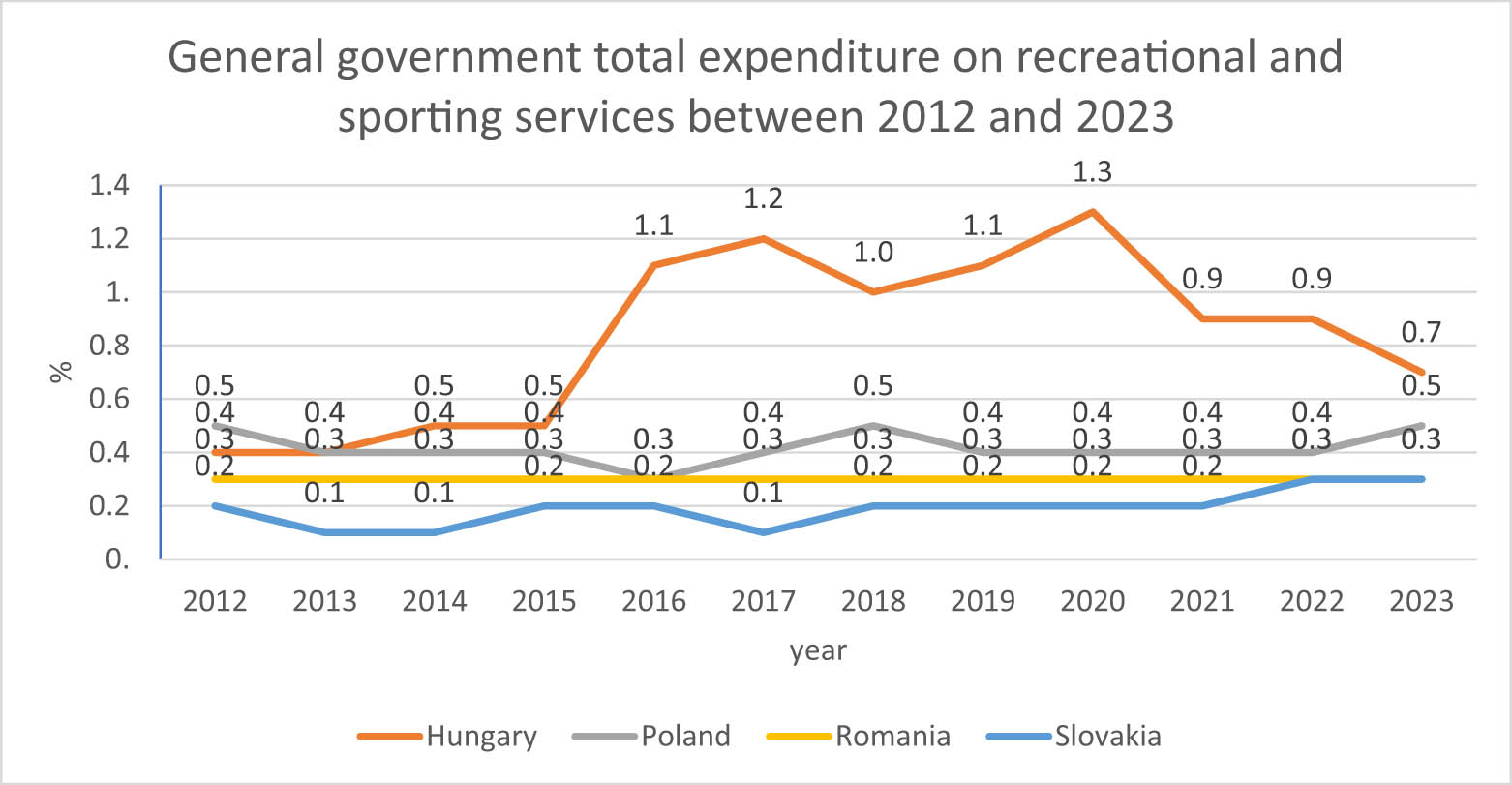
Chart 1
General government total expenditure on recreational and sporting services in relation with the national GDP.
Source: Eurostat: https://ec.europa.eu/eurostat/databrowser/view/gov_10a_exp/default/table? lang = en, own.
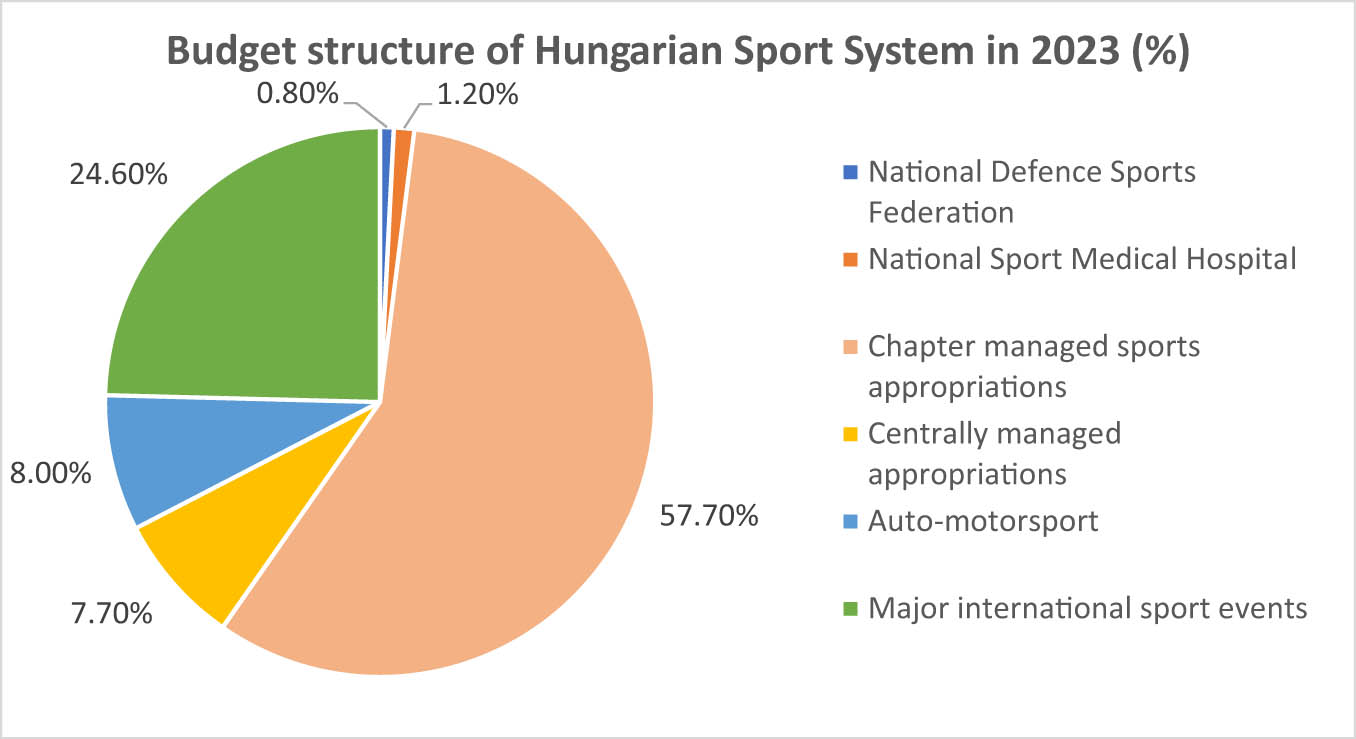
Chart 2
Budget structure of Hungarian sport, 2023.
Source: National Budget 2023.
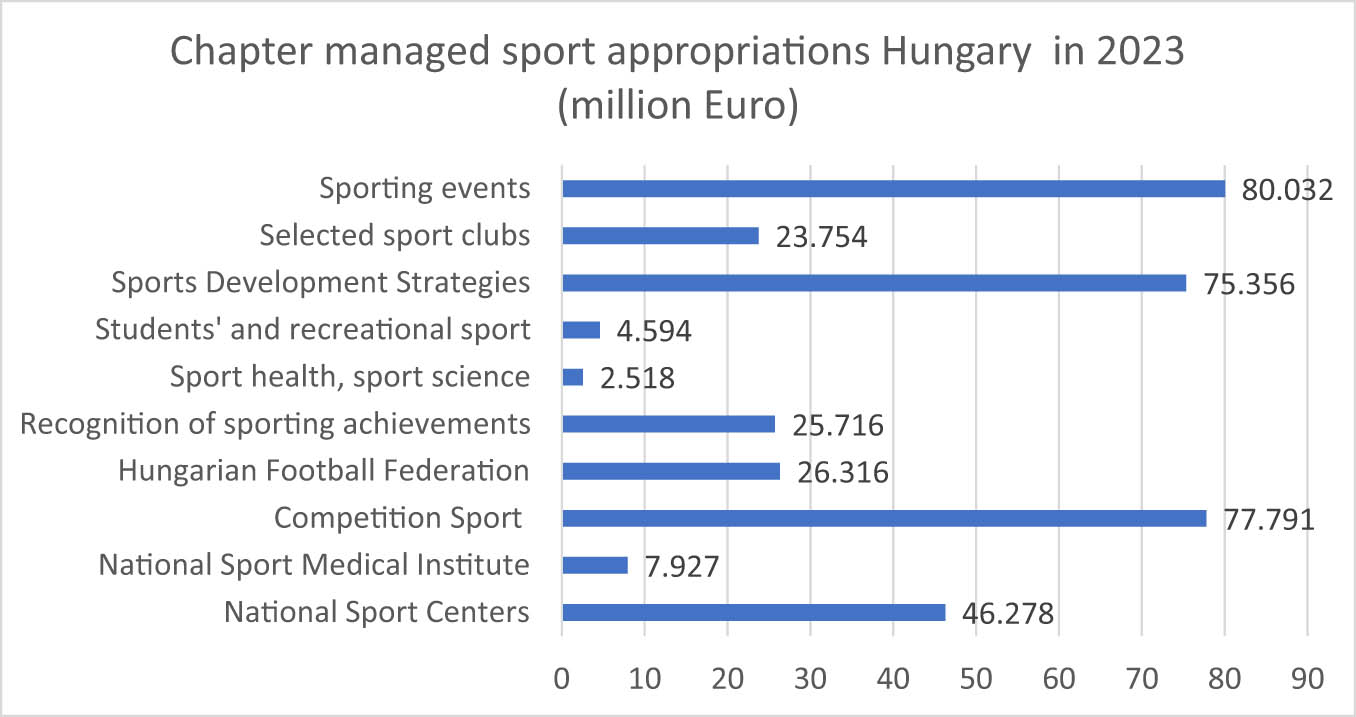
Chart 3
Budget structure of Hungarian sport (2023) – Chapter-managed sport appropriations.
Source: Állami költségvetés 2023. [National Budget 2023]. https://mkogy.jogtar.hu/jogszabaly? docid = A2300006.TV.
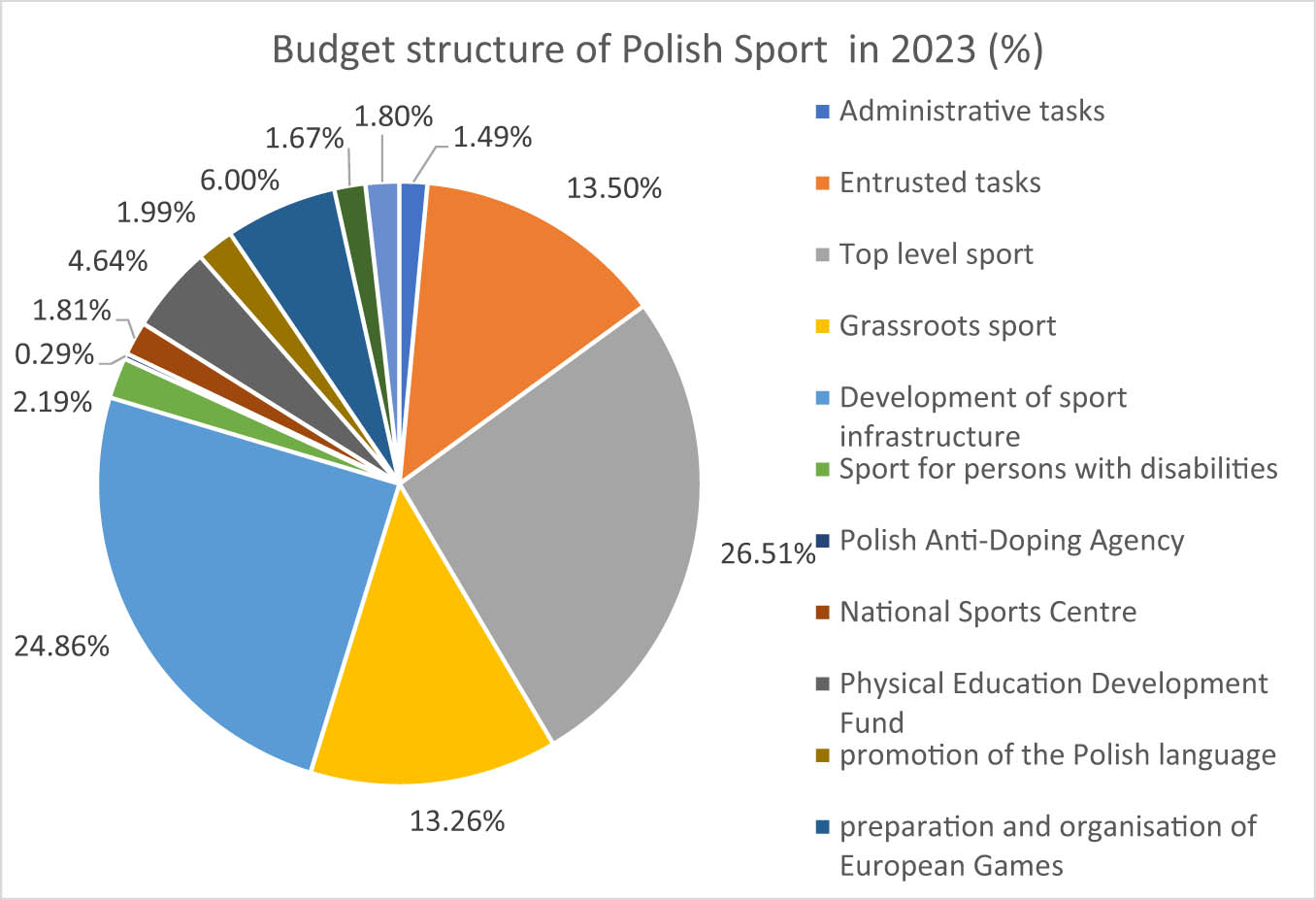
Chart 4
Budget structure of Polish sport (2023).
Source: https://www.gov.pl/web/ministry-of-sports-and-tourism.
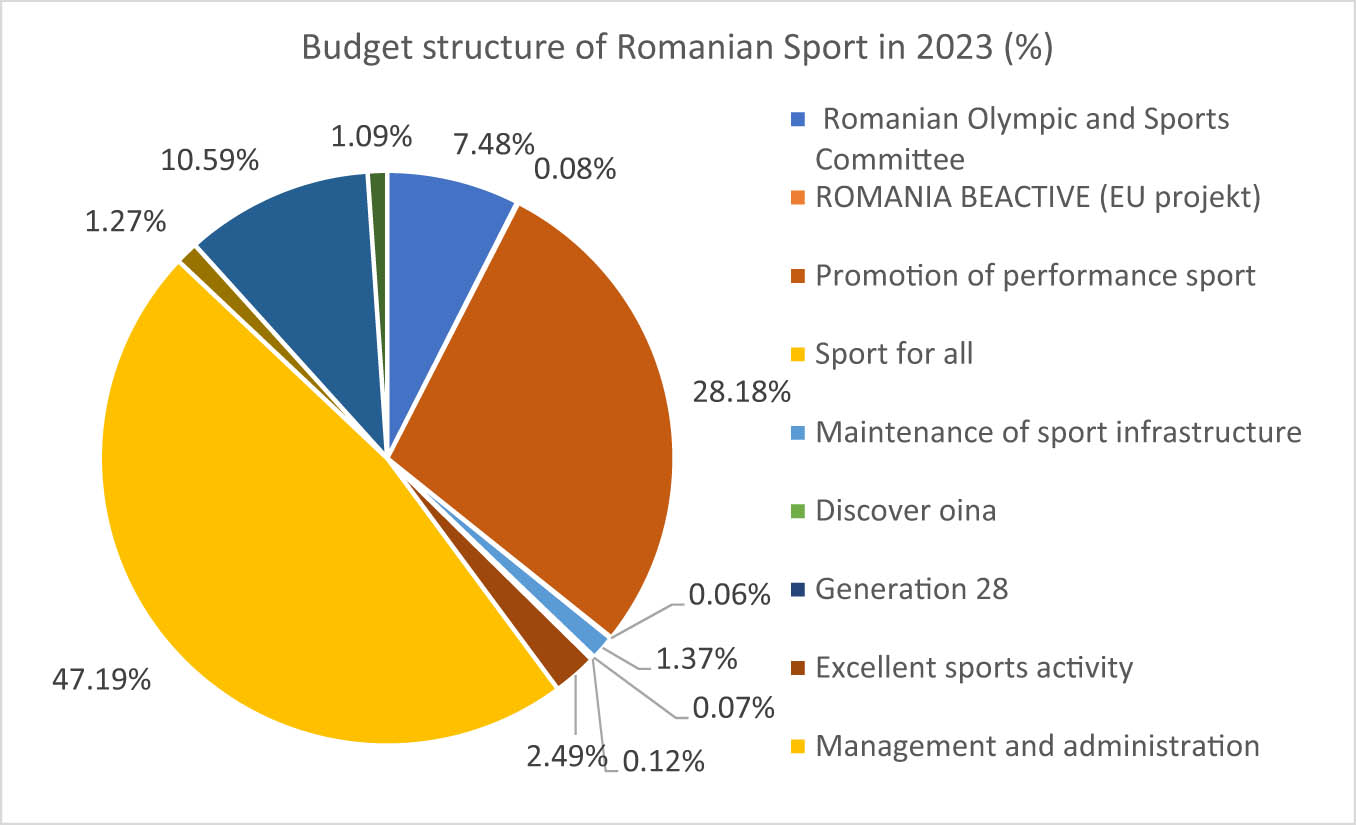
Chart 5
Budget structure of Romanian sport (2023).
Source: https://mfinante.gov.ro/static/10/Mfp/buget2022/proiectbuget2022/Anexa3/Ministerul_Sportului.pdf.
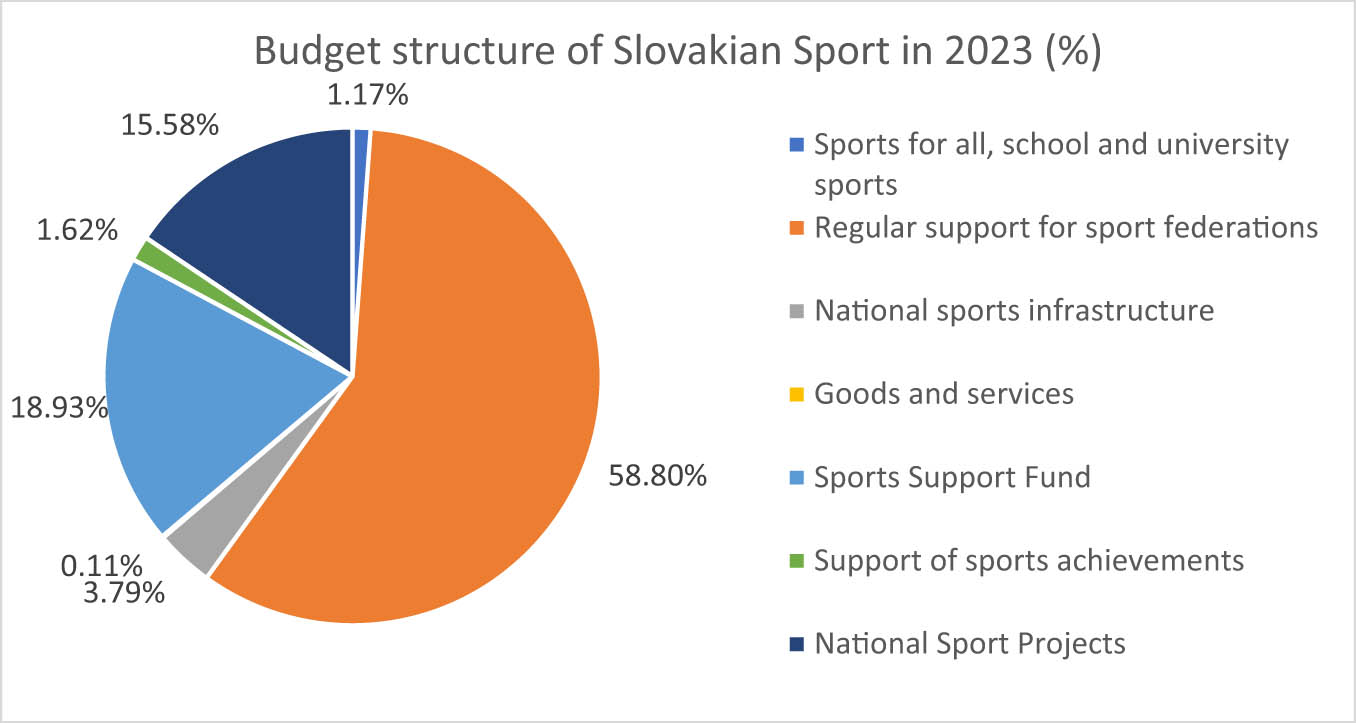
Chart 6
Budget structure of Slovakian sport (2023).
Source: https://www.minedu.sk/data/att/89d/28534.3a695a.pdf.
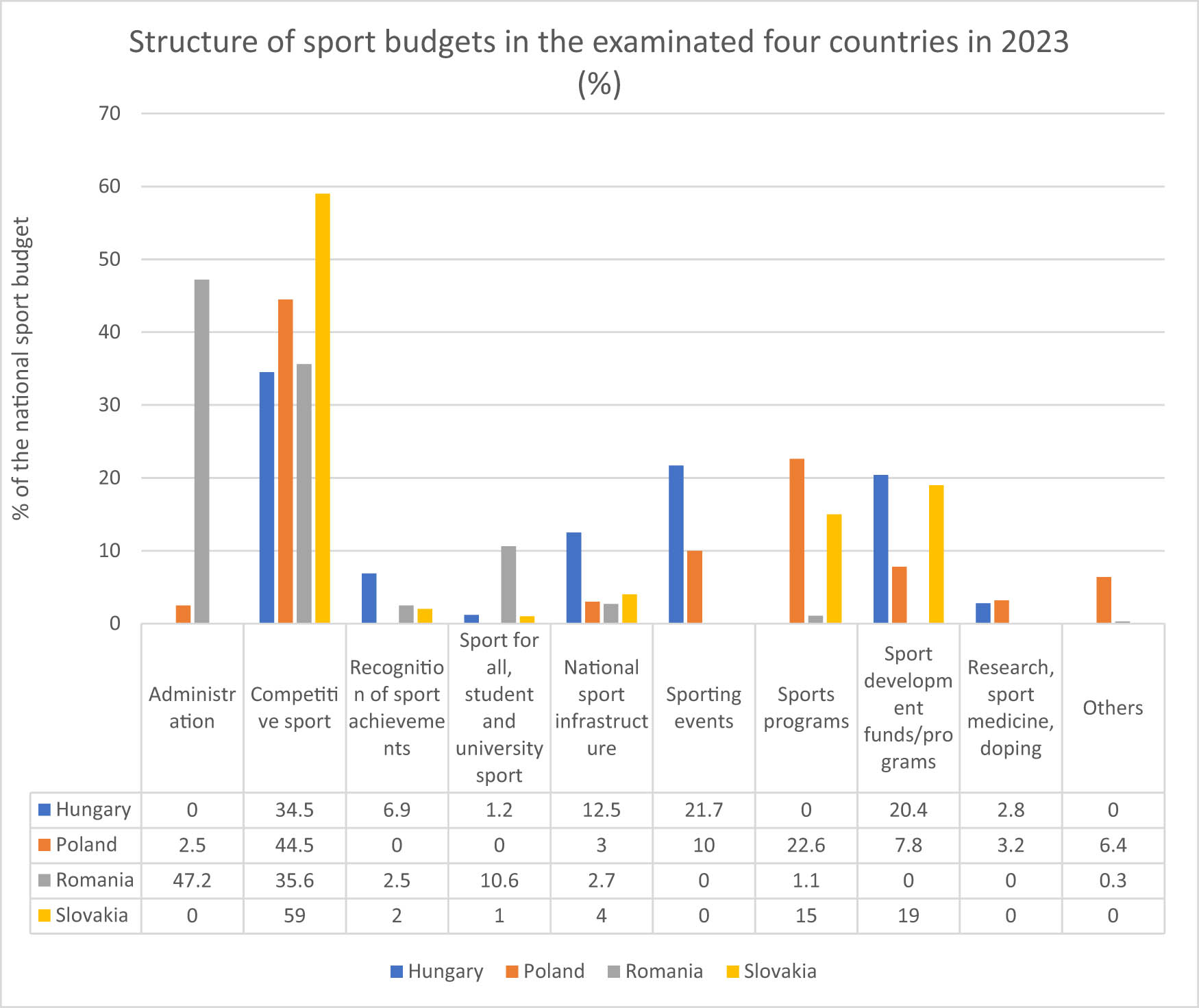
Chart 7
Budget structure of the countries examined in 2023.
Source: Sport budget of the four countries in 2023.
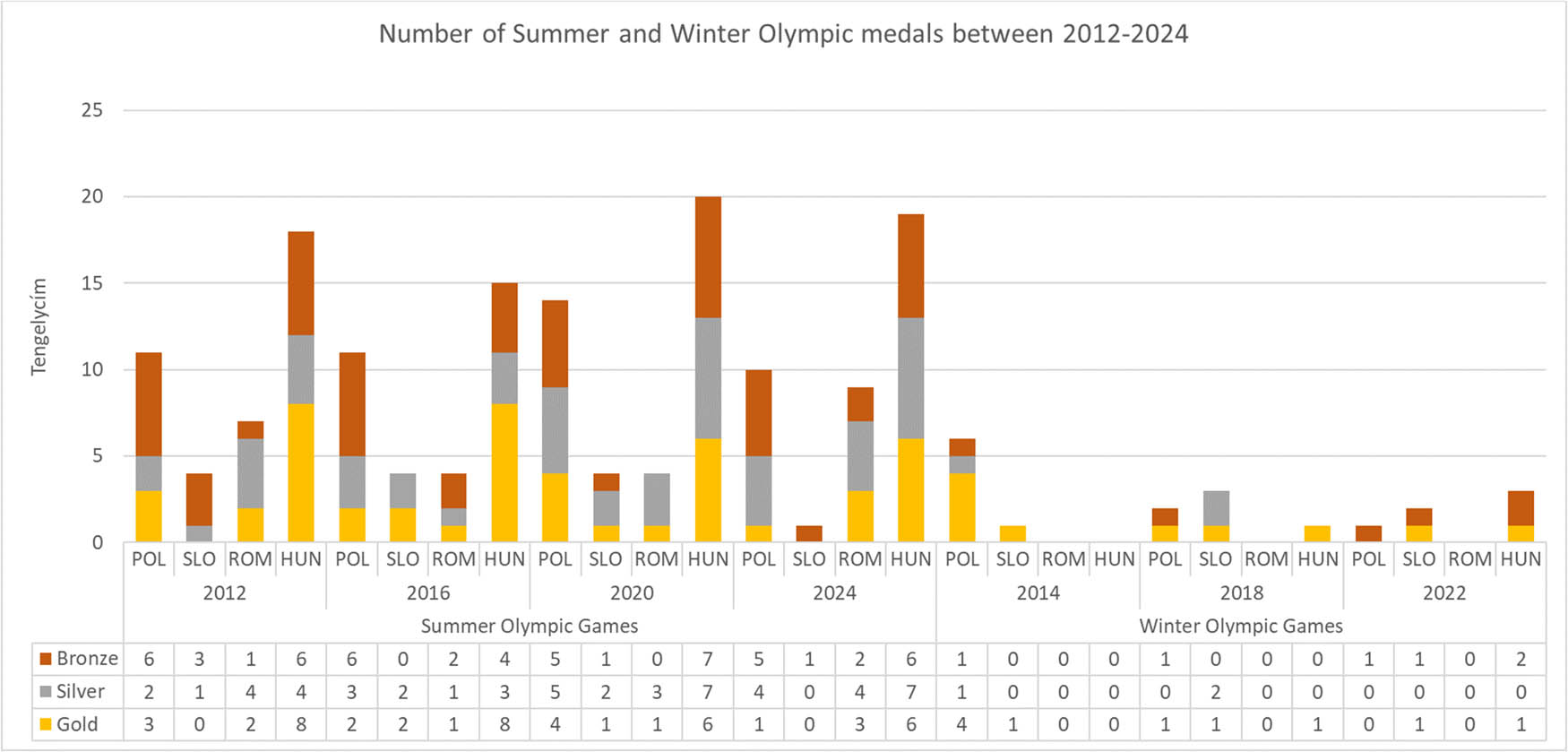
Chart 8
Number of Olympic medals won at the Summer and Winter Olympic Games (2012–2024), POL: Poland, SLO: Slovakia, ROM: Romania, Hun: Hungary.
Source: Data from the Official Website of the IOC.
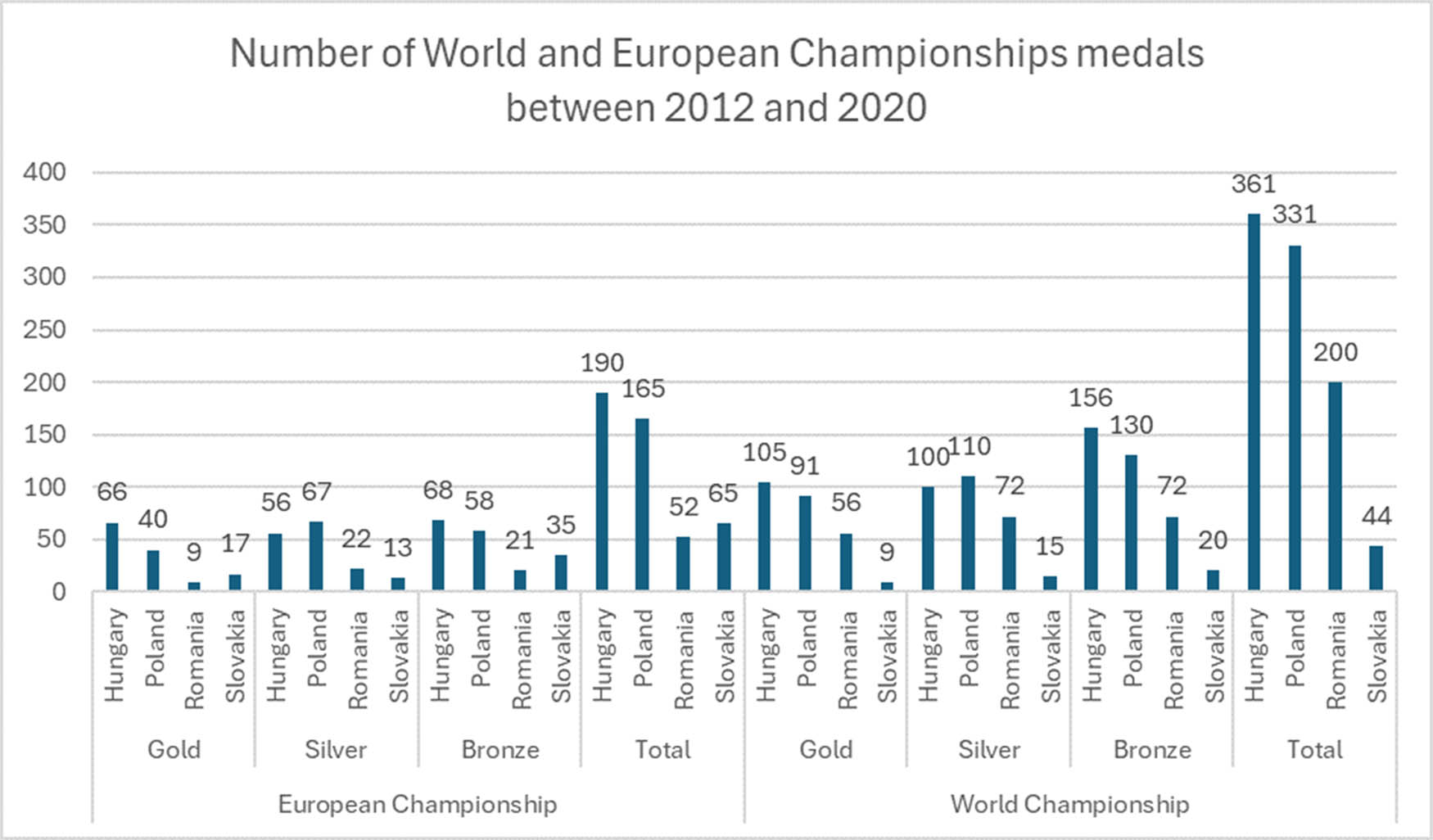
Chart 9
Number of World Championships and European Championships medals in Olympic disciplines (2012–2020).
Source: Data from the official websites of the International and European Sport Federations.
Table 2
Medals per capita regarding the time period 2012–2024.
| Country | Population (approx. 2024) | Total medals (2012–2024) | Medals per million people |
|---|---|---|---|
| Hungary | 9.5 million | 76 | 8 |
| Poland | 38.5 million | 55 | 1.43 |
| Romania | 19 million | 26 | 1.37 |
| Slovakia | 5.5 million | 15 | 2.72 |
Source: Data from Eurostat and the Official Website of the IOC.
Table 3
Alignment of national sport systems with institutional theory in Central and Eastern Europe.
| Country | Institutional logic | Governance structure | Funding style | Olympic trend (2012–2024) | Theoretical interpretation |
|---|---|---|---|---|---|
| Hungary | Institutional inertia | Centralized, state-led | Strong state support | Consistently high | Legacy structures sustain performance |
| Poland | Policy adaptability | Semi-centralized | Mixed funding with EU and local government | Stable, improving | Adaptive institutions support resilience |
| Romania | Reform gaps | Volatile, fragmented | Underinvestment | Declining | Weak institutions undermine reform |
| Slovakia | Selective focus | Fragmented, federation-led | Focused support | Modest, niche success | Strategic targeting in lieu of breadth |
Source: Author’s contribution.