
1. Introduction
The construction industry faces persistent challenges related to productivity, quality, efficiency, sustainability and competitiveness, which directly impact project performance (Mellado and Lou 2020; Sepasgozar et al. 2021; Pérez et al. 2024; Awe et al. 2025). These difficulties manifest in both small- and large-scale projects, resulting in high levels of waste, missed deadlines, interdisciplinary lack of coordination and significant cost overruns (Mellado and Lou 2020; Moradi and Sormunen 2024; Pérez et al. 2024). Given this scenario, the search for innovative and effective methods for continuous improvement has become a key response in comprehensive project management.
In this context, two approaches have gained significant relevance in the specialised literature: Lean Construction and Building Information Modelling (BIM) (Alizadehsalehi and Hadavi 2023; El Mounla et al. 2023; Garcés and Peña 2023; Ismail et al. 2023; Aziz et al. 2024). Both methodologies, whether used individually or in combination, have proven to offer effective solutions to common problems in project management, such as lack of planning, uncoordinated work, poor traceability and inefficient use of resources. Their application has generated improvements in terms of performance, timelines, construction quality and collaboration among the various project stakeholders (Faria et al. 2023; Rashidian et al. 2023; Schery et al. 2023; Mayouf et al. 2024; Pérez et al. 2024).
The combination of Lean and BIM not only enables more efficient execution but also represents a paradigm shift in how construction processes are planned, coordinated and controlled. Lean provides a management philosophy based on value creation, waste elimination, and continuous improvement, while BIM offers a collaborative digital environment that facilitates the visualisation, simulation and analysis of projects at all stages (Wu et al. 2022; Moradi and Sormunen 2024; Awe et al. 2025). This methodological convergence is positioned as one of the most effective strategies for addressing the challenges of the current sector.
In this context, conducting a critical review of recent scientific literature on Lean Construction and BIM is essential, as it allows for the systematisation of theoretical and methodological advances achieved in recent years, as well as highlighting knowledge gaps and practical limitations that hinder their proper implementation (Mellado and Lou 2020; Awe et al. 2025). Despite the extensive documentation of Lean Construction and BIM individually, the existing literature exhibits a clear conceptual fragmentation regarding their methodological integration, as well as a lack of comprehensive synthesis on how this synergy addresses persistent productivity and cost challenges. Furthermore, a significant research gap remains concerning how multidimensional barriers interact with emerging technological trends across different project scales.
Given this context, this study is guided by the following research question: How does the integration of Lean Construction and BIM influence project performance, the management of implementation barriers and the evolution of technological trends within the construction sector? Addressing this question is crucial to bridging the gap between theoretical frameworks and practical deployment in the industry.
To this end, the present work focuses on the analysis of academic publications produced between 2015 and June 2025, with the aim of analysing the benefits, barriers and trends associated with the application of these methodologies, both individually and in an integrated manner.
2. Methodology
This research was conducted following the Preferred Reporting Items for Systematic Reviews and Meta-Analyses (PRISMA) protocol and aimed to analyse and synthesise relevant scientific publications on Lean Construction and BIM. The Scopus and Web of Science databases were used, along with the following search query:
(‘Lean Construction’) AND (‘BIM’ OR “Building Information Modelling’) AND (‘Construction Projects’).
It is important to note that the search query was deliberately scoped using ‘Building Information Modelling’ and ‘Construction Projects’ in plural form to ensure direct relevance to project-level performance evaluations. While this precise string structure minimised tangential non-project literature and guaranteed high data quality for our open-access journal sample, future extensions of this review will incorporate broader wildcard truncations and international spelling variations (such as ‘Building Information Modelling’ and singular project terms) to capture an even wider international repository.
The following search filters were also applied: Period: 2015 to 30 June 2025 (FB-01); Language (FB-02); Open Access (FB-03); and Document Type: Journal (FB-04). Table 1 shows the inclusion and exclusion criteria used to select the eligible sample for the research.
Tab. 1:
Inclusion and exclusion criteria.
| Criterion | Code | Inclusion | Exclusion | |
|---|---|---|---|---|
| Filter | Year of publication | FB-01 | 2015 to June 2025 | Before 2015 or after June 2025 |
| Language | FB-02 | Spanish and English | Other languages without accessible translation | |
| Access | FB-03 | Open Access | Restricted or unavailable publications | |
| Document type | FB-04 | Journal | Books, papers, theses, abstracts, editorials, conferences | |
| Eligibility | Thematic Area | RT-01 | Application and approach of Lean Construction and/or BIM in the Construction Industry | Application and approach of Lean Construction and/or BIM in sectors other than the Construction sector |
| Relevance in results | RT-02 | Contributions resulting from research on benefits and/or barriers and/or trends | Net presentation of results without added value or conclusions regarding benefits and/or barriers and/or trends | |
| Type of studies | RT-03 | Case studies, systematic reviews, empirical studies | Tests without evidence or practical application in construction projects. |
The flow diagram developed according to the PRISMA method (Figure 1) presents in detail the steps followed during the process of searching, selecting, and cleaning the scientific articles included in this systematic review.
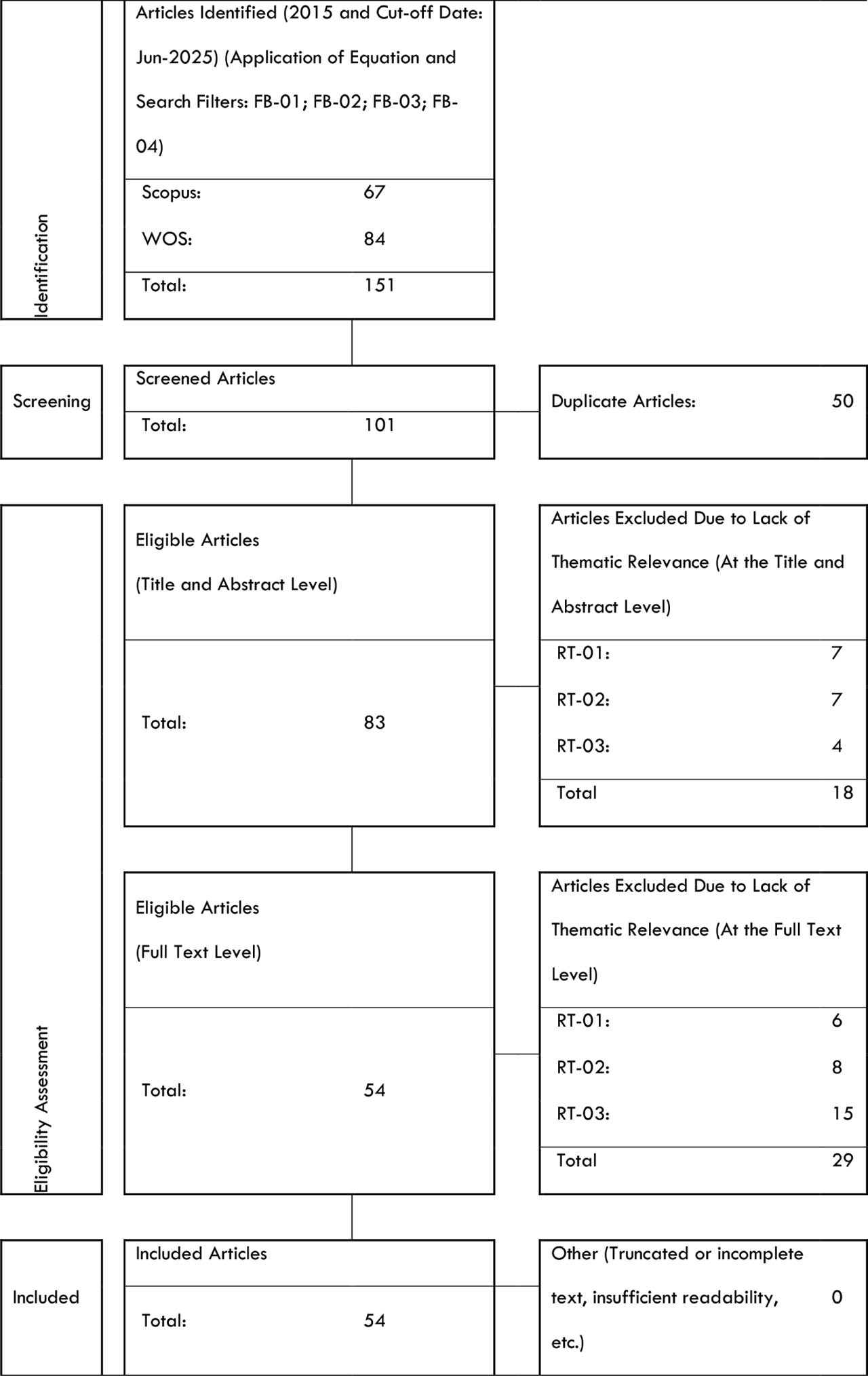
Fig. 1:
PRISMA process flow. PRISMA, Preferred Reporting Items for Systematic Reviews and Meta-Analyses.
In the Identification phase, after initiating the search query in the Scopus and Web of Science databases and applying the search filters (FB-01, FB-02, FB-03, and FB-04), 151 articles were identified. In the Screening phase, duplicate documents were discarded from these 151 articles, resulting in 50 articles found in both databases and a final total of 101 articles. Continuing with the Eligibility stage, articles were excluded according to inclusion and exclusion criteria at the Abstract and Title level (RT-01, RT-02, and RT-03) defined in Table 1, resulting in 83 excluded articles, while a subsequent full-text review led to the exclusion of 29 additional articles, bringing the final total to 54 articles. It should be noted that the inclusion and exclusion criteria were based on a general analysis of Lean Construction and BIM, considering articles related to the benefits, barriers, and trends of the last 10 years, which are related to the 54 articles mentioned in Figure 1 (PRISMA Process Flow). Finally, the analysis of the 54 articles was systematised and categorised according to the thematic relevance criteria (benefits, barriers and trends) defined as the main categories, from which several subcategories were established, as presented in Table 2.
Tab. 2:
Identified subcategories
| Category | Subcategory |
|---|---|
| Benefits | Productivity |
| Cost efficiency | |
| Interdisciplinary coordination | |
| Quality improvement | |
| Waste reduction | |
| Data-driven decision-making | |
| Barriers | Technological |
| Cultural | |
| Economic | |
| Training/skills | |
| Trend | Use of 4D and 5D models |
| Integration of Lean + BIM frameworks | |
| Digitisation of collaborative processes | |
| Automation and predictive analytics | |
| Standardisation and repeatability of processes | |
| Cultural and organisational transformation |
3. Results
Figure 2 shows that most publications are concentrated in the last 4 years, reaching their peak in 2023. In contrast, during 2019 and 2021, production remained stable, with an average of six publications per year. This clear upward trend in recent years reflects the growing academic and practical urgency to adopt digital transformation strategies, demonstrating that the convergence of Lean Construction and BIM has transitioned into a core area of research interest and industry focus over the past decade.
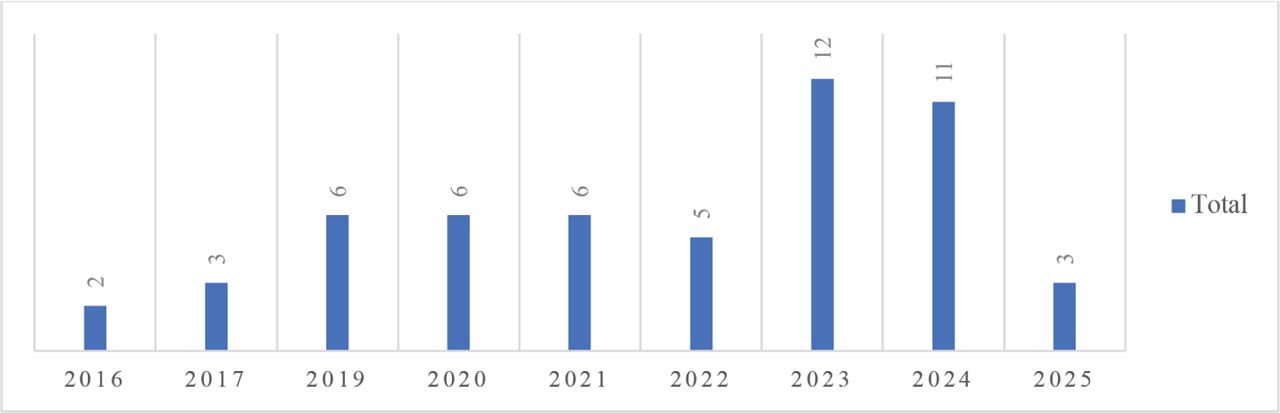
Fig. 2:
Publications per year.
While initial searches identified 151 records across both platforms with an overlap of 50 duplicates, the final sample of 54 articles reflects the combined contributions retrieved through Scopus and Web of Science. Presenting this breakdown is essential to demonstrate the relative coverage and complementarity of each database, justifying the methodological necessity of utilising both engines to ensure a comprehensive and rigorous literature retrieval.
Table 3 details the geographic distribution based on the country of the publisher or institutional source. While this illustrates where the academic output originates, we acknowledge that tracking the actual geographical locations of the empirical construction projects applying Lean and BIM represents a more insightful perspective for future mapping.
Figure 3 shows the number of articles grouped by source name, highlighting that the highest concentration of publications comes from journals, such as Buildings, Sustainability, and the Journal of Information Technology in Construction. Presenting this grouping is essential to identify the core academic outlets driving this research field, and mapping out the key editorial platforms where advancements in Lean Construction and BIM convergence are covered.
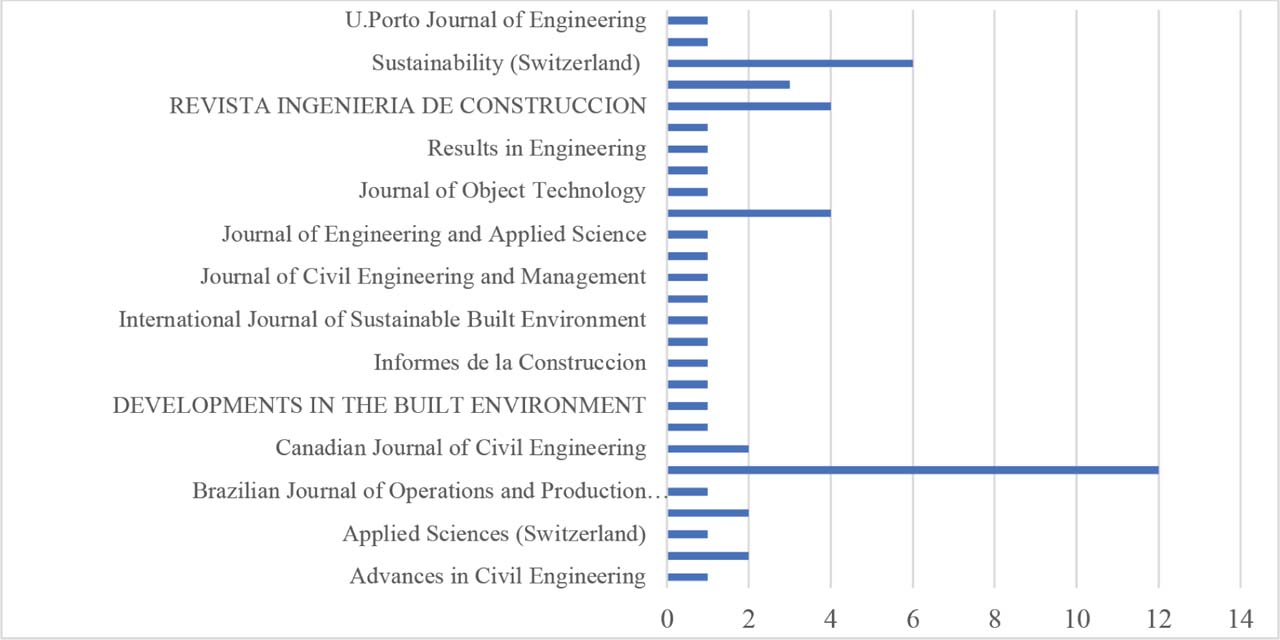
Fig. 3:
Number of articles grouped by source name.
Figure 4 shows the number of articles per publisher, with standardised publisher names to accurately reflect institutional and corporate contributions. Presenting this publisher distribution is essential because it reveals the structural market concentration of academic output in this field, highlighting which publishing models and editorial houses dominate the dissemination of research at the intersection of Lean Construction and BIM.
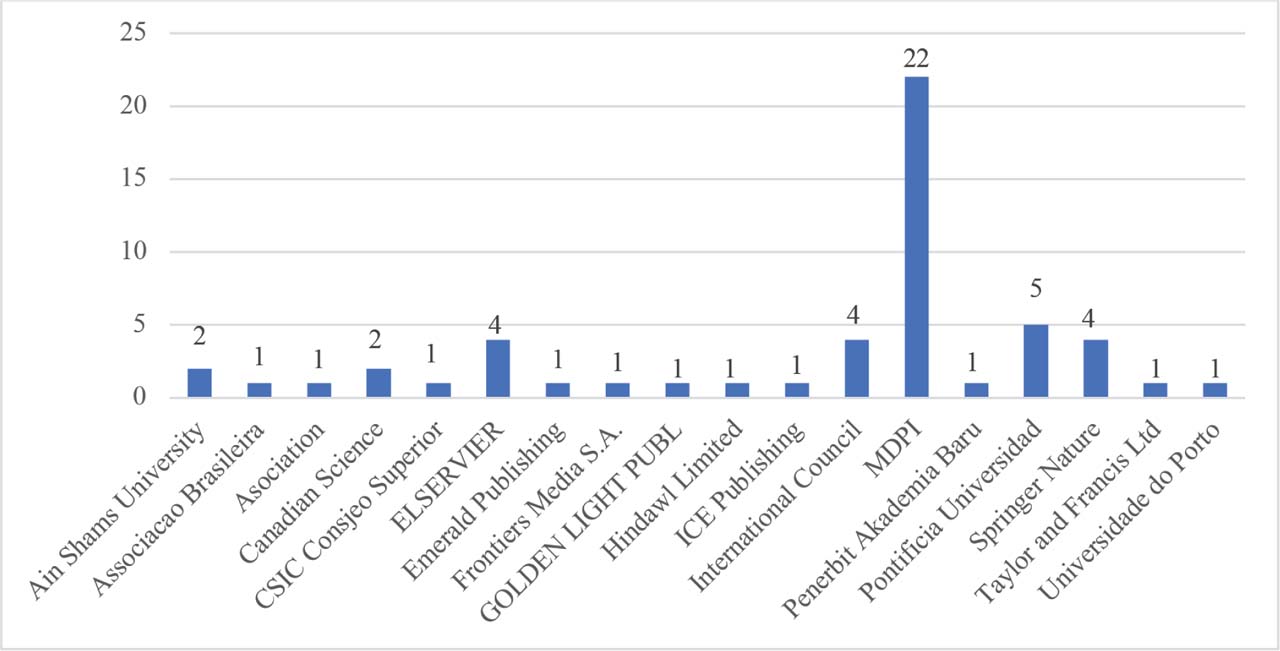
Fig. 4:
Number of articles per publisher.
Table 4 shows the number of articles published per country, highlighting Switzerland as the largest contributor with 23 articles, followed by the United Kingdom with 10 and the Netherlands with 6. Chile also has a significant presence with five publications. Other countries with relevant contributions are Canada (2) and the United States (2). The world map visualises this distribution using a colour scale that reflects the number of articles per country. The Americas and Europe are the regions with the greatest representation, while Asia and Southeast Asia have minimal contributions. Overall, the map highlights a concentration of academic output in certain regions, primarily Europe, followed by the Americas.
Tab. 4:
Number of articles per country of publication
| Continent | Subgroup | Country | Frequency | % of total |
|---|---|---|---|---|
| America | North America | Canada | 2 | 3.70 |
| North America | USA | 2 | 3.70 | |
| South America | Chili | 5 | 9.26 | |
| South America | Brazil | 1 | 1.85 | |
| Asia | Western Asia | Türkiye | 1 | 1.85 |
| Southeast Asia | Malaysia | 1 | 1.85 | |
| Europe | Southern Europe | Spain | 1 | 1.85 |
| Southern Europe | Portugal | 1 | 1.85 | |
| Western Europe | Swiss | 23 | 42.59 | |
| Western Europe | United Kingdom | 10 | 18.52 | |
| Western Europe | Netherlands | 6 | 11.11 | |
| Eastern Europe | Lithuania | 1 | 1.85 |
Table 5 presents the classification of the analysed scientific articles related to Lean Construction, BIM and their integration (Lean + BIM), organised into three main categories: benefits, barriers and trends. Each of these categories is subdivided into specific subcategories, indicating the number of corresponding articles and the percentage they represent of the total of 54 studies reviewed.
Tab. 5:
Number of journals according to category and subcategories
| Category | Subcategory | Lean construction | BIM | LEAN + BIM | |||
|---|---|---|---|---|---|---|---|
| N Articles | % Articles | N Articles | % Articles | N Articles | % Articles | ||
| Benefits | Productivity | 29 | 53.70 | 28 | 51.85 | 21 | 38.89 |
| Cost efficiency | 21 | 38.89 | 22 | 40.74 | 18 | 33.33 | |
| Interdisciplinary coordination | 17 | 31.48 | 24 | 44.44 | 21 | 38.89 | |
| Quality improvement | 23 | 42.59 | 24 | 44.44 | 22 | 40.74 | |
| Waste reduction | 23 | 42.59 | 24 | 44.44 | 21 | 38.89 | |
| Data-driven decision making | 20 | 37.04 | 22 | 40.74 | 20 | 37.04 | |
| Barriers | Technological | 19 | 35.19 | 19 | 35.19 | 17 | 31.48 |
| Cultural | 12 | 22.22 | 11 | 20.37 | 10 | 18.52 | |
| Economic | 7 | 12.96 | 6 | 11.11 | 6 | 11.11 | |
| Training/skills | 13 | 24.07 | 12 | 22.22 | 12 | 22.22 | |
| Trend | Use of 4D and 5D models | 12 | 22.22 | 13 | 24.07 | 13 | 24.07 |
| Integration of Lean + BIM frameworks | 20 | 37.04 | 18 | 33.33 | 20 | 37.04 | |
| Digitisation of collaborative processes | 18 | 33.33 | 19 | 35.19 | 19 | 35.19 | |
| Automation and predictive analytics | 11 | 20.37 | 15 | 27.78 | 12 | 22.22 | |
| Standardisation and repeatability of processes | 16 | 29.63 | 14 | 25.93 | 17 | 31.48 | |
| Cultural and organisational transformation | 20 | 37.04 | 21 | 38.89 | 21 | 38.89 | |
4. Discussion
4.1. Category: Benefits
The integration of Lean Construction and BIM brings key benefits to the construction sector, including increased cost efficiency, productivity, quality improvements and waste reduction. This synergy optimises planning, improves coordination between disciplines and enables more agile decision-making through the use of real-time data. Overall, it contributes to more efficient and collaborative projects with better execution and management outcomes.
Beyond isolated performance metrics, these findings indicate that the benefits of Lean + BIM are mutually reinforcing; operational transparency enabled by digital data directly feeds the continuous improvement cycles required by Lean thinking, transforming technical gains into overarching strategic advantages.
4.1.1. Subcategory: Productivity
The integration of Lean and BIM has become established as an effective strategy for improving productivity in construction projects. Several studies highlight that improved planning, activity coordination and reduced downtime contribute significantly to overall project performance (Aziz et al. 2024; Rashidian et al. 2024; Awe et al. 2025). According to Pérez et al. (2024), this synergy allows for more continuous workflows, while Mayouf et al. (2024) emphasise the importance of digital tools for anticipating clashes. For authors such as Faria et al. (2023) and Ismail et al. (2023), the use of 4D models and collaborative environments improves the understanding of schedules and strengthens the efficiency of on-site teams. Furthermore, Schery et al. (2023) and Zhao et al. (2023) agree that the early application of Lean + BIM increases operational capacity and reduces time losses associated with poor planning.
This concentration of evidence suggests that productivity gains are not an automatic byproduct of software adoption, but rather the result of synchronising digital workflows with pull-planning techniques that proactively eliminate bottlenecks before site execution begins.
4.1.2. Subcategory: Cost efficiency
Specialised literature recognises that Lean + BIM allows for more precise management of economic resources on construction sites. According to Rashidian et al. (2024) and Pishdad and Onungwa (2024), 5D modelling improves cost estimation and allows for continuous budget monitoring. Pérez et al. (2024) and Mayouf et al. (2024) maintain that this efficiency is reflected in the reduction of rework and errors, while Aziz et al. (2024) and Ismail et al. (2023) highlight the role of collaborative planning in reducing indirect costs. It is also observed that authors such as Faria et al. (2023) and Schery et al. (2023) link efficiency to the use of prefabricated components, which optimises logistics and shortens timelines. Zhao et al. (2023) and Awe et al. (2025) conclude that this integration not only improves financial control but also allows for greater predictability in the development of the project.
The literature demonstrates that 5D BIM and Lean cost controls shift financial management from a reactive posture (tracking post-construction overruns) to a proactive mechanism where cost predictability is achieved through rigorous pre-planning and supply chain optimisation.
4.1.3. Subcategory: Interdisciplinary coordination
Lean and BIM strengthen collaboration between specialities, promoting greater integration from the early stages of a project. Pérez et al. (2024) point out that collaborative models and common data environments allow for the detection of clashes before execution. Along these lines, Rashidian et al. (2024) and Faria et al. (2023) highlight that pull planning and visual management encourage the active participation of all stakeholders. For Schery et al. (2023) and Zhao et al. (2023), this coordination is key in complex projects, where information fragmentation can lead to serious failures. Furthermore, similar studies by Ismail et al. (2023) and Awe et al. (2025) show that interdisciplinary coordination facilitates joint decision-making, which helps reduce conflicts and improve the construction sequence.
This highlights that technical coordination tools (like clash detection) and social collaborative practices (like last planner sessions) must function concurrently; technology provides the platform for detection, while Lean principles provide the behavioural framework for joint problem-solving.
4.1.4. Subcategory: Quality improvement
Construction quality directly benefits from the combined implementation of Lean and BIM. Rashidian et al. (2024) indicate that traceability and continuous monitoring allow for the correction of errors before they impact the construction site. For Pérez et al. (2024) and Mayouf et al. (2024), digital models offer a more rigorous environment for technical verification, while Aziz et al. (2024) and Schery et al. (2023) highlight that visual management facilitates the detection of deviations from standards. Ismail et al. (2023) also emphasise the importance of continuous feedback for improving finishes, and Zhao et al. (2023) suggest that quality improves when prefabricated systems under factory control are incorporated. Overall, the studies agree that quality improvement is not only technical but also related to processes and customer satisfaction.
The reviewed studies collectively show that quality enhancement under Lean + BIM transcends defect correction, shifting towards a systemic verification process where factory-controlled prefabrication and digital models drastically reduce site variability.
4.1.5. Subcategory: Waste reduction
One of the most notable advantages of applying Lean + BIM is the reduction of waste in all its forms. According to Aziz et al. (2024) and Pérez et al. (2024), standardised processes and collaborative planning allow for the elimination of unnecessary activities. Rashidian et al. (2024) and Ismail et al. (2023) state that digital integration promotes more organised execution, while Faria et al. (2023) and Zhao et al. (2023) highlight that the use of 4D models reduces waiting times and improves the construction sequence. Schery et al. (2023) link this reduction to the logistics of materials and prefabricated components, and Awe et al. (2025) agree that operational efficiency translates into less rework and reduced resource use. This evidence suggests that Lean + BIM not only optimises the final result but also contributes to more sustainable construction.
By linking waste reduction directly to logistics and 4D sequencing, the literature underscores that environmental and operational sustainability are deeply intertwined; eliminating waiting times and material mishandling directly minimises the carbon and economic footprint of construction sites.
4.1.6. Subcategory: Data-driven decision making
Data-driven decision making is one of the pillars strengthened by the integration of Lean and BIM. According to Rashidian et al. (2024) and Pérez et al. (2024), digital environments allow access to real-time, up-to-date information, facilitating faster responses. Aziz et al. (2024) and Zhao et al. (2023) indicate that visual control systems and digital indicators improve the traceability of decisions. Ismail et al. (2023) and Awe et al. (2025) add that the use of analytical tools and predictive models allows for anticipating problems, reducing risks during execution. Meanwhile, Faria et al. (2023) and Schery et al. (2023) emphasise that data availability facilitates alignment between the different levels of project management, promoting more coherent and effective decisions.
The capability to process real-time information bridges the traditional gap between upper management planning and on-site execution, ensuring that strategic decisions are grounded in empirical operational indicators rather than intuition or outdated reports.
4.2. Category: Barriers
The implementation of Lean Construction, BIM and their integration faces several barriers that limit their adoption within the construction industry. Technological barriers are particularly relevant, as the lack of suitable digital tools, poor interoperability between platforms and the absence of technological infrastructure hinder the application of modern methodologies (Schery et al. 2023; Moradi and Sormunen 2024). Furthermore, increasing technical complexity, such as the use of 4D BIM or integration with artificial intelligence (AI), requires advanced capabilities that many organisations do not yet possess (Götz et al. 2020; Awe et al. 2025). First and foremost are technological barriers, related to the lack of suitable digital tools, interoperability issues between platforms, insufficient infrastructure and the technical complexity involved in using advanced systems. Added to this are significant cultural barriers, such as resistance to change, rigid organisational structures, lack of collaboration between teams, and a culture rooted in improvisation rather than planning and continuous improvement.
Critically, these barriers do not operate in isolation; rather, they form a self-reinforcing cycle where economic constraints limit technological acquisition, which in turn reinforces cultural resistance and highlights a severe skills shortage across organisations.
4.2.1. Subcategory: Technological barriers
Technological barriers significantly hinder the implementation of Lean, BIM and their integration due to a lack of adequate digital infrastructure, the technical complexity of the tools and poor interoperability between platforms. For example, the execution of Lean tools such as the Ultima planning system is limited in environments lacking digital resources (Moradi and Sormunen 2024), while inefficient practices such as ‘making-do’ persist in contexts without digital control such as Mandujano et al. (2016), Götz et al. (2020), and Demirdöğen et al. (2021). In the case of BIM, advanced and up-to-date tools are required, often with AI integration, which increases the technical requirements (Awe et al. 2025). Furthermore, interoperability issues are reported, especially in modular projects (Mayouf et al. 2024), and the lack of infrastructure in the public sector is a recurring barrier (Schery et al. 2023). Lean-BIM integration intensifies these challenges, as it demands integrated information flows and advanced computing capabilities (Götz et al. 2020; Demirdöğen et al. 2021; Alizadehsalehi and Hadavi 2023).
The evidence suggests that technology-induced friction stems less from the inherent limitations of software tools and more from a systemic mismatch between high-end digital requirements and the foundational digital maturity of traditional construction firms.
4.2.2. Subcategory: Cultural barriers
Cultural barriers represent a structural limitation that hinders the organisational transformation necessary to implement Lean, BIM or their integration. Many organisations maintain traditional hierarchical structures, resistance to change and a low willingness to engage in collaborative work (Alizadehsalehi and Hadavi 2023). The culture of improvisation, also called ‘making-do’, continues to be accepted in some environments, which slows down planning and standardisation, such as Mandujano et al. (2016), Sepasgozar et al. (2021), and Andújar-Montoya et al. (2020). In the case of BIM, a lack of trust in sharing digital models has been observed, motivated by fear of error or external judgement (Moradi and Sormunen 2024), and some companies adopt this technology superficially, without modifying internal processes (Andújar-Montoya et al. 2020). In Lean-BIM environments, fragmented organisational cultures hinder the alignment of objectives (Sepasgozar et al. 2021), while other studies highlight that successful cases are only achieved through a deep cultural transformation (Moradi and Sormunen 2022; Karaz et al. 2024).
Overcoming cultural inertia requires structural governance changes rather than superficial interventions, as traditional hierarchies and fear of transparency directly neutralise the collaborative ethos that both Lean and BIM demand.
4.2.3. Subcategory: Economic barriers
On the economic front, one of the main challenges is the perception that Lean and BIM involve high initial costs and that their benefits are not immediately apparent. In the case of Lean, although its process-oriented approach suggests low costs, its implementation requires investment in training and change management, which many organisations consider expensive (Garcés and Peña 2023). Similarly, in countries like New Zealand, it has been documented that Lean is perceived as an investment without immediate visible results (Likita et al. 2022). For its part, BIM faces criticism due to the high costs of software, hardware and training such as Eldeep et al. (2021) and Likita et al. (2022), which is especially restrictive in the public sector (Schery et al. 2023). Lean-BIM integration requires even greater investment, both in tools and in human resources and joint adoption processes (Faria et al. 2023; Pérez et al. 2024). Even in successful experiences, the learning curve and the total cost of implementation remain a concern (Hei et al. 2024).
The reluctance to invest highlights a persistent misalignment between short-term capital expenditures and long-term lifecycle savings, indicating that financial metrics must evolve to capture the qualitative and waste-reduction returns of Lean + BIM integration.
4.2.4. Subcategory: Training and skills barriers
The lack of specific training and skills constitutes a key cross-cutting barrier to the implementation of Lean, BIM and their integration. In the case of Lean, practical training in methodologies, such as the Last Planner System, 5S or VSM is required, which is not always available (Aziz et al. 2024). Several studies have indicated that the lack of adequate training has led to partial or erroneous implementations, such as Wu et al. (2022), Singh and Kumar (2020) and Nguyen and Akhavian (2019). BIM, for its part, requires technical mastery of the software, model interpretation and collaborative work skills – competencies that are often limited even when the technological tools are available (Eldeep et al. 2021; Schery et al. 2023). Furthermore, it has been identified that training designers alone is insufficient; all project stakeholders must be trained (Nguyen and Akhavian 2019). For Lean-BIM integration, the challenge is amplified, as it requires personnel with skills in both approaches, something uncommon in the current market (Sepasgozar et al. 2021). In this context, some authors propose specific educational programmes as a strategy to close this gap (Patching et al. 2023).
The skills gap acts as the ultimate bottleneck for integration; procuring advanced software or deploying continuous improvement philosophies remains ineffective without interdisciplinary professionals trained to bridge operational management with digital execution.
4.3. Category: Trends
The construction sector is undergoing a transformation driven by digitalisation and the adoption of collaborative methodologies geared towards continuous improvement. In this context, the combination of Lean Construction and BIM has generated new, more efficient and sustainable management approaches. This study examines five key trends identified in recent literature: 4D/5D models, Lean-BIM methodological frameworks, collaborative digitalisation, automation with predictive analytics and cultural transformation. These trends, supported by evidence from 54 studies, are redefining traditional practices and provide insight into the progress and challenges in adopting the Lean-BIM approach.
Critically, these trends demonstrate that technological innovation in construction cannot be viewed as a standalone upgrade; instead, emerging trends only yield sustainable performance enhancements when coupled with synchronised methodological frameworks and cultural alignment.
4.3.1. Subcategory: Use of 4D and 5D models
The adoption of 4D (time) and 5D (cost) models represents one of the main innovations in the digital transformation of the construction sector, with a clear convergence between Lean Construction and BIM (Mayouf et al. 2024; Pishdad and Onungwa 2024; Awe et al. 2025). The reviewed literature provides strong support for this trend, with documented applications encompassing planning, construction control and simulation (Rashidian et al. 2022; Alizadehsalehi and Hadavi 2023; Khodabocus and Seyis 2023; Mayouf et al. 2024). The 4D model has been shown to improve the sequencing and visualisation of activities (Sbiti et al. 2021; Alizadehsalehi and Hadavi 2023; Awe et al. 2025), while 5D has optimised cost estimation and control through its link with design (Zhao et al. 2023; Hei et al. 2024; Rashidian et al. 2024). Furthermore, experiences such as the delivery of prefabricated elements (Bataglin et al. 2019), the effect of Lean and BIM synergy (Nguyen and Akhavian 2019), and simulations with other tools (Jeong et al. 2016) have demonstrated a tangible improvement in coordination, workflow and project performance. However, challenges such as interoperability, low standardisation and lack of integration with project execution persist (Sbiti et al. 2021; Hei et al. 2024; Karaz et al. 2024; Rashidian et al. 2024).
The widespread adoption of 4D and 5D modelling signifies a paradigm shift from reactive schedule monitoring to proactive timeline and cost simulation, though their true potential is frequently bottlenecked by poor data interoperability and rigid legacy workflows.
4.3.2. Subcategory: Integration of lean + BIM frameworks
The literature shows a growing development of methodological frameworks that seek to articulate the principles of Lean Construction with the technological capabilities of BIM (Demirdöğen et al. 2021; Likita et al. 2022; Ismail et al. 2023; Khodabocus and Seyis 2023). This integration is seen as a path towards comprehensive efficiency in project management, by reducing waste, facilitating improved decision-making and collaboration. Articles addressing this trend include Rashidian et al. (2022, 2023, 2024), Sepasgozar et al. (2021), Tezel et al. (2020), Nascimento et al. (2017), Karaz et al. (2024) and Hei et al. (2024). For example, El Mounla et al. (2023) propose a Lean-BIM approach to improve performance in the design phase, and Alizadehsalehi and Hadavi (2023) analyse the synergies between Lean, BIM and Extended Reality. Similarly, Ahuja et al. (2017) apply qualitative analysis to demonstrate how integration contributes to lean and sustainable goals. Studies by Bataglin et al. (2019), Nguyen and Akhavian (2019), and Mitera-Kiełbasa and Zima (2025) document empirical benefits of prefabrication and collaborative design, and Karaz et al. (2024) dynamically models the effects of this synergy on poor practices. Despite these advances, articles by Moradi and Sormunen (2024) and Wu et al. (2022) warn of obstacles such as a lack of standardisation, insufficient training and cultural resistance within organisations.
The evolution of these frameworks highlights that combining philosophies requires more than theoretical alignment; it demands systematic procedural guidelines that bridge the operational pull-planning of Lean with the digital visualisation of BIM.
A critical comparison among these frameworks reveals a clear methodological division: while process-oriented models (such as those centred on Last Planner workflows and value stream mapping) prioritise behavioural alignment, pull-planning discipline, and waste reduction, technology-driven frameworks focus primarily on digital visualisation, automated clash detection, and common data environments. However, a significant gap remains in frameworks that achieve true bidirectionality (where real-time digital feedback from BIM models dynamically triggers and modifies Lean site-level tactical decisions rather than serving merely as a static visualisation medium).
4.3.3. Subcategory: Digitisation of collaborative processes
The digitisation of collaborative processes, understood as the synchronisation of information between actors through shared environments and integrated flows, has been widely addressed in the literature (Nascimento et al. 2017; Bataglin et al. 2019; Nguyen and Akhavian 2019; Ratajczak et al. 2019; Ardila and Francis 2020; Sbiti et al. 2021; Sepasgozar et al. 2021; Rashidian et al. 2022, 2024; Alizadehsalehi and Hadavi, 2023; Ismail et al. 2023; Patching et al. 2023; Schery et al. 2023; Hei et al. 2024; Herrera and Castañeda 2024; Pino Álvarez et al. 2024; Awe et al. 2025; Mitera-Kiełbasa and Zima 2025). Platforms such as collaborative BIM and common data environments have been shown to facilitate communication and information management in real time (Bataglin et al. 2019; Nguyen and Akhavian 2019; Sbiti et al. 2021; Alizadehsalehi and Hadavi 2023; Herrera and Castañeda 2024; Rashidian et al. 2024). However, gaps still persist related to the complete integration of the supply chain, the standardisation of tools, and digital training. Rashidian et al. (2022), Sepasgozar et al. (2021), Ardila and Francis (2020), Karaz et al. (2024), Mitera-Kiełbasa and Zima (2025), and Herrera and Castañeda (2024) highlight the need for digital governance that ensures interoperability and seamless coordination, while Ismail et al. (2023), Götz et al. (2020), and Patching et al. (2023) emphasise the value of collaborative systems from the design stage to implementation.
Common data environments serve merely as a technical medium; true collaborative digitisation depends on establishing robust digital governance and shared accountability structures across the entire supply chain.
4.3.4. Subcategory: Automation and predictive analytics
Automation and predictive analytics have emerged as strategic capabilities for optimising project planning and control. Thanks to BIM tools integrated with sensors, algorithms and automated workflows, it is possible to detect deviations, anticipate risks and generate solutions in real time. This trend is widely supported by research, such as that in the articles Awe et al. (2025), Pishdad and Onungwa (2024), Zhao et al. (2023), Schery et al. (2023), Alizadehsalehi and Hadavi (2023), Rashidian et al. (2022), Sbiti et al. (2021), Sepasgozar et al. (2021), Götz et al. (2020), Bataglin et al. (2019), Pino Álvarez et al. (2024), Herrera and Castañeda (2024), Karaz et al. (2024), and Pal et al. (2023), which present use cases in visual tracking, dynamic programming and instant feedback. Awe et al. (2025) highlight the incorporation of AI to improve 4D models, while Zhao et al. (2023), Sepasgozar et al. (2021), and Herrera et al. (2021) explore automated data capture and analysis systems for Lean management. Meanwhile, Karaz et al. (2024) demonstrate the potential of predictive simulation for evaluating practices such as ‘making-do’. Despite the demonstrated benefits, the articles Rashidian et al. (2022), Sbiti et al. (2021), and Pal et al. (2023) reveal limitations related to data quality and resistance to replacing manual controls with automated models, suggesting a gap between technological potential and practical adoption.
While AI and predictive algorithms offer unprecedented capabilities for real-time risk mitigation, a stark gap remains between technical forecasting potential and organisational readiness to trust automated insights over traditional manual controls.
4.3.5. Subcategory: Standardisation and repeatability of processes
Standardisation is a recurring theme in research on Lean and BIM as drivers of continuous improvement. In Lean, several studies (Nascimento et al. 2017; Bataglin et al. 2019; Tezel et al. 2020; Demirdöğen et al. 2021; Likita et al. 2022; Moradi and Sormunen 2022; Wu et al. 2022; El Mounla et al. 2023; Ismail et al. 2023; Khodabocus and Seyis 2023; Hei et al. 2024; Rashidian et al. 2024; Mitera-Kiełbasa and Zima 2025, among others) highlight that standardising workflows reduces variability, eliminates waste and facilitates tools such as the Last Planner System or Value Stream Mapping. In industrialised environments, these repetitive systems improve predictability and logistical efficiency (Bataglin et al. 2019).
In BIM, the standardisation of data structures (specifically leveraging open standards like openBIM [IFC]) and the comprehensive definition of the level of development (LOD), integrating both geometry and non-graphical information, minimise errors and improve traceability (Jeong et al. 2016).
In the Lean-BIM convergence, the literature emphasises benefits such as repetitive processes geared towards continuous improvement, early validation and replicability across projects (Mellado and Lou 2020; Moradi and Sormunen 2022). These approaches strengthen sustainability, integration maturity and sector performance through stable and predictable practices. Overall, the studies agree that standardisation drives knowledge management, training and the scalability of best practices, although challenges such as cultural resistance and adaptation to local contexts remain.
Standardisation acts as the essential backbone for scaling Lean-BIM integrations; without structured data libraries and uniform workflows, organisations risk repeating localised successes without achieving enterprise-wide scalability.
4.3.6. Subcategory: Cultural and organisational transformation
The effective implementation of Lean and BIM requires a profound transformation not only technological, but also cultural and organisational. Various studies, Rashidian et al. (2024), Faria et al. (2023), Schery et al. (2023), El Mounla et al. (2023), Alizadehsalehi and Hadavi (2023), Moradi and Sormunen (2024), Likita et al. (2022), Wu et al. (2022), Sepasgozar et al. (2021), Mellado and Lou (2020), Andújar-Montoya et al. (2020), Tezel et al. (2020), Bataglin et al. (2019), Nguyen and Akhavian (2019), Darabseh (2019), Nascimento et al. (2017), Jeong et al. (2016), Mandujano et al. (2016), Herrera and Castañeda (2024), Karaz et al. (2024), Hei et al. (2024), Moradi and Sormunen (2022), and Demirdöğen et al. (2021) demonstrate that sustainable change depends on adaptive structures, leadership commitment and continuous training. Alizadehsalehi and Hadavi (2023) highlight the importance of fostering a collaborative mindset to fully leverage Lean-BIM synergies, while Moradi and Sormunen (2024) identify cultural barriers as one of the main obstacles. Likita et al. (2022), Wu et al. (2022), and Sepasgozar et al. (2021) highlight the need to train all hierarchical levels and create organisational frameworks that promote learning. Demirdöğen et al. (2021) propose a maturity model that includes organisational culture as a key axis of digital integration. Despite these advances, resistance to change, contractual fragmentation and a lack of adequate incentives remain challenges for comprehensive transformation, as discussed by Bataglin et al. (2019) and Herrera and Castañeda (2024).
Ultimately, the success of any technological or methodological trend is bounded by organisational culture; unless leadership actively dismantles contractual fragmentation and risk-averse behaviours, advanced digital tools will only automate existing inefficiencies rather than eliminate them.
5. Conclusions
The integrated combination of Lean Construction and BIM has proven to be an effective strategy for improving performance in construction projects by facilitating more precise planning, streamlined execution and seamless coordination among stakeholders. This approach reduces unproductive time, allows for the early identification of interdisciplinary conflicts, and promotes a continuous workflow, which in turn drives team synchronisation and contributes to more sustainable on-site results. From a technical and economic perspective, the use of tools such as 5D modelling and prefabrication offers more rigorous cost control and minimises losses associated with errors or rework, while also enhancing construction quality by enabling reviews and adjustments before physical execution. Furthermore, collaboration is strengthened by shared digital environments that facilitate informed decision-making from the early design phases through to construction. A key element is the ability to manage real-time data and employ predictive analytics and reliable indicators, which transforms how projects are managed. All of this, together with waste reduction and resource optimisation, fosters an organisational culture focused on efficiency and continuous improvement, consolidating Lean + BIM as a profound change in the way of planning, building and managing.
The analysis reveals that the barriers to implementing Lean, BIM and their Lean + BIM integration are multidimensional and interrelated, intensifying when both approaches are applied together. Technological limitations are significant in contexts with limited digital infrastructure, poor interoperability or a lack of real-time information flows, hindering the use of tools such as the Last Planner System or 4D models with AI. In the cultural sphere, resistance to change, rigid hierarchies and improvisational practices reduce the effectiveness of the methodologies, which require collaboration, trust and continuous improvement to generate real value. Added to this are economic barriers, as the initial investment in software, hardware, training and process restructuring is considerable, discouraging organisations with tight budgets or short-term visions. The lack of appropriate skills is a cross-cutting limitation: Lean demands training in tools such as VSM or 5S, BIM requires mastery of platforms and collaborative work, and Lean + BIM demands professionals with combined skills and change management abilities. Even with the technology in place, deployment is incomplete without qualified personnel. Finally, factors such as company size and industry influence the magnitude of the barriers, which are more critical in public or small organisations due to their budget constraints and less organisational flexibility.
The trends identified in Lean-BIM integration show a sustained advance towards more efficient, coordinated and controlled processes, driven by the use of 4D and 5D models, which optimise planning and cost control, and by methodological frameworks that align operational philosophy and digital tools. The digitisation of collaborative processes and the incorporation of automation with predictive analytics allow for real-time information management, anticipation of deviations and enhanced project performance. Technologies such as common data environments and AI strengthen communication among stakeholders and the early detection of risks, although challenges persist related to data quality and standardisation, insufficient training, and resistance to abandoning manual methods. Process standardisation and cultural transformation are consolidating as fundamental pillars to ensure the repeatability and scalability of efficient practices. Achieving full adoption requires leadership commitment, cross-functional training and adaptation to new ways of working that overcome cultural and contractual barriers. Taken together, the six observed trends point to a path towards a more integrated industry, where technological innovation and organisational evolution advance in parallel to consolidate an effective implementation of Lean + BIM.
The review reveals that, although the benefits of Lean and BIM and their integration are widely documented, gaps remain. Most studies focus on developed countries, while evidence in emerging economies is very limited, especially regarding local conditions for technological and cultural adoption. Moreover, the heavy concentration of research originating from developed regions creates a pronounced geographic imbalance, weakening the generalisability of conclusions for developing nations where infrastructure, economic frameworks and technological maturity differ substantially. Furthermore, there is a gap in research that quantitatively addresses the combined impact of Lean + BIM on productivity, cost or sustainability metrics, as much of the literature is qualitative or based on case studies. There is also little standardisation in the methodological frameworks for measuring the maturity of Lean-BIM integration, which hinders comparisons between projects and sectors. In addition, the main limitations of this review are related to the scope and heterogeneity of the sources. Many studies lack robust empirical evidence and are limited to case studies, which restricts the generalisability of the findings. Furthermore, a substantial portion of the cited literature consists of qualitative case reports that lack robust quantitative metrics, limiting the precise measurement of Lean-BIM’s long-term economic and environmental impacts. There is also conceptual fragmentation, as Lean and BIM are often addressed separately and not always from an integrated perspective. On the other hand, rapid technological evolution (AI, automation and advanced digital environments) creates a gap between the available literature and current applications in the industry, which can leave out emerging trends such as those mentioned. Additionally, restricting the literature pool exclusively to peer-reviewed, open-access journal papers in English and Spanish omits conference proceedings and academic theses, which may contain valuable, ground-level industrial insights and localised practical applications. While this boundary was established to ensure high methodological rigor and quality control, future studies should broaden the scope to include grey literature and conference repositories.
From a theoretical standpoint, the results reinforce the need to move towards a conceptual framework that coherently articulates Lean and BIM as complementary, rather than isolated, approaches. This implies rethinking project management models by incorporating both continuous improvement principles and digital tools within a systemic framework.
From a practical standpoint, the findings suggest that adopting Lean + BIM can generate substantial benefits in productivity, costs, quality and sustainability, but only if accompanied by cultural and organisational changes. For construction professionals, this means that technological investment must go hand in hand with training programmes, change management strategies and the creation of collaborative environments that foster interdisciplinary coordination.
Finally, it is recommended that future research could focus on developing standardised metrics to assess the maturity level and quantitative impact of Lean + BIM in real-world projects, exploring comparative studies in different geographical contexts and project types, especially in developing countries, analysing the role of emerging technologies (AI, automation) in Lean-BIM integration, and delving deeper into longitudinal research that allows observation of the effects of integration over time, not necessarily the immediate results of a project.
Furthermore, future research should prioritise investigating the specific geographic locations of the actual construction projects implementing Lean and BIM (rather than solely focusing on publisher origins) to better understand regional adoption barriers and local industry contexts.