
Tab. 1:
Inclusion and exclusion criteria for studies in the literature review.
| Type | Criterion | Code | Inclusion | Exclusion |
|---|---|---|---|---|
| Search filters | Year of publication | F-01 | Documents published between 2015 and June 2025. | Documents published before 2015 or after June 2025. |
| Document type | F-02 | Articles and/or reviews. | Conference proceedings, reviews, editorials, theses, book chapters. | |
| Access to the document | F-03 | Documents available in full text (open access). | Documents without access to the full text. | |
| Language | F-04 | Documents in English and Spanish. | Articles in other languages. | |
| Eligibility | General subject area | R-01 | Studies addressing barriers to the implementation of sustainable construction. | Studies not related to the topic of interest. |
| Specific thematic area | R-02 | Studies focused exclusively on developing countries. | Studies related to developed countries. | |
| Access to the document | R-03 | Studies related to the topic, but with access to the full text. | Studies related to the topic, but without access to the full text. |
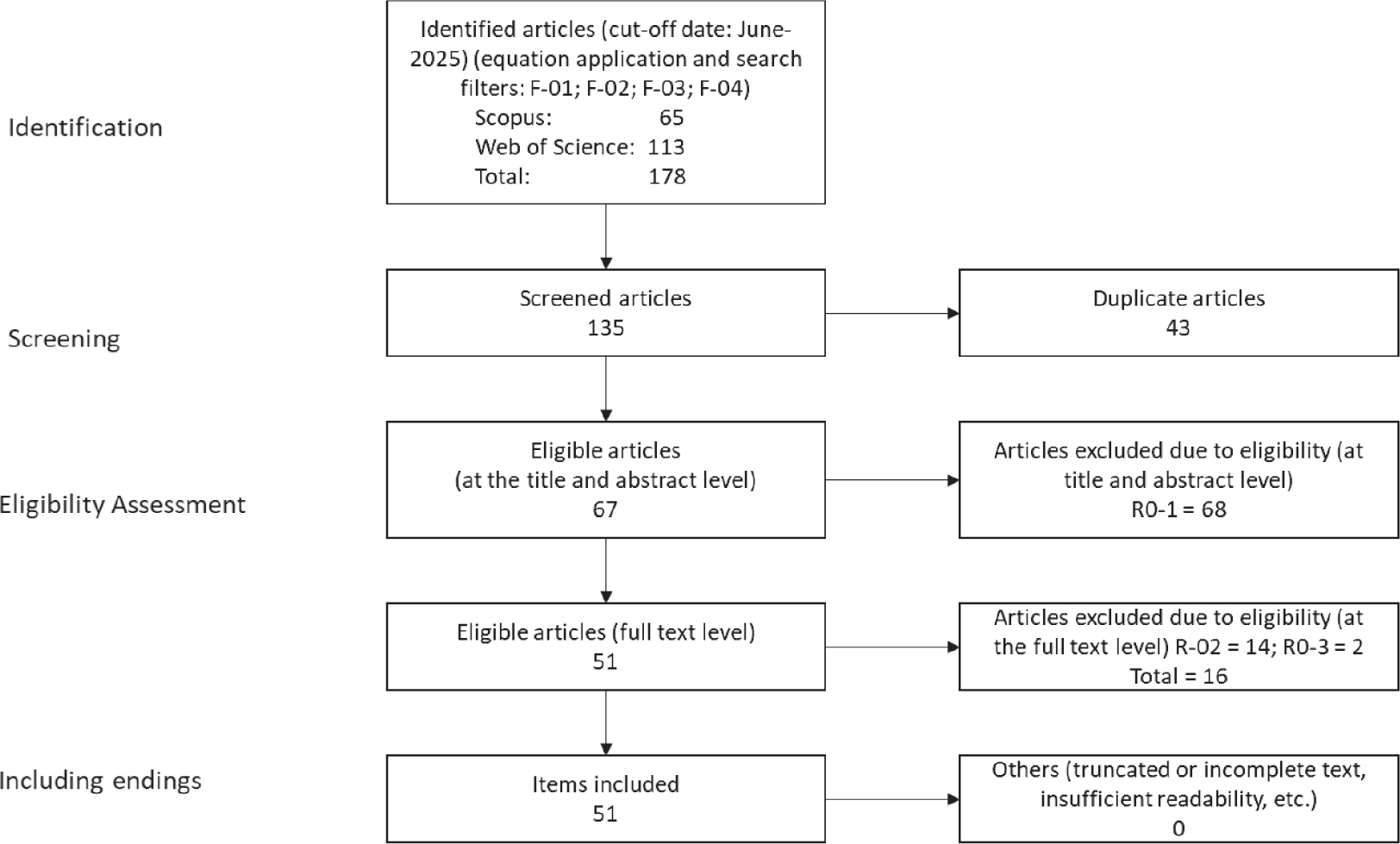
Fig. 1:
PRISMA diagram.
Tab. 2:
Definition of categories and subcategories of barriers to construction.
| Category | Definition | Subcategory (barrier type) | Definition |
|---|---|---|---|
| 1. Economic and financial barriers | Limitations associated with costs, financing mechanisms and economic conditions that restrict the adoption of sustainable construction practices in developing countries | High initial costs | Perception or reality of higher initial investments required for sustainable design, materials, technologies and certifications compared with conventional construction. |
| Limited access to financing | Difficulties in accessing credit, loans or suitable financial instruments for sustainable construction projects, especially in underdeveloped financial markets. | ||
| Lack of economic incentives | Absence or insufficiency of subsidies, tax benefits, tax incentives or other economic mechanisms that promote investment in sustainable construction. | ||
| 2. Knowledge and awareness barriers | Obstacles related to the level of information, training, experience and awareness of the actors involved regarding the benefits and requirements of sustainable construction | Public awareness | Low level of knowledge and awareness among users, clients and society in general regarding the environmental, economic and social benefits of sustainable construction. |
| Lack of experience | Insufficient technical training and practical experience of professionals, designers and builders in the implementation of sustainable solutions and technologies. | ||
| 3. Regulatory and political barriers | Limitations arising from regulatory frameworks, public policies and institutional mechanisms that do not favour or hinder the adoption of sustainable construction | Inadequate regulations | Outdated, ambiguous, or non-existent regulations that do not incorporate sustainability criteria or establish clear standards for their implementation. |
| Lack of government support | Limited institutional support through public policies, promotion programmes, financing or strategic guidelines aimed at sustainable construction. | ||
| 4. Industry-related barriers | Difficulties specific to the construction sector related to traditional practices, operational capabilities and market structure. | Resistance to change | Reluctance of companies, professionals and stakeholders in the sector to modify conventional construction practices and incorporate sustainable approaches. |
| Certified supply chain issues | Limited availability, access or reliability of materials, technologies and suppliers certified as sustainable. | ||
| Lack of compliance and supervision | Weak control, oversight and monitoring of compliance with regulations, standards and best practices associated with sustainable construction | ||
| 5. Cultural and social barriers | Sociocultural factors that influence the perception, acceptance and adoption of sustainable construction practices | Cultural norms | Deeply ingrained beliefs, habits and values that favour traditional construction methods and limit the acceptance of sustainable solutions. |
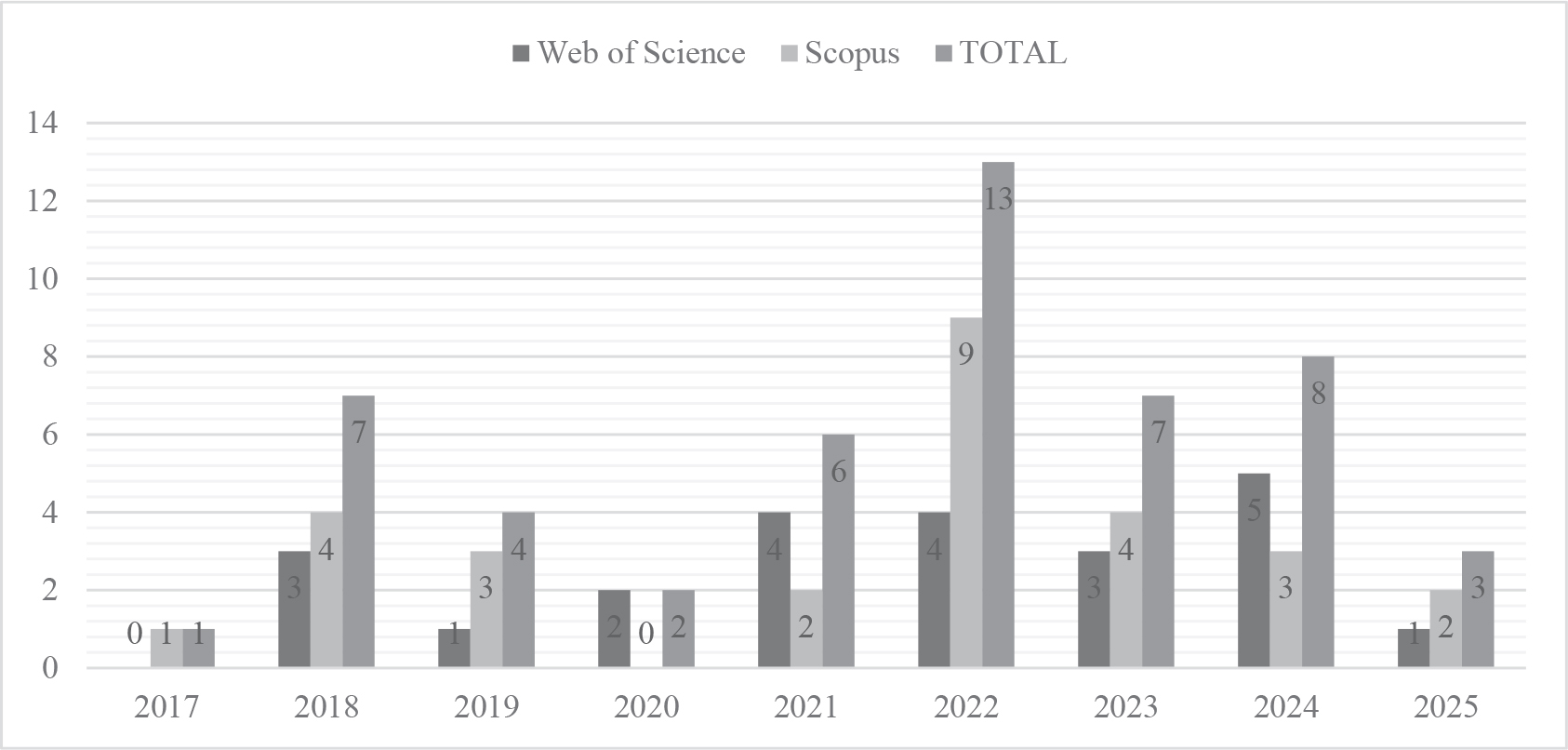
Fig. 2:
Evolution of article publication per year.
Tab. 3:
Number of publications by continent and by country.
| Continent | Country | Total continent | (%) Continent | Total country | (%) Country | Scopus | Web of Science |
|---|---|---|---|---|---|---|---|
| Africa | Ghana | 17 | 33.3 | 6 | 11.76 | 4 | 2 |
| Libya | 1 | 1.96 | 1 | ||||
| Nigeria | 4 | 7.84 | 1 | 3 | |||
| South Africa | 2 | 3.92 | 1 | 1 | |||
| Tanzania | 1 | 1.96 | 1 | ||||
| Zambia | 1 | 1.96 | 1 | ||||
| Morocco | 1 | 1.96 | 1 | ||||
| Ghana and Egypt | 1 | 1.96 | 1 | ||||
| Asia | Cambodia | 25 | 49.0 | 1 | 1.96 | 1 | |
| Indonesia | 3 | 5.88 | 1 | 2 | |||
| Iran | 1 | 1.96 | 1 | ||||
| Iraq | 1 | 1.96 | 1 | ||||
| Jordan | 2 | 3.92 | 2 | ||||
| Malaysia | 1 | 1.96 | 1 | ||||
| Singapore | 1 | 1.96 | 1 | ||||
| Thailand | 2 | 3.92 | 2 | ||||
| Turkey | 2 | 3.92 | 2 | ||||
| Vietnam | 4 | 7.84 | 2 | 2 | |||
| Saudi Arabia | 2 | 3.92 | 2 | ||||
| China | 3 | 5.88 | 3 | ||||
| Iraq | 1 | 1.96 | 1 | ||||
| Kazakhstan | 1 | 1.96 | 1 | ||||
| America–Asia | US–India–Afghanistan | 1 | 2.0 | 1 | 1.96 | 1 | |
| N/E | N/E | 8 | 15.7 | 8 | 15.69 | 5 | 3 |
Tab. 4:
Distribution of the research focus in the selected articles.
| Approach | Total articles | Scopus | Web of Science | |||
|---|---|---|---|---|---|---|
| N° | % | N° | % | N° | % | |
| Qualitative | 10 | 19.61 | 7 | 25.00 | 3 | 13.04 |
| Quantitative | 29 | 56.86 | 13 | 46.43 | 16 | 69.57 |
| Mixed | 9 | 17.65 | 5 | 17.86 | 4 | 17.39 |
| Bibliographic review | 2 | 3.92 | 2 | 7.14 | 0 | 0.00 |
| Systematic review | 1 | 1.96 | 1 | 3.57 | 0 | 0.00 |
Tab. 5:
Barriers to sustainable construction identified in an aggregate manner in the selected articles.
| Category | Subcategory (barrier type) | Number of articles | (%) Articles analysed |
|---|---|---|---|
| 1. Economic and financial barriers | High initial costs | 34 | 66.67 |
| Limited access to financing | 6 | 11.76 | |
| Lack of economic incentives | 30 | 58.82 | |
| 2. Knowledge and awareness barriers | Public awareness | 26 | 50.98 |
| Lack of experience | 28 | 54.90 | |
| 3. Regulatory and political barriers | Inadequate regulations | 4 | 7.84 |
| Lack of government support | 32 | 62.75 | |
| 4. Industry-related barriers | Resistance to change | 15 | 29.41 |
| Certified supply chain issues | 23 | 45.10 | |
| Lack of compliance and supervision | 2 | 3.92 | |
| 5. Cultural and social barriers | Cultural norms | 18 | 35.29 |
Tab. 6:
Interrelationship between the identified barriers to sustainable construction.
| Category | Subcategory (barrier type) | Interrelated subcategory | Category |
|---|---|---|---|
| 1. Economic and financial barriers | High initial costs | Lack of experience | 2. Knowledge and awareness barriers |
| Certified supply chain issues | 4. Industry-related barriers | ||
| Limited access to financing | Resistance to change | 4. Industry-related barriers | |
| Lack of economic incentives | Lack of government support | 3. Regulatory and political barriers | |
| 2. Knowledge and awareness barriers | Public awareness | Inadequate regulations | 3. Regulatory and political barriers |
| Lack of experience | Lack of government support | 3. Regulatory and political barriers | |
| 3. Regulatory and political barriers | Inadequate regulations | Public awareness | 2. Knowledge and awareness barriers s |
| Lack of government support | Public awareness | 2. Knowledge and awareness barriers | |
| 4. Industry-related barriers | Resistance to change | Public awareness | 2. Knowledge and awareness barriers |
| Lack of experience | 2. Knowledge and awareness barriers | ||
| Inadequate regulations | 3. Regulatory and political barriers | ||
| Cultural norms | 5. Cultural and social barriers | ||
| Certified supply chain issues | Inadequate regulations | 3. Regulatory and political barriers | |
| Lack of compliance and supervision | Public awareness | 2. Knowledge and awareness barriers | |
| Lack of experience | 2. Knowledge and awareness barriers | ||
| 5. Cultural and social barriers | Cultural norms | High initial costs | 1. Economic and financial barriers |
| Public awareness | 2. Knowledge and awareness barriers | ||
| Inadequate regulations | 3. Regulatory and political barriers |