
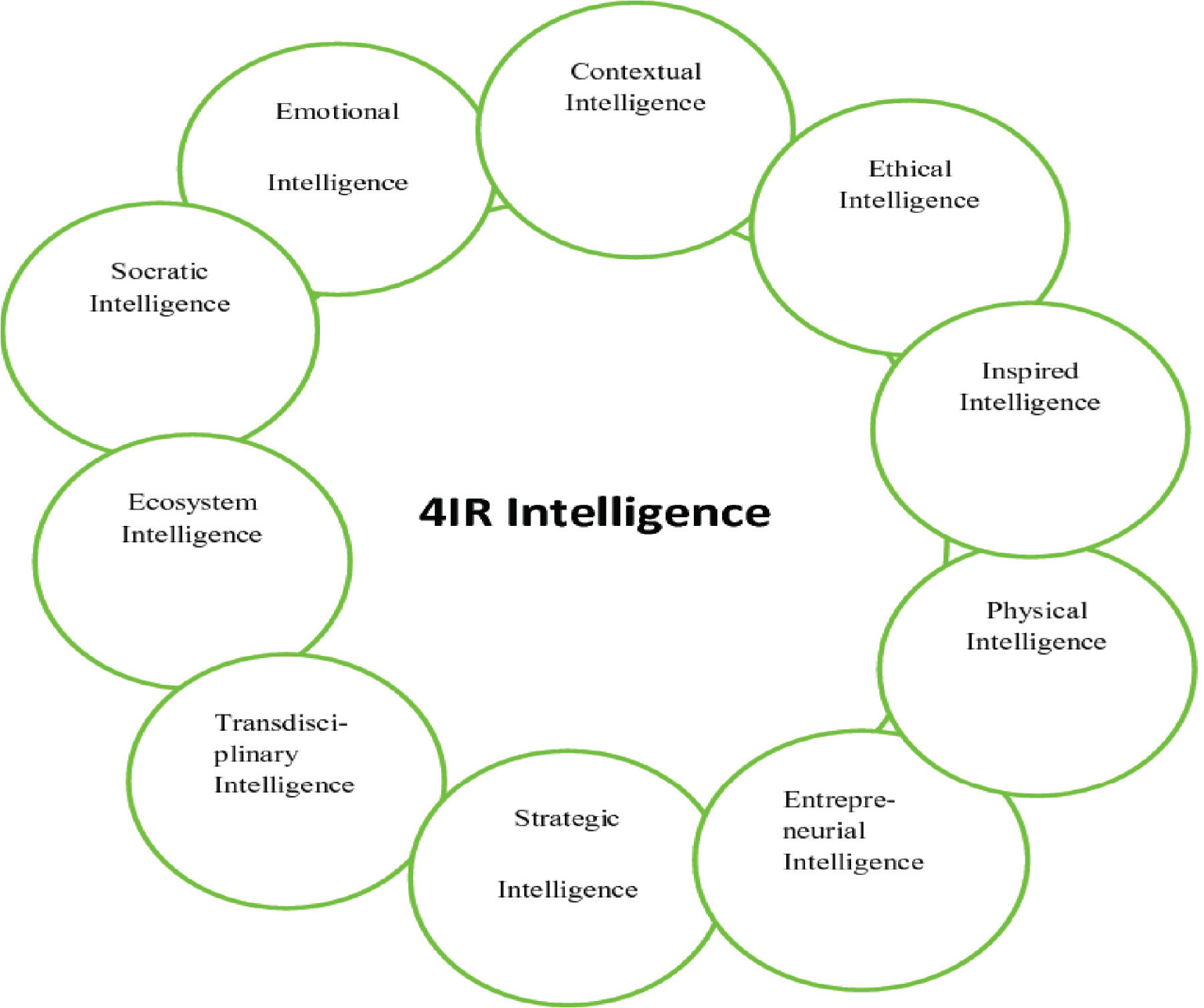
Fig. 1:
4IR Leadership intelligence features. Source: Alade and Windapo (2020). 4IR, Fourth Industrial Revolution.
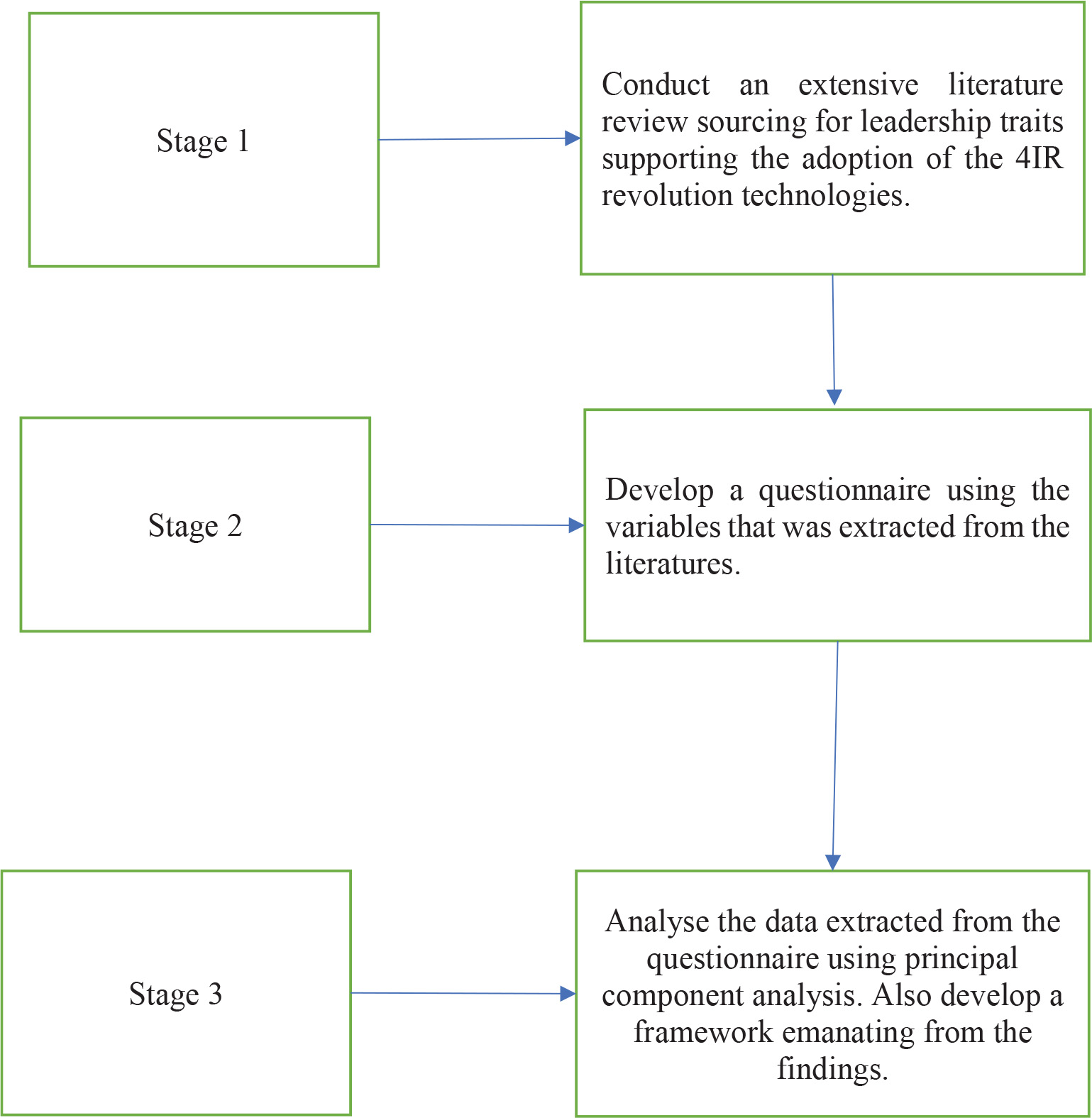
Fig. 2:
Research methodology framework. 4IR, Fourth Industrial Revolution.
Tab. 1:
Background information results.
| Background information | Percentage (%) | Ranking (R) | |
|---|---|---|---|
| Professional background | Construction managers | 46 | 2nd |
| Project managers | 54 | 1st | |
| Profession registration | Professional construction project manager | 10.8 | 4th |
| PMSA professional project manager | 1.8 | 7th | |
| Professional construction manager | 9.9 | 5th | |
| Senior project manager | 1.8 | 7th | |
| PMSA project manager | 7.2 | 6th | |
| Candidate construction project manager | 16.3 | 2nd | |
| Candidate construction manager | 15.3 | 3rd | |
| Not registered | 36.9 | 1st | |
| Educational qualification | Grade 12 (Matric, Std 10) | 2.8 | 4th |
| Post-matric diploma or certificate | 41.1 | 1st | |
| Baccalaureate degree(s) | 38.3 | 2nd | |
| Master’s degree | 15.9 | 3rd | |
| Doctorate degrees | 1.9 | 5th |
Tab. 2:
KMO and Bartlett’s test.
| KMO measure of sampling adequacy | 0.779 | |
| Bartlett’s test of sphericity | Approx. Chi-square | 1,098.557 |
| df | 351 | |
| Sig. | 0.000 |
Tab. 3:
Components eigenvalues.
| Component | Total | Variance | Cumulative variance |
|---|---|---|---|
| 1 | 5.288 | 19.584 | 19.584 |
| 2 | 3.356 | 12.431 | 32.015 |
| 3 | 2.496 | 9.244 | 41.258 |
| 4 | 1.6981 | 6.261 | 47.520 |
Tab. 4:
Rotated component matrix
| Rotated component matrixa | ||||
|---|---|---|---|---|
| Leadership styles component | ||||
| 1 Transformational leadership | 2 Charismatic leadership | 3 Transactional leadership | 4 Autocratic leadership | |
| Keep the communication open at all times | 0.721 | |||
| Sometimes ask for ideas from subordinates | 0.697 | |||
| Monitor all projects that am in charge of to ensure the team meets its goal | 0.696 | |||
| Encourage creativity and new ideas | 0.645 | |||
| Leader gathers feedback from the subordinates before deciding | 0.583 | . | ||
| Help others with their self-development | 0.472 | |||
| Workforce should work on their understanding of the work given | 0.450 | |||
| Involve employees in project decision-making | 0.408 | |||
| A significant part of leadership involves teaching | 0.727 | |||
| Leadership preference is to think long-range: what it might be | 0.663 | |||
| Leaders must represent a higher morality | 0.630 | |||
| Manage others by setting standards that are agreed upon | 0.614 | |||
| Provide necessary resources to employees and let employees work | 0.561 | |||
| Facilitate events for the workforce | 0.535 | |||
| Emphasise discipline when subordinates do something wrong | 0.463 | |||
| The leader initiates methods and processes | 0.763 | |||
| Persuade others to do things as commanded | 0.730 | |||
| Allow flexibility to the employees | 0.728 | |||
| Allow employees to make decisions and have complete freedom | 0.575 | |||
| Prompt personnel through rewards and payments | 0.455 | |||
| Employees do their jobs when the project has been awarded | 0.444 | |||
| Spend considerable energy in arousing expectations among workers | 0.724 | |||
| Employees should obey instructions and commands | 0.666 | |||
| Extraction method: PCA. | ||||
| Rotation method: Varimax with Kaiser normalisation | ||||
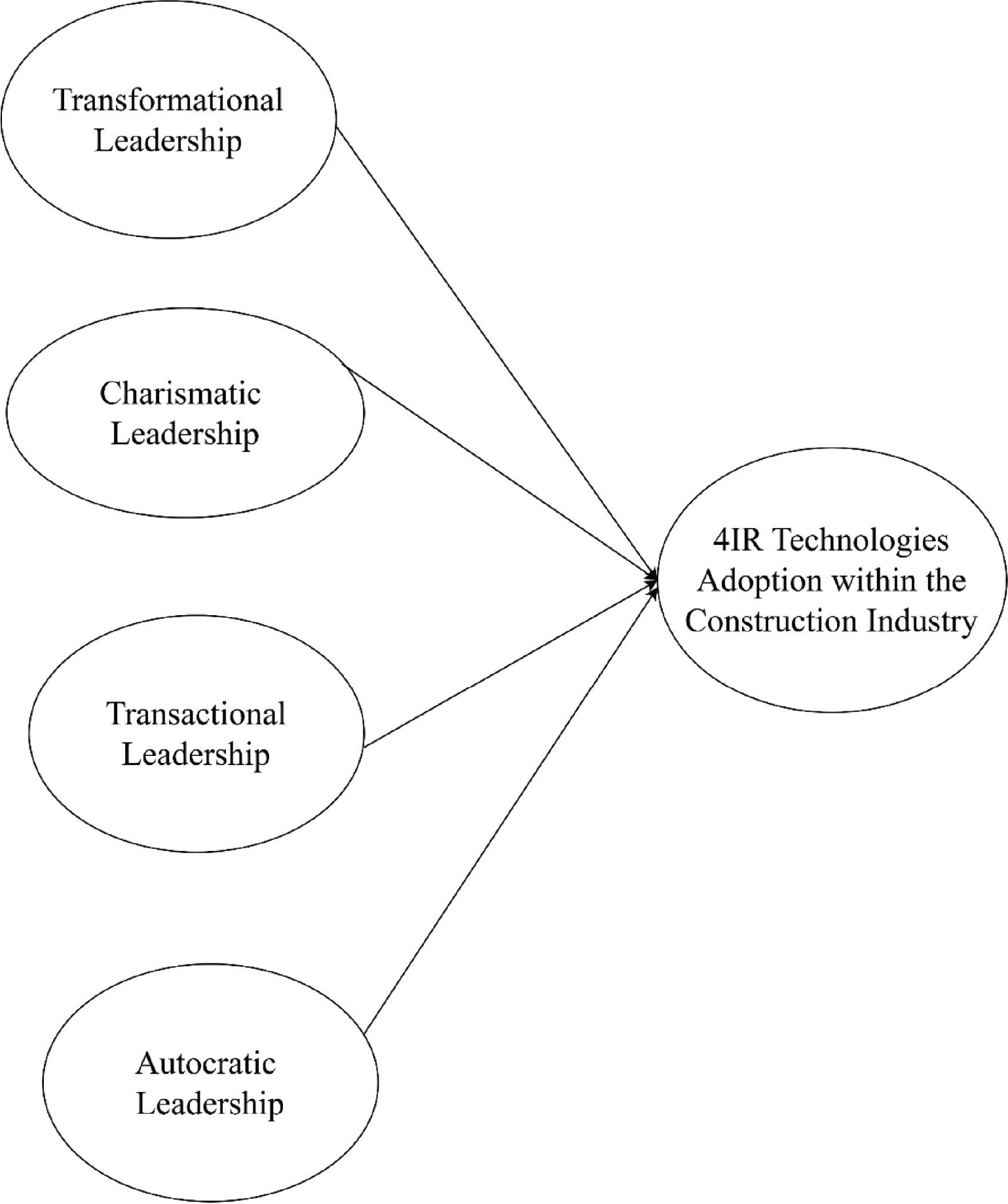
Fig. 3:
Leadership style framework supporting the adoption of 4IR technologies. 4IR, Fourth Industrial Revolution.
Tab. 5:
Leadership framework comparison table.
| Previous framework study | Focus area | Leadership dimensions | Scope | Technology integration | Limitations | Current framework novelty |
|---|---|---|---|---|---|---|
| Rehan et al. (2024) | Communication-centric leadership | Communication strategies and channels | Construction project teams | Limited focus on digital tools | Reductionist view; focuses only on communication aspects | Integrates multiple leadership styles beyond communication |
| Guha et al. (2025) | Leadership qualities | Individual leadership traits and competencies | Construction managers | Minimal emphasis on 4IR technologies | Focuses on personal qualities rather than contextual application | Context-specific framework for 4IR adoption across all construction sectors |
| Gledson et al. (2024) | Digital leadership | Digital competencies and skills | Digital transformation initiatives | Focuses on digital aspects only | Limited to digital leadership without broader leadership styles | Comprehensive multi-dimensional approach combining traditional and digital leadership |
| Current framework (Figure 3) | Holistic 4IR technology adoption | Four dimensions: transformational, charismatic, transactional, and autocratic leadership | All construction industry sectors | Specifically designed for 4IR technology adoption | None identified; comprehensive approach | • Integrates four distinct leadership styles • Holistic view applicable to entire construction industry • Specifically addresses 4IR technology adoption barriers • Balances inspirational and operational leadership needs • Sector-agnostic application |