
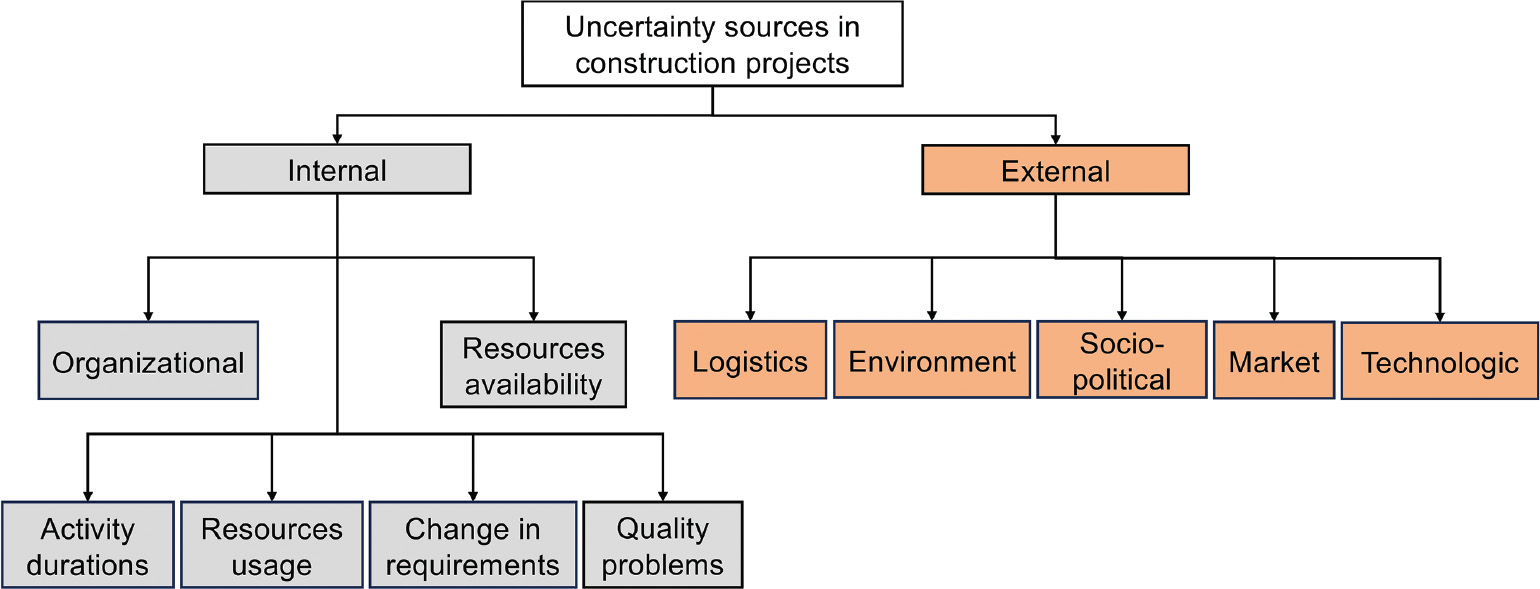
Fig. 1:
Classification of uncertainty sources in construction projects.
Source: (Hazr and Ulusoy 2020).
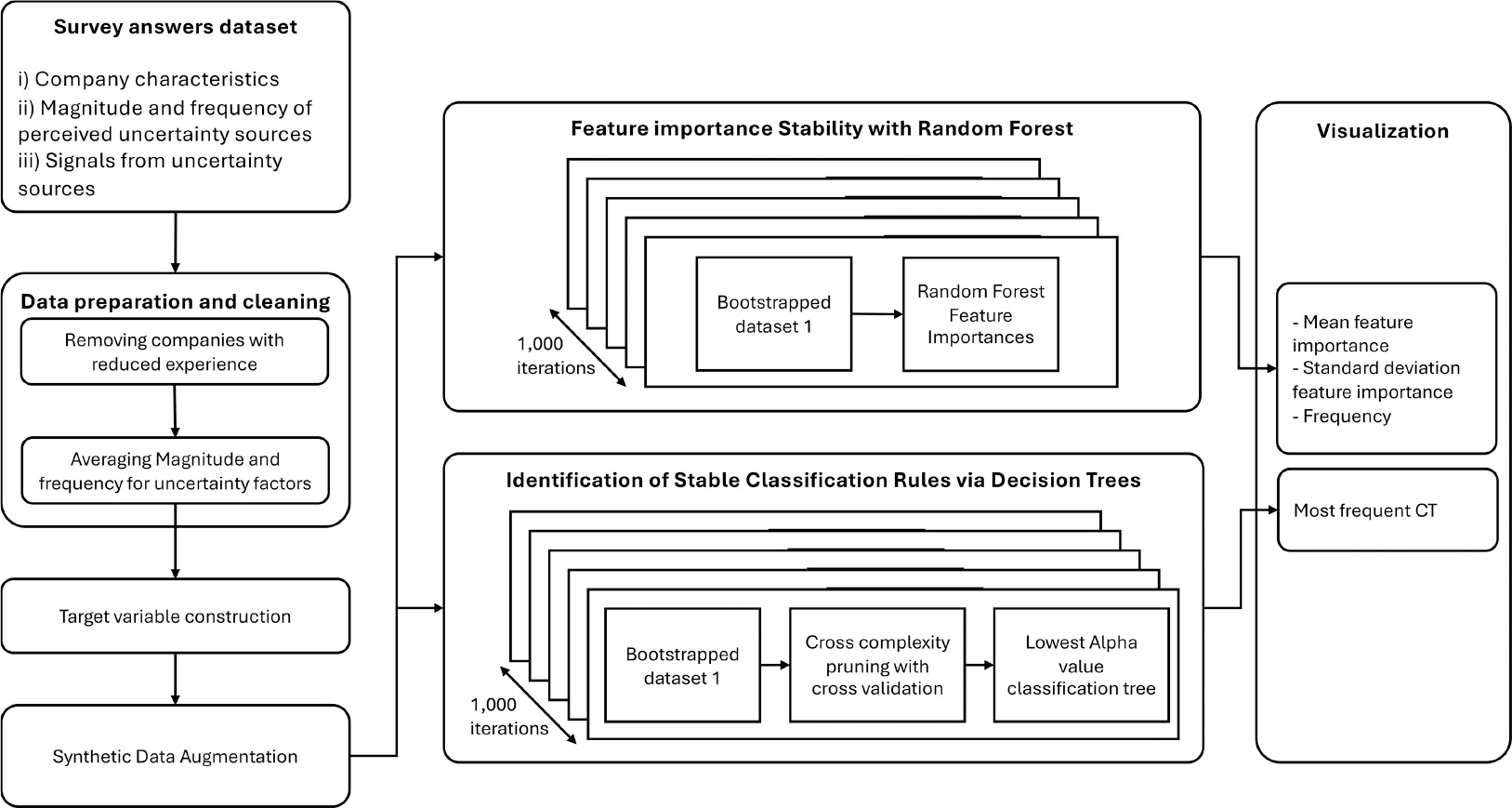
Fig. 2:
Data processing pipeline.
Source: Own 2025. CT, classification tree.
Tab. 1:
Validity of controlled data expansion strategy across internal and external sources of uncertainty.
| Uncertainty source | Lower uncertainty class | Higher uncertainty class | Total observations | ||||
|---|---|---|---|---|---|---|---|
| Original sample number | Augmented sample number | Lowest p-value across all variables | Original sample number | Augmented sample number | Lowest p-value across all variables | ||
| Organisational | 2 | 8 | 0.62 | 23 | 95 | 0.45 | 103 |
| Activity durations | 5 | 21 | 0.29 | 20 | 82 | 0.68 | |
| Resource use | 7 | 29 | 0.69 | 18 | 74 | 0.52 | |
| Requirement changes and quality issues | 13 | 54 | 0.54 | 12 | 49 | 0.56 | |
| Resource availability | 8 | 33 | 0.47 | 17 | 70 | 0.40 | |
| Logistics | 2 | 8 | 0.62 | 23 | 95 | 0.29 | |
| Environmental | 4 | 16 | 0.32 | 21 | 87 | 0.52 | |
| Sociopolitical | 5 | 21 | 0.29 | 20 | 82 | 0.47 | |
| Market | 1 | 4 | 1.00 | 24 | 99 | 0.56 | |
| Technological | 4 | 16 | 0.37 | 21 | 87 | 0.27 | |
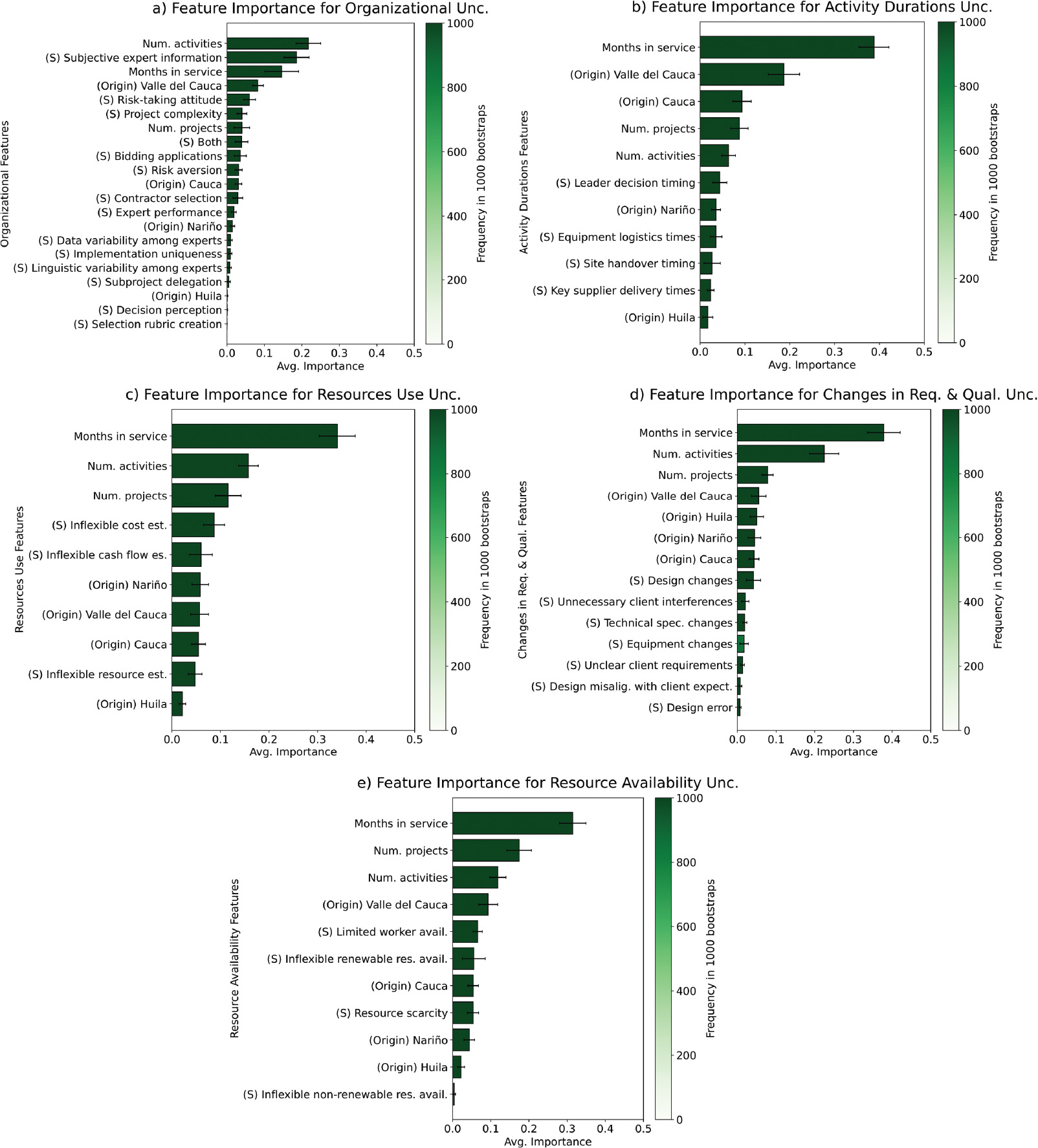
Fig. 3:
Bootstrap-based feature importances (1,000 iterations) for internal sources of uncertainty in construction projects (a) Feature importance of organisational Unc. (b) Feature importance of activity durations Unc. (c) Feature importance of resource use Unc. (d) Feature importance of changes in Req. & Qual. Unc. (e) Feature importance of resource availability Unc.
Source: Own, 2025.
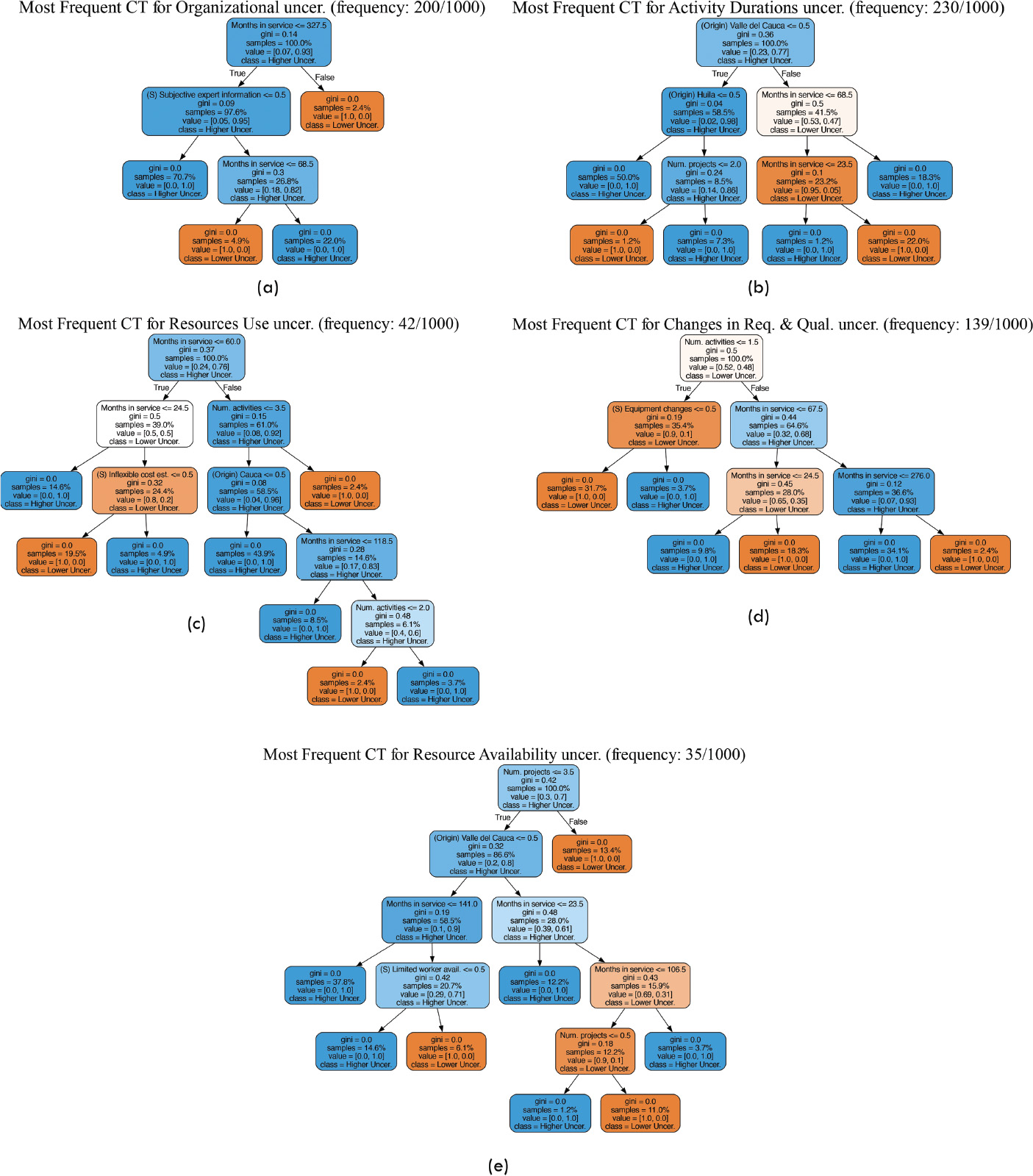
Fig. 4:
CT with the highest frequency across bootstrap samples for internal uncertainty sources in construction projects (a) Most frequent CT for organisational uncer. (frequency: 200/1000) (b) Most frequent CT for activity durations uncer. (frequency: 230/1000) (c) Most frequent CT for resource use uncer. (frequency: 42/1000) (d) Most frequent CT for changes in Req. & Qual. Uncer. (frequency: 139/1000) (e) Most frequent CT for resource availability uncer. (frequency: 35/1000).
Source: Own, 2025. CT, classification tree.
Tab. 2:
Descriptive statistics of the surveyed companies.
| Variable meaning | Sub-variables | Mean | SD | Min | Max |
|---|---|---|---|---|---|
| Origin state of the company | Cauca | 0.35 | 0.49 | 0 | 1 |
| Nariño | 0.19 | 0.40 | 0 | 1 | |
| Valle del Cauca | 0.35 | 0.49 | 0 | 1 | |
| Huila | 0.12 | 0.33 | 0 | 1 | |
| Number of states where the company has projects | - | 1.62 | 0.98 | 1 | 4 |
| Number of months since the commercial registration date of the company | - | 92.31 | 81.7 | 15 | 363 |
| Size of the company | Micro | 0.92 | 0.27 | 0 | 1 |
| Small | 0.04 | 0.20 | 0 | 1 | |
| Medium | 0.04 | 0.20 | 0 | 1 | |
| Number of ISIC activities the company executes | - | 2.00 | 0.94 | 1 | 4 |
| Economic activities carried out by companies | Construction of residential buildings | 0.35 | 0.49 | 0 | 1 |
| Construction of non-residential buildings | 0.23 | 0.43 | 0 | 1 | |
| Construction of roads and railways | 0.12 | 0.33 | 0 | 1 | |
| Construction of utility projects | 0.23 | 0.43 | 0 | 1 | |
| Construction of other civil engineering works | 0.42 | 0.50 | 0 | 1 | |
| Other specialised activities | 0.27 | 0.45 | 0 | 1 | |
| Real estate activities | 0.04 | 0.20 | 0 | 1 | |
| Architectural activities | 0.15 | 0.37 | 0 | 1 | |
| Technical consultancy | 0.19 | 0.40 | 0 | 1 |
Tab. 3:
Perceived frequency of the sources of uncertainty.
| Source of uncertainty | Variable | Mean* | SD |
|---|---|---|---|
| Organisational | Inherent complexity of the construction project | 4.62 | 1.30 |
| Ambiguity in selection criteria | 3.85 | 1.59 | |
| Experts’ consultation | 4.31 | 1.26 | |
| Risk-taking willingness of decision makers | 3.96 | 1.18 | |
| Activity durations | Activity duration differing from actual duration | 4.12 | 1.58 |
| Resource use | Inaccurate resource estimation | 3.81 | 1.52 |
| Requirement changes and quality Issues | Changes in project requirements | 3.77 | 1.27 |
| Resource availability | Inflexible resource availability | 3.54 | 1.36 |
| Logistics | Safety issues | 3.77 | 1.21 |
| Site access conditions | 2.88 | 1.18 | |
| Supply availability fluctuations | 3.58 | 1.21 | |
| Environmental | Inconsistent weather | 4.00 | 1.41 |
| Adverse geographic conditions | 3.65 | 1.60 | |
| Sociopolitical | Policies and regulations | 3.50 | 1.39 |
| Social conditions | 3.27 | 1.48 | |
| Market | Market conditions | 4.27 | 1.56 |
| Technological | Equipment reliability and construction methods | 3.42 | 1.33 |
Tab. 4:
Perceived magnitude of the sources of uncertainty (Likert scale: 1–4).
| Source of uncertainty | Variable | Mean* | SD |
|---|---|---|---|
| Organisational | Inherent complexity of the construction project | 3.15 | 0.78 |
| Ambiguity in selection criteria | 2.77 | 0.95 | |
| Experts’ consultation | 2.69 | 0.88 | |
| Risk-taking willingness of decision makers | 2.81 | 1.06 | |
| Activity durations | Activity duration differing from actual duration | 2.92 | 0.80 |
| Resource use | Inaccurate resource estimation | 2.92 | 1.06 |
| Requirement changes and quality Issues | Changes in project requirements | 2.38 | 1.02 |
| Resource availability | Inflexible resource availability | 2.85 | 0.97 |
| Logistics | Safety issues | 3.15 | 0.88 |
| Site access conditions | 2.19 | 0.98 | |
| Supply availability fluctuations | 3.12 | 0.95 | |
| Environmental | Inconsistent weather | 3.08 | 0.74 |
| Adverse geographic conditions | 2.92 | 0.98 | |
| Sociopolitical | Policies and regulations | 2.85 | 0.88 |
| Social conditions | 2.81 | 1.02 | |
| Market | Market conditions | 3.35 | 0.75 |
| Technological | Equipment reliability and construction methods | 3.04 | 0.82 |
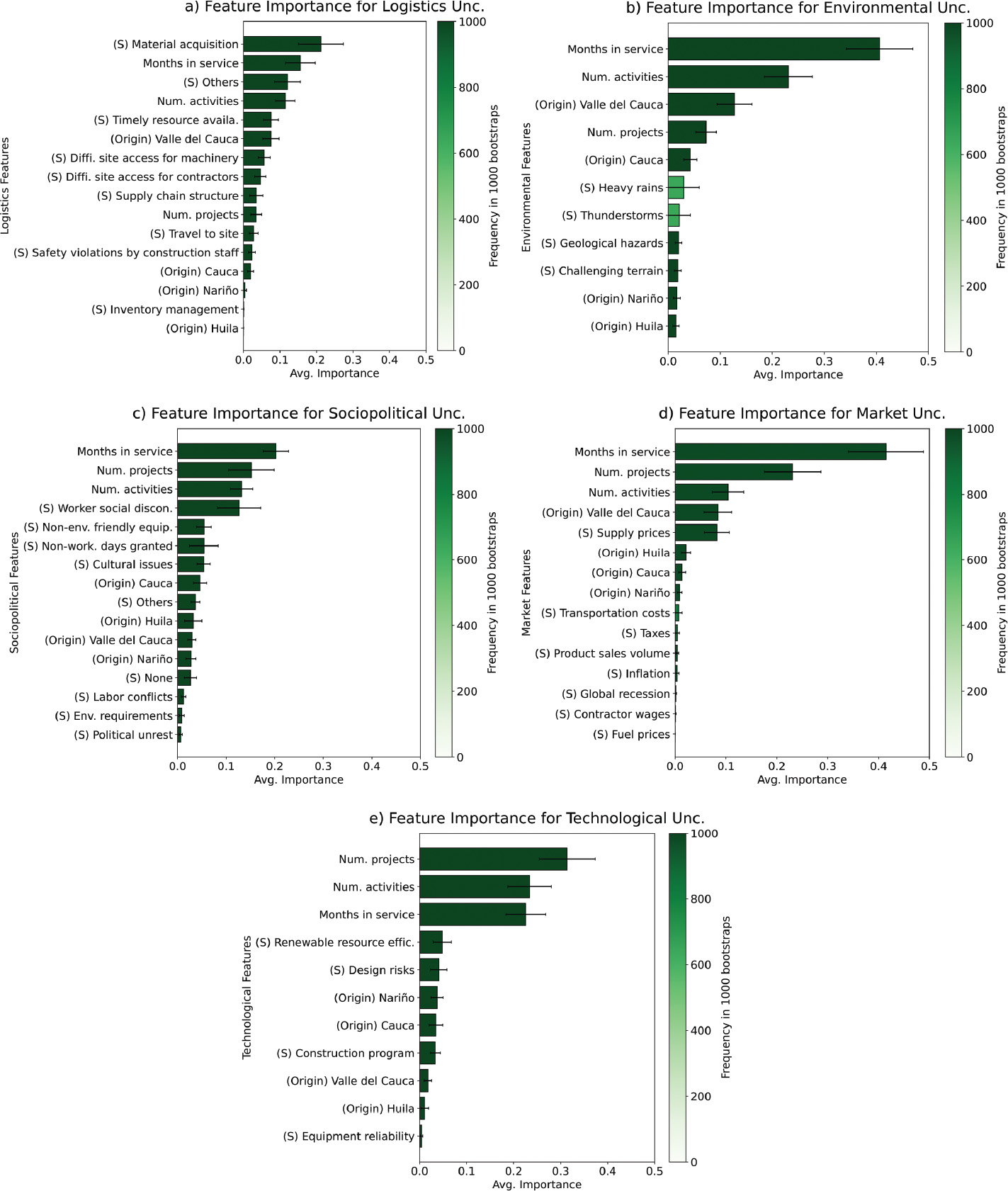
Fig. 5:
Bootstrap-based feature importances (1,000 iterations) for external sources of uncertainty in construction projects (a) Feature importance of logistics Unc. (b) Feature importance of environmental Unc. (c) Feature importance of sociopolitical Unc. (d) Feature importance of market Unc. (e) Feature importance of technological Unc.
Source: Own, 2025.
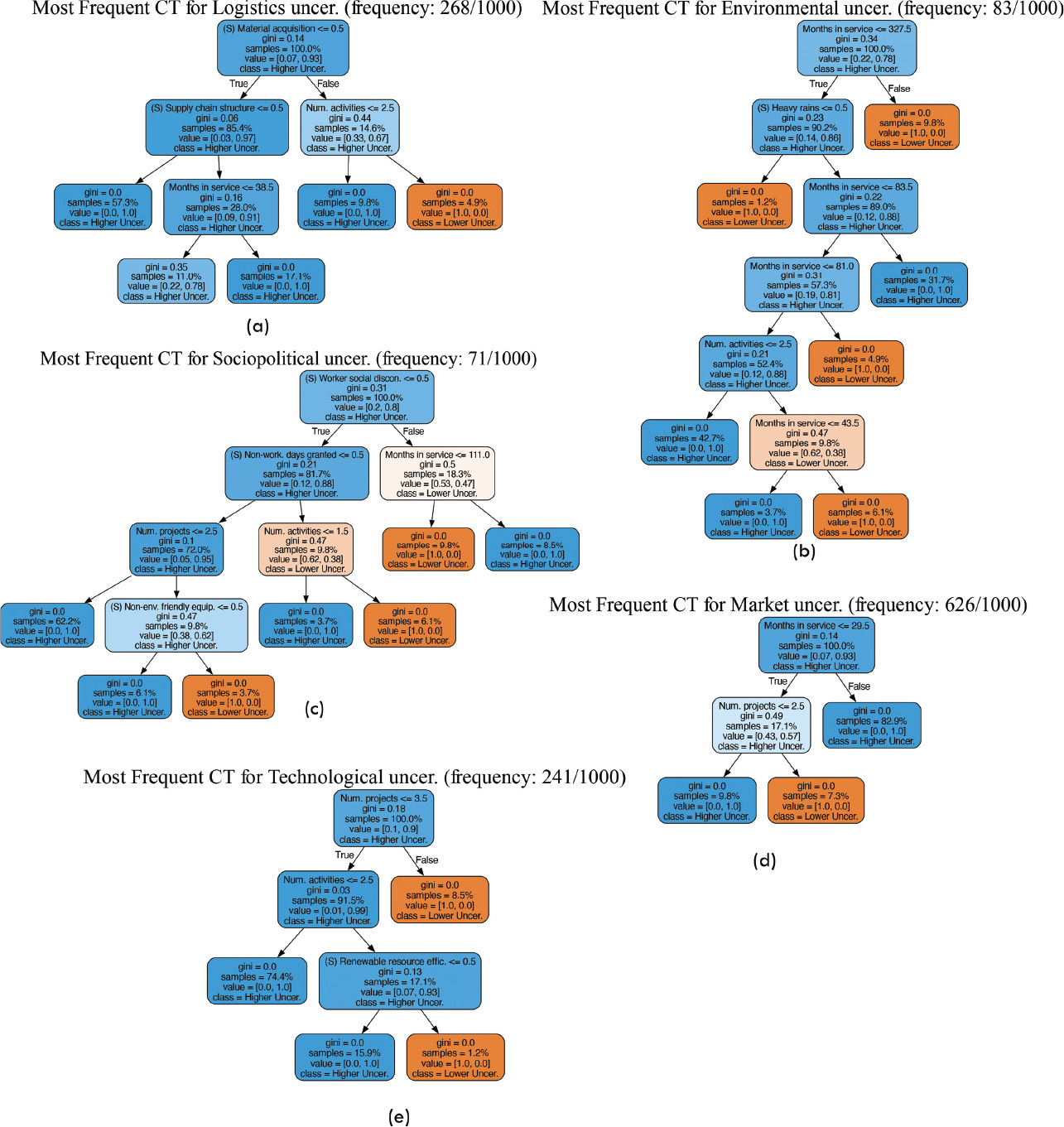
Fig. 6:
CT with the highest frequency across bootstrap samples for external uncertainty sources in construction projects (a) Most frequent CT for logistics uncer. (frequency: 268/1,000). (b) Most frequent CT for environmental uncer. (frequency: 83/1,000). (c) Most frequent CT for sociopolitical uncer. (frequency: 71/1,000). (d) Most frequent CT for market uncer. (frequency: 626/1,000). (e) Most frequent CT for technological uncer. (frequency: 241/1,000).
Source: Own, 2025. CT, classification tree.
Tab. 5:
Summary of the most influential features and dominant classification rules associated with higher perceived uncertainty across domains.
| Uncertainty source | Feature importance | CT rules for a higher level of uncertainty | ||||||||
|---|---|---|---|---|---|---|---|---|---|---|
| Most important feature | MDI | Most important signal | MDI | Number of activities | Number of state projects | Months in service | Origin | Signal | Highest% companies classified in a leaf node (%) | |
| Organisational | Number of activities | 0.217 | Subjective expert information | 0.185 | - | ≤327 | - | Subjective expert information | 70.7 | |
| Activity durations | Months ¡n service | 0.388 | Leader decision timing | 0.044 | - | - | - | Outside of Valle del Cauca and Huila | - | 50 |
| Resource use | Months in service | 0.341 | Inflexible cost estimation | 0.087 | ≤3 | - | ≥60 | Outside of Cauca | 43.9 | |
| Requirement changes and Quality issues | Months in service | 0.379 | Design changes | 0.042 | ≥l | - | ≥67 and ≤276 | - | - | 34.1 |
| Resource availability | Months in service | 0.315 | Limited availability of capable workers in the area | 0.066 | ≤3 | - | ≤I4I | Outside Valle del Cauca | - | 37.8 |
| Logistics | Material acquisition | 0.212 | Material acquisition | 0.212 | - | - | Other signals different to Material Acquisition and supply chain structure | 57.3 | ||
| Environmental | Months in service | 0.406 | Heavy rains | 0.030 | ≤2 | - | ≤327 | - | Heavy rains | 42.7 |
| Sociopolitical | Months in service | 0.202 | Worker social discontent | 0.127 | ≤2 | - | - | Other signals different to worker social discontent and non-working days granted | 62.2 | |
| Market | Months in service | 0.414 | Supply prices | 0.082 | - | - | ≥29 | - | - | 82.9 |
| Technological | number of states where the company has projects | 0.314 | Renewable resource efficiency | 0.048 | ≤2 | ≤3 | - | - | 74.4 | |
Tab. 6:
Comparison with previous approaches to uncertainty assessment in construction projects and this study’s contribution.
| Study | Approach/method | Project scale | Data nature | Limitation | Study contribution |
|---|---|---|---|---|---|
| Ali et al. (2018) | Expert-based RII | Public infrastructure | Five-item Likert scale from domain experts | Subjective weighting; limited empirical validation | Provides baseline prioritisation for public-sector risk budgeting; relies on expert weighting rather than empirical inference |
| Shabani et al. (2023) | Narrative search and semi-structured expert interviews | Public road projects | Expert-informed categorisation | Subjective categorisation; limited replicability across contexts | Enhanced understanding of contextual, operational and strategic uncertainty through expert narratives |
| Erol et al. (2022) | ANP model with a two-round Delphi process | Mega construction projects | Domain experts weighting | Subjective weighting and limited applicability to MSMEs | Risk quantification model for mega construction projects |
| Ulupui et al. (2024) | Partial Least Squares and RA for ARI | Multisector MSMEs from Indonesia | Five-item Likert scale from MSME representatives | Applied to MSMEs, but not the construction industry explicitly | Framework for quantifying the interactions of technological, organisational and environmental risk dimensions among MSMEs |
| Our approach | RF feature importance and CTs | Construction MSMEs from Colombia | Empirical survey data combined with class-preserving synthetic augmentation for small-sample modelling | Strategic-level focus; does not capture operational dynamics | First interpretable, machine-learning framework modelling ten internal and external uncertainty sources in construction MSMEs |