
1. INTRODUCTION
The beginning of the 21st century was marked by a huge shortage of water resources and dramatic salinization of soils and water [Shrivastava, Kumar 2015]. It was found that more than 800 million hectares of irrigated land producing one-third of the world's food is salt-affected [Munn, Tester 2008]. There are two major causes of soil salinity — primary (natural) and secondary (human-made) salinization [Singh 2022]. The occurrence of parent rocks, weathering of minerals and infiltration of seawater are the main natural causes of soil salinization [Ramos et al. 2020]. Up to 412 million ha are affected by this salinity, which has both natural causes and human-induced ones, such as poor irrigation management and the overexploitation of saline groundwater resources.
The destruction of the Kakhovka hydroelectric power station on the Dnipro River in Ukraine occurred in June 2023 during the Russian-Ukrainian war, and led to the stopping of 31 irrigation systems in the Dnipro, Kherson, and Zaporizhzhia regions with a total area of 584,000 ha [Vyshnevskyi et al. 2023; Hapich, Onopriienko 2024, Hapich et al. 2024; Snizhko et al. 2024]. Limited access to water created pressure on small rivers, such as tributaries of the Dnipro River (the Ingulets, Saksagan, Bazavluk, Solona and others), due to their use as alternative sources of irrigation of arable lands. These rivers' mineralization (5–7 dS/m) now significantly exceeds permissible standards due to the discharge of saline quarry waters from the Nikopol manganese ore basin, and the iron ore deposit from the Kryvbas to smaller rivers [Kharytonov et al. 2012]. Climate change has a significant impact on agricultural productivity in the steppe zone of Ukraine as well [Vozhehova 2021]. Therefore, the cultivation of vegetable crops under irrigation requires the use of additional mitigating measures for growing conditions depending on crops' sensitivity to saline soil or irrigation with saline water. For example, eggplants are characterized by their high resistance, and are able to withstand irrigation with water due to their level of electrical conductivity of 6 dS/m [Savvas, Lenz 2000]. Tomato, pepper and lettuce, on the other hand, have lower tolerance levels for salinity (between 1.5 and 2.5 dS/m) [Machado, Serralheiro 2017; Yasuor et al. 2017; Fallik et al. 2019; Al-Maskri et al. 2020].
Optimal fertilizer/nutrient element management and environmental regulation play vital roles in producing good-quality vegetables under controlled environmental conditions [Bian et al. 2020]. It is possible to minimize the adverse effect of irrigation water salinity on the growth of vegetable crops by increasing the content of nitrogen compounds in the nutrient solution, which allows for the realizing of the antagonism between NO3− and Cl− ions [Kafkafi et al. 1982; Cohen et al. 2003]. Nitrogen, in the form of nitrates, is easily absorbed by plants and is used to build various molecules. The application of potassium nitrate (KNO3) as a foliar treatment enhances the osmotic regulation and antioxidant capacity of citrus plants under water-deficit stress [Gimeno et al. 2014]. Field experiments conducted with eggplants using three irrigation sources with different levels of salinity (EC 1.0; 2.5 and 5 dS/m) at three levels of nitrogen application found that the introduction of increased nitrogen compounds into salty water by fertigation with the use of drip irrigation leads to decreased in chloride content in fruits, as well as increases in eggplant productivity, water use productivity and NPK absorption [Sheoran et al. 2023]. Salinity affects nutrient uptake differently depending on the nitrogen source. In model experiments with tomatoes conducted in closed hydroponic system, the effects of three options of the ratio of ammonium ions to total nitrogen were studied against two irrigation water salinities (2.2 and 7.5 dS/m) by adding NaCl to the nutrient solution [Tzortzakis et al. 2022]. Maintaining the NH4-N/N ratio at 0.15 in the saline water option at electrical conductivity (EC) 7.5 dS/m improved the organoleptic characteristics of the yield and increased fruit firmness at harvest after storage. In experiments with peas, plants grown on a nitrate nutrient background were less sensitive to sodium and chloride salinity than those fed with ammonium [Frechilla et al. 2001]. The interaction effect between different concentrations of nitrate and chloride and the dry weight of cucumber shoots, roots, and fruits was studied using the nutrient film technique [Shawer 2014]. The highest values of fresh- and dry-fruit weight of cucumber plant were recorded at 8 mM of nitrate with 10 mM of chloride. Supplementary potassium nitrate at a dose of 10 mM led to increases in leaf number and area, stem elongation, and Chl content, as well as maximal PSII photochemical efficiency and effective quantum yield of salt-stressed (50 mM NaCl) citrus seedlings [Khoshbakht et al. 2014]. In this way, nitrate ameliorated the deleterious effects of NaCl stress and stimulated photosynthetic activity, plant metabolism and growth.
The salt-tolerant wheat variety accumulated more K+ in both shoots and roots compared to the higher Na+ accumulation typical of the salt-sensitive variety [Zheng et al. 2008]. It has been shown that rice's salt tolerance, which is mediated by a specific gene, is nitrate-dependent and positively correlated with nitrate concentration [Alfatih et al. 2023]. In two strawberry varieties, membrane permeability increased with high NaCl levels and was decreased after Ca(NO3)2 sprays [Kaya et al. 2002]. Concentrations of calcium and nitrogen were much lower in plants grown in high NaCl than in unstressed plants, and foliar Ca(KNO3)2 sprays increased concentrations of both nutrients. Additional treatments with KNO3 and proline significantly mitigated the adverse effects of salinity on plant growth, melon fruit yield, and the physiological parameters studied [Kaya et al. 2007]. The two additives maintained membrane permeability and increased the concentrations of Ca2+, N, and K+ in the leaves of the salt-stressed plants.
Plant adaptations to salinity are of three distinct types: osmotic stress tolerance, Na+ or Cl− exclusion, and the tolerance of tissue to accumulated Na+ or Cl− [Munns, Tester 2008]. Osmotic stress realized by putative osmosensor induces membrane tension through the activation of mechanosensitive Ca2+ channels or specific plasma membrane proteins in response to the Na+ ion stress [Banik, Dutta 2023].
A third mechanism depends on the plasma membrane's receptor-like kinases, which detect damage to the cell wall and are activated by external stimuli such as reactive oxygen species (ROS). ROS are generated during salinity stress as a by-product of various metabolic pathways, e.g., photosynthetic electron transport [Mansoor et al. 2022]. Potassium is well known for its role in balancing sodium concentrations in plants [Raddatz et al. 2020; Zorb et al. 2014]. Alleviation of NaCl stress symptoms by simultaneous application of increased amounts of KNO3 was more effective in the salt-tolerant variety than in the salt-sensitive variety. Lettuce plants were exposed to salinity (100 mM NaCl) using radicular and foliar humic-substance treatment based on a leonardite-suspension concentrate product called BLACKJAKR [Atero-Calvo et al. 2024]. Application of calcium nitrate to salt-stressed Cucurbita pepo (zucchini) plants reduced levels of ROS (H2O2), malondialdehyde (MDA) as a product of lipid peroxidation by ROS, and the antioxidative defense compound proline [Behtash et al. 2023].
Lettuce (Lactuca sativa L.) is one of the most extensively cultivated and eaten fresh-leaf vegetables [Rubatzky, Yamaguchi 1997]. The young leaf category is important among leafy vegetables of the Lactuca sativa harvested in the early vegetative phase [Nicola, Fontana 2014], providing an important source of health-promoting compounds such as carotenoids, vitamin C and polyphenols [DuPont et al. 2000; El-Nakhel et al. 2019]. Several salt-tolerant lettuce varieties showed biomass reductions of less than 15% in a screening of over 3,800 genotypes [Xu, Mou 2015]. Changes in the lettuce's plant growth and other physiological and biochemical responses to the varying salt stress conditions allowed for the identification of a maximum tolerance threshold, specific to lettuce, of 100 mM NaCl (Sardar et al. 2023; Fedeli et al. 2024].
The main objective of this study was to estimate the effect of NaCl stress, both with and without KNO3 application, on the MDA, proline and photosynthetic pigment content in lettuce plants' leaves. We hypothesized that the application of potassium nitrate alleviated the effects of the NaCl by reducing oxidative stress and thus reducing leaf MDA and proline contents, while also enhancing leaf concentrations of photosynthetic pigments.
2. MATERIALS AND METHODS
2.1. Experiment design
Lettuce (Lactuca sativa L. cv. Salanova) seedlings were purchased in cassette from a local nursery. The seedlings with compost were transplanted into plastic pots filled with quartz sand to a final volume of 150 ml. The compost/sand ratio was 1:10. Seedlings were grown for six weeks in a greenhouse with a day/night cycle of 16/8 h from 1 November to 15 December 2024. Day/night temperature varied from 23 °C to 5 °C and relative humidity from 60 to 75%. Immediately after transplantation, plants were irrigated once per day with the following pot experiment scheme: control – distilled water; potassium nitrate (KNO3) solutions (20 mM and 40 mM); sodium chloride (NaCl) solutions (100 mM and 200 mM); 20 mM KNO3 and 100 mM NaCl; 40 mM KNO3 and 100 mM NaCl; 20 mM KNO3 and 200 mM NaCl; 40 mM KNO3 and 200 mM NaCl. Five replicates were prepared for each of the nine treatments.
2.2. Measurement of soil and plant parameters
In a glass, 50 ml of distilled water was added to 10 g of soil and stirred every 5 min with a glass rod for 30 min at room temperature. The electrical conductivity of the soil extract in the supernatant was measured using a conductometer (LF 40, Germany) at μS/cm unit. A mortar was used on 0.5 g of the plant material (leaves) and 5 to 10 ml of distilled water. The leaf extract transferred into a measuring cylinder and diluted to 20 ml with distilled water. Determination of the electrical conductivity of the leaf extract was made with a conductometer at μS/cm unit. Malondialdehyde (MDA) reacts with 2-thiobarbituric acid (TBA) to form a fluorescent product with an emission maximum of 532 nm. The non-specific turbidity was taken into account through measurement at 600 nm [Heath, Packer 1968]. The molar concentration of MDA (mM or mmol/l) was calculated using the molar extinction coefficient (155 mM−1 cm−1) according to the equation:
For readability of the results, mM was converted to μM. Finally, to convert the molar concentration of MDA (μM) to μmol per 1 gram of fresh plant material, the following equation was used:
where n is the amount of MDA contained in 1 gram of fresh plant material, μmol/g; c is the molar concentration of MDA in μmol/l, calculated using the molar extinction coefficient; V is the volume of 2-thiobarbituric acid, l (0.005 l); and W is the weight of fresh plant material, g (0.2 g).Proline amino groups react in the acidic range with ninhydrin to form a reddish complex that dissolves in toluene. They were first precipitated with sulfosalicylic acidin order to prevent interference from amino groups of proteins. Proline reacts with the formation of a colored complex under these test conditions. The absorbance was measured at 546 nm in a spectrophotometer [Bates et al. 1973]. The amount of proline contained in 1 gram of fresh plant material was calculated according to the equation:
where p is the amount of proline contained in 1 gram of fresh plant in μg/g; c is the concentration of proline in the sample determined from the calibration curve in μg/ml; V is the volume of sulfosalicylic acid in ml (10 ml); and W is the weight of fresh plant material in g (1 g).The concentrations of chlorophyll (Chl) a, Chl b, and carotenoids were measured at the spectrophotometer [Lichtenthaler, Wellburn 1983]. Extinction was measured at 663, 646 and 470 nm (E663, E646, E470) using a spectrophotometer (Spectroquant Prove 300 UV/VIS, Germany).
The filtrate's chlorophyll and carotenoids content was calculated according to the following equations:
The pigment content in leaves was calculated using the following expression:
Where c is the concentration of pigments in the sample determined from the calibration curve, μg/ml; V is the volume of acetone in ml (10 ml); and W is the weight of fresh plant material in g (200 mg).
2.3. Statistical analysis
All data statistical processing was performed in R Version 4.3.2 [R Core Team 2023]. The following packages were used for statistical analysis and data manipulation: readr, dplyr, stats, and multcompView [Graves 2023; R Core Team 2023; Wickham et al. 2023]. The analysis of variance for two factors was done using two-way ANOVA. The pairwise comparison of means was performed using Tukey's HSD test. Pearson's correlation coefficients were calculated using the metan package [Olivoto, Lúcio 2020]. The plots were constructed using the packages ggplot2 and ggthemes [Arnold 2021; Wickham 2016].
3. RESULTS
Results showed that salt stress significantly reduced leaves' fresh weight (FW), especially with 200 mM NaCl (Figure 1).
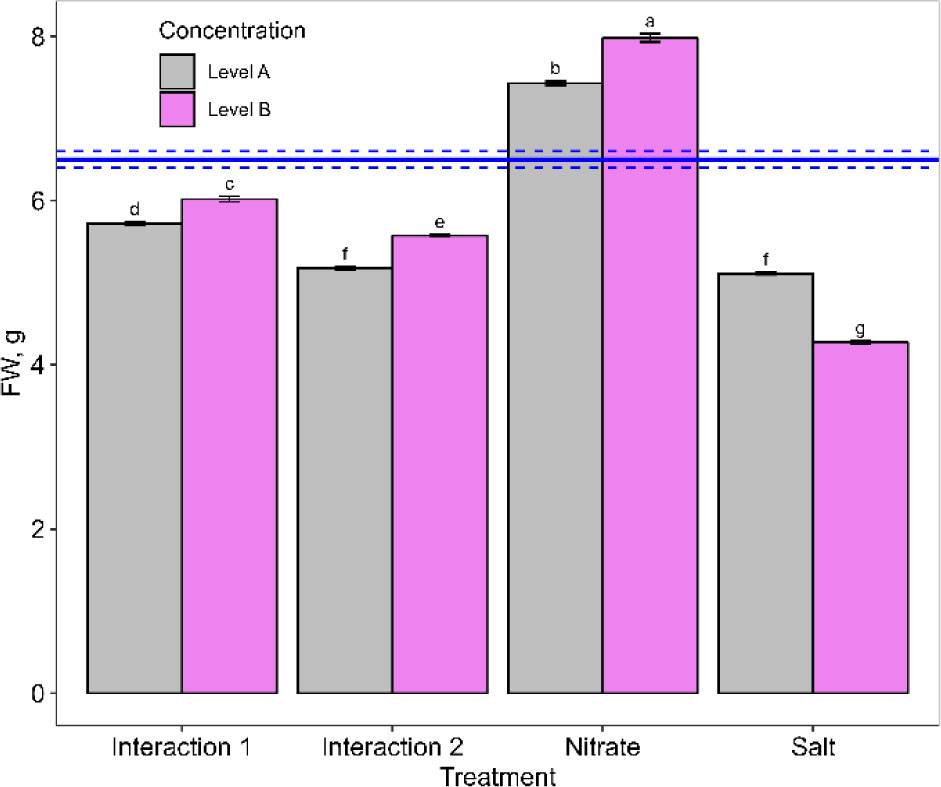
Figure 1.
Fresh weight of leaves
Nitrate Level A: 20 mM, Nitrate Level B: 40 mM; Salt Level A: 100 mM, Salt Level B: 200 mM;
Interaction 1 Level A – Salt 100 mM + Nitrate 20 mM, Interaction 1 Level B – Salt 100 mM + Nitrate 40 mM;
Interaction 2 Level A – Salt 200 mM + Nitrate 20 mM, Interaction 2 Level B – Salt 200 mM + Nitrate 40 mM
ANOVA: Treatment:Concentration – p < 0.001. Values are expressed as means ± standard error (n = 5). The control mean is shown by the blue line, and the standard error by the blue dotted lines.
A potassium nitrate solution provided the mitigation effects in the 100 NaCl + 40 mM KNO3 and 200 NaCl + 40 mM KNO3 treatments, increasing leaves' FW by 18.9% and 30.0%, respectively.
Electrical conductivity (EC) of soil strongly depended on both factors: treatment and concentration (p < 0.001).
Table 1 and Figure 2 present the results of two-way ANOVA. Both effects of both factors were additive. The highest EC in both leaves and soil was characteristic of simultaneous treatment with chloride (200 mM) and nitrate (40 mM). Nitrate itself did not produce the same increase in EC as chloride, which is most likely due to its lower concentration (20 and 40 mM, compared to 100 and 200 mM).
Table 1.
Electrical conductivity (EC) of soil (mean ± se, n = 5)
| Treatment | Concentration | EC soil mean ± se, μS/cm | |
|---|---|---|---|
| 1 | Interaction 2 | Level B | 1331 ± 18.6a |
| 2 | Interaction 2 | Level A | 1167 ± 27.2b |
| 3 | Interaction 1 | Level B | 1002 ± 14.9c |
| 4 | Salt | Level B | 959 ± 4.17c |
| 5 | Interaction 1 | Level A | 855 ± 7.40d |
| 6 | Salt | Level A | 603 ± 13.3e |
| 7 | Nitrate | Level B | 316 ± 7.02f |
| 8 | Nitrate | Level A | 166 ± 5.22g |
| 9 | Control | Water | 27.2 ± 1.39 |
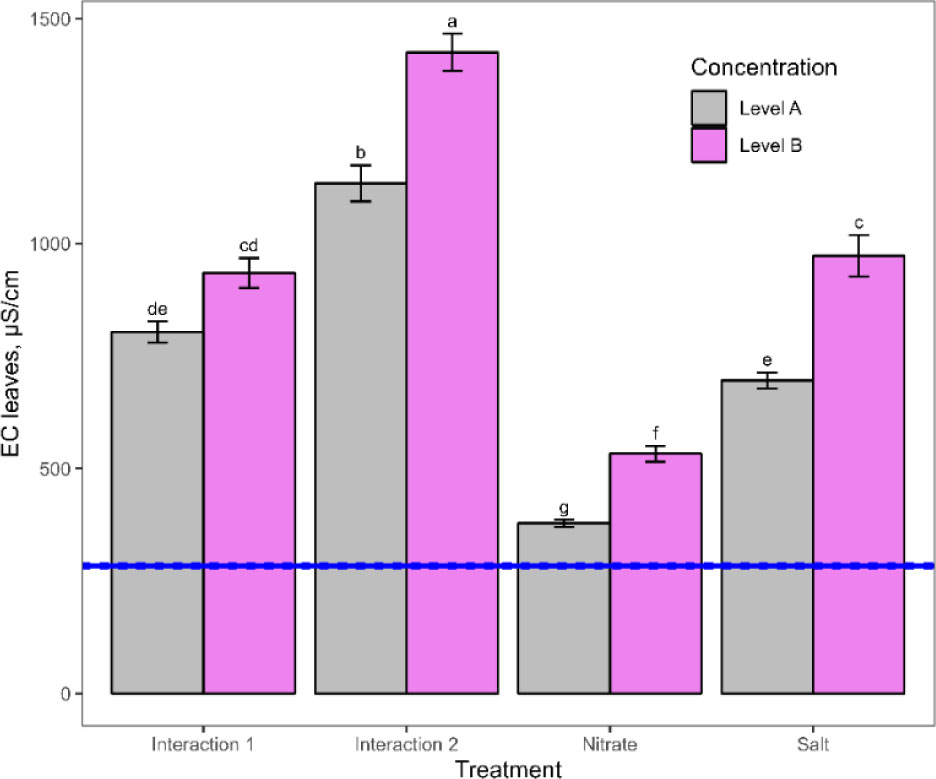
Figure 2.
Electrical conductivity of leaves
Nitrate Level A – 20 mM, Nitrate Level B – 40 mM; Salt Level A – 100 mM, Salt Level B – 200 mM;
Interaction 1 Level A – Salt 100 mM + Nitrate 20 mM, Interaction 1 Level B – Salt 100 mM + Nitrate 40 mM;
Interaction 2 Level A – Salt 200 mM + Nitrate 20 mM, Interaction 2 Level B – Salt 200 mM + Nitrate 40 mM
ANOVA: Treatment:Concentration – p < 0.05. Values are expressed as means ± standard error (n = 5). The control mean is shown by the blue line, the standard error by the blue dotted lines.
A chloride concentration of 200 mM had a more pronounced effect on EC than simultaneous treatment with chloride (100 mM) and nitrate (20 and 40 mM). The lowest EC was found in the control treatment.
3.1. MDA as an end product of membrane lipid peroxidation and a stress marker
The intensity of lipid peroxidation in the cell was indicated by an increase in the MDA content. Obviously, both factors (Treatment:Concentration) had a strong effect on the MDA content of the lettuce leaves (p < 0.001). Compared to the control (31.5 ± 0.786 nmol/g FW), the MDA content increased by 40% (44.0 ± 0.553 nmol/g FW) and 104% (64.2 ± 2.11 nmol/g FW) depending on the salt concentration. Doubling the saline concentration (see Figure 3, bar “a”) resulted in a 46% increase in the MDA content compared to the 100 mM-salt condition (bar “bc”). The application of nitrate at concentrations of 20 mM (33.1 ± 0.260 nmol/g FW) and 40 mM (31.4 ± 1.22 nmol/g FW) had no effect on the lipid peroxidation marker concentrations, since the MDA content remained at the control level. No significant differences were found between means of the control and nitrate-treated groups.
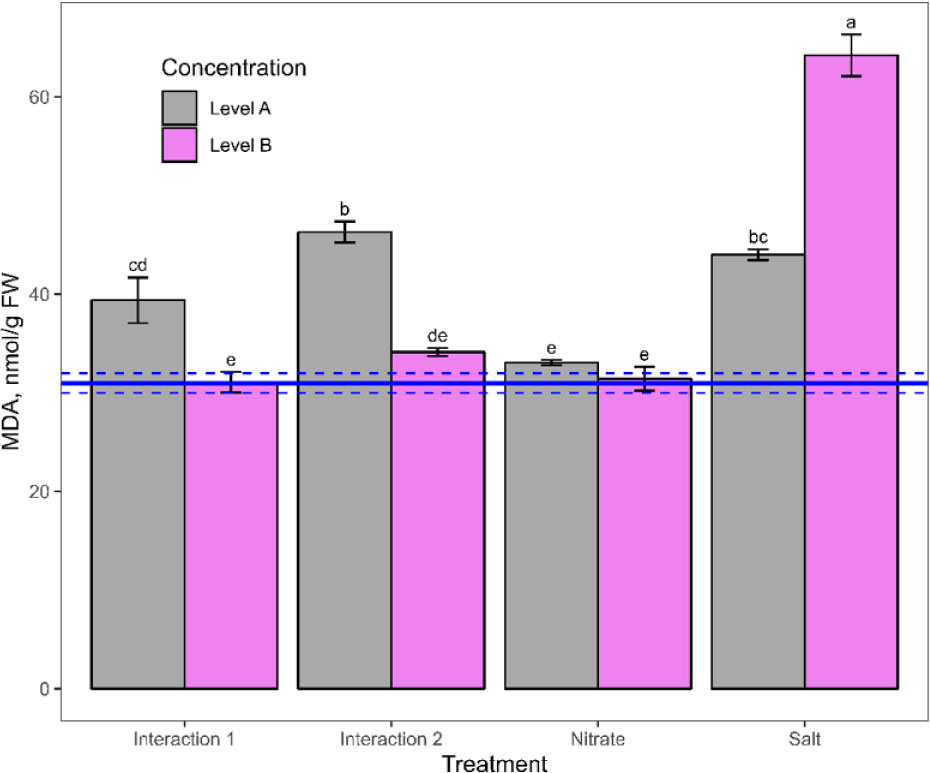
Figure 3.
MDA content (nmol/g FW) in lettuce leaves depending on treatment and concentration
Nitrate Level A – 20 mM, Nitrate Level B – 40 mM, Salt Level A – 100 mM, Salt Level B – 200 mM;
Interaction 1 Level A – Salt 100 mM + Nitrate 20 mM, Interaction 1 Level B – Salt 100 mM + Nitrate 40 mM;
Interaction 2 Level A – Salt 200 mM + Nitrate 20 mM, Interaction 2 Level B – Salt 200 mM + Nitrate 40 mM
ANOVA: Treatment:Concentration – p < 0.001. Values are expressed as means ± standard error (n = 5). The control mean is shown by the blue line, the standard error by the blue dotted lines.
The effectiveness of salt stress mitigation significantly depended on treatment and concentration factors (p < 0.001). The application of 40 mM nitrate as a mitigation agent of salt stress contributed to a significant (29%) decrease in the MDA content for 100 mM (44.0 ± 0.553 nmol/g “bc” vs. 31.1 ± 1.04 nmol/g “e”) and a 47% decrease for 200 mM (64.2 ± 2.11 nmol/g “a” vs. 34.1 ± 0.426 nmol/g “de”). In general, a nitrate concentration of 20 mM was not sufficient to completely minimize salt stress (indicated by reaching the control level) and, accordingly, lipid peroxidation; the 20 mM nitrate mitigation treatment resulted in a 28% decrease in MDA only when interacting with 200 mM salt (64.2 ± 2.11 nmol/g “a” vs 46.3 ± 1.07 “b”).
3.2. Proline as an indicator of salt stress
Soil treatment with both nitrate and saline solutions resulted in a significant increase in proline content (p < 0.001). The addition of nitrates at concentrations of 20 and 40 mM led to a increases in proline of 286% (214 ± 17.7 μg/g FW) and 527% (348 ± 16.0 μg/g FW), respectively (the control level was 55.5 ± 19.4 μg/g FW). Proline content increased by 63% in the 40-mM-nitrate treatment over the 20-mM treatment. Soil salinization with a 100-mM saline solution resulted in a 776% increase in proline over the control (486 ± 13.4 μg/g FW), while salinization with a 200-mM saline solution resulted in a 956% increase compared to the control (586 ± 15.2 μg/g FW). Proline content increased by 21% more in the 200-mM treatment than in the 100-mM treatment.
3.3. Proline as a non-enzymatic antioxidant and osmo-protectant
Figure 4 demonstrates a gradual increase in proline concentration in lettuce depending on single (water, nitrate, salt) and mixed (salt and nitrate) treatments. Compared to the saline condition at concentrations of 100 mM and 200 mM, mitigation treatment with 20 mM of nitrate contributed to a 29–171% increase in proline content, while 40 mM of nitrate resulted in a 64–173% increase. Thus, the increase in the proline content was stronger at higher salt concentrations.
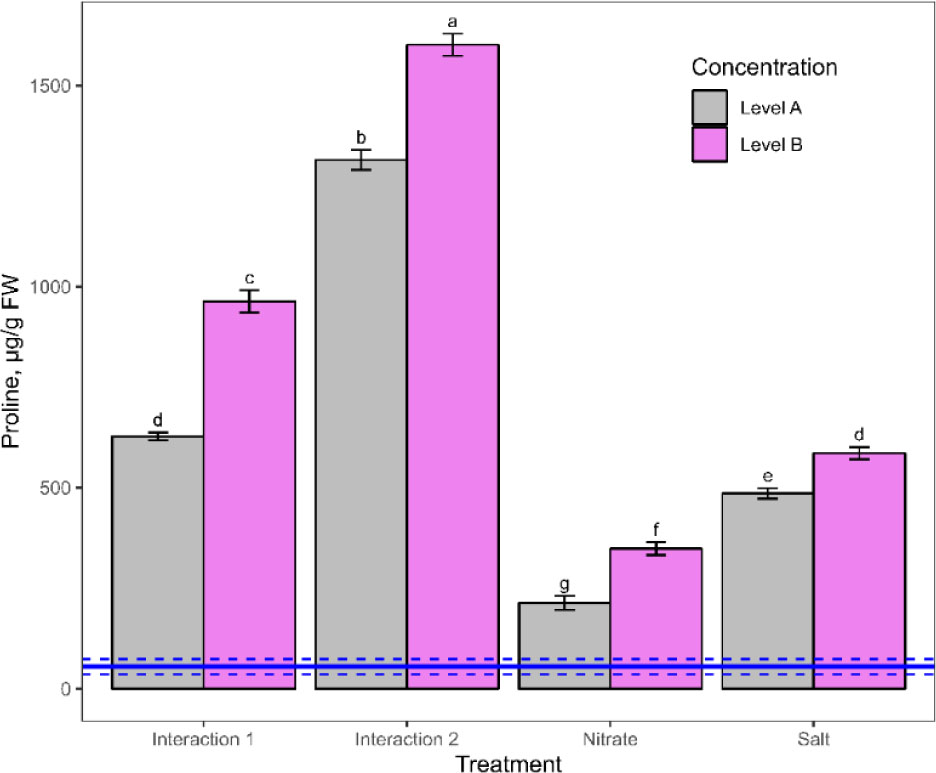
Figure 4.
Proline content (μg/g FW) in lettuce leaves depending on treatment and concentration
Nitrate Level A – 20 mM, Nitrate Level B – 40 mM, Salt Level A – 100 mM, Salt Level B – 200 mM;
Interaction 1 Level A – Salt 100 mM + Nitrate 20 mM, Interaction 1 Level B – Salt 100 mM + Nitrate 40 mM;
Interaction 2 Level A – Salt 200 mM + Nitrate 20 mM, Interaction 2 Level B – Salt 200 mM + Nitrate 40 mM
ANOVA: Treatment:Concentration – p < 0.001. Values are expressed as means ± standard error (n = 5). The control mean is shown by the blue line, the standard error by the blue dotted lines.
3.4. Photosynthetic pigments
It is known that lettuce's core complexes harbour chlorophyll (Chl) a, β-carotene, and all the electron transport cofactors of the reaction center [Wientjes 2017]. The peripheral antenna coordinates additional pigments, namely chlorophylls a and b (Chls a/b) and carotenoids, which increase the absorption cross-section. PSI coordinates several Chls that absorb light at wavelengths longer than 700 nm, while PSII is enriched with Chl b and therefore shows stronger absorption around 475 nm and 650 nm [Blankenship 2002].
Compared to the control (385 ± 2.79 μg/g FW), soil enrichment with nitrates contributed to a 9.9 – 22% increase in the Chl a concentration, while soil salinization decreased Chl a by 8.3 – 36% (Figure 5).
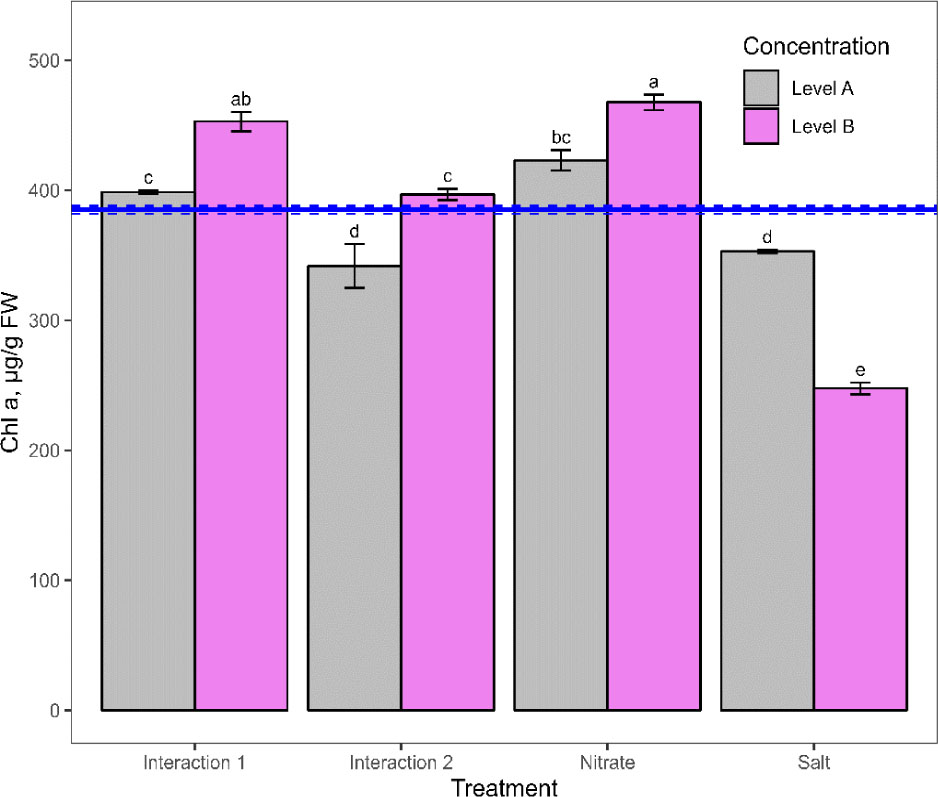
Figure 5.
Chlorophyll a content in lettuce leaves depending on treatment and concentration
ANOVA: Treatment:Concentration – p < 0.001. Values are expressed as means ± standard error (n=5). The control mean is shown by the blue line, the standard error by the blue dotted lines.
The mitigative effect of the nitrate solution was significant for both salt levels. Nitrate at a concentration of 40 mM significantly contributed to restoring the lettuce's Chl a content to the control level in the 200-mM-salt-exposure condition (397 ± 4.38 μg/g FW vs. 385 ± 2.79 μg/g FW), and even increased the Chl a level for the 100-mM-salt condition (453 ± 7.39 μg/g FW vs. 385 ± 2.79 μg/g FW). Mitigation treatment with 40 mM nitrate increased the content of Chl a by 28% in the 100 mM-salt-exposure condition (453 ± 7.39 μg/g FW “ab” vs 353 ± 1.12 μg/g FW “d”) and 60% in the 200-mM salt condition (397 ± 4.38 μg/g FW “c” vs 248 ± 4.54 μg/g FW “e”). Nitrate mitigation treatment at 20 mM increased the content of Chl a by 13% (399 ± 1.48 FW “c” vs 353 ± 1.12 μg/g FW “d”) compared to 100-mM-exposure condition and 38% (342 ± 16.9 μg/g FW “d” vs 248 ± 4.54 μg/g FW “e”) compared to the 200-mM exposure.
Overall, saline treatment resulted in a decrease in the Chl b content, but the saline concentration did not have a very significant effect (Figure 6).
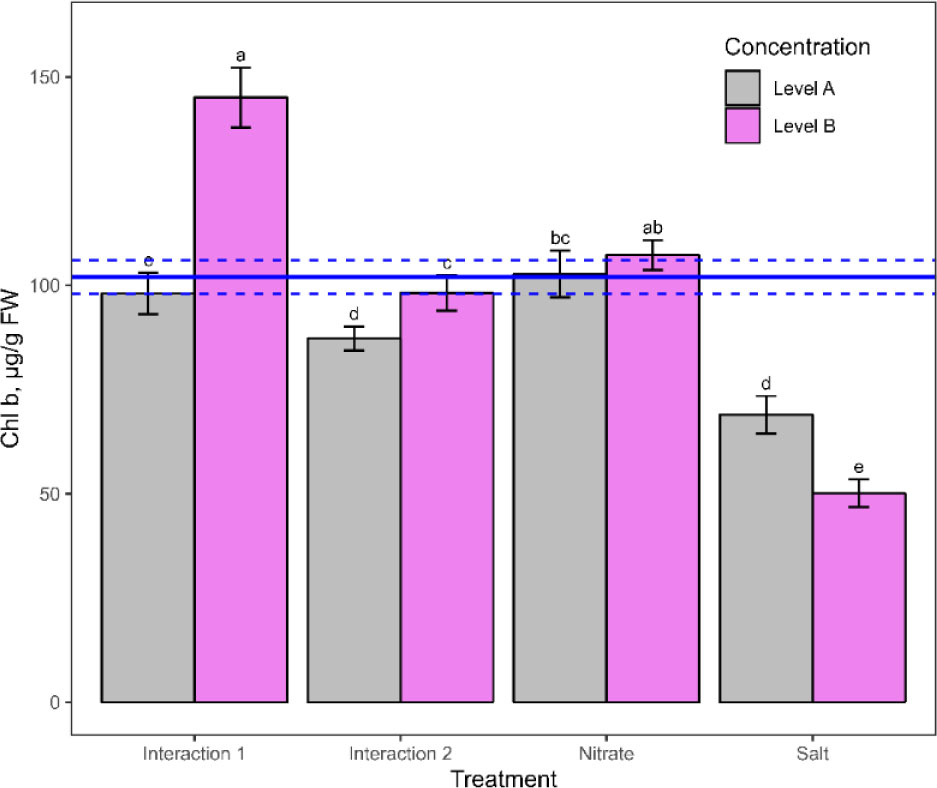
Figure 6.
Chlorophyll b content in lettuce leaves depending on treatment and concentration
ANOVA: Treatment: Concentration – p < 0.001. Values are expressed as means ± standard error (n=5). The control mean is shown by the blue line, the standard error by the blue dotted lines.
Compared to the 100 mM salt treatment, the 200 mM salt treatment led to a 27% decrease in Chl b content (68.9 ± 4.49 μg/g FW “cd” vs 50.1 ± 3.33d μg/g FW “d”). Compared to the control (102 ± 3.92 μg/g FW), salt concentrations of 100 mM led to a 32% decrease in the Chl b content (68.9 ± 4.49 μg/g FW “cd”), and a concentration of 200 mM led to a 51% decrease (50.1 ± 3.33d μg/g FW “d”). The application of 20-mM and 40-mM nitrate solutions contributed to only an insignificant Chl b increase of 1% (103 ± 5.59 μg/g FW “b”) and 5% (107 ± 3.55 μg/g FW “b”).
The Chl b content increased significantly in the interaction groups, however. Compared to the 100 mM salt group (68.9 ± 4.49 μg/g FW “cd”), the Chl b content increasing were 42% and 110% with using 20 mM nitrate (98.0 ± 4.95 μg/g FW “b”) and 40 mM nitrate (145 ± 7.18 μg/g FW “a”), respectively. Compared to the 200 mM salt group (50.1 ± 3.33d μg/g FW “d”), the Chl b content increased by 74% and 96% when using 20 mM nitrate (87.3 ± 2.89 μg/g FW “bc”) and 40 mM nitrate (98.1 ± 4.21 μg/g FW “b”), respectively.
The two-factor effect on Chl b was not so noticeable for both nitrate levels, nor for the “Salt 100 mM + Nitrate 20 mM” and “Salt 200 mM + Nitrate 40 m” groups. The use of nitrate as a mitigation agent did not affect this indicator significantly (the bars indicated as “bc and ab”. Only the means of the “Salt 100 mM + Nitrate 40 mM” (“a”) and “Salt 100 mM + Nitrate 20 mM” (“b”) groups differed significantly. Thus, we can conclude that the Chl b content increased by 48% (145 ± 7.18 μg/g FW “a” vs 98.0 ± 4.95 μg/g FW “b”) as a result of the 40 mM mitigation treatment. Only the treatment factor had an effect on the Chl a / Chl b ratio (p < 0.001, concentration: p = 0.297, treatment: Concentration – p = 0.151). Table 2 presents the results of the two-way ANOVA. Only the “Salt 100 mM” (“a”) group significantly differed from the “Salt 100 mM + Nitrate 40 mM” (“c”) treatment.
Table 2.
Chl a / Chl b ratio depending on two factors: treatment and concentration
| Treatment | Concentration | Ratio of Chl a / Chl b mean ± se | |
|---|---|---|---|
| 1 | Salt | Level A | 5.21 ± 0.350a |
| 2 | Salt | Level B | 5.03 ± 0.361ab |
| 3 | Nitrate | Level B | 4.38 ± 0.139abc |
| 4 | Nitrate | Level A | 4.18 ± 0.278abc |
| 5 | Interaction 1 | Level A | 4.11 ± 0.224abc |
| 6 | Interaction 2 | Level B | 4.08 ± 0.196abc |
| 7 | Interaction 2 | Level A | 3.96 ± 0.331bc |
| 8 | Interaction 1 | Level B | 3.16 ± 0.185c |
Compared to the control (146 ± 2.01 μg/g FW), the 100-mM and 200-mM salt treatments led to a decrease in the carotenoid content by 7.6% (135 ± 1.86 μg/g FW “d”) and 27% (106 ± 3.10 μg/g FW “e”), respectively (Figure 7).
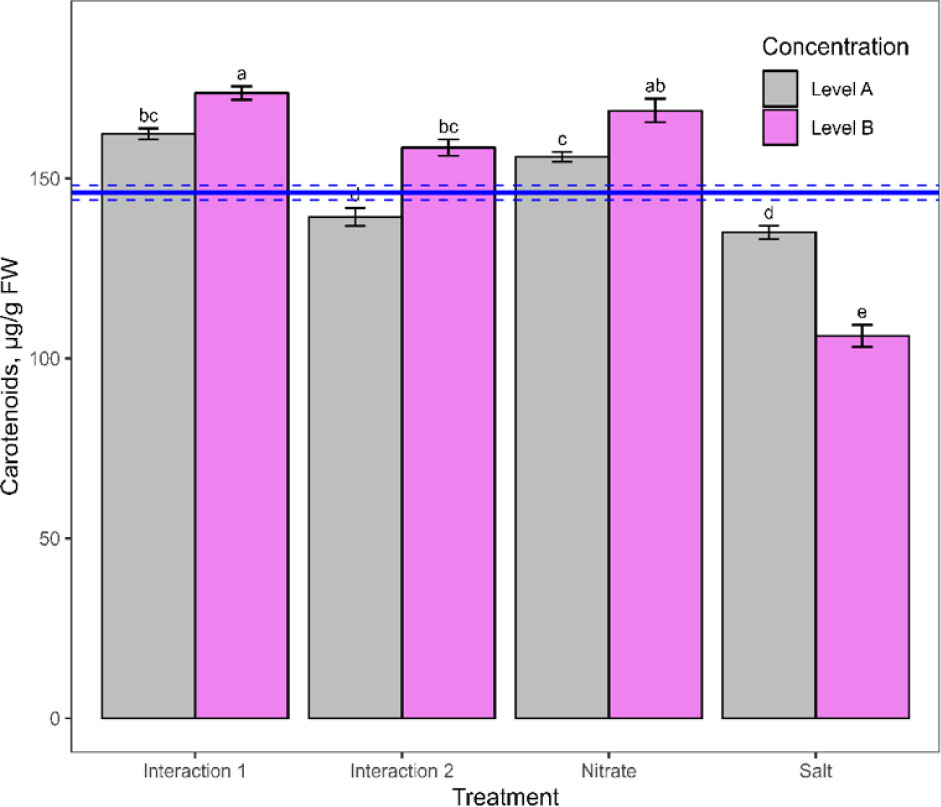
Figure 7.
Carotenoid content in lettuce leaves depending on treatment and concentration
ANOVA: Treatment:Concentration; p < 0.001. Values are expressed as means ± standard error (n = 5). The control mean is shown by the blue line, the standard error by the blue dotted lines.
In contrast, the application of 20 mM and 40 mM nitrate solutions resulted in increases in carotenoid content of 6.8% (156 ± 1.38 μg/g FW “c”) and 16% (169 ± 3.28 μg/g FW “ab”), respectively. The highest concentration of carotenoids was detected in the “Salt 100 mM + Nitrate 40 mM” group (174 ± 1.89 μg/g FW “a”). The group “Nitrate 40 mM” group had the second-highest concentration (169 ± 3.28 μg/g FW “ab”) and “Salt 100 mM + Nitrate 20 mM” had the third highest (162 ± 1.50 μg/g FW “bc”). In general, the mitigation effects of 20 mM and 40 mM nitrate were significant for both salt levels (Interaction 1 Level A, B and Interaction 2 Level A, B). Compared to the 100-mM-salt group (135 ± 1.86 μg/g FW “d”), the carotenoid content increased by 20% (162 ± 1.50 μg/g FW “bc”) with the 20-mM nitrate mitigation treatment and by 29% (174 ± 1.89 μg/g FW “a”) for the 40-mM nitrate treatment. Compared to the 200-mM salt group (106 ± 3.10 μg/g FW “e”), the carotenoid content increased by 31% (139 ± 2.49 μg/g FW “d”) for the 20-mM nitrate treatment and by 50% (159 ± 2.25 μg/g FW “bc”) for the 40-mM nitrate treatment.
The Chl/Car ratio decreased under salinity stress (Figure 8). However, supplementation with 40 mM nitrate at low salt stress, and with both nitrate concentrations at high salt stress, increased the Chl/Car ratio. This was mainly due to the positive effect of nitrate on Chl a and Chl b. The application of nitrate at a concentration of 40 mM completely neutralized the negative effect of the 100-mM salt solution. There was no significant difference between the “Nitrate 40 mM” (3.41 ± 0.058a) and “Salt 100 mM + Nitrate 40 mM” (3.44 ± 0.054a) groups. Moreover, the Chl: carotenoids ratio for the “Salt 100 mM + Nitrate 40 mM” group increased by 10% compared to the group “Salt 100 mM” (3.13 ± 0.036bc). The analysis also showed that the means of the “Salt 200 mM + Nitrate 40 mM” (3.12 ± 0.018c), “Salt 200 mM + Nitrate 20 mM” (3.08 ± 0.097c) and “Salt 100 mM + Nitrate 20 mM” (3.06 ± 0.016c) groups were all equal.
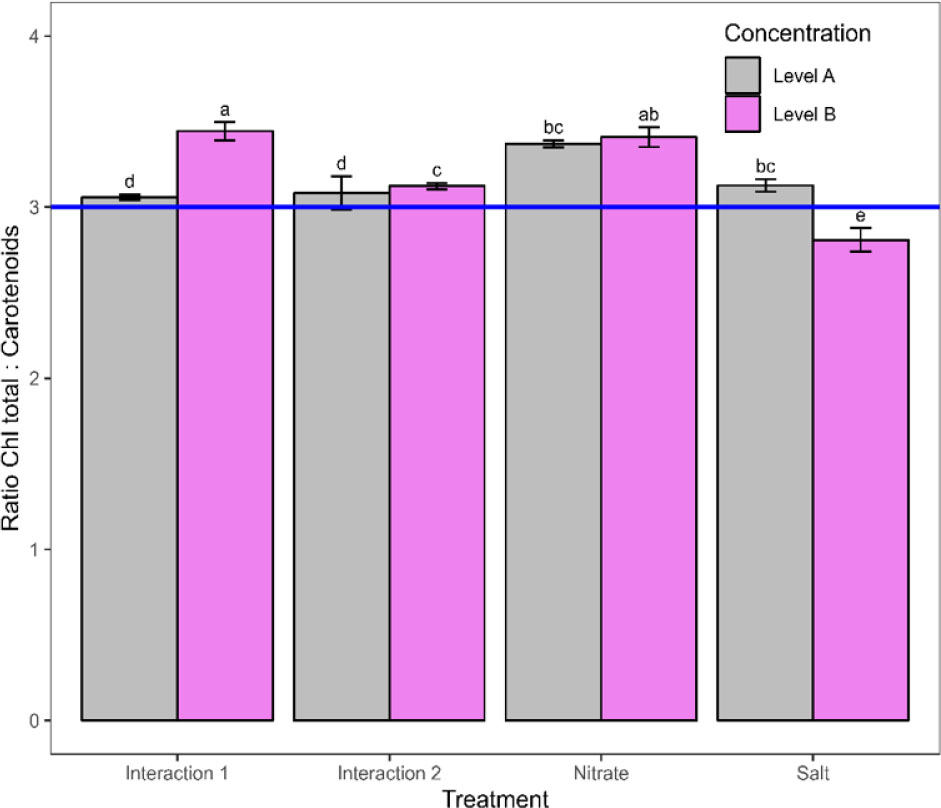
Figure 8.
The ratio of total chlorophyll to carotenoids depending on treatment and concentration
ANOVA: Treatment: Concentration – p < 0.001. Values are expressed as means ± standard error (n=5). The control mean is shown with the blue line, and the standard error with blue dotted lines.
3.5. Correlations
The MDA content in the lettuce was strongly negatively correlated with the content of total chlorophyll (r = −0.89, p < 0.001), chlorophyll a (r = −0.88, p < 0.001), carotenoids (r = −0.85, p< 0.001), and chlorophyll b (r = −0.77, p < 0.001) (Figure 9).
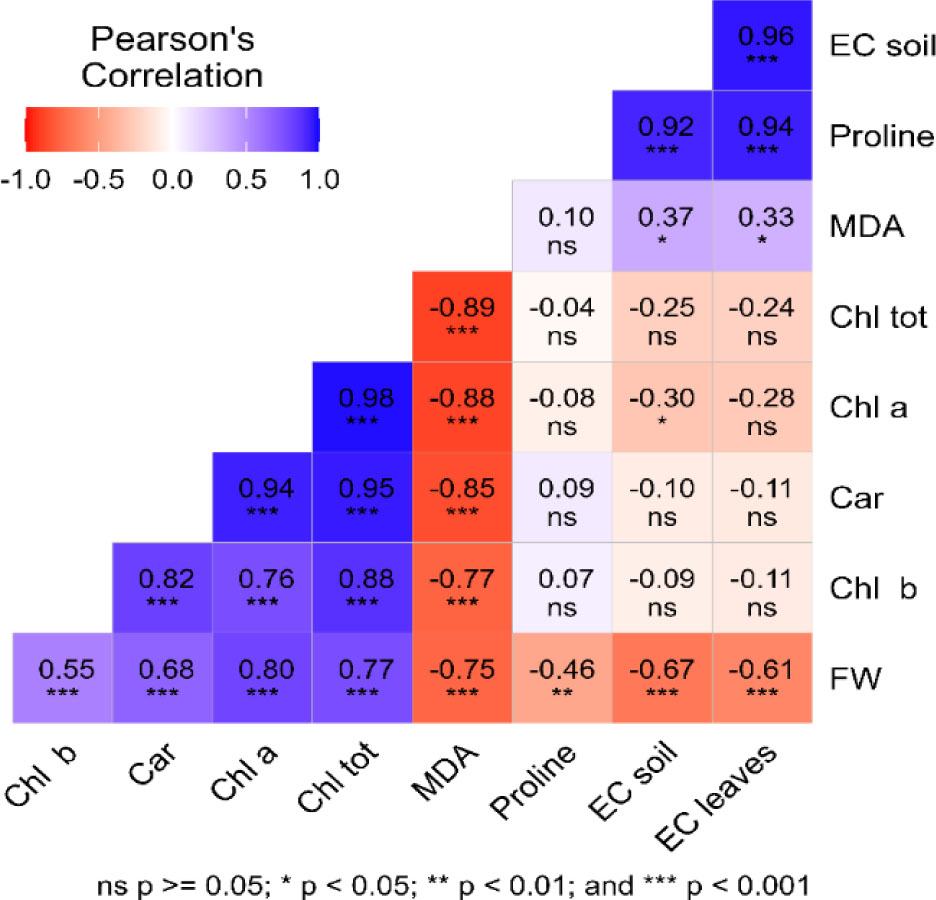
Figure 9.
Pearson's correlation matrix with p-values for MDA, proline, photosynthetic pigments, EC and FW
The MDA content demonstrated a weak positive correlation with the EC of the soil (r = 0.37, p < 0.05) and leaves (r = 0.33, p < 0.05). The pigments were strongly positively correlated with each other. The highest positive correlation coefficients were found for total chlorophyll and chlorophyll a (r = 0.98, p < 0.001), carotenoids (r = 0.95, p < 0.001) and chlorophyll b (r = 0.88, p < 0.001). The lowest positive correlation among pigments was for chlorophyll a and b (r = 0.76, p < 0.001). Proline was the only indicator that was not correlated with MDA and pigments (ns, p > = 0.05). It was, however, strongly positively correlated with the electrical conductivity of the soil (r = 0.92, p < 0.001) and leaves (r = 0.94, p < 0.001). The fresh weight (FW) of lettuce was positively correlated with the pigment content, especially chlorophyll a (r=0.80, p<0.001) and negatively correlated with the stress indicators (MDA and proline) and the electrical conductivity of soil and leaves.
4. DISCUSSION
4.1. Nitrate fertilizers as an antagonist of salt stress
Model experiments with growing lettuce under artificial salinity conditions were carried out with solution salinity levels ranging from 25 to 400 mM NaCl [Lucini et al. 2015; Shin et al. 2020; Zuzunga-Rosas et al. 2024]. We studied the mitigation and antagonist effect of the exogenous application of potassium nitrate (both 20 and 40 mM) on lettuce's physiological and common stress indicators under sodium chloride stress at both 100- and 200-mM saline concentrations. It must be recognized that knowledge of the processes of nitrate regulation of nitrogen remobilization has not yet been fully studied [Kant 2018]. NO3 is known to be involved in the alleviation of salt stress in plants as a signaling molecule [Alfatih et al. 2023]. Our results showed that exogenous application of potassium nitrate increased the tolerance of the lettuce to salt stress.
The data obtained on the content of MDA, proline, chlorophyll a, b and carotenoids in lettuce leaves under two different KNO3 treatments (20 and 40 mM) confirmed the feasibility of using nitrate fertilizers in plants as an inhibitor of salt stress or an activator of the antioxidant system.
Malondialdehyde (MDA) content in the cell is a common indicator used to assess the level of damage to the cell membrane due to lipid peroxidation [Miftahudin et al. 2020]. Low MDA levels in a cell indicate that the cell is more resistant to stress [Fu, Huang 2001]. Increased lipid peroxidation may be partly due to increased photorespiratory H2O2 production as a result of increased glycolate oxidase activity in the leaf peroxisomes of plants suffering from K+ deficiency [Houmani et al. 2022]. Thus, the more MDA is produced, the more sensitive the plant is to stress. The MDA level increased 40% and 104% in response to irrigation with 100 mM and 200 mM salt water, respectively. On the other hand, treatment with potassium nitrate at a dose of 40 mM reduced the MDA level in the 100-mM and 200-mM salt treatment to the control level, corroborating our hypothesis.
In contrast, leaf proline concentrations were increased by nitrate application to salt-stressed plants, particularly under 200 mM NaCl. Proline has the ability to form a stable radical and quench free radical reactions, including lipid peroxidation [Mittler 2002]. In this way, it helps the plant maintain a dynamic balance between ROS formation and antioxidant enzyme activity by protecting enzymes, photosynthetic apparatus and cell membranes from ROS, thereby increasing the plant's resistance to salinity [Ben Ahmed et al. 2012; Hayat et al. 2012].
Proline, as a multifunctional amino acid, requires bioavailable nitrogen for its construction [Szabados, Savouré 2010; Moukhtari et al. 2020]. In our case study, it was clear that the potassium-nitrates amendment activated and maintained the immune and antioxidant systems of lettuce plants in a combat-ready state. Salt stress inhibits photosynthesis in plants by affecting the chloroplast ultrastructure, photosynthetic apparatus, the electron transport chain, and photophosphorylation process [Goussi et al. 2018]. In our experiment, the increased MDA content in lettuce cells was negatively correlated with the general indicators of plant health — namely, the content of photosynthetic pigments. The proline content was not correlated with the content of photosynthetic pigments and MDA; this may be related to the fact that proline is one of many non-enzymatic, low-molecular-weight compounds participating in the elimination of excess amounts of ROS, and that it is an important compatible solute during osmotic stress. Thus, the proline concentration is an indicator of the general effects of salinity on cell metabolism, rather than being associated with any specific metabolic process. A strong positive correlation was found between proline and the electrical conductivity of soil and leaves (salinity). This is consistent with the finding that both individual and mixed application of chloride and nitrate caused an increase in proline levels in lettuce.
It is worth noting that the combined effect of salt and nitrate was significantly higher than the individual effect of each. Apparently, the additive accumulative effect is caused by two opposite mechanisms: release of proline from proteins (protein degradation) under the influence of salt (NaCl) stress, and intensive synthesis of proline under the influence of nitrate. The MDA content showed a weak positive correlation with the soil and leaf electrical conductivity (salinity), with the bars for 100 mM salt and 200 mM salt indicating that 1) potassium nitrate and sodium chloride have completely different effects on plants; 2) nitrate is an antagonist of chloride, and potassium (K) is an antagonist of sodium (Na); and 3) there are complex mechanisms of activation of the plant antioxidant system associated with exogenous application of nitrate as an important nutrient and building material of enzymatic and non-enzymatic antioxidants.
4.2. An optimal fertilization strategy for growing lettuce under greenhouse conditions
The limitations of modern agriculture have highlighted the need to develop optimal fertilization strategies to meet food security and environmental protection needs. At the same time, the use of potassium nitrate as a means of compensating for salt stress risks creating excessive nitrate content in lettuce leaves. It is known that the European Union has imposed restrictions on nitrate levels some commercially traded leaf vegetables, including lettuce [European Commission, 2011]. Reducing nitrate concentrations in vegetables grown in nutrient solutions has significantly reduced nitrate accumulation in hydroponic lettuce [Liu et al. 2011; Wang, Shen 2011]. Decreasing the ratio of nitrate to other nitrogen sources, or replacing nitrate ions with chlorides, has resulted in a 20 – 40% reduction in nitrate concentrations in the leaves of hydroponic vegetables [Urlic et al. 2017].
Rocket salad, as a leaf vegetable, has a short production cycle and can accumulate nitrate in its leaves at levels considered potentially toxic to human health [Santamaria et al. 2001]. Mitigation measures include removing some or all of the nitrate nitrogen from the nutrient solution a few days before harvest.
For two varieties of lettuce (Valerianella locusta L. Laterr.) grown in a floating system in a greenhouse, replacing the nutrient solution with rainwater three days before harvest resulted in a reduction in leaf nitrate content by one-third [Gonnella et al. 2004]. Thus, the choice of more efficient lettuce genotypes, along with adjustments to the nitrogen fertilization process, may help minimize the risks in leafy vegetables of yield losses from irrigation with saline water and exceeding nitrate standards [Di Gioia et al. 2017].
5. CONCLUSION
The data obtained demonstrated that soil salinity leads to significant lipid peroxidation in lettuce cells. It is also obvious that the simultaneous application of saline and nitrate solutions resulted in the greatest increase in proline content. Soil treatment with NaCl had the most significant negative impact on lettuce leaves' fresh weight, as well as the Chl a and carotenoid content in lettuce leaves. The lettuce's MDA content was strongly negatively correlated with carotenoid content (Chl a and Chl b). When irrigated with saline solution, soil treatment with nitrate at a concentration of 40 mM contributed to a significant decrease in oxidative stress, as indicated by the lower MDA content (29% lower with 100 mM of saline solution and 47% lower with 200 mM). Compared to saline soil (treated with 100 mM and 200 mM of salt), 20 mM and 40 mM nitrate treatment contributed to increases in proline content of 29 – 171% and 64 – 173%, respectively. Treatment of artificially saline soil with nitrate at a concentration of 40 mM significantly also contributed to the restoration of the lettuce's Chl a, b and carotenoid levels up to the control level.
Thus, amendment of saline soil with potassium nitrate can alleviate NaCl stress via reducing oxidative stress and promoting the accumulation of protective, compatible solutes, such as proline. The use of potassium nitrate as a salt stress mitigation method seems less risky for lettuce cultivation in hydroponic systems and greenhouse conditions when part or all of the nitrate nitrogen is removed from the nutrient solution a few days before harvesting.
ACKNOWLEDGMENTS
This case study was supported by DAAD-Programme “Ostpartnerschaften” (“Subject related Partnerships with Institutions of Higher Education”), German Academic Exchange Service.
Funded by the European Union. Views and opinions expressed are, however, those of the author(s) only, and do not necessarily reflect those of the European Union or the European Education and Culture Executive Agency (EACEA). Neither the European Union nor the granting authority can be held responsible for them.