
1. INTRODUCTION
In places with a significant accumulation of raw rock materials and convenient conditions for their exploitation, specialised industrial centres have been established for the extraction and processing of the raw material into a finished product (e.g, cement, lime, lime meal, chalk, or aggregates). Facilities of this type, grouped in international producer groups such as Lhoist, Dyckerhoff, Holcim, and Lafarge, operate in Poland in the larger centres: Gdynia, Bielawy, Ożarów, Strzelce Opolskie, Kraków, Chełm, Nowiny, Małogoszcz. There are also a dozen or so smaller ones, such as Celiny in the Świętokrzyskie Voivodeship. The mining history of the study area began after the concession for the extraction of Jurassic limestone from the “Celiny I” deposit was obtained on 1.07.2003. The mining area had a surface area of 27 ha, while the space where there were anticipated to be harmful effects from the mine's activities — i.e. the mining area [Geological and Mining Law of 9 June 2011] — was defined at over 130 ha. The first concessionaire was Przedsiębiorstwo Robót Inżynieryjno-Drogowych, or “MAKADAM” S.A. [Midas Database]. The company currently mining, Kopalnia Granitu Kamienna Góra Celiny sp. z o.o., became the legal successor to the concession to exploit the deposit through a notarial deed dated 19.09.2007. The currently exploited mining area “Celiny V” has an area of 72,65 ha and a mining area of almost 150 ha. Mining in this plant is carried out by open-pit, longwall system, using blasting technique with explosives, in accordance with the Local Development Plan [MPZP 2008]. An exception is the north-eastern part of the deposit, which, in order to ensure safety for the national road and detached houses, is mined using the mechanical method. The first, second and third levels of exploitation have footwall ordinates of 275 m a.s.l., 264 m a.s.l. 253 m a.s.l, respectively. Mining is carried out above the aquifer; the plant does not have a permit to dewater the lode. There is a protective shelf above the water table with a thickness of approximately 2 meters.
The main objective of this study is to determine the magnitude of dust deposition and its impact on precipitation properties in the vicinity of rock mining in Celiny near Kielce (Figure 1, Table 1). Of particular interest was the direct influence on atmospheric air. A quantitative and qualitative analysis of dust deposition in the vicinity of the plant was carried out as part of the study, along with microphotographic imaging of the deposited material. Exposure to dust, especially crystalline silica, poses a health risk, potentially causing pneumoconiosis — one of the oldest occupational diseases. Dust pneumoconiosis has been classified by the European Occupational Disease Statistics as the sixth-most-common respiratory disease. Dusts from the many different stages of mining (drilling, crushing, transport, etc.) can also adversely affect the population and the environment around the mine [Misra et al. 2023]. In addition, occupational exposure to respirable crystalline silica (SiO2) is one of the most common and serious occupational health risks for workers grinding silica composites, from which kitchen worktops and windowsills are made [Requena-Mullor et al. 2021].
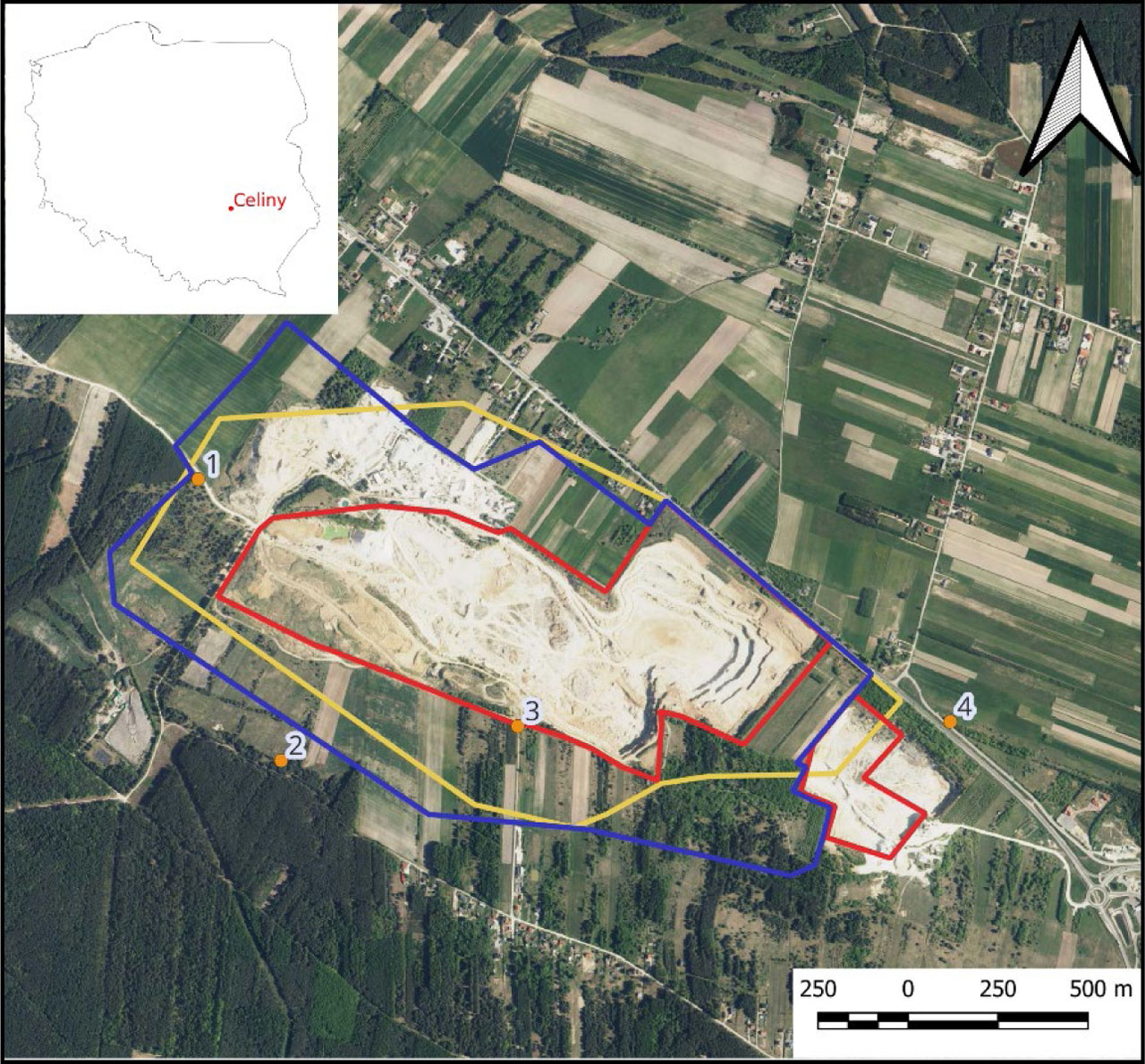
Figure 1.
Location of the study area (own compilation based on QGIS)
2. STUDY AREA AND METHODS
The study area is located in the Szydłów Foothills mesoregion; in the southern part of the Kielce Upland microregion; in the central part of the Małopolska Upland subprovince; and in the Polish Uplands province [Richling et al. 2021]. The neighbouring mesoregions are Świętokrzyskie Mountains (to the north and east); Połaniec Basin (to the south); and the Nida River Valley (to the west) [Strzyż 2021]. The morphology of the Szydłów Foothills is characterised by gentle hills in the NW-SE direction, punctuated by local river valleys [Spiżewski, Turkowski 2002]. The studied area is situated, tectonically, on the West European platform; in the south-eastern part of the Szczecin-Miechów synclinorium; and in the Miechów segment [Żelaźniewicz et al. 2011]. The object of exploitation is a deposit of Upper Jurassic Oxfordian and Kimmeridgian fracture limestones [Mądry, Salwa 2020], with intercalations, named “Celiny I.” It has a depositional form. The minerals belong to the “broken and blocky stones” group; according to the National Resource Classification nomenclature, it is a deposit of limestone building and road stones [Midas Database], but the extracted raw material is also used in agriculture [Przeniosło et al. 2005]. Stratigraphically, the limestone belongs to the upper rocky limestone [Kutek 1969]. It has a mean thickness of 54.4 m. The proportion of karst in the deposit was determined to be 4.5 per cent, while 14.8 per cent is made up of all non-useful overgrowth [Midas Database]. The deposit is saturated below the ordinate of 253 m a.s.l.
The exposed container method, using vessels of known volume and defined catchment surface area deployed in the field, was used to measure bulk precipitation (Figure 1, Table 1). The coordinates of the points are provided in Table 1. Samples were taken on a monthly basis from June 2023 to May 2024. The volume of each collector was 5 dm3 and the top area was 0.1194 m2. The volume of bulk precipitation was measured and then filtered (with paper filters, round, diameter = 185 mm, average seepage rate) at the Environmental Research Laboratory of UJK in Kielce. The filtrate was subjected to chemical analysis using liquid chromatography (single sample averaged from all points), while the paper filter was dried for 24 hours at 65°C in a thermostatic cabinet (POLEKO 6) and weighed on an analytical balance — KERN PJR 220 (particulate mass). The solids remaining on the walls and bottom were rinsed with distilled water. A DIONEX ICS-3000 ion chromatograph IonPac CS16 with 3×250 mm (cations) and IonPac AS18 2×250 mm (anions) analytical columns was used to determine the chemical composition. The analytical instrument was validated with certified reference material [Dionex Seven Standard Thermo no. 057590]. Scanning electron microscopy (SEM) was used to image the particulate matter deposited at the measurement points, and energy-dispersive spectrometry (EDS) was used to determine the chemical composition. The surface area of glass fibre filter (Whatman GF/D) used to prepare samples for ion analysis was analysed at different magnifications from ×1000 to ×5000. Numerical data were collated and analysed using MS Office Excel (version: 2404). Meteorological conditions in the study area were determined on the basis of data from the IMGW Kielce-Suków station, while immission data came from the station of the Chief Inspectorate of Environmental Protection – Gołchów-Ujęcie Wody. The study area is non-urban, sits at an elevation of 270 m a.s.l., and serves as a background air quality monitoring station. It is located approximately 7 km southwest of the plant. For the purposes of this study, an analysis of PM10 immission data was carried out [CIEP Measurement Data Bank], (Figure 2).
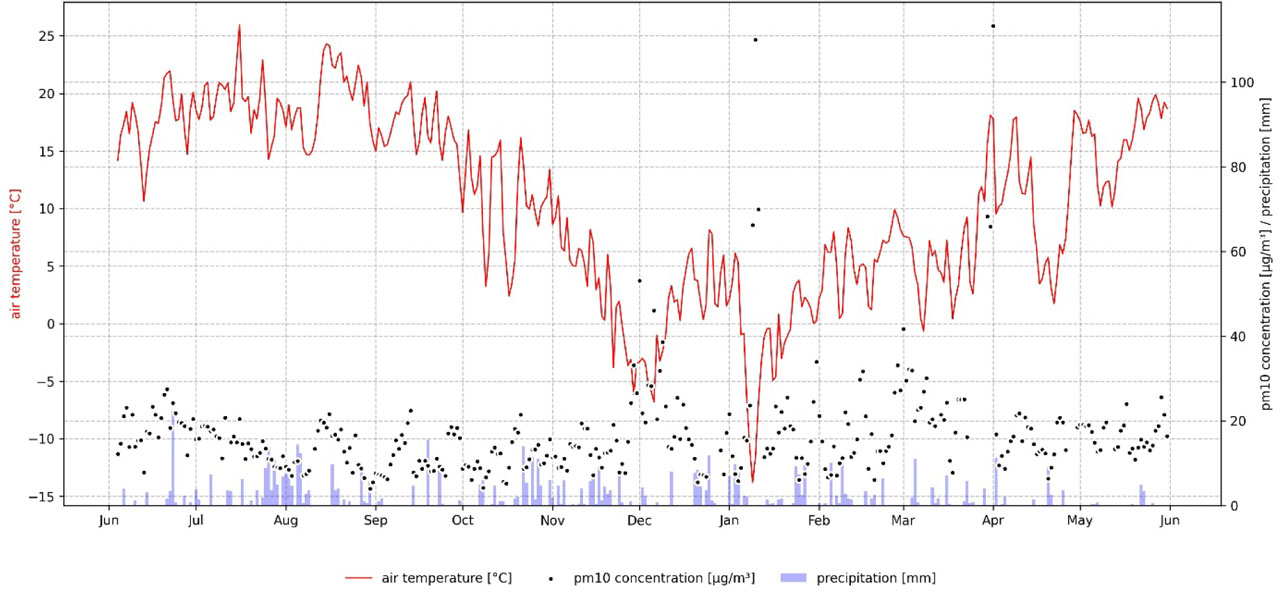
Figure 2.
Daily concentration of PM10 dust against mean air temperature and daily precipitation totals during the study period (own elaboration, based on IMGW and CIEP data)
3. RESULTS
The study area lies in a predominantly westerly wind zone. Total precipitation at the time of the study reached 628.6 mm (IMGW). The average air temperature was 10.5°C. According to data obtained from IMGW, the month with the most rainfall was August 2023 (90 mm) and the month with the lowest was May 2024 (10.4 mm). The highest mean monthly air temperature was in August 2023, and the lowest was in January 2024. During the period covered by the study (June 2023 to May 2024), the alert level air-quality level of 150 μg/m3 was not exceeded, but the information level of 100 μg/m3 [Regulation…2012] was reached twice (Figure 2). The highest recorded value was 113.3 μm/m3 on 01.04.2024. The permissible level was exceeded seven times — once in 2023 (1st of December) and six times in 2024 (9th, 10th, and 11th of January; 30th and 31st of March; and 1st of April).
The surveys showed the presence of ions with concentrations in the following descending sequence, from highest to lowest: Ca2+ > SO42− > NO3− > Cl− > Mg2+ > K+ > NH4+ > Fe3+. The highest concentrations of most ions occurred in September, with chloride (Cl−) reaching 29.16 mg/l, sulphates (SO42−) at 31.68 mg/l, sodium (Na+) at 20.50 mg/l, magnesium (Mg2+) at 19.85 mg/l, and calcium (Ca2+) as high as 72.24 mg/l (Table 2). In the same month, high concentrations of potassium (K+: 3.87 mg/l) and nitrate (NO3−: 12.8 mg/l) were also recorded (Figure 3). The annual average values of the individual ions were: 4.05 mg/l Cl−; 5.50 mg/l SO42−; 4.39 mg/l NO3−; 3.07 mg/l Na+; 0.91 mg/l NH4+; 2.59 mg/l Mg2+, 1.85 mg/l K+; and 19.34 mg/l Ca2+. Iron concentration (Fe3+) was measured in only one case (August, VIII – 0.0743 mg/l).
Table 2.
Average monthly concentrations of the main ions calculated based on the determination in 4 collectors (n.a. = below detection level)
| Ions | Cl− | SO42− | NO3− | Fe3+ | Na+ | NH4+ | Mg2+ | K+ | Ca2+ | OA |
|---|---|---|---|---|---|---|---|---|---|---|
| Unit | mg/l | mm | ||||||||
| VI | 1.32 | 2.23 | n.a. | n.a. | 1.22 | 0.27 | 0.51 | 1.33 | 9.23 | 5.86 |
| VII | 0.00 | 0.00 | n.a. | n.a. | 0.80 | 0.24 | 0.54 | 0.65 | 11.34 | 20.66 |
| VIII | 1.58 | 3.79 | 0.15 | 0.0743 | 1.38 | 0.52 | 0.75 | 1.49 | 20.42 | 4.50 |
| IX | 29.16 | 31.68 | 12.78 | n.a. | 20.50 | 0.66 | 19.85 | 3.87 | 72.24 | 6.85 |
| X | 1.93 | 2.29 | 16.50 | n.a. | 1.49 | 2.60 | 1.34 | 5.68 | 19.74 | 19.45 |
| XI–XII | 0.74 | 0.82 | 1.33 | n.a. | 0.64 | 0.97 | 0.05 | 0.14 | 0.48 | 30.03 |
| I | 1.05 | 1.11 | 1.35 | n.a. | 0.78 | 0.78 | 1.10 | 0.25 | 8.23 | 12.35 |
| II | 0.61 | 1.34 | 2.27 | n.a. | 0.66 | 1.66 | 0.22 | 0.26 | 2.72 | 10.26 |
| III | 3.01 | 8.17 | 0.12 | n.a. | 1.89 | 1.11 | 0.36 | 1.02 | 12.86 | 3.20 |
| IV | – | – | – | n.a. | – | – | – | – | – | – |
| V | 1.12 | 3.52 | 0.62 | n.a. | 1.29 | 0.26 | 1.20 | 3.78 | 36.14 | 4.61 |
| Average annual value | 4.05 | 5.50 | 4.39 | 0.07 | 3.07 | 0.91 | 2.59 | 1.85 | 19.34 | 11.78 (117.77 in total) |
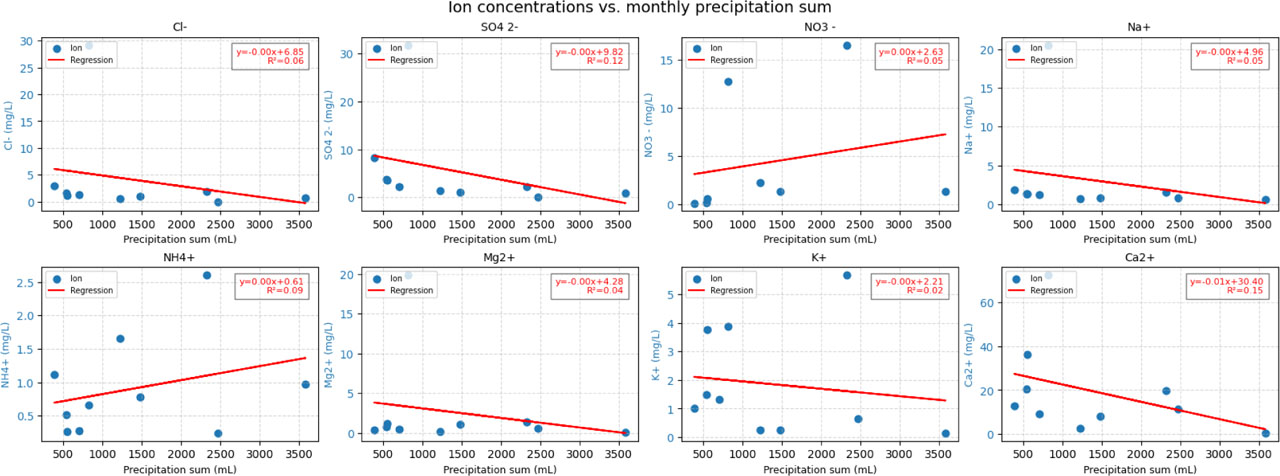
Figure 3.
Ion concentration vs. monthly precipitation sum
In the course of the study, only the April sample was collected without wet precipitation. It was categorised as a dry precipitation sample with weight that varied from point to point ranging from 0.0751 g (point 2) to 0.2576 g (point 1), with an average of 0.1354 g. The highest particulate mass in total precipitation was obtained in the months of May and August (Table 3). The point with the highest particle capture during the test year was point 1. The average value for all points over the whole test period was calculated to be 0.1370 g per month and 1.05 g/m2 per month. Adding up the dust mass from the entire study period and dividing it by the total inlet area of the collectors yielded a value of 11.3 g/m2 per year.
Table 3.
Mass of particulate matter in bulk precipitation
| Point number | 1 | 2 | 3 | 4 | Average value for the month |
|---|---|---|---|---|---|
| Unit | g | ||||
| VI | 0.5144 | 0.7759 | 0.3654 | – | 0.5519 |
| VII | 0.1488 | 0.057 | – | 0.0335 | 0.0798 |
| VIII | 0.1961 | 0.0920 | 0.2401 | 0.2547 | 0.1957 |
| IX | 0.0268 | – | 0.0195 | 0.0531 | 0.0331 |
| X | 0.0556 | 0.0220 | 0.0654 | 0.0945 | 0.0594 |
| XI–XII | 0.0284 | 0.0399 | – | 0.0569 | 0.0417 |
| I | 0.0124 | 0.0274 | 0.1792 | 0.0046 | 0.0559 |
| II | 0.0368 | 0.0321 | 0.0403 | 0.0303 | 0.0349 |
| III | 0.1182 | 0.0530 | 0.0640 | 0.0650 | 0.0751 |
| IV | 0.2576 | 0.0751 | 0.0877 | 0.1205 | 0.1354 |
| V | 0.5478 | 0.1310 | 0.1117 | 0.1314 | 0.2305 |
| Annual average | 0.1643 | 0.1121 | 0.1304 | 0.0820 | 0.1370 |
The concentrations of major ions varied over the study period, with Ca2+ showing the highest mean concentration (≈ 19.3 mg/L, max 72.2 mg/L), likely reflecting the influence of local mineral dust sources (Table 2). Other ions, including Cl−, SO42−, Na+, and K+, exhibited lower but still variable concentrations. Correlation analysis with monthly precipitation sums (OA) showed that some ions, such as Ca2+ (a ≈ −0.39) and Na+ (a ≈ −0.23), were negatively influenced by precipitation, indicating a partial dilution or washout effect during months with higher rainfall (Figure 3). In contrast, NH4+ shows a positive correlation (a ≈ 0.30), suggesting that local emissions or atmospheric chemical processes may play a larger role in its variability, while SO42− exhibits a moderate negative correlation (a ≈ −0.34). Temporal trends highlight seasonal patterns; for example, Ca2+ concentrations are higher in September, and this may correspond to increased dust transport or dry deposition events.
The mass of particulate matter from individual collectors shows a noticeable spatial variability, with mean values ranging from 0.08 g (Collector 4) to 0.18 g (Collector 1), and standard deviations indicating heterogeneous deposition across collection sites (Figure 4). Mean PM across all collectors remains relatively stable ( ≈ 0.14 g), while negative correlations with precipitation (a = −0.25 to −0.38 for individual collectors and a = −0.41 for mean PM) indicate that higher rainfall totals reduce airborne particulate matter through washout or dilution.
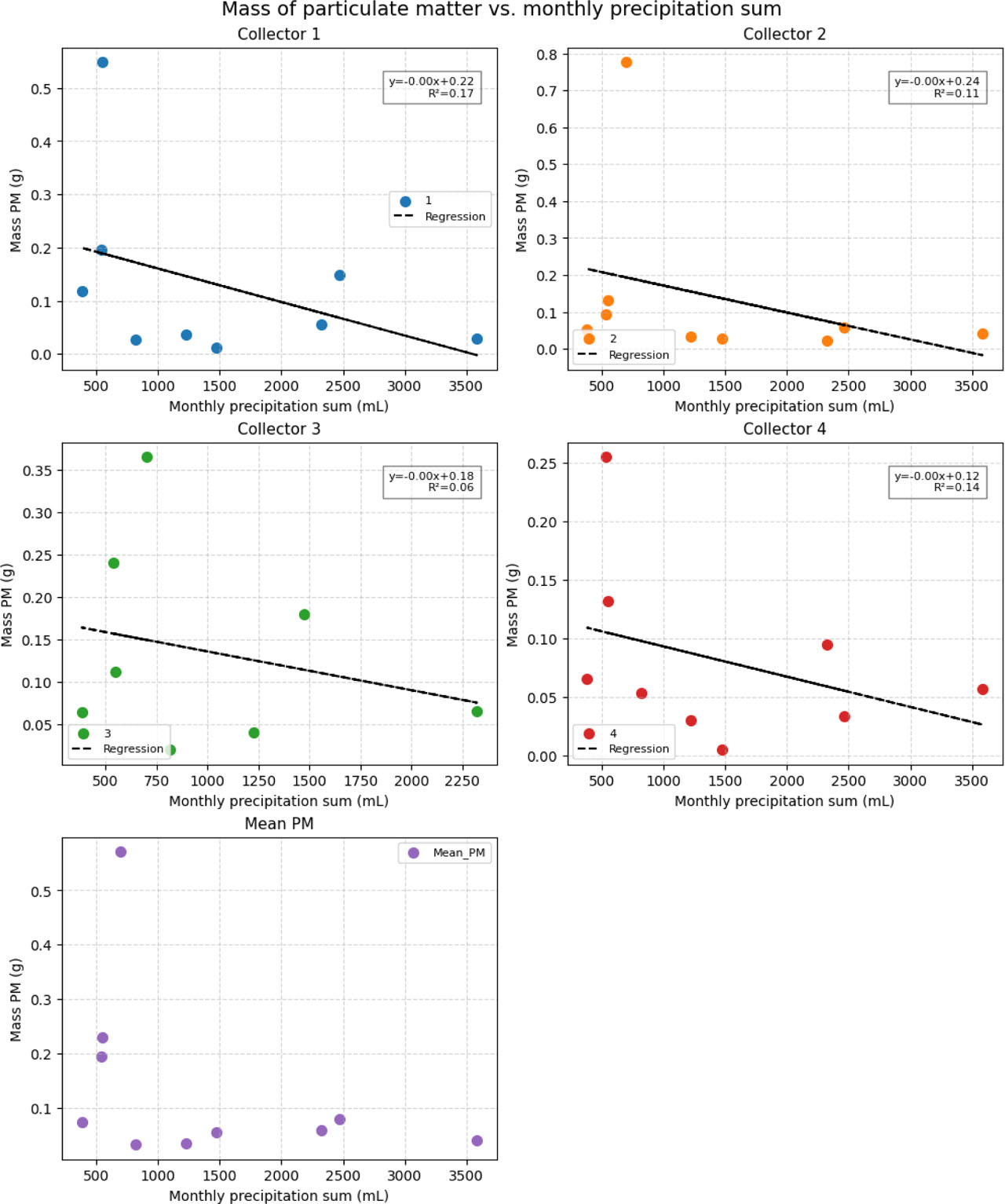
Figure 4.
Mass of particulate matter (PM) vs. sum of monthly precipitation
Combining the chemical composition of rainwater with particulate matter data highlights the interplay between atmospheric inputs and precipitation dynamics. Presence and concentration of ions such as Ca2+ and Na+ is influenced primarily by local dust sources, although Na+ may partly include long-range background contributions, and particulate matter deposition patterns reflect spatial heterogeneity and the mitigating effect of rainfall. The observed temporal and spatial variability in both ion concentrations and particulate matter underscores the importance of multi-collector sampling for capturing fine-scale differences in atmospheric deposition. These findings allow for a comprehensive assessment of the chemical and particulate characteristics of precipitation, which is critical for understanding deposition processes, potential nutrient inputs, and pollutant transport in the area under study.
In the SEM image (Figure 5), the long, densely-packed silicic fibres, from which the filter is made, are the most numerous. Sharp-edged and spherical figures are also visible. The dimensions of most of these are between 20 and 50 μm. An analysis of the chemical composition of the deposited dust on the quartz filter was performed using EDS.
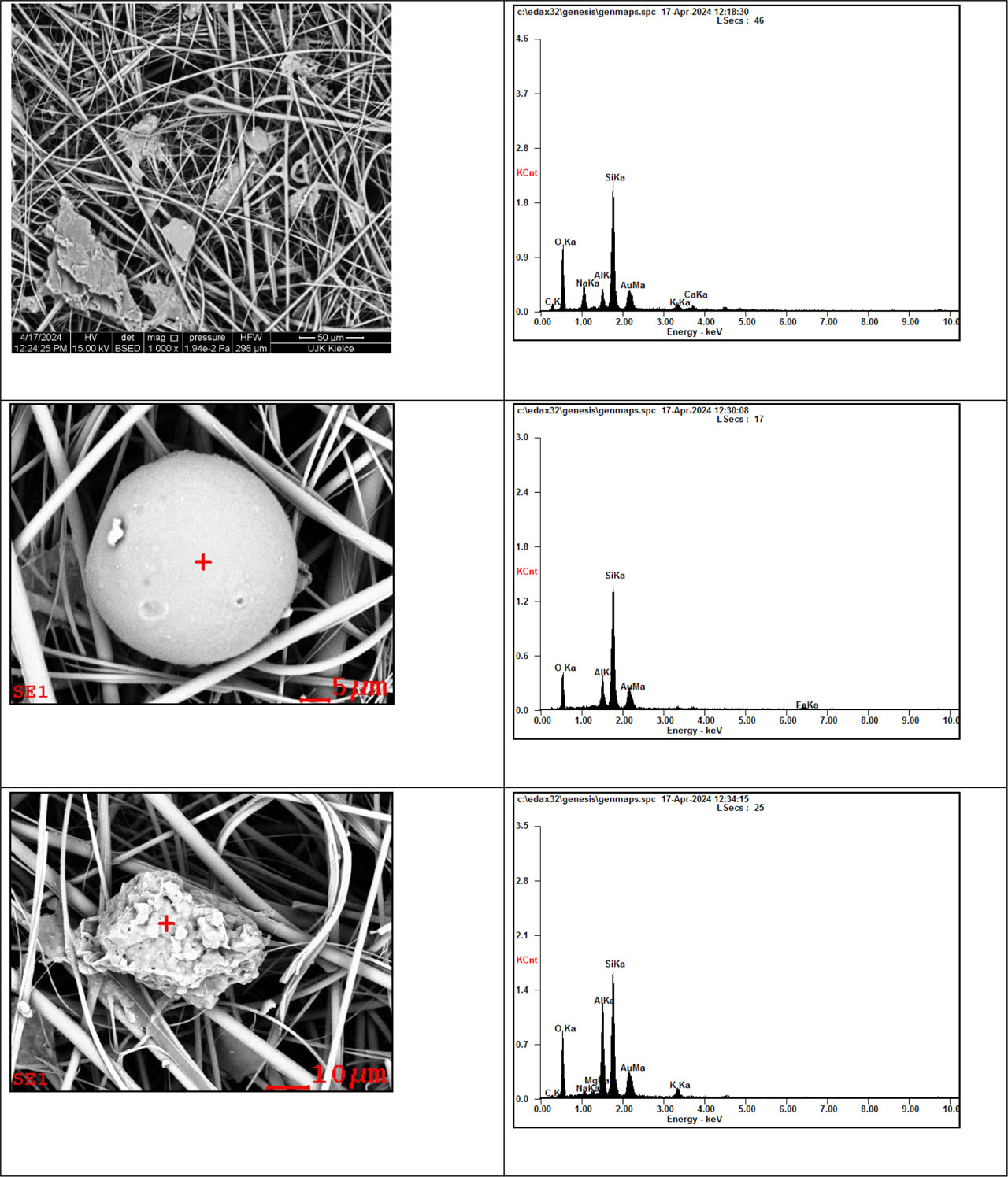
Figure 5.
EDS analysis of exemplary objects
Silicon was dominant in the particle composition in round and more complex particle shapes, along with aluminium, iron, sodium, calcium and magnesium. The sample shown in Figure 5 originates from site 4 and was collected in March. The microphotographs and spectrograms illustrate features characteristic of samples taken around the plant, which were also observed in the remaining samples.
4. DISCUSSION
Dust in a rock mining area comes from one of two sources: the excavation process (primary) and transport (secondary). Existing orographic barriers and dense forest complexes, together with meteorological conditions, have a modifying effect on the deposition value [Aufar, Emil 2023]. The reference value for PM10, set at 40 μg/m3 per year, was not exceeded; for Celiny during the study period; it was 16.7 μg/m3. The daily limit value of 50 μg/m3, however, was exceeded 7 times [Regulation…2012]. Analysis of the total precipitation and solids deposited on the surface of the filters showed varied precipitation water chemical composition, shape and particle size.
The data obtained from the April samples as part of this study was compared with the results of similar work carried out within open-pit mines. Jóźwiak [2013] used deposition collectors to conduct quantitative studies of dust fallout in the vicinity of the mine in Łagów, and collected a mass of precipitation there that was 3 to as much as 121 times higher. There are also greater disparities between the largest and smallest amount of dust intercepted during each study; in Jóźwiak's study, it was as high as 233.8 g/m2 per year (196 times higher) and in Celiny, it was only 4.4 g/m2 per year (17 times higher). The present study also covered the area in closer vicinity to the mining plant and the stony access road to the mine (secondary emissions). The amounts of precipitation detected there reach values exceeding the reference value by as much as 14 times.
In the Świętokrzyskie Voivodeship, studies of the physical and chemical properties of snow in the vicinity of the town of Łagów have been conducted by Szwed and Kozłowski [2022]. Thirteen measurement points were established over an area four times larger than that of the present study. Samples were taken twice at a two-week interval. Both the averaged and maximum values turned out to be much lower than in the analysis carried out in the present study. There was also a discrepancy in the descending ion sequence, with SO42+ ranking fourth in the analysis from the scientists from Kielce, and second in the study of the Celiny mine.
The observed positive correlation in the present study between NH4+ and NH3 (a ≈ 0.30) is consistent with the findings of previous studies. The literature indicates that the variability of particulate NH4+ is strongly influenced by local and regional emissions of NH3, which is its primary gaseous precursor [Seinfeld, Pandis 2016; Aneja et al. 2001]. Numerous field measurements have demonstrated clear positive correlations between NH4+ and NH3 (R = 0.6–0.8) resulting from the conversion of ammonia into ammonium salts (such as ammonium sulphate and ammonium nitrate) through the neutralization of inorganic acids present in the atmosphere [Diao et al. 2022]. This indicates that both local NH3 emissions and atmospheric chemical processes play a key role in shaping the variability of NH4+ concentrations.
The moderate or weak correlation between NH4+ and SO42− (a ≈ −0.34) is also consistent with observations reported in the literature. Many studies emphasize that this relationship strongly depends on the seasonal ratios of NH3, NO3−, and SO42−, as well as on the availability of inorganic acids (H2SO4, HNO3), which compete for reaction with NH3 [Wang et al. 2022; Guo et al. 2017]. A negative or weakened correlation may indicate that NO3− was the dominant anion associated with NH4+ during the analysed period, which is common in winter and in environments affected by strong local emissions of NOx and NH3 [Sun et al. 2016]. Additionally, it should be noted that the precursor of SO42−, SO2, often originates from industrial sources and long-range transport, which may lead to different temporal patterns compared with locally emitted NH3 [Zhang et al. 2018].
Overall, the correlation patterns observed in this study are in agreement with trends described in the literature, confirming that the variability of NH4+ concentrations is governed by the combined influence of regional chemical processes, local emission sources, and competition among inorganic anions involved in aerosol neutralisation.
Research into the environmental impact of open cast mines has also been conducted using other media. Common choices have been pine needles, bark, soil [Kozłowski et al. 2021] and lichens [Łubek 2010], due to their widespread occurrence in Poland and low tolerance to air pollution. SEM/EDS analysis of leaves and needles is also a frequent practise [Maňkovská et al. 2004, Szwed et al. 2020, Szwed et al. 2021]. Particles of similar shape, size and elemental composition to those identified on the foliage are found on filters. In the Celiny area, mineral particles with clay and silicon building round and more complex structures predominate. Their presence in the air is related to intensified mining activities and the natural weathering process of rocks and minerals. Substances dissolved and suspended in precipitation water have a significant impact on elements of the environment, including flora [Szwed et al. 2021, Szwed et al. 2020, Chudzińska, Prus-Głowacki 2005], soil [Barga-Więcławska, Świercz 2015], surface water [Gately et al. 2023], and microbiota [Pecoriano et al. 2015]. Artificial intelligence has made it possible to automate the detection of air pollutants and their sources [Szwed 2025, Szwed et al. 2025, Szwed et al. 2024], which could significantly reduce the time needed to perform analyses.
5. SUMMARY AND CONCLUSIONS
The monitoring of industrial activities is an important element in well-organised raw materials management practices, especially in areas lacking automatic measuring stations. A wealth of information is needed to develop awareness in both the authorities and the public. The chemical composition of atmospheric precipitation in the vicinity of the Celiny mine is strongly related to the profile of the economic activities carried out in the area. The analysis of PM10 dust concentrations did not exceed the alert and information levels, although the permissible level was exceeded several times during the year. The weighed amount of dust present in the total precipitation was not high. The use of scanning microscopy in this study has allowed for the identification of the main admixtures (pollutants), but can also allow for the identification of emission sources. The next part of the study will develop an intelligent detection model for selected objects (dust) using artificial intelligence. Further research at the described site, but also at similar sites, is still warranted.
Industrial activity monitoring remains essential, particularly in regions without automatic measuring stations, as it provides the data necessary for informed decision-making by authorities and for increasing public environmental awareness.
The chemical composition of atmospheric precipitation near the Celiny mine reflects the local industrial profile, indicating a clear link between emitted pollutants and ongoing economic activities.
Although PM10 concentrations did not reach the information or alert thresholds, exceedances of the permissible annual limits occurred several times, highlighting episodic but relevant air quality concerns.
The mass of dust present in total precipitation was relatively low, yet scanning electron microscopy effectively identified key particulate contaminants and demonstrated potential for tracing emission sources. Future work will focus on developing an intelligent detection framework for particulate matter using AI. Continued monitoring at this and other comparable sites is justified to better understand pollution dynamics and support better environmental management.