
1. INTRODUCTION
The observed increase in global temperature has led to heightened social awareness and compelled policymakers at all levels to take action in response to this global challenge. The issue is exacerbated by the global utilisation of fossil fuels, which dominate numerous sectors of the economy [Energy Institute 2024]. Local governments, particularly those in urban areas, have a significant role to play, given that their scope of responsibility and actions have been shown to have a considerable impact on the activities of their inhabitants [Gupta, Shukla 2024]. Cooperation with higher authorities has been demonstrated to increase the effectiveness of climate change mitigation [Masuda et al. 2022] and the effectiveness of adaptation to climate change and resilience [Wang, Chen 2024]. As asserted by Zheng et al. (2023), climate change mitigation policies may encompass a range of instruments, including those directed towards the development of renewable energy sources (RES) and the promotion of energy efficiency.
Poland is a medium-income economy that has undergone significant development and industrialisation, albeit at a rate that falls short of that observed in Western Europe. Poland has relatively high greenhouse gas emissions in comparison to other countries, both in absolute terms and as a percentage of GDP. This is primarily because the country's energy mix includes a substantial share of coal, with no incorporation of nuclear energy and a very limited potential for hydroelectricity and geothermal energy [Mączka et al. 2025]. As posited by Hadasik et al. (2025), further issues are constituted by the preponderance of road transportation and the inadequate energy efficiency of households, in conjunction with the inclement climatic conditions. Historical reliance on coal has led to the establishment of a narrative that positions fossil fuels as “traditional energy sources,” which are perceived as a source of stability and economic advantage during periods of energy crises [Kryszk et al. 2023].
The generation of power at conventional power plants is seldom determined at the level of local governments. However, the adoption of renewable energy sources (RES), particularly photovoltaics (PV), may be promoted by local authorities [Mey et al. 2016] and contribute to the development of the “smart city” concept [Yandem et al. 2025]. The decarbonisation of electricity consumed within the community can be achieved through on-site renewable generation, which is subject to limitations, or by procuring certified renewable electricity from an external provider [Breetz et al. 2022]. In order to achieve a more profound decarbonisation, the utilisation of additional electricity services, such as energy storage, may prove advantageous [Huang et al. 2024]. The assistance of local governments significantly enhances the adoption of renewable energy sources (RES). This enhancement is evident not only in the subsidiaries of local governments, such as educational institutions, but also among business entities and private individuals. Renewable energy development in Poland exhibits a geographically uneven distribution [Pelczar 2025]. As Tomczyk and Łapniewska (2025) demonstrate, the development of rooftop solar installations is occurring on a country-wide scale, irrespective of potential local incentives and barriers.
Another key area of responsibility for local governments is energy efficiency. This is an expansive issue, encompassing all aspects of energy use, from indoor lighting in schools [Muñoz-Viveros et al. 2024] to district heating [Kalina et al. 2025] and urban planning [Zhou et al. 2025]. Energy efficiency is a particularly salient aspect of climate change mitigation in urban areas, since it involves examining the manner in which energy is consumed. Consequently, this necessitates a critical analysis of urban activity and property. Energy efficiency has been demonstrated to have a significantly more extensive impact in comparison with the development of renewable energy sources (RES). This is due to the fact that it generally results in substantial financial savings and contributes to the enhancement of energy security and the reduction of energy poverty. Households in Poland have been found to have limited capacities and competences for decarbonisation of their buildings [Dańkowska et al. 2025], thus emphasising the role of the local government in addressing this issue.
The present study has been narrowed to focus on RES and energy efficiency, with the objective of facilitating a more profound comprehension of these two aspects. The present study has been conducted in small- and medium-sized towns (defined as urban areas with a population of less than 100,000 inhabitants). The rationale behind the decision to conduct research on small- and medium-sized towns is that this group is comparatively under-researched in comparison to larger urban areas on a global scale. A considerable amount of effort is invested in enhancing sustainability within major metropolitan areas and in specific economic sectors, such as electricity generation. As Neij and Heiskanen (2021) point out, there is a paucity of research on the role of small- and medium-sized towns in climate change mitigation. The adoption of RES is found to be less prevalent in regions characterised by lower population density in comparison to urban areas [Yudiartono et al. 2024]. As demonstrated by Brandoni et al. (2012), the successful development of renewable energy sources (RES) in urban areas is contingent upon enhanced communication between local government and the populace in small communities. However, the limited resources available, as well as a paucity of knowledge or inadequate awareness and motivation for change, may impede the willingness of authorities in small- and medium-sized towns to develop renewable energy sources and enhance energy efficiency.
In the present study, an investigation was conducted into the following factors that may influence the activity of small- and medium-sized towns' authorities in the development of RES and energy efficiency:
- town size,
- the level of awareness among town representatives and members of environmental departments (measured by their willingness to participate in webinars and workshops dedicated to RES and energy efficiency),
- the level of activity and the degree of pressure exerted by the town's inhabitants and non-governmental organisations (NGOs),
- requests and demands of higher authorities (regional and national).
The objective of this research is to evaluate whether municipal authorities in Polish towns are taking action to mitigate climate change. An investigation was conducted to ascertain the factors that contribute to the development (or absence thereof) of RES and energy efficiency. In instances where feasible, an attempt was made to quantify the influence of municipal size and other factors that may have an impact on such decisions. The objective of the present study was to propose policy measures with the aim of encouraging such effective action.
2. METHODS
The study was conducted through the distribution of surveys to 250 randomly selected small- and medium-sized towns in Poland. The sample selected for the survey has been meticulously designed to ensure geographical diversity. For each of the 16 voivodeships, 15–16 towns with populations below 100,000 inhabitants have been selected, thereby ensuring a comprehensive representation of the demographic and geographical diversity of the country. A set of questions was posed to town representatives (see Table 1) on the subjects of climate change mitigation and adaptation in their respective towns. The survey posed questions regarding the objectives and actions undertaken in the town, in addition to the presumed barriers to effective climate change mitigation and the potential methods to surmount those barriers. The survey instrument has been subjected to a validation process, which entailed consultations with representatives from three distinct towns. The towns that were consulted for the survey have not been included in the research sample.
Table 1.
Questions for town representatives and numerical values assigned to answers for statistical analysis
| Number | Question | Answers | Points |
|---|---|---|---|
| RES | |||
| Q1_1 | Have town representatives taken part in debates and workshops regarding RES development in the last 5 years? | YES/NO | 1/0 |
| Q2_1 | Does inhabitants or NGOs demand from town representatives more active action for RES development? | Demand often / Demand from time to time / No | 2/1/0 |
| Q3_1 | Did the regional or national authorities approached town representatives regarding RES development in the last 5 years? | YES/NO | 1/0 |
| Q4 | Does the town has binding targets for RES development? | YES, quantified, measurable targets/YES, declarative, not-measurable targets/NO | 2/1/0 |
| Q5_1 | Did the town take action for RES development in the last 5 years? | YES/NO | 1/0 |
| Q6_1 | Did the town finance inhabitants initiatives for RES development in the last 5 years? | YES/NO | 1/0 |
| Q7_1 | If the town was about to establish a grant scheme for private investments of the inhabitants, what would be the target for such a scheme? Would new RES on private residential property be a priority? | 1–5, where 1 – this should not be supported financially by the town; 5 – it is extremely important for the town to support this financially | 1–5 |
| Energy efficiency | |||
| Q1_2 | Have town representatives taken part in debates and workshops regarding energy efficiency (including thermal insulation and passive buildings) in the last 5 years? | YES/NO | 1/0 |
| Q2_2 | Does inhabitants or NGOs demand from town representatives more active action for energy efficiency? | Demand often / Demand from time to time / No | 2/1/0 |
| Q3_2 | Did the regional or national authorities approached town representatives regarding energy efficiency (including thermal insulation and passive buildings) in the last 5 years? | YES/NO | 1/0 |
| Q5_2 | Did the town take action for energy efficiency (including thermal insulation and passive buildings) in the last 5 years? | YES/NO | 1/0 |
| Q6_2 | Did the town finance inhabitants initiatives for thermal insulation of buildings in the last 5 years? | YES/NO | 1/0 |
| Q7_2 | If the town was about to establish a grant scheme for private investments of the inhabitants, what would be the target for such a scheme? Thermal insulation of homes? | 1–5, where 1 – this should not be supported financially by the town; 5 – it is extremely important for the town to support this financially | 1–5 |
Between November 2022 and March 2023, a total of 101 completed questionnaires were received. The results encompass town representatives from all administrative divisions nationwide, encompassing a total of sixteen voivodeships, and include towns across a range of population sizes, with the majority falling below the 100,000-inhabitant threshold. The survey posed questions regarding energy efficiency, the development of renewables, and climate change mitigation (see Table 1). It is important to note that all of the questions posed in the course of this research were of a closed nature.
The data pertaining to the size of the town has been sourced from Statistics Poland [2024] and represents values as of the end of 2022. Municipal income per inhabitant has been sourced from the same data set. The statistical analysis was conducted using Pearson's correlation coefficient, with the assistance of the TIBCO Statistica 13 software.
3. RESULTS
The findings indicate that a mere 8% of municipalities have established specific, quantifiable objectives for the advancement of renewable energy sources (RES). It is evident that twice as many towns have not set targets for RES development (Fig. 1). Furthermore, RES development is not a priority for inhabitants, since only 20% of towns have NGOs that support their development. Nevertheless, it is notable that 78% of the population is in favour of the development of renewable energy sources (RES), and in 75% of towns, the local population is in favour of energy efficiency measures. It was revealed that 90% of town representatives responded that the town had invested in RES development over the preceding five-year period.
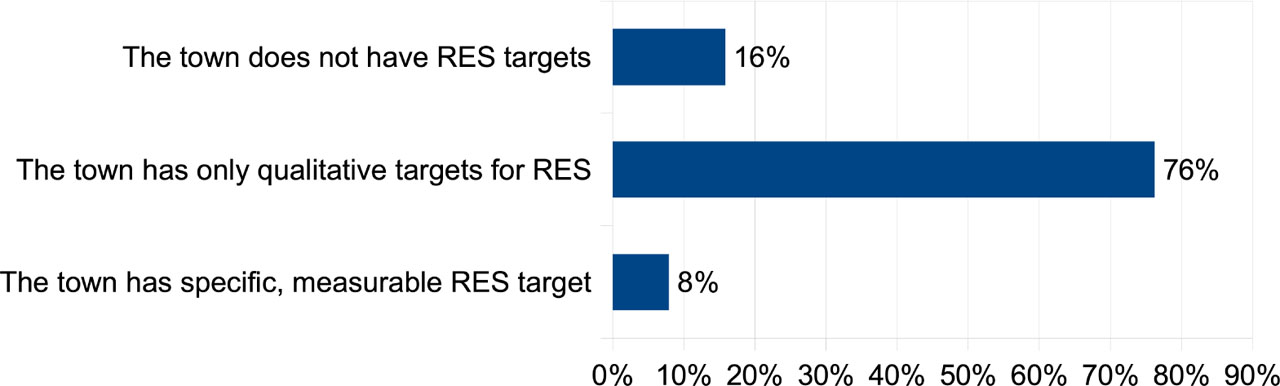
Figure 1.
Does the town have specific targets for RES development? (percentage)
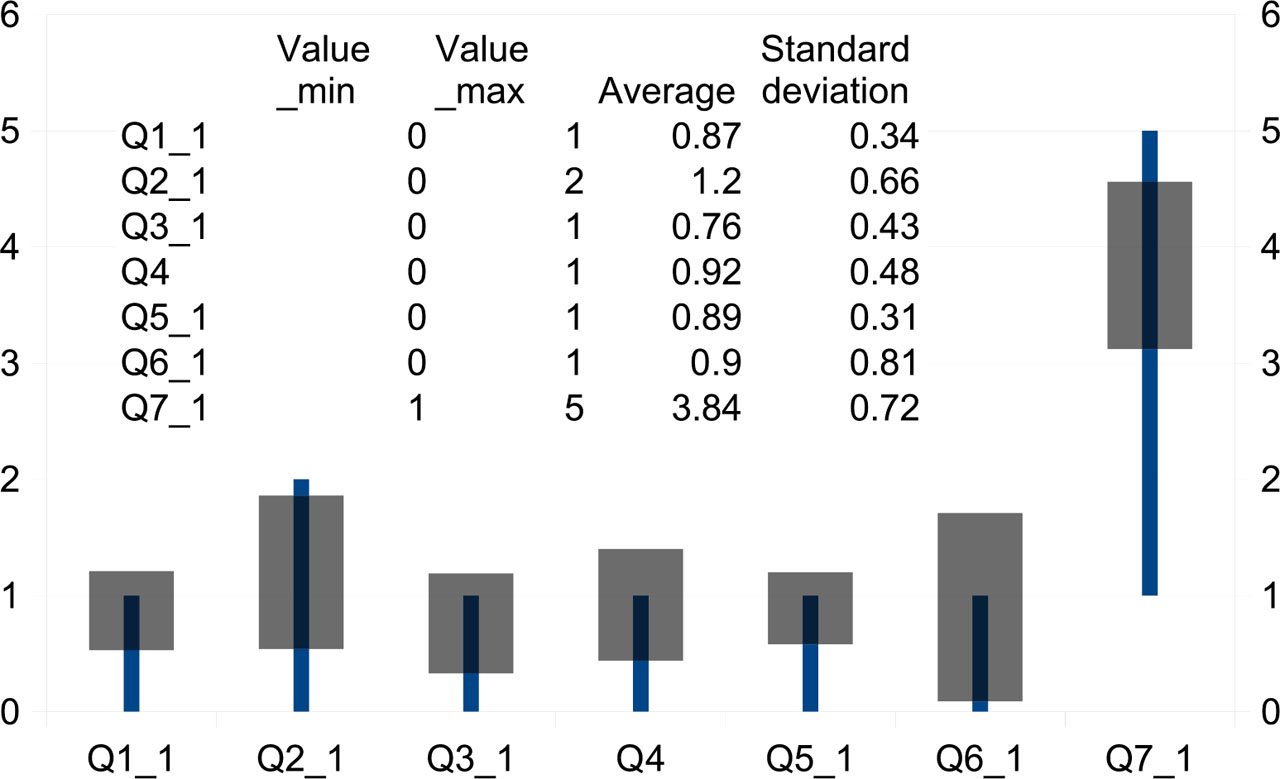
Figure 2.
Statistical distribution of answers to questions pertaining to RES (for question codes, see Table 1)
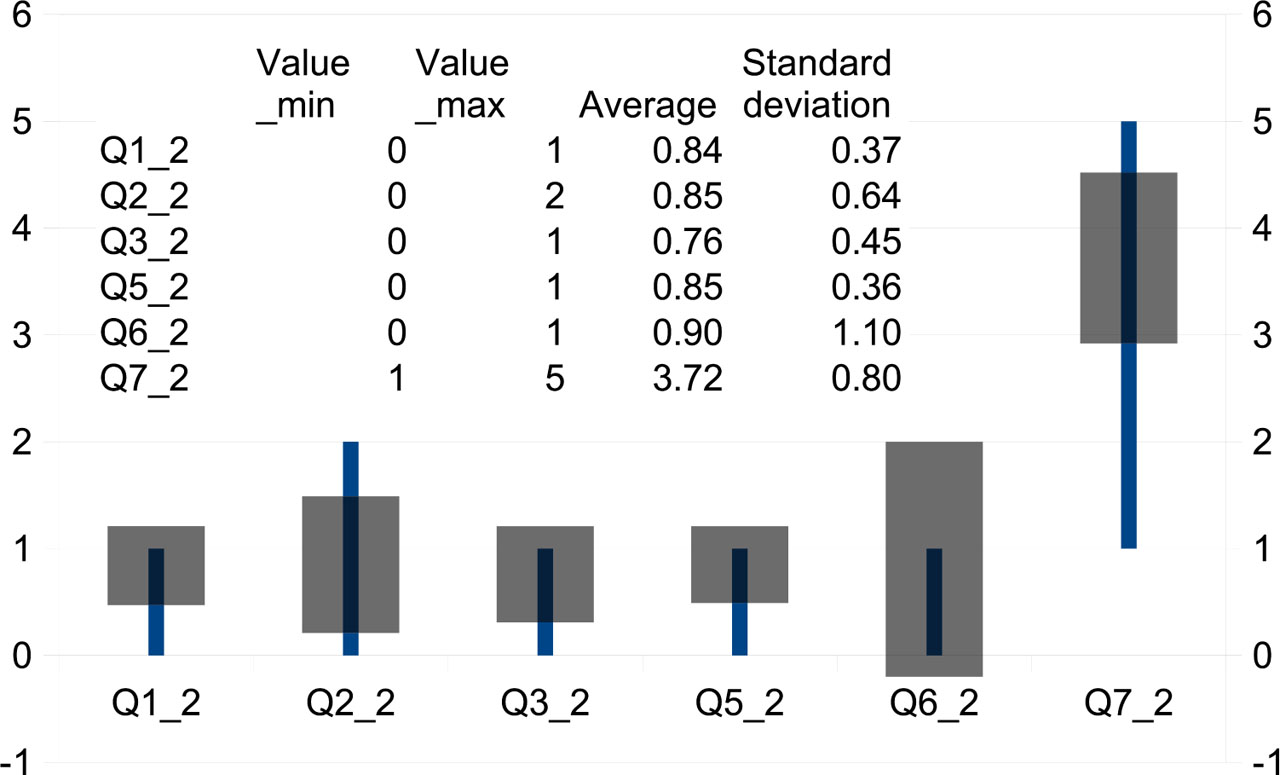
Figure 3.
Statistical distribution of answers to questions pertaining to energy efficiency (for question codes, see Table 1)
The findings indicate that municipalities are more likely to establish mandatory renewable energy targets in instances where the individuals responsible for environmental policy have engaged in discussions or participated in workshops concerning the advancement of renewable energy sources (RES). This relationship is statistically significant with a p-value of 0.0019 and an r-value of 0.3055. As demonstrated in Table 2, additional correlations with statistical significance are observed. These include instances where higher authorities inquired with town representatives about the development of renewable energy sources (RES), as indicated by a significant correlation coefficient (r) of 0.2950 and a p-value of 0.0028. Additionally, there are cases where actions have been initiated for the advancement of RES, exhibiting a correlation coefficient of 0.2728 and a p-value of 0.0058. A significant proportion of towns (89%) that have reported RES development in the last five years have also set targets for the development of RES (r = 0.2728, p = 0.0058). Furthermore, these towns have been found to be more involved in debates and workshops concerning the development of RES (r = 0.2453, p = 0.0134). However, a negative correlation has been observed between town population and RES development (r = −0.1976, p = 0.0476).
Table 2.
Correlations (Pearson's r values) between answers to the surveys and between answers and town characteristics for questions pertaining to renewables
| x | Population | Town income per inhabitant | Q1_1 Have town representatives taken part in debates and workshops regarding RES development in the last 5 years? | Q2_1 Does inhabitants or NGOs demand from town representatives more active action for RES development? | Q3_1 Did the regional or national authorities approached town representatives regarding RES development in the last 5 years? | Q4 Does the town has binding targets for RES development? | Q5_1 Did the town take action for RES development in the last 5 years? | Q6_1 Did the town finance inhabitants initiatives for RES development in the last 5 years? | Q7_1 If the town was about to establish a grant scheme for private investments of the inhabitants, what would be the target for such a scheme? Would new RES on private residential property be a priority? |
|---|---|---|---|---|---|---|---|---|---|
| Population | 1.0000 | 0.2112 * | −0.0492 | 0.0024 | 0.0859 | 0.0887 | −0.1976 * | 0.1286 | 0.1085 |
| Town income per inhabitant | 0.2112 * | 1.0000 | −0.3344 *** | −0.1143 | −0.1255 | −0.0939 | −0.1672 | −0.0295 | 0.1837 |
| Q1_1 | −0.0492 | −0.3344 *** | 1.0000 | 0.1600 | 0.4801 *** | 0.3055 *** | 0.2453 * | −0.2317 * | 0.1632 |
| Q2_1 | 0.0024 | −0.1143 | 0.1600 | 1.0000 | 0.0617 | 0.1429 | 0.0567 | 0.0557 | 0.0666 |
| Q3_1 | 0.0859 | −0.1255 | 0.4801 *** | 0.0617 | 1.0000 | 0.2950 ** | 0.1035 | −0.0979 | 0.0716 |
| Q4 | 0.0887 | −0.0939 | 0.3055 *** | 0.1429 | 0.2950 ** | 1.0000 | 0.2728 ** | 0.0823 | 0.0211 |
| Q5_1 | −0.1976 * | −0.1672 | 0.2453 * | 0.0567 | 0.1035 | 0.2728 ** | 1.0000 | 0.1549 | 0.1005 |
| Q6_1 | 0.1286 | −0.0295 | −0.2317 * | 0.0557 | −0.0979 | 0.0823 | 0.1549 | 1.0000 | 0.0245 |
| Q7_1 | 0.1085 | 0.1837 | 0.1632 | 0.0666 | 0.0716 | 0.0211 | 0.1005 | 0.0245 | 1.0000 |
The present study has not focused on the issue of energy efficiency, nor has it examined the inclusion of targets in official documents. However, it has posed the question of whether the town has taken measures to increase energy efficiency, including thermal insulation and/or the construction of passive buildings. As illustrated in Table 3, 85% of town representatives provided a positive response. This has been found to be significantly associated with the response to the inquiry regarding whether higher authorities have consulted with town representatives on this matter (r=0.5239, p=0.0000). Further statistically significant correlations have been identified, including those with the participation of town representatives in debates or workshops concerning energy efficiency, particularly within the building sector (r=0.3526, p=0.0003) and the potential prioritisation of thermal insulation for private residences in the event of the town financing climate change mitigation and adaptation measures (r=0.3087, p=0.0017).
Table 3.
Correlations (Pearson's r values <0.05) between answers to the surveys and between answers and town characteristics for questions pertaining to energy efficiency.
| Question | Population | Town income per inhabitant | Q1_2 Have town representatives taken part in debates and workshops regarding energy efficiency (including thermal insulation and passive buildings) in the last 5 years? | Q2_2 Does in-habitants or NGOs demand from town representatives more active action for energy efficiency? | Q3_3 Did the regional or national authorities approached town representatives regarding energy efficiency (including thermal insulation and passive buildings) in the last 5 years? | Q5_2 Did the town take action for energy efficiency (including thermal insulation and passive buildings) in the last 5 years? | Q6_2 Did the town finance inhabitants initiatives for thermal insulation of buildings in the last 5 years? | Q7_2 If the town was about to establish a grant scheme for private investments of the inhabitants, what would be the target for such a scheme? Thermal insulation of homes? |
|---|---|---|---|---|---|---|---|---|
| Population | 1.0000 | 0.2112 * | −0.0029 | −0.0313 | 0.0340 | −0.0310 | −0.0639 | 0.1471 |
| Town income per inhabitant | 0.2112 * | 1.0000 | −0.0178 | −0.1163 | 0.1639 | 0.0573 | −0.0195 | 0.0436 |
| Q1_2 | −0.0029 | −0.0178 | 1.0000 | 0.1547 | 0.4959 *** | 0.3526 *** | 0.0103 | 0.2912 ** |
| Q2_2 | −0.0313 | −0.1163 | 0.1547 | 1.0000 | −0.1239 | −0.0100 | 0.1639 | 0.0555 |
| Q3_2 | 0.0340 | 0.1639 | 0.4959 *** | −0.1239 | 1.0000 | 0.5239 *** | 0.0328 | 0.3142 ** |
| Q5_2 | −0.0310 | 0.0573 | 0.3526 *** | −0.0100 | 0.5239 *** | 1.0000 | −0.0632 | 0.3087 ** |
| Q6_2 | −0.0639 | −0.0195 | 0.0103 | 0.1639 | 0.0328 | −0.0632 | 1.0000 | 0.0706 |
| Q7_2 | 0.1471 | 0.0436 | 0.2912 ** | 0.0555 | 0.3142 ** | 0.3087 ** | 0.0706 | 1.0000 |
The population of the town or the income of the municipality per inhabitant has not been found to be significantly correlated (p<0.05) with any of the environmental factors. Furthermore, the investigation revealed that neither pressure from local residents nor that from non-governmental organisations (NGOs) had played a significant role in the decision-making process.
4. DISCUSSION
The results indicate that a significant proportion of the surveyed towns have declared their intention to take action in order to develop renewable energy sources (RES) and to increase energy efficiency. However, there is a paucity of evidence to suggest that the effects are measured and accounted for, nor that towns' action for RES and energy efficiency forms a coherent strategy. It appears that Polish towns demonstrate a suboptimal commitment to strategic planning, as evidenced by the absence of concrete, measurable targets. The creation of such documents is either non-existent or of a substandard quality. The energy transition in Poland is centred on point sources of CO2 and other pollutants, with a lack of emphasis on diffuse or linear sources (such as agriculture and roads) in the context of decarbonisation efforts [Standar et al. 2025]. This finding aligns with the findings of other research conducted in Poland on climate change adaptation, which has revealed inadequate planning [Karaczun et al. 2022].
It can be hypothesised that the data collection method (involuntary surveys) may be biased towards more proactive towns, i.e. those with either greater institutional capacity or a more proactive approach to climate protection. These towns are more likely to have responded to the survey by submitting an answer. The presence of this potential bias could not be avoided, as it was not possible to compel specific towns to respond to the survey or to extrapolate the results to towns that did not provide answers.
Despite the relatively modest sample size (n=101), Pearson's correlations with extremely high statistical significance (p<0.001) have been observed. The observed values of r, ranging from 0.30 to 0.53, indicate a very high degree of confidence (p < 0.002) in the correlation between the variables. However, it is important to note that correlation does not necessarily imply causation. The results of the study indicate a broad range of potential avenues for further research, including the identification of the underlying causes of these responses and the exploration of strategies to enhance climate change mitigation efforts in urban areas. Multivariate analysis has not been performed due to the relatively simple construction of the survey.
The research did not find any correlation between town size and climate action in urban areas with a population below 100 thousand inhabitants. As Browne et al. (2024) argue, effective climate policy, even at a local level, must be meticulously designed, with several criteria in mind. As a general rule, the volume of research conducted in small- and medium-sized towns is comparatively limited [Neij, Heiskanen 2021]. Research undertaken in Poland has concluded that the nation's climate policy is not always aligned with the requirements and ambitions of the European Union, as evidenced by discrepancies between stated objectives and actual actions [Swacha et al. 2022].
The level of public support for RES and energy efficiency in Polish towns remains high, but, in addition to declarations of support, town representatives do not report organised pressure from the population. This may be attributable to the relatively effective communication between the local government and the population [Brandoni et al. 2012].
The most promising instruments for encouraging local governments to enhance energy efficiency and the development of renewable energy sources (RES) appear to be debates and workshops, particularly those organised by the higher level authorities (regional, national or EU-level). A robust and statistically significant correlation has been identified between participation in these initiatives and the subsequent declaration of action for RES development and energy efficiency. Local governments appear to be inclined to act when they receive tacit or overt (or especially financial) support from higher authorities. Takao's (2020) research demonstrated that, in Japan, the personal interests of decision-makers also significantly influence outcomes. Towns are keen to provide support not only for RES and energy efficiency in their own building stock [Krawczyk et al. 2025][Jerominko, Cichowicz 2025], but also to provide subsidies or other forms of assistance to local inhabitants in their decarbonisation efforts. In this domain, the presence of higher authorities and active engagement in debates and workshops has been demonstrated to be associated with favourable outcomes. Rout and Gochhayat's (2024) seminal study revealed a significant correlation between governance quality and the outcomes of climate policy. The absence of a statistically significant correlation suggests that pressure from inhabitants and non-governmental organisations (NGOs) may not be a significant factor.
The correlation between the size of towns or the financial resources per inhabitant and action for RES or energy efficiency appears negligible. As Swoczyna and Karaczun (2023) point out, a potential barrier to the development of renewable energy sources in some Polish municipalities may be the financial dependence on incomes from the fossil fuel industry. However, this factor was not taken into account in the discussed studies.
5. SUMMARY
The research indicates that local governments in towns have a substantial role to play in reducing their carbon footprint, particularly in the areas of RES development and energy efficiency. Polish towns have declared their commitment to RES development and energy efficiency, yet the actions undertaken and the level of ambition exhibited are found to be significantly influenced by pressure from higher authorities. It is evident that the most efficacious approach to enhance the activity of local governments with regard to energy efficiency and the development of renewable energy sources (RES) appears to be a combination of the following:
- pressure from the authorities at a higher level,
- the provision of assistance from the relevant authorities (at either a national or EU level)
The pressure exerted by local communities and non-governmental organisations (NGOs) does not appear to be associated with a stronger commitment to the development of renewable energy sources (RES) and energy efficiency.
It is hoped that these results will prove useful to researchers in a number of other countries as well. This is for two main reasons. Firstly, the problem is transnational and, secondly, the towns in question share the same challenges as towns in both developed and developing countries. It is evident that municipalities have the capacity to make a more substantial contribution to the protection of the climate. This can be achieved through the implementation of renewable energy sources (RES) and the promotion of energy efficiency measures. Consequently, further research in this area is warranted.