
1. INTRODUCTION
The progressive degradation of the natural environment mainly stems from strong anthropogenisation, especially in urbanised and industrialised areas. With time, humans have exerted increasing pressure on the environment, leaving many traces of their activity. The Earth’s surface, defined as its landforms, soil, ground and groundwater, is particularly vulnerable to the negative impact of human industrial activity [Regulation…2016]. Contamination of the Earth’s surface manifests itself in pollution by chemical elements and compounds commonly that are considered harmful or hazardous to human health or life, as well as to the natural environment. Heavy metal pollution of soils is a global problem causing a serious public health threat [Jiang et al. 2019].
Contamination of the soil surface is largely associated with post-industrial sites where intensive production activities were carried out using risk-causing substances. These are understood to be hazardous substances belonging to one or more of the hazard classes listed in Parts 2–5 of Annex I to Regulation (EC) No 1272/2008 of the European Parliament and of the Council of 16 December 2008 on classification, labelling and packaging of substances and mixtures. The most commonly identified contaminants in soil are heavy metals [Kabata-Pendias, Pendias 2001]. Due to their prevalence, heavy metals are one of the most commonly studied chemical compounds found in the environment. Metals are natural components of the environment and are in constant circulation within the air-water-soil system [Kabata-Pendias, Pendias 1999].
Plants take toxic compounds up from the soil through the soil solution [Ali et al. 2013]. Soluble forms of heavy metals migrate easily through the soil-water environment, posing a significant threat [Kabata-Pendias, Pendias 2001, Karczewska 2008]. Because plants with the ability to degrade heavy metals may interacti with the soil environment, bioavailable forms of metals may migrate into forms that are more difficult to access [Berti et al. 1998, Sas-Nowosielska et al. 2008]. The immobilisation of contaminants in the soil is based on the following processes: absorption and accumulation in roots; adsorption on the root surface; or transformation within the rhizosphere into compounds that are difficult to solubilise [Ruttens et al. 2006]. The main objective in the remediation of contaminated soil is not to remove the contaminants completely (which is often not realistic), but to reduce their negative impacts on human life and health, and on the environment [Stuczyński et al. 2004, Ali et al. 2013]. The use of plants to treat or immobilise contaminants in the soil further promotes soil stabilisation and slows the erosion process, thereby reducing the surface spreading of contaminated soil [Baran 2000].
Phytoremediation is an ecological and sustainable bioremediation process that uses green plants to remove heavy metal contaminants from contaminated soil. It has been widely accepted as an effective and promising technology for controlling heavy metal pollution. Using both pot and field experiments, many researchers have confirmed the capacity of some plants for uptake of Zn and Cd from the soil, and their ability to collect these compounds in their aboveground parts [Baran 2001, Boyter et al. 2009, Meers et al. 2005, Pulford et al. 2002, Rosselli et al. 2003, Vervaeke et al. 2003]. Some experiments have also indicated a high potential for Cu accumulation in plants’ aboveground parts [Kuzovkina et al. 2004, Pulford et al. 2002]. The method of phytoremediation of heavy metal-contaminated soils has been applied and confirmed effective in both field and pot experiments using various plant species such as Populus tremuloides [Martin et al. 2004], Alyssum pintodasilvae [Kidd et al. 2007], Brassica junceva [Bluskov et al. 2005] or species of the Gramineae family [Bodar et al. 2006, Antosiewicz et al. 2008, Robinoson et al. 2000, Zhand et al. 2010].
Research on the accumulation of heavy metals by plants in urban ecosystems on anthropogenic soils [Rahmonov et al. 2023a, Rahmonov et al. 2023b] with varying degrees of contamination [Rahmonov et al. 2014] also indicates an ability in some plant species to accumulate heavy metals in both their aboveground and underground parts. Symphoricarpos albus and Hippophae rhamnoides, with a rapid rate of reproduction and growth, show good adaptability and tolerance to contaminated environments. A study by Koev and Dimitrova [1995] confirmed the ability of S. albus to accumulate heavy metals such as lead, zinc, cadmium and copper. In turn, Kałużny et al. [2016] proved S. albus’s uptake of zinc and lead from highly-contaminated soil.
Among various heavy metal contaminants, cadmium is identified as one of the most significant pollutants due to its strong bio-toxicity and high transfer risk [Khan et al. 2017]. Zinc pollution is also widespread in the world [Hou et al. 2019, Kumar et al. 2019]. Therefore, castor (R. communis) is currently considered to have great potential for contaminated soil remediation and is favoured by many researchers [Koev, Dimitrova 1995, Kałużny et al. 2016, Goroleva, Frontasyewa 2017]. S. albus is also considered promising for the remediation of Zn, Pb and Cd-contaminated soil. However, most studies have focused on a single heavy metal instead of combined pollution from Cd and Zn [He et al. 2020]. Relatively high values of TF (transfer factor, i.e. the transfer of metals from the soil to the aerial parts of the plant) of 0.2–1 for the element Zn in S. albus confirms the possibility of this plant’s use in phytoremediation [Goroleva, Frontasyewa 2017].
Hippophae rhamnoides survives well in poor soils and is able to tolerate extreme temperatures ranging from −40 °C to +40 °C [Feng et al. 2004]. As a “pioneer species,” it has few requirements for growing conditions, and behaves invasively if it grows in low-humidity, alluvial gravel; wet landslips; or riverside and polluted soil [Ciesarova et al. 2020]. Due to this wider ecological tolerance, it has been used in the processes of reclamation of anthropogenically altered habitats [Wang et al. 2022]; soil contaminated with oil [Zhang et al. 2016]; metal accumulation [Eng et al. 2004, Gutzeit et al. 2008, Micu et al. 2016, Bingol et al. 2023]; and biological cleanup of oil-contaminated soils [Shevchi, Romaniuk 2016, Bogatu et al. 2007], which indicates its ability to remove organic and inorganic contaminants (heavy metals) from the soil.
In the literature described above, however, there is little or no information on the phytoremediation role of the species analysed, particularly their and physiological resistance and response to various environmental stresses. These species are commonly found in urban green spaces and used in reclamation pits after sand extraction, as well as in consolidating unstable soils. This article aims to present the results of using pioneer shrub species, such as Symphoricarpos albus and Hippophae rhamnoides, in the remediation of a historically contaminated area of a former metal smelter.
2. MATERIALS AND METHODS
2.1. Study area
The research was conducted within an experimental plot on the site of the former Jedność Steelworks in Siemianowice Śląskie (50°17′ 58.58″ N; 19° 1′ 48.75″ E) (Figure 1). Most of the site is not developed, as the entire infrastructure associated with the steelworks has been demolished. At present, the site is not in use and there is spontaneous overgrowth of herbaceous vegetation in areas of varying relief.
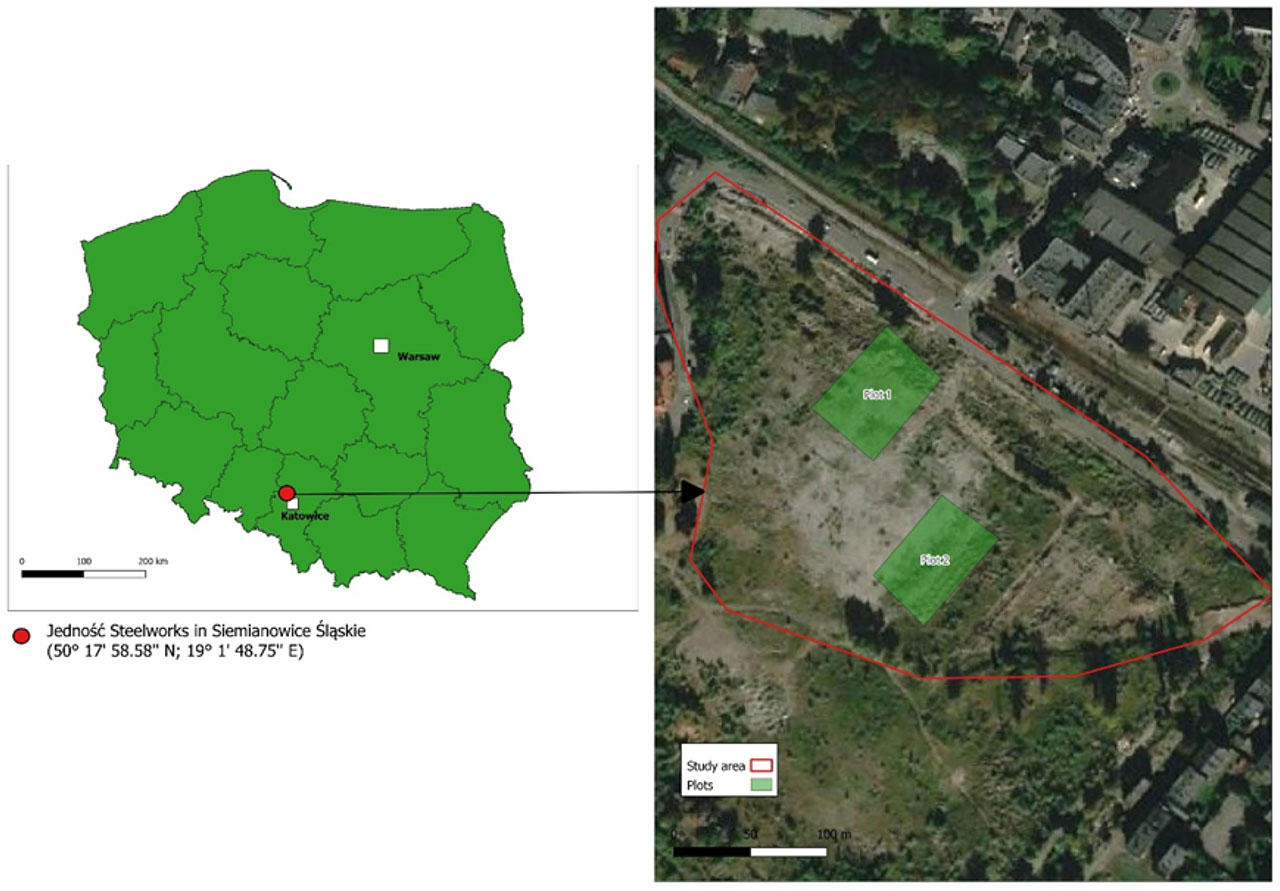
Figure 1.
Location of the study area and plots against the background of Poland and the Silesian Voivodeship.
The site was in operation from 1863 to 2003 and covers an area of approximately 5 ha. In its history it has produced a wide range of products, such as pig iron, puddling steel, open-hearth steel, bars of various shapes, barrel rings, angle irons, railway rails, thick plate, thin plate, barrels, buckets, gutters, hot-welded pipes with lining and butt joints, and seamless pipes. Bearing in mind the materials produced, the smelter was a major source of heavy-metal pollution [Różkowski et al. 2023]. Knowledge of the site’s history and the presence of historical contamination made it a compelling place to conduct a cleaning experiment using well-known heavy metal phytoremediation methods.
2.2. Experimental design
Two plots of similar size (1,500 m2) and shape were established on selected sections of the steelworks site. The area was being developed by other entities, so only two plots were established due to the limited amount of space available. The two plots were characterized by the same morphological and habitat features.
First, soil samples (see section 2.3) were taken for laboratory analysis as remediation samples before planting the proposed species. This was followed by shrub planting in both plots in the first half of October 2018. Two vascular plant species capable of remediating heavy metal-contaminated soil were used in the study: Hippophae rhamnoides and Symphoricarpos albus (Figure 2). Within plot 1, 25 H. rhamnoides seedlings, approximately 0.5 m in height, were planted at intervals of approximately 0.7 m. Within plot 2, 25 S. albus seedlings, approximately 0.4 m high, were planted.
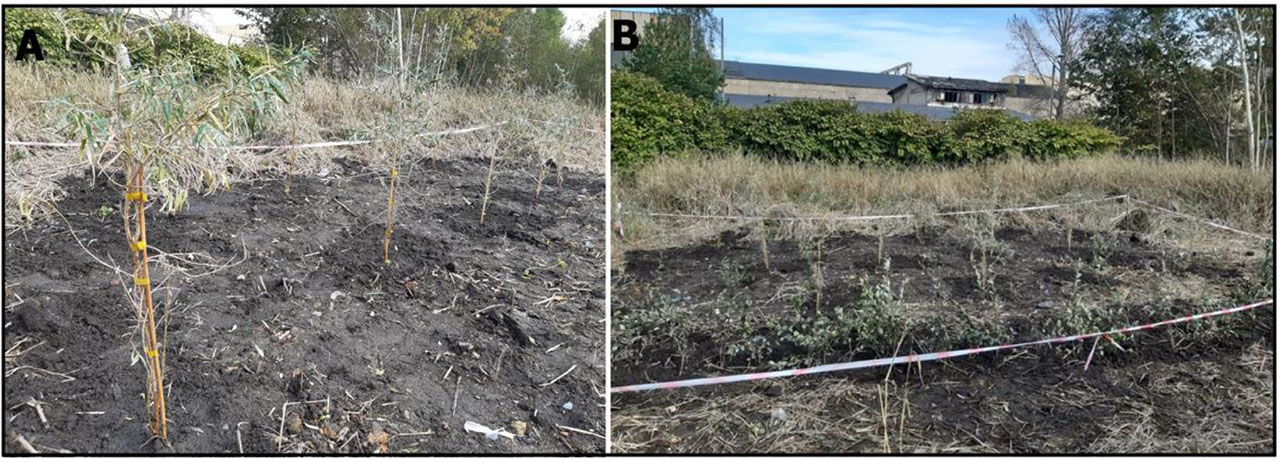
Figure 2.
H. rhamnoides seedlings in plot 1 (A) and S. albus in plot 2 (B).
H. rhamnoides is a shrub that reaches a height of up to about 3 m. It grows in a variety of habitats and thus can be considered a eurybiont [Ciesarova et al. 2020]. The plant is an indigenous species, although in Poland its natural stands occur only on the Baltic Sea coast. It is often used as an ornamental species, and its specific root system makes it ideal for strengthening slopes and reclaiming coal heaps and excavations after sand mining.
S. albus is a 1–3 m tall shrub and is native to North America. In Poland, it grows on wastelands, in abandoned parks, roadside thickets and forest edges, and is also used in cemeteries and gardens as an ornamental species. It prefers moderately rich and moderately moist soils.
2.3. Soil and plant sampling
The research material consisted of soil samples taken from the surface layer (0–0.25 m below ground level). Within each plot, 15 individual soil samples and mixed to create one bulk sample for each plot, which was then tested. Soil samples were collected according to the procedure specified in the Regulation of the Minister of Environment of 1 September 2016 on the method of conducting the assessment land surface contamination [Regulation…2016]. Soil samples were taken three times: prior to planting, then 12 and 24 months after planting.
Soil samples were transported under refrigerated conditions at 4°C to an accredited research laboratory. After drying and weighing, the soil material samples were subjected to laboratory analysis for heavy metal content (As, Ba, Cr, Sn, Zn, Cd, Co, Cu, Mo, Ni, Pb, Hg).
Plant material was sampled both before planting (after buying the seedlings) and 12 months after planting. The leaves of plants were sampled at the end of the vegetation season in late September and early October. Plant material (leaves) of both species were sampled randomly and simultaneously. 5 g of dry weight of each of the analytical samples were obtained. The preliminary preparation of the samples for analysis involved washing the plant material with distilled water (the use of stronger agents can remove heavy metals), and drying at room temperature and at 105 °C for 4 h, followed by homogenization. Sampling and preparation procedures followed method of MacNaeidhe [1995] and Markert [1995]. The total content of toxic elements (As, Ba, Cr, Sn, Zn, Cd, Co, Cu, Mo, Ni, Pb, Hg) was measured in the samples collected.
The granulometric composition of the samples was determined using standard grain-size analysis with a fixed-mesh-size sieve column. The test was carried out with a set of sieves with different mesh sizes: 20 mm, 10 mm, 5 mm, 2 mm, 1 mm, 0.5 mm, 0.25 mm, 0.1 mm, 0.05 mm, 0.02 mm, 0.006 mm, and 0.002 mm. The mass of the sample remaining in each sieve was calculated as the percentage of grains of a given size in the total mass of the sample [Bednarek et al. 2004].
Concentrations of elements in plant material and soil were measured using inductively coupled plasma optical emission spectrometry (ICP–OES). The basis for this method is the measurement of the intensity of characteristic radiation emitted by elements excited in an inductively coupled plasma. Prior to analysis, all samples were submitted to wet mineralization in nitrohydrochloric acid (3HCl + HNO3) [Bednarek et al. 2004, Rahmonov et al. 2023c]. The analyses were performed at the GBA Polska Sp. z o.o. Laboratory in Poland. All plant tissues and soil samples were analysed in triplicate for all the parameters being investigated, and mean values were calculated.
Bio-accumulation Factor (BAF) can be employed to quantify toxic element accumulation efficiency in plants by comparing the concentrations in biota with those in an external medium (e.g. soil). BAF = Cb/Cs, where Cb and Cs are heavy metal concentrations in the aerial part of the plant (mg·kg−1) and in soil (mg·kg−1), respectively. BAF < 1 was categorised as excluder, 1–10 as accumulator, and > 10 as hyperaccumulator [Salt et al. 1995, Baker et al. 2000, Sakabira et al. 2011].
3. RESULTS
3.1. Heavy metal concentration in the soil during phytoremediation
On the experimental plot selected for the study, which is a fragment of land within the former Jedność Steelworks in Siemianowice Śląskie, elevated values of heavy metals were found, three of which (cadmium, zinc and lead) were present at levels exceeding the permissible values defined for Group IV (industrial land) in the Regulation of the Minister of Environment of 1 September 2016 on the method of conducting the assessment land surface contamination [Regulation…2016] (Table 1).
Table 1.
The concentration of heavy metals in soil on plots 1 and 2 (average values from three analytical series with standard deviation)
| Tested element | Unit | Concentration of heavy metals in soil | Limit value1 (industrial areas) | |||||
|---|---|---|---|---|---|---|---|---|
| Initial value (beginning of the remediation) | Final value (after 12 months) | Final value (after 24 months) | ||||||
| Plot 1 | Plot 2 | Plot 1 | Plot 2 | Plot 1 | Plot 2 | |||
| H. rhamnoides | S. albus | H. rhamnoides | S. albus | |||||
| As | mg·kg−1 | 67±4 | 5.7±0.3 | 54±4.5 | 5±0.4 | 48±5.2 | 4.9±0.4 | 100 |
| Ba | 234±2 | 81±4 | 224±14.5 | 64±5.5 | 197±12.8 | 70±4.5 | 1500 | |
| Cr | 21±3.5 | 9.4±0.4 | 18±2.5 | 7±0.6 | 16±1.5 | 8.5±0.5 | 1000 | |
| Sn | <5.0 | <5.0 | <5.0 | <5.0 | <5.0 | <5.0 | 350 | |
| Zn | 3014±9.8 | 3521±26.9 | 2427±42.9 | 3201±24.7 | 1915±22.5 | 2740±40.5 | 2000 | |
| Cd | 22±3 | 67±6 | 19.5±2.5 | 59±3 | 14±1 | 57±3 | 15 | |
| Co | 6.6±0.2 | <0.20 | 5.7±0.6 | <0.20 | 5±1.3 | <0.20 | 200 | |
| Cu | 144±4.0 | 240±12 | 123±6.1 | 216±7.5 | 109±8.6 | 200±7 | 600 | |
| Mo | <0.40 | <0.40 | <0.40 | <0.40 | <0.40 | <0.40 | 250 | |
| Ni | 18±2 | 37±3.5 | 13±1.5 | 35±4.5 | 13±1 | 34±3 | 500 | |
| Pb | 809±8.2 | 754±10.5 | 698±24.5 | 708±9.5 | 550±16.9 | 587±8.1 | 600 | |
| Hg | <0.10 | <0.10 | <0.10 | <0.10 | <0.10 | <0.10 | 30 | |
In terms of granulometric composition, the results of the analysis show variation in terms of grain size in the plots. The granulometric composition in the plot 1 was as follows: sand – 79.1%; silt – 15.6%; clay – 5.3% and plot 2: sand – 41.6%; silt – 56.2%; clay – 2.2%. The soil reaction was pH = 6.1 in both plots. Plant species such as H. rhamnoides and S. albus have performed well in studies involving cleaning up heavy metal-contaminated soil. The heavy metal content levels of the soil before the phytoremediation process, and obtained after 12 and 24 months of the process, are presented in Table 1.
After a 12-month phytoremediation process of heavy metal-contaminated soil using seedlings of H. rhamnoides and S. albus, it was found that remediation of heavy metal-contaminated soil in the 0.0–0.25 m below-ground level (depth) interval resulted in contaminant reductions ranging between 4.3% (for barium) and 12.8% (for zinc) for the section planted with H. rhamnoides, and between 5.4% (for nickel) and 9.7% (for zinc) for the section planted with S. albus seedlings. The remediation process using these two species was extended for a further 12 months (Table 1).
3.2. Heavy metal content in the leaves of H. rhamnoides and S. albus during phytoremediation
The process of the accumulation of heavy metals in the green leaves of the species analysed is differentiated in Table 2. The greatest increase in the content of the analysed elements after a 12-month phytoremediation period was clearly observed for Ba, which went from 7.2 mg kg−1 to 15 mg·kg−1in the case of H. rhamnoides, and from 10 mg·kg−1 to 18 mg·kg−1 in the case of S. albus. Zn levels went from 56 mg·kg−1 to 130 mg·kg−1 in the case of H. rhamnoides and from 45 mg·kg−1 to 125 mg·kg−1 in the case of S. albus. The concentrations of heavy metals in the leaves of the species analysed were ranked as follows:
Leaves (H. rhamnoides): Zn>Cr>Ba>Cu>Ni>Pb>Cd>As>Mo>Co>Hg
Leaves (S. albus): Zn>Cr>Ba>Cu>Ni>Pb>Cd>As>Mo>Co>Hg
Table 2.
Heavy metal content in the leaves of the species studied before planting and after 12 months (average values from three analytical series with standard deviation)
| Tested element | Unit | Leaves: Before planting | Leaves: After 12 months | ||
|---|---|---|---|---|---|
| H. rhamnoides | S. albus | H. rhamnoides | S. albus | ||
| As | mg·kg−1 | <5.0 | <5.0 | <5.0 | <5.0 |
| Ba | 7.2±0.6 | 10±1.5 | 15±2.5 | 18±3 | |
| Cr | 48±3.5 | 26±4 | 56±4 | 33±3 | |
| Sn | <5.0 | <5.0 | <5.0 | <5.0 | |
| Zn | 56±5.5 | 45±4.5 | 130±8.5 | 125±6 | |
| Cd | 0.21±0.06 | 0.22±0.04 | 0.36±0.06 | 0.38±0.04 | |
| Co | <0.20 | <0.20 | <0.20 | <0.20 | |
| Cu | 4.9±2.8 | 6.9±0.5 | 6.8±3.5 | 9.2±0.3 | |
| Mo | <0.40 | <0.40 | <0.40 | <0.40 | |
| Ni | 2.6±0.4 | 2.6±0.3 | 5±1.3 | 6.9±0.4 | |
| Pb | <1.0 | <1.0 | 4.1±0.3 | 2.7±0.4 | |
| Hg | <0.10 | <0.10 | <0.10 | <0.10 | |
Table 3.
Bioaccumulation factor (BAF) values for leaves of plants
| Tested element | BAF* | |||
|---|---|---|---|---|
| H. rhamnoides | S. albus | |||
| Beginning | After 12 months | Beginning | After 12 months | |
| Zn | 0.018 | 0.053 | 0.013 | 0.04 |
| Cd | 0.009 | 0.018 | 0.0032 | 0.006 |
| Pb | 0.0012 | 0.006 | 0.0013 | 0.004 |
These results show that for both species, the concentration of Zn and Cr in the leaves was highest in the initial remediation stage. The lowest concentrations were found for Co and Hg, where the values of the former in the leaves of H. rhamnoides and S. albus may be connected to chemical composition of the mineral substrate.
3.3. Bioacumulation factors (BAF)
This indicator confirms a high concentration of Cd, Zn and Pb. In the case of H. rhamnoides, the BAF for Zn and Cd increased by a factor of 3, and for Pb, it increased by a factor of 6. In the case of S. albus, the BAF for Zn increased by a factor of 3, the BAF for Pb increased by a factor of 4, and for Cd, it doubled. The analysed species thus have an excluder character.
4. DISCUSSION
The mechanism of phytoremediation, known as green technology, is mainly based on applying plant activity in processes related to the removal, translocation, stabilisation and/or degradation of contaminants in the soil. Using plants to the greatest possible degree fits into pro-environmental strategies for cleaning up contaminated and degraded soils. The compounds taken up by the plant from the soil are accumulated by the plant, where they can then be biodegraded within the tissues, neutralised, or even excreted outside the plant system [Nanda Kumar et al. 1995, Zemleduch, Tomaszewska 2007]. The natural ability of plants to accumulate toxic substances in their tissues without adverse effects on the plant body is the basis of phytoremediation [Baran 2000, Ghosh, Sing 2005].
4.1. Changes in soil heavy metal content during phytoremediation
On both test plots, a decrease in the concentration of heavy metals in the investigated soils was achieved. Due to the relatively short duration of the experimental research, the positive effects of the phytoremediation process were not fully achieved; the concentrations of heavy metals in the soil studied were characterised by a decreasing trend, but their values did not yet meet the standards established for Group IV land, according to Regulation of the Minister of Environment of 1 September 2016 on the method of conducting the assessment land surface contamination [Regulation…2016]. A verification study of the contaminated soil carried out after 24 months of the phytoremediation process using H. rhamnoides and S. albus showed a significant decrease in the concentration of heavy metals identified at the initial stage of the experiment on the site in question. In the case of the soil remediation process on plot 2, which was contaminated with heavy metals in the surface soil layer, the remediation effect was significantly weaker when using S. albus cuttings than when using H. rhamnoides seedlings. The soil tested exhibited a reduction in contaminants ranging from 8.1% for Ni to 22.2 % for Zn. Good results in the phytoremediation of heavy metals in soils have been obtained using a remediation agent in the form of various grass species, such as Festuca rubra, Lolium perenne, Agrostis capillaris, and others [Gucwa-Przepióra, Błaszkowski 2007]. Phytoremediation can also be achieved with certain woody and shrubby plants that have proven effective in this process [Bingol et al. 2023, Preciado, Li 2006]. Taking into account the results obtained for the soil from plot 2, the decrease in the contamination of the soil in question was not sufficient to meet the standards required for Group IV land according to the Regulation of the Minister of Environment of 1 September 2016 on the method of conducting the assessment land surface contamination [Regulation…2016].
4.2. Changes in the heavy metal content of the leaves of the species studied
Over the course of the research work on the remediation of heavy metal-contaminated soil, relationships within the soil-plant system were observed, with the main focus being the ability of selected plant species to accumulate heavy metals in their tissues. The observations focused on the foliage of H. rhamnoides and S. albus over a 12-month period. In both species, the highest amounts per unit in plant leaves were found for zinc, chromium and barium. However, in terms of uptake from the soil and accumulation of heavy metals, the highest proportions were for zinc, lead and cadmium. However, the biggest effect in incorporating heavy metals into plant tissues was achieved in the case of lead. Excessive amounts of lead were recorded – 4.1 and 2.7 mg kg−1 – when the normal content in plants should not exceed 1.5 mg kg−1 [Gorlach, Gambuś 2000]. For the other heavy metals in the plants, their normal content levels were not exceeded in either species [Kabata-Pendias, Pendias 1999, Alcantara et al. 2001].
In both plants, the general rate of accumulation was highest for cadmium and lead. This makes these species particularly suitable for treating soils contaminated by these elements, which are among the most common so-called post-industrial pollutants. The high accumulation of heavy metals in the plant tissues was in spite of the fact that the species used also have a high capacity for phytovolatilization; under favourable conditions, they can transpire a pollutant or a modified form of it through their stomata into the atmosphere, without prior incorporation into their tissues. For both species, the highest bioaccumulation after 12 months was achieved for lead (0.006) and cadmium (0.018). It was slightly higher for zinc (0.053), indicating that these species are better able to cope with zinc-related contaminants.
4.3. Suitability of H. rhamnoides and S. albus in phytoremediation
The ability of S. albus to accumulate heavy metals such as lead, zinc, cadmium and copper was confirmed by Koev et al. [1995]. The potential of this species to absorb zinc and lead contained in large quantities in the soil was also proven by Kałużny et al. [2016]. Gorelova et al. [2017] also determined S. albus’s efficient heavy metal accumulation in the phytoremediation of contaminated soils on the basis of the species’ biological accumulation capacity, indicating S. albus’s potential for phytoremediating heavy metals from soils, mainly zinc and copper. The findings of the present study are consistent with data from the literature. A reduction in the content of individual heavy metals in the soil was demonstrated.
In the scientific literature, few studies have used H. rhamnoides seedlings for the phytoremediation of soil contaminated with heavy metals. A study by Bogatu et al. [2007] confirmed the ability of H. rhamnoides to transport heavy metals from the soil by accumulating them in its organic matter. This species’ ability for uptake of heavy metals from soils, and the possibility of using it for phytoremediation, were also confirmed by [Comakli 2022], who identified high concentrations of heavy metals such as aluminium (0.625 mg kg−1), manganese (0.32 mg kg−1), iron (0.60 mg kg−1), zinc (0.077 mg kg−1) or nickel (0.009 mg kg−1) in the leaves and branches of H. rhamnoides.
Bingöl et al. [2023] determined the content of heavy metals in H. rhamnoides leaves and soil located near a motorway. High concentrations of zinc (66.44 mg kg−1) were identified in H. rhamnoides leaves, and the concentrations of individual metals taken up by H. rhamnoides from the contaminated soil were as follows: Cu > Zn > Pb > Cd > Mn > Ni > Cr. The heavy metal content of H. rhamnoides leaves growing on soil contaminated with tailings was also studied by Micu et al. [2016]. Their study established levels of 15.5 mg·kg−1 for Zn; 8.6 mg·kg−1 for Fe; 2.15 mg·kg−1 for Mn; 1.22 mg·kg−1 for Pb; 0.96 mg·kg−1 for Ni and 0.25 mg·kg−1 for Cu in H. rhamnoides leaves. Tian et al. [2012] set out to determine the heavy metal content of different aboveground parts of H. rhamnoides in order to identify those with the highest heavy metal accumulations. It was shown that the highest concentration of heavy metals was in the leaves of H. rhamnoides, followed by its stems and its fruits.
Feng et al. [2004] investigated phytoremediation potential of dioecious H. rhamnoides inoculated with arbuscular mycorrhizal fungi to Pb and Zn contamination. According to a study by Duan et al. [2023], H. rhamnoides can also be an effective tool for the treatment of soil contamination with petroleum compounds. The results of the study showed that the removal rate of petroleum substances through the use of H. rhamnoides seedlings was significantly increased in petroleum-contaminated soils by up to 15,000 mg·kg−1 after just one growing season. It should be noted, however, that the results may vary depending on soil conditions and contaminant concentrations. H. rhamnoides has been found to successfully adapt to the adverse conditions of the petroleum contaminated soils, improving their physical, chemical and biological properties [Shevchuk & Romaniuk 2019]. Akar et al. [2009] found that S. albus can remove over 88% of Pb from an aquatic solution containing a mixture of heavy metals. The case of soil, the effectiveness of S. albus is many times lower, as research has shown.
5. CONCLUSIONS
One natural method of cleaning up soil contaminated with heavy metals is in situ remediation using the ability of plants to bioaccumulate heavy metals. Studies using plant species such as Hippophae rhamnoides and Symphoricarpos albus for phytoremediation have shown good results in cleaning up heavy metal-contaminated soil. After a 24-month phytoremediation process performed on soil contaminated with heavy metals using H. rhamnoides and S. albus seedlings, it was found that the values of individual metals (expect Zn and Cd) decreased significantly, reaching the permissible values set by Polish standards for soils in industrial areas. The species analysed in this study are best-suited to treating soils contaminated with barium (Ba), zinc (Zn), cadmium (Cd) and lead (Pb). In the case of lead, H. rhamnoides has a higher accumulation, while in the case of zinc and cadmium, a higher accumulation was noted in the leaves of S. albus. Taking into account the ability of H. rhamnoides and S. albus to grow in habitat with a high content of pollutants, especially heavy metals, and the ability of these species to accumulate heavy metals, it can be concluded that these species show promise for the phytoremediation of polluted areas, particularly such areas as mining dumps and post-smelting areas.