
1. Introduction
Turkey is surrounded by the Black Sea, the Aegean Sea, the Mediterranean Sea and the inland sea called the Marmara Sea. Although the Black Sea is very extensive compared to the Marmara Sea, it is a closed system fed by rivers (Tuğrul 2017). The sea, which for a long time was a lake connected to the Caspian Sea, is connected with the Mediterranean Sea through the Marmara Sea and the Istanbul Strait, also known as the Bosphorus (Beşiktepe et al. 1994; Zaitsev & Mamaev 1997). The Istanbul and Çanakkale (Dardanelles) straits, which are the narrowest straits in Europe, form the Turkish Straits System together with the Marmara Sea (Özsoy 2016). The Marmara Sea connects the Black Sea with the Mediterranean Sea and has a two-layer water system formed by waters originating in each of these seas. The upper layer consists of low-salinity Black Sea waters and the lower layer consists of high-salinity Mediterranean waters (Yüce, Türker 1991). While the density stratification between the layers prevents oxygen from reaching the substrate, particles of biogenic origin at the seabed increase oxygen consumption (Beşiktepe et al. 2000). While the saline Mediterranean waters are transported to the Black Sea through the Istanbul Strait, the salinity of surface waters drops due to substantial freshwater inflows from rivers such as the Danube, the Dniester, and the Dnieper. As a result of vertical stratification and high-rate transport of organic matter, the bottom layer is anoxic and contains high levels of sulfur (Tezcan et al. 2017). The Black Sea, whose coastlines are located in six countries, is characterized by high eutrophication levels due to transport from both rivers and anthropogenic effects (Bakan & Büyükgüngör 2000). Another common feature between these two closed seas is their unique fauna and flora. The fauna of the Black Sea, in particular, differs significantly from that of other seas due to its anoxic nature and high biomass production, as well as its low biodiversity compared to the Mediterranean Sea (Alexandrov & Zaitsev 1998; Bat et al. 2011). At present, both seas are under intense pressure from pollution. While rivers are the main source of pollution in the Black Sea, the Marmara Sea is heavily affected by nearby industrial facilities, anthropogenic factors and marine traffic (Aksu et al. 2016; Balkıs.et al. 2016; Ünlü 2016; Frid & Caswell 2017). For this reason, it is critical to regularly monitor biodiversity, which is greatly affected by environmental factors. Arthropods in particular occupy an important place in the benthic fauna of the Black Sea in terms of the number of species (Sezgin & Kurt-Şahin 2017). Crustacea, which constitute the majority of Arthropoda not only in the Black Sea but in all marine ecosystems, are a very large group of animals that are widespread in marine habitats, but also in freshwater (Sampaio et al. 2016).
Research on Crustacea in the Black Sea goes back to Holthuis (1961) and Kocataş (1981, 1982), followed by Mutlu & Ünsal (1991–1992, 1992), Mutlu et al. (1992), Öztürk (1999), Bat et al. (2000), Sezgin et al. (2001), Kocataş & Katağan (2003), Bilgin & Çelik (2004), Gönlügür-Demirci & Katağan (2004), Bilgin & Gönlügür-Demirci (2005), Gönlügür-Demirci (2006), Kırkım et al. (2006), Sezgin & Katağan (2007), Bilgin et al. (2007), Karaçuha et al. (2009), Ateş et al. (2010), Sezgin et al. (2010a,b), Balkıs et al. (2012), Kırkım et al. (2014), Kurt-Şahin et al. (2017). A number of researchers have also tried to explore the crustacean fauna of the Marmara Sea, including Sowinsky (1897), Demir (1952), Holthuis (1961), Caspers (1968), Băcescu (1982), Balkıs (1992), Kocataş and Katağan (1993), Topaloğlu (1993; 2014), Balkıs (1994), Balkıs (1998–99a,b), Uysal et al. (2002), Balkıs et al. (2002), Yurdabak (2004), Kalkan et al. (2006), Ritt et al. (2010), Bakır et al. (2011), Aslan-Cihangir & Panucci-Papadopolou (2011), Bakır (2012), Mülayim et al. (2015a,b), Bakır et al. (2016), Ayfer et al. (2017) and Bakır & Ateş (2018).
As demonstrated above, crustaceans in the Black Sea and the Marmara Sea have already been the subject of many studies. Most of these studies targeted limited areas in these seas to study crustacean species. There are no studies in the literature that cover crustaceans from the Black Sea and the Marmara Sea together. This study presents detailed and up-to-date information on the soft-bottom crustacean fauna of this large and important region based on samples collected at different locations representing the Turkish waters of the Black Sea and the Marmara Sea. This provides insight into similarities and differences in the crustacean fauna of both seas. Overall, I have updated the list of crustacean species with new records for these areas and provided information on their habitats.
2. Materials and methods
Sampling for the study was conducted within the scope of the “Integrated Marine Pollution Monitoring 2017–2019 Program” coordinated by TÜBİTAK – Marmara Research Center of the Environment and Cleaner Production Institute with the support of the Ministry of Environment and Urbanization of the Turkish Republic. Sampling was carried out in the Marmara Sea between 24 July and 1 August 2019 and in the Black Sea between 4 and 16 July 2019 from the TUBİTAK Marmara Research Vessel.
Sampling was carried out at 27 sites at a depth ranging from 10 to 87 m in the Marmara Sea and the Istanbul Strait, and at 20 sites at a depth of 8.5–45 m in the area between İğneada and Hopa in the Black Sea (Fig. 1). Three replicate samples were collected using a Van Veen Grab sampler in an area of 0.1 m2. Information about the sites is provided in detail in Table 1. Sediment samples were sieved through a 0.5 mm mesh sieve and fixed with 4% formaldehyde solution. They were examined under a Leica M205C Stereomicroscope to determine the number of species and individuals.
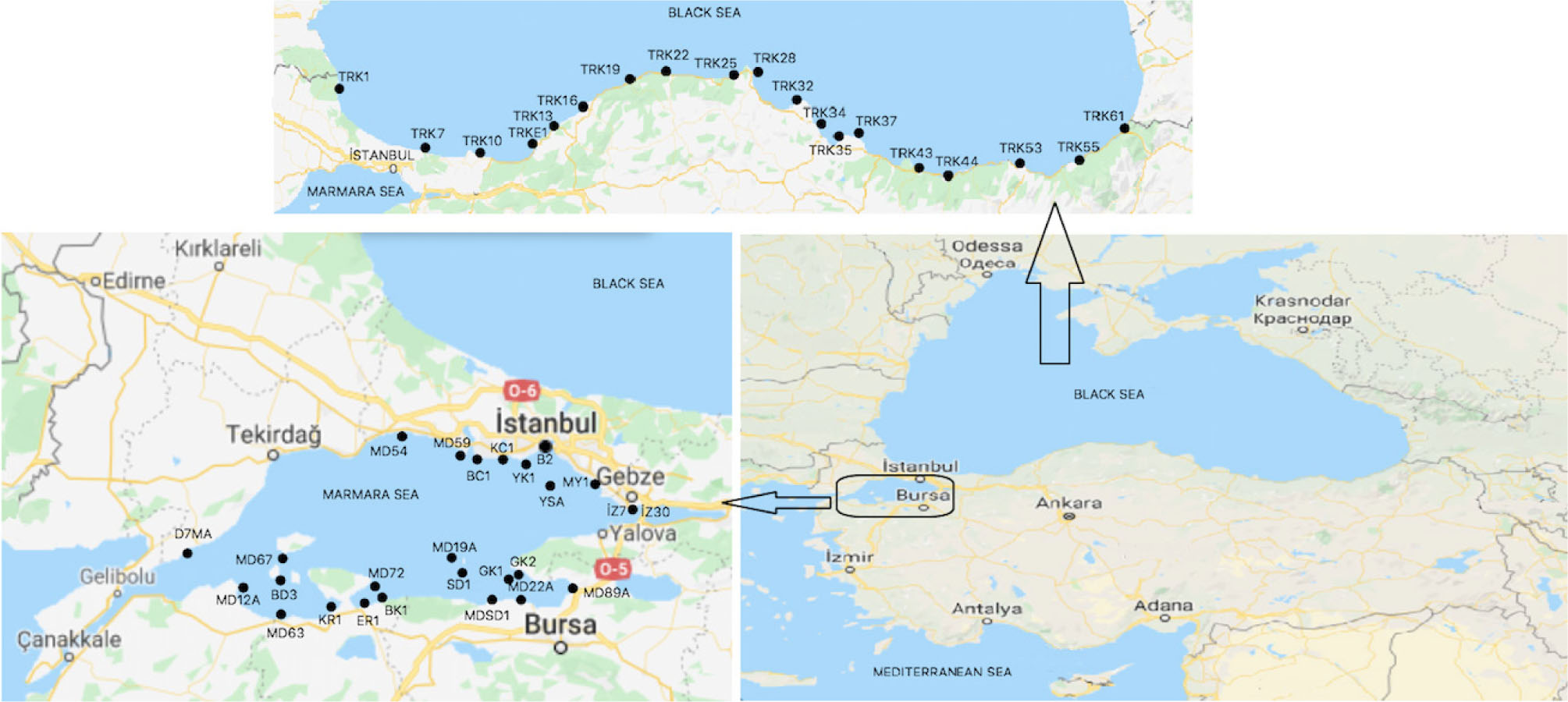
Figure 1
Map of the sampling sites
Table 1
Codes, coordinates, habitat structure, sampling dates and depth of the sampling locations in the Black Sea and the Marmara Sea
| Site code | Site name | Date | Depth (m) | Coordinates | Substrate | |
|---|---|---|---|---|---|---|
| Latitude | Longitude | |||||
| THE BLACK SEA | ||||||
| TRK1 | İğneada and Danube River water | 04.07.2019 | 20 | 41°52′12″N | 28°3′33″E | shells and sand |
| TRK7 | Şile | 05.07.2019 | 22 | 41°11′30″N | 29°35′24″E | mud |
| TRK10 | Sakarya River | 06.07.2019 | 21 | 41°8′45″N | 30°37′39″E | mud |
| TRKE1 | Karadeniz Ereğlisi | 07.07.2019 | 14 | 41°16′28″N | 31°23′54″E | shells and fine sand |
| TRK13 | Zonguldak | 07.07.2019 | 20 | 41°27′36″N | 31°46′24″E | detrital black sandy mud |
| TRK16 | Bartın | 08.07.2019 | 22 | 41°35′32″N | 32°3′3″E | phytodetritus |
| TRK19 | Cide | 08.07.2019 | 24 | 41°54′43″N | 32°55′32″E | shells and mud |
| TRK22 | İnebolu | 09.07.2019 | 25 | 41°59′17″N | 33°47′2″E | shells and detrital mud |
| TRK25 | Sinop 2 | 09.07.2019 | 20 | 41°3′49″N | 34°55′4″E | mud |
| TRK28 | Sinop 1 | 10.07.2019 | 22 | 41°0′57″N | 35°9′28″E | shells and coarse sand |
| TRK32 | Kızılırmak | 10.07.2019 | 24 | 41°44′44″N | 35°57′26″E | mud |
| TRK34Y | Samsun | 12.07.2019 | 20 | 41°19′1″N | 36°21′35″E | mud with phytodetritus |
| TRK35 | Samsun | 11.07.2019 | 48 | 41°20′49″N | 36°23′23″E | shells |
| TRK37 | Yeşilırmak | 13.07.2019 | 8.5 | 41°23′37″N | 36°39′9″E | mud |
| TRK43 | Ordu | 14.07.2019 | 11.6 | 41°0′14″N | 37°53′36″E | shells and sand |
| TRK44 | Ordu | 14.07.2019 | 48 | 41°1′14″N | 37°54′27″E | phytodetritus clay |
| TRK46 | Giresun | 14.07.2019 | 20 | 40°55′21″N | 38°24′21″E | mud |
| TRK53 | Trabzon | 15.07.2019 | 35 | 41°1′0″N | 39°43′42″E | mud with phytodetritus and sand |
| TRK55 | Rize | 16.07.2019 | 25 | 41°2′ 7″N | 40°32′ 20″E | shells and mud |
| TRK61 | Hopa | 16.07.2019 | 45 | 41°30′52″N | 41°30′50″E | mud |
| THE MARMARA SEA | ||||||
| İZ7 | İzmit Bay | 24.07.2019 | 65 | 40°45′54″N | 29°27′38″E | mud, fine sand, shells |
| İZ30 | İzmit Bay | 24.07.2019 | 27 | 40°45′15″ N | 29°54′47″E | clay, phytodetritus |
| MY1 | Pendik | 24.07.2019 | 38 | 40°52′4″N | 29°14′27″E | mud and fine sand |
| YSA | Yassıada | 23.07.2019 | 87 | 40°51′23″N | 28°59′12″E | clay and fine sand |
| B2 | İstanbul Strait | 26.07.2019 | 30 | 41°1′ 46″N | 29°0′50″E | mud and fine sand |
| YK1 | Yenikapı shore | 26.07.2019 | 15 | 40°56′26″N | 28°50′20″E | coralline, mud, fine sand |
| KC1 | Küçükçekmece shore | 27.07.2019 | 20 | 40°58′12″N | 28°45′20″E | clay, phytodetritus |
| BC1 | Büyükçekmece shore | 27.07.2019 | 51 | 40°56′51″N | 28°36′22″E | clay, fine sand |
| MD54 | Silivri shore | 27.07.2019 | 31 | 41°3′26″N | 28°14′27″E | clay, fine sand |
| MD59 | Tekirdağ shore | 28.07.2019 | 20 | 40°57′40″N | 28°31′29″E | mud, fine sand |
| D7MA | Şarköy | 28.07.2019 | 32 | 40°33′14″N | 27°1′27″E | mud, fine sand, shells |
| BD3 | Erdek Bay | 28.07.2019 | 37 | 40°25′25″N | 27°22′37″E | mud, fine sand, shells |
| MD12A | Erdek Bay | 29.07.2019 | 44 | 40°25′17″N | 27°32′1″E | mud, fine sand, shells |
| BK1 | Bandırma | 30.07.2019 | 35 | 40°22′12″N | 27°57′42″E | mud, shells, phytodetritus |
| MD72 | Bandırma | 30.07.2019 | 44 | 40°24′27″N | 28°4′24″E | mud, shells |
| MD19A | Bayramdere | 31.07.2019 | 43 | 40°32′10″N | 28°25′24″E | mud, fine sand |
| SD2 | Susurluk Stream | 31.07.2019 | 10 | 40°24′32″N | 28°31′11″E | fine sand |
| MD89A | Gemlik Bay | 1.08.2019 | 39 | 40°25′50″N | 29°8′17″E | mud, phytodetritus |
| MD22A | Gemlik Bay | 31.07.2019 | 35 | 40°22′51″N | 28°53′11″E | mud, phytodetritus |
| GK2 | Gemlik Bay | 1.08.2019 | 39 | 40°29′42″N | 28°49′27″E | mud, shells |
| MD24 | Yalova Shore | 1.08.2019 | 51 | 40°40′0″N | 29°14′52″E | mud |
| GK1 | Gemlik Bay | 31.07.2019 | 64 | 40°27′13″N | 28°45′10″E | mud |
| MDSD1 | Mudanya | 31.07.2019 | 27 | 40°23′13″N | 28°43′44″E | clay, phytodetritus |
| ER1 | Erdek Bay | 29.07.2019 | 33 | 40°23′44″N | 28°2′15″E | mud, fine sand, shells |
| KR1 | Kurşunlu shore | 30.07.2019 | 47 | 40°20′38″N | 27°48′7″E | mud, fine sand |
| MD67 | Erdek Bay | 29.07.2019 | 60 | 40°32′55″N | 27°34′36″E | mud, fine sand, shells |
| MD63 | Denizkent-Erdek Bay | 29.07.2019 | 15 | 40°19′5″N | 27°32′34″E | mud, phytodetritus |
Species were identified using a number of references (Barnard 1925; Monod 1926; Bouvier 1940; Zariquiey-Alvarez 1946; 1968; Tattersall & Tattersall 1951; Bacescu 1954; Holthuis 1956; Naylor 1972; Jones 1976; Wägele 1981; Bacescu 1982; 1988; Bellan-Santini et al. 1982; 1989; 1993; 1998; Holdich & Jones 1983; Holthuis 1987; Watling 1991; Koçak et al. 2007; Curatolo et al. 2013). The nomenclature follows WoRMS (2020).
The frequency index (Fi) of Soyer (1970) was used to determine the frequency of crustacean species in the study area. According to the calculated Fi values, the results were categorized into three groups: “constant” (Fi 50%), “common” (50% > Fi ≥ 25%) and “rare” (Fi < 25%). The dominance index (Di) was used to determine the dominance of crustacean species in the study area (Bellan-Santini 1969). The evenness index (J′) and the Shannon–Wiener index were used to determine the diversity of crustacean species (Shannon & Weaver 1963; Pielou 1966). Multidimensional scaling (MDS) methods were used to analyze the Bray–Curtis similarity index and the regional distribution model to determine similarity between the sampling locations. To this end, log (x + 1) transformation was applied to the raw data. The percentage contribution of each species to the similarities and differences derived from the stack analysis was determined using the SIMPER analysis. Primer 6 software (Clarke & Warwick 2001) was used for the analysis.
3. Results
A total of 32 crustacean species were found in the Black Sea during the study (Table 2). The order Amphipoda (50%) was represented by the largest number of species and was followed by Decapoda (19%; Fig. 2). The least frequent order was Mysida, which was represented by only one species – Gastrosaccus sanctus (Van Beneden, 1861). Three amphipods [Gammaropsis palmata (Stebbing & Robertson, 1891), Pontocrates arenarius (Bate 1858), and Synchelidium haplocheles (Grube, 1864)] of the identified species were reported for the first time from the Black Sea. Considering the values of the frequency index, only two species [Ampelisca pseudospinimana Bellan-Santini & Kaim-Malka, 1977 and Perioculodes longimanus (Spence Bate & Westwood, 1868)] are constant and six species [Ampelisca diadema (Costa, 1853), Ampelisca pseudosarsi Bellan-Santini & Kaim-Malka, 1977, Iphinoe tenella Sars, 1878, Iphinoe trispinosa (Goodsir, 1843), Pseudocuma (Pseudocuma) longicorne (Bate, 1858) and Diogenes pugilator (Roux, 1829)] are common. The remaining species can be described as rare. The species with the highest dominance indices were I. tenella (14.6%) and A. pseudospinimana (11.2%; Table 2). The highest similarity (68%) between the locations sampled in the Black Sea was found between the TRK46 site in Giresun and the TRK61 site in Hopa. I. tenella, A. pseudospinimana and P. longimanus contributed most to this similarity. The second highest similarity (62.2%) was observed between TRK43 in Ordu and TRK55 in Rize. A. pseudospinimana, A. acutum and Pseudocuma (Pseudocuma) longicorne (Bate, 1858) contributed most to the similarity (Fig. 3).
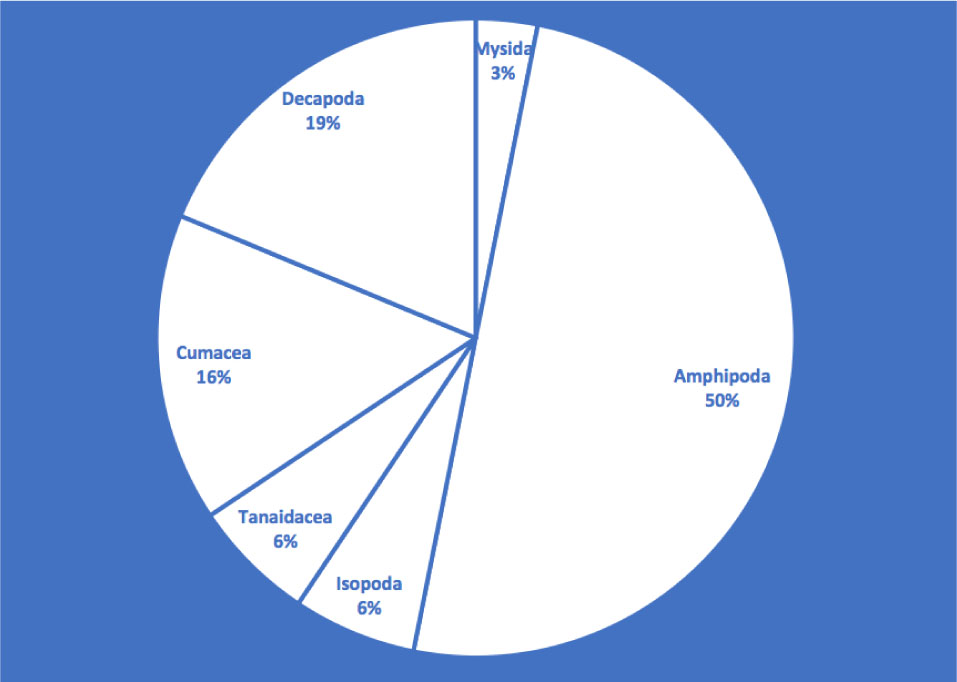
Figure 2
Distribution of species per order in the Black Sea
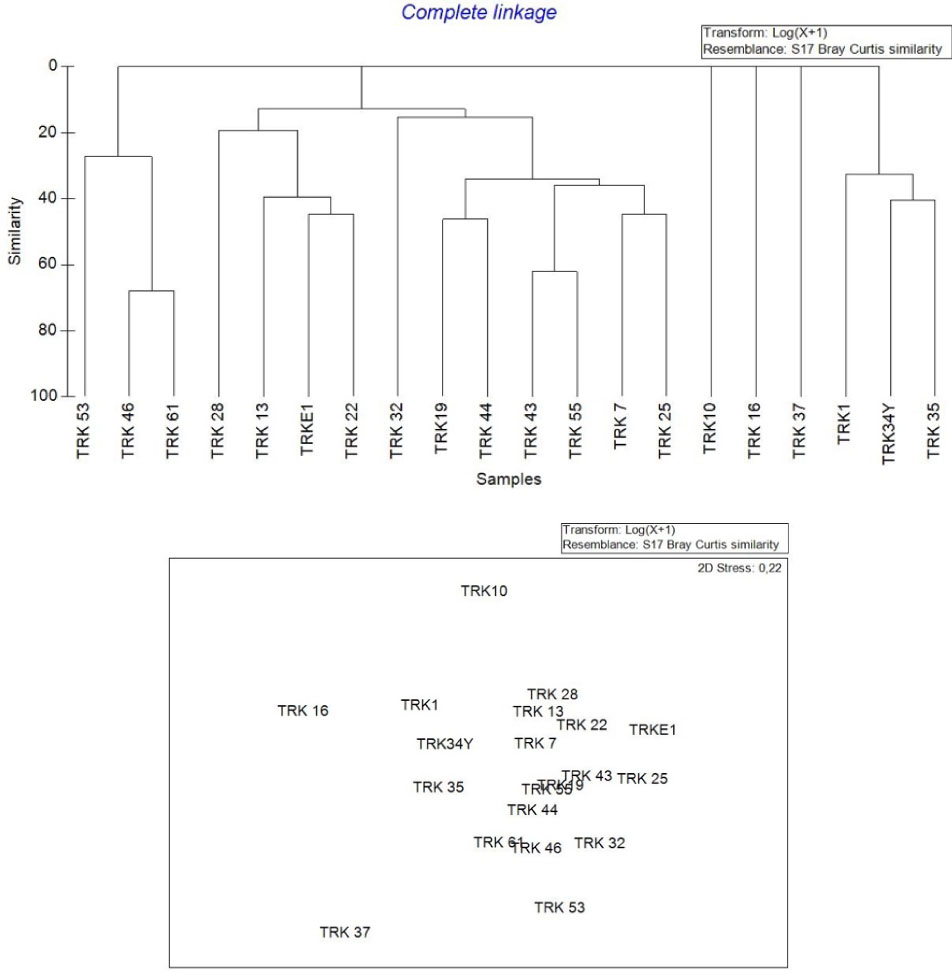
Figure 3
Similarity between the Black Sea sites
Table 2
Crustacean species found in the Black Sea; Frequency (Fi) and Dominance Index (Di) values
| TRK1 | TRK7 | TRK10 | TRKE1 | TRK13 | TRK16 | TRK19 | TRK22 | TRK25 | TRK28 | TRK32 | TRK34Y | TRK35 | TRK37 | TRK43 | TRK44 | TRK46 | TRK53 | TRK55 | TRK61 | Fi % | Di % | |
|---|---|---|---|---|---|---|---|---|---|---|---|---|---|---|---|---|---|---|---|---|---|---|
| MYSIDA | ||||||||||||||||||||||
| Gastrosaccus sanctus (Van Beneden, 1861) | 3 | 3 | 10 | 0.2 | ||||||||||||||||||
| AMPHIPODA | ||||||||||||||||||||||
| Ampelisca diadema (Costa, 1853) | 17 | 7 | 73 | 3 | 7 | 30 | 13 | 20 | 40 | 6.3 | ||||||||||||
| Ampelisca pseudosarsi Bellan-Santini & Kaim-Malka, 1977 | 3 | 30 | 10 | 3 | 70 | 47 | 3 | 35 | 6.1 | |||||||||||||
| Ampelisca pseudospinimana Bellan-Santini & Kaim-Malka, 1977 | 27 | 57 | 7 | 3 | 3 | 30 | 7 | 43 | 7 | 7 | 107 | 7 | 60 | 11.2 | ||||||||
| Ampelisca sp. | 7 | 20 | 90 | 3 | 3 | 3 | 10 | 35 | 5 | |||||||||||||
| Amphipoda (sp.) | 3 | 10 | 10 | 0.5 | ||||||||||||||||||
| Apocorophium acutum (Chevreux, 1908) | 3 | 107 | 10 | 15 | 4.4 | |||||||||||||||||
| Bathyporeia guilliamsoniana (Spence Bate, 1857) | 23 | 120 | 10 | 5.3 | ||||||||||||||||||
| Dexamine spiniventris (Costa, 1853) | 3 | 3 | 10 | 0.2 | ||||||||||||||||||
| Ericthonius brasiliensis (Dana, 1853) | 50 | 5 | 1.8 | |||||||||||||||||||
| *Gammaropsis palmata (Stebbing & Robertson, 1891) | 3 | 20 | 10 | 0.8 | ||||||||||||||||||
| Medicorophium runcicorne (Della Valle, 1893) | 3 | 7 | 10 | 7 | 20 | 1 | ||||||||||||||||
| Medicorophium sp. | 7 | 3 | 3 | 15 | 0.5 | |||||||||||||||||
| Megaluropus massiliensis Ledoyer, 1976 | 7 | 20 | 10 | 1 | ||||||||||||||||||
| Microdeutopus sp. | 13 | 5 | 0.5 | |||||||||||||||||||
| Microdeutopus versiculatus (Spence Bate, 1857) | 57 | 40 | 7 | 3 | 20 | 3.9 | ||||||||||||||||
| Perioculodes longimanus (Spence Bate & Westwood, 1868) | 33 | 7 | 3 | 17 | 7 | 27 | 13 | 3 | 7 | 40 | 3 | 10 | 3 | 65 | 6.4 | |||||||
| Perioculodes sp. | 3 | 3 | 10 | 0.2 | ||||||||||||||||||
| Phtisica marina Slabber, 1769 | 3 | 3 | 3 | 15 | 0.3 | |||||||||||||||||
| *Pontocrates arenarius (Spence Bate, 1858) | 3 | 5 | 0.1 | |||||||||||||||||||
| *Synchelidium haplocheles (Grube, 1864) | 7 | 7 | 3 | 10 | 20 | 1 | ||||||||||||||||
| Synchelidium maculatum Stebbing, 1906 | 3 | 5 | 0.1 | |||||||||||||||||||
| ISOPODA | ||||||||||||||||||||||
| Eurydice pulchra Leach, 1815 | 7 | 7 | 70 | 3 | 20 | 3 | ||||||||||||||||
| Isopoda (sp.) | 3 | 5 | 0.1 | |||||||||||||||||||
| Paragnathia formica (Hesse, 1864) | 7 | 5 | 0.1 | |||||||||||||||||||
| TANAIDACEA | ||||||||||||||||||||||
| Apseudopsis acutifrons (Sars, 1882) | 13 | 13 | 17 | 15 | 1.6 | |||||||||||||||||
| Apseudopsis latreillii (Milne Edwards, 1828) | 3 | 7 | 7 | 3 | 7 | 13 | 30 | 1.5 | ||||||||||||||
| CUMACEA | ||||||||||||||||||||||
| Cumacea (sp.) | 3 | 5 | 0.1 | |||||||||||||||||||
| Iphinoe serrata Norman, 1867 | 3 | 5 | 0.1 | |||||||||||||||||||
| Iphinoe sp. | 7 | 3 | 23 | 3 | 3 | 3 | 30 | 1.5 | ||||||||||||||
| Iphinoe tenella Sars, 1878 | 7 | 3 | 7 | 57 | 283 | 13 | 27 | 35 | 14.6 | |||||||||||||
| Iphinoe trispinosa (Goodsir, 1843) | 7 | 3 | 10 | 3 | 23 | 67 | 3 | 50 | 10 | 45 | 6.5 | |||||||||||
| Eudorella truncatula (Bate, 1856) | 7 | 10 | 17 | 15 | 1.3 | |||||||||||||||||
| Pseudocuma (Pseudocuma) longicorne (Bate, 1858) | 3 | 17 | 3 | 3 | 73 | 70 | 3 | 10 | 40 | 6.7 | ||||||||||||
| DECAPODA | ||||||||||||||||||||||
| Athanas nitescens (Leach, 1813) | 10 | 5 | 0.4 | |||||||||||||||||||
| Brachynotus sexdentatus (Risso, 1827) | 10 | 3 | 10 | 0.5 | ||||||||||||||||||
| Decapoda (sp.) | 3 | 3 | 10 | 0.2 | ||||||||||||||||||
| Gebiidea (sp.) | 10 | 3 | 10 | 0.5 | ||||||||||||||||||
| Diogenes pugilator (Roux, 1829) | 3 | 3 | 3 | 3 | 3 | 3 | 37 | 10 | 40 | 2.4 | ||||||||||||
| Liocarcinus depurator (Linnaeus, 1758) | 7 | 5 | 0.3 | |||||||||||||||||||
| Pilumnus hirtellus (Linnaeus, 1761) | 3 | 5 | 0.1 | |||||||||||||||||||
| Upogebia pusilla (Petagna, 1792) | 23 | 3 | 7 | 15 | 1.2 | |||||||||||||||||
| Upogebia sp. | 3 | 5 | 0.1 | |||||||||||||||||||
A total of 77 crustacean species were identified in the Marmara Sea and two of them [Kupellonura mediterranea Barnard, 1925, Leucon (Macrauloleucon) siphonatus Calman, 1905] represent new records for the Turkish Seas, 12 species [Cirolana cranchii Leach, 1818, Cumella (Cumella) pygmaea G.O. Sars, 1865, Cyathura carinata (Krøyer, 1847), Cymodoce truncata Leach, 1814, Eurydice pulchra Leach, 1815, Gammaropsis sophiae (Boeck, 1861), Harpinia truncata Sars, 1891, Iphinoe serrata Norman, 1867, Iphinoe trispinosa (Goodsir, 1843), Liocarcinus pusillus (Leach, 1816), Nebalia strausi Risso, 1826 and Synchelidium maculatum Stebbing, 1906] are reported for the first time from the Marmara Sea (Table 3). K. mediterranea, which is a new record for the Turkish Seas, is an isopod species found at three sites in Erdek Bay during the study. Of these sites, BD3 was 37 m deep, MD12A was 44 m deep and MD67 was 60 m deep. The substrate at all three sites was mud, fine sand and shells. Leucon (Macrauloleucon) siphonatus, belonging to Cumacea, was found in Erdek Bay at a depth of 60 m. The substrate at this site was also mud, fine sand and shells. As in the Black Sea, most species (63%) from the Marmara Sea belonged to the order Amphipoda, followed by Decapoda (14%). Species from the Mysida order were not found (Fig. 4).
Table 3
Crustacean species identified in the Marmara Sea; Frequency (Fi) and Dominance Index (Di) values
| İZ7 | İZ30 | MY1 | YSA | B2 | YK1 | KC1 | BC1 | MD54 | MD59 | D7MA | BD3 | MD12A | BK1 | MD72 | MD19A | SD2 | MD89A | MD22A | GK2 | MD24 | GK1 | MDSD1 | ER1 | KR1 | MD67 | MD63 | Fi % | Di % | |
|---|---|---|---|---|---|---|---|---|---|---|---|---|---|---|---|---|---|---|---|---|---|---|---|---|---|---|---|---|---|
| LEPTOSTRACA | |||||||||||||||||||||||||||||
| *Nebalia strausi Risso, 1826 | 10 | 7 | 7 | 0.06 | |||||||||||||||||||||||||
| AMPHIPODA | |||||||||||||||||||||||||||||
| Ampelisca diadema (Costa, 1853) | 3 | 7 | 117 | 20 | 20 | 13 | 3 | 63 | 27 | 53 | 33 | 243 | 73 | 43 | 52 | 2.49 | |||||||||||||
| Ampelisca gibba Sars, 1883 | 7 | 40 | 7 | 0.16 | |||||||||||||||||||||||||
| Ampelisca planierensis Bellan-Santini & Kaim-Malka, 1977 | 7 | 203 | 40 | 807 | 157 | 63 | 317 | 13 | 47 | 33 | 5.74 | ||||||||||||||||||
| Ampelisca pseudospinimana Bellan-Santini & Kaim-Malka, 1977 | 13 | 27 | 73 | 7 | 30 | 77 | 43 | 113 | 3 | 850 | 30 | 130 | 44 | 4.85 | |||||||||||||||
| Ampelisca sp. | 100 | 3 | 3 | 107 | 37 | 17 | 100 | 40 | 83 | 93 | 113 | 113 | 50 | 43 | 50 | 33 | 59 | 3.42 | |||||||||||
| Ampelisca spinipes Boeck, 1861 | 40 | 4 | 0.14 | ||||||||||||||||||||||||||
| Ampelisca tenuicornis Lilljeborg, 1855 | 50 | 10 | 7 | 7 | 15 | 0.26 | |||||||||||||||||||||||
| Ampelisca typica (Spence Bate, 1856) | 10 | 4 | 0.03 | ||||||||||||||||||||||||||
| Ampithoe ramondi Audouin, 1826 | 3 | 4 | 0.01 | ||||||||||||||||||||||||||
| Aora gracilis (Spence Bate, 1857) | 3 | 4 | 0.01 | ||||||||||||||||||||||||||
| Apherusa chiereghinii Giordani-Soika, 1949 | 3 | 4 | 0.01 | ||||||||||||||||||||||||||
| Apocorophium acutum (Chevreux, 1908) | 7903 | 3 | 4 | 27.45 | |||||||||||||||||||||||||
| Apolochus neapolitanus (Della Valle, 1893) | 7 | 4 | 0.02 | ||||||||||||||||||||||||||
| Autone sp. | 3 | 4 | 0.01 | ||||||||||||||||||||||||||
| Autonoe karamani (Myers, 1976) | 10 | 4 | 0.03 | ||||||||||||||||||||||||||
| Caprella acanthifera Leach, 1814 | 7 | 4 | 0.02 | ||||||||||||||||||||||||||
| Caprella rapax Mayer, 1890 | 3 | 4 | 0.01 | ||||||||||||||||||||||||||
| Carangoliopsis spinulosa Ledoyer, 1970 | 7 | 4 | 0.02 | ||||||||||||||||||||||||||
| Centraloecetes dellavallei (Stebbing, 1899) | 7 | 27 | 7 | 0.12 | |||||||||||||||||||||||||
| Corophium sp. | 3 | 3 | 7 | 0.02 | |||||||||||||||||||||||||
| Gammarella fucicola (Leach, 1814) | 520 | 4 | 1.81 | ||||||||||||||||||||||||||
| Gammaropsis palmata (Stebbing & Robertson, 1891) | 3 | 23 | 3 | 10 | 57 | 17 | 7 | 26 | 0.42 | ||||||||||||||||||||
| *Gammaropsis sophiae (Boeck, 1861) | 3 | 3 | 13 | 11 | 0.07 | ||||||||||||||||||||||||
| Gitana sarsi Boeck, 1871 | 3 | 3 | 3 | 7 | 15 | 0.06 | |||||||||||||||||||||||
| Harpinia crenulata (Boeck, 1871) | 17 | 4 | 0.06 | ||||||||||||||||||||||||||
| Harpinia dellavallei Chevreux, 1910 | 3 | 13 | 7 | 0.06 | |||||||||||||||||||||||||
| *Harpinia truncata Sars, 1891 | 10 | 10 | 7 | 0.07 | |||||||||||||||||||||||||
| Hippomedon massiliensis Bellan-Santini, 1965 | 3 | 4 | 0.01 | ||||||||||||||||||||||||||
| Jassa marmorata Holmes, 1905 | 230 | 4 | 0.80 | ||||||||||||||||||||||||||
| Leptocheirus mariae Karaman, 1973 | 10 | 3 | 3 | 310 | 17 | 19 | 1.19 | ||||||||||||||||||||||
| Leucothoe incisa Robertson, 1892 | 7 | 4 | 0.02 | ||||||||||||||||||||||||||
| Leucothoe lilljeborgi Boeck, 1861 | 7 | 10 | 3 | 11 | 0.07 | ||||||||||||||||||||||||
| Maera grossimana (Montagu, 1808) | 53 | 4 | 0.18 | ||||||||||||||||||||||||||
| Maera sp. | 3 | 4 | 0.01 | ||||||||||||||||||||||||||
| Medicorophium rotundirostre (Stephensen, 1915) | 3 | 3 | 20 | 17 | 15 | 0.15 | |||||||||||||||||||||||
| Medicorophium runcicorne (Della Valle, 1893) | 3 | 3 | 3 | 11 | 0.03 | ||||||||||||||||||||||||
| Medicorophium sp. | 3 | 3 | 3 | 11 | 0.03 | ||||||||||||||||||||||||
| Megamphopus cornutus Norman, 1869 | 33 | 4 | 0.11 | ||||||||||||||||||||||||||
| Melita palmata (Montagu, 1804) | 40 | 4 | 0.14 | ||||||||||||||||||||||||||
| Microdeutopus algicola Della Valle, 1893 | 233 | 13 | 7 | 0.85 | |||||||||||||||||||||||||
| Microdeutopus gryllotalpa A. Costa, 1853 | 4070 | 4 | 14.13 | ||||||||||||||||||||||||||
| Microdeutopus sp. | 7 | 4 | 0.02 | ||||||||||||||||||||||||||
| Microdeutopus versiculatus (Spence Bate, 1857) | 27 | 17 | 30 | 11 | 0.26 | ||||||||||||||||||||||||
| Paraphoxus oculatus (G. O. Sars, 1879) | 23 | 4 | 0.08 | ||||||||||||||||||||||||||
| Parvipalpus linea Mayer, 1890 | 23 | 3 | 7 | 0.09 | |||||||||||||||||||||||||
| Perioculodes longimanus (Spence Bate & Westwood, 1868) | 3 | 20 | 83 | 30 | 40 | 7 | 3 | 3 | 30 | 0.66 | |||||||||||||||||||
| Photis longicaudata (Spence Bate & Westwood, 1862) | 3 | 10 | 7 | 0.05 | |||||||||||||||||||||||||
| Phtisica marina Slabber, 1769 | 963 | 73 | 3 | 3 | 17 | 13 | 10 | 13 | 30 | 3.80 | |||||||||||||||||||
| Pontocrates arenarius (Spence Bate, 1858) | 10 | 4 | 0.03 | ||||||||||||||||||||||||||
| Pseudoprotella phasma (Montagu, 1804) | 3 | 3 | 7 | 0.02 | |||||||||||||||||||||||||
| Stenothoe monoculoides (Montagu, 1813) | 17 | 4 | 0.06 | ||||||||||||||||||||||||||
| *Synchelidium maculatum Stebbing, 1906 | 7 | 4 | 0.02 | ||||||||||||||||||||||||||
| Tryphosa nana (Krøyer, 1846) | 17 | 7 | 20 | 7 | 0.15 | ||||||||||||||||||||||||
| Westwoodilla caecula (Spence Bate, 1857) | 7 | 4 | 0.02 | ||||||||||||||||||||||||||
| ISOPODA | |||||||||||||||||||||||||||||
| *Cirolana cranchii Leach, 1818 | 3 | 4 | 0.01 | ||||||||||||||||||||||||||
| *Cyathura carinata (Krøyer, 1847) | 3 | 4 | 0.01 | ||||||||||||||||||||||||||
| *Cymodoce truncata Leach, 1814 | 3 | 4 | 0.01 | ||||||||||||||||||||||||||
| *Eurydice pulchra Leach, 1815 | 793 | 4 | 2.75 | ||||||||||||||||||||||||||
| Gnathia dentata (Sars G.O., 1872) | 3 | 4 | 0.01 | ||||||||||||||||||||||||||
| **Kupellonura mediterranea Barnard, 1925 | 3 | 3 | 3 | 11 | 0.03 | ||||||||||||||||||||||||
| Paragnathia formica (Hesse, 1864) | 3 | 3 | 7 | 0.02 | |||||||||||||||||||||||||
| TANAIDACEA | |||||||||||||||||||||||||||||
| Apseudopsis acutifrons (Sars, 1882) | 33 | 4 | 0.11 | ||||||||||||||||||||||||||
| Apseudopsis latreillii (Milne Edwards, 1828) | 6653 | 3 | 3 | 67 | 3 | 19 | 23.36 | ||||||||||||||||||||||
| Chondrochelia savignyi (Kroyer, 1842) | 60 | 3 | 7 | 0.22 | |||||||||||||||||||||||||
| CUMACEA | |||||||||||||||||||||||||||||
| Cumacea (sp.) | 3 | 4 | 0.01 | ||||||||||||||||||||||||||
| *Cumella (Cumella) pygmaea G.O. Sars, 1865 | 37 | 4 | 0.13 | ||||||||||||||||||||||||||
| Diastyloides bosphorica (Băcescu, 1982) | 3 | 27 | 3 | 27 | 17 | 3 | 3 | 43 | 40 | 33 | 0.58 | ||||||||||||||||||
| Diastyloides serratus (Sars G.O., 1865) | 10 | 17 | 20 | 3 | 33 | 10 | 22 | 0.32 | |||||||||||||||||||||
| Diastyloides sp. | 7 | 4 | 0.02 | ||||||||||||||||||||||||||
| Eudorella truncatula (Bate, 1856) | 3 | 4 | 0.01 | ||||||||||||||||||||||||||
| *Iphinoe serrata Norman, 1867 | 13 | 3 | 3 | 11 | 0.07 | ||||||||||||||||||||||||
| Iphinoe sp. | 30 | 4 | 0.10 | ||||||||||||||||||||||||||
| *Iphinoe trispinosa (Goodsir, 1843) | 247 | 7 | 7 | 67 | 11 | 1.14 | |||||||||||||||||||||||
| **Leucon (Macrauloleucon) siphonatus Calman, 1905 | 1 | 4 | 0.003 | ||||||||||||||||||||||||||
| Leucon sp. | 3 | 4 | 0.01 | ||||||||||||||||||||||||||
| DECAPODA | |||||||||||||||||||||||||||||
| Anomura sp. | 7 | 4 | 0.02 | ||||||||||||||||||||||||||
| Callianassa subterranea (Montagu, 1808) | 3 | 4 | 0.01 | ||||||||||||||||||||||||||
| Decapoda (sp.) | 3 | 3 | 3 | 3 | 3 | 19 | 0.05 | ||||||||||||||||||||||
| Diogenes pugilator (Roux, 1829) | 3 | 4 | 0.01 | ||||||||||||||||||||||||||
| Gebiidea (sp.) | 13 | 3 | 7 | 0.06 | |||||||||||||||||||||||||
| Liocarcinus depurator (Linnaeus, 1758) | 3 | 3 | 3 | 3 | 15 | 0.04 | |||||||||||||||||||||||
| Liocarcinus marmoreus (Leach, 1814) | 3 | 4 | 0.01 | ||||||||||||||||||||||||||
| Liocarcinus navigator (Herbst, 1794) | 13 | 4 | 0.05 | ||||||||||||||||||||||||||
| *Liocarcinus pusillus (Leach, 1816) | 3 | 4 | 0.01 | ||||||||||||||||||||||||||
| Liocarcinus sp. | 3 | 4 | 0.01 | ||||||||||||||||||||||||||
| Pagurus cuanensis Bell, 1845 | 3 | 4 | 0.01 | ||||||||||||||||||||||||||
| Processa edulis (Risso, 1816) | 10 | 4 | 0.03 | ||||||||||||||||||||||||||
| Processa macrophthalma Nouvel & Holthuis, 1957 | 3 | 7 | 17 | 11 | 0.09 | ||||||||||||||||||||||||
| Processa sp. | 3 | 7 | 7 | 3 | 3 | 3 | 3 | 26 | 0.10 | ||||||||||||||||||||
| Upogebia pusilla (Petagna, 1792) | 10 | 4 | 0.03 | ||||||||||||||||||||||||||
| Upogebia sp. | 3 | 4 | 0.01 | ||||||||||||||||||||||||||
| Xantho poressa (Olivi, 1792) | 3 | 4 | 0.01 | ||||||||||||||||||||||||||
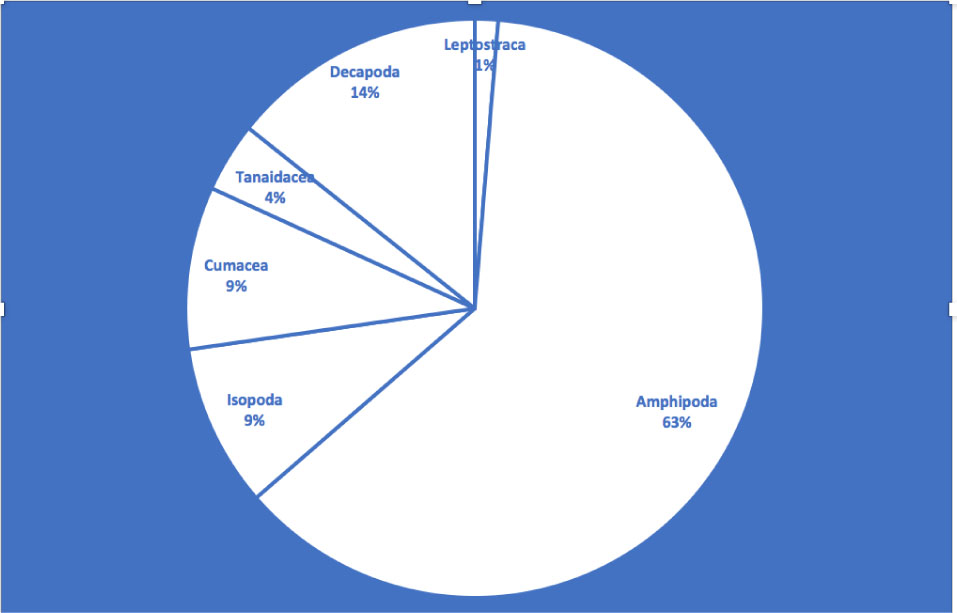
Figure 4
Distribution of species per order in the Marmara Sea
Only two species [A. diadema (52%) and I. trispinosa (67%)] were constant in the Marmara Sea, while Ampelisca planierensis Bellan-Santini & Kaim-Malka, 1977, A. pseudospinimana, G. palmata, P. longimanus, Phtisica marina Slabber, 1769 and Apseudopsis acutifrons (Sars, 1882) were common, the remaining species were categorized as rare. The species with the highest dominance indices were Apocorophium acutum (Chevreux, 1908) – 27.5% and Microdeutopus gryllotalpa A. Costa, 1853 – 14.1%.
The sites with the highest similarity (66.67%) in the Marmara Sea were YSA sites in Yassıada and GK1 sites in Gemlik Bay. It is seen that station groups BC1 on Buyukcekmece shore, GK2 on Gemlik Bay and KR1 on Kursunlu shore with a similarity index of 58.28% take the second place (Fig. 5). Diastyloides bosphorica (Băcescu, 1982) contributed greatly to the similarity of the first group, and A. diadema, A. planierensis and D. bosphorica contributed most to the similarity of the second group.
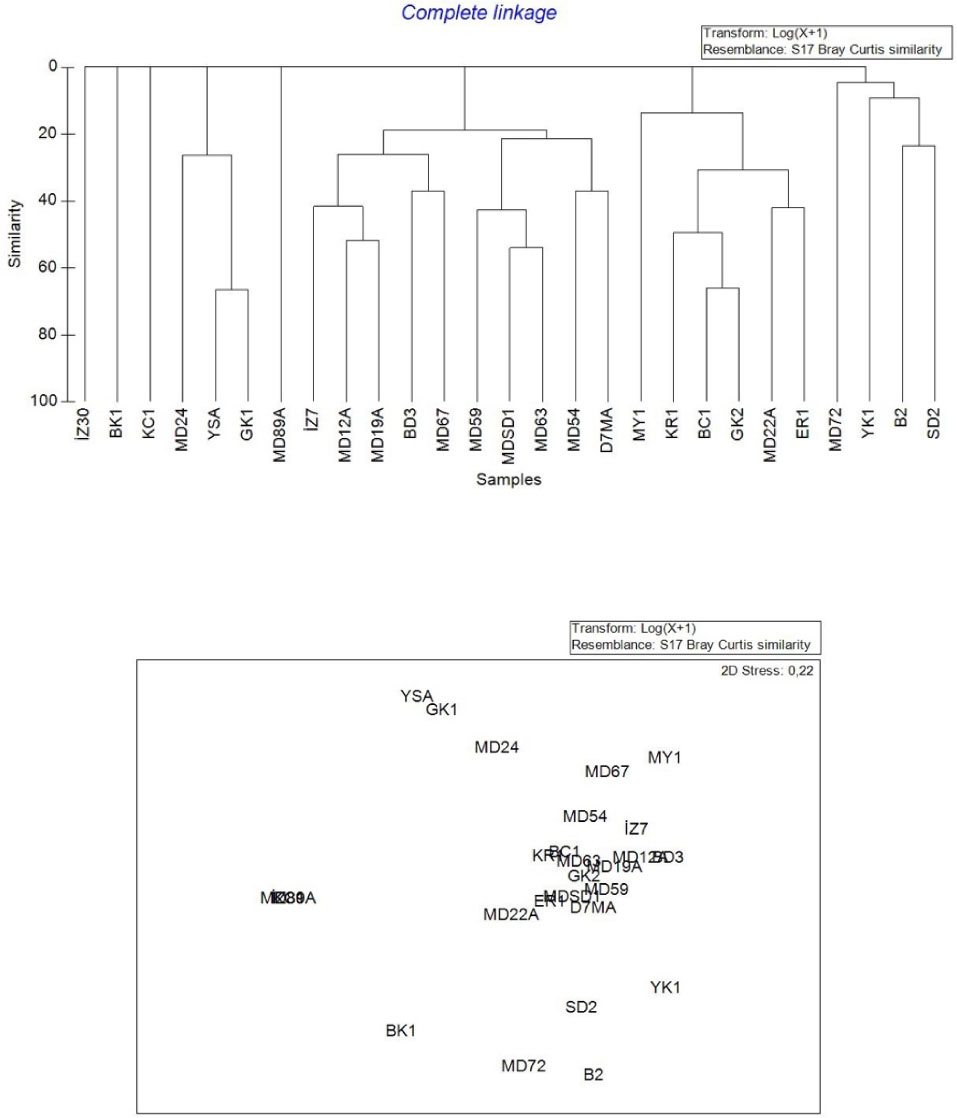
Figure 5
Similarity between the Marmara Sea sites
The lowest value of the diversity index (H′) in the Black Sea was found for TRK16 (H′ = 0) in Bartın, where three individuals belonging to one species were found and TRK37 (H′ = 0) Yeşilırmak (Table 4, Fig. 6). The second lowest scores were determined for TRK53 in Trabzon (H′ = 0.8), TRK46 in Giresun (H′ = 1), and TRK10 (H′ = 1.1) in the Sakarya River. The highest H′ value was obtained for site TRK28 in Sinop 1 (3.7) and site TRK19 in Cide (3.5). In the Marmara Sea, H′ values were 0 at four sites (MD89A, YSA and İZ30, KC1), which are located in Gemlik Bay, Yassıada, Izmit Bay and on the Küçükçekmece shore (Table 4, Fig. 7). The second lowest value (H′ = 0.9) was determined for MD22A and GK1 (H′ = 1), also located in Gemlik Bay, and BK1 in Bandırma Bay. The highest value (H′ = 3.8) was determined for YK1 in Yenikapı, D7MA (H′ = 3.4) in Şarköy and MD63 (H′ = 3.2) in Denizkent-Erdek Bay.
Table 4
Shannon–Wiener diversity index (H’) values
| THE BLACK SEA | ||||||
|---|---|---|---|---|---|---|
| Site code | Site name | S | N | d | J′ | H′(log2) |
| TRK1 | İğneada and Danube River water | 8 | 140 | 1.4 | 0.8 | 2.4 |
| TRK7 | Şile | 11 | 153 | 2 | 0.8 | 2.7 |
| TRK10 | Sakarya River | 5 | 89 | 0.9 | 0.5 | 1.1 |
| TRKE1 | Karadeniz Ereğlisi | 3 | 54 | 0.5 | 0.9 | 1.4 |
| TRK13 | Zonguldak | 6 | 33 | 1.4 | 0.9 | 2.4 |
| TR16 | Bartın | 1 | 3 | 0 | 0 | 0 |
| TRK19 | Cide | 18 | 148 | 3.4 | 0.8 | 3.5 |
| TRK22 | İnebolu | 11 | 129 | 2.1 | 0.7 | 2.4 |
| TRK25 | Sinop 2 | 10 | 484 | 1.5 | 0.9 | 2.9 |
| TRK28 | Sinop 1 | 15 | 91 | 3.1 | 0.9 | 3.7 |
| TRK32 | Kızılırmak | 7 | 35 | 1.7 | 0.9 | 2.6 |
| TRK34Y | Samsun | 8 | 75 | 1.6 | 0.8 | 2.3 |
| TRK35 | Samsun | 7 | 127 | 1.2 | 0.7 | 2 |
| TRK37 | Yeşilırmak | 0 | 0 | 0 | 0 | 0 |
| TRK43 | Ordu | 12 | 313 | 1.9 | 0.7 | 2.6 |
| TRK44 | Ordu | 10 | 160 | 1.8 | 0.8 | 2.6 |
| TRK46 | Giresun | 4 | 70 | 0.7 | 0.5 | 1 |
| TRK53 | Trabzon | 4 | 336 | 0.5 | 0.4 | 0.8 |
| TRK55 | Rize | 12 | 219 | 2 | 0.8 | 2.7 |
| TRK61 | Hopa | 5 | 57 | 1 | 0.8 | 1.9 |
| THE MARMARA SEA | ||||||
| İZ7 | İzmit Bay | 7 | 176 | 1.16 | 0.66 | 1.8 |
| İZ30 | İzmit Bay | 0 | 0 | 0 | 0 | 0 |
| MY1 | Pendik | 3 | 13 | 0.78 | 0.92 | 1.5 |
| YSA | Yassıada | 1 | 3 | 0 | 0 | 0 |
| B2 | İstanbul Strait | 15 | 20693 | 1.41 | 0.53 | 2.1 |
| YK1 | Yenikapı Shore | 27 | 334 | 4.47 | 0.80 | 3.8 |
| KC1 | Küçükçekmece shore | 0 | 0 | 0 | 0 | 0 |
| BC1 | Büyükçekmece shore | 7 | 483 | 0.97 | 0.73 | 2 |
| MD54 | Silivri shore | 10 | 139 | 1.82 | 0.73 | 2.4 |
| MD59 | Tekirdağ shore | 12 | 473 | 1.79 | 0.67 | 2.4 |
| D7MA | Şarköy | 19 | 296 | 3.16 | 0.80 | 3.4 |
| BD3 | Erdek Bay | 12 | 126 | 2.27 | 0.82 | 2.9 |
| MD12A | Erdek Bay | 11 | 218 | 1.86 | 0.68 | 2.3 |
| BK1 | Bandırma | 2 | 34 | 0.28 | 1 | 1 |
| MD72 | Bandırma | 3 | 9 | 0.91 | 1 | 1.6 |
| MD19A | Bayramdere | 5 | 212 | 0.75 | 0.78 | 1.8 |
| SD2 | Susurluk Stream | 14 | 1060 | 1.87 | 0.40 | 1.5 |
| MD89A | Gemlik Bay | 0 | 0 | 0 | 0 | 0 |
| MD22A | Gemlik Bay | 8 | 943 | 1.02 | 0.31 | 0.9 |
| GK2 | Gemlik Bay | 10 | 472 | 1.46 | 0.72 | 2.4 |
| MD24 | Yalova shore | 5 | 33 | 1.14 | 0.82 | 1.9 |
| GK1 | Gemlik Bay | 2 | 6 | 0.56 | 1 | 1 |
| MDSD1 | Mudanya | 18 | 1775 | 2.27 | 0.59 | 2.4 |
| ER1 | Erdek Bay | 9 | 453 | 1.31 | 0.51 | 1.6 |
| KR1 | Kurşunlu shore | 9 | 201 | 1.51 | 0.77 | 2.4 |
| MD67 | Erdek Bay | 16 | 191 | 2.86 | 0.77 | 3.1 |
| MD63 | Denizkent-Erdek Bay | 15 | 460 | 2.28 | 0.83 | 3.2 |
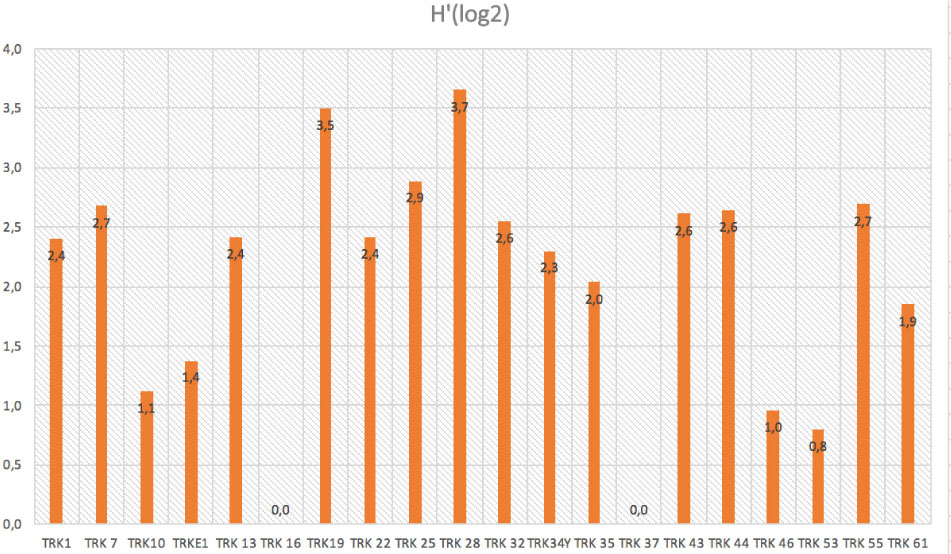
Figure 6
H′ values for the Black Sea sites
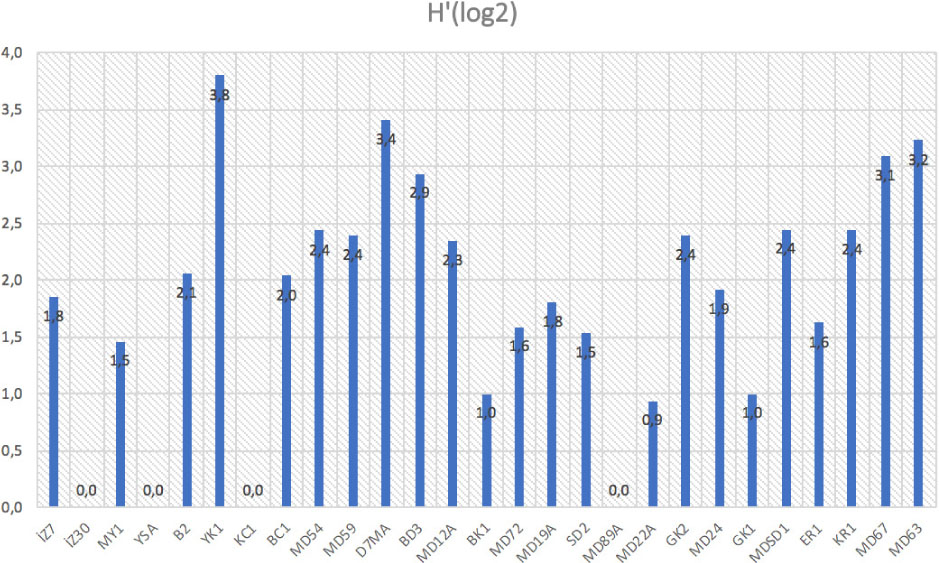
Figure 7
H′ values for the Marmara Sea sites
4. Discussion
Biodiversity in the Black Sea is quite low compared to other seas (Gönlügür et al. 2004; Bat et al. 2011). Our study corroborates previous findings regarding the difference in biodiversity between these two seas by identifying 77 crustacean species in the Marmara Sea and only 32 species in the Black Sea. Bakır et al. (2014) reported the presence of 172 benthic crustacean species in the Black Sea, but approximately 30 species were found only in soft-bottom benthos (Kırkım et al. 2006; Sezgin et al. 2010b). Kırkım et al. (2006) observed the dominance of Pseudocuma longicorne, Iphinoe elisae, Iphinoe tenella, Ampelisca diadema, Bathyporeia guilliamsoniana and Perioculodes longimanus longimanus. Similarly, P. longimanus, P. longicorne, I. tenella, A. diadema were found to be common species in this study, along with A. pseudospinimana, A. pseudosarsi, I. trisipinosa and D. pugilator. Other species commonly identified by the above-mentioned researchers were found in this study, but were classified into the category of rare species. The dominance of I. tenella from Cumacea was observed in both studies, followed by the Ampelisca genus. The results obtained by Sezgin et al. (2010b) were quite similar to those obtained in this study. The study by Sezgin et al. (2010b) was conducted on the southern coast of the Black Sea, with 30 crustacean species identified. Their findings showed the following distribution of species per order: Amphipoda (70%), Cumacea (13%), Decapoda (10%) and Tanaidacea (7%). In this study, the distribution of species was as follows: Amphipoda (50%), Decapoda (19%), Cumacea (16%), Tanaidacea (6%), Isopoda (6%) and Mysidacea (3%). As evidenced, species of Amphipoda, Cumacea and Decapoda occupy an important place in the benthic crustacean fauna of the Black Sea. Pseudocuma longicorne (37%) occurred with the highest frequency index according to the Kırkım et al. (2006) and Sezgin et al. (2010b), followed by Iphinoe tenella, Ampelisca diadema, Iphinoe elisae and Perioculodes longimanus. The dominant species in that study were: I. elisae (25%), I. tenella (17%), A. diadema (16%), P. longicorne (11%) and Bathyporeia guilliamsoniana (6%). In this study, I. tenella (14.6%), A. pseudospinimana (11.2%) and Pseudocuma longicorne (6.7%) were dominant. Mutlu et al. (1992), like other researchers, also stated that amphipods have an important place in the diversity of the crustacean fauna in the Turkish waters of the Black Sea. They also mentioned the dominance of Ampelisca diadema, Phtisica marina, Corophium volutator, Microdeutopus gryllotalpa and Iphinoe elisae (Mutlu et al. 1992). The prevalence of A. diadema was observed in our study and many other studies (Mutlu et al. 1992; Kırıkım et al. 2006; Sezgin et al. 2010b). A. diadema, a member of the Ampeliscidae family that occurs in all seas up to the polar ones, shows a wide distribution not only in the Turkish waters but also in the entire Black Sea due to its very good adaptation to environmental stresses (Stoykov & Uzunova 2001). In addition, A. pseudospinimana, which is common in Turkish waters, is an expected result in this study (Teaca & Gomoiu 2007). The prevalence and dominance of I. tenella, P. longimanus, P. longicorne, I. elisaeand B. guilliamsoniana in the Black Sea is remarkable. The benthic fauna of the Black Sea is dominated by polychaetes and mollusks, followed by crustaceans. Among crustaceans, amphipods dominate and are followed by decapods and isopods (Bat et al. 2011). Similarly, amphipods are known to be the dominant crustaceans, both in terms of the number of species and the number of individuals, not only in the Black Sea but in all benthic habitats. On the other hand, cumaceans, especially the species P. longicorne and I. tenella, dominate in the soft bottom with fine grain structure and organic enrichment (Moreira et al. 2008). It is noteworthy that very few species belonging to the order Mysidacea were found in this study. Only one Mysid species was found in the Black Sea and no species were found in the Marmara Sea. This can be attributed to the grab sampling method. Tanaids were represented in the Black Sea only by species belonging to the genus Apseudopsis. According to Moeria et al. (2008), these species are detritivores and tolerant of organic content. They are also found in high density in ports with high metal pollution (Guerra Garcia et al. 2003). However, according to Carretero et al. (2010), Apseudopsis latreillei is a sensitive species and, particularly affected by discharges.
Today, species of Mediterranean origin dominate in the Black Sea ecosystem, where organisms of miscellaneous origin occur due to the influence of the straits (Finenko 2008). Some species identified in the Black Sea (G. sanctus, A. pseudosarsi, B. guilliamsoniana, D. spiniventris, E. brasiliensis, M. massiliensis, I. tenella, P. longicorne, A. nitescens, B. sexdentatus and P. hirtellus) were not found in the Marmara Sea during this study, even though they are known to occur there (Bakır et al. 2014; Balkıs.et al. 2016).
As for the distribution of crustaceans in the Marmara Sea, Amphipoda (63%) are the largest group, followed by Decapoda (14%), Isopoda (9%), Cumacea (9%), Tanaidacea (4%) and Leptostraca (1%). According to Balkıs.et al. (2016), 418 malacostracan crustacean species are known from the Marmara Sea. Of these, 195 are amphipods, 140 are decapods and the rest belong to Isopoda (42), Cumacea (18), Mysidacea (12), Tanaidacea (7), Stomatopoda (2) and Leptostraca (1). Several researchers have expressed their doubts about the presence of six species from this checklist. According to Bakır et al. (2014), Nebalia bipes from Leptostraca is one of these species. Nebalia strausi was previously reported from the Aegean Sea and the Mediterranean Sea (Koçak & Katağan 2006; Koçak et al. 2011, Bakır et al. 2014) and in this study it is reported for the first time from the Marmara Sea. Bakır et al. (2012) identified 77 crustacean species on the soft bottom of the Marmara Sea, similar to this study. Their distribution by syntaxonomic order was as follows: Amphipoda (50%), Decapoda (14%), Cumacea (6%), Tanaidacea (2%) and Mysidacea (2%). In this study, Amphipoda (63%) and Decapoda (14%) were ranked first, and were followed by Isopoda (9%), Cumacea (9%), Tanaidacea (4%) and Leptostraca (1%). As mentioned above, no species belonging to the Mysidacea order were found. Previous researchers reported the dominance of Microdeutopus versiculatus (Spence Bate, 1857), Ampelisca sp., Apseudes sp., Megamphopus katagani Bakır Sezgin & Myers, 2011 and Monocorophium sextonae (Crawford 1937). They found that the species with the highest frequency index were: M. versiculatus, Apseudes sp. (40.7%), Leptochelia dubia (Kroyer 1842), Phtisica marina Slabber, 1769, Harpinia crenulata (Boeck 1871) and Ampelisca pseudospinimana Bellan-Santini & Kaim-Malka, 1977 (Bakır, 2012). According to our findings, the species with the highest frequency in the Marmara Sea are A. diadema (52%) and I. trispinosa (67%), followed by A. planierensis, A. pseudospinimana, G. palmata, P. longimanus, P. marina and A. acutifrons. The species with the highest dominance index are Apocorophium acutum (27.5%) and Microdeutopus gryllotalpa (14.1%). M. gryllotalpa is known for its tolerance to a wide range of salinity. This species, which occurs in many different habitats, can dominate in both sea meadows and regions with high levels of organic content (Drake & Arias 1995; Carvalho et al. 2006; Cacabelos et al. 2010). In the Marmara Sea, which consists of two layers of water with varying salinity and is under pressure of pollution, the dominance of this species may be related to its ecological tolerance. Similarly, A. acutum is a detritivore species whose abundance increases with organic content and occurs in many different ecosystems (Chintiroglou et al. 2004; Doğan et al. 2008). We observed a significant increase in the number of individuals of A. acutum (7903), A. latreillii (6653), M. gryllotalpa (4070) and P. marina (963) in the Istanbul Strait (site B2). Hydrodynamic processes are known to have a particular effect on the distribution of macrobenthic fauna, especially in the Istanbul Strait (Uysal et al. 2002). The high abundance in the Istanbul Strait, observed in this study, may be related to the species resistance to hydrodynamic conditions (Moyano & Gomez 1998). In addition, opportunistic pollution indicator species are known to increase in number under ecological pressure (Lo Brutto et al. 2016). These species are also known to tolerate organic pollution (Aslan-Cihangir & Pancucci-Papadopoulou 2011; Srinivas et al. 2019).
We recorded two species in the Marmara Sea, which are new to the Turkish seas. Kupellonura mediterranea, which is an isopod originating from the Mediterranean and Red seas, is distributed in the Mediterranean at a depth of 70–880 m (Barnard 1925; Wägele 1981). However, the fact that Barranco et al. (2012) found this species in the Cerro Gordo cave in Spain proves its wide distribution. Leucon (Macrauloleucon) siphonatus is a cumacean species (Watling 1991) known from the Northeast Atlantic, the Mediterranean and the Gulf of Mexico (Bãcescu 1988; Petrescu & Heard 2010).
When analyzing the H′ values, we note that some sites scored zero values. These zero values apply only to crustacean diversity and do not reflect macrobenthic diversity as a whole. However, we cannot ignore the fact that peracarid crustaceans in particular are good bioindicators of ecological conditions (Conradi et al. 1997; Chintiroglou et al. 2004; Moreira et al. 2008; Ambrosio et al. 2014; Podlesińska & Dąbrowska 2019). According to Bellan-Santini (1981), H′ values between 0.16 and 1.96 indicate ecosystems under pollution pressure, while a range of 2.4–4.6 is normal for uncontaminated environments (Chintiroglou et al. 2004).
Accordingly, seven out of 20 sites (Sakarya – TRK10, Karadeniz Ereğlisi – TRKE1, Bartın – TRK16, Yeşilırmak – TRK37, Giresun – TRK46, Trabzon – TRK53, Hopa – TRK61) sampled in the Black Sea belong to the above-mentioned first group. In the Marmara Sea, 13 out of 27 sites sampled (Izmit Bay – Z7, IZ30, Pendik – MY1, Yassıada – YSA, Küçükçekmece – KC1, Bandırma – BK1, Bayramdere – MD19A, Susuruk Stream – SD2, Gemlik – MD22A, GK1, Yalova – MD24, Erdek – ER1) are in the first group under pollution pressure. The situation in Izmit Bay, on the Küçükçekmece shore and at the Yassıada sites in the Marmara Sea (H′ = 0) is particularly noteworthy. Bakır et al. (2012) also reported low diversity of crustaceans in Izmit Bay and linked it to pollution.
Many alien species are known to live in the Black Sea, which has a wide variety of habitats, but these species were not found in this study (Bat et al. 2011; Bilgin 2019). K. mediterranea was the only alien species found in the Marmara Sea (Çınar et al. 2005).
The Giresun and Hopa sites in the Eastern Black Sea region, with the highest similarity observed in the Black Sea, had a habitat structure consisting of mud. I. tenella, A. pseudospinimana and P. longimanus contributed to the similarity between these sites. The second highest similarity was observed at the sites in Ordu (shells and sand) and Rize (shells and mud). A. pseudospinimana, A. acutum and P. longicorne contributed most to their similarity. The highest similarity in the Marmara Sea was found for Yassıada (clay and fine sand) and the sites in Gemlik Bay (mud). Another similar group comprises the Büyükçekmece shore (clay and fine sand), Gemlik Bay (mud and shells) and the Kurşunlu shore (mud and fine sand). Peracarid species alone account for this similarity. The structure of habitats at the similar sites is also similar. The type of sediment is the primary factor affecting the distribution of peracarids, but there are many other important factors such as temperature, salinity, organic matter accumulation, food availability and pollution (Lourido et al. 2008). Correlating the similarities between the surveyed sites with the sediment structure alone is insufficient.
This study presents the current status of the crustacean fauna in the Black and Marmara seas along with information on the species distribution. The study has added to the knowledge about benthic biodiversity of both seas, which is now greater with the new recorded species.
Acknowledgements
This work was supported by the Ministry of Environment and Urbanization, Directorate General of EIA, Permit and Inspection, and the Department of Laboratory, Measurement and Monitoring within the framework of the “Integrated Marine Pollution Monitoring (2017–2019) Program” coordinated by TUBITAK – MRC ECPI. The author is grateful to Dr. Güley Kurt, Dr. Senem Çağlar and Dr. Iorgu Petrescu.