
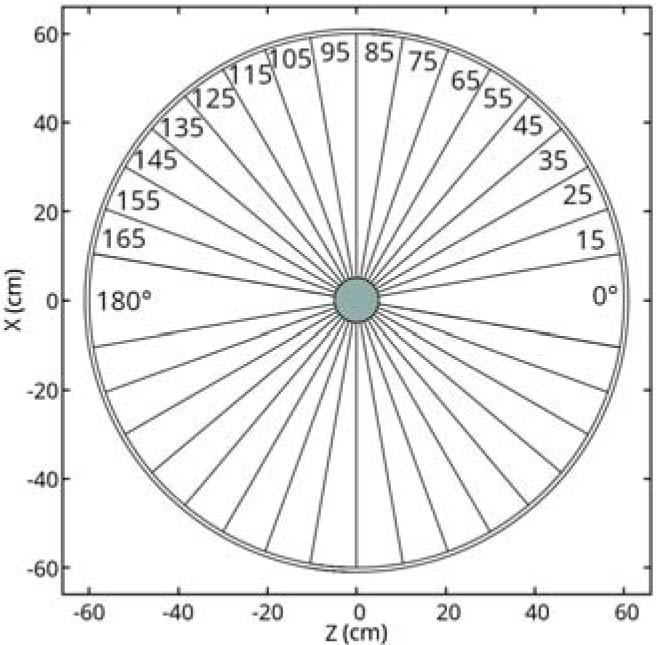
Fig. 1.
The geometry setup for Monte Carlo calculation is as follows. The vertical cross-section of the applied tungsten conversion target, as well as the detector arrangement. The numerical values represent the mean angular position of each detector in degrees. The system manifests rotational symmetry about the Z-axis for the coordinate X = 0.
Table 1.
Summary of the masses of the selected investigated tungsten spheres
| Diameter (cm) | M (kg) |
|---|---|
| 1 | 0.010 |
| 2 | 0.081 |
| 3 | 0.27 |
| 4 | 0.65 |
| 5 | 1.26 |
| 6 | 2.18 |
| 7 | 3.47 |
| 8 | 5.17 |
| 9 | 7.37 |
| 10 | 10.1 |
| 12 | 17.5 |
| 14 | 27.7 |
| 16 | 41.4 |
| 18 | 58.9 |
| 20 | 80.8 |
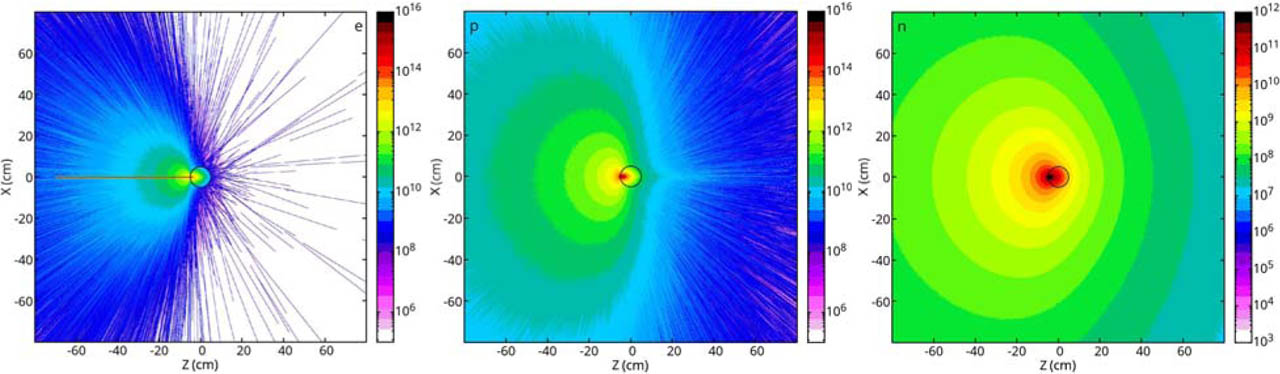
Fig. 2.
The distribution of the particle flux for electrons (e), photons (p), and neutrons (n) shown in 1/cm2/s.
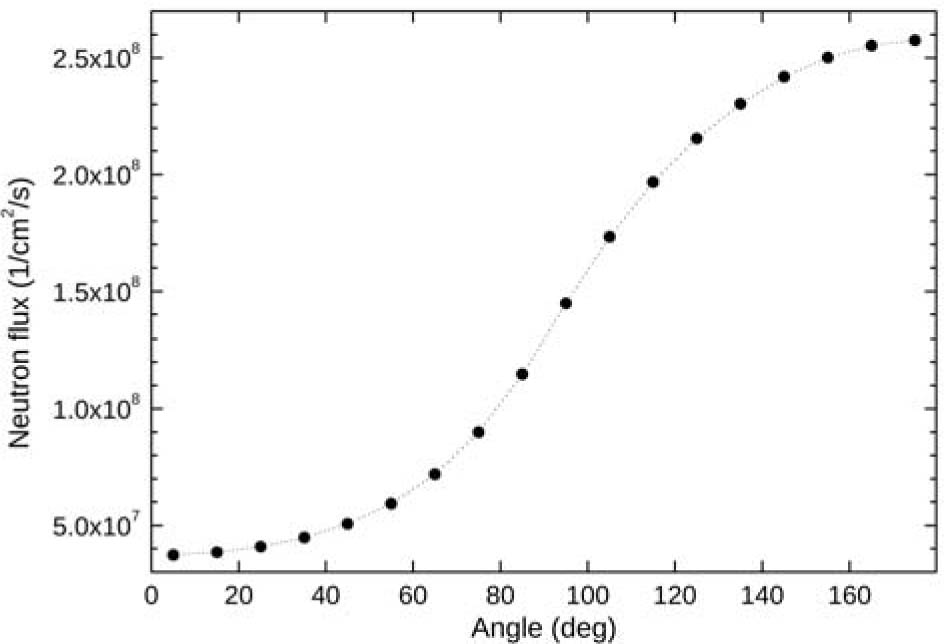
Fig. 3.
Dependence of the neutron flux emitted from a 10 cm diameter tungsten sphere as a function of angle with respect to the direction of the primary electron beam. The flux was calculated at a distance of 60 cm from the centre of the tungsten sphere. The dotted smooth line represents the trend line and is intended only to aid interpretation.
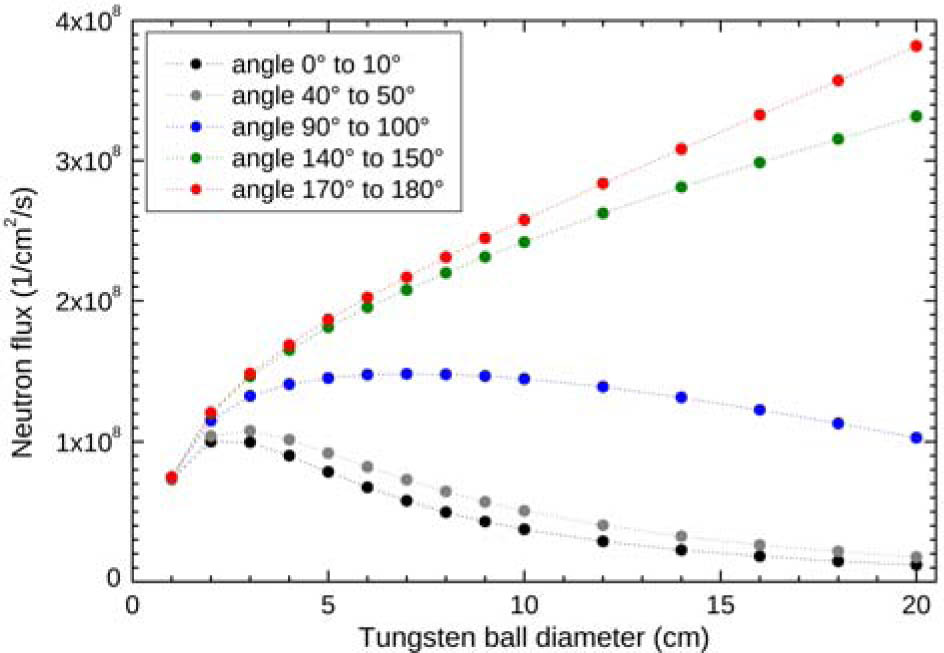
Fig. 4.
Dependence of the neutron flux on the diameter of the tungsten sphere for selected neutron scattering angles with respect to the electron beam axis. The flux was calculated at a distance of 60 cm from the centre of the tungsten sphere. The dotted smooth lines represents the trend lines and are intended only to aid interpretation.
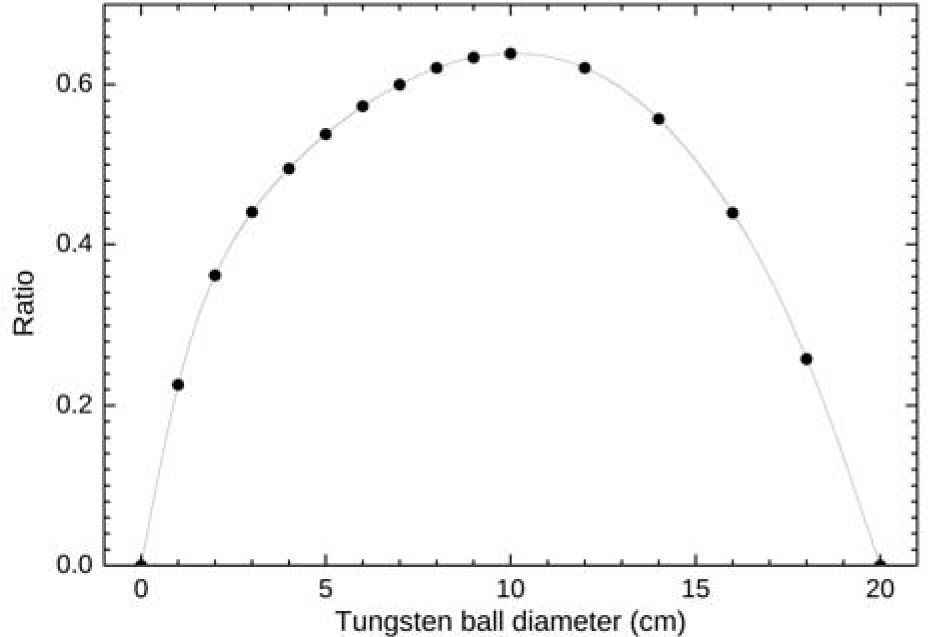
Fig. 5.
Relative criterion for the selection of the tungsten converter sphere diameter. Ratio = (1 – M) · Φ, where M is the ratio of the converter sphere mass to that of a sphere with a diameter of 20 cm, and Φ is the neutron flux generated at an angle of 145°, normalised to the flux produced by a sphere with a diameter of 20 cm within the investigated range of converter sizes.
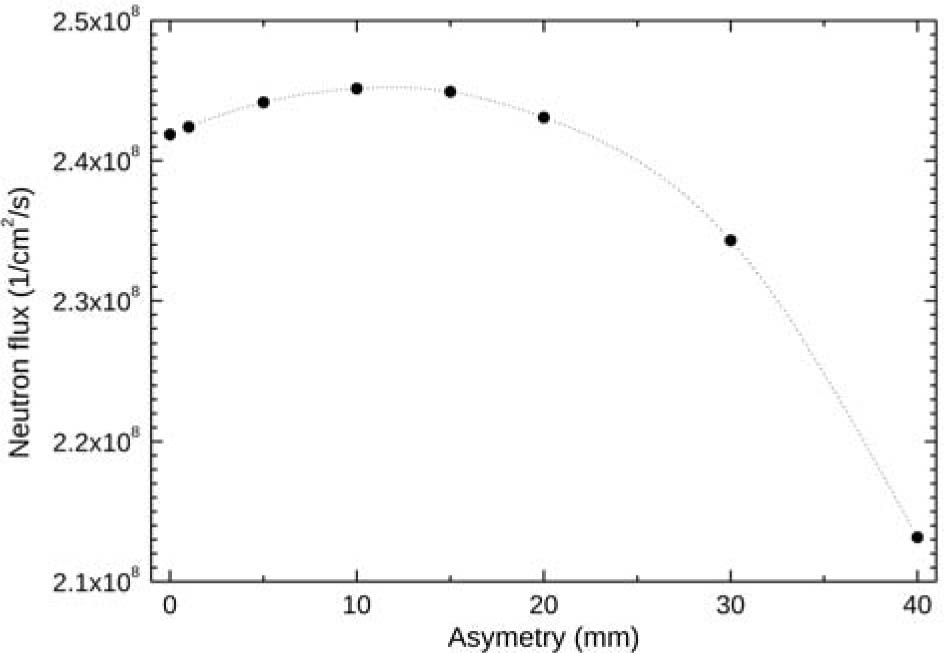
Fig. 6.
Dependence of the neutron flux on the asymmetry of the tungsten sphere positioning for a neutron scattering angle of 145° with respect to the electron beam axis. The direction of the shift is perpendicular to the beam axis, with the asymmetry aligned along the X-axis. The flux was calculated at a distance of 60 cm from the centre of the tungsten sphere.