
Introduction
Neutrons play a crucial role in many areas of science and technology, including nuclear research, neutron imaging, and the production of medical isotopes [1,2,3,4,5]. Precise control of neutron source parameters is particularly essential for improving performance and adapting to specific applications. While traditional methods of neutron generation include nuclear reactors and ion accelerators, increasing attention is being paid to neutron sources based on linear electron accelerators. These sources are characterised by high flexibility and precise control of beam parameters.
A considerable number of publications have addressed the issue of neutron background around medical accelerators, neutron beams, and isotopes produced via photoneutron reactions in electron accelerators [6,7,8,9,10,11,12,13,14,15].
A fundamental component of a neutron generator is an efficient conversion target serving as the neutron-producing element. Disc or cylinder-shaped targets are the most commonly employed [16,17,18,19]. The advantages of this design include structural simplicity, effective cooling due to the flat surface, and relatively uniform irradiation. Nevertheless, there remains potential for optimisation of the geometry in order to enhance neutron production efficiency. As demonstrated in [20], neutron extraction in the backward direction is more favourable process. The objective of the present study is to analyse the effect of employing a spherical target instead of a conventional flat target. Spherical symmetry may reduce the influence of target geometry on production efficiency and allow for a more appropriate selection of the optimal emission angle of the generated neutrons. The present work presents the results of calculations analysing the angular distribution of neutrons generated in a tungsten spherical conversion target irradiated with a 30 MeV electron beam. Such targets have been explored only to a limited extent, for example in studies of spherical surfaces reported in [21].
Monte Carlo simulations
Theoretical modelling of photoneutron production was conducted using the Monte Carlo code FLUKA [22, 23] in version 2011.2x.
The neutron generation from a high-energy electron beam occurs predominantly via photo-nuclear reactions. Within the converter material, the electrons produce bremsstrahlung photons, which subsequently induce neutron emission. The most critical component of a neutron generation system based on an accelerator-driven electron beam is a properly configured conversion target, manufactured from a material with a high atomic number (Z) and high density. These criteria are best satisfied by tungsten (Z = 74, ρ = 19.3 g/cm3). In order to eliminate geometrical edge effects, a spherical geometry was selected for the conversion target. The detectors for the flux of generated particles were defined as annular regions formed by the intersection of cones, with their apex at the origin of the coordinate system, and a sphere of radius 60 cm. The annular regions are characterised by a sequence of cones with opening angles ranging from 10° to 170°, in increments of 10°.
Monte Carlo calculations were performed using the FLUKA code in version 2011.2x on the CIŚ computing cluster [24] for a series of cases in which tungsten spheres with diameters of 1, 2, 3, 4, 5, 6, 7, 8, 9, 10, 12, 14, 16, 18, and 20 cm were irradiated with a parallel, monoenergetic 30 MeV electron beam with a full width at half maximum (FWHM) of 2 mm. The simulations were conducted for a total of 108 primary beam electrons for each of the investigated cases. The geometry of the tungsten sphere and the detector arrangement used in the Monte Carlo calculations are shown in Fig. 1, while a summary of the calculated masses of the analysed spheres is presented in Table 1.
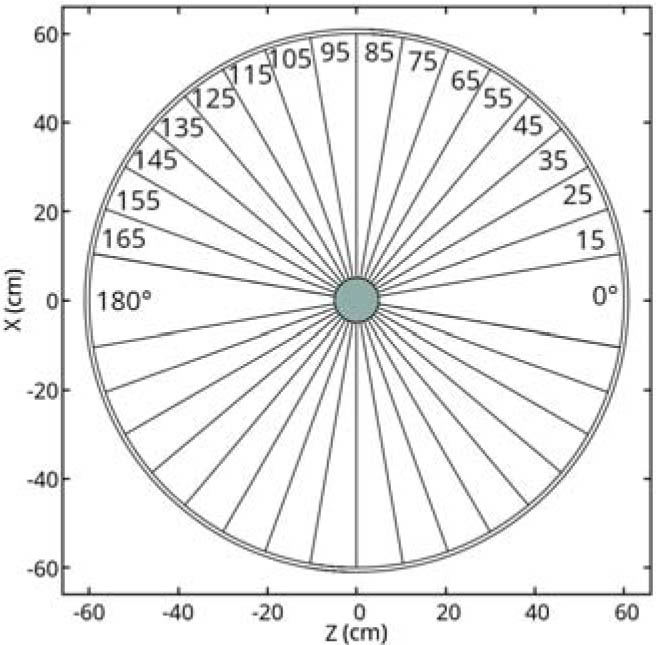
Fig. 1.
The geometry setup for Monte Carlo calculation is as follows. The vertical cross-section of the applied tungsten conversion target, as well as the detector arrangement. The numerical values represent the mean angular position of each detector in degrees. The system manifests rotational symmetry about the Z-axis for the coordinate X = 0.
Table 1.
Summary of the masses of the selected investigated tungsten spheres
| Diameter (cm) | M (kg) |
|---|---|
| 1 | 0.010 |
| 2 | 0.081 |
| 3 | 0.27 |
| 4 | 0.65 |
| 5 | 1.26 |
| 6 | 2.18 |
| 7 | 3.47 |
| 8 | 5.17 |
| 9 | 7.37 |
| 10 | 10.1 |
| 12 | 17.5 |
| 14 | 27.7 |
| 16 | 41.4 |
| 18 | 58.9 |
| 20 | 80.8 |
The transport cut-offs were set at 100 keV for electrons, 30 keV for photons, and 10−5 eV for neutrons. Neutron fluxes were recorded using an USRBDX card.
Results and discussion
The results of the Monte Carlo calculations presented in Figs. 2–4 indicate that the neutron flux is highest in the direction from which the primary electron beam is incident. However, since the beam-forming components of the electron accelerator will be located in this region, preventing the extraction of the neutron beam, an alternative direction must be selected, albeit one that is closely related. Analysis of the angular distribution shown in Fig. 3 reveals that the neutron flux at 145° is only 3% lower than that at 180°. Therefore, this angle appears to be a suitable choice for extracting the neutron beam.
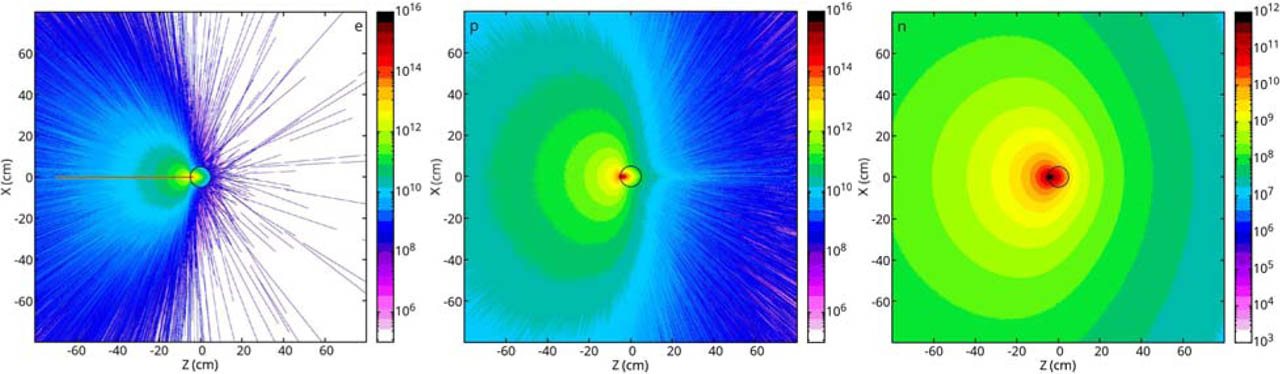
Fig. 2.
The distribution of the particle flux for electrons (e), photons (p), and neutrons (n) shown in 1/cm2/s.
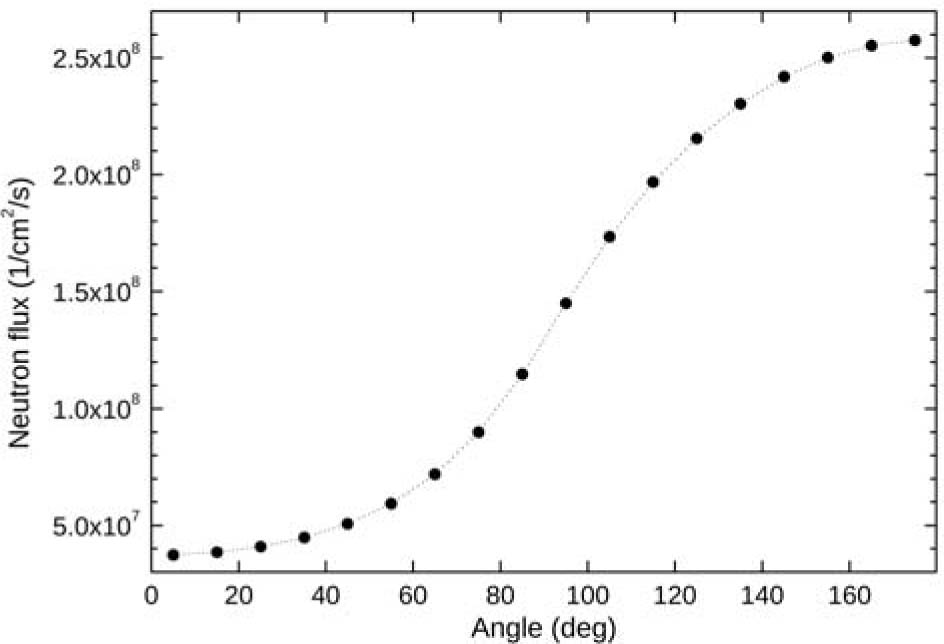
Fig. 3.
Dependence of the neutron flux emitted from a 10 cm diameter tungsten sphere as a function of angle with respect to the direction of the primary electron beam. The flux was calculated at a distance of 60 cm from the centre of the tungsten sphere. The dotted smooth line represents the trend line and is intended only to aid interpretation.
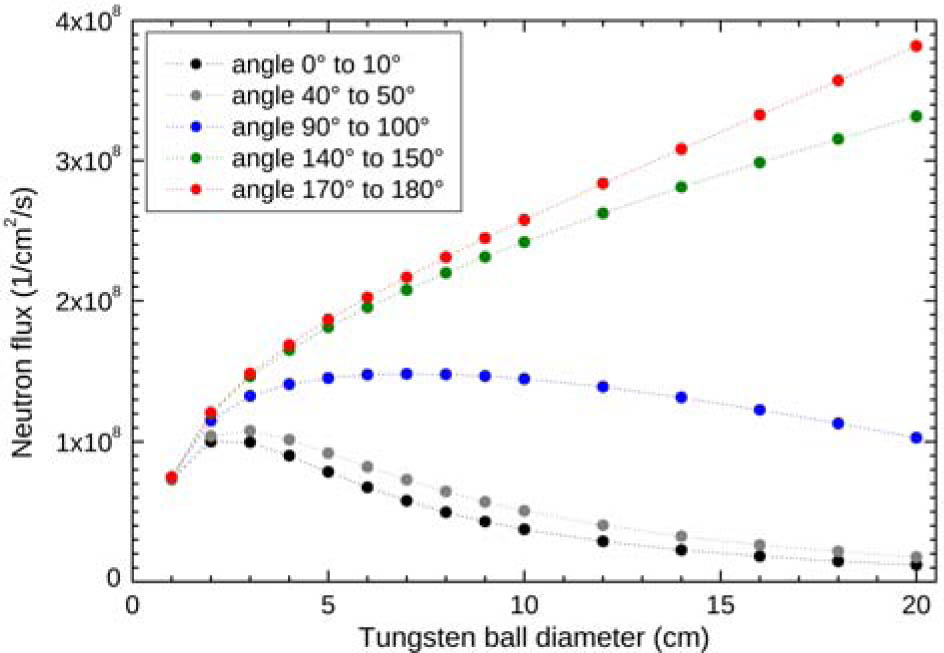
Fig. 4.
Dependence of the neutron flux on the diameter of the tungsten sphere for selected neutron scattering angles with respect to the electron beam axis. The flux was calculated at a distance of 60 cm from the centre of the tungsten sphere. The dotted smooth lines represents the trend lines and are intended only to aid interpretation.
Furthermore, the present work has demonstrated that, for the optimal emission angle, the neutron flux at a distance of 60 cm from the centre of the spherical converter amounts to 2.4286(3)·108 n/cm2/s, which is slightly higher than the mean neutron flux reported in Ref. [20], in which the flux for the backward emission direction is 2.05036(6)·108 n/cm2/s at a distance of 60 cm from the geometric centre of the conversion target. The estimated uncertainty of the result is due to the fact that FLUKA calculates the standard error of the mean based on multiple cycles containing comparable numbers of particle histories. When using at least 20 cycles, as in the present study, the distribution of results closely approximates a Gaussian distribution, enabling a reliable estimation of statistical uncertainties. However, the reported statistical uncertainty does not include systematic errors associated with the physical models implemented in the FLUKA code. The quality of the results is also visually evident in the two-dimensional USRBIN distribution maps shown in Fig. 2: the absence of artefacts and ‘hot spots’ indicates good convergence of the simulations.
Analysis of Fig. 4 indicates that the generated neutron flux increases with increasing converter sphere diameter. While enlarging the diameter of the tungsten sphere beyond 10 cm does result in a higher neutron flux, this increase is accompanied by a corresponding rise in the sphere's mass, thereby reducing the neutron flux efficiency relative to the converter mass. Moreover, for practical reasons such as heating and activation, the component should remain relatively lightweight and easy to handle and transport. For an emission angle of 145°, a relative selection criterion for the converter sphere diameter may be introduced, defined as Ratio = (1 – M) · Φ, where M is the ratio of the converter sphere mass to that of a sphere with a diameter of 20 cm, and Φ is the neutron flux generated at an angle of 145°, normalised to the flux produced by a sphere with a diameter of 20 cm within the investigated range of converter sizes. This is more of an engineering criterion than a purely physical one, and it is intended to be a practical compromise between the physical magnitude of neutron production and the associated costs and losses of the target's mass. It allows an optimal conversion target size to be selected – not necessarily the largest, but the most efficient and cost-effective. As can be seen in Fig. 5, this relative selection criterion is satisfied by a sphere with a diameter of 10 cm.
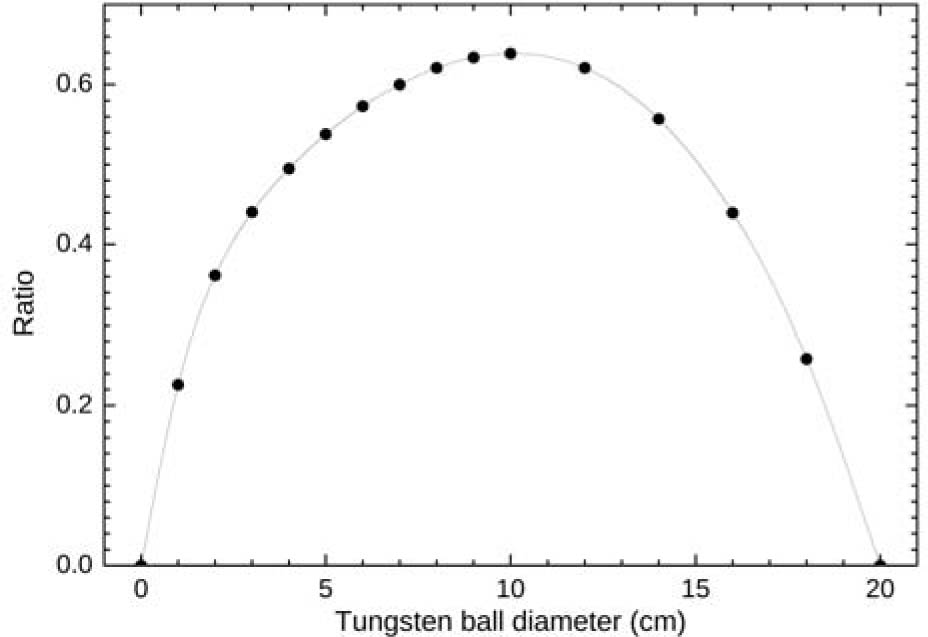
Fig. 5.
Relative criterion for the selection of the tungsten converter sphere diameter. Ratio = (1 – M) · Φ, where M is the ratio of the converter sphere mass to that of a sphere with a diameter of 20 cm, and Φ is the neutron flux generated at an angle of 145°, normalised to the flux produced by a sphere with a diameter of 20 cm within the investigated range of converter sizes.
Analysis of Fig. 6 indicates that a slight asymmetry in the system, defined as a displacement of the sphere centre relative to the beam axis, may further enhance the neutron flux generated at an emission angle of 145°. It can be observed that a 1 cm offset increases the neutron flux at this emission angle by approximately 1.4% compared with the ideal configuration exhibiting zero asymmetry. The observed increase in the neutron flux at an angle of 145° for a slightly asymmetric alignment of the beam axis with respect to the centre of the converter sphere is due to the fact that the flux is being measured at an angle that does not align with the symmetry of the investigated geometry.
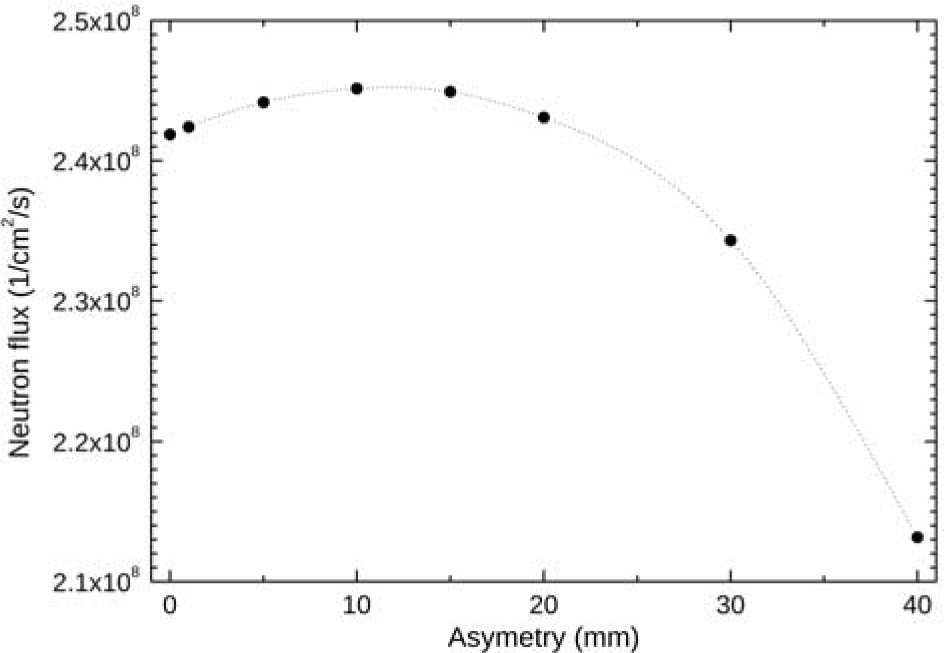
Fig. 6.
Dependence of the neutron flux on the asymmetry of the tungsten sphere positioning for a neutron scattering angle of 145° with respect to the electron beam axis. The direction of the shift is perpendicular to the beam axis, with the asymmetry aligned along the X-axis. The flux was calculated at a distance of 60 cm from the centre of the tungsten sphere.
The observed angular distribution of the neutron flux can be qualitatively explained by the interplay between bremsstrahlung production and neutron transport within the target. High-energy electrons predominantly generate bremsstrahlung photons in the forward direction, leading to a forward-peaked photon field inside the converter. However, neutrons produced via photonuclear reactions are emitted approximately isotropically in the nuclear rest frame. As a result, neutrons travelling in the forward direction must traverse a larger effective thickness of the converter material, leading to increased attenuation and scattering losses. In contrast, neutrons emitted in the backward direction experience a shorter escape path and therefore a higher probability of leaving the target. This combination of forward-directed photon production and asymmetric neutron attenuation leads to the observed maximum of neutron flux in the backward direction.
Conclusions
On the basis of the angular distribution of the neutron flux generated from a spherical conversion target, it has been demonstrated that the highest neutron flux is produced in directions opposite to that of the incident primary electron beam. The maximum flux is obtained in the strictly backward direction; however, for practical reasons in a realistic configuration, the optimal neutron emission direction should be assumed to be close to, but not exactly coincident with, the backward direction. This intentional breaking of symmetry implies that a slight asymmetry in the positioning of the conversion target with respect to the electron beam axis should be taken into account.