
Introduction
One of the main natural background radiation sources is soil. For the general public, gamma rays from terrestrial radionuclides such as 40K, 226Ra, and 232Th are a significant source of exposure to natural radioactivity [1–5]. Through paths for ingestion and inhalation, these radionuclides can go from the soil into plants and ultimately into the human body. These radionuclides emit gamma radiation with enough intensity to enable precise concentration measurements using gamma spectrometry methods [6]. Furthermore, because to variations in soil composition and mineral content, soil radioactivity levels range greatly between places. As such, the gamma-ray spectra can be used as distinctive indicators of the type of soil at a particular location [6–10].
Given the recognized health effects of ambient radiation exposure, it is critical to regularly monitor and assess radiation levels. Estimating the amount of radiation that individuals absorb and evaluating possible health hazards require measuring radioactivity levels and figuring out the concentrations of radionuclides in soil. This topic has been the subject of numerous research conducted worldwide, which have also supplied baseline data on natural radioactivity levels in different regions [11–15].
This study’s objective is to determine the activity concentrations of the natural radioisotopes 40K, 226Ra, and 232Th in soil samples that were gathered from the Karbala Governorate’s Al-Hindiya District in Iraq. In order to assess the possible radiological risks in the area, the annual effective dose is also computed. It is anticipated that the current investigation will help determine the local population’s radiation exposure and offer baseline data on natural radioactivity levels.
Experimental details
Study area
18 soil samples were taken in January 2023 from the Al-Hindiya District, which is about 20 km east of Karbala, Iraq. Two irrigation canals cross the area on either side of the Euphrates River, which runs along its banks. The area under investigation exhibits significant anthropogenic activity, with the majority of the land is used for agriculture, as indicated by the many vegetable crops and date palms. This area’s soil is primarily loamy, with roughly 20.5% sand, 37.8% clay, and 41.6% silt [16]. Figure 1 displays the sampling locations’ coordinates.
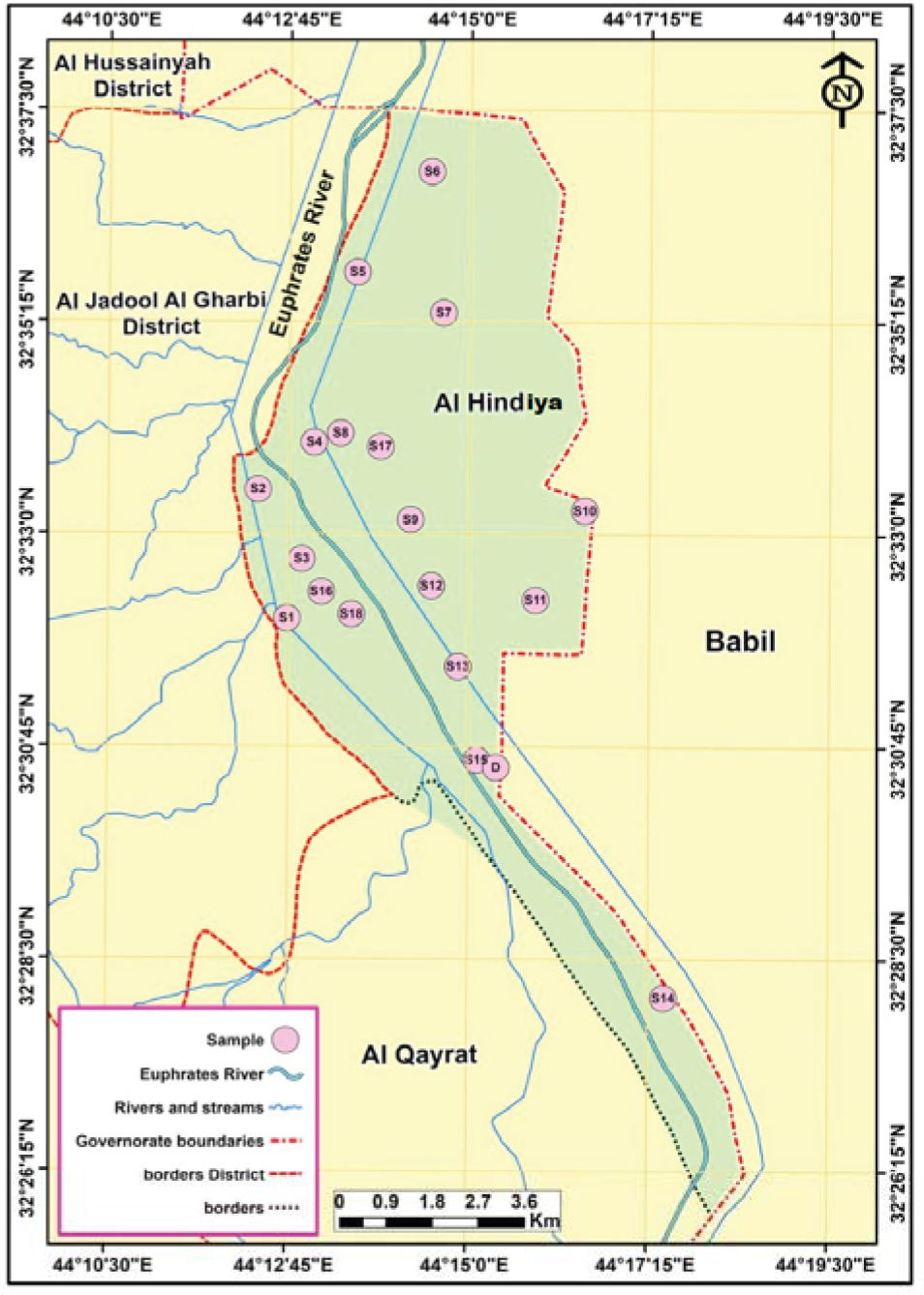
Fig. 1.
Al-Hindiya map with samples location.
Sample collection, preparations and measurement
All samples whose coordinates are shown in Fig. 1 were obtained from a depth of about 5 cm. Specimens S1, S2, S4, S5, and S13 were collected from the zones adjacent to the two irrigation canals. After removing plant roots, leaves, and stones, the soil samples were dried in an oven set to about 100°C. They were then ground into a uniform powder and sieved using a 0.5 mm mesh screen. To allow for the establishment of secular equilibrium between the decay products of the 238U and 232Th series, the homogenized samples were sealed in Marinelli beakers and kept for at least four weeks [17].
Additional samples, such as a sandy soil sample from dredging operations in the Euphrates River at the city center, a water sample from the same river, and dates sample, were gathered in order to perform a thorough survey of the activity concentrations of 40K, 226Ra, and 232Th in the study area. The same processing methods used for the original soil samples were applied to the date and sandy soil samples.
Using a NaI(Tl) scintillation detector (Ortec, 3" × 3") with a relative efficiency of 7.4% for the 661.6 keV gamma line of 137Cs, gamma-ray spectrometry was carried out to assess the activity concentrations of 40K, 226Ra, and 232Th in the collected soil samples. A counting time of 5 hours was employed to ensure adequate detection sensitivity. The detector was connected to a 1024-channel multichannel analyzer (Ortec DigiBase), and the gamma spectra were analyzed using Maestro-32 software.
To lessen background radiation, a cylindrical lead shield encased the detector. The system was calibrated using standard gamma sources of 22Na, 152Eu, 137Cs, and 60Co. The activity concentrations of 226Ra and 232Th were determined using the 1764 keV gamma-ray peak from 214Bi and the 2614 keV peak from 208Tl, respectively, where 214Bi and 208Tl are in secular equilibrium with 238U and 232Th series. Its distinctive gamma-ray band at 1460.8 keV was used to directly detect the activity concentration of 40K [18]. Each sample’s spectrum was subtracted from a background spectrum that was gathered during the same counting period.
Activity and dose assessment
The activity concentration A (Bq/kg) for each soil sample can be calculated according to the relation [19, 20]:
where N is net area under the peak, I is the probability of gamma emission, measurement time t (s), ε is the detector efficiency and m (kg) is the sample mass. Human exposure to external radiation is influenced by the decay of terrestrial radionuclides. The activity concentrations of pertinent radionuclides in the soil can be used to estimate the external gamma dose rate in air, which is expressed in nanograys per hour (nGy/h). The 238U decay series in the samples is thought to have reached secular equilibrium, which means that the uranium-238 activity is roughly equal to the 226Ra activity, i.e. AU ≅ ARa. Yang and Sun [17] reported that the activity ratio of 238U to 226Ra is 0.95 ± 0.16, which supports this assumption. The following relation can be used to determine the external gamma dose rate at a height of 1 m above ground level [17, 21]: where AK, AU, and ATh are the activity concentrations of 40K, 238U and 232Th (Bq/kg) respectively. The annual effective dose rate H (μSv/y) for adults was calculated by the formula [22]Results and discussion
Table 1 shows the observed activity concentrations of 40K, 226Ra, and 232Th in soil samples taken from the Al-Hindiya District in Karbala, Iraq. The average concentration of 40K was 395 Bq/kg, with a range of 329 Bq/kg to 498 Bq/kg. The mean value for 226Ra was 22.2 Bq/kg, with values ranging from 18.9 Bq/kg to 28.2 Bq/kg. The average concentration of 232Th was 11 Bq/kg, with a range of 8.2 Bq/kg in (S12) to 13.1 Bq/kg in (S1). According to UNSCEAR [22], the concentration of 40K in the soil of this area is near the global average value of 420 Bq/kg, with a typical global range of 140–850 Bq/kg. On the other hand, the average activity concentrations of 226Ra and 232Th in the samples under study were lower than the corresponding global average values of 32 Bq/kg and 45 Bq/kg, respectively, as published by UNSCEAR [22].
Table 1.
Activity concentrations and annual effective dose rate for soil samples
| Sample name | Activity concentration (Bq/kg) | H (mSv/y) | ||
|---|---|---|---|---|
| 40K | 226Ra | 232Th | ||
| S1 | 396 | 26.2 | 13.1 | 44.8 |
| S2 | 410 | 19.9 | 12.3 | 41.3 |
| S3 | 430 | 22.5 | 8.5 | 41.0 |
| S4 | 372 | 22.1 | 11.9 | 40.3 |
| S5 | 344 | 18.9 | 9.8 | 35.5 |
| S6 | 334 | 19.0 | 9.2 | 34.6 |
| S7 | 388 | 20.4 | 12.4 | 40.6 |
| S8 | 363 | 20.5 | 12.4 | 39.4 |
| S9 | 388 | 23.0 | 12.7 | 42.3 |
| S10 | 361 | 21.4 | 10.4 | 38.3 |
| S11 | 329 | 20.0 | 10.8 | 36.1 |
| S12 | 413 | 20.2 | 8.2 | 38.6 |
| S13 | 389 | 24.5 | 10.5 | 41.5 |
| S14 | 411 | 20.2 | 8.3 | 38.6 |
| S15 | 416 | 23.1 | 11.7 | 43.0 |
| S16 | 488 | 25.6 | 12.2 | 48.5 |
| S17 | 498 | 24.8 | 12.3 | 48.6 |
| S18 | 380 | 28.2 | 11.7 | 44.1 |
| Mean | 395 | 22.2 | 11.02 | 40.95 |
The area being studied is located in a sedimentary zone. In general, there is little natural radioactivity in the soil in this area. Since most of the land in this area is used for farming, the application of chemical fertilizers for agricultural purposes is probably responsible for the observed relative rise in radioactivity in some samples.
The sandy soil sample taken from the Euphrates River dredging in the heart of Al-Hindiya had activity concentrations of 271 Bq/kg, 13.1 Bq/kg, and 7.3 Bq/kg for 40K, 226Ra, and 232Th, respectively. These results are similar to the 205.2 Bq/kg, 8.2 Bq/kg, and 7.5 Bq/kg [23] recorded for sediment samples from the Tigris River in Baghdad. Low levels of these radionuclides are found in the riverbed sediments, according to this comparison.
For 40K, 226Ra, and 232Th, the observed radioactive concentrations in the Euphrates River water sample were 2.13, 0.06, and <MDA Bq/L, respectively. Since the ‘Zahdi’ dates is one of the most widely grown in this region, it was chosen for the date sample. The location D is where this sample was taken. For 40K, 226Ra, and 232Th, the corresponding radioactive concentrations in the date sample were determined to be 380, 1.5, and <MDA Bq/kg. For 40K, 226Ra, and 232Th, the corresponding MDA values were 0.16 Bq/kg, 0.06 Bq/kg, and 0.03 Bq/kg.
According to reports, the average activity concentrations of 40K, 238U, and 232Th in soil in the surrounding areas were 413 Bq/kg, 16 Bq/kg, and 8.45 Bq/kg in Hilla city [24], 375 Bq/kg, 17 Bq/kg, and 9.4 Bq/kg in Baghdad [25], and 319.3 Bq/kg, 11.53 Bq/kg, and 8.7 Bq/kg in the Al-Samawah Desert [26].
As seen in Table 2, the activity concentration of 40K is comparable to these values and compatible with its concentration in other parts of the world. On the other hand, 226Ra and 232Th activity concentrations are lower than those found in the regions indicated in Table 2.
Table 2.
Activity concentrations of soil and corresponding H in some countries
| Country | Activity concentrations (Bq/kg) | H (mSv/y) | ||
|---|---|---|---|---|
| 40K | 226Ra | 232Th | ||
| Abha, Saudi Arabia [27] | 217.3 | 39.3 | 31.5 | 57.3 |
| Kuwait [28] | 385 | – | 15 | 40.7 |
| Syria [29] | 336 | 26 | 24 | 52 |
| Dehloran, Iran [30] | 205.3 | 292 | – | – |
| Ganos fault, Turkey [31] | 445 | 35 | 27 | – |
| Guangdong, China [17] | 535.8 | 75.1 | 101.0 | 147.2 |
| Spain [32] | 578 | 39 | 41 | 49 |
| Present work | 395 | 22.2 | 11.02 | 41 |
| World average [22] | 400 | 35 | 30 | 70 |
Lastly, the annual effective dose rate data showed an average of 41 μSv/y, with a range of 34.6 μSv/y to 48.6 μSv/y. Values recorded in other local localities, about 37 μSv/y and 36 μSv/y in Hilla and Baghdad, respectively, are comparable to this average [24, 25]. The effective dose rate (H) values for various nations are shown in Table 2. The average value found in this study, however, is less than the 70 μSv/y outdoor global average that UNSCEAR [22] stated.
Conclusions
In soil samples from the Al-Hindiya District, the activity concentrations of natural radionuclides (40K, 226Ra, and 232Th) are below the world average levels and comparable to those found in other local investigations. Furthermore, these radionuclides produce annual effective dose rate that is below the global average. As a result, both residential and agricultural uses of the soil in this area can be regarded as radiologically safe.
Acknowledgment
The authors would like to thank the University of Kerbala for its support in terms of interest in these topics and encouragement to complete studies in this field.
Notes
[1] Contributed by Author contribution. Hayder J. Musa and Rajaa Hussein Abd Ali: sonceptual writing and editing. Adil J. Najim, Abass J. Al-Saadi: sample collection and results analysis.
[2] Generative AI and AI-assisted technologies in the writing process. The article was edited and modified by the authors and no artificial intelligence tools were used.
[3] Conflicts of interest Conflict of interest. The authors declare that there are no conflicts of interest related to the research, authorship, or publication of this manuscript.