
Introduction
Gamma exposure from the uranium-238 (U-238) decay chain is acknowledged implicitly within broader discussions of natural radiation or spent fuel (SF) or mill tailings. Explicit analyses or warnings about its long-term implications under approaching secular equilibrium conditions, or at full equilibrium, are not highlighted. Discussions and analyses of U-238 hazards emphasize, rather, its chemical toxicity and alpha radiation [1,2,3,4,5,6]. Depleted uranium (DU) is hardly seen as a gamma-radiation issue as well, as its chemical toxicity is its most hazardous property [3]. Moreover, traditional illustrations of the U-238 decay scheme neglect gamma-radiation emissions (see part “The radiological model” in the next section).
The motivation for this study is twofold: (a) to fill a gap in the scientific literature on the gamma hazards of the U-238 decay chain at, or while approaching, secular equilibrium and (b) to alert both policymakers and waste management and environmental protection specialists on the need for developing sustainable strategies to protect public health and the environment from the inevitable manifestation, sooner or later, of these hazards with the progress of time, given that U-238 has a 4.47 billion years half-life.
U-238 accounts for 99.3% of the naturally occurring uranium, and it is utilized primarily for nuclear energy production. The uranium-fuel economy rests on the fission of the U-235 isotope, which represents only 0.7% of the uranium in nature and it needs to be enriched to 3.5% within a U-238 matrix. As a result, fuel fabrication mobilizes vast amounts of U-238. Besides, only about 1% of the U-238 in the fuel is lost during energy production [7]. We describe as “Humanity's U-238 inventory” the U-238 that has been extracted, processed, conditioned, or left behind through human activity. Most of Humanity's U-238 is in the form of DU and residual U-238 in mill tailings.
This paper develops a first-in-the-literature, coherent estimation of the quantities of U-238 in all by-product streams of the nuclear-fuel cycle. It then demonstrates that the gamma hazards from these inventories exceed the recommended safety thresholds long-before full equilibrium is reached. The paper also addresses U-238 contamination from military uses and in mining regions.
Data and methods
The radiological hazard model
Figure 1 presents a detailed illustration of the U-238 decay chain. This visualization is traditional for its inclusion of beta and alpha radiation 1 , yet it is a rarity for its inclusion of gamma radiation. The foundation for Fig. 1 stems from a largely forgotten 1980 report that acknowledged the importance of gamma emissions from the U-238 decay chain in understanding radiological hazards of mill tailings, but then focused on off-site short-term risks [8]. The omission of gamma radiation in traditional charts obscures the full radiological risk posed by U-238's decay products. By revisiting and elaborating on this critical but neglected insight, Fig. 1 reframes the U-238 decay chain as a comprehensive radiological hazard model.
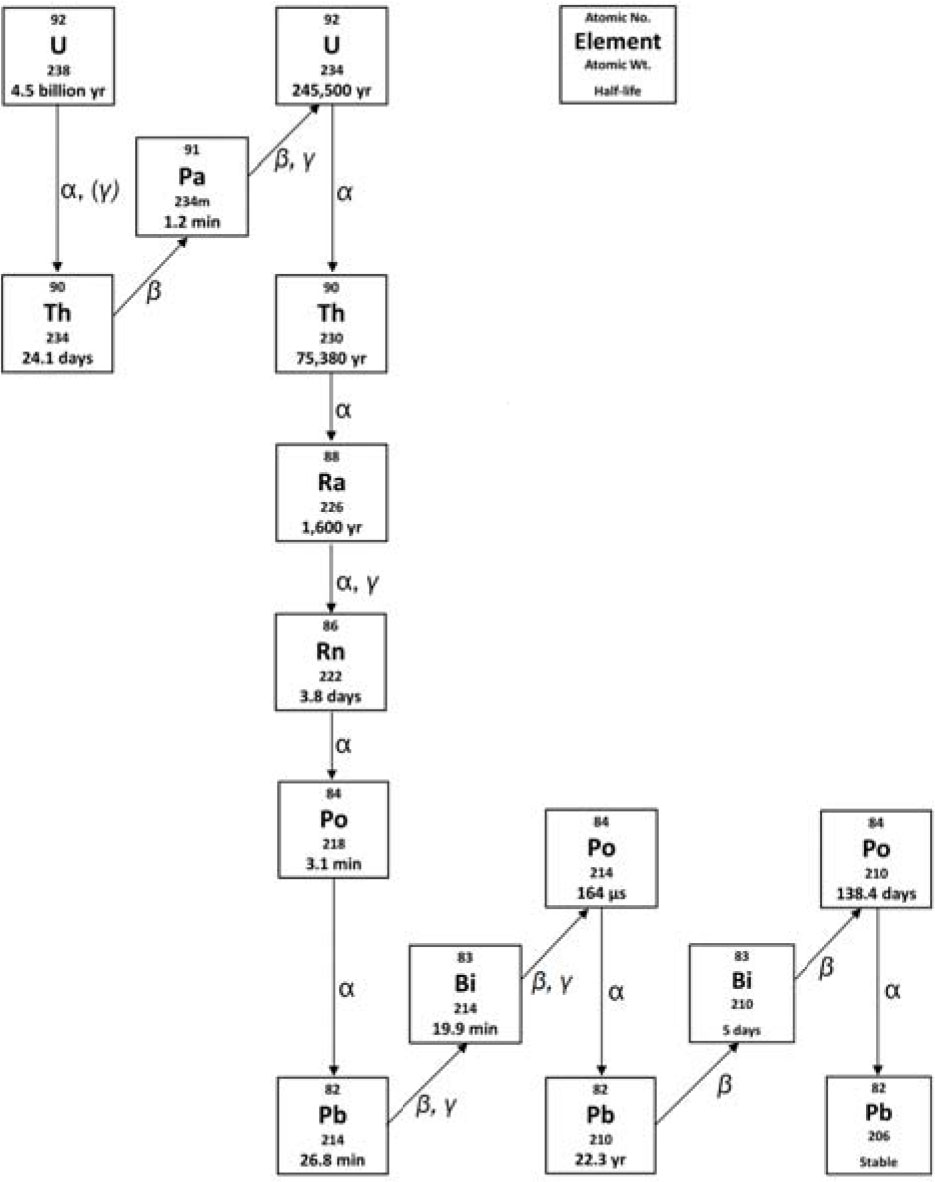
Fig. 1.
The U-238 decay-chain including gamma emissions. In parenthesis, the not-significant gamma from the decay of U-238 itself.
Central to the issue is the concept of secular equilibrium, a state whereby the activity (rate of decay) of all the decay products matches the activity of the parent radionuclide. This state occurs after a certain amount of time, when a long-lived parent-radionuclide decays into a series of much shorter-lived progeny. The U-238 chain (Fig. 1) consists of 15 members, each with significantly shorter half-lives than U-238. All members of the chain are either alpha or beta emitters. A few of them are also gamma emitters. At secular equilibrium, each curie of U-238 will comprise seven curies of alpha radiation, six curies of beta-, and four curies of gamma-radiation.
Table 1 reports the intensity-weighted energies of the four most significant gamma-emissions. At full secular equilibrium, Bi-214 contributes to nearly 78%, followed by Pb-214 at 20.5%, and Pa-234m at a distant third with 0.91%. Given the extremely short half-life of Pa-234m, equilibrium with U-238 can be considered immediate within the timescales of this study.
Table 1.
Intensity-weighted gamma energy per decay and equilibrium contribution
| Isotope | Intensity-weighted gamma energy per decay (keV) | Contribution at equilibrium (%) |
|---|---|---|
| Pa-234m | 8.41 | 0.91 |
| Ra-226 | 6.10 | 0.66 |
| Pb-214 | 189.29 | 20.49 |
| Bi-214 | 1076.40 | 77.94 |
Figure 2 plots the approach to secular equilibrium based both on the U-234/U-238 and Th-230/U-238 activity ratios. The two paths join at 600 000 years and then progress in step toward secular equilibrium with their common U-238 ancestor. Achieving full equilibrium requires up to 2 million years. Interim stages of partial equilibrium include 5% (Th-230) or 13% (U-234) at 50 000 years, and 15% (Th-230) or 25% (U-234) at 100 000 years. In turn, calculations show that Th-230 will be quickly in equilibrium with Ra-226, Pb-214, and Bi-214. The Th-230 path is then the privileged path for calculating gamma doses progression.
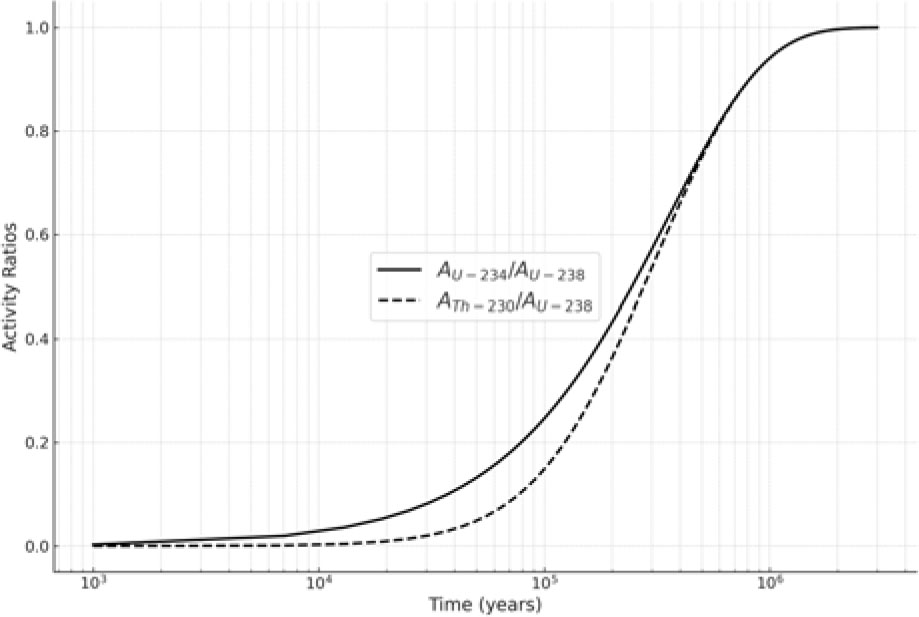
Fig. 2.
Secular equilibrium paths of the U-238 decay-chain.
The activity ratio equation used in this study, including for Fig. 2, is obtained in Appendix A and it is based on standard formulations derived from the Bateman equations. However, its application to long-term gamma-hazard modeling of U-238 decay products, particularly in the context of secular equilibrium and dose progression, represents a novel integration into radiological risk assessment frameworks.
U-238 inventory and hazard analysis
The study uses literature data of Humanity's U-238 inventory to recalibrate the full inventory to the year 2022 (Appendix B). The recalibrated figures resolve inconsistencies in the international datasets and provide the foundation for dose progression modeling and hazard assessment across all timescales.
Dose modeling focuses on the approach to secular equilibrium via the Th-230/U-238 path, as calculations show that this route provides a practical and sufficient basis for assessing the gamma radiation hazards of the U-238 decay chain.
To provide a meaningful context for risk assessment, the study uses, as a reference point, the ICRP-recommended public dose-limit of 1 mSv/y from all controlled sources. 1-mSv/y is also the International Commission on Radiological Protection's (ICRP) threshold reference-level for intervention in the case of existing exposure situations [9]. Accordingly, all dose calculations are expressed in units of mSv/y. As detailed in the following section, gamma emissions from the various stocks that constitute Humanity's U-238 inventory will surpass this radiological exposure threshold long before full secular equilibrium is achieved.
The nuclear fuel cycle U-238 inventory and its gamma liability
This section provides an “overnight” evaluation of the gamma liability associated with the nuclear-fuel-cycle U-238 inventory.
Terminology
To capture the unique characteristics and hazards associated with different U-238 stocks, we subdivide the U-238 inventory into three categories: conditioned, tailings, and total-mined. Total-mined is a synonym of Humanity's U-238 inventory.
– Conditioned U-238 refers to the portion of U-238 that was recovered from the original ore. It exists in retrievable and potentially usable forms, such as low-enriched uranium (LEU), SF, reprocessed uranium (RU), and DU. These materials are stored in various containment structures. Conditioned U-238 amounts to roughly 80.6% of the total-mined U-238 (Appendix B).
– Tailings U-238 is the U-238 that could not be recovered from the original ore and is now in the mill-tailings. It amounts to roughly 19.4% of the total-mined U-238 (Appendix B).
– Total-mined U-238 is the sum of conditioned and tailings U-238. It represents the U-238 inventory that has been extracted, processed, recovered, or left behind by human activity. This category captures the combined gamma-radiation liability of all U-238 stocks associated with the nuclear fuel cycle, whether in storage, designated for potential use, or else left in the mill tailings. It is Humanity's U-238 inventory, a term that frames the issue of U-238 management over time as a shared, global responsibility.
Table 2, derived in Appendix B, provides an original and, in the literature, first estimate of the amounts of Humanity's U-238 inventory in each byproduct stream by the year 2022. The three largest stocks are DU (69.24%), tailings U-238 (19.4%), and SF (8.4%). We will concentrate on these for dose modeling.
Table 2.
Humanity's U-238 inventory in metric tons and curies as of 2022
| Category | Stock type | Metric tons | Activity (Curies) | Percentage of total-mined (%) |
|---|---|---|---|---|
| Conditioned U-238 by stock | LEU | 18 252 | 6 156 | 0.41 |
| Reprocessed uranium | 127 000 | 42 799 | 2.84 | |
| Spent nuclear fuel | 363 000 | 122 631 | 8.4 | |
| DU | 3 100 000 | 1 044 700 | 69.24 | |
| Total conditioned U-238 | 3 608 252 | 1 216 286 | 80.6 | |
| Tailings U-238 | Mill-tailings | 868 500 | 292 700 | 19.4 |
| Humanity's U-238 | Total-mined | 4 476 752 | 1 507 984 | 100 |
There is no previous comprehensive inventory of all U-238 stocks together at the same time. Table 2 is obtained in Appendix B based on (a) reported values by the International Atomic Energy Agency (IAEA) and the Organization for Economic Cooperation and Development Nuclear Energy Agency (OECD/NEA) of the LEU and SF stocks worldwide; (b) literature-reported DU/U ratios; and (c) on recalibrating mill-tailings production-data based on the LEU, SF, and DU stocks upon assuming, for the original ore, a world-average value of 0.15 wt% uranium. The data in Table 2 are internally consistent and provide a reasonable estimate of the so-far mined U-238 distribution across its various stocks. Future updates, although they are recommended as further research, should not change this paper's results and conclusions significantly.
Evaluating the gamma liabilities through dose modeling
The “frozen” inventory in Table 2 provides a baseline for understanding the gamma-radiation liability that each U-238 category represents, both separately and globally, as of the year 2022. The calculations of the gamma dose rates are rather straightforward. Namely, we start with previously known activities and/or previously known gamma-dose rates at a given time, then we apply the secular equilibrium equation or the equations for the approach to equilibrium (see Appendix A) to calculate or extrapolate the gamma dose rates at any time. The calculations are highly reliable as they involve only exponential functions and the basic understanding of a decay chain.
The gamma hazard of conditioned U-238
Conditioned U-238 refers to U-238 that was separated from its decay products during the milling process. As a result, all stocks of conditioned U-238 begin from zero in their progression toward secular equilibrium. To manage the intensifying gamma emissions (Fig. 2) over time, each conditioned U-238 stock-type will require increasingly robust containment measures, such as thicker shielding or deeper storage. This holds true also for SF, whose composition 2 is 95% U-238 [7].
For a more specific, quantitative estimation of the strength and progression of the gamma dose from conditioned U-238 over time, consider a sample 238UO2-cylinder of 40-cm height and 10-cm diameter. Its surface gamma-dose-rate at 1 million years is known from analyses of industry-provided values [10] and it is approximately 0.82 mSv/h or 7183 mSv/y. This value is 7183 times the ICRP recommended 1-mSv/y yearly-dose-limit.
The value of the gamma dose-rate at 1 million years serves as a basis for recalculating its evolution over time along the Th-230/U-238 equilibrium path (Fig. 2) accounting, as well, for the immediate secular equilibrium between U-238 and Pa-234m. Figure 3 plots the progression of the gamma dose rate between 100 years and 3 million years. The dose rate starts from the baseline, a constant value of 70 mSv/y (0.008 mSv/h) representing the Pa-234m contribution of 0.91% of the full-equilibrium dose rate (see Table 1). It increases slowly over the first 5000 years, or so, then it accelerates to reach 7580 mSv/y by 2 million years, firmly in the deterministic health effects region. Namely, the dose rate increases over 100-fold over 2 million years. Afterwards, it remains at these high levels essentially indefinitely.
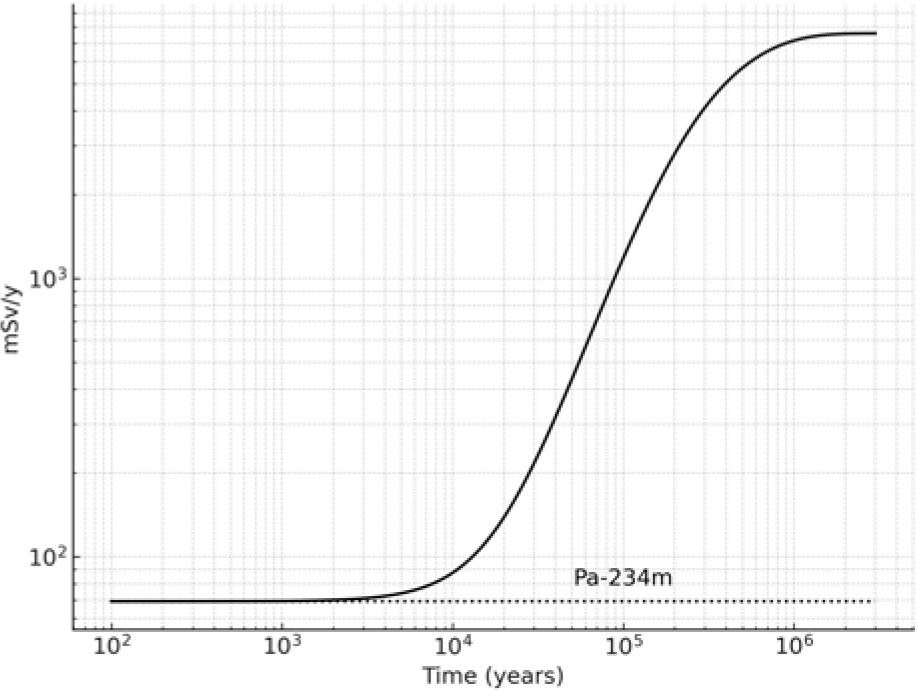
Fig. 3.
Evolution of the U-238 chain gamma dose-rate at the surface of an unshielded 238UO2-cylinder 40-cm-tall and 10-cm diameter. Pa-234m dominates at the start and for a few thousand years.
If the sample was DU conditioned as UO2 the dose rate would be larger and earlier, because DU includes excess 3 U-234. If DU was conditioned as U3O8, which is another oxide form foreseen for the de-conversion and conditioning of DU, the dose rate will not change significantly. Excess U-234 would still be present, and while the U3O8 matrix is of a lower density than UO2, by the same token, it is also less self-shielding. Also, U3O8 conditioning would require more containers.
If the reference 238UO2-cylinder was broken into a combination of smaller fragments, the total gamma hazard would be larger still, for, while the volumetric density of 238UO2 stays the same, smaller fragments are much less self-shielding than larger blocks [10].
A simple calculation reveals the magnitude of the latent gamma-radiation hazard of conditioned U-238. Namely, our reference 238UO2 sample weighs 34.5 kg. The total stock of conditioned U-238 weighs 3.6 million tons. The DU, alone, corresponds to 90 million such 238UO2 samples. The 400 000 metric tons of RU + SF U-238 correspond to 11.6 million samples. Overall, conditioned U-238 constitutes a major, future gamma-radiation liability that needs preparing for.
Managing the gamma hazard of conditioned U-238
Currently, nations are formulating or are implementing deep disposal programs to deal with the hazard connected with SF. Under the aegis of the IAEA, most have signed an international convention to that effect [12]. Albeit the understanding was primarily to protect humans and the environment from the fission products and other isotopes within SF, this approach will also mitigate the gamma-risks from the U-238 chain.
The latent gamma-risk of DU is largely unrecognized. However, the current inventories of U-238 in DU and SF will progress towards a secular equilibrium practically in tandem. By 1 million years, say, DU's U-238 inventory – nearly 10 times larger than SF's – will constitute a significantly greater gamma hazard.
Measures have yet to be implemented to safeguard future generations and the environment from the inevitable liabilities posed by DU [11, 13, 14]. A statement by UNSCEAR, Except for a few specific scenarios (such as long-term handling), radiation exposures should be negligible (para. 36 in Ref. [3]), hints at an awareness of DU gamma risks but fails to identify the magnitude of its long-term hazards.
The lack of a sustainable utilization of DU heightens its status as a liability. Unless breeder reactors are developed, most of the DU cannot be brought back into the reactor cycle and needs to be managed as long-lived nuclear waste. As one analyst observed: The calm tolerance of such massive waste in any other endeavor, and if widely publicized, would be cause for great political discomfort, and an immediate re-evaluation… [15].
The gamma hazard of mill tailings
Complementary to conditioned U-238, the tailings U-238 represents the U-238 fraction that was not recovered during the milling process. Tailings U-238 is in secular equilibrium with its progeny. Meanwhile, the progeny of conditioned U-238, separated from its parent radionuclide during milling, forms a new decay-chain headed by Th-230. This orphaned Th-230 chain (Fig. 1) mirrors the original U-238 chain, sharing the same progeny isotopes. However, it will fade over 700 000 years due to the 75 380-year half-life of Th-230. As a result, the current gamma emissions from mill tailings closely resemble those of total-mined U-238 before milling.
As reported in Appendix C, measurements show that gamma dose-rates near uncovered uranium tailings range from around 7 μSv/h to peaks of 20 μSv/h, with an average dose rate of 10 μSv/h (88 mSv/y). As one cannot assume that currently stabilized piles will stay stable over centuries to thousands of years or longer, this average dose rate is significant. Annual exposure at this dose rate is as follows:
– Approximately 30 times the average, annual background radiation of 3 mSv from all natural sources globally [16];
– Almost 90 times the ICRP's public dose-limit of 1 mSv/y from all controlled sources [9].
Given its relationship to the conditioned U-238 chain, the decay of the orphaned Th-230 chain, representing 80.6% of the total dose-rate, will lead to a gradual reduction in gamma emissions (Fig. 4), stabilizing the gamma field of mill tailings by approximately 700 000 years. At that point, the dose rate will derive solely from the tailings U-238, settling at approximately 19.4% its present value. Namely, 17.5 mSv/y for uncovered mill tailings – about 17 times the ICRP yearly, public dose limit – highlighting the persistent hazard posed by mill tailings, especially as stabilization measures degrade or if these sites are repopulated or repurposed for human activity (see next section).
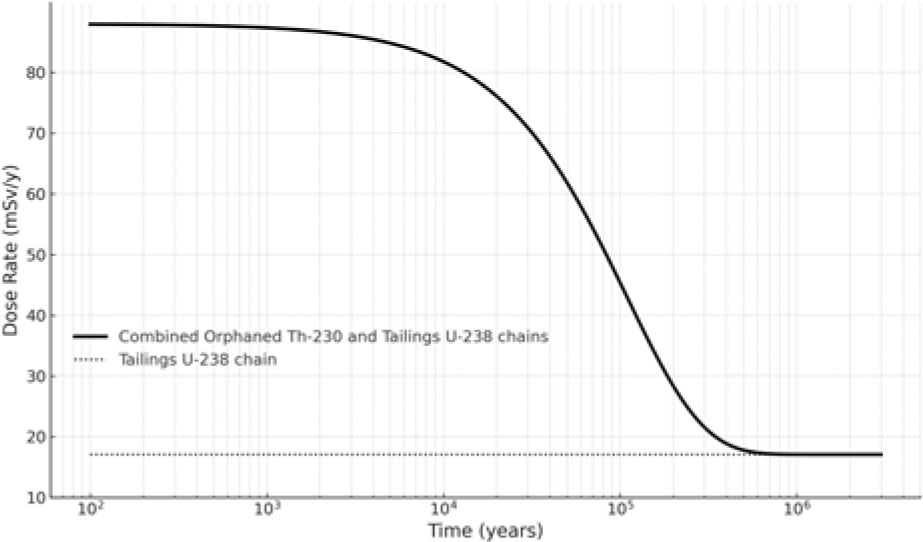
Fig. 4.
Gamma dose-rate from uncovered mill tailings as a function of time.
Managing the gamma hazard of mill tailings
Immediate and short-term risks emanating from mill tailings are typically managed through restricted access and stabilization measures, as emphasized by the IAEA's focus on containment strategies to minimize environmental and radiological impacts over prolonged timescales [17]. Beyond operational control, however, the NEA acknowledges that there is effectively no enduring policy or approach capable of guaranteeing protection against direct gamma exposure, revealing an inherent and unresolved challenge in long-term stewardship and liability, whereby The residual facilities left after closure can be attractive for the development of dwellings (i.e., unpopulated areas cleared of vegetation, topographic highs with local “rock” sources for building, etc.) (p. 53, in Ref. [18]).
Globally, approximately 3 billion metric tons of mill tailings are spread over thousands of sites across all continents and spanning a large variety of climatic situations. These tailings represent a significant gamma hazard, alongside other risks such as radon emissions, groundwater contamination, and contamination through soil erosion.
The instructive case of long-lived nuclear waste
Vitrified high-level waste (VHLW), produced from immobilizing SF-reprocessing waste in a glass matrix, may contain relatively important concentrations of U-238. The French VHLW program is slated to create over 50 000 standard-size containers of HLW, each container incorporating 2 kg or more of U-238, for a combined, total amount of at least 100 metric tons. It turns out that the gamma dose from VHLW is dominated by the radionuclides in the Np-237 chain until 20–25 million years. Afterwards, as Np-237 decays further, the gamma emitters of the U-238 chain take over, notably, its Bi-214 and Pb-214 emitters. As a result, all French VHLW will not be fit for handling or proximity. Relatively small fragments of VHLW, or a combination of these fragments, may also pose a gamma radiation hazard [10].
The French VHLW case is instructive in that it shows that even a small amount of U-238 – of the order of 100 metric tons spread over 50 000 containers – can constitute an indefinite gamma hazard if the U-238 is sufficiently concentrated.
In this light, it seems prudent to examine the U-238 content of long-lived low- and medium-level waste, especially from such activities as MOX fuel fabrication, as well as in anticipation of potential, repeated reprocessing of uranium fuels in nuclear-fuel-cycles currently under study. Accumulation of U-238 from these wastes in near-surface repositories may result, over time, in direct gamma exposures.
Dispersed U-238
DU contamination from military uses
The use of DU munitions in military conflicts has resulted in U-238 contamination across regions such as Iraq, the Balkans, and Afghanistan. U-238 contamination affects vast areas, spanning tens of thousands of square kilometers [19,20,21,22]. As an example, studies conducted in 2002 in Afghanistan's Jalalabad province revealed uranium concentrations of up to 200 times higher than control populations. Soil samples from bombsites demonstrated uranium levels two to three times above global concentration norms (2–3 mg/kg) as well as water concentrations exceeding World Health Organization (WHO) permissible levels [23]. Given the evidence of man-made U-238 contamination, any other risk will be compounded, in the future, by the gamma-radiation emitted by the U-238 decay chain as it progresses toward secular equilibrium. It is an issue that warrants recognition and comprehensive assessment.
Nuclear weapons testing sites
Atmospheric nuclear weapons tests, conducted throughout the mid-20th century, have contaminated vast regions. Notably, the Nevada Test Site in the United States, which is approximately 3500 km2 and one of the largest restricted-access areas in the United States. The Semipalatinsk Test Site, in Kazakhstan, covering 18 500 km2 was the primary site for Soviet nuclear weapons tests. Concerning weapons sites, …radioactive residue in some environments may be considerable (para. 33 in Ref. [3]). Besides, on these sites, there likely exist disposal sites of classified materials also containing U-238, such as the Greater Confinement Facility at the Nevada Test Site [24].
Monitoring and remediation efforts for sites contaminated by weapons testing tend to focus on the immediate threats posed by plutonium isotopes and certain fission products [25, 26]. This emphasis is justified due to the high radiotoxicity of plutonium isotopes and their role as tracers for anthropogenic nuclear activities. On the other hand, the presence of these isotopes is also a signature of weapons U-238. Current monitoring efforts eschew the contamination of weapons U-238 and may miss on the future, gradual, and persistent emergence of the gamma hazards from U-238's decay chain.
Contamination around mining and milling sites
For many reasons, enumerated and discussed in Ref. [27], people in uranium mining districts may be exposed to radiation doses from mining, milling, transport of radioactive materials, radioactive dust and contaminated water and foodstuffs. Perhaps the most direct implication of mining and milling residues as a radiation source sufficient to cause human health impacts relates to their reuse for building materials. This has happened in many places around the world: The long half-lives of radionuclides from uranium tailings and the demonstrated risks associated with them have given rise to high levels of concern among the general public and in government – in some places exacerbated by official secrecy and lack of data on health impacts [27]. In spite of the mention of the “long half-lives”, the potential long-term gamma-hazard from the full U-238 chain does not seem to be recognized in the literature.
Containment challenges and management priorities
The analysis of Humanity's U-238 inventory underscores the scale and diversity of its gamma liabilities spanning both short- and long-term timescales. Yet, U-238 stocks are primarily managed with a focus on mitigating contemporary risks. Current containment systems, such as dry cask storage for SF and steel cylinders for DU, are designed with operational lifespans of only 100–300 years [28, 29]. During this period, monitoring and maintenance are necessary [30]. Beyond this period, structural degradation due to corrosion, seismic activity, or climate change threatens their integrity, requiring ongoing maintenance, refurbishment, or replacement. Even millennia of containment efforts would be insufficient, given the longevity of U-238's hazards and the complex protection issues it raises. Furthermore, relying on perpetual human intervention is impractical, given the near certainty of societal discontinuities, including technological regression, resource scarcity, or loss of institutional memory.
Addressing the gamma hazards of U-238's decay chain requires a paradigm shift in how this radionuclide is managed. Key priorities for action include the following:
– Conduct a comprehensive inventory of U-238 stocks. A transparent and comprehensive inventory of all dispersed and non-dispersed U-238, including within low- and intermediate-level radioactive waste, is essential for effective long-term planning. This inventory would provide a baseline for targeted containment strategies and hazard assessments and should be updated regularly.
– Integrate gamma radiation into hazard assessments extending beyond immediate concerns. Gamma risks over all timescales must be explicitly incorporated into radiological risk frameworks, including those for emerging nuclear-fuel cycles and legacy waste management. Conventional assessments focusing on alpha radiation and chemical toxicity and focusing on only immediate concerns are insufficient and fail to capture the full scope of U-238's hazards.
– Develop advanced containment materials research. Self-healing concretes, radiation-shielding polymers, and multilayer barriers could play a useful role mitigating gamma risks for at least over hundreds of years. For DU, the deconversion of DUF6 into a chemically stable form like U3O8 should be prioritized to reduce chemical and radiological vulnerabilities.
– Reclassify DU and mill tailings for long-term management. Regulatory frameworks should recognize DU and tailings U-238 as radiological liabilities requiring correspondingly robust management strategies over the long-term. A similar suggestion was made by President Carter's Interagency Review Group in 1979 (pp. 80–81 in Ref. [31]). Current classifications fail to account for their significant gamma risks, leaving them inadequately managed for the future 4
– Establish mechanisms for intergenerational knowledge transfer. Ensuring that future generations are informed of the persistent hazards of U-238 is vital. Mechanisms such as durable records, institutional knowledge preservation, and public awareness campaigns must be established to maintain continuity in U-238 management efforts. The adoption of an ethical chart [32] to that effect would be a useful start. A methodology is presented in Ref. [33].
– Promote equitable responsibility. Decision-making should be driven by principles of intergenerational equity. Collaborative efforts, both national and international, should identify the financial and technical burdens of U-238 management. Application of the “Polluter Pays Principle” should ensure that the financial liabilities are shared equitably. Without this, the burden will fall on future generations disproportionately.
Conclusion
This study establishes Humanity's U-238 inventory as a significant and enduring gamma-radiation liability. By leveraging secular equilibrium analysis, dose progression modeling, and recalculated inventory projections, this work quantifies the magnitude and timeline of gamma hazards and provides a comprehensive framework for understanding the persistent risks associated with U-238 decay products across all timescales. Gamma emissions should be incorporated in U-238 risk assessments, broadening the traditional focus on chemical toxicity and alpha radiation.
A key finding is that gamma hazards from U-238 inventories – including DU, SF, and mill tailings – exceed recommended safety thresholds long-before full equilibrium is reached. In particular, the latent risks associated with DU are largely unacknowledged in current regulatory frameworks, despite their potential to surpass those of SF in the long term due to the scale of DU stocks. While SF U-238 benefits from existing long-term disposal plans, similar provisions are currently absent for DU and mill tailings, highlighting a critical gap in the management of Humanity's U-238 inventory. Namely, only about 8% of the U-238 inventory is managed under robust long-term plans, while the remaining 92% remains inadequately prepared for the future.
The inadequacy of current containment strategies – designed for operational lifespans of mere centuries – is evident, except for SF. To address these persistent gamma liabilities, this study advocates for integrating gamma hazards explicitly into radiological risk models and regulatory frameworks; developing advanced containment materials to mitigate long-term gamma emissions; reclassifying DU and mill tailings as radiological liabilities requiring regulatory reassessment and robust oversight; and establishing mechanisms for intergenerational financial equity and knowledge transfer in line with the Polluter Pays Principle.
The overarching goal is to ensure robust environmental stewardship, recognizing U-238 as a shared global liability requiring both immediate and coordinated efforts.
Appendices
APPENDIX A. Equation for the chain activity ratios
Given a decay chain where the parent, U-238 in this case, is very closely a constant source with activity, A0, greater than zero and the other members start from zero, the activity relationship between two consecutive members of the chain is given as follows:
where t is the time, n = 0, 1, 2,…, and Fn+1(t) is the build-up factor: where λn is the decay constant of the nth member. Applying Eq. (A.1) recursively, the time-dependent activity ratio An+1/A0 is expressed as a product of build-up factors. Namely:We have used Eq. (A.3) for calculating and/or plotting the activity ratios in the body of the paper.
This expression follows directly from solving the Bateman equation for activity under the conditions explained above.
APPENDIX B. Reassessing U-238 amounts by product stream
This Appendix updates and reconciles inconsistencies in international inventory projections. The revised figures offer a realistic representation of Humanity's U-238 inventory, providing a critical foundation for more informed risk assessments and management strategies.
B.1. Low-enriched uranium
Low-enriched uranium (LEU), enriched to 3–5% U-235 with the remainder as U-238, serves as the primary fuel for nuclear reactors. According to the 2022 NEA and IAEA “Redbook” report [34], LEU stockpiles held by utilities globally amounted to approximately 18 252 metric tons of uranium. This figure includes fuel currently in use as well as unirradiated reserve-fuel intended to meet immediate operational demands.
Given the annual global LEU requirement of around 7000 tHM, the LEU stock functions primarily as a short-term operational reserve sufficient to meet near-term reactor needs for approximately 2.5 years.
B.2. Spent fuel
Spent fuel (SF) is a significant source of U-238. At discharge from the reactor, SF contains a variety of radioactive isotopes, but approximately 95% of its mass is still un-used U-238 [7, 29]. This material is distinct from LEU and involves specific management requirements due to its radiation and heat generation.
In 2022, global SF stockpiles were reported to be 390 000 metric tons of U-238, encompassing 263 000 metric tons in SF storage, and 127 000 metric tons of reprocessed U-238 [34, 35].
B.3. Depleted uranium amounts based on LEU and SF data
Depleted uranium (DU) is a byproduct of uranium enrichment whereby seven tons of DU of 0.3% tail assay are produced per ton of enriched uranium at 3.5% [36]. If the DU tail assay was lowered to 0.2% as suggested in Ref. [35], this would result 5 in eight tons of DU. Applying this DU/LEU ratio to the total amount of LEU plus SF by 2022, we estimate the cumulative DU stockpile as follows:
– Combined LEU and SF total:
18 252 metric tons (LEU) + 390 000 metric tons (SF) = 408 252 metric tons of U-238.
– DU total:
at a 1:7 ratio: 2 857 764 metric tons DU, at a 1:8 ratio: 3 266 016 metric tons of DU.
This calculation places the DU stockpile between 2.9 and 3.3 million metric tons of U-238 as of 2022, representing a significant portion of the U-238 of the nuclear fuel cycle. In this paper we settle for a middle value of 3 100 000 metric tons for calculation purposes.
B.4. Tailings U-238
Uranium extraction from ore generates mill tailings. Globally, uranium production has led to extensive accumulations of tailings in all continents, where legacy and current tailings management practices differ [17, 18]. The number of uranium mining or milling sites is huge. For instance, in France, not a significant uranium-exporting country, there are 247 such sites requiring active safety and security management [37].
Table B.1 provides literature estimates of global tonnage of mill tailings and the environmental concerns that they raise. The reported figures, though, show that the global estimates were not properly updated from one decade to the other. If we take the 2014 reported value of “over a billion metric tons” and use the suggested 200-million-metric-tons estimate for the annual production, the global uranium-tailings volumes will have increased by additional 2 billion metric tons in the next decade. A cumulative total of approximately 3 billion metric tons by 2022 seems justified.
Table B.1.
Global mill tailings estimates by source, date, and key concerns
| References | Global mill tailings estimate | Annual production estimate | Major regions affected | Key concerns |
|---|---|---|---|---|
| IAEA [17] | Over 900 million cubic meters | Not specified | North America, Europe, Africa | Radon emissions, groundwater contamination, soil erosion |
| Sutherland [15] | Over 1 billion metric tons in the year 2000 (sic) | Over 200 million metric tons annually | United States, Canada, former Soviet Union areas | Radon release, groundwater contamination from in situ leaching |
| NEA [18] | Over 1 billion metric tons | Not specified | North America, Europe, Central Asia | Long-term containment, groundwater protection |
| NEA/IAEA Red Book [34] | Over 1 billion metric tons | Not specified | North America, Europe, Central Asia | Radon emissions, erosion, groundwater contamination |
If we now take, as reference average, a 0.15%-rich uranium ore, and observe that, for each ton of ore, about 1 ton of mill tailings is also created, then, in order to generate the so-far extracted and accumulated 3.6 million tons of conditioned U-238, we obtain 868 500 tons of U-238 left in the tailings and a U-238 recovery from the ore of 80.6%. It turns out that 80.6% recovery is ballpark for 0.15%-rich uranium ore, given 85–90% recovery rates for conventional milling and 60–80% for heap leaching, confirming the credibility of Table B.1 estimates. Table B.2 reports these and other related data.
Table B.2.
Estimated global-tailings U-238 and other relevant parameters
| Parameter | Value |
|---|---|
| Global tons of ore or tailings | 3 billion tons ore or tailings |
| Reference uranium content in ore | 0.15% (1.5 kg uranium/ton) |
| Fraction of U-238 in natural uranium | 99.3% |
| U-238 content per ton of ore | 1.4895 kg |
| Recovered U-238 per ton of ore | 1.2 kg |
| Unrecovered U-238 per ton of ore/tailing | 0.2895 kg |
| Conditioned U-238 | 3.6 million tons |
| Tailings U-238 | 868 500 tons |
| Recovery efficiency from ore | 80.6% |
B.5. Humanity's total U-238 inventory
Based on the previous sections, the total inventory of U-238 that Humanity has mined and mobilized by the year 2022 is summarized in Table 2 of this paper. The largest quantities are DU and tailings U-238. The former is more than eight times, and the latter more than double, the quantity of SF. As explained in the main text, both are, by and large, insufficiently managed as long-term hazards.
APPENDIX C. Gamma doses from non-stabilized mill tailings
Due to the combined contributions of the gamma field of tailings U-238 and of the orphaned Th-230 chain, current mill tailings deliver gamma dose rates that closely mirror the equilibrium signature of the original U-238 in the mined ore before milling operations. Measurements show that gamma dose-rates atop uncovered uranium tailings range from around 7 μSv/h to peaks of 20 μSv/h, with an average dose rate of 10 μSv/h or 88 mSv/y. Table C.1 cites several scientific studies that have specifically documented these radiation levels and have called for mitigation strategies.
Table C.1.
Observed gamma doses from uncovered mill-tailings
| Location | Gamma dose rate observed | Key findings |
|---|---|---|
| Bellezane site, France [38] | Above 10 μSv/h in certain areas | Gamma radiation levels vary by depth and exposure; higher values observed in specific areas emphasize the need for location-specific radiation mitigation strategies. |
| Tuyuk-Suu, Kyrgyzstan [39] | 10 μSv/h and higher in tailings | Highlights potential for elevated gamma exposure in legacy uranium processing regions, underscoring radiological risks in abandoned sites. |
| Former uranium mining sites, Portugal [40] | Frequently exceeded 10 μSv/h, peaks at 20 μSv/h | Persistent gamma dose rates on tailings surfaces present significant radiological hazards, necessitating ongoing monitoring and potential intervention. |
| Pridnieprovsky Chemical Plant, Ukraine [41] | Up to 10 μSv/h in tailings and buildings | High gamma exposure levels detected in tailing areas and nearby structures suggest the need for targeted remediation in legacy milling sites. |
| Granitic uranium deposit, China [42] | Average of 17.79 μSv/h | Technologically elevated gamma dose rates in a natural uranium-rich area high-light the potential for occupational and environmental exposure risks. |
| Uranium mining legacy sites, Portugal [43] | 7.5–9.5 μSv/h on tailings piles | Gamma radiation from tailings poses long-term environmental and health risks, indicating the persistent impact of historical uranium mining. |
From the United States, relevant references include the Ambrosia Lake Mill-Tailings [44], with an average of 7 μSv/h 1-m above the tailings pile, and the Vitro Corporation mill tailings near Salt Lake City (Utah) [45] with readings between 4 μSv/h and 20 μSv/h 1 m above the center of the pile. The exposure rate from a material taken from the natural Oklo reactor in Gabon – 40 μSv/h at 5 cm – is in line with the above data [46].
Acknowledgments
I would like to express my gratitude to my colleagues and friends, Jonas Palm and Federico Mompeán, for their support in refining earlier drafts of this paper. I am also deeply thankful to Prof. Cornelius Holtorf for his steadfast encouragement to build bridges between technical rigor and humanistic aspects. Lastly, my enduring appreciation goes to Terry Sullivan, a faithful sounding-board and sparring partner for over four decades now.