
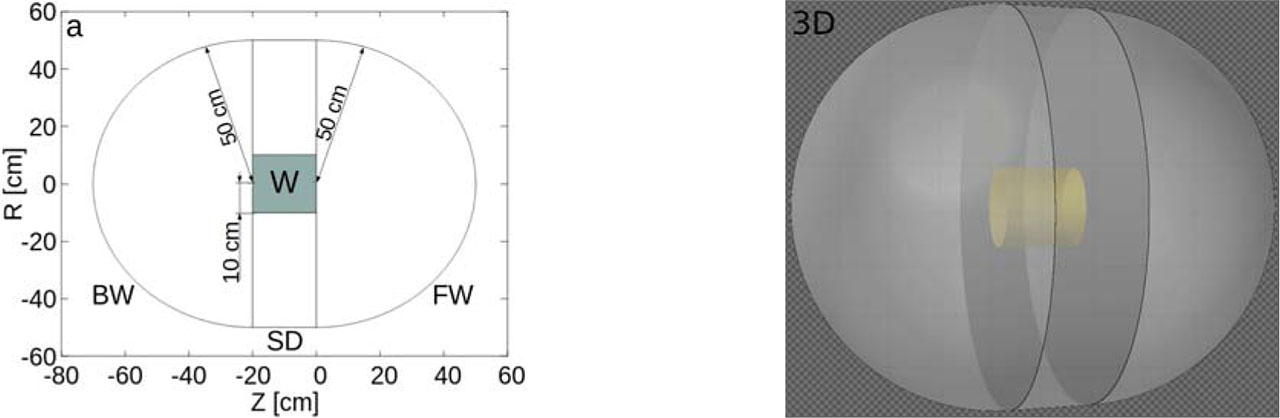
Fig. 1.
The cross-section (a) and 3D view of the system geometry (3D) used for simulation with the FLUKA Monte-Carlo code. It comprises a tungsten cylinder (W) with a diameter of 20 cm and a thickness of 20 cm, along with three particle flux detectors, BW, FW and SD. These detectors register all selected particles passing through the boundary between defined regions. BW, backward; FW, forward; SD, side direction.
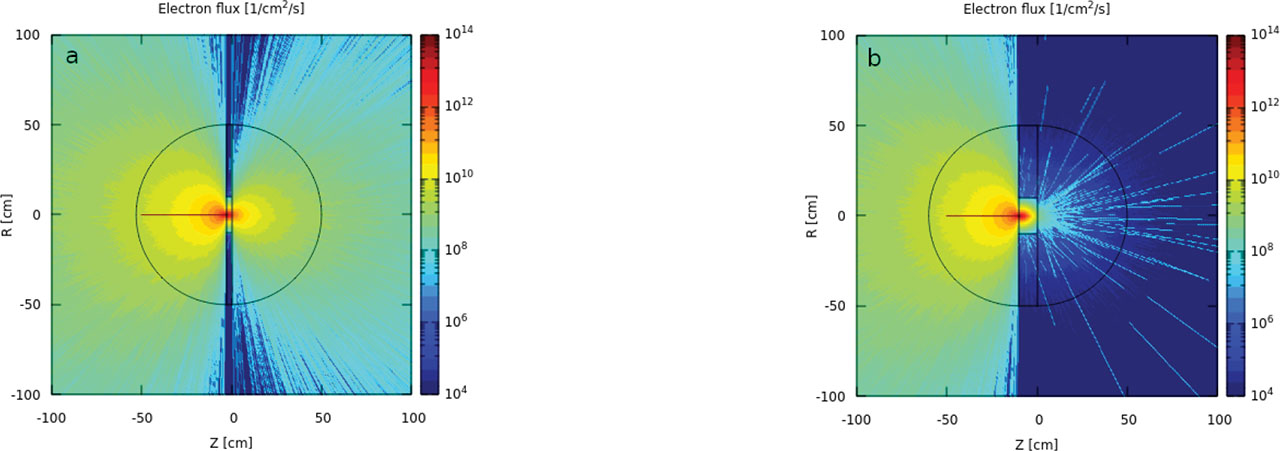
Fig. 2.
The electron flux registered in the system for 30 MeV electron energy for a converter thickness of 3 cm (a) and 10 cm (b), the section in the plane parallel to the axis of the electron beam.
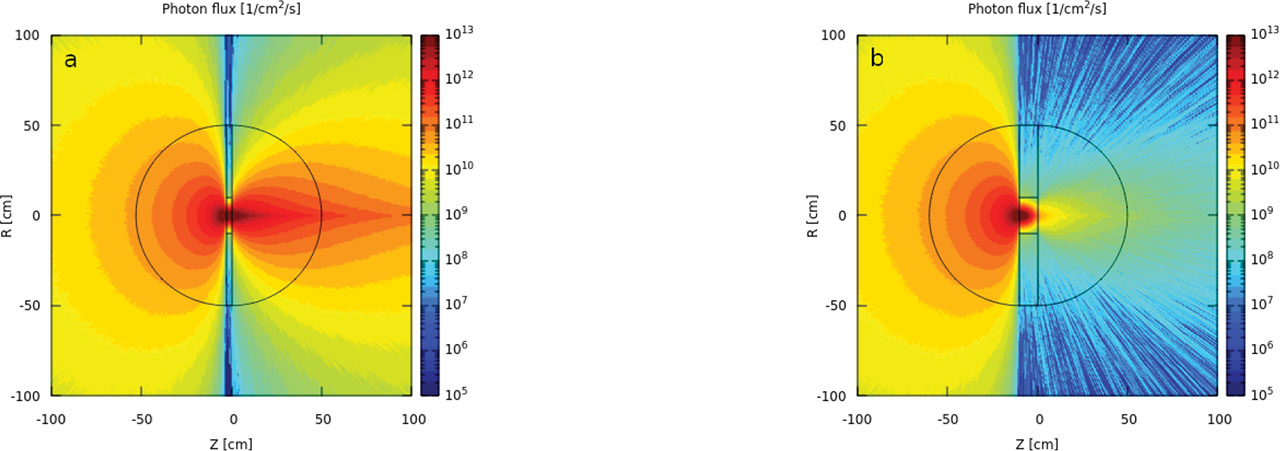
Fig. 3.
The photon flux registered in the system for 30 MeV electron energy for a converter thickness of 3 cm (a) and 10 cm (b), the section in the plane parallel to the axis of the electron beam.
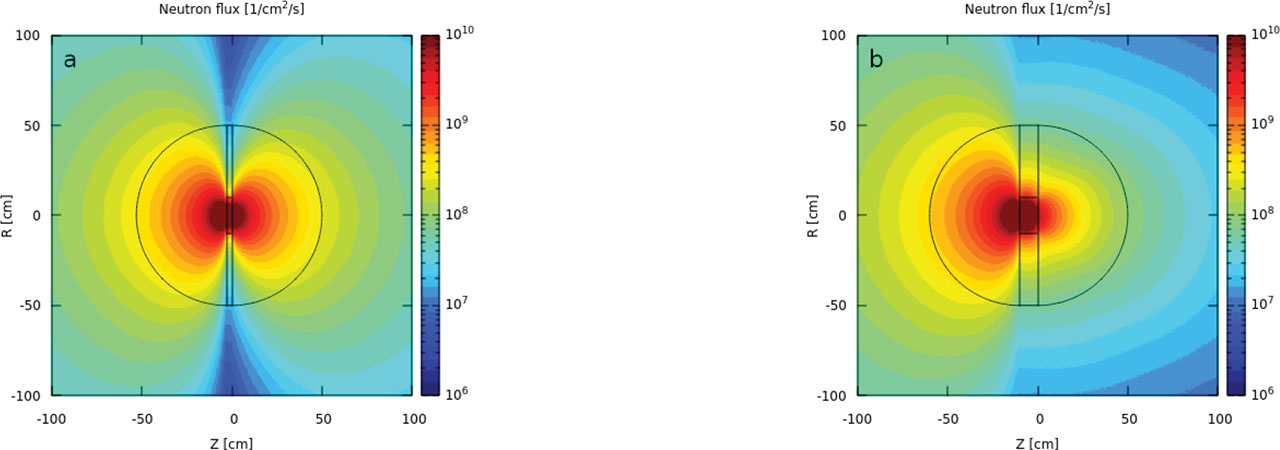
Fig. 4.
The neutron flux registered in the system for 30 MeV electron energy for a converter thickness of 3 cm (a) and 10 cm (b), the section in the plane parallel to the axis of the electron beam.
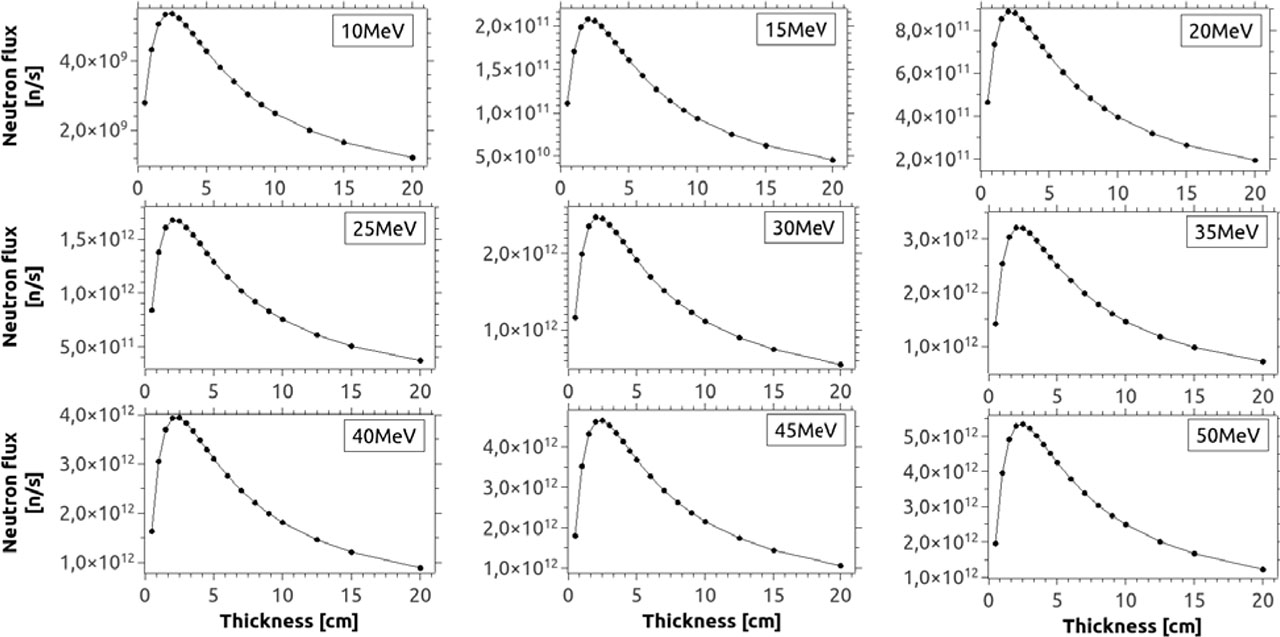
Fig. 5.
The neutron flux generated by tungsten irradiated with a monoenergetic electron beam of 7.5·1014 e/s and registered in the detector positioned in towards the direction of the electron beam (FW). The optimal thickness of the conversion target to achieve the maximum neutron flux in the direction aligned with the primary beam was found to be approximately 2.0–2.5 cm.
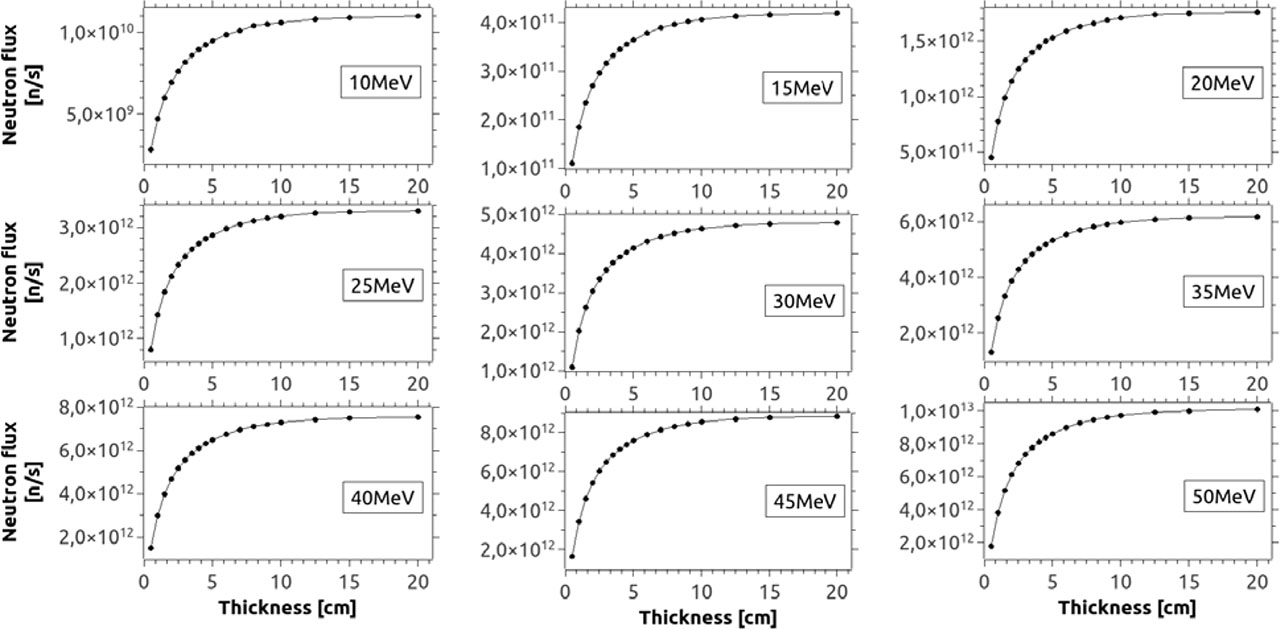
Fig. 6.
The neutron flux registered in the detector positioned from the side that is exposed by the electron primary beam (BW). The optimal thickness of the conversion target for achieving the maximum BW neutron flux was found to be approximately 10 cm.
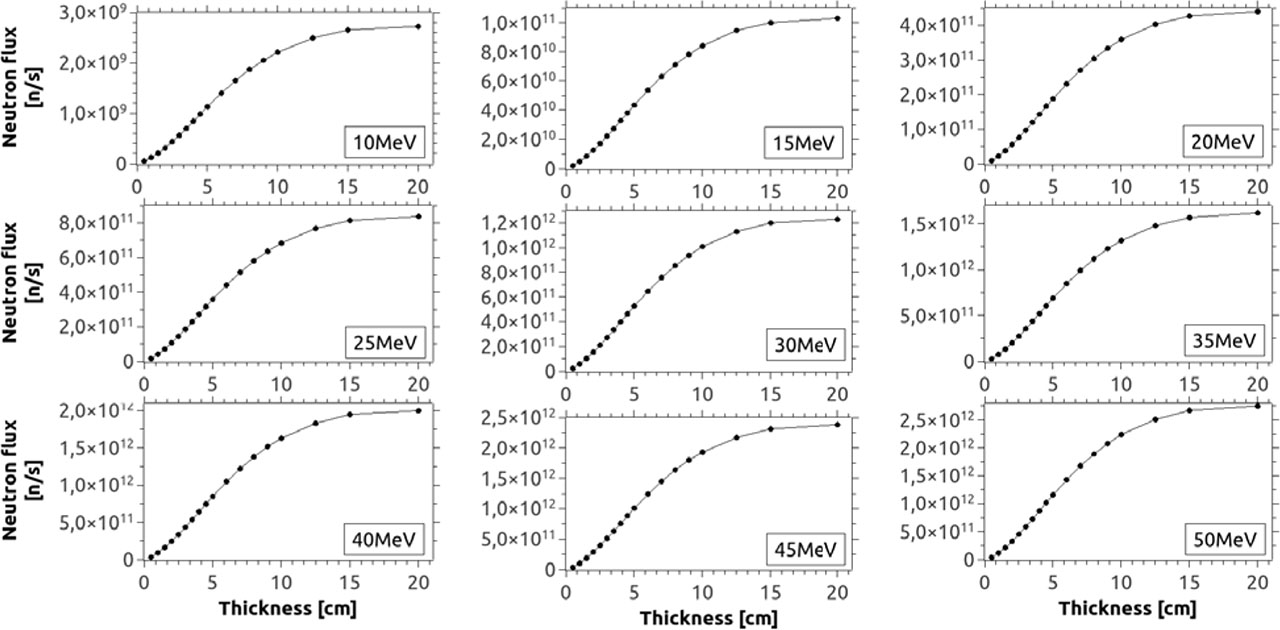
Fig. 7.
The neutron flux registered in the detector positioned at an angle of 90° to the direction of the electron primary beam (SD).
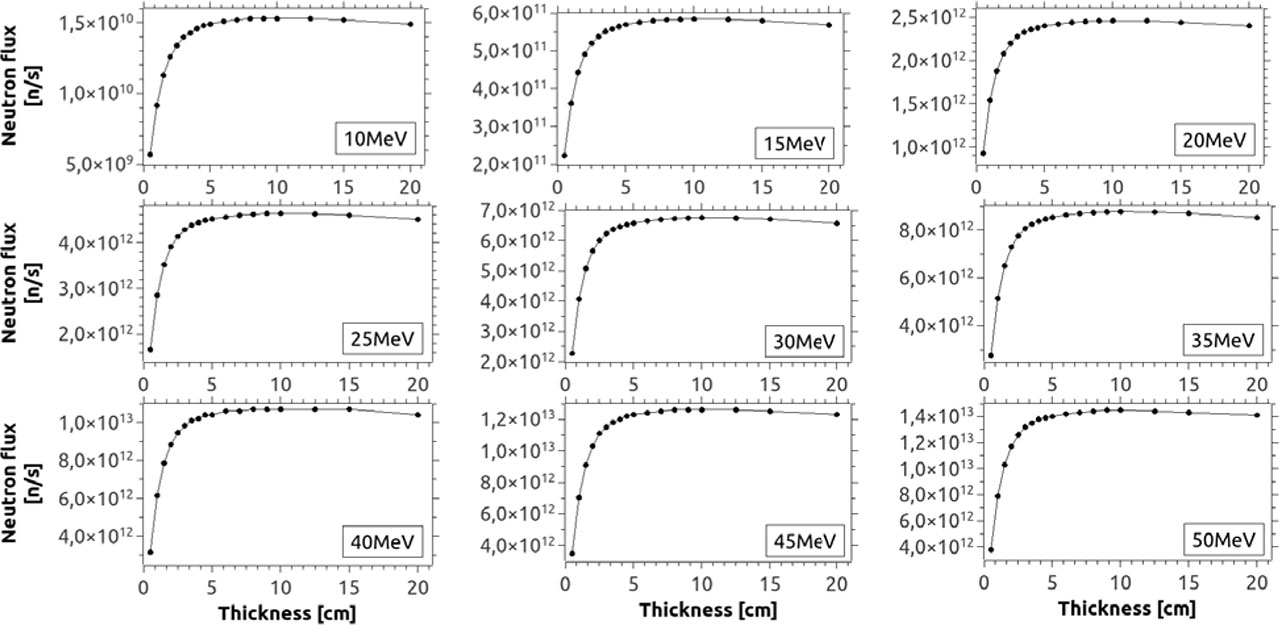
Fig. 8.
The total neutron flux is defined as the sum of the neutron fluxes registered in all defined detectors (FW + SD + BW). The optimal thickness of the conversion target to achieve maximum total emitted neutron flux is approximately 10 cm.
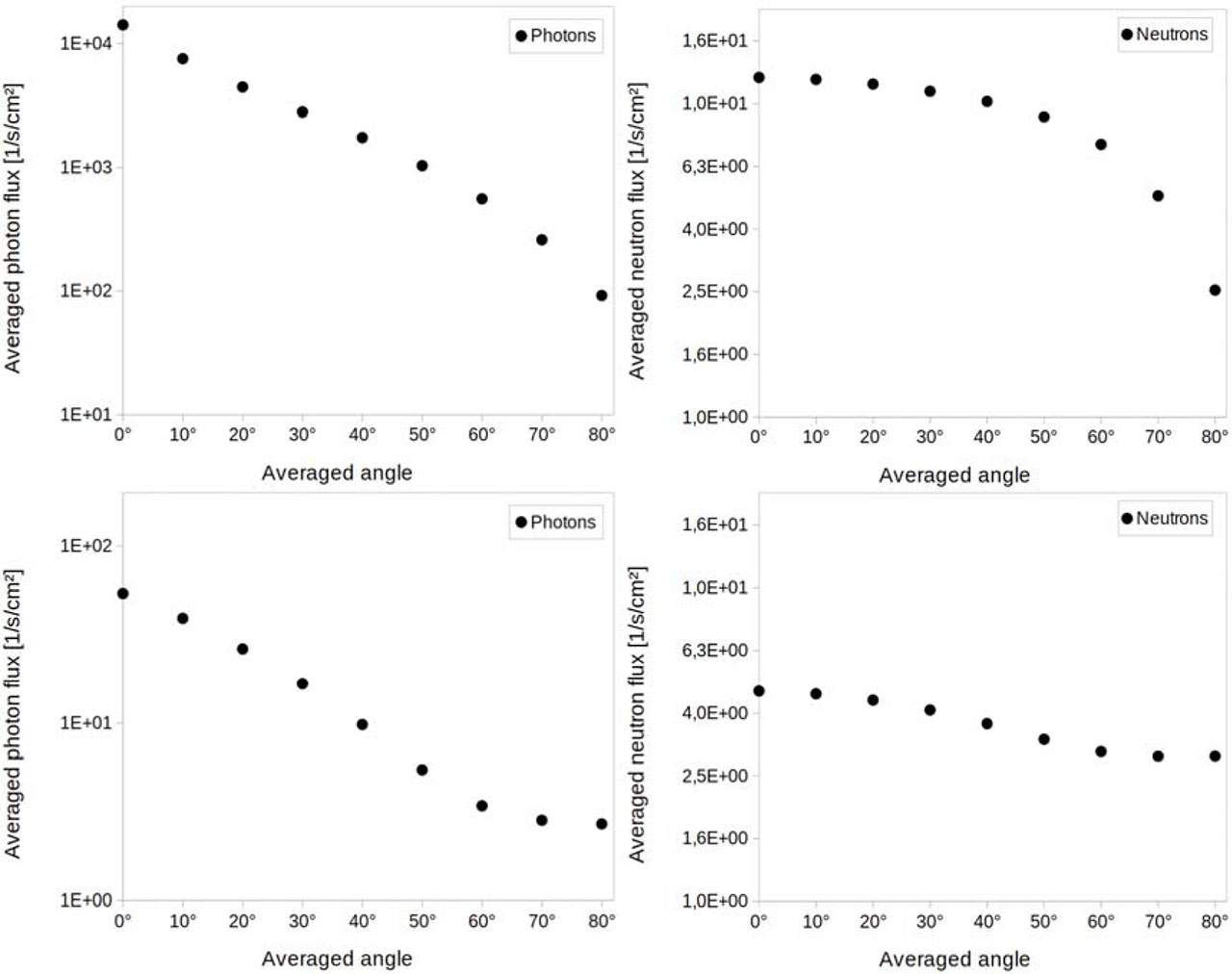
Fig. 9.
The angular distributions of photon and neutron fluxes emitted from a tungsten conversion target presented for two example thicknesses: 3 cm (top row) and 10 cm (bottom row) for a randomly selected 30 MeV electron energy. The fluxes are averaged over angles of 5° in relation to the orientation of the primary beam, 5–15°, and so forth up to 85°. The magnitudes of the statistical errors are invisible with the scale used.
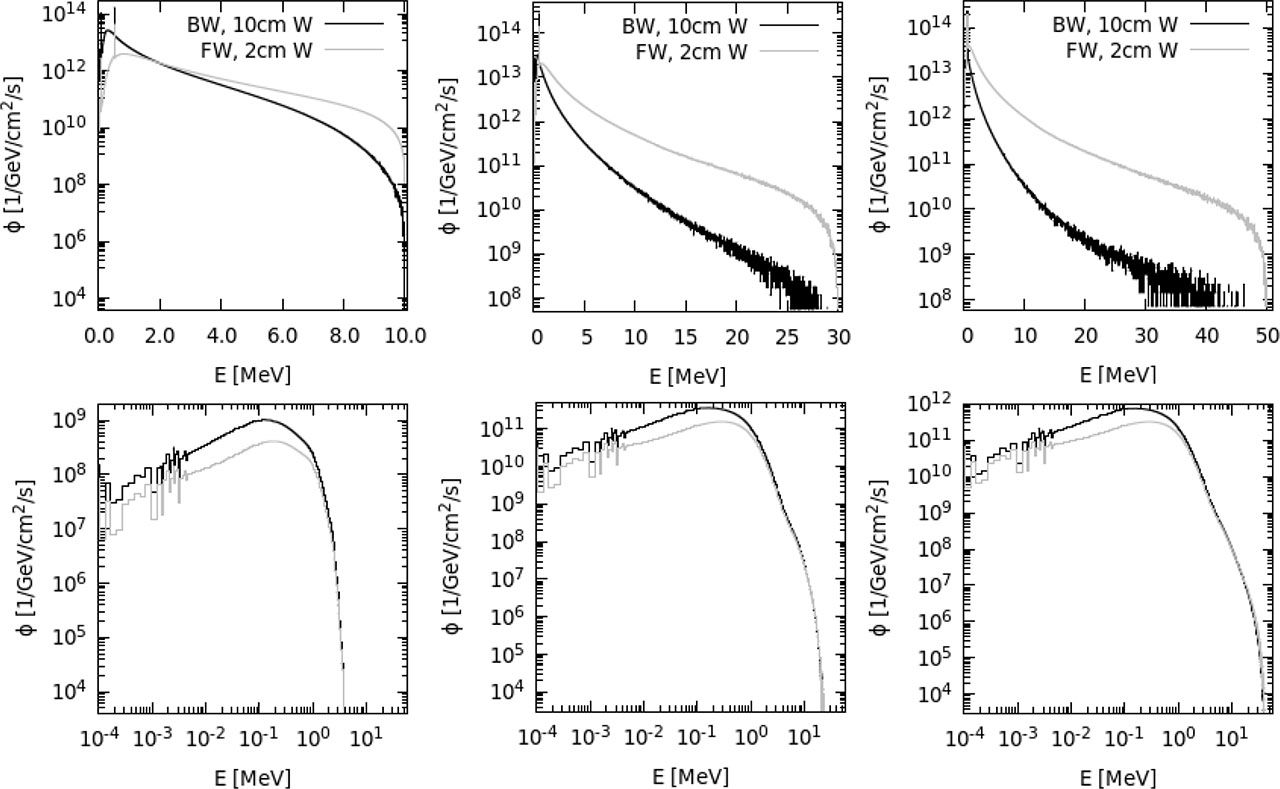
Fig. 10.
The energy spectra of photons (top row) and neutrons (bottom row) presented for randomly selected primary electron beam energies of 10 MeV, 30 MeV, and 50 MeV observed at a distance of 50 cm from the centre of the surface of the tungsten converter in FW and BW detectors.