Have a personal or library account? Click to login
Electron source model responsible for low power beam losses of 1 W/m along the entire PolFEL superconducting electron linear accelerator Cover

Electron source model responsible for low power beam losses of 1 W/m along the entire PolFEL superconducting electron linear accelerator

By: Adam Wasilewski  
Open Access
|Nov 2024

Figures & Tables

Fig. 1.

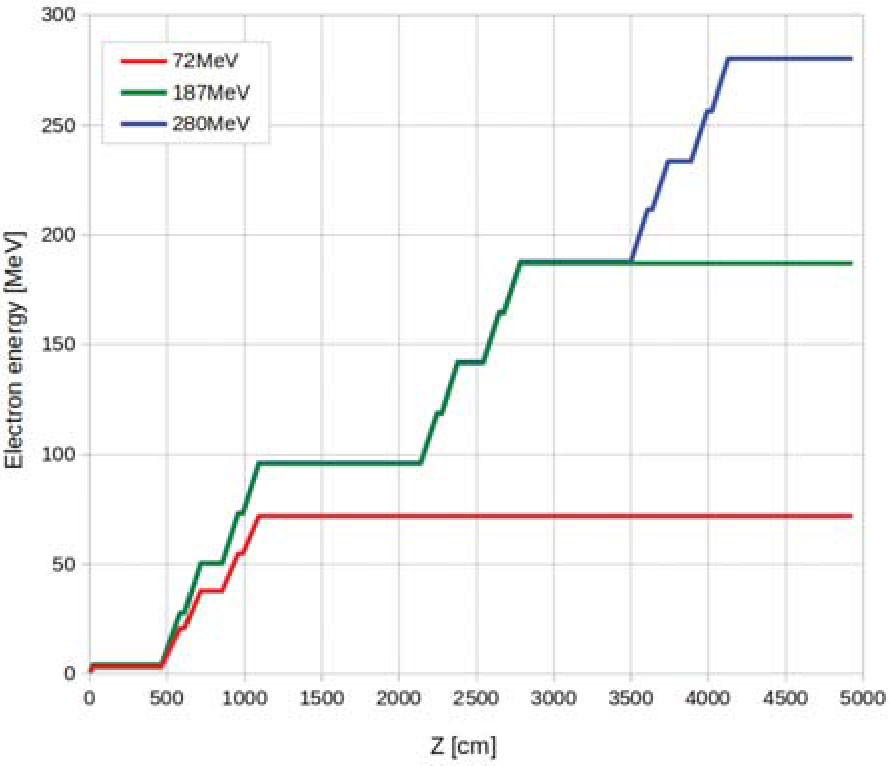
Planned electron beam energy dependence as a function of Z coordinate, along a superconducting linear PolFEL accelerator.
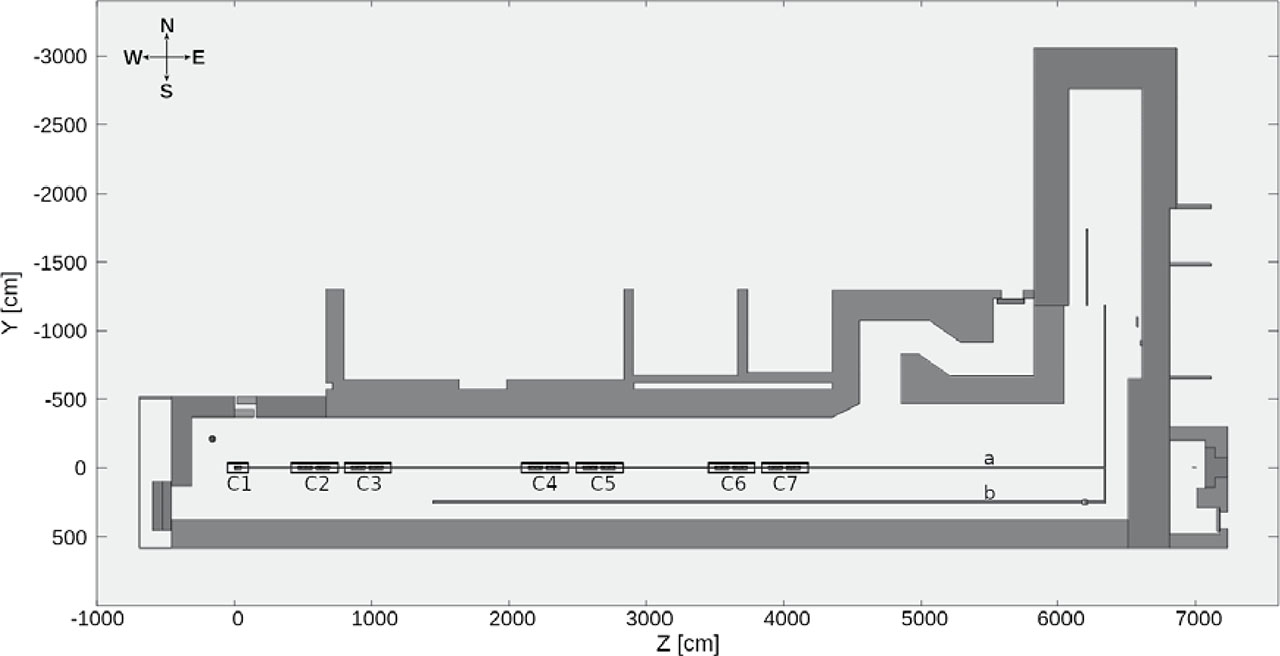

Fig. 2.

Model of a linear electron accelerator for the planned energies of 72 MeV, 187 MeV and 280 MeV, together with the planned seven superconducting accelerating cryomodules (C1–C7) required to achieve the maximum assumed electron beam energy of 280 MeV. One can see the two trajectories foreseen for the 187 MeV and 280 MeV beams (a) and for the 72 MeV beam (b). The scheme shows one of the planned versions of the shield walls, based in part on the walls of another already existing bunker. In the upper left corner, there is an indication of the world directions in relation to which the planned bunker will be oriented.
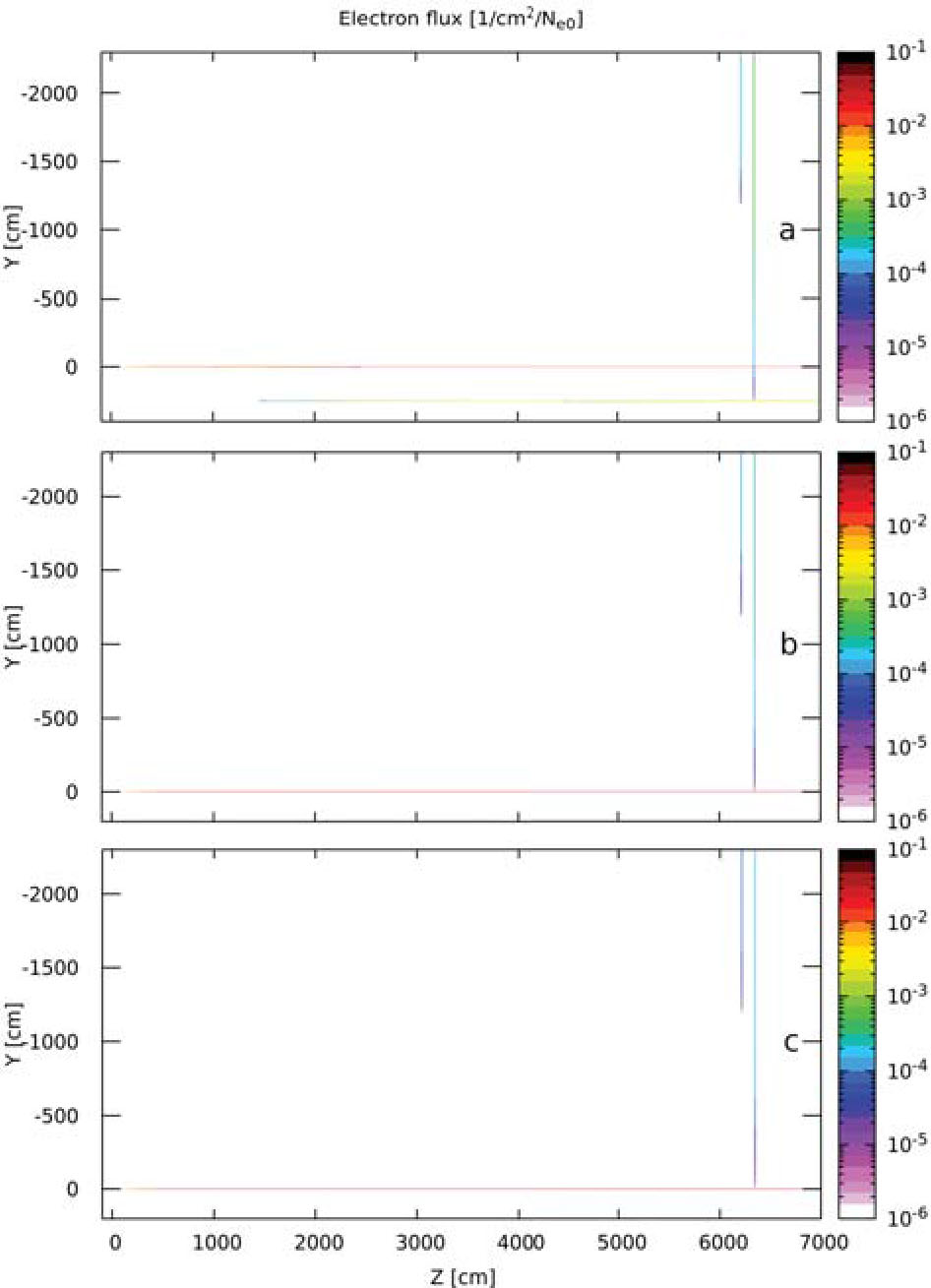

Fig. 3.

Spatial distribution of electron fluxes lost from the main beam and transported in vacuum for 72 MeV (a), 187 MeV (b) and 280 MeV (c). Horizontal view, parallel to the beam axis. All Monte Carlo calculation results presented in this paper are normalized to a single primary beam electron.

Fig. 4.

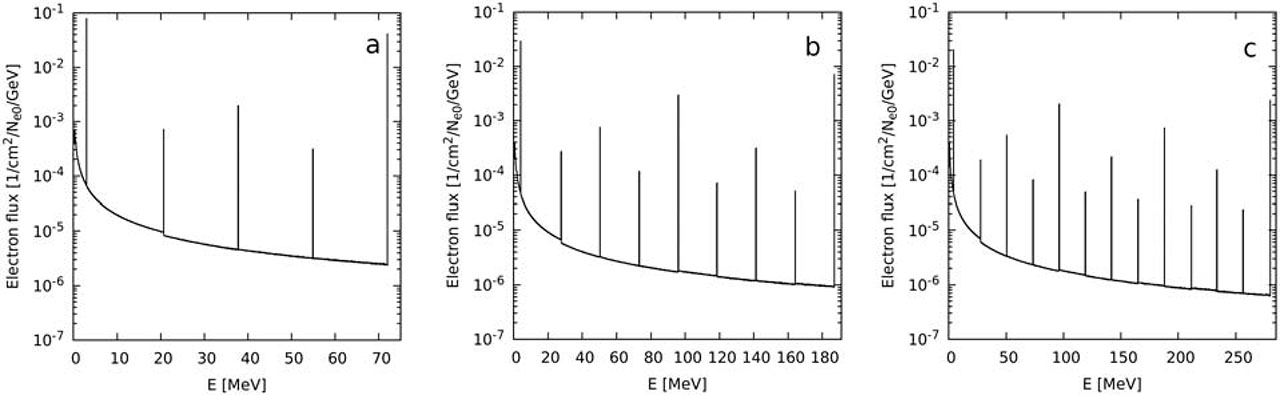
Calculated spectra of electrons incident on the inner surface of the beam pipe for 72 MeV (a), 187 MeV (b) and 280 MeV (c).
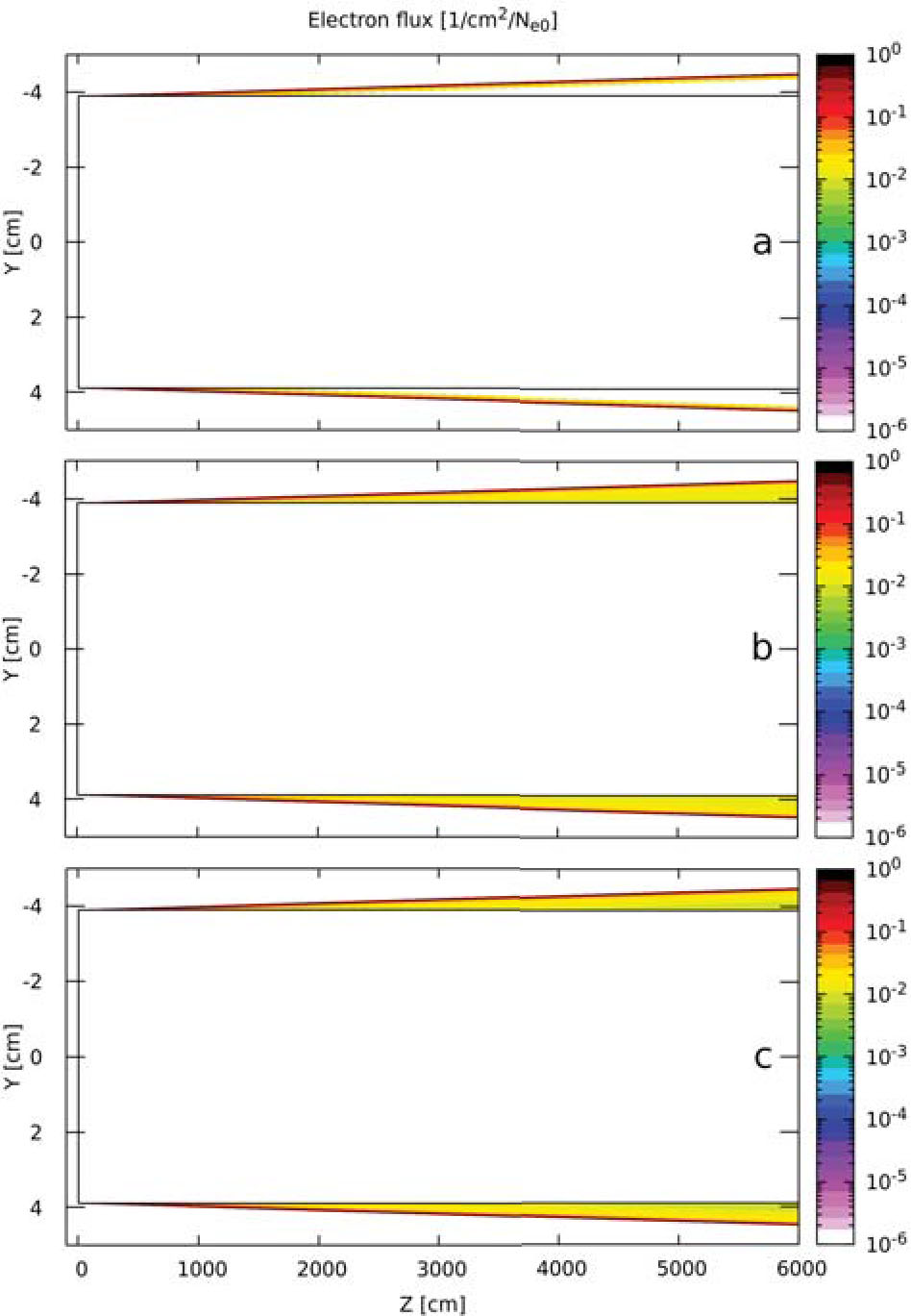

Fig. 5.

Spatial distribution of electron fluxes lost from the main beam and transported in vacuum for 72 MeV (a), 187 MeV (b) and 280 MeV (c). Magnification along the beam pipe with cryomodules. The limits of a cylinder of radius 3.9 cm are visible. The vertical and horizontal axis scales are different.
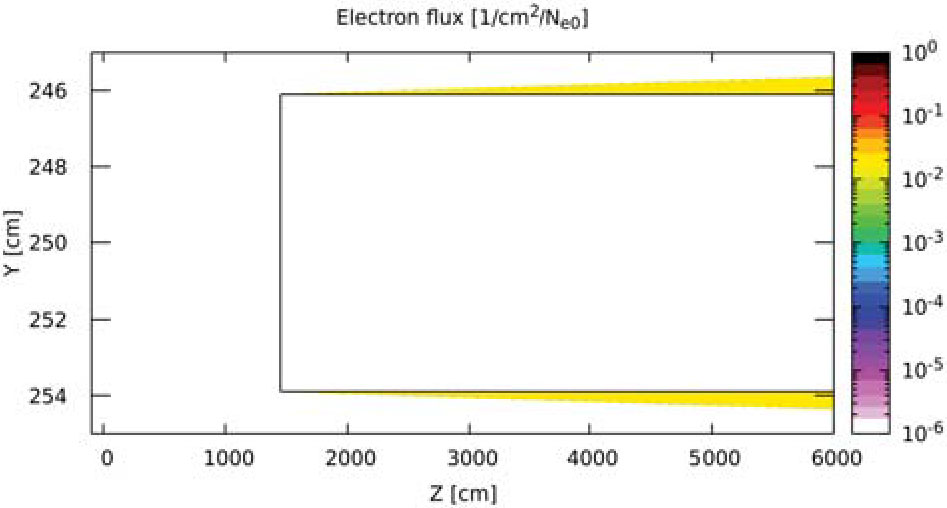
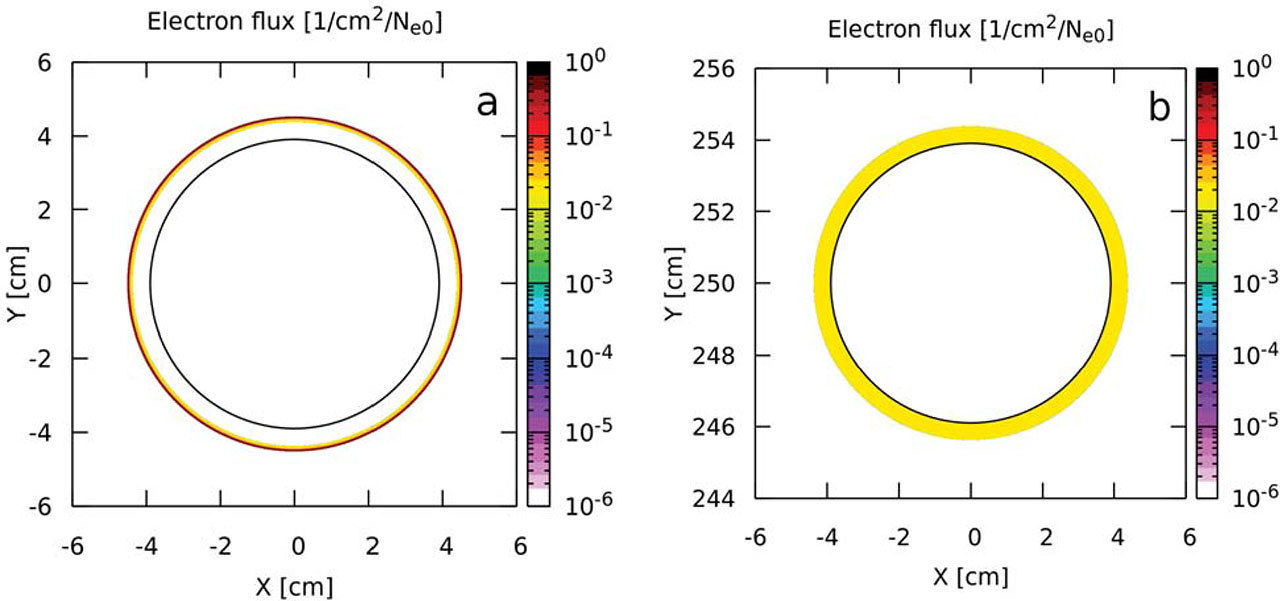
Fig. 6.

Magnification of spatial distribution of electron flux lost from the branch for 72 MeV and transported in vacuum. The limits of a cylinder of radius 3.9 cm are visible. The vertical and horizontal axis scales are different.

Fig. 7.

Magnification of the spatial distribution of electron flux for 72 MeV, (a) for the main beam pipe and (b) for the beam pipe shifted by 2.5 m. The limits of a cylinder of radius 3.9 cm are visible. View in the plane perpendicular to the beam axis for Z coordinate = 62 m.
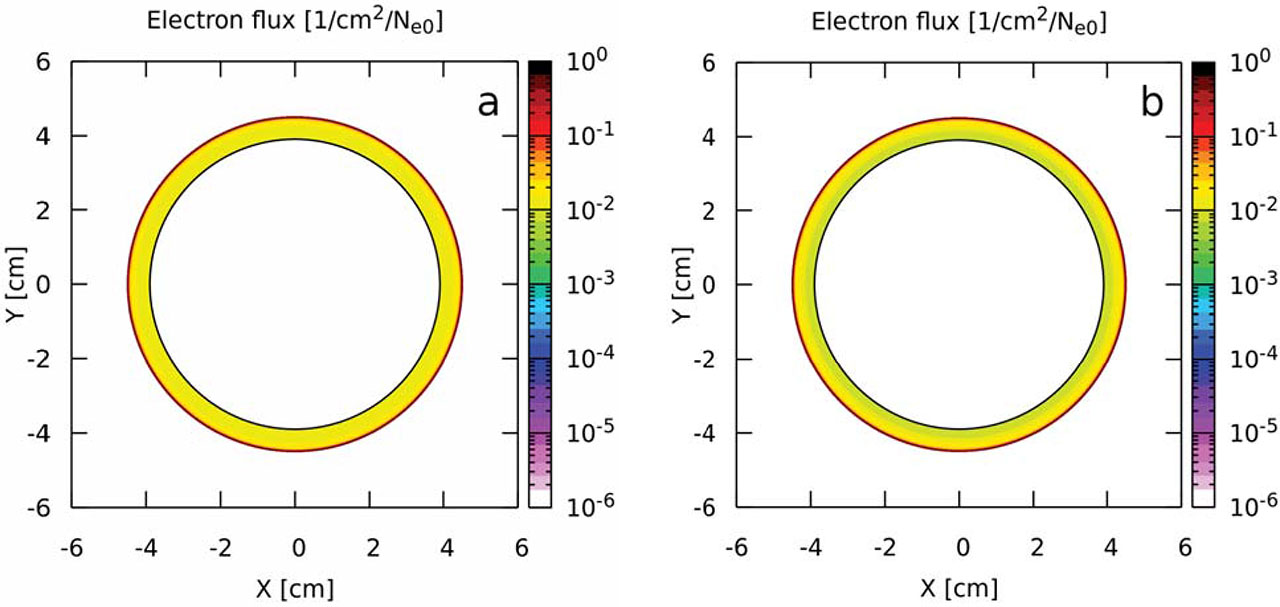

Fig. 8.

Magnification of the spatial distribution of electron flux for 187 MeV (a) and for 280 MeV (b). The limits of a cylinder of radius 3.9 cm are visible. View in the plane perpendicular to the beam axis for Z coordinate = 62 m.

Summary of calculated electron fluxes lost from a cylinder with a radius of 3_9 cm to provide a beam loss of 1 W/m_ This radius corresponds to the radius of the designed beam pipe

Electron energy (MeV)Φnoacc (e/s)Φacc (e/s)Φ (e/s)
721.5840 × 10132.152 × 10121.7991 × 1013
1879.729 × 10121.808 × 10121.1537 × 1013
2809.097 × 10121.915 × 10121.1012 × 1013
DOI: https://doi.org/10.2478/nuka-2024-0025 | Journal eISSN: 1508-5791 | Journal ISSN: 0029-5922
Language: English
Page range: 179 - 184
Submitted on: Feb 12, 2024
|
Accepted on: May 16, 2024
|
Published on: Nov 20, 2024
In partnership with: Paradigm Publishing Services
Publication frequency: 4 issues per year

© 2024 Adam Wasilewski, published by Institute of Nuclear Chemistry and Technology
This work is licensed under the Creative Commons Attribution-NonCommercial-NoDerivatives 4.0 License.