
Table 1.
Critical facility characteristics
| Reactor type | Tank |
|---|---|
| Thermal power (W) | 100 |
| Reflector | Light water and/or beryllium |
| Moderator | Light water and/or beryllium |
| Maximum thermal neutron flux (cm−2·s−1) | 3 × 10⁹ |
| Maximum fast neutron flux (cm−2·s−1) | 2 × 10⁸ |
| Fuel composition | UO2 + Al |
| U-235 enrichment (%) | 19.7 |
| Experimental channel’s diameter (mm) | 65, 96, 140 |
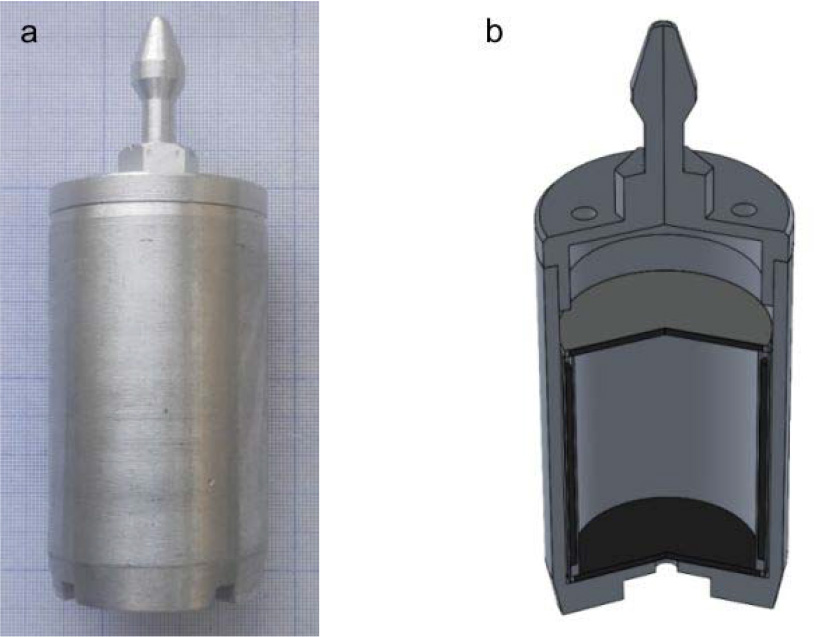
Fig. 1.
Layout of the irradiation device: (a) appearance; (b) three-dimensional cross-sectional image.
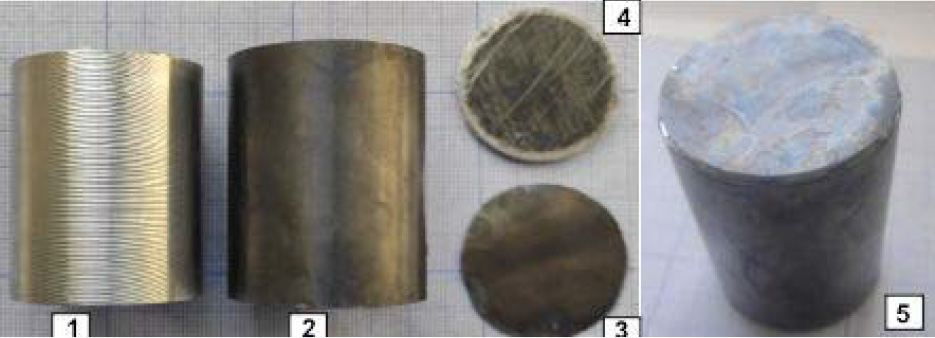
Fig. 2.
Appearance of a sandwich screen made of tantalum foil and boron carbide: 1 – screen made of boron carbide, 2 – screen made of tantalum, 3 – end tantalum screen of a round shape, 4 – screen of boron carbide of a round shape, 5 – view of a sandwich screen assembled.
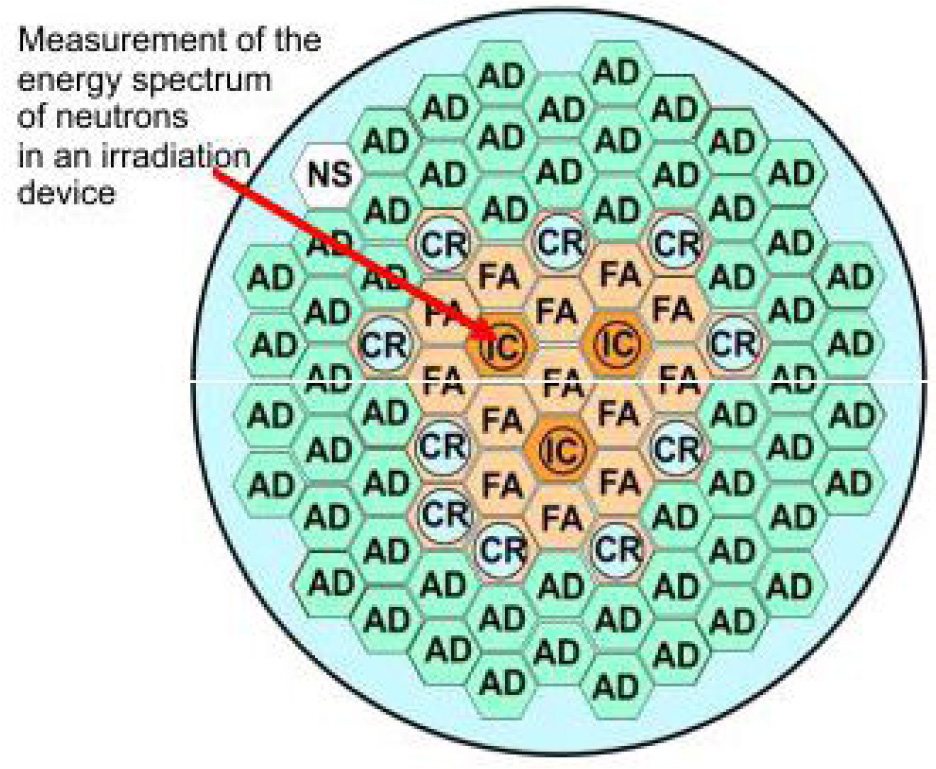
Fig. 3.
The core of the critical facility. AD, aluminum displacer; CR, type 2 fuel assemblies with an absorbing rod; FA, type 1 fuel assemblies; IC, irradiation channel; NS, neutron source.
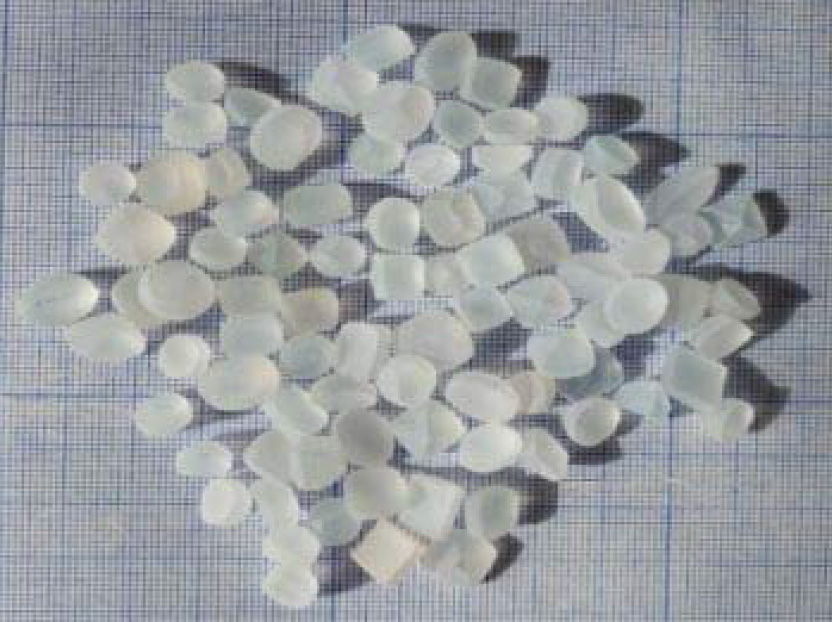
Fig. 4.
Non-irradiated topaz.
Table 2.
Nuclear physical characteristics of activation detectors
| Detector type | Gold | Indium |
|---|---|---|
| Neutron energy region | Thermal | Fast |
| Energy threshold | 0 ≤ En ≤ 0.625 eV | En >1.15 MeV |
| Nuclear reactions | 197Au(n,γ)198Au | 115In(n,n′)115mIn |
| Half-life | 2.696 days | 4.486 h |
| Reaction cross-section (barn) | 98.7 | 0.286 |
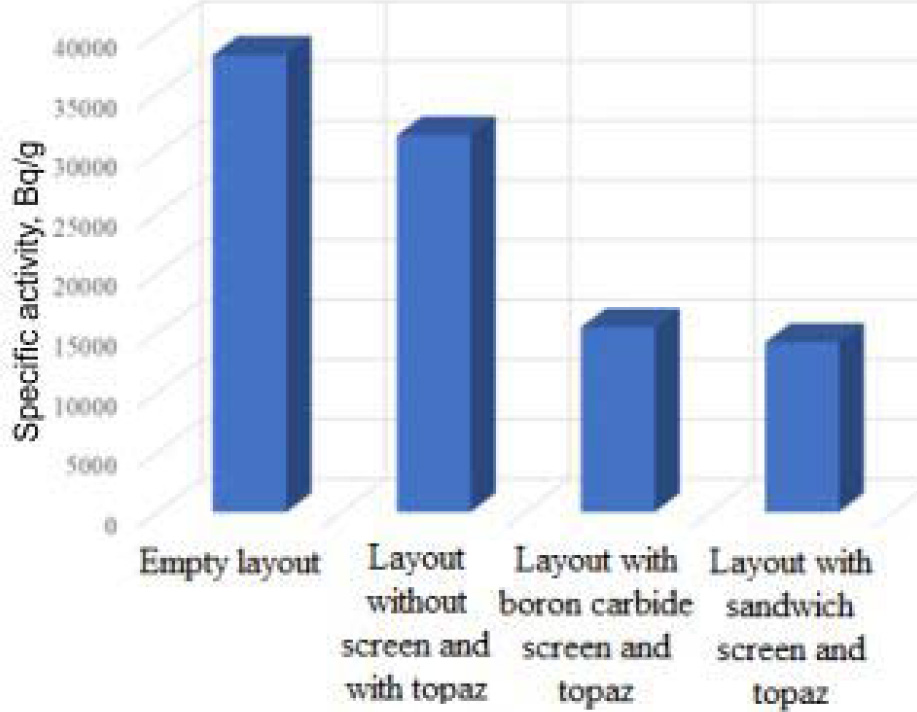
Fig. 5.
Dynamics of changes in the induced activity of a tantalum monitor.
Table 3.
The flux density of thermal and fast neutrons in the layout of the irradiation device
| Configuration | Neutron flux density (cm−2·s−1) | |
|---|---|---|
| En <0.625 eV | En >1.15 MeV | |
| Empty layout | (1.28 ± 0.11) × 109 | (2.38 ± 0.20) × 108 |
| Layout with topaz | (8.76 ± 0.62) × 108 | (2.45 ± 0.19) × 108 |
| Model with boron carbide screen and topaz | (1.72 ± 0.14) × 108 | (2.15 ± 0.18) × 108 |
| Layout with sandwich screen and topaz | (1.54 ± 0.62) × 108 | (2.28 ± 0.17) × 108 |
Table 4.
Radionuclide composition of topaz after each stage of experiments
| Layout type | Specific activity (Bq·g−1) | ||
|---|---|---|---|
| Ga-72 (T1/2 = 14.1 h) | Na-24 (T1/2 = 14.9 h) | Ta-182 (T1/2 = 114 days) | |
| Layout without a screen | 1290 ± 70 | 28 658 ± 1146 | 23 ± 3 |
| Layout with boron carbide screen | 316 ± 16 | 12 600 ± 447 | 15 ± 4 |
| Layout with sandwich screen | 302 ± 43 | 13 666 ± 548 | – |