
Table 1.
Methods for the removal of hydroxyquinine from aqueous solutions
| Method | Conditions | Efficiency | Ref. |
|---|---|---|---|
| Photochemical decomposition | pH 3–10 | Half-lives of 5.5 min (pH3) to 23.1 h (pH4) Hydrolytic degradation <5% | [7, 8] |
| Adsorbents | |||
| Living microalgae | HCQ 20 mg·L-1, pH 9.9, 45 min, 300 rpm stirring speed microalgae loading of 100 mg·L-1 | 92.10 ± 1.25% maximum biosorption capacity is 339.02 mg·g-1 | [18] |
| H3PO4-activated Cystoseira barbata (Stackhouse) C. Agardh biochar | Adsorbent dose (0.025–1 g·L-1), pH (4–11) contact time (0–240 min) HCQ (10–50 mg·L-1) | 98.9% (qmax = 353.58 mg·g-1) surface area (1088.806 m2·g-1) | [19] |
| Natural zeolite CP | pH 2–7.5 298 K, 303 K, and 308 K | 7 mg·g-1 7 cycles reuse | [20] |
| Algerian kaolin | 0.05–0.15 g·L-1 sorbent, and pH of 3–7 5–50 mg·L-1 HCQ | Capacity of 51 mg·g-1 0.15 g·L-1 of kaolin, 5 mg·L-1 as HCQ initial concentration, and pH 7 are optimal | [21] |
| Catalysis | |||
| ZnO-CP catalyst | 2 g·L-1 15% ZnO-CP pH = 7.5 UV-A radiation, 10 mg·L-1 HCQ, 180 min | 96% | [17] |
| Modified titanium oxide using beta-bismuth oxide TiO2/ß-Bi2O3 | 120 min, pH 3–11 10 mg·L-1 HCQ, 0.1 g·L-1 catalyst, 0.1 mg·L-1 H2O2 | 91.8% 6 cycles >70% degradation | [12] |
| MoS2/CNTs nanocomposite | MoS2/CNTs 10:1 ratio loading of 0.1 g·L-1 pH of 8.7, HCQ-20 mg·L-1 120 min | 70% Lower band gap energy (1.2 eV), higher specific surface area (30.6 m2·g-1) | [13] |
| Ti3GeC2 with peroxydisulfate | 20 mg·L-1 HCQ 0.2 g·L-1 Ti3GeC2, 0.15 mmol·L-1 PDS, ultrasound irradiation 80 min | 60.42% Dependent on catalyst dosage (0.1–0.2 g·L-1) | [16] |
| Advanced oxidation processess | |||
| Electrochemical oxidation | BDD anodes, HCQ 36–250 mg·L-1, j = 20 mA·cm-2, pH = 7.1, T = 25°C, 0.05 M Na2SO4 | 100% | [14] |
| Electrochemical oxidation | BDD electrode 15 mA·cm-2, 30 mA·cm-2, and 45 mA·cm-2 | 100% COD (68%, 71%, and 84%) | [15] |
| Fe(0)//UV system | dose: 194.31 mg·L-1; Fe(0): 198.83 mg·L-1; pH = 2.02 and HCQ 296.41 mg·L-1 60 min | 98.95% | [21] |
| Gamma irradiation | 100 ppm HCQ A dose rate of 26.31 Gy·min-1 pH = 6.2 | 98.5% TOC removal (8 kGy) complete mineralization | [22] |
| Gamma irradiation | 20 ppm HCQ, 1 kGy dose 4.2 kGy1 | 100% | [23] |
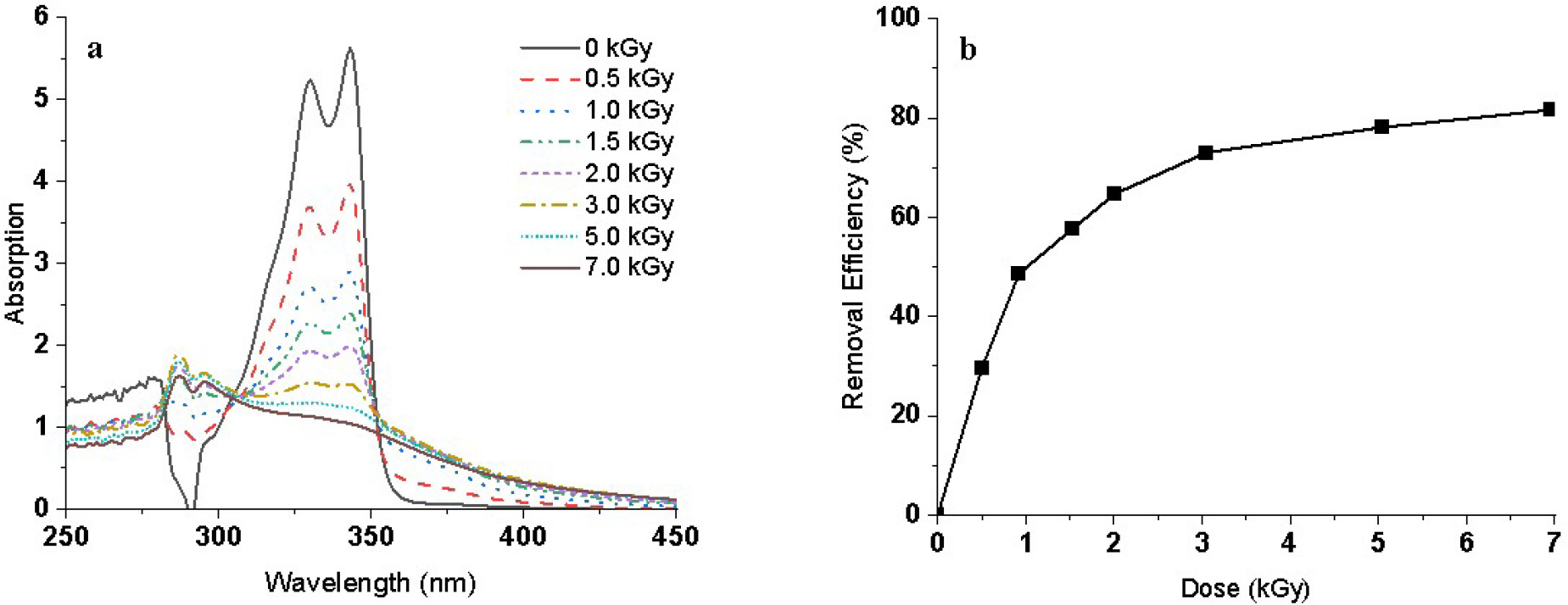
Fig. 1.
Dégradation of 2.88 × 10⁻⁴ M of hydroxychloroquine under electron beam treatment. (a) UV-VIS absorption spectrum of HCQ solution with an initial concentration of 2.88 × 10—4 M was observed at 343 nm at doses ranging from 0 kGy to 7 kGy. (b) The removal efficiency of 2.88 × 10⁻⁴ M HCQ solution under EB irradiation.
Table 2.
Reaction rates of aminoquinoline derivatives with hydroxyl radical and hydrated electrons
| Reactive spp | Hydroxychloroquine [30] | Chloroquine [31] | Amodiaquine [32] |
| •OH | 9.5 × 10⁹ M-1·s-1 | 7.3 × 10⁹ M-1·s-1 | 9.0 × 10⁹ M-1·s-1 |
| 2.0 × 10⁹ M-1·s-1 | 4.8 × 10¹⁰ M-1·s-1 | 1.6 × 10¹⁰ M-1·s-1 |
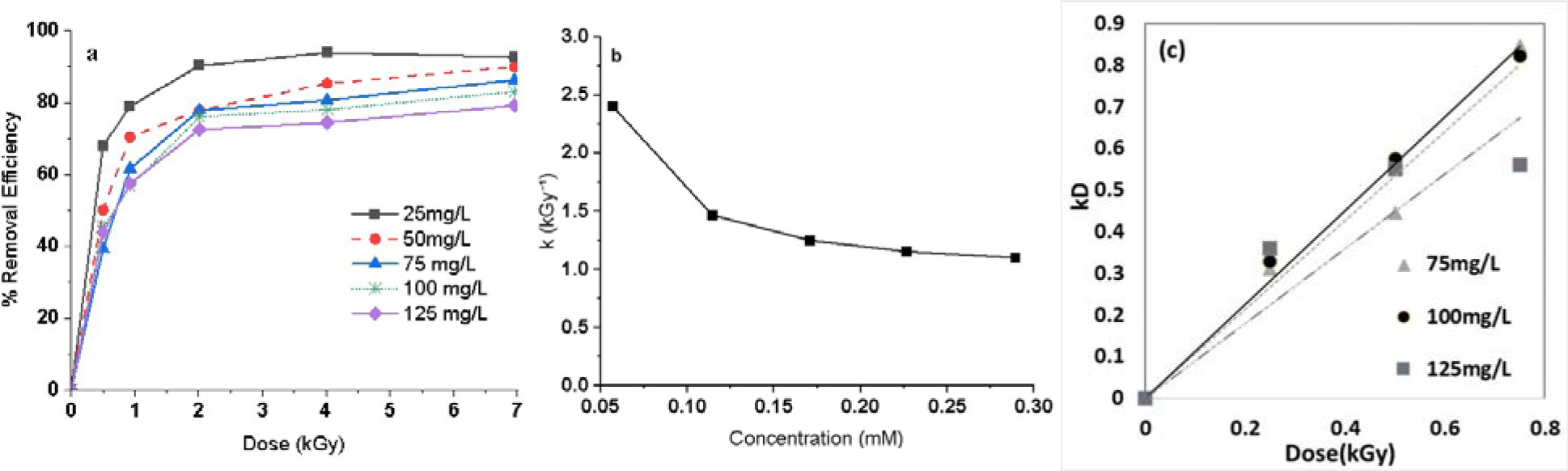
Fig. 2.
Degradation of different concentrations of hydroxychloroquine solutions under EB irradiation. (a) Variation in the removal efficiency with increasing HCQ concentration. (b) Variation of reaction rate k with increasing concentrations of HCQ. (c) Variation of reaction rate k with increasing doses for different concentrations of HCQ.
Table 3.
Rate constant k for different concentrations of hydroxychloroquine and corresponding R2 values
| Concentation (mg·L-1) | k (kGy-1) | R2 |
| 75 | 1.1287 | 0.9974 |
| 100 | 1.0706 | 0.9887 |
| 125 | 0.8980 | 0.9443 |
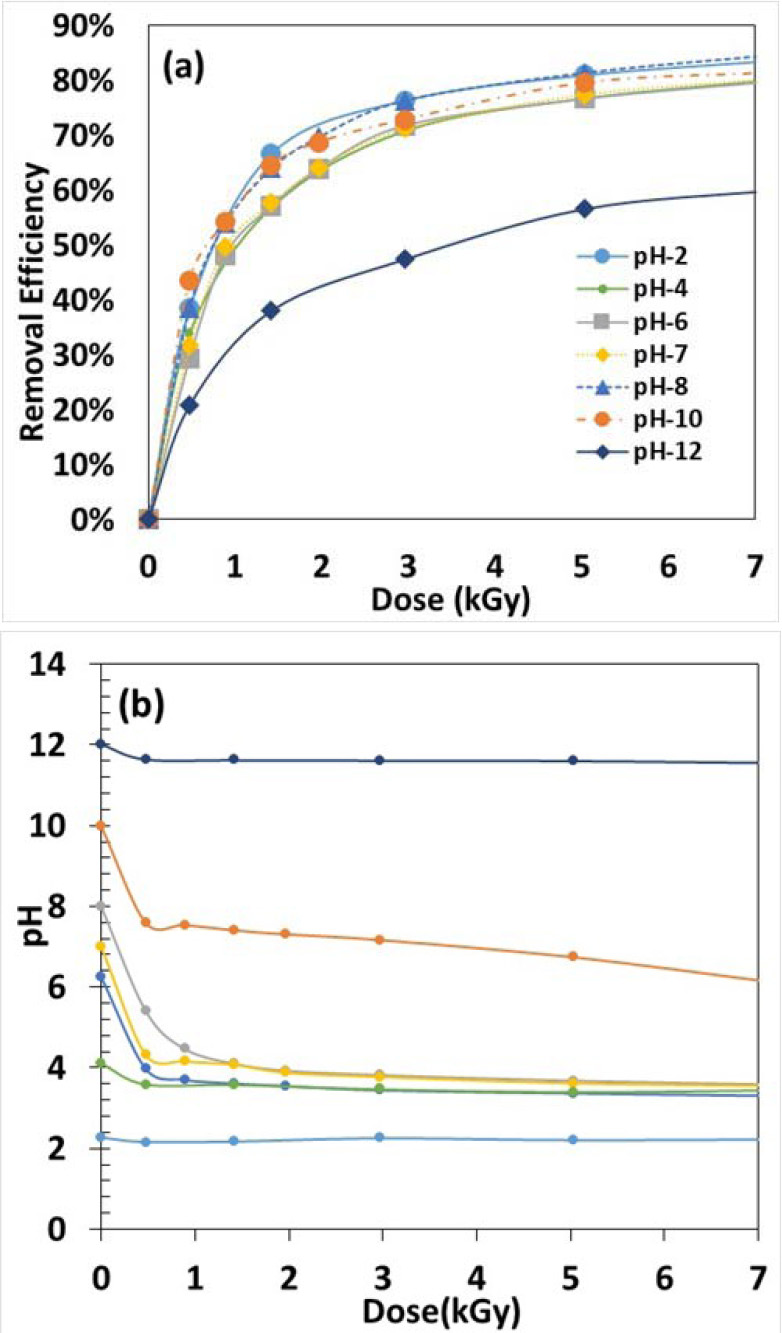
Fig. 3.
The effect of pH on the removal of 2.88 × 10⁻⁴ M of hydroxychloroquine. (a) Removal efficiency under different initial pH under electron beam treatment. (b) The changes in pH during electron beam irradiation with different initial pH.
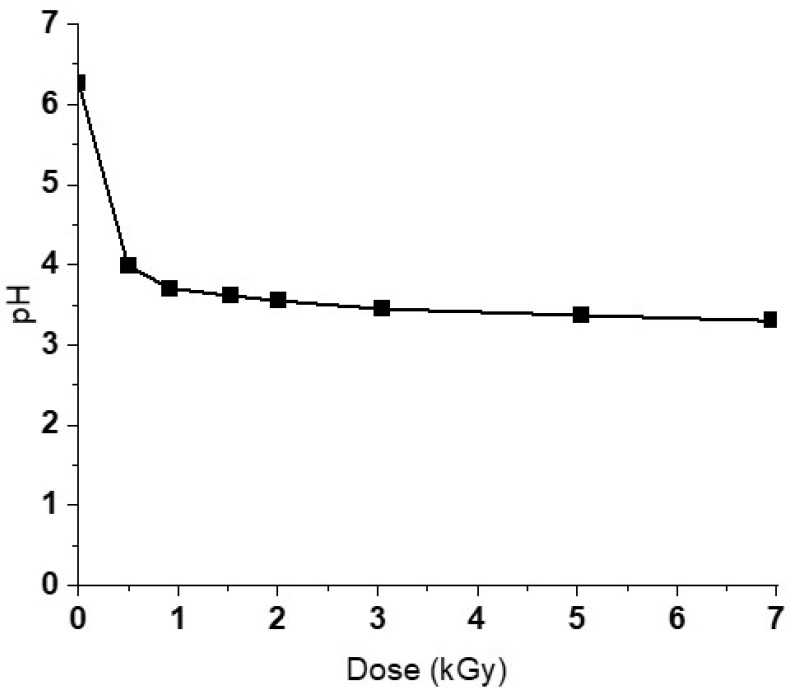
Fig. 4.
Changes in pH concentration during electron beam treatment of 2.88 × 10⁻⁴ M HCQ. The pH varied from slightly acidic before irradiation to acidic at the end of irradiation.
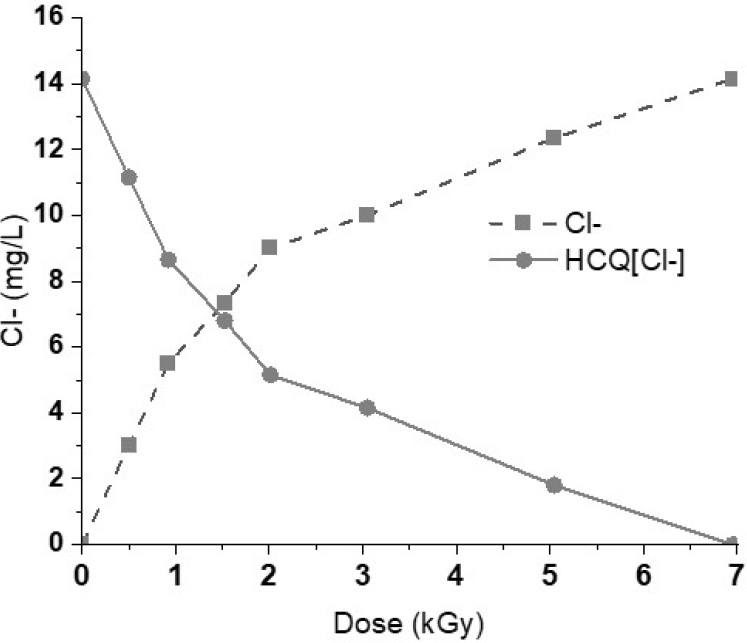
Fig. 5.
Release of the Cl- ion during the degradation of 2.88 × 10⁻⁴ M solution of HCQ under electron beam treatment.
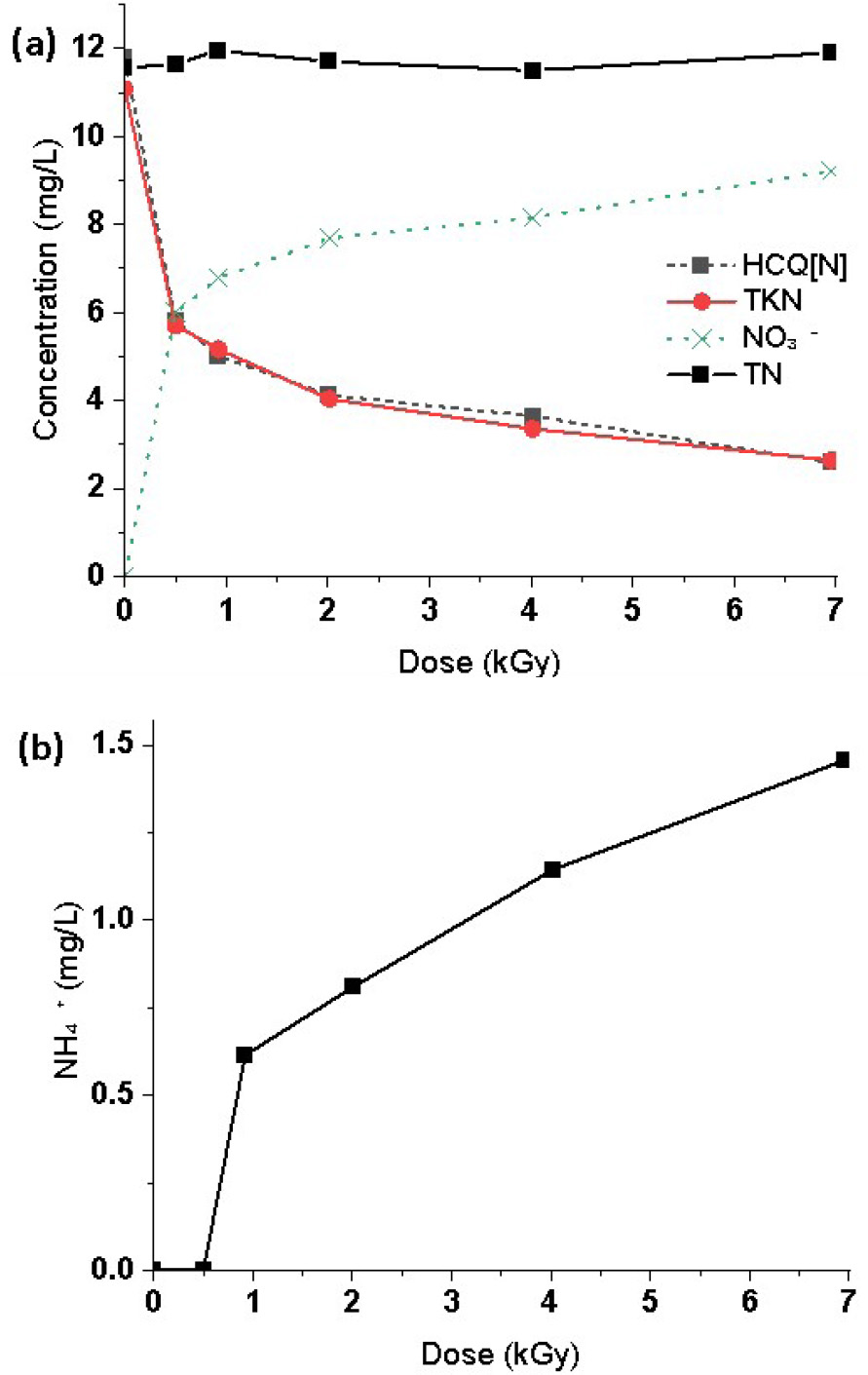
Fig. 6.
(a) Nitrification of organic bound nitrogen (HCQ[N]) with subsequent formation of during the electron beam treatment of 2.88 × 10⁻⁴ M of HCQ. (b) Formation of ion. HCQ, hydroxychloroquine; TKN, total Kjeldahl nitrogen; TN, total nitrogen.
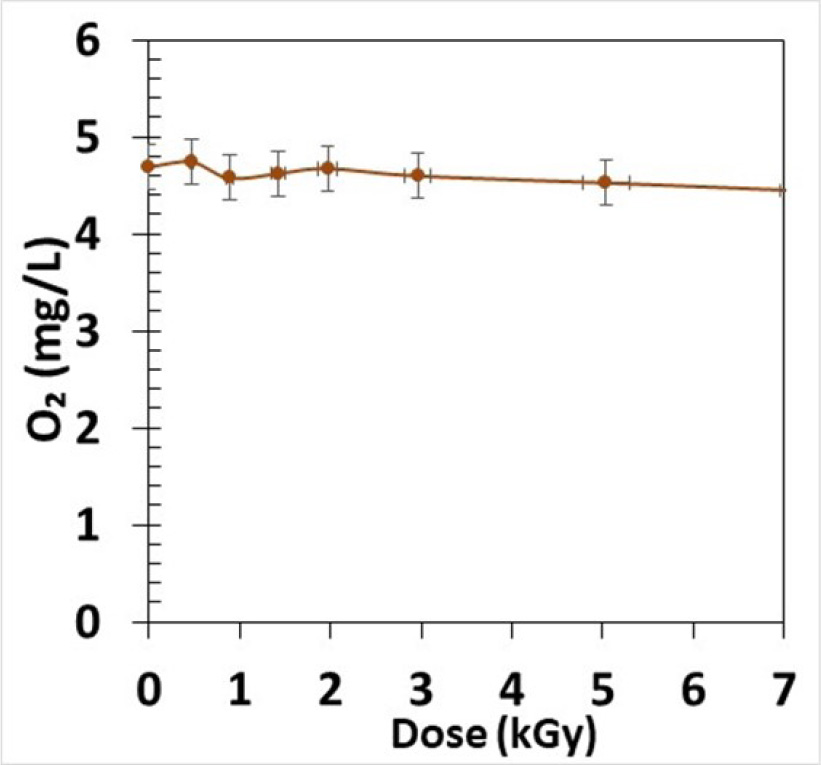
Fig. 7.
Changes in the dissolved oxygen concentration during electron beam irradiation of 2.88 × 10⁻⁴ M HCQ.
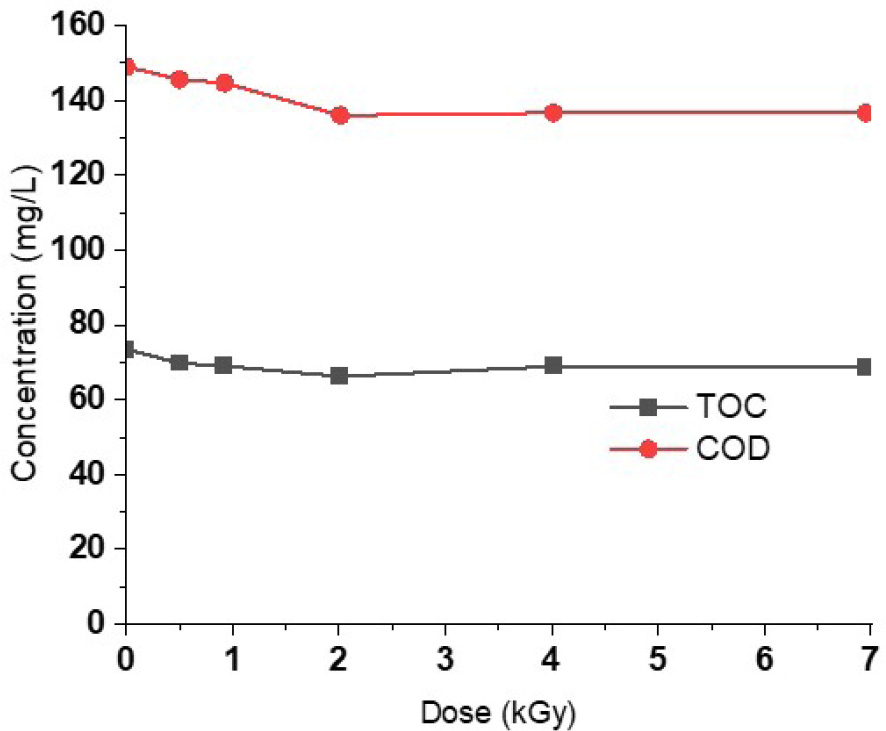
Fig. 8.
Variation in COD and TOC during electron beam degradation of 2.88 × 10⁻⁴ M HCQ aqueous solutions.