
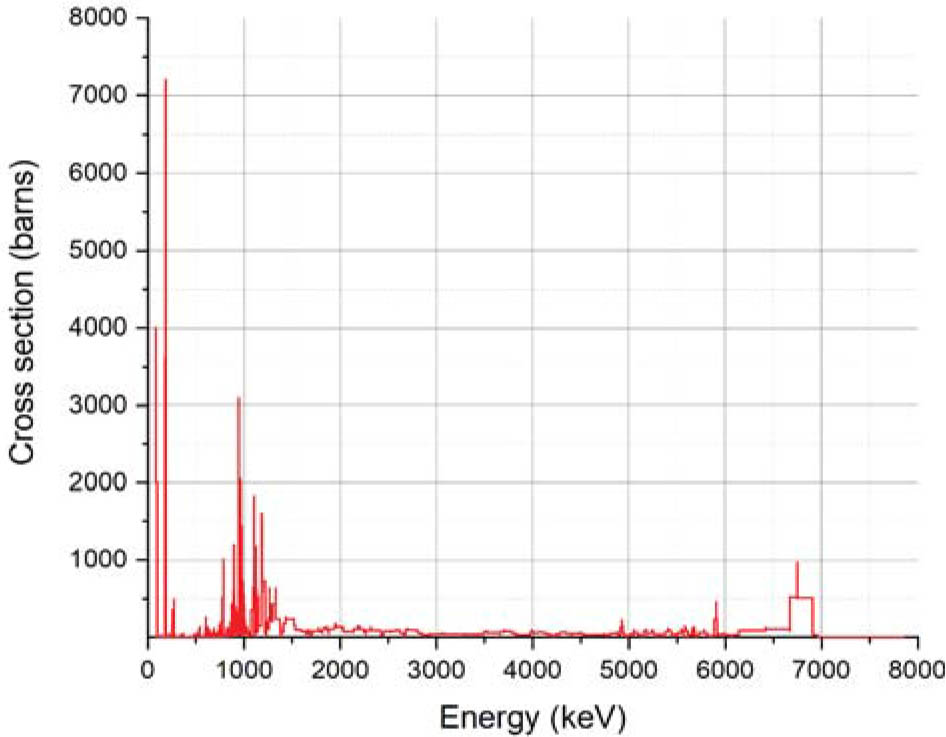
Fig. 1
Prompt gamma-ray spectrum of the reaction 157Gd (n, γ).
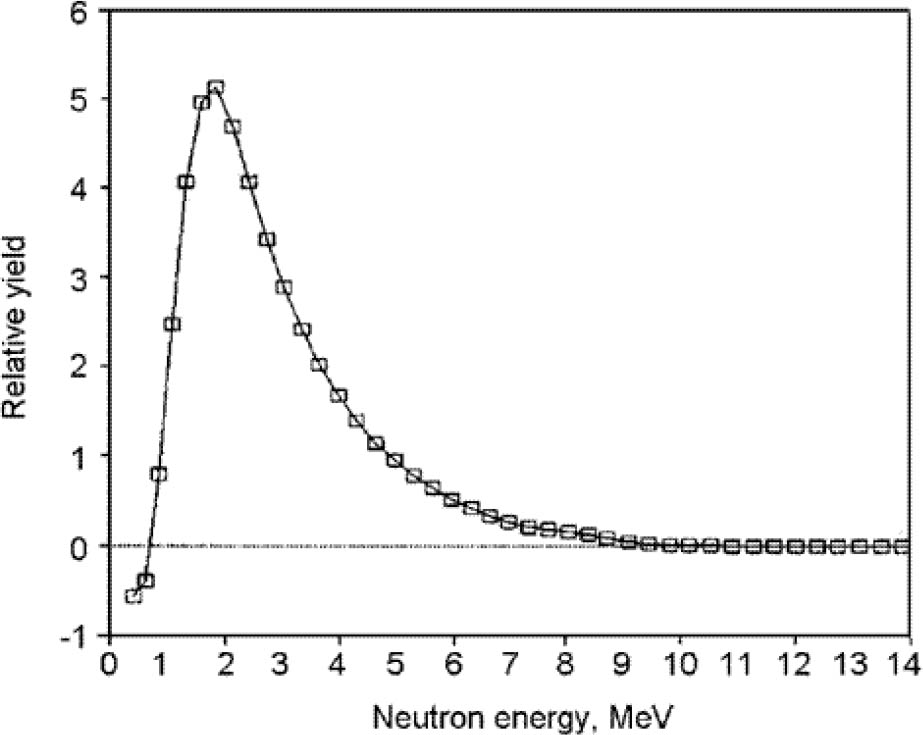
Fig. 2
Neutron spectrum of 252Cf.
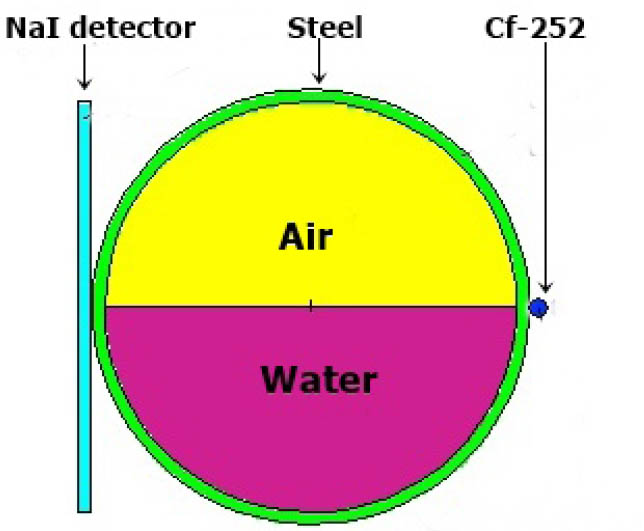
Fig. 3
Simulation setup.
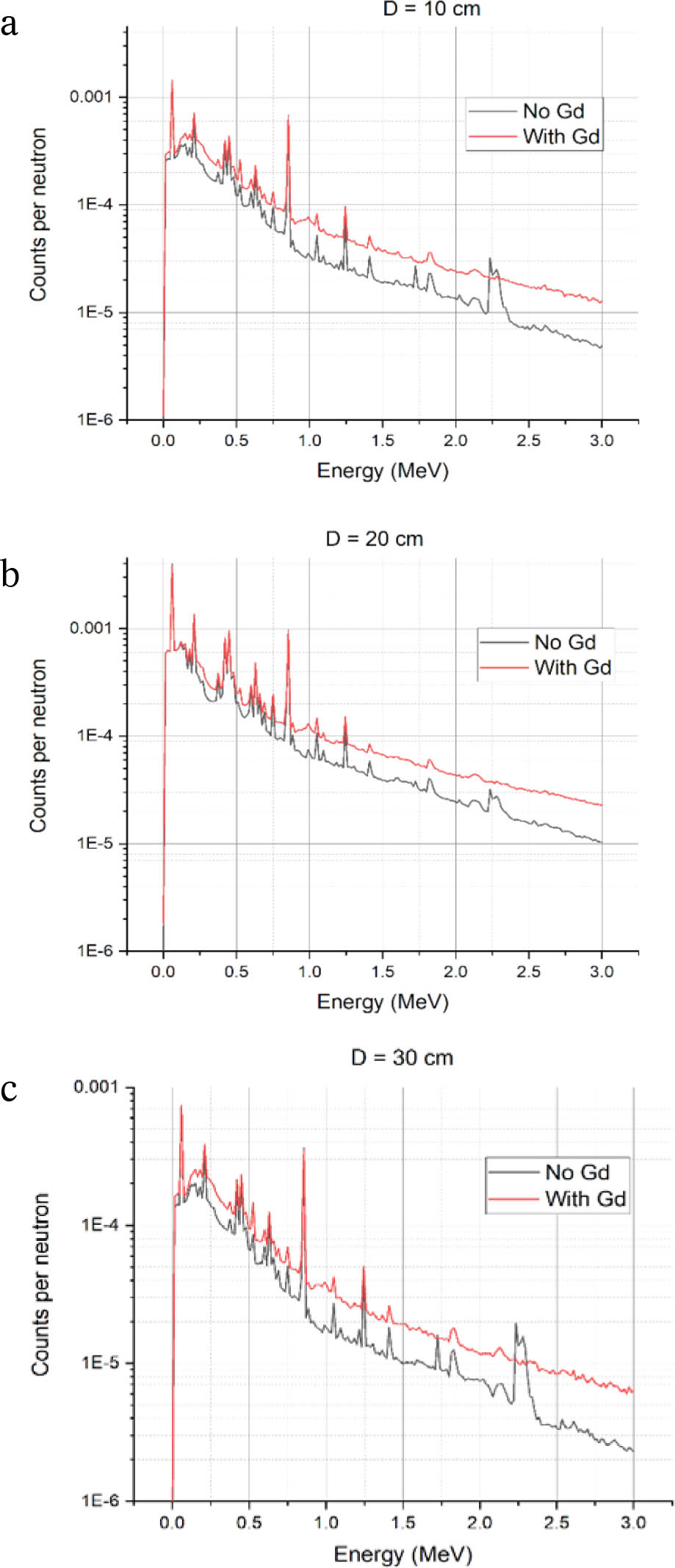
Fig. 4
The gamma-ray spectrum obtained in the simulation: the pipe with a diameter of 10 cm (a), 20 cm (b), and 30 cm (c).
Table 1
Neutrons interactions with air, water, gadolinium, steel, and the detector
| Material | Nuclides | Atom fraction | Total collisions | Collisions weight | Weight lost to capture | Photons produced | Photon weight produced% |
|---|---|---|---|---|---|---|---|
| Air | C | 1.50E–04 | 4 | 1.68E–08 | 0.00E+00 | 0 | 0.00 |
| N | 7.84E–01 | 49 813 | 2.09E–04 | 1.06E–05 | 515 | 2.16E–04 | |
| O | 2.11E–01 | 15 614 | 6.55E–05 | 2.77E–07 | 42 | 1.76E–05 | |
| Ar | 4.67E–03 | 309 | 1.30E–06 | 0.00E+00 | 66 | 2.77E–05 | |
| Water + 5% Gd | H | 6.65E–01 | 193 776 900 | 8.13E–01 | 2.67E–04 | 35 038 | 1.47E–02 |
| O | 3.33E–01 | 37 866 142 | 1.59E–01 | 4.52E–04 | 91 459 | 3.84E–02 | |
| 157Gd | 2.01E–03 | 6 394 471 | 2.68E–02 | 2.37E–02 | 19 207 904 | 8.25E–02 | |
| Steel | C | 2.28E–02 | 484 984 | 2.03E–03 | 1.46E–06 | 2 726 | 1.14E–03 |
| Fe | 9.77E–01 | 29 489 449 | 1.24E–01 | 5.04E–04 | 7 955 587 | 3.34E–02 | |
| NaI | Na | 5.00E–01 | 8 353 033 | 3.50E–02 | 4.11E–05 | 1 276 750 | 5.36E–03 |
| I | 5.00E–01 | 14 164 504 | 5.94E–02 | 1.88E–03 | 8 494 594 | 3.56E–02 |
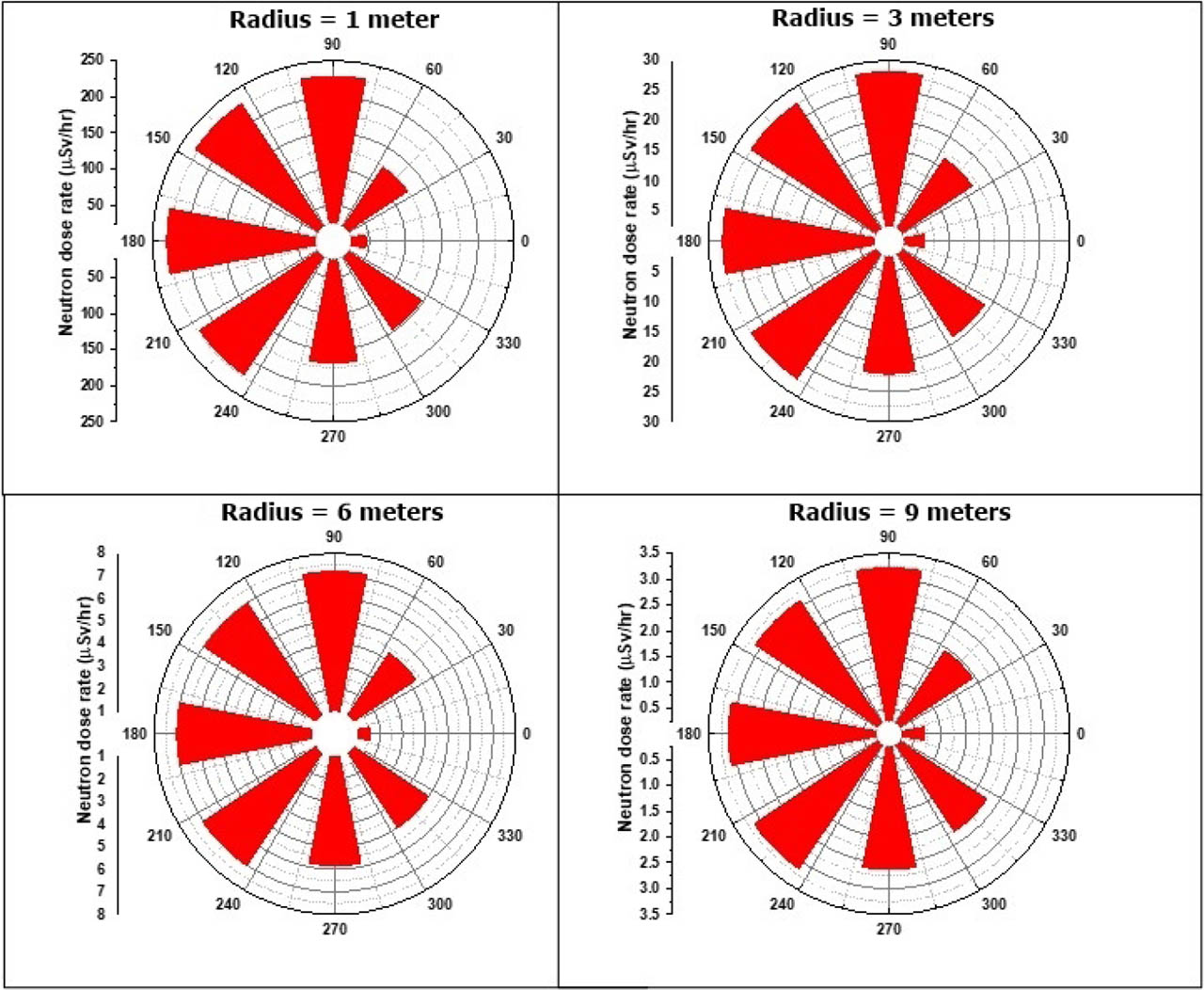
Fig. 5
Neutron dose rates from the neutron source with the minimum activity at different radii.
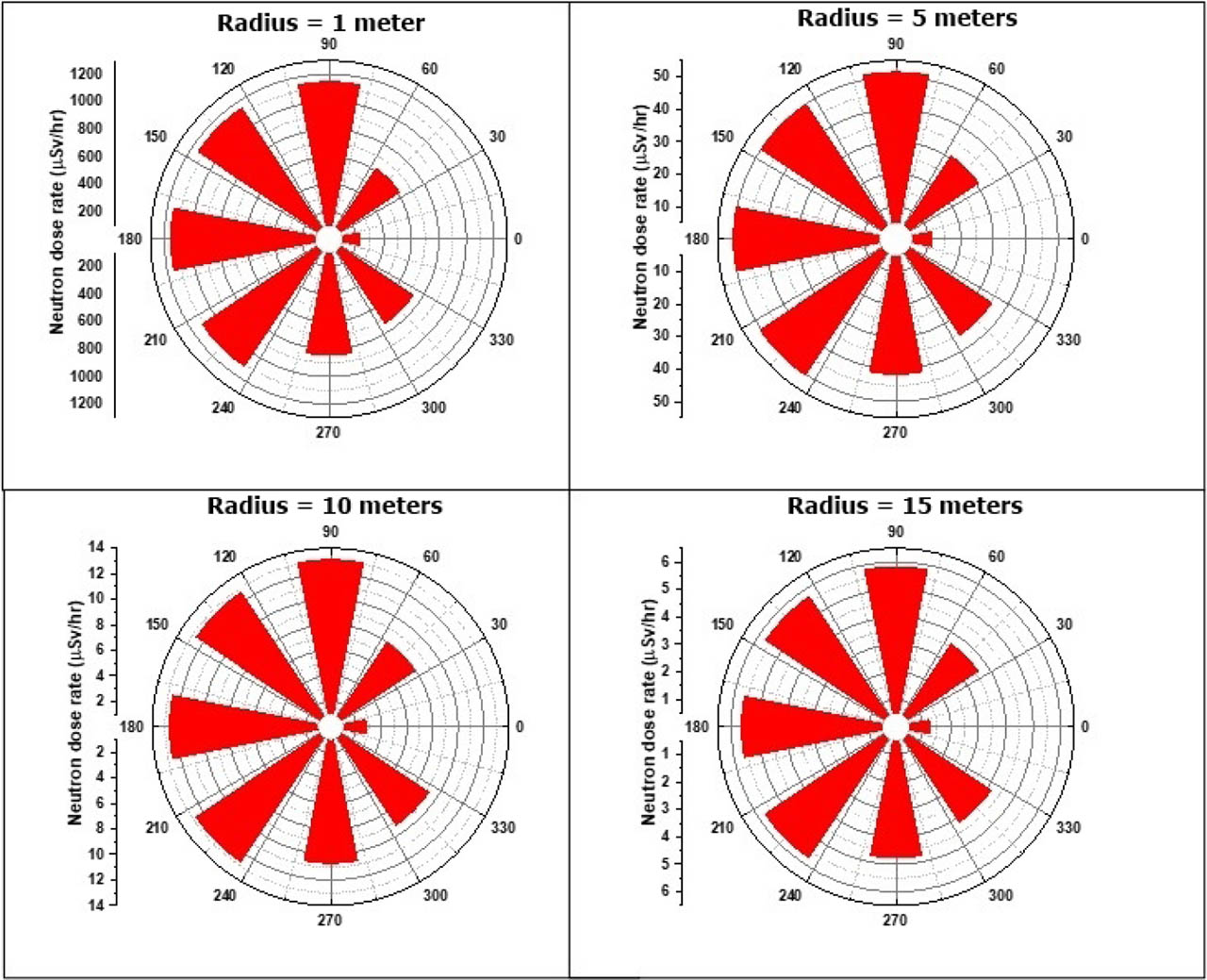
Fig. 6
Neutron dose rates from the neutron source with the maximum activity at different radii.
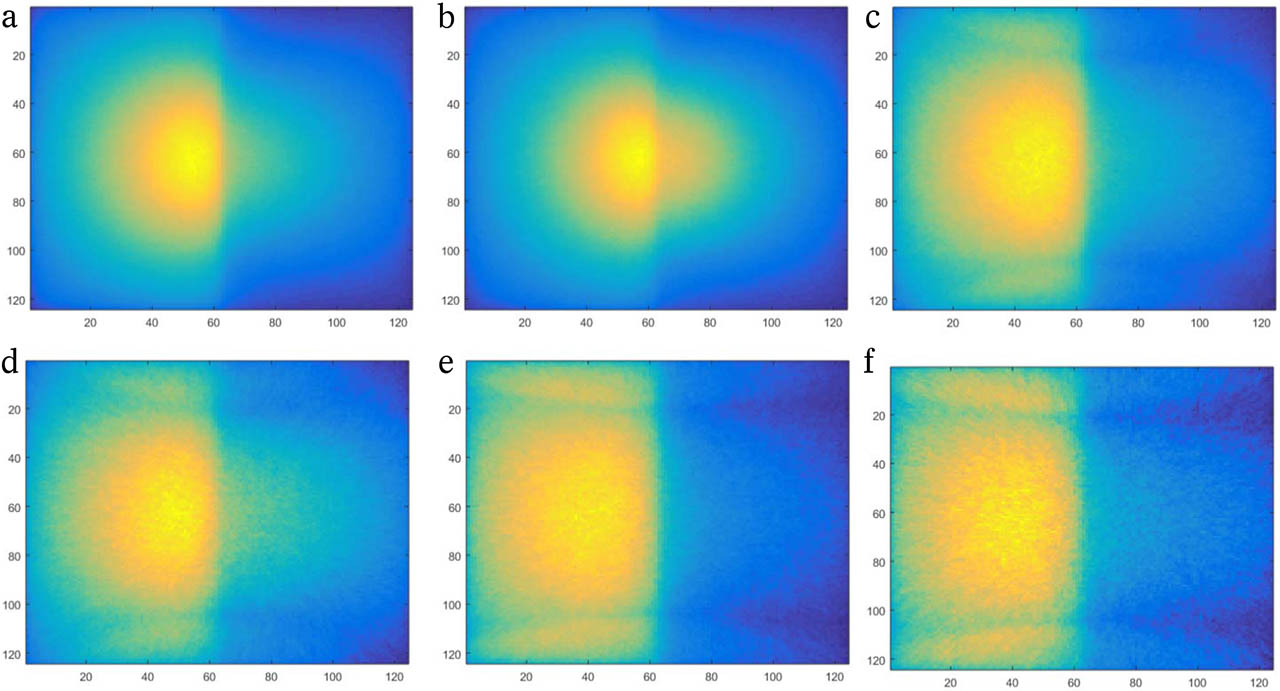
Fig. 7
The pipe with a diameter 10 cm without 57Gd (a) and with 57Gd (b). The pipe with a diameter 20 cm without 57Gd (c) and with 57Gd (d). The pipe with a diameter 30 cm without 57Gd (e) and with 57Gd.
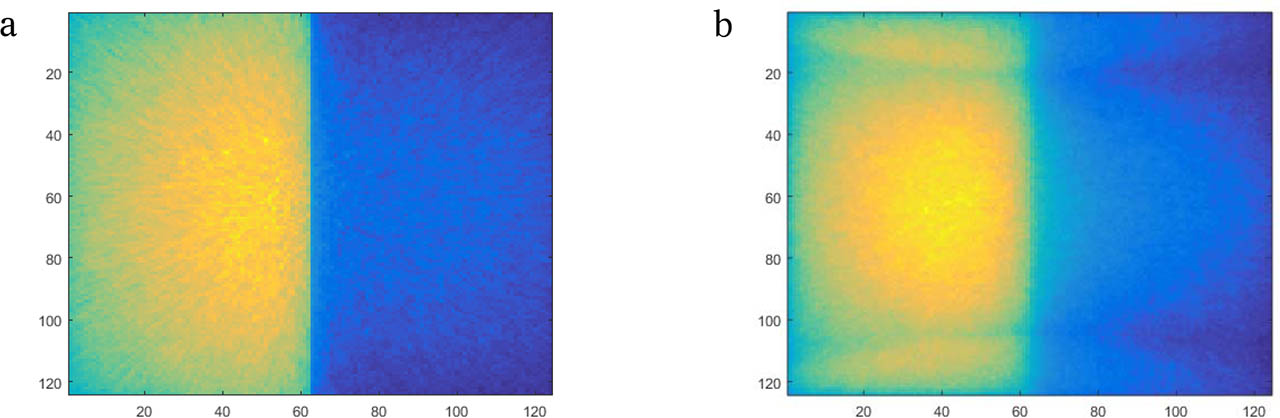
Fig. 8
Imaging of the pipe with diameter 30 cm using 60Co (a) and prompt gamma-ray (b). (Fig. 8b is reproduced from Fig. 7e).
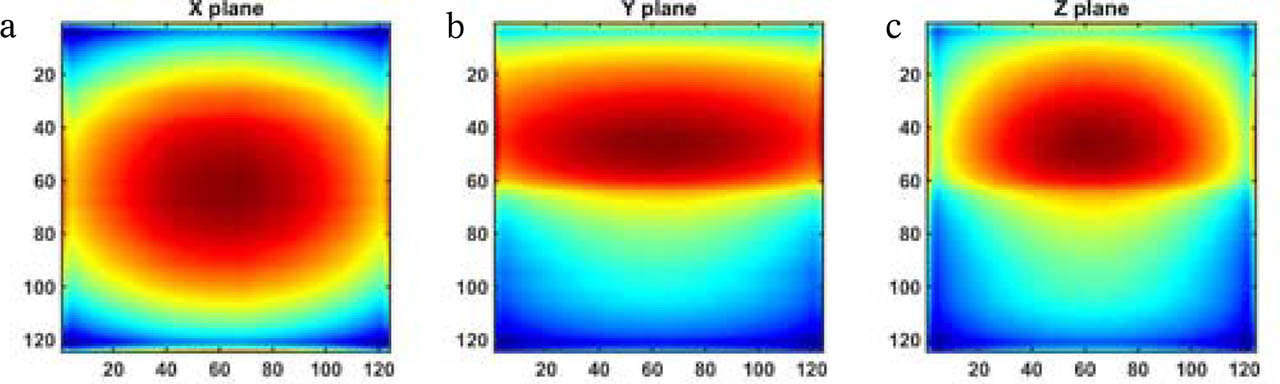
Fig. 9
Reconstructed prompt gamma CT images: (a) X plane, (b) Y plane, (c) Z plane.