1. Introduction
The global phenomenon of decreasing statutory corporate income tax rates (STR) has been documented in numerous sources. Along with a reduction in STR, prior studies have observed a decline in the effective tax rates (ETR) of companies in various countries, particularly in the United States (e.g., Dyreng et al. 2008, Dyreng et al. 2017). ETRs can deviate from statutory tax rates for many reasons, including tax avoidance or tax rules like loss carry-forwards and depreciation allowances. ETRs of firms are important for governments, as collected corporate income tax revenue is directly linked to ETRs that represent actual corporate income tax payments relative to firms’ profits. Corporate income tax revenue, on the other hand, is an important part of governments’ total tax revenue. For example, an average of 9.6% of the total tax revenue in OECD member states during 2019 consisted of corporate tax revenues (OECD 2023). Understanding the decline in ETRs is essential to preserving corporate income as a stable source of tax revenue in the future.
This paper aims to address two key questions regarding the decline in ETRs. First, we study the evolution of ETRs over time and to what extent these changes are explained by changes in taxation and firm characteristics. Second, we examine how trends and their causes differ for multinational and domestic companies. It is often argued that multinational companies have more aggressive tax planning strategies since they have more opportunities to avoid taxes, and therefore their ETRs would deviate from statutory tax rates. However, it is not only large multinational companies that use aggressive tax planning, as firms operating purely domestically can also engage in it (see, e.g., Dyreng et al. 2013, Dyreng et al. 2017). In the United States, domestic firms may find aggressive tax planning easier than European domestic firms due to differences in state taxation rules in the United States. Finally, we study heterogeneity in the time trend across the ETR distribution to provide a more comprehensive picture of the phenomenon of declining ETRs.
Using unique, detailed data from financial statements and confidential corporate income tax returns from Finland for the years 2000–2015, we further explore firm heterogeneity in effective tax rates. With these highly granular data, we are also able to calculate corporate groups’ loss histories, take loss carry-forwards appropriately into account, and directly observe several sources of book-tax differences. However, since we do not observe tax data on foreign parts of multinational enterprises, the trend might represent profit shifting more than other tax avoidance channels. We aim to address this issue by incorporating data on the locations of foreign affiliates and specifically using the presence in tax havens as a proxy for profit shifting. Although this does not fully resolve the concern, it offers the most feasible adjustment given the data at hand. Moreover, the previous literature studying ETRs has mostly used linear regression methods, which in the presence of multimodal data such as ours might be insufficient to pinpoint whether changes in the mean originate from changes elsewhere in the distribution. Therefore, we also apply unconditional quantile regression (Firpo et al. 2009) to study changes in the entire unconditional distribution of ETRs. This method enables us to study time trends at different points of the distribution within the subgroups of domestic and multinational firms.
We document a declining trend in the ETR that is particularly pronounced for Finnish-headquartered multinational corporate groups. We show that accounting for book-tax differences, domestic tax environment, or firm characteristics explains little of this trend for multinational firms. Although Finnish headquartered and foreign-headquartered MNEs possess the same instruments for tax avoidance, the observed trend is much smaller for foreign-headquartered MNEs. As Finland is a fairly small country with a relatively low corporate tax rate, it is possible that engaging in tax avoidance is not worth the costs for foreign-headquartered multinationals. Moreover, using unconditional quantile regression to study changes in various quantiles of the ETR distribution, we find the largest decreasing trend in the lowest quantiles, consistent with an increasing share of firms with zero taxable income. To explore the decreasing trend for multinationals in more detail, we show that Finnish-headquartered multinationals that have a tax haven affiliate more often report zero taxable profit in Finland. For domestic corporate groups, the trend coefficient is not significant after controlling for book-tax differences, and the trend is also more uniform throughout the distribution.
This paper is the first to address ETR changes specifically in Finland, a country in which there are notably few loopholes in the corporate tax base definition. Most of the previous studies focus on the United States, where the tax base is narrower than the broad tax bases in Nordic countries. Thus, we complement the scarce discussion in the earlier literature on how differences in tax regimes affect the conclusions that can be drawn about changes in ETRs. Additionally, we utilize high-quality Finnish register data, which enables us to control for several sources of book-tax differences as well as firm characteristics. Some earlier studies have mentioned Finland in their analyses. Thomsen & Watrin (2018) study the effective tax rates and STR-ETR deviations in several European countries and compare them to the United States. Regarding Finland, they note that the STR-ETR deviations are small but that the ETRs are statistically significantly higher than the STR. However, they study only multinational companies with a limited sample size. Additionally, when focusing only on a small sub-sample of firms, mean ETRs may be driven by a small bunch of observations, whereas medians are effectively unchanged by extreme values. This paper, meanwhile, broadens the scope to include Finnish domestic firms and leverages a comprehensive administrative database to examine the wider distribution of ETRs. Furthermore, during the sample period 2000–2015, particularly in the early 2000s, fewer anti-avoidance measures were in place, leaving more room for tax avoidance practices. 1
Although the decreasing trend for MNEs remains robust to using a balanced sample and sample restrictions on losses, loss carry-forwards explain most of the trend for domestic groups and standalones. Drake et al. (2020) and Christensen et al. (2022) find that consistently low ETRs are often achieved through loss utilization rather than aggressive tax planning in the United States. The increasing share of loss-making firms and the accumulation of carry-forwards have also been noted by OECD (2011) and Schwab et al. (2023). Loss utilization is usually not related to tax avoidance, as unprofitable subsidiaries have little incentive to engage in further tax avoidance when the losses can be used to offset actual profits. Nevertheless, Schwab et al. (2023) observe that many persistently loss-making firms engage in tax avoidance, especially when future profitability is expected. In addition, loss-making subsidiaries can be a target of profit shifting by providing low marginal tax rates for multinational corporate groups, especially in countries with a time limit for utilizing loss carry-forwards. As suggested in other recent papers, the effects of loss utilization on tax avoidance behavior and the incentives of loss-making firms to engage in tax avoidance remain a potential area for further research.
The remainder of the paper is structured as follows. Section 2 describes the institutional setting, and Section 3 reviews the related literature on ETRs. Section 4 describes the methodology and the data. Section 5 presents the results, and Section 6 concludes.
2. Institutional Background
2.1. Accounting and Taxation
The effective tax rate (ETR) is a measure that determines the effective rate of taxation faced by a firm in contrast to the statutory tax rate (STR). In other words, ETRs represent the tax burden borne by a firm. The two most widely used versions of ETRs are the accounting ETR (or GAAP ETR) and the CASH ETR. The former uses tax expenses as the numerator, while the latter uses actual cash taxes paid. Generally, both typically use pre-tax income as the denominator.
The main practical differences between GAAP and CASH ETRs stem from book-tax differences, or more specifically, from the differing objectives of accounting and taxation principles. It might also be in the firm’s interest to amplify these differences: a high accounting income could be a signal of strong financial performance, while attaining a low taxable income reduces the tax burden. This incentive could negatively impact the CASH ETR, which may also exhibit greater volatility compared to the GAAP ETR (Dyreng et al. 2017, Hanlon & Heitzman 2010).
However, in the literature, the CASH ETR is generally preferred over the GAAP ETR, as it reflects both actual taxes paid and the wide spectrum of tax avoidance strategies that reduce taxable income, without the need to specify them (Dyreng et al. 2017). Nevertheless, many papers do not use CASH ETRs, as obtaining data on cash taxes paid is difficult. Unlike financial statements, which are readily available from multiple databases, tax data is usually administrative and more difficult to access. 2 Even in cases where researchers are able to access administrative tax data, it is nearly impossible to get equally accurate tax payment data from each subsidiary of a multinational company operating in several jurisdictions. This issue also affects our study because, despite using detailed administrative data, it only includes firms operating in Finland and their tax payments within Finland. As a result, we cannot observe the group-level CASH ETRs of multinational enterprises.
The most common reason for the difference between the CASH ETR and the statutory corporate tax rate is, as mentioned, the difference between the accounting and tax treatment of some items. The cash taxes paid are based on the firm’s taxable profit, which is adjusted from the accounting profit as follows:
Non-deductible expenses (expenses deducted in accounting but not deductible in taxation) include items such as statutory provisions, fines, and book-tax differences in depreciation and amortization. 3 Tax-exempt revenues consist of items like dividends from other corporations (including subsidiaries). Confirmed losses refer to losses from prior years that are deductible from taxable income. These book-tax differences may cause the CASH ETR to be either lower or higher than the STR. In an ideal setting where we would be able to observe everything, this means that we could just decompose the ETR changes into the effects of different items. However, even our administrative data do not include everything, which means that the time trend is a proxy for the effects of unobserved items, which comprise, among other things, changes in enforcement over time, the foreign operations of multinational enterprises, possible legal interpretation shifts, as well as tax avoidance.
Dyreng et al. (2008) define tax avoidance as the ability of firms to pay a low amount of taxes per dollar of income. In general, there are several ways for firms to avoid taxes, especially for large multinational enterprises. Many strategies depend on subsidiaries in tax havens or other low tax countries. Examples of these are intragroup loans, transfer pricing, intangible asset relocations, royalty payments, and corporate inversions. Domestic corporate groups can also utilize some of these strategies, although to a more limited extent. However, there are large national differences in how international income is treated in taxation which, on the other hand, impacts the opportunities multinationals have to avoid taxes. These differences are especially noteworthy, since most of the earlier literature on ETRs and tax avoidance is focused on the United States. In a different taxation context, the extent to which ETRs mechanically deviate from STRs might be different, and thus affect the interpretation. For example, Thomsen & Watrin (2018) observe that while the STR-ETR gap in the United States is greater than 11%, the corresponding gaps in Europe are less than 2%. In some European countries, ETRs even exceed STRs.
2.2. The Finnish Corporate Income Tax System
Finnish corporations pay the uniform corporate tax rate (20% since 2014) based on their taxable income. Accounting and taxable profits are quite aligned in Finland, so ETRs are generally closer to statutory rates than, for example, in the United States. To properly contextualize our results, in this subsection we identify some of the broad differences in the Finnish corporate tax system compared to other tax systems.
Statutory tax rates affect the incentives of tax avoidance. When the domestic tax rate decreases, there is less to be gained from avoiding taxes through the use of foreign subsidiaries. In fact, Thomsen & Watrin (2018) suggest that this is one of the main reasons why there seems to be less tax avoidance in Europe compared to the United States. Figure 1 shows how the STR in Finland has been decreasing since the beginning of the millennium. It was 25% in 1993, increasing to 29% in 2000–2004 before steadily decreasing to 20% in 2014. This fairly competitive corporate income tax rate is complemented by a broad tax base. To provide some context, Figure 1 also shows the corporate income tax rates in the United States, Sweden, and the mean tax rates in the OECD and EU. In the United States, the federal corporate income tax rate was 35% for decades before the Tax Cuts and Jobs Act of 2017, which reduced the STR to 21%. 4 Despite the seemingly high rate, there were and still are many loopholes, deductions, and credits that allow firms to decrease taxable income and paid taxes in the United States. In recent years there has been some effort to close these loopholes. 5 The pattern of the Swedish corporate income tax rate is quite similar to Finland, as seen in Figure 1. The figure also shows how the OECD and EU means have likewise been decreasing for almost 40 years. Figure 1 clearly demonstrates the competitiveness of the Finnish tax rate, as can be seen from the figure that the Finnish tax rate is below the means of the OECD and EU from 2014 onward.
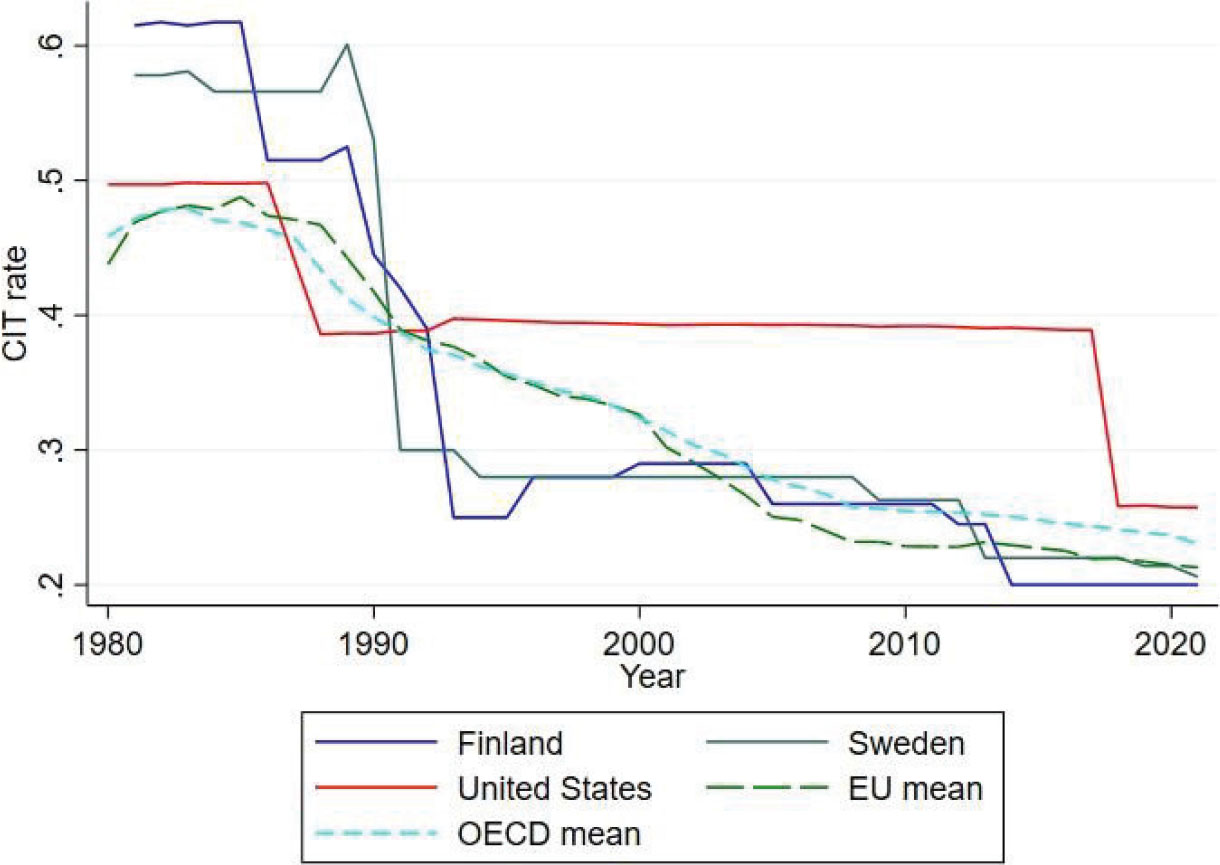
Figure 1:
The evolution of statutory corporate income tax rates during 1980–2020.
Notes: EU and OECD means are unweighted averages. Data source: Tax Foundation.
In Finland, firms can deduct most of their business-related costs in taxation, and the list of bonus depreciation rules and nondeductible expenses is rather short. The only source of other depreciation allowances is the 50% bonus depreciation for research and development expenses. 6 A notable difference to many other tax systems is that in Finland tax loss carry-forwards only last for 10 years and do not carryback, whereas many other European countries and the United States allow carrying losses forward indefinitely until the amount of losses is exhausted, and also allow loss carry-backs, which can yield tax refunds from later losses. For capital losses from asset sales, the carry-forward is only 5 years (PwC 2023a, PwC 2023b). This means that book and taxable income are rather aligned by default, meaning that ETRs should be mostly close to STRs. For comparison, in the United States the list of bonus and accelerated depreciation allowances and sources of tax credit is a lot longer, including, for example, employee benefit plans, foreign-derived intangible income, state and municipal income taxes, and royalty payments. In addition to deductions which reduce taxable income, tax credits that directly decrease the final tax bill are available from dozens of incentivized economic objectives, such as certain investments targeting, for example, reducing inequality or supporting renewable energy (PwC 2023b). Between European countries, there are differences in, for example, inventory costing methods (first-in first-out vs. last-in first-out) and depreciation methods, e.g., declining balance vs. straight line methods. 7
In addition to general differences between corporate tax systems, corporate groups also have some special taxation features. Finland has tax treaties with many countries (Verohallinto 2022) which means that, e.g., royalty payments and service fees to many countries are taxed at a very low rate or are even tax-free. Dividends from subsidiaries to group parents are also tax-free, as long as the subsidiary is located within the EU/EEA. In addition to the possibility of tax-free subsidiary dividends (and common intra-group loans), Finnish legislation allows for group contributions, which can be used to balance earnings within the group: one group company making profits and another making losses can even out each other using a group contribution, as the contribution is treated as an expense for the payer and an income for the receiver. As a domestic specialty, group contributions can only be used between Finnish subsidiaries. In addition, group contributions can only transfer current profits, while subsidiary dividends can be used to also transfer income from earlier years. Finally, with regard to transfer pricing, tax law requires that transfer prices be set at arm’s length. In terms of enforcement, Finland introduced a transfer pricing documentation requirement in 2007 (Verohallinto 2007). Small and medium-sized firms are exempt from this reporting obligation, and the documentation must be submitted only upon request by the tax authorities.
3. Related Literature
Dyreng et al. (2017) is one of the most important and cited recent contributions studying the changes in effective tax rates over time. They use Compustat data on US multinational (MNE) and domestic corporations from 1988 to 2016, the longest possible period available in the United States with no changes in the STR, and study the determinants of CASH ETR (cash taxes paid / pre-tax income) changes. First, Dyreng et al. (2017) study whether the mean CASH ETR has been decreasing over time by regressing the CASH ETR on the linear time trend and find a statistically significant trend of −0.41 ppt per year. Second, they do not find statistically significantly different trend coefficients for MNEs and domestic companies. Third, they study whether the domestic and foreign ETRs of MNEs have been decreasing separately, and find that indeed both have. As potential explanations for the observed decline in ETRs, Dyreng et al. (2017) suggest decreases in foreign STRs, changes in firm characteristics, or changes in the United States tax system and accounting rules during the sample period. However, the time trend remains negative and statistically significant even when these explanations are controlled for one at a time.
Edwards et al. (2021) argue that the negative trend observed by Dyreng et al. (2017) could be explained by the growth of pre-tax income (PI). This means that instead of decreasing taxes (numerator of CASH ETR), the observed decline of CASH ETR could be due to the increasing denominator. They suggest that instead of a proportional model, taxes paid (TXPD) should be modeled with a linear model of the form TXPD = α + β PI, which when solved for β yields CASH ETR as a convex function of 1/PI. In other words, they suggest that the term 1/PI should be included in the CASH ETR specifications. Using this specification, they replicate the results by Dyreng et al. (2017), assuming explicitly that α and β in the aforementioned tax function remain constant, i.e., there are no intertemporal changes in tax avoidance. The time trend then becomes economically and statistically insignificant. Regarding the other main result of Dyreng et al. (2017), Edwards et al. (2021) also study MNEs and domestic companies separately and observe a significantly larger increase in the profits of domestic companies.
Chen et al. (2020) further expand the analysis of Dyreng et al. (2017) by replicating the results using GAAP ETR (income tax expenses / pre-tax income) instead of CASH ETR. The results remain essentially the same when using GAAP ETR, although the difference between MNEs and domestics is now statistically significant, with the ETRs of MNEs increasing more rapidly. They also do the same analysis with Japanese data for the same period 1988–2016. In Japan, the STR was very high, 48% in 1999, but it has decreased since then. In 2016, the Japanese STR was 30.86%. The Japanese tax system in general is reminiscent of the US tax system in many ways. They find that when controlling for STR, the time trend for multinationals is no longer statistically significant, but there is a statistically significant decreasing trend for small and mediumsized domestic enterprises. In accordance with Dyreng et al. (2017), Chen et al. (2020) also observe that changes in firm characteristics do not explain changes in ETRs.
Thomsen & Watrin (2018) study the GAAP ETRs in the United States and in 12 European countries, including Finland, during the period 2005–2016. Using data from Compustat, they observe a decrease in the STR-ETR difference over time, which might imply a decrease in tax avoidance. In Europe, STRs have been steadily decreasing, and this appears to explain the ETR decreases to a large extent. In the United States, the STR was unchanged during the sample period, but ETRs on average decreased. This continental difference is rather striking, since especially large European companies would be expected to have the same tax avoidance opportunities as their US counterparts. Looking for the reasons behind this phenomenon, Thomsen & Watrin (2018) compare the sub-samples divided at the medians of different characteristics of the firm. They find the largest differences with profitability: firms in the upper half of the profitability distribution report on average significantly lower ETRs than those in the lower half. They also employ CASH ETR instead of GAAP ETR, 8 which makes the time trend statistically insignificant, but the downward trend in the STR-ETR difference remains statistically significant. Finally, they conclude that possible explanations for the observed decrease in tax avoidance in Europe might be the increased tax enforcement or the decreased marginal benefit of tax avoidance since STRs in Europe have been decreasing at the same time and are in general lower in Europe than in the United States.
Drake et al. (2020) further seek to explain the decreasing time trend observed by Dyreng et al. (2017). They find valuation allowances and loss histories to play an important role in determining ETR, 9 and thus, ETR decreases might not necessarily indicate tax avoidance. Christensen et al. (2022) end up with the same conclusion while studying how the firms with the lowest ETRs (<10%) achieve it. They find that multinational companies and those with a tax haven subsidiary have a smaller probability for achieving a low ETR, even though they, in principle, should have better opportunities for tax avoidance (or aggressive tax planning). In turn, Christensen et al. (2022) find that tax loss carry-forwards better explain having and retaining a low ETR than aggressive tax planning does. A major explanation they propose is the cost: reducing taxes paid via operating losses does not cost anything, whereas aggressive tax planning always has a cost, and the lower the ETR already is, the higher the cost is relative to the marginal benefit. This implies that the (marginal) willingness for aggressive tax planning would decrease with the effective tax rate.
4. Methods and Data
4.1. Methods
We estimate the time trend in tax avoidance by studying the changes in ETRs that cannot be attributed to book-tax differences or variation in firm characteristics. For instance, the firm’s decision to invest in intangible assets is a business decision, but the determination of location and of intra-group royalty payments are related to tax avoidance.
We use CASH ETR with pre-tax income in the denominator as the dependent variable. Formally, we employ the following model:
where the CASH ETRit of firm i in year t is explained first of all with Trendt, which is defined as year t minus 2000, the first year of our data set. Trend represents the linear time trend in CASH ETR. Moreover, we add a vector of firm level controls, , capturing firm characteristics and sources of book-tax differences. These controls include, for example, (the logarithm of) total assets, R&D expenses, statutory provisions, and book-tax differences in amortization. We also include a vector of variables controlling for changes in the tax environment, including the STR and, in robustness specifications, R&D bonus deductions and accelerated depreciation. Finally, we also control for firm and industry specific factors by including firm and industry fixed effects, 10 αi and γs. The assumption of this methodology is that once we control for changes in STRs and other obligations, as well as firms’ business decisions and sources of book-tax differences, the remaining trend is attributed to tax avoidance. 11 While we do not interpret this as causal evidence of tax avoidance, our highly detailed data allow us to control for many book-tax differences, thereby reducing the number of unobserved factors. Changes in regulation or enforcement could also affect ETRs systematically, but such measures mostly take place only after our sample period.Our main specification consists of OLS and unconditional quantile regressions (UQR). UQR was introduced by Firpo et al. (2009), who regress recentered influence functions (RIFs) on the explanatory variables to achieve a robust and easily interpretable model. UQR differs from conditional quantile regression (CQR) in that it is used to study how changes in the distribution (i.e., the mean) of explanatory variables affects the unconditional distribution of the dependent variable. The time trend then provides a straightforward interpretation: it indicates how the τ th quantile of the unconditional ETR distribution changes with a one-year increase in time, keeping everything else fixed. We use this method to quantify the evolution of the CASH ETR distribution over time. We find that it complements the current methods used in the tax avoidance literature by providing an easily implementable framework for studying heterogeneity beyond subsampling.
To outline the UQR estimation, the influence function (IF) is first defined as the change in the distributional statistic v (Fy) when the value of a single observation yi changes. The RIF, as defined by Firpo et al. (2009), can then be written as
with the convenient property that the expectation of the RIF equals the distributional statistic of interest, i.e., such that the change in the distributional statistic equals the average of the contributions of individual observations (Rios-Avila & Maroto 2024).In practice, UQR is estimated by first constructing the RIF based on the unconditional distribution of CASH ETR, and then regressing the RIF on the explanatory variables with ordinary least squares (OLS), which enables using the within transformation to estimate high-dimensional, i.e., firm-level, fixed effects (Rios-Avila & Maroto 2024). Since the RIF is based on the unconditional distribution, fixed effects do not cause the quantiles to be redefined (as they would with CQR). Instead, fixed effects control for time-invariant unobserved heterogeneity affecting the RIFs, the average of which is the effect on the full unconditional distribution. The estimation equation is therefore as in Equation 1, with the difference that the dependent variable is now RIF (yi, v, FCASH ETR) instead of CASH ETRit.
4.2. Data and Sample Selection
Our primary data source is the YRTTI database, which comprises confidential corporate income tax returns from all firms in Finland. We supplement these data with two additional datasets from Statistics Finland, including information on group structures and financial statements. We are also able to link these data to the Outward Statistics on Foreign Affiliates (OFATS) data, also from Statistics Finland, which are a panel of foreign affiliates owned by Finnish multinationals from 2007 onward. In addition to covering a much shorter period of time, the OFATS data only include information on the location, employment, turnover, and investments of the foreign affiliate, and not complete financial statements or tax returns. The OFATS data do not overcome the lack of tax data, but allow us to draw some insights into the foreign activities of MNEs. Thus, our main sample does not include foreign affiliates, but we also present additional results that control for foreign activity with a shorter sample period.
We can categorize the firms in our data into four types according to the Eurostat enterprise group type. The first type is Finnish-headquartered MNEs, which are groups with parents headquartered in Finland. The second type is foreign-headquartered MNEs, which are foreign-controlled multinational groups, i.e., groups with a parent headquartered outside Finland. The remaining domestic-resident firms are further classified into domestic corporate groups or domestic standalones. Domestic groups are groups that only have subsidiaries in Finland. All observations are originally at the un-consolidated level. We aggregate all variables at the group level according to the group structure. Since we do not have information on intra-group transactions, we cannot consolidate the group-level financial statements. The data only include firms registered in Finland, so the observed group structures are incomplete for MNEs and only include financial information in Finland. However, group companies are not consolidated for tax purposes in Finland. Groups may use group contributions, which we observe, to even out taxable profits and losses within the corporate group in Finland. Subsidiary dividends to a Finnish parent may inflate the accounting profit in Finland, but they are taken into account among our book-tax difference controls. 12
The main sample period for the YRTTI data is 2000–2015. Following previous literature, we drop the years in which the group profits are zero or negative. 13 We also drop firms that are in industries defined as having weak-quality data according to Statistics Finland. 14 We further exclude small companies that have an average turnover of less than €1 million. The final sample consists of 1,279 distinct domestically headquartered MNEs, 2,113 foreign-headquartered MNEs, 2,554 domestic corporate groups, and 23,765 domestic standalones. We observe multinational groups on average 9.7 times, and domestic firms/groups on average 10.3 times. Furthermore, of the Finnish-headquartered multinational groups for which we observe at least one foreign affiliate in 2007–2015, there are 3,096 firm-year observations, and on average the number of foreign affiliates is 9.3. On the other hand, there are 440 firm-year observations that have at least one tax haven affiliate, and the average number of tax haven affiliates is 2.8. 15
The numerator of the ETR measure in YRTTI consists of the (group-level) cash taxes paid in Finland. 16 For MNEs, the CASH ETR is calculated based only on its domestic parts, as we do not observe the foreign parts of MNEs. As these variables are from tax returns, the calculated CASH ETRs are very reliable. The denominator of our CASH ETR measure is pretax income (PI), following the earlier literature (e.g., Dyreng et al. 2017, Edwards et al. 2021). We control for firm characteristics by including control variables for (the natural logarithm of) total assets, return on assets (ROA), debt-to-equity ratio, paid dividends, and fixed assets. The inverse of pre-tax income (denoted as pre-tax income growth) is also added, as suggested by Edwards et al. (2021). In addition, we control for sources of book-tax differences, including intra-group gross interest payments (scaled by total assets), statutory provisions (scaled by sales), changes in the book-tax difference of depreciation and amortization (both scaled by sales), R&D expenses (scaled by sales), received dividends 17 (scaled by total assets), contributions and subsidies (scaled by total assets)-which cover, for example, government subsidies—and special items, which cover, e.g., group contributions. 18 To account for losses, we use the change and the cumulative sum of net operating losses (NOL). The change is defined as the negative of pre-tax income, and the rolling sum of ΔNOL is then calculated, replacing negative values with zeros (since the firm cannot have negative deductions).
Regarding industry, we calculate for each corporate group-year observation a computational main industry variable determined as follows. For each (2-digit) NACE code owned by the same corporate group identifier, we sum up the earnings and use the industry code with the highest total earnings as the computational main industry of the corporate group. Since the computational main industry may change between years, we include industry fixed effects in addition to firm fixed effects. 19 For standalone firms, we use the reported industry code. Table 1 presents the summary statistics of the variables used in the regression analyses. All variables are winsorized at the 1% level yearly, except for the ETR variables that are truncated at 0 and 1. Table 1 presents the statistics for the entire sample, whereas Appendix Table A1 only includes corporate groups. On average, the firms in Table 1 have a CASH ETR of 23%. For comparison, the average STR of the entire sample is 25.9% (not reported in the table). Of the observations, roughly 11% are from multinational enterprises. 20
Table 1:
Summary statistics for the baseline YRTTI analysis sample.
| Panel A: Entire sample | N | Mean | St. dev. | p1 | p25 | p50 | p75 | p99 |
|---|---|---|---|---|---|---|---|---|
| Firm characteristics | ||||||||
| CASH ETR | 194,138 | 0.23 | 0.14 | 0 | 0.16 | 0.25 | 0.29 | 0.74 |
| Pre-tax income | 194,138 | 2,067,682 | 41,726,102 | 2,662 | 64,586 | 168,194 | 433,479 | 23,040,336 |
| MNE | 194,138 | 0.11 | 0.31 | 0 | 0 | 0 | 0 | 1 |
| Log total assets | 194,138 | 14.3 | 1.50 | 11.4 | 13.3 | 14.0 | 15.0 | 19.2 |
| Fixed assets | 194,138 | 0.31 | 0.26 | 0 | 0.082 | 0.25 | 0.50 | 0.93 |
| Return on assets (ROA) | 194,138 | 0.17 | 0.15 | 0.0027 | 0.061 | 0.13 | 0.23 | 0.71 |
| Debt-to-Equity | 194,138 | 96.4 | 307.6 | −256.8 | 0 | 10.2 | 69.8 | 1987.9 |
| Paid dividends1 | 194,138 | 0.045 | 0.069 | 0 | 0 | 0.025 | 0.062 | 0.38 |
| Book-tax differences | ||||||||
| Special items2 | 194,138 | −0.0011 | 0.011 | −0.070 | 0 | 0 | 0 | 0.020 |
| R&D expenses2 | 194,138 | 0.0010 | 0.0041 | 0 | 0 | 0.000025 | 0.00043 | 0.017 |
| Intra-group interest payments1 | 194,138 | 0.00073 | 0.0033 | 0 | 0 | 0 | 0 | 0.020 |
| Statutory provisions2 | 194,138 | 0.00050 | 0.0028 | 0 | 0 | 0 | 0 | 0.020 |
| Δ Book-tax amortization difference2 | 194,138 | 0.00030 | 0.0038 | −0.0086 | 0 | 0 | 0 | 0.021 |
| Δ Book-tax depreciation difference2 | 194,138 | 0.000090 | 0.00079 | 0 | 0 | 0 | 0 | 0.0041 |
| Received dividends1 | 194,138 | 0.028 | 0.058 | 0 | 0 | 0 | 0.038 | 0.34 |
| Contributions and subsidies1 | 194,138 | 0.00081 | 0.0030 | 0 | 0 | 0 | 0 | 0.017 |
| NOL1 | 194,138 | 0.027 | 0.14 | 0 | 0 | 0 | 0 | 0.78 |
| ΔNOL1 | 194,138 | −0.012 | 0.040 | −0.23 | 0 | 0 | 0 | 0 |
Notes: This table presents the summary statistics for all observations in 2000–2015. Panel A presents the statistics for the entire sample. See Table A1 in Appendix for Panel B (restricted to corporate groups). CASH ETR is cash taxes paid divided by earnings before taxes. MNE is an indicator variable equal to 1 if the firm is a multinational enterprise and 0 otherwise. NOL = Total net operating losses. ΔNOL = net operating losses utilized to reduce taxable income.
Figure 2 displays the mean and quantile trends for CASH ETR for the period 2000–2015 using the main data source YRTTI separately for multinational and domestic firms. We immediately see why focusing purely on mean ETRs might not tell everything, especially for MNEs, since the lower quantiles in particular show an emphasized decreasing trend over time. For domestic firms, the quantile trends are more synchronous. Figure 3 shows that the share of firms with ETRs above and below the STR has remained relatively stable over time, while the share of firms with ETRs equal to zero is increasing over time for both multinational and domestic firms.
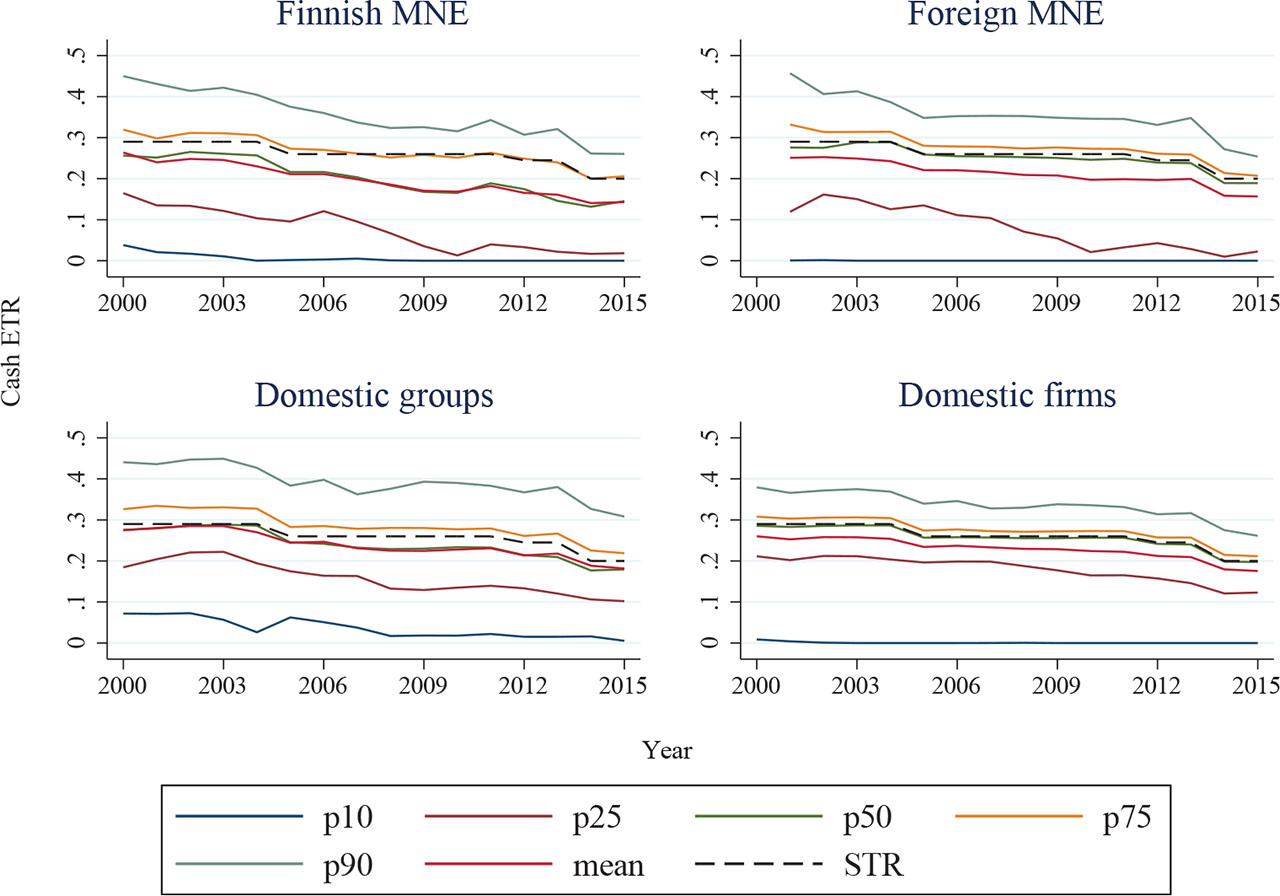
Figure 2:
Evolution of CASH ETR quantiles 0.1, 0.25, 0.5, 0.75, and 0.9 separately for MNEs and domestics.
Notes: The figure plots ETR quantiles 0.1, 0.25, 0.5, 0.75, and 0.9 against the sample years 2000–2015 using the main data source, YRTTI tax return data. The dashed line represents the Finnish statutory corporate income tax rate. Finnish MNEs include Finnish-headquartered multinationals. Foreign MNEs include subsidiaries of foreign-headquartered multinationals that are located in Finland. Domestic groups include purely domestic corporate groups and domestic firms include domestic standalone firms.
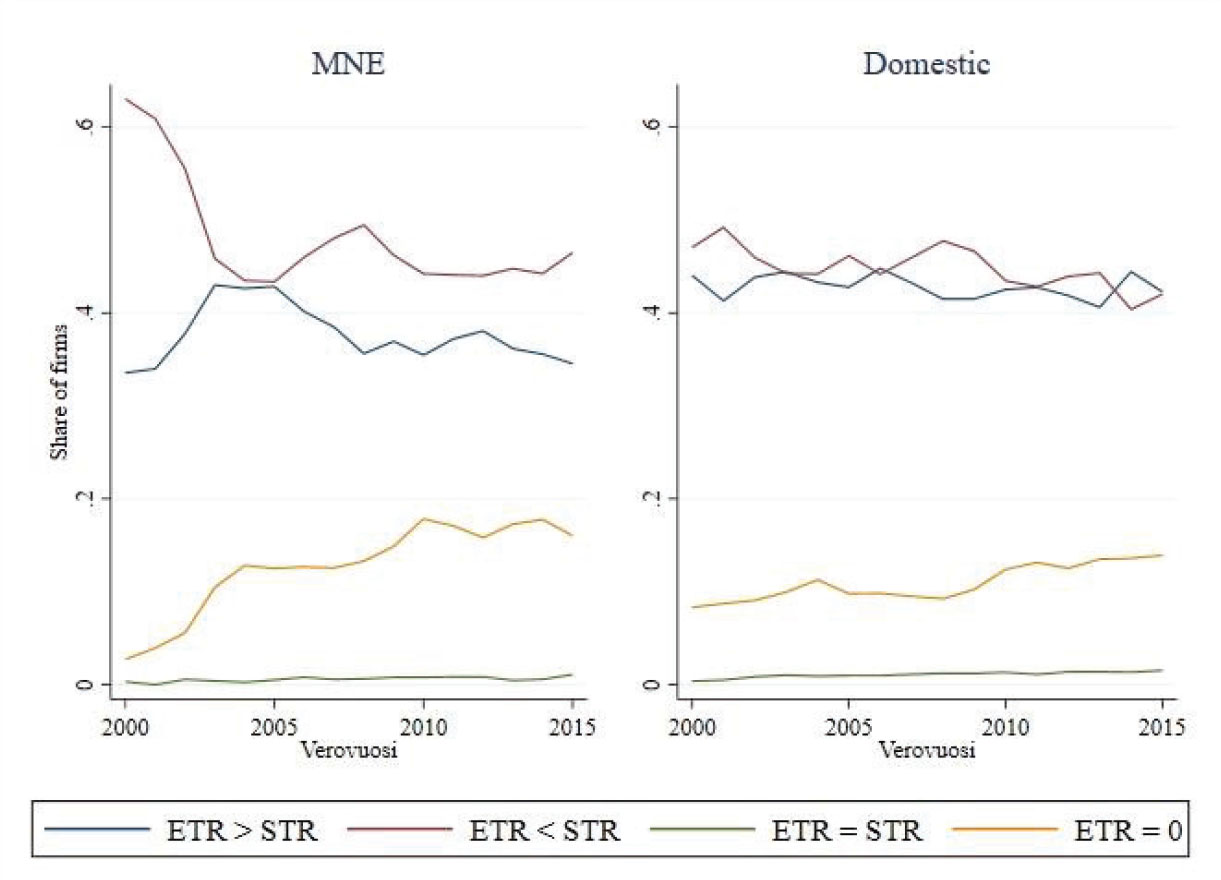
Figure 3:
Yearly share of firms with CASH ETR above and below the statutory tax rate for MNEs and domestics.
Notes: YRTTI data, full sample. Left panel figure (MNE) includes Finnish-headquartered multinationals and Finnish subsidiaries of foreign-headquartered multinationals. Right panel figure (Domestic) includes domestic corporate groups and domestic standalone firms. ETR=STR includes firms with an ETR within ±0.01% of the STR.
Figure 4 shows the density of differences between the CASH ETR and the STR in the first and last years of our sample. We see that both years exhibit large spikes around zero and minus STR. We also see that the share of zero ETR observations clearly increases from 2000 to 2015, suggesting that changes in the annual mean CASH ETR stem largely from the relative share of zero ETR firms. However, there are still observations in the area between these spikes, but with simultaneous changes in the STR, it is difficult to assess their changes visually.
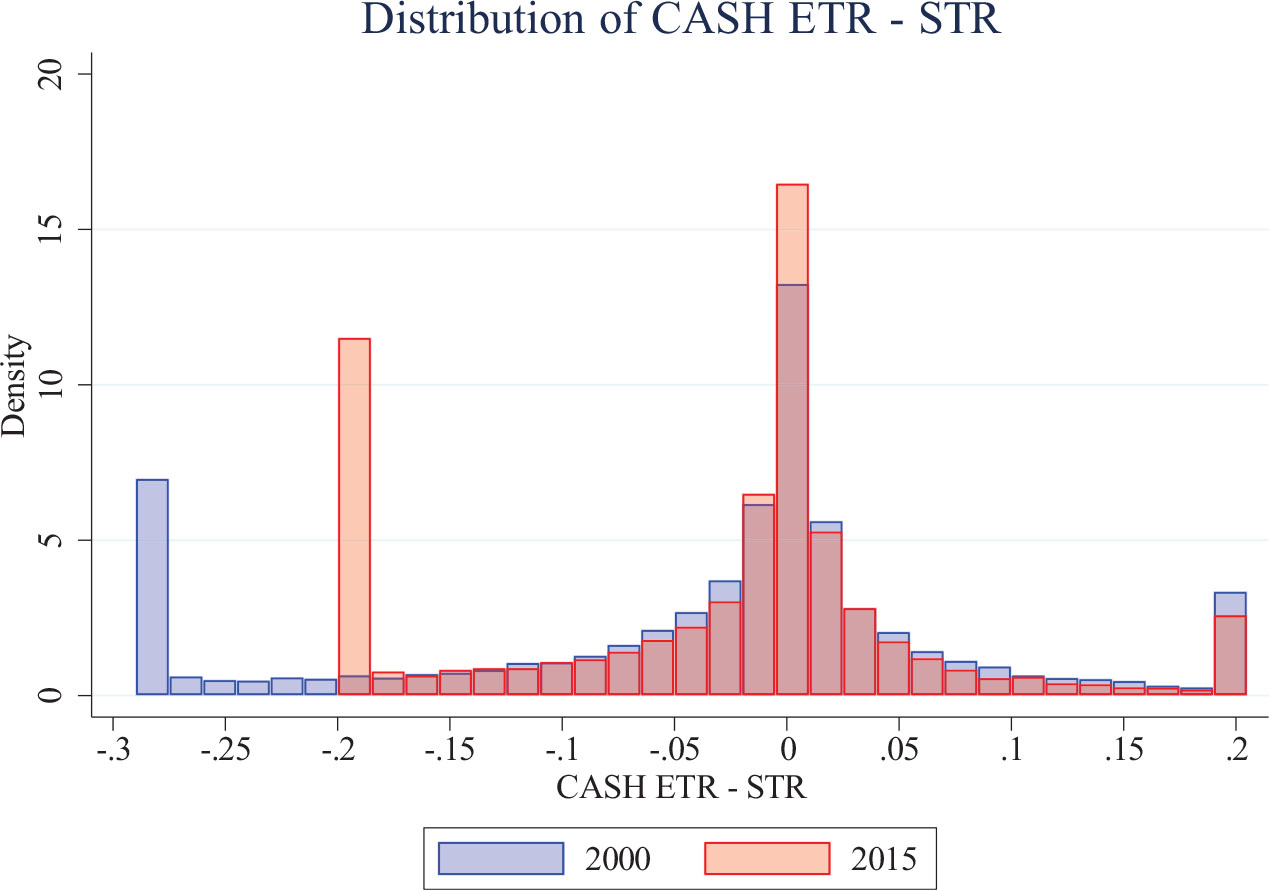
Figure 4:
Distributions of the difference between CASH ETR and statutory tax rate (STR) in 2000 and 2015.
Notes: YRTTI data, full sample for years 2000 and 2015. The distribution is winsorized from right at 0.2 to increase readability, that is, all values above 0.2 are set to 0.2. The distribution of values above 0.2 is flat with a very low density.
5. Results
5.1. Main Results
In this section, we present our main results. Table 2 shows the results of estimating Equation (1) with OLS. Column 1 includes the full sample, while columns 2 to 5 are restricted to sub-samples. The results of column 1 reveal a significant negative trend for all firms (−0.11 ppt per annum), but the negative trend mostly originates from MNEs, particularly Finnish-headquartered multinationals in column 2 (−0.78 ppt p.a.) compared to MNEs headquartered abroad in column 3 (−0.16 ppt p.a.). The trend in column 4 is relatively large but not statistically significant for domestic corporate groups (−0.19 ppt p.a.) and statistically but not economically significant for domestic firms in column 5 (−0.006 ppt p.a.). Changes in the Finnish STR affect domestic firms more than multinationals, which is intuitive. Profitability, fixed assets, leverage, and loss histories are associated with a lower ETR. The coefficient of the current period utilized loss carry-forwards (ΔNOL) is, as expected, larger than that of the total outstanding losses (NOL). Special items, which is a net variable, has a positive coefficient, as expected. The items creating persistent or temporary book-tax differences are also statistically significant, as expected. 21
The results indicate a clear difference between Finnish- and foreign-headquartered MNEs. Both are negative, but the magnitude of the trend is much smaller and statistically weaker for foreign-headquartered MNEs. One potential explanation is that the operations of most foreign-headquartered MNEs in Finland are relatively small, and combined with the relatively low STR, the foreign-headquartered MNEs may not find the tax savings related to tax planning in Finland large enough to be worth engaging in.
As demonstrated by the graphical evidence presented earlier, there are quite a lot of firms with zero-CASH ETRs, often achieved by deducting earlier losses. Table 3 tests how some additional sample restrictions affect the main results. In column 1, we first restrict the sample to the balanced sample of firms. Then, in column 2, we require that in addition to being balanced, the firm never reports negative accounting profit, i.e., is never dropped from the sample. Columns 3 and 4 further require that the firm never has any NOLs. Columns 1 to 4 use the sample of all firms. Except for column 1, the sign of the trend coefficient changes, and its magnitude becomes economically insignificant. Moreover, we observe that the STR coefficient approaches one. Columns 5 to 8 perform the same checks for the subsample of corporate groups, where the time trend remains large and negative. These observations suggest that the downward trend in Table 2 for domestic firms, particularly standalone firms, is largely due to loss carry-forwards. In Finland, the tax administration automatically deducts loss carry-forwards from taxable profits when possible, so there is no strategic element whatsoever in utilizing them, even though there may be some in creating them. There is always some uncertainty when it comes to loss carry-forwards about whether the firm will be able to generate enough taxable income to utilize the carry-forwards during the following 10 years.
Table 2:
OLS regressions of CASH ETR on trend for different sub-samples.
| (1) All firms | (2) Finnish MNEs | (3) Foreign MNEs | (4) Domestic groups | (5) Domestic firms | |
|---|---|---|---|---|---|
| Trend | −0.00111*** (−4.65) | −0.00780*** (−5.63) | −0.00162* (−1.66) | −0.00187 (−1.51) | −0.000578** (−2.31) |
| STR | 0.645*** (27.63) | 0.267** (1.99) | 0.581*** (6.78) | 0.715*** (6.23) | 0.673*** (26.87) |
| Controls for firm characteristics | |||||
| Pre-tax income growth | −97.42*** (−7.60) | 358.1* (1.82) | −164.1*** (−2.77) | 365.2** (2.31) | −94.70*** (−7.14) |
| Log total assets | −0.00390*** (−4.19) | 0.00328 (0.56) | −0.00251 (−0.70) | 0.00321 (0.56) | −0.00443*** (−4.50) |
| Fixed assets | −0.0412*** (−12.34) | −0.0371* (−1.90) | −0.0365** (−2.51) | −0.0882*** (−5.22) | −0.0378*** (−10.60) |
| ROA | −0.0523*** (−14.93) | −0.0560** (−2.23) | −0.0565*** (−4.03) | −0.136*** (−7.09) | −0.0471*** (−12.67) |
| Debt-to-Equity | −0.0000468*** (−29.14) | −0.0000216*** (−3.09) | −0.00000910** (−2.06) | −0.0000294*** (−4.02) | −0.0000515*** (−28.84) |
| Paid dividends | 0.191*** (24.28) | 0.264*** (3.05) | 0.144*** (6.00) | 0.210*** (4.16) | 0.192*** (23.01) |
| Controls for book-tax differences | |||||
| Special items | 1.734*** (33.84) | 0.560*** (4.60) | 1.337*** (9.75) | 0.951*** (5.35) | 2.143*** (35.39) |
| R&D expenses | −0.173 (−1.57) | −0.130 (−0.48) | −0.130 (−0.50) | −0.191 (−0.44) | −0.117 (−0.85) |
| Intra-group interest payments | −1.938*** (−11.18) | −1.750*** (−2.92) | −2.357*** (−7.76) | −3.490*** (−4.32) | −1.467*** (−6.53) |
| Statutory provisions | 0.602*** (2.64) | −1.009 (−1.27) | 0.974** (2.03) | 2.496** (2.20) | 0.713*** (2.66) |
| Δ Book-tax amortization diff. | −2.033*** (−17.80) | −1.704*** (−5.47) | −1.574*** (−4.87) | −1.759*** (−5.28) | −2.164*** (−15.68) |
| Δ Book-tax depreciation diff. | −2.915*** (−6.79) | −2.823*** (−2.79) | −3.914*** (−3.23) | −2.369* (−1.70) | −2.402*** (−4.43) |
| Received dividends | −0.0482*** (−6.03) | −0.157* (−1.67) | −0.0527** (−2.18) | −0.0702 (−1.39) | −0.0396*** (−4.64) |
| Contributions and subsidies | 3.048*** (19.33) | 1.077 (1.32) | 2.469** (2.25) | 2.060*** (2.82) | 3.222*** (19.49) |
| NOL | −0.126*** (−23.82) | −0.0917*** (−2.75) | −0.0824*** (−6.10) | −0.124*** (−2.84) | −0.136*** (−23.02) |
| ΔNOL | 0.503*** (44.70) | 0.511*** (6.16) | 0.371*** (7.97) | 0.615*** (6.92) | 0.512***(43.17) |
| Constant | 0.208*** (4.64) | 0.204* (1.78) | 0.00344 (0.03) | 0.0875 (0.70) | 0.197*** (4.60) |
| Firm & industry FE | Yes | Yes | Yes | Yes | Yes |
| N | 190975 | 6723 | 13325 | 10880 | 159192 |
| R-squared | 0.506 | 0.540 | 0.560 | 0.515 | 0.507 |
| Adj. R-squared | 0.431 | 0.452 | 0.484 | 0.403 | 0.432 |
[i] Notes: This table presents the results of estimating equation 1 with an ordinary least squares specification with different sample restrictions. Column 1 includes all firms, column 2 includes only Finnish-owned multinationals, column 3 includes only subsidiaries of foreign owned MNEs located in Finland, column 4 includes only domestic corporate groups, and column 5 includes only domestic standalone firms. Trend is the linear time trend, defined as the tax year less of 2000, the first sample year. Thus, Trend receives values 0–15. All other variables are as defined in Section 4.2. The estimation sample is the entire sample from YRTTI tax return data. t statistics are in parentheses.
Table 3:
OLS regressions of CASH ETR on trend with sample restrictions on loss histories.
| All firms | Corporate groups only | |||||||
|---|---|---|---|---|---|---|---|---|
| (1) Balanced | (2) Bal., never losses | (3) Never losses | (4) Never NOL | (5) Balanced | (6) Bal., never losses | (7) Never losses | (8) Never NOL | |
| Trend | −0.000901** (−2.47) | 0.000601 (1.19) | 0.000837*** (2.87) | 0.000852*** (2.79) | −0.00370***(−3.96) | −0.00578*** (−3.47) | −0.00290*** (−3.67) | −0.00307*** (−3.75) |
| STR | 0.692*** (18.60) | 0.849*** (18.79) | 0.841*** (31.11) | 0.859*** (30.82) | 0.488*** (5.48) | 0.371** (2.24) | 0.633*** (8.83) | 0.629*** (8.69) |
| Controls for firm characteristics | ||||||||
| Pre-tax income growth | −134.6*** (−5.60) | 49.11 (0.71) | 28.38 (1.06) | 30.84 (1.08) | −121.5 (−1.45) | 11899.4 (1.62) | 274.4** (2.39) | 270.6** (2.35) |
| Log total assets | −0.00189 (−1.06) | −0.00650** (−2.29) | −0.00927*** (−7.27) | −0.00841*** (−6.32) | 0.00384 (0.92) | 0.00484 (0.38) | −0.00346 (−1.01) | −0.00310 (−0.88) |
| Fixed assets | −0.0321*** (−5.49) | −0.0234*** (−3.15) | −0.0347*** (−8.21) | −0.0307*** (−7.13) | −0.0736*** (−4.84) | −0.0827*** (−3.51) | −0.0583*** (−4.89) | −0.0590*** (−4.82) |
| ROA | −0.0685*** (−10.80) | −0.0852*** (−8.94) | −0.0943*** (−20.76) | −0.0909*** (−19.31) | −0.105*** (−5.92) | −0.0578* (−1.75) | −0.105*** (−8.33) | −0.101*** (−7.94) |
| Debt-to-Equity | −0.0000579*** (−17.06) | −0.0000649*** (−5.50) | −0.0000527*** (−18.43) | −0.0000507*** (−16.74) | −0.0000269*** (−3.20) | −0.0000119 (−1.00) | −0.0000228*** (−4.59) | −0.0000228*** (−4.37) |
| Paid dividends | 0.204*** (16.61) | 0.117*** (7.28) | 0.140*** (15.37) | 0.133*** (14.23) | 0.163*** (5.83) | 0.354*** (4.03) | 0.141*** (5.87) | 0.141*** (5.77) |
| Controls for book-tax differences | ||||||||
| Special items | 1.836*** (21.23) | 1.230*** (7.91) | 1.798*** (25.62) | 1.750*** (23.66) | 0.883*** (6.54) | 0.538*** (3.55) | 1.015*** (10.03) | 0.947*** (9.51) |
| R&D expenses | −0.0613 (−0.32) | −0.473** (−2.51) | −0.404*** (−3.20) | −0.363*** (−2.79) | 0.141 (0.49) | −0.248 (−0.54) | −0.279 (−1.27) | −0.259 (−1.16) |
| Intra-group interest payments | −1.990*** (−6.75) | −1.902*** (−3.50) | −1.912*** (−8.03) | −2.035***(−8.22) | −2.555*** (−6.20) | −2.408*** (−3.66) | −2.679*** (−8.01) | −2.828*** (−8.76) |
| Statutory provisions | 0.682* (1.86) | 0.0912 (0.16) | 0.521* (1.71) | 0.675** (2.08) | 0.706 (1.09) | −0.480 (−0.65) | 0.505 (1.06) | 0.750 (1.55) |
| Δ Book-tax amortization diff. | −2.224*** (−13.44) | −2.151*** (−7.47) | −2.157*** (−15.05) | −2.155*** (−14.57) | −1.904*** (−6.76) | −1.393*** (−4.10) | −1.719*** (−7.56) | −1.713*** (−7.82) |
| Δ Book-tax depreciation diff. | −2.716*** (−3.99) | −2.165*** (−2.61) | −2.520*** (−4.62) | −2.610*** (−4.63) | −4.358*** (−3.90) | −0.710 (−0.60) | −2.441*** (−2.89) | −2.259*** (−2.59) |
| Received dividends | −0.0425*** (−3.39) | −0.0408*** (−2.98) | −0.0525*** (−6.04) | −0.0524*** (−5.86) | −0.0566* (−1.92) | −0.315*** (−3.41) | −0.0637*** (−2.72) | −0.0683*** (−2.87) |
| Contributions and subsidies | 2.977*** (11.57) | 2.122*** (5.32) | 2.745*** (13.95) | 2.645*** (12.95) | 2.600*** (3.59) | 2.181 (0.79) | 2.253*** (3.51) | 2.427*** (3.71) |
| NOL | −0.117*** (−11.74) | −0.131 (−1.10) | −0.0380 (−1.00) | −0.0923*** (−3.97) | −4.844 (−1.27) | 0.0816 (1.07) | ||
| ΔNOL | 0.601*** (27.90) | 0.585*** (3.13) | −0.0816*** (−4.00) | 0.564*** (9.65) | −1.549* (−1.73) | −0.295** (−2.41) | ||
| Constant | 0.129*** (4.72) | 0.153*** (3.80) | 0.255*** (6.34) | 0.172*** (8.09) | 0.0290 (0.30) | 0.0925 (0.41) | 0.206** (2.09) | 0.202** (2.03) |
| Firm & industry FE | Yes | Yes | Yes | Yes | Yes | Yes | Yes | Yes |
| N | 74031 | 21600 | 95338 | 86240 | 12844 | 2526 | 17724 | 17024 |
| R-squared | 0.495 | 0.439 | 0.530 | 0.532 | 0.535 | 0.556 | 0.544 | 0.547 |
| Adj. R-squared | 0.433 | 0.399 | 0.455 | 0.457 | 0.452 | 0.511 | 0.465 | 0.469 |
[i] Notes: This table presents the results of estimating equation 1 with an ordinary least squares specification with different sample restrictions. The estimation sample is the entire sample from YRTTI tax return data, but columns 5 to 8 are restricted to corporate groups. Additionally, column 1 (5) restricts the sample to firms (corporate groups) that are observed in each sample year (whether the observation is kept in the final sample or not). Column 2 (6) additionally requires that the firm (corporate group) never reports negative accounting profits. Column 3 (7) requires never utilizing loss carryforwards, and column 4 (8) requires never having outstanding loss carryforwards. Trend is the linear time trend, defined as the tax year less of 2000, the first sample year. Thus, Trend receives values 0–15. All other variables are as defined in Section 4.2. tstatistics are in parentheses.
For comparison, Dyreng et al. (2017) use similar sample restrictions to check the robustness of their trend coefficient estimates. The significance of the trend coefficients in their sample does not disappear. This suggests that the decreasing ETRs observed by Dyreng et al. (2017) stem primarily from tax avoidance, although their time trend captures a wider variety of unspecified means than ours. A similar connection between (consistently) low ETRs and the increase in loss carry-forwards and their utilization has also been established by OECD (2011), Drake et al. (2020), and Christensen et al. (2022). In addition to potential loss-shifting, loss-making subsidiaries in multinational groups may create incentives for “anti-avoidance,” where profits are transferred to such subsidiaries to utilize the loss carry-forwards, using, e.g., financial instruments or transfer pricing. Recent empirical evidence from the United States studied by Schwab et al. (2023) suggests that many loss-making firms engage in tax avoidance since they often expect to become profitable in the future. The share of loss-making firms increases with time among both multinational and domestic firms (Figure A1).
Altogether, focusing only on the mean ETRs might be somewhat inconclusive, as it may largely reflect the loss-making tendency of the firms (especially smaller ones), which is not necessarily related to tax avoidance and which may be problematic since the ETR is not meaningful when the denominator is negative. For corporate groups, the decreasing time trend in the CASH ETR is not driven by loss histories. However, the data of multinational companies are not on the complete corporate group level, as we do not observe multinationals’ foreign subsidiaries or parents, in cases of foreign-headquartered subsidiaries located in Finland. It is possible that these groups use profit shifting to avoid paying taxes in Finland. Profit shifting would cause the ETR of the Finnish parts to be low, or most likely zero. We will discuss this further in Subsection 5.4.
5.2. Quantile Regression Results
We next use unconditional quantile regression to study how the distribution of ETRs evolves over time. These regression results, shown in Tables A2–A5, are presented in the Appendix A.2. 22 The lowest quantiles consist entirely of zero CASH ETRs, so the model cannot be estimated there. From the results, we see that changes in the STR have the largest effect on the median. In addition, STR changes have a larger effect on domestic firms, which is expected given that they operate solely in Finland.
An increase in profitability (ROA) has a positive partial effect in the left tail of the distribution but a negative one in the right tail. Henry & Sansing (2019) point out two possible relations between profitability and ETR. Since book-tax differences increase in absolute value with income, ETRs of firms having ETR < STR could be expected to decrease with income (this is called the tax avoidance effect). On the other hand, having ETR > STR causes marginal income taxed at STR to shift the ETR downwards and vice versa (dubbed “the income effect”). The observations from Appendix A.2 are consistent with the income effect. Book-tax differences are statistically significant throughout. The effect of losses is also statistically and economically very significant, especially among the lower parts of the distribution.
Figure 5 shows the trend coefficient from the regressions of every quantile from 1 to 90, instead of just a few quantiles as in Appendix A.2, which illustrates the trend in more detail. The specifications are otherwise the same, and all control variables are included, but only the trend coefficient is plotted in this figure. The results indicate that the values of different quantiles of the distribution decrease over time, i.e., that the unconditional ETR distribution moves asymmetrically to the left over time.
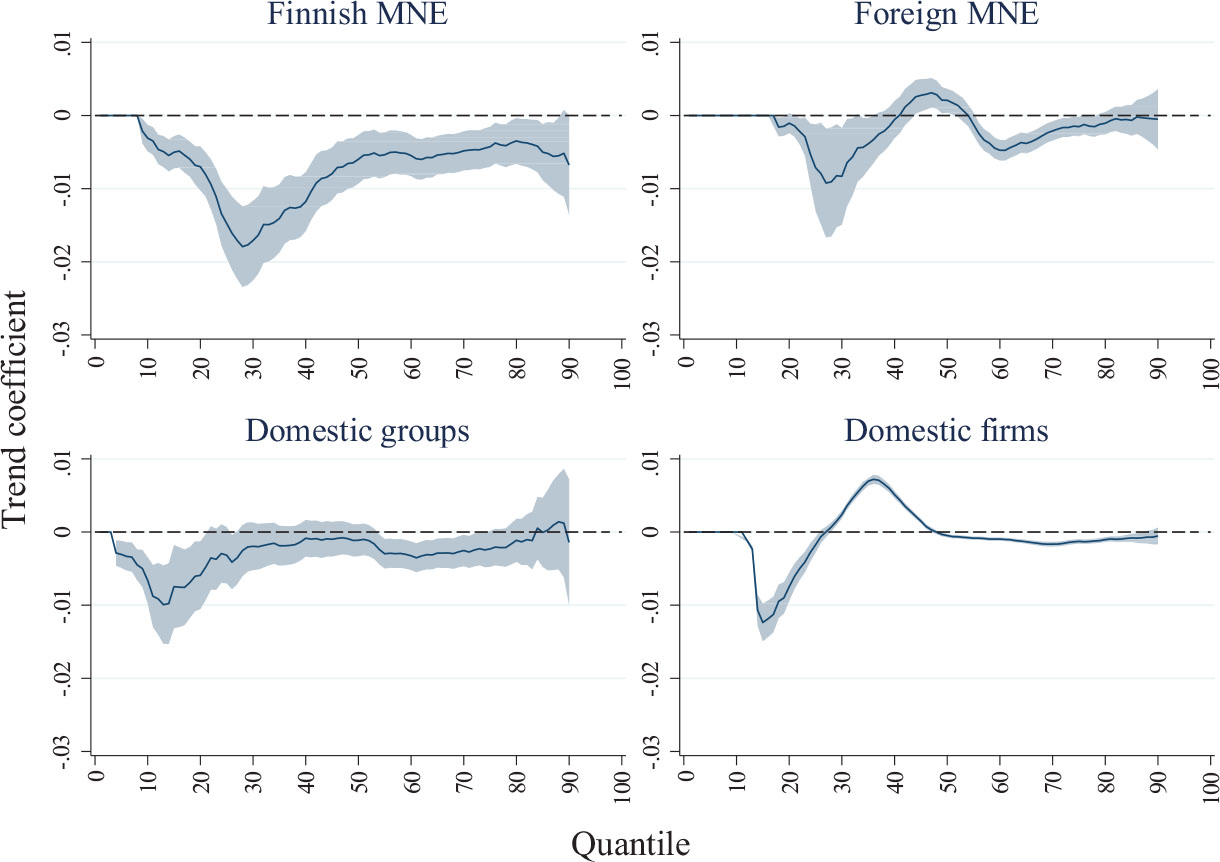
Figure 5:
Trend coefficients over the CASH ETR distribution for different sub-samples.
Notes: The figures plot the coefficient point estimates of Trend for every quantile of the CASH ETR distribution for the four different firm types. The shaded blue area describes the 95% confidence interval of the point estimates. The used data is the YRTTI tax return data for 2000–2015. Finnish MNEs include Finnish-headquartered multinationals. Foreign MNEs include subsidiaries of foreign-headquartered multinationals that are located in Finland. Domestic groups include purely domestic corporate groups and domestic firms include domestic standalone firms.
If the entire distribution moved to the left, we would observe a constant trend coefficient for different quantiles. However, we observe a large negative coefficient in the low quantiles for both MNEs and domestic firms. This suggests that the low quantiles decrease substantially over time, consistent with the increasing share of zero CASH ETR observations over time driving down the lower quantiles. For Finnish-headquartered MNEs, the trend is negative throughout the distribution. For domestic corporate groups, the trend is similarly negative throughout, but mostly not statistically different from zero. Corporate groups can use group contributions and other within-group transactions to balance current period profits without necessarily creating losses, so there are fewer domestic groups with zero CASH ETR. Domestic groups therefore exhibit a more uniform trend pattern than domestic firms. The heterogeneity in the distributional changes is smaller as the confidence intervals are wide and do not reject a constant effect. For foreign-headquartered MNEs and domestic firms, we observe a large decrease in the lower quantiles and an increase around the median. Among domestic firms, there is more entry, and without the possibility of current-year profit balancing, these firms become unobserved when making losses. There is a similar pattern among foreign-headquartered MNEs, which is somewhat surprising.
5.3. Mechanisms: Temporary Tax Changes, the Global Financial Crisis, and Affiliation with Tax Havens
As discussed previously, there are some factors that could be driving our results. While the time trend catches “learning” or increased use of tax avoidance opportunities, we should check whether the trend we found is driven by changes in other tax rules, like temporary bonus deductions, or other external events, such as the global financial crisis. We also utilize an auxiliary dataset containing some information on foreign subsidiaries of corporate groups with Finnish parents to study the extent to which the decreasing time trend is associated with having tax haven subsidiaries.
The main temporary tax incentives during the sample period were accelerated depreciation in 2009– 2010 and again in 2013–2015, as well as the R&D bonus deduction in 2013–2014. There has also been an interest barrier in place since 2014, limiting the tax deductibility of interest payments. The interest barrier was implemented to restrict the profit shifting of MNEs through debt shifting. Harju et al. (2025) study the impact of the interest barrier implemented in 2014 on debt shifting. Their results suggest that the interest barrier seems to decrease the debt shifting, but firms substituted to use more transfer pricing to shift profit. Thus, according to Harju et al. (2025), the effects of the interest barrier on total profit shifting are inconclusive.
We study the effects of these temporary tax incentives by interacting the time trend with the indicators for the periods of the temporary tax changes. We also include the interaction with a post-financial crisis indicator (post-2009). Restricting our purview to firms that do not utilize losses in 2010 would not be sufficient since the business of even always-profitable firms might still have suffered from the financial crisis.
Table 4 presents the results. Odd numbered columns add the interaction of the trend with the post-2009 indicator. This interaction term is significant only for Finnish-headquartered MNEs, positive for foreign-headquartered MNEs, and negative for domestic firms. We see that the time trend for multinational firms and domestic groups is much smaller after the financial crisis, but larger for domestic standalone firms. One potential reason for this is firm dynamics: we observe an increase in both entry and exit around 2008–2010 for domestic firms, but no similar increase for MNEs. This would also explain why the Post GFC dummy is positive for domestic standalone firms.
Table 4:
Robustness of the main results to inclusion of interaction terms.
| Finnish MNEs | Foreign MNEs | Domestic groups | Domestic firms | |||||
|---|---|---|---|---|---|---|---|---|
| (1) | (2) | (3) | (4) | (5) | (6) | (7) | (8) | |
| Trend | −0.0100*** (−6.25) | −0.00768*** (−5.38) | −0.00130 (−0.86) | −0.00237** (−2.32) | −0.00287* (−1.83) | −0.00208 (−1.62) | −0.0000492 (−0.17) | −0.000879*** (−3.42) |
| Post GFC | −0.0744 (−1.63) | −0.0715** (−2.27) | −0.0867** (−2.25) | 0.0499*** (5.78) | ||||
| I(2009-2010) | −0.276** (−2.22) | 0.0904 (1.20) | −0.0314 (−0.29) | −0.0164 (−0.71) | ||||
| I(2013-2015) | −0.0980 (−0.99) | 0.0995 (1.56) | −0.0677 (−0.81) | 0.0972*** (4.94) | ||||
| Trendx Post GFC | 0.00512** (2.00) | 0.00375** (2.02) | 0.00517** (2.39) | −0.00308*** (−6.40) | ||||
| Trendx I(2009-2010) | 0.0158** (2.09) | −0.00603 (−1.32) | 0.00174 (0.27) | 0.000963 (0.69) | ||||
| Trendx I(2013-2015) | 0.00522 (1.07) | −0.00468 (−1.47) | 0.00398 (0.97) | −0.00514*** (−5.30) | ||||
| STR | 0.394** (2.40) | 0.515*** (2.90) | 0.777*** (7.47) | 0.552*** (4.73) | 0.892*** (6.43) | 0.928*** (6.45) | 0.550*** (17.25) | 0.480*** (13.68) |
| Constant | 0.183 (1.55) | 0.141 (1.17) | −0.0502 (−0.43) | 0.0384 (0.32) | 0.0396 (0.31) | 0.0243 (0.19) | 0.232*** (5.42) | 0.258*** (5.95) |
| Firm characteristic controls | Yes | Yes | Yes | Yes | Yes | Yes | Yes | Yes |
| Book-tax difference controls | Yes | Yes | Yes | Yes | Yes | Yes | Yes | Yes |
| Firm & industry FE | Yes | Yes | Yes | Yes | Yes | Yes | Yes | Yes |
| N | 6723 | 6723 | 13325 | 13325 | 10880 | 10880 | 159192 | 159192 |
| R-squared | 0.542 | 0.542 | 0.561 | 0.561 | 0.516 | 0.516 | 0.507 | 0.507 |
| Adj. R-squared | 0.453 | 0.454 | 0.484 | 0.485 | 0.404 | 0.404 | 0.433 | 0.433 |
[i] Notes: This table presents the results of estimating equation 1 with an ordinary least squares specification with different sample restrictions. Columns 1 and 2 include only Finnish-owned multinationals, columns 3 and 4 include only subsidiaries of foreign owned MNEs located in Finland, columns 5 and 6 include only domestic corporate groups and columns 7 and 8 include only domestic standalone firms. Trend is the linear time trend, defined as the tax year less of 2000, the first sample I(2013–2015) year. Trend receives values 0–15. Post GFC is an indicator which gets the value 1 after the year 2007. I(2009–2010) and I(2013–2015) are indicators which get the value 1 during years 2009–2010 and 2013–2015. Other variables are as defined in Section 4.2. Coefficients for the control variables are omitted here, see Appendix Table A9 for entire regression output. t statistics are in parentheses.
The even numbered columns of Table 4 include the interactions with the indicators for 2009–2010 and 2013– 2015. These interaction terms are mostly statistically insignificant. However, there were many simultaneous changes in Finnish corporate taxation during the period 2013–2015. In addition to the R&D bonus deduction and the introduction of the interest barrier, there were changes in dividend taxation and in the tax treatment of the reserve for invested unrestricted equity (SVOP-rahasto in Finnish), among other things. These factors all coincide during this period with the decrease in the Finnish corporate tax rate (in 2014). We cannot separate their effects with this simple interaction approach. However, we can say that the STR change is a much more likely explanation for the significance of this interaction than the R&D deduction or the interest barrier, especially considering that the interaction is not statistically significant for multinationals and R&D expenses have not been significant in almost any of the earlier specifications. Furthermore, it has been estimated that the R&D deduction was considerably underutilized, since approximately 800 firms used the deduction (Kuusi et al. 2016). Therefore, these two temporary changes in the tax environment are unlikely to drive our results.
Finally, we present some additional robustness checks by altering the control variables. First, we exclude all control variables and keep only the statutory tax rate and the fixed effects. The results, as shown in Table A6, show that the trend coefficient without control variables is smaller in absolute terms for MNEs and greater for domestic entities compared to the baseline results in Table 2. Second, as explained in section 4.2, the dividends received in our main specification included all the dividends received without distinguishing between taxable and tax-free dividends. After 2006, we directly observe tax-free dividends. For 2000–2005, we count the tax-free dividends that we can observe, which comprise subsidiary dividends and tax-free foreign dividends. Table A7 shows the results with an alternative definition of the received dividends. The results remain mostly unchanged. The trend coefficients decrease slightly in absolute terms, and the trend coefficient for foreign-headquartered MNEs is no longer statistically significant at the 10% level. Third, one may be concerned whether the inclusion of some of the book-tax differences controls too much: after all, some of them may be related to tax avoidance. Table A8 presents the results in which only the characteristics of the company, special items, and NOLs are controlled. The latter two are kept because NOLs are automatically deducted if the firm has any remaining, and special items include group contributions. The time trends slightly increase in absolute terms compared to the baseline results, except for foreign-headquartered MNEs, for which the trend decreases and is no longer statistically significant at the 10% level. The increase in the magnitude of the time trend is consistent with the control variables possibly capturing tax avoidance to some extent. However, the economic significance of the results remains unchanged again.
The time trend for Finnish-headquartered MNEs remains large and statistically significant across different specifications. One possible explanation for this is that MNEs are benefiting from their foreign operations. To investigate this conjecture, we exploit the information available on foreign affiliates between the years 2007–2015 and include foreign affiliate controls in Table A10. Column 1 shows the regression results for multinational firms for the sample period without controls, whereas columns 2 to 5 alter the set of foreign activity control variables. 23 We see that the results from column 1 are very stable to the inclusion of the different foreign affiliate controls, as in all columns, the trend coefficient is −0.38 ppt per year and statistically significant at the 10% level. In addition, the two different tax haven measures, the dummy variable for having a tax haven subsidiary and the number of tax haven subsidiaries, do not result in statistically significant estimates and the coefficients for subsidiary sales and employees are economically small, though statistically significant. This, together with the fact that the trend coefficient remains unchanged, suggests that the decline in ETR over time is not explained by a change in foreign activities, at least to the extent we can measure them. 24 Finally, the trend coefficient for this shorter sample period beginning in 2007 is approximately half the size of the baseline trend coefficient reported in column 2 of Table 2, which is based on the longer period. This weaker downward trend may be explained by the introduction of transfer pricing documentation rules in 2007, which likely constrained profit shifting opportunities for multinationals.
5.4. Extensive Margin Response: Zero Taxable Profit
Our regression analysis excludes by definition observations with zero pre-tax income, as the dependent variable in the regression analysis is cash taxes paid divided by pre-tax income. A low CASH ETR could indicate tax avoidance, so a downward trend in CASH ETR could suggest that tax avoidance is increasing. However, as suggested by Bilicka (2019), reporting zero taxable income could also be interpreted as a sign of aggressive tax planning. Having zero taxable profit can be seen as the firm avoiding taxes overall, i.e., representing the extensive margin of tax avoidance. Moreover, corporate groups, especially multinational groups, have more opportunities to avoid taxes. Multinationals can reduce their global tax liability by decreasing their taxable profit in high tax countries to as low as possible or even by reporting zero taxable profit and contrarily report more profit in low tax countries.
Since our tax return data covers only the parts of multinational groups that operate in Finland, we cannot observe the global amount of taxes paid or profit reported by the multinationals. A multinational paying no taxes or a low amount of taxes, or reporting no or a low amount of taxable profit in Finland, may possibly indicate profit shifting. Although our trend variable in the regressions of the preceding subsections also catches trends in profit shifting, it does not separate it from other tax avoidance activities. To complement our analysis, we present some descriptive analysis in the vein of Bilicka (2019) and Johannesen et al. (2020) to study whether there is bunching around zero in the taxable profits of MNEs. For the graphs in this section, we do not drop firms with zero or negative accounting profits.
Firms might not have incentives to diminish their (group total) accounting profits to zero, but they would like to lower their taxable income to elude taxes. To investigate this, Figure 6 shows the yearly share of firms with zero taxable profit and zero accounting profit. Following Johannesen et al. (2020), we define a firm as reporting zero (accounting) taxable profit if the (accounting) taxable profit to the total assets share of the firm falls between −0.5 and 0.5 percent. Since firms have different opportunities to reduce their taxable income to zero, we group the firms into five groups: tax haven affiliated Finnish-headquartered multinationals (Haven affiliated MNEs), non-haven affiliated Finnish-headquartered multinationals (Non-haven affiliated MNEs), foreign-headquartered affiliates located in Finland (Foreign MNEs), Finnish domestic corporate groups (Domestic groups), and Finnish standalone entities (Domestic firms). The share of firms that report zero taxable profit in these different groups has remained relatively stable over the years, as seen in Figure 6. We also observe that the share of firms that report zero profits is the highest among Finnish-headquartered multinationals that have at least one affiliate located in a tax haven destination (blue line), where the share is between 40% and 50% of firms. Furthermore, almost 30% of domestic corporate groups (yellow line) as well as Finnish-headquartered multinationals without tax haven affiliates (green line) report zero taxable profit. These shares of firms that report zero taxable profit are relatively high, especially compared to the average share of firms that report zero accounting profit, i.e., about 3% among all firms (dashed black line). 25 This graphical evidence supports the argument that firms with more opportunities for tax avoidance, i.e., firstly corporate groups overall, secondly multinational corporate groups, and finally tax haven affiliated corporate groups, also seem to do that more on the extensive margin.
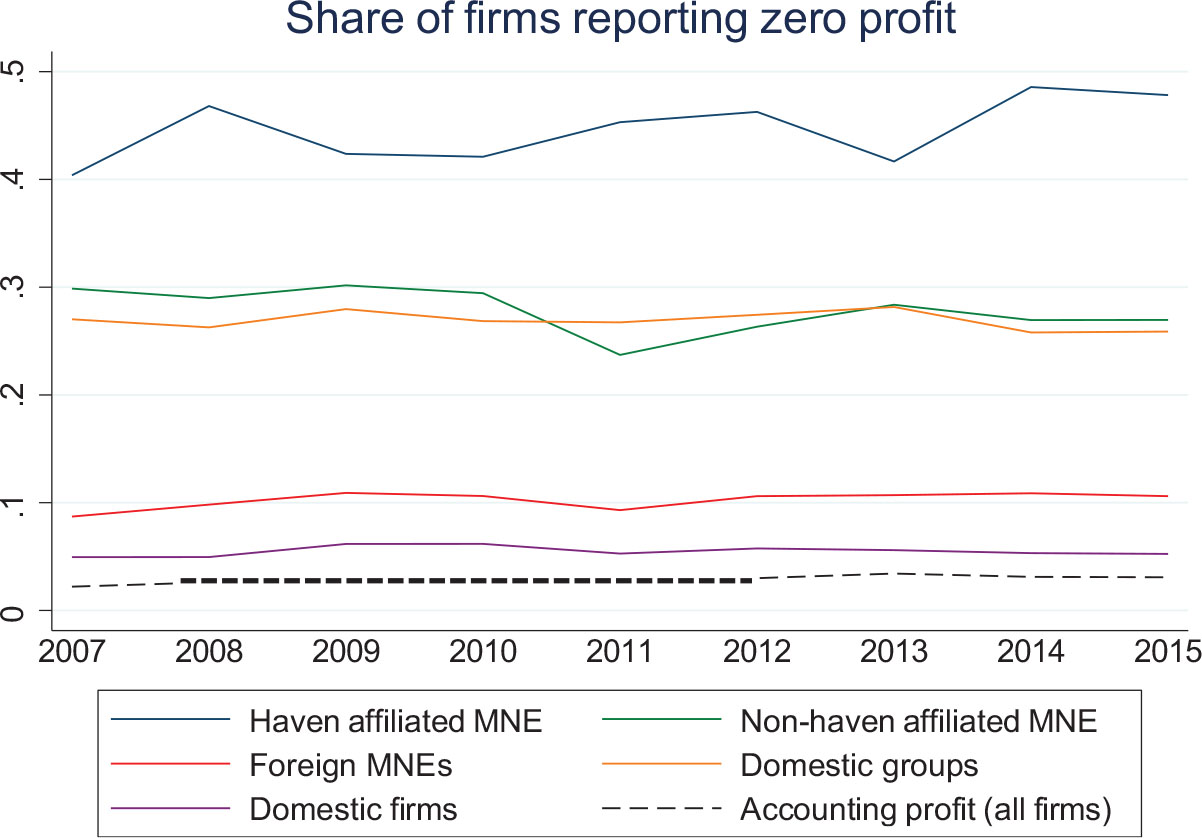
Figure 6:
Share of firms reporting zero profit by year.
Notes: The figure illustrates the evolution of firms reporting zero taxable profit and zero accounting profit. The used data source is the YRTTI tax return data for 2007–2015. Firm is considered as reporting zero profit if the taxable (accounting) profit to total assets share of the firm falls between −0.5 and 0.5 percent. Haven affiliated MNEs include Finnish-headquartered multinationals with at least one affiliate located in a tax haven country defined by Menkhoff & Miethe (2019). Non-haven affiliated MNEs include Finnish-headquartered multinationals with no affiliates in tax haven countries. Foreign MNEs include subsidiaries of foreign-headquartered multinationals that are located in Finland. Domestic groups include purely domestic corporate groups and domestic firms include domestic standalone firms. Accounting profit includes all firms due to the share being very similar across the different groups of firms.
Figure 7 complements Figure 6 as it presents the line histograms of the return on assets (ROA) calculated by dividing the accounting profit with the total assets and the ratio of taxable profits to the total assets around zero (i.e., the measures used in Figure 6 to calculate the share of firms that report zero profit). In the ROA panels, i.e., the figures in the left panel, we see that tax haven affiliated Finnish-headquartered multinationals (blue line) are on a somewhat higher level, suggesting that a larger share of these firms report a ROA closer to zero. 26 However, there is no clear evidence of the figures in the left panel bunching around zero in any of the groups. In the taxable profit panels on the right side, we notice clear bunching at zero, which remains even after removing firms which deduct earlier losses. We also see that Finnish corporate groups, especially those with tax haven affiliates (blue line), tend to bunch close to zero, supporting the evidence provided in Figure 6. These results are similar to those of Bilicka (2019), who finds that a higher share of foreign multinational subsidiaries report zero taxable profit in the United Kingdom. However, note that we do not perform a similar matching as Bilicka (2019) and there are differences in observables between MNEs and domestic firms.
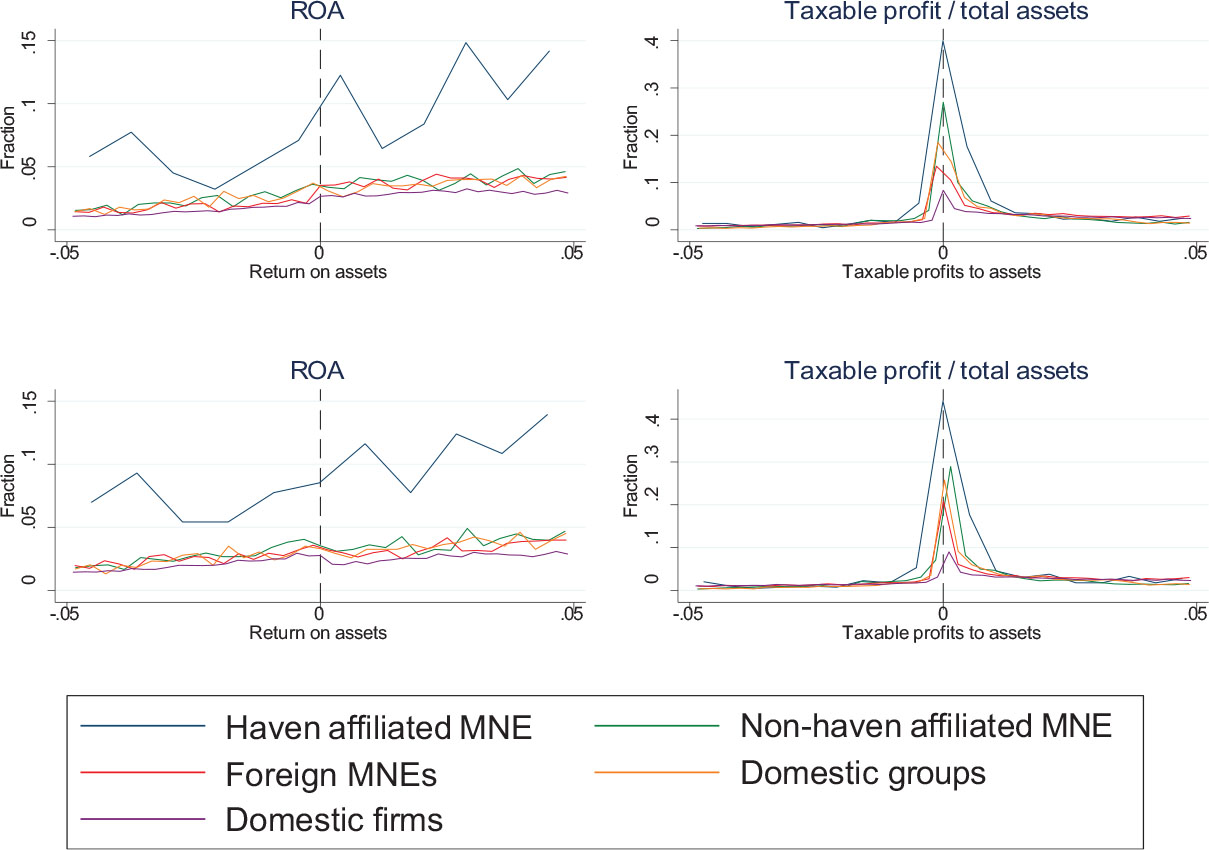
Figure 7:
Histograms of ROA and the ratio of taxable profits to total assets.
Notes: The histograms illustrate the distribution of observations around zero return on assets (ROA) and the ratio of taxable profits to total assets. The top panel figures use all observations whereas the bottom panel figures discard observations with any deducted losses. Left panel figures show the histograms of ROA and right panel figures of taxable profits to total assets. The data source is the YRTTI tax return data for 2007–2015. Haven affiliated MNEs include Finnish-headquartered multinationals with at least one affiliate located in a tax haven country defined by Menkhoff & Miethe (2019). Non-haven affiliated MNEs include Finnish-headquartered multinationals with no affiliates in tax haven countries. Foreign MNEs include subsidiaries of foreign-headquartered multinationals that are located in Finland. Domestic groups include purely domestic corporate groups and domestic firms include domestic standalone firms.
5.5. Discussion
Although loss carry-forward reserves and their utilization have increased, especially after the financial crisis, the lower quantiles of the CASH ETR distribution show a decline already before then, as indicated in Figure 2. Although the median firm has a CASH ETR very close to the STR, our results suggest that tax avoidance may have increased over time. Unconditional quantile regression does not rely on rank similarity or invariance, so the UQR results do not tell whether the same firms are consistently decreasing their ETRs or whether many different firms experience large ETR decreases. The former seems more likely, given that the trend is even more emphasized for the balanced sample, and the results are robust to the exclusion of loss-utilizing groups. However, even if a subsidiary is constantly generating losses, the group-level profits may always remain positive because of group contributions. In addition, analyzing the incentives of loss-making firms remains a fruitful area for future research. This could, for example, involve looking into the book-tax differences in firms that consistently report losses, as in Schwab et al. (2023).
Increasing tax avoidance might mean that either the marginal costs and benefits of engaging in more extensive avoidance change over time, or firms are not always behaving optimally and learn over time. Jacob et al. (2021) model the determination of the level of tax avoidance as a function of moral hazard, avoidance costs, and future profitability expectations. These determinants, and also the learning process, tend to be time-variant and are caught by the time trend (and firm fixed effects if time-invariant). Our empirical models remain silent on why all firms do not engage in tax avoidance, but the different marginal costs are a likely explanation, since the observed trend was largest for MNEs and smallest for domestic firms (standalones included).
6. Conclusion
We study the trends in the effective tax rates (ETRs) of Finnish multinational and domestic firms over the period 2000–2015 using administrative tax return and financial statement data. In addition to leveraging highly granular data, we complement the previous academic literature by studying the heterogeneity of ETRs across firms. Similarly to the earlier literature on the topic for various countries (e.g., Dyreng et al. 2017, Edwards et al. 2021, Thomsen & Watrin 2018, Chen et al. 2020), we find a decreasing time trend in ETRs, particularly for Finnish-headquartered multinational enterprises. Changes in book-tax differences, the tax environment, or firm characteristics explain little of this trend. We do not find a statistically significant decreasing trend for domestic corporate groups or an economically significant one for domestic standalones, consistent with our detailed data being able to capture the vast majority of items causing book-tax differences.
Our unconditional quantile regression results suggest that the decreasing ETR is largely associated with an increasing share of zero ETR observations rather than a uniform trend in the ETR distribution. Our robustness checks indicate that while the level of ETRs decreased markedly after the financial crisis of 2009, the time trend was also attenuated. The financial crisis therefore had a lasting legacy on Finnish firms, creating large loss carry-forwards that were deducted in the following years. Moreover, we are able to link Finnish-headquartered MNEs to their foreign subsidiaries. This makes it possible to investigate the decreasing ETR time trend for Finnish-headquartered MNEs in more detail, in addition to allowing us to study the effects of having a tax haven affiliate on the ETR. We find that MNEs with tax haven presence report zero taxable profits in Finland much more often than non-haven affiliated ones. However, this finding must not be categorically interpreted as profit shifting, since there may be other differences between tax haven and non-haven affiliated multinationals.
One should be cautious about deriving policy implications from our results. In general, differences between effective and statutory tax rates are very small for the majority of firms in Finland, and loss carry-forwards play a major role in the decreasing time trend in ETRs. Our results do therefore call for future work to better understand the incentives of loss-making firms, especially in countries where there is no loss carry-back. A closer look into the foreign operations of Finnish multinationals is also warranted, particularly the establishment and business activity of tax haven affiliates.
Acknowledgements
We are grateful to Seppo Kari and Olli Ropponen for many insightful comments and suggestions. We also thank the audiences at the VATT Morning Coffee Workshop and at the 44th Annual Meeting of the Finnish Economic Association for comments and discussions.
Notes
A
Appendix
A.1
Additional Descriptive Evidence of the Data
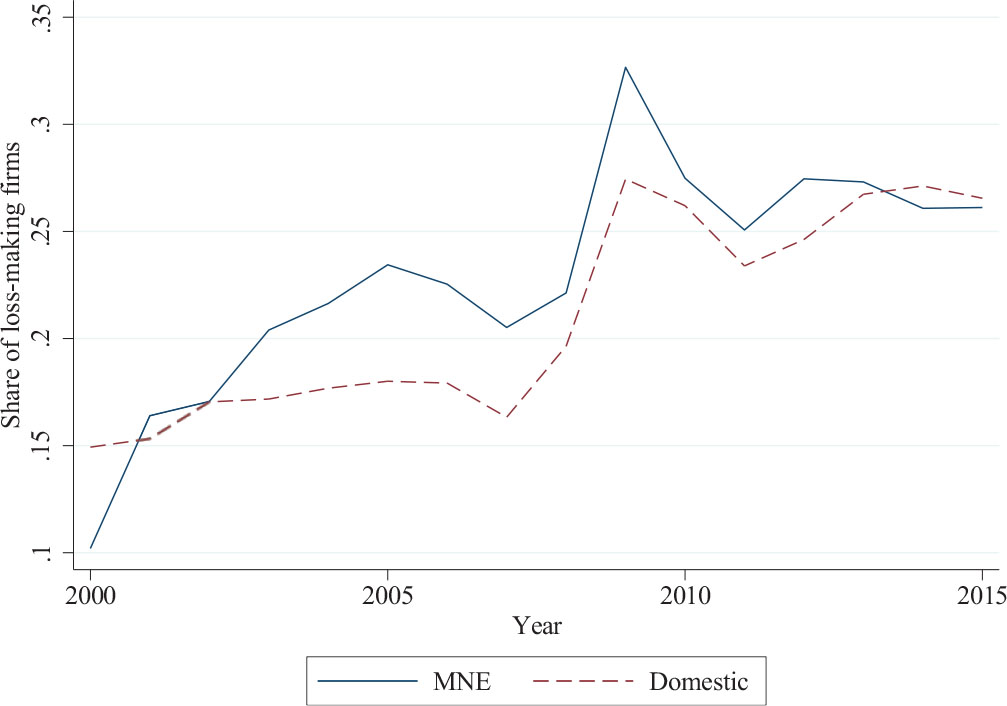
Figure A1:
The yearly share of loss-making firms (i.e.,negative accounting profits).
Notes: The data source is the YRTTI tax return data for 2000–2015. MNE includes Finnish-headquartered multinationals as well as subsidiaries of foreign-headquartered multinationals that are located in Finland. Domestic includes domestic corporate groups and domestic standalone firms.
Table A1:
Summary statistics for the corporate groups in the YRTTI sample.
| Panel B: Corporate groups only | N | Mean | St. dev. | p1 | p25 | p50 | p75 | p99 |
|---|---|---|---|---|---|---|---|---|
| Firm characteristics | ||||||||
| CASH ETR | 32,036 | 0.21 | 0.16 | 0 | 0.10 | 0.22 | 0.28 | 0.79 |
| Pre-tax income | 32,036 | 10,498,615 | 101,811,096 | 10,760 | 243,609 | 793,707 | 2,976,211 | 162,794,000 |
| MNE | 32,036 | 0.64 | 0.48 | 0 | 0 | 1 | 1 | 1 |
| Log total assets | 32,036 | 16.1 | 1.76 | 12.6 | 14.7 | 15.9 | 17.3 | 19.6 |
| Fixed assets | 32,036 | 0.33 | 0.26 | 0 | 0.088 | 0.31 | 0.53 | 0.93 |
| ROA | 32,036 | 0.15 | 0.14 | 0.00092 | 0.054 | 0.11 | 0.20 | 0.74 |
| Debt-to-Equity | 32,036 | 86.5 | 300.8 | −290.6 | 0 | 8.82 | 61.6 | 1932.4 |
| Paid dividends1 | 32,036 | 0.040 | 0.074 | 0 | 0 | 0.0051 | 0.049 | 0.38 |
| Book-tax differences | ||||||||
| Special items2 | 32,036 | −0.0023 | 0.014 | −0.074 | 0 | 0 | 0 | 0.027 |
| R&D expenses2 | 32,036 | 0.0020 | 0.0061 | 0 | 0.00000025 | 0.00010 | 0.0011 | 0.029 |
| Intra-group interest payments1 | 32,036 | 0.0026 | 0.0055 | 0 | 0 | 0 | 0.0022 | 0.024 |
| Statutory provisions2 | 32,036 | 0.0015 | 0.0045 | 0 | 0 | 0 | 0 | 0.024 |
| Δ Book-tax amortization difference2 | 32,036 | 0.00060 | 0.0055 | −0.013 | 0 | 0 | 0 | 0.031 |
| Δ Book-tax depreciation difference2 | 32,036 | 0.00027 | 0.0014 | 0 | 0 | 0 | 0 | 0.0090 |
| Received dividends1 | 32,036 | 0.030 | 0.067 | 0 | 0 | 0 | 0.031 | 0.38 |
| Contributions and subsidies1 | 32,036 | 0.00077 | 0.0027 | 0 | 0 | 0 | 0.000084 | 0.017 |
| NOL1 | 32,036 | 0.029 | 0.15 | 0 | 0 | 0 | 0 | 0.87 |
| ΔNOL1 | 32,036 | −0.0091 | 0.034 | −0.20 | 0 | 0 | 0 | 0 |
Notes: This table presents the summary statistics for corporate groups in 2000–2015. Panel A with the entire sample is presented in Table 1. CASH ETR is cash taxes paid divided by earnings before taxes. MNE is an indicator variable equal to 1 if the firm is a multinational enterprise and 0 otherwise. NOL = Total net operating losses. △NOL = net operating losses utilized to reduce taxable income.
A.2
Unconditional Quantile Regression Results
Table A2:
UQR results for the YRTTI sample of Finnish multinational enterprises.
| OLS | Unconditional Quantile Regression | |||||
|---|---|---|---|---|---|---|
| (1) OLS | (2) Q10 | (3) Q25 | (4) Q50 | (5) Q75 | (6) Q90 | |
| Trend | −0.00780*** (−5.63) | −0.00309*** (−3.33) | −0.0148*** (−6.10) | −0.00598*** (−3.52) | −0.00428*** (−3.06) | −0.00676* (−1.94) |
| STR | 0.267** (1.99) | −0.147 (−1.43) | −0.468* (−1.92) | 0.710*** (3.91) | 0.713*** (5.07) | 0.571* (1.65) |
| Pre-tax income growth | 358.1* (1.82) | −307.3 (−1.49) | −239.3 (−0.68) | 67.46 (0.38) | 240.9 (1.25) | 1399.4** (2.46) |
| Controls for firm characteristics | ||||||
| Log total assets | 0.00328 (0.56) | 0.0182*** (4.34) | 0.0212** (2.16) | −0.00695 (−1.06) | −0.0116* (−1.96) | 0.000128 (0.01) |
| Fixed assets | −0.0371* (−1.90) | −0.0306* (−1.79) | −0.0906** (−2.23) | −0.0513** (−2.13) | −0.0156 (−0.79) | 0.0501 (1.11) |
| ROA | −0.0560** (−2.23) | 0.0961*** (4.81) | 0.265*** (5.64) | 0.0771** (2.36) | −0.124*** (−5.21) | −0.466*** (−7.48) |
| Debt-to-Equity | −0.0000216*** (−3.09) | −0.00000479 (−0.60) | −0.0000366** (−2.54) | −0.0000300*** (−3.62) | −0.00000287 (−0.46) | 0.00000114 (0.06) |
| Paid dividends | 0.264*** (3.05) | 0.0758 (1.51) | 0.00208 (0.02) | 0.273** (2.50) | 0.414*** (4.18) | 0.464** (2.18) |
| Controls for book-tax differences | ||||||
| Special items | 0.560*** (4.60) | −0.0740 (−0.88) | 0.366 (1.34) | 0.580*** (3.51) | 0.389*** (3.32) | 1.001*** (3.17) |
| R&D expenses | −0.130 (−0.48) | −0.159 (−0.52) | −0.448 (−0.58) | −0.152 (−0.35) | 0.385 (1.29) | −0.467 (−0.78) |
| Intra-group interest payments | −1.750*** (−2.92) | −0.0808 (−0.16) | −2.415* (−1.90) | −2.864*** (−3.87) | −1.634*** (−2.92) | −1.588 (−1.22) |
| Statutory provisions | −1.009 (−1.27) | −0.853 (−1.50) | −3.204** (−2.53) | −0.822 (−1.07) | −0.288 (−0.39) | −1.227 (−0.59) |
| Δ Book-tax amortization diff. | −1.704*** (−5.47) | 0.0872 (0.31) | −1.660** (−2.39) | −2.123*** (−4.67) | −1.459*** (−4.17) | −2.609*** (−3.33) |
| Δ Book-tax depreciation diff. | −2.823*** (−2.79) | −2.568*** (−3.36) | −5.932*** (−3.18) | −3.153** (−2.54) | −1.237 (−1.21) | −2.103 (−0.85) |
| Received dividends | −0.157* (−1.67) | −0.0434 (−0.85) | 0.157 (1.14) | −0.0746 (−0.65) | −0.357*** (−3.29) | −0.412* (−1.71) |
| Contributions and subsidies | 1.077 (1.32) | −0.181 (−0.39) | 0.221 (0.19) | 2.264*** (2.71) | 1.792** (2.50) | 2.784 (1.27) |
| NOL | −0.0917*** (−2.75) | −0.108*** (−3.41) | −0.160** (−2.50) | −0.0683** (−2.02) | −0.0407* (−1.70) | −0.130** (−2.04) |
| △NOL | 0.511*** (6.16) | 0.241** (2.41) | 0.929*** (5.30) | 0.557*** (6.03) | 0.306*** (4.85) | 0.382** (2.14) |
| Constant | 0.204* (1.78) | −0.200** (−2.35) | −0.00952 (−0.05) | 0.255* (1.92) | 0.382*** (3.20) | 0.331 (1.03) |
| Firm & industry FE | Yes | Yes | Yes | Yes | Yes | Yes |
| N | 6723 | 7004 | 7004 | 7004 | 7004 | 7004 |
| R-squared | 0.540 | 0.547 | 0.566 | 0.541 | 0.476 | 0.421 |
| Adj. R-squared | 0.452 | 0.438 | 0.461 | 0.430 | 0.349 | 0.281 |
[i] Notes: This table presents the results of estimating equation 1 with an ordinary least squares specification in column 1 and unconditional quantile regressions in columns 2–6. Trend is the linear time trend, defined as the tax year less of 2000, the first sample year. Thus, Trend receives values 0–15. All other variables are as defined in Section 4.2. The estimation sample is the Finnish-owned multinationals in the YRTTI tax return data. t statistics are in parentheses.
Table A3:
UQR results for the YRTTI sample of foreign multinational enterprises.
| OLS | Unconditional Quantile Regression | |||||
|---|---|---|---|---|---|---|
| (1) OLS | (2) Q10 | (3) Q25 | (4) Q50 | (5) Q75 | (6) Q90 | |
| Trend | −0.00162* (−1.66) | 0 (.) | −0.00712** (−2.36) | 0.00208** (2.40) | −0.00152** (−2.27) | −0.000497 (−0.24) |
| STR | 0.581*** (6.78) | 0 (.) | −0.578** (−2.11) | 1.745*** (18.94) | 0.645*** (10.12) | 0.845*** (4.28) |
| Controls for firm characteristics | ||||||
| Pre-tax income growth | −164.1*** (−2.77) | 0 (.) | −1054.5*** (−6.16) | −161.1*** (−3.78) | −4.383 (−0.16) | 193.9* (1.74) |
| Log total assets | −0.00251 (−0.70) | 0 (.) | 0.0410*** (3.67) | −0.00127 (−0.43) | −0.00649*** (−3.02) | −0.0217*** (−2.96) |
| Fixed assets | −0.0365** (−2.51) | 0 (.) | −0.145*** (−3.04) | −0.0532*** (−4.44) | −0.0124 (−1.44) | 0.0214 (0.79) |
| ROA | −0.0565*** (−4.03) | 0 (.) | 0.370*** (8.42) | 0.0404*** (3.41) | −0.102*** (−10.64) | −0.395*** (−12.09) |
| Debt-to-Equity | −0.00000910** (−2.06) | 0 (.) | −0.0000220 (−1.06) | −0.00000633* (−1.74) | −0.00000165 (−0.64) | −0.0000147* (−1.94) |
| Paid dividends | 0.144*** (6.00) | 0 (.) | 0.254*** (4.19) | 0.0713*** (3.33) | 0.177*** (7.31) | 0.168** (2.26) |
| Controls for book-tax differences | ||||||
| Special items | 1.337*** (9.75) | 0 (.) | 3.897*** (7.58) | 1.137*** (8.52) | 0.497*** (5.72) | 1.108*** (4.40) |
| R&D expenses | −0.130 (−0.50) | 0 (.) | −0.562 (−0.66) | 0.187 (0.91) | 0.164 (1.08) | 0.536 (0.90) |
| Intra-group interest payments | −2.357*** (−7.76) | 0 (.) | −5.948*** (−5.47) | −2.671*** (−10.22) | −1.331*** (−7.21) | −1.010* (−1.78) |
| Statutory provisions | 0.974** (2.03) | 0 (.) | −0.523 (−0.35) | 0.483 (1.30) | 0.711** (2.35) | 3.022*** (2.69) |
| Δ Book-tax amortization diff. | −1.574*** (−4.87) | 0 (.) | −1.057 (−1.05) | −2.107*** (−7.02) | −1.503*** (−6.32) | −1.967*** (−2.84) |
| Δ Book-tax depreciation diff. | −3.914*** (−3.23) | 0 (.) | −7.420 (−1.55) | −2.217** (−2.09) | −0.926 (−1.16) | −3.740* (−1.67) |
| Received dividends | −0.0527** (−2.18) | 0 (.) | −0.0624 (−1.05) | −0.00125 (−0.06) | −0.184*** (−7.53) | −0.106 (−1.36) |
| Contributions and subsidies | 2.469** (2.25) | 0 (.) | 1.584 (0.55) | 1.692* (1.83) | 1.959** (2.20) | 5.615** (2.16) |
| NOL | −0.0824*** (−6.10) | 0 (.) | −0.328*** (−7.16) | −0.0235** (−2.42) | −0.0213*** (−3.04) | −0.0746*** (−3.31) |
| △NOL | 0.371*** (7.97) | 0 (.) | 1.621*** (10.09) | 0.336*** (9.27) | 0.0192 (0.78) | −0.166* (−1.88) |
| Constant | 0.00344 (0.03) | 0.0268 (.) | −0.331 (−0.71) | −0.279*** (−2.95) | 0.148** (2.13) | 0.280 (1.45) |
| Firm & industry FE | Yes | Yes | Yes | Yes | Yes | Yes |
| N | 13325 | 13557 | 13557 | 13557 | 13557 | 13557 |
| R-squared | 0.560 | . | 0.628 | 0.568 | 0.466 | 0.382 |
| Adj. R-squared | 0.484 | . | 0.556 | 0.485 | 0.362 | 0.262 |
[i] Notes: This table presents the results of estimating equation 1 with an ordinary least squares specification in column 1 and unconditional quantile regressions in columns 2–6. Trend is the linear time trend, defined as the tax year less of 2000, the first sample year. Thus, Trend receives values 0–15. All other variables are as defined in Section 4.2. The estimation sample is the subsidiaries offoreign owned multinationals located in Finland. t statistics are in parentheses.
Table A4:
UQR results for the YRTTI sample of domestic corporate groups.
| OLS | Unconditional Quantile Regression | |||||
|---|---|---|---|---|---|---|
| (1) OLS | (2) Q10 | (3) Q25 | (4) Q50 | (5) Q75 | (6) Q90 | |
| Trend | −0.00187 (−1.51) | −0.00661*** (−4.10) | −0.00317 (−1.61) | −0.00112 (−1.01) | −0.00231* (−1.85) | −0.00141 (−0.32) |
| STR | 0.715*** (6.23) | −0.221 (−1.50) | 0.689*** (3.49) | 1.138*** (10.06) | 0.629*** (5.74) | 1.059*** (2.64) |
| Controls for firm characteristics | ||||||
| Pre-tax income growth | 365.2** (2.31) | −521.2** (−2.52) | −182.4 | (−1.07) 89.78 (0.90) | 273.3** (2.20) | 1778.4*** (3.54) |
| Log total assets | 0.00321 (0.56) | 0.0270*** (3.19) | 0.0184* (1.89) | −0.00858 (−1.58) | −0.00939* (−1.82) | −0.0145 (−0.79) |
| Fixed assets | −0.0882*** (−5.22) | −0.0787*** (−3.45) | −0.123*** (−4.46) | −0.0675*** (−4.40) | −0.0340** (−2.09) | −0.120** (−2.14) |
| ROA | −0.136*** (−7.09) | 0.0743*** (2.80) | 0.0912*** (3.07) | −0.0311* (−1.71) | −0.157*** (−8.05) | −0.641*** (−8.92) |
| Debt-to-Equity | −0.0000294*** (−4.02) | −0.0000386*** (−2.75) | −0.0000456*** (−4.01) | −0.0000160** (−2.50) | −0.0000129** (−2.05) | −0.0000347 (−1.62) |
| Paid dividends | 0.210*** (4.16) | 0.110** (2.28) | 0.159** (2.44) | 0.137*** (3.07) | 0.214*** (3.53) | 0.391* (1.87) |
| Controls for book-tax differences | ||||||
| Special items | 0.951*** (5.35) | 0.489** (2.11) | 0.818*** (2.84) | 0.681*** (4.11) | 0.685*** (4.76) | 2.233*** (3.87) |
| R&D expenses | −0.191 (−0.44) | −1.575** (−2.04) | −0.231 (−0.28) | 0.483 (1.26) | 0.285 (0.69) | −0.680 (−0.53) |
| Intra-group interest payments | −3.490*** (−4.32) | −3.215*** (−2.83) | −6.072*** (−4.49) | −2.877*** (−3.86) | −1.502** (−2.26) | −3.002 (−1.27) |
| Statutory provisions | 2.496** (2.20) | 1.443 (1.06) | 2.751 (1.63) | 1.702** (2.06) | 1.068 (1.10) | 6.893** (2.02) |
| Δ Book-tax amortization diff. | −1.759*** (−5.28) | −0.367 (−0.69) | −3.175*** (−5.89) | −1.755*** (−6.25) | −1.202*** (−4.66) | −2.236** (−2.27) |
| Δ Book-tax depreciation diff. | −2.369* (−1.70) | −4.636** (−2.39) | −3.393 (−1.64) | −0.501 (−0.41) | −2.279* (−1.76) | −3.863 (−0.90) |
| Received dividends | −0.0702 (−1.39) | 0.116** (2.38) | 0.131* (1.73) | −0.0614 (−1.21) | −0.185*** (−2.92) | −0.218 (−1.11) |
| Contributions and subsidies | 2.060*** (2.82) | 1.377* (1.96) | 1.646* (1.67) | 1.461** (2.37) | 1.833** (2.49) | 5.313** (2.04) |
| NOL | −0.124*** (−2.84) | −0.242*** (−2.88) | −0.190*** (−2.94) | −0.0656** (−2.16) | −0.0396 (−1.30) | −0.129 (−1.12) |
| △NOL | 0.615*** (6.92) | 0.954*** (5.76) | 1.082*** (7.22) | 0.331*** (4.01) | 0.129 (1.52) | 0.645** (2.21) |
| Constant | 0.0875 (0.70) | −0.187 (−1.23) | −0.140 (−0.77) | 0.156 (1.50) | 0.316*** (2.66) | 0.227 (0.44) |
| Firm & industry FE | Yes | Yes | Yes | Yes | Yes | Yes |
| N | 10880 | 11475 | 11475 | 11475 | 11475 | 11475 |
| R-squared | 0.515 | 0.599 | 0.563 | 0.550 | 0.477 | 0.411 |
| Adj. R-squared | 0.403 | 0.480 | 0.432 | 0.415 | 0.321 | 0.235 |
[i] Notes: This table presents the results of estimating equation 1 with an ordinary least squares specification in column 1 and unconditional quantile regressions in columns 2–6. Trend is the linear time trend, defined as the tax year less of 2000, the first sample year. Thus, Trend receives values 0–15. All other variables are as defined in Section 4.2. The estimation sample is domestic corporate groups in the YRTTI tax return data. t statistics are in parentheses.
Table A5:
UQR results for the YRTTI sample of domestic standalone firms.
| OLS | Unconditional Quantile Regression | |||||
|---|---|---|---|---|---|---|
| (1) OLS | (2) Q10 | (3) Q25 | (4) Q50 | (5) Q75 | (6) Q90 | |
| Trend | −0.000578** (−2.31) | 0 (.) | −0.00176*** (−3.18) | −0.000543*** (−4.25) | −0.00128*** (−8.05) | −0.000536 (−0.92) |
| STR | 0.673*** (26.87) | 0 (.) | 0.724*** (12.26) | 0.712*** (52.69) | 0.399*** (25.89) | 0.602*** (10.14) |
| Controls for firm characteristics | ||||||
| Pre-tax income growth | −94.70*** (−7.14) | 0 (.) | −676.0*** (−30.72) | −49.18*** (−11.74) | 10.75** (2.08) | 324.9*** (13.20) |
| Log total assets | −0.00443*** (−4.50) | 0 (.) | 0.00564*** (2.58) | −0.00293*** (−6.07) | −0.00766*** (−13.18) | −0.0239*** (−11.33) |
| Fixed assets | −0.0378*** (−10.60) | 0 (.) | −0.0999*** (−13.20) | −0.0252*** (−14.64) | −0.0130*** (−6.05) | −0.0115 (−1.44) |
| ROA | −0.0471*** (−12.67) | 0 (.) | 0.196*** (23.73) | 0.0321*** (16.90) | −0.0666*** (−29.63) | −0.404*** (−44.58) |
| Debt-to-Equity | −0.0000515*** (−28.84) | 0 (.) | −0.000118*** (−29.01) | −0.0000168*** (−24.48) | −0.0000150*** (−20.95) | −0.0000413*** (−14.46) |
| Paid dividends | 0.192*** (23.01) | 0 (.) | 0.217*** (13.53) | 0.0785*** (18.33) | 0.263*** (38.99) | 0.214*** (9.47) |
| Controls for book-tax differences | ||||||
| Special items | 2.143*** (35.39) | 0 (.) | 4.479*** (32.90) | 0.758*** (30.11) | 0.678*** (22.58) | 2.240*** (16.88) |
| R&D expenses | −0.117 (−0.85) | 0 (.) | −0.448 (−1.37) | −0.0269 (−0.40) | 0.265*** (3.81) | 0.216 (0.72) |
| Intra-group interest payments | −1.467*** (−6.53) | 0 (.) | −3.310*** (−5.87) | −1.014*** (−9.80) | −0.821*** (−7.22) | −1.120*** (−2.59) |
| Statutory provisions | 0.713*** (2.66) | 0 (.) | 0.629 (1.11) | 0.0801 (0.68) | 0.228 (1.56) | 1.464** (2.45) |
| Δ Book-tax amortization diff. | −2.164*** (−15.68) | 0 (.) | −5.180*** (−16.75) | −1.044*** (−16.76) | −0.815*** (−11.79) | −2.946*** (−9.90) |
| Δ Book-tax depreciation diff. | −2.402*** (−4.43) | 0 (.) | −6.650*** (−4.94) | −1.652*** (−5.77) | −1.408*** (−3.99) | −0.937 (−0.78) |
| Received dividends | −0.0396*** (−4.64) | 0 (.) | 0.0965*** (5.68) | −0.0145*** (−3.07) | −0.282*** (−39.55) | −0.0204 (−0.86) |
| Contributions and subsidies | 3.222*** (19.49) | 0 (.) | 2.569*** (8.82) | 1.351*** (19.07) | 2.201*** (22.17) | 8.117*** (18.56) |
| NOL | −0.136*** (−23.02) | 0 (.) | −0.231*** (−19.27) | −0.0163*** (−7.78) | −0.0274*** (−11.32) | −0.132*** (−14.11) |
| △NOL | 0.512*** (43.17) | 0 (.) | 1.595*** (52.62) | 0.200*** (35.73) | 0.0620*** (10.34) | −0.0997*** (−4.28) |
| Constant | 0.197*** (4.60) | 0.0156 (.) | 0.0620 (0.42) | 0.111*** (7.13) | 0.307*** (16.79) | 0.527*** (11.27) |
| Firm & industry FE | Yes | Yes | Yes | Yes | Yes | Yes |
| N | 159192 | 162102 | 162102 | 162102 | 162102 | 162102 |
| R-squared | 0.507 | − | 0.576 | 0.522 | 0.437 | 0.346 |
| Adj. R-squared | 0.432 | − | 0.502 | 0.440 | 0.340 | 0.233 |
[i] Notes: This table presents the results of estimating equation 1 with an ordinary least squares specification in column 1 and unconditional quantile regressions in columns 2–6. Trend is the linear time trend, defined as the tax year less of 2000, the first sample year. Thus, Trend receives values 0–15. All other variables are as defined in Section 4.2. The estimation sample is the domestic standalone firms in the YRTTI tax return data. t statistics are in parentheses.
A.3
Robustness of Main Results
Table A6:
Robustness of main results to the exclusion of control variables.
| (1) All firms | (2) Finnish MNEs | (3) Foreign MNEs | (4) Domestic groups | (5) Domestic firms | |
|---|---|---|---|---|---|
| Trend | −0.00221*** (−9.46) | −0.00579*** (−4.85) | −0.00185* (−1.76) | −0.00352*** (−3.19) | −0.00167*** (−6.68) |
| STR | 0.619*** (23.88) | 0.238* (1.76) | 0.642*** (6.53) | 0.560*** (4.71) | 0.649*** (23.09) |
| Constant | 0.0989** (2.51) | 0.186*** (2.83) | −0.0106 (−0.18) | 0.324*** (7.34) | 0.0667* (1.75) |
| Industry FE | Yes | Yes | Yes | Yes | Yes |
| N | 194138 | 7004 | 13557 | 11475 | 162102 |
| R-squared | 0.0495 | 0.0917 | 0.0602 | 0.0675 | 0.0480 |
| Adj. R-squared | 0.0491 | 0.0824 | 0.0551 | 0.0614 | 0.0476 |
[i] Notes: This table presents the results of estimating equation 1 with an ordinary least squares specification with different sample restrictions. Column 1 includes all firms, column 2 only Finnish owned multinationals, column 3 only subsidiaries of foreign owned multinationals located in Finland, column 4 only domestic corporate groups, and column 5 only domestic standalone firms. Trend is the linear time trend, defined as the tax year less of 2000, the first sample year. Thus, Trend receives values 0–15. All other variables are as defined in Section 4.2. t statistics are in parentheses.
Table A7:
Robustness of main results to the definition of received dividends.
| (1) All firms | (2) Finnish MNEs | (3) Foreign MNEs | (4) Domestic groups | (5) Domestic firms | |
|---|---|---|---|---|---|
| Trend | −0.000852*** (−3.67) | −0.00581*** (−4.31) | −0.00112 (−1.18) | −0.000650 (−0.54) | −0.000486** (−1.99) |
| STR | 0.657*** (28.29) | 0.342*** (2.59) | 0.603*** (7.12) | 0.751*** (6.67) | 0.682*** (27.27) |
| Controls for firm characteristics | |||||
| Pre-tax income growth | −93.72*** (−7.31) | 319.3 (1.57) | −157.5*** (−2.65) | 333.5** (2.15) | −93.68*** (−7.07) |
| Log total assets | −0.00385*** (−4.15) | 0.00492 (0.87) | −0.00158 (−0.44) | 0.00387 (0.69) | −0.00444*** (−4.52) |
| Fixed assets | −0.0366*** (−11.02) | −0.0256 (−1.31) | −0.0284** (−1.98) | −0.0799*** (−4.84) | −0.0349*** (−9.85) |
| ROA | −0.0460*** (−13.18) | −0.0246 (−0.97) | −0.0427*** (−3.06) | −0.109*** (−5.78) | −0.0446*** (−12.03) |
| Debt-to-Equity | −0.0000469*** (−29.27) | −0.0000201*** (−2.85) | −0.0000101** (−2.30) | −0.0000298*** (−4.12) | −0.0000516*** (−28.89) |
| Paid dividends | 0.165*** (27.16) | 0.208*** (3.66) | 0.107*** (7.42) | 0.201*** (5.13) | 0.171*** (25.24) |
| Controls for book-tax differences | |||||
| Special items | 1.767*** (34.86) | 0.641*** (5.20) | 1.365*** (10.08) | 1.033*** (5.85) | 2.154*** (35.64) |
| R&D expenses | −0.0907 (−0.84) | −0.104 (−0.40) | −0.0784 (−0.31) | −0.102 (−0.24) | −0.0693 (−0.50) |
| Intra-group interest payments | −1.968*** (−11.54) | −1.781*** (−2.96) | −2.376*** (−8.03) | −3.513*** (−4.43) | −1.441*** (−6.40) |
| Statutory provisions | 0.601*** (2.68) | −0.966 (−1.21) | 0.966** (2.03) | 2.427** (2.20) | 0.696*** (2.60) |
| Δ Book-tax amortization diff. | −2.053*** (−18.08) | −1.900*** (−6.24) | −1.584*** (−4.86) | −1.769*** (−5.43) | −2.175*** (−15.82) |
| Δ Book-tax depreciation diff. | −2.508*** (−5.93) | −2.467** (−2.47) | −3.165*** (−2.58) | −1.968 (−1.43) | −2.202*** (−4.11) |
| Tax-free dividends received | −1.510*** (−30.70) | −1.475*** (−13.73) | −1.284*** (−10.63) | −1.419*** (−15.00) | −1.520*** (−17.77) |
| Contributions and subsidies | 3.047*** (19.45) | 1.307* (1.65) | 2.431** (2.22) | 2.024*** (2.75) | 3.209*** (19.50) |
| NOL | −0.126*** (−23.96) | −0.102*** (−3.16) | −0.0826*** (−6.11) | −0.125*** (−2.84) | −0.136*** (−22.93) |
| △NOL | 0.501*** (44.48) | 0.467*** (5.47) | 0.377*** (8.14) | 0.633*** (7.24) | 0.509*** (42.89) |
| Constant | 0.202*** (4.50) | 0.139 (1.26) | −0.0239 (−0.21) | 0.0554 (0.45) | 0.194*** (4.50) |
| Firm & industry FE | Yes | Yes | Yes | Yes | Yes |
| N | 190975 | 6723 | 13325 | 10880 | 159192 |
| R-squared | 0.511 | 0.557 | 0.565 | 0.530 | 0.509 |
| Adj. R-squared | 0.436 | 0.472 | 0.490 | 0.421 | 0.435 |
[i] Notes: This table presents the results of estimating equation 1 with an ordinary least squares specification with different sample restrictions. Column 1 includes all firms, column 2 includes only Finnish-owned multinationals, column 3 includes only subsidiaries of foreign owned MNEs located in Finland, column 4 includes only domestic corporate groups, and column 5 includes only domestic standalone firms. Trend is the linear time trend, defined as the tax year less of 2000, the first sample year. Thus, Trend receives values 0–15. All other variables are as defined in Section 4.2. The estimation sample is the entire sample from YRTTI tax return data. t statistics are in parentheses.
Table A8:
Robustness of main results to the exclusion of book-tax differences possibly directly related to tax avoidance.
| (1) All firms | (2) Finnish MNEs | (3) Foreign MNEs | (4) Domestic groups | (5) Domestic firms | |
|---|---|---|---|---|---|
| Trend | −0.00146*** (−6.22) | −0.00792*** (−5.87) | −0.00117 (−1.21) | −0.00234* (−1.91) | −0.000986*** (−4.02) |
| STR | 0.634*** (27.21) | 0.284** (2.18) | 0.578*** (6.77) | 0.688*** (6.01) | 0.659*** (26.33) |
| Controls for firm characteristics | |||||
| Pre-tax income growth | −98.22*** (−7.62) | 348.9* (1.78) | −161.6*** (−2.73) | 372.6** (2.34) | −95.04*** (−7.14) |
| Log total assets | −0.00464*** (−4.95) | 0.00190 (0.33) | −0.00405 (−1.14) | 0.00201 (0.34) | −0.00489*** (−4.94) |
| Fixed assets | −0.0440*** (−13.11) | −0.0407** (−2.09) | −0.0565*** (−3.83) | −0.0887*** (−5.21) | −0.0392*** (−10.95) |
| ROA | −0.0572*** (−16.28) | −0.0581** (−2.29) | −0.0598*** (−4.23) | −0.144*** (−7.50) | −0.0520*** (−13.92) |
| Debt-to-Equity | −0.0000470*** (−29.36) | −0.0000221*** (−3.17) | −0.0000118*** (−2.64) | −0.0000304*** (−4.13) | −0.0000515*** (−28.91) |
| Paid dividends | 0.168*** (27.20) | 0.182*** (3.06) | 0.114*** (7.56) | 0.169*** (4.37) | 0.174*** (25.63) |
| Controls for book-tax differences | |||||
| Special items | 1.727*** (33.60) | 0.557*** (4.47) | 1.316*** (9.79) | 0.886*** (4.97) | 2.145*** (35.45) |
| NOL | −0.125*** (−23.76) | −0.0920*** (−2.76) | −0.0859*** (−6.25) | −0.118*** (−2.66) | −0.136*** (−22.97) |
| △NOL | 0.505*** (44.73) | 0.512*** (6.38) | 0.389*** (8.27) | 0.615*** (6.87) | 0.512*** (43.09) |
| Constant | 0.250*** (4.23) | 0.230** (2.07) | 0.0333 (0.26) | 0.108 (0.87) | 0.238*** (4.11) |
| Firm & industry FE | Yes | Yes | Yes | Yes | Yes |
| N | 190975 | 6723 | 13325 | 10880 | 159192 |
| R-squared | 0.501 | 0.535 | 0.553 | 0.509 | 0.502 |
| Adj. R-squared | 0.425 | 0.446 | 0.476 | 0.396 | 0.427 |
[i] Notes: This table presents the results of estimating equation 1 with an ordinary least squares specification with different sample restrictions. Column 1 includes all firms, column 2 includes only Finnish-owned multinationals, column 3 includes only subsidiaries of foreign owned MNEs located in Finland, column 4 includes only domestic corporate groups, and column 5 includes only domestic standalone firms. Trend is the linear time trend, defined as the tax year less of 2000, the first sample year. Thus, Trend receives values 0–15. All other variables are as defined in Section 4.2. The estimation sample is the entire sample from YRTTI tax return data. t statistics are in parentheses.
Table A9:
Robustness of the main results to inclusion of interaction terms (entire regression output).
| Finnish MNEs | Foreign MNEs | Domestic groups | Domestic firms | |||||
|---|---|---|---|---|---|---|---|---|
| (1) | (2) | (3) | (4) | (5) | (6) | (7) | (8) | |
| Trend | −0.0100*** (−6.25) | −0.00768*** (−5.38) | −0.00130 (−0.86) | −0.00237** (−2.32) | −0.00287* (−1.83) | −0.00208 (−1.62) | −0.0000492 (−0.17) | −0.000879*** (−3.42) |
| Post GFC | −0.0744 (−1.63) | −0.0715** (−2.27) | −0.0867** (−2.25) | 0.0499*** (5.78) | ||||
| I(2009-2010) | −0.276** (−2.22) | 0.0904 (1.20) | −0.0314 (−0.29) | −0.0164 (−0.71) | ||||
| I(2013-2015) | −0.0980 (−0.99) | 0.0995 (1.56) | −0.0677 (−0.81) | 0.0972***(4.94) | ||||
| Trend Post GFC | 0.00512** (2.00) | 0.00375** (2.02) | 0.00517** (2.39) | −0.00308*** (−6.40) | ||||
| Trend I(2009-2010) | 0.0158** (2.09) | −0.00603 (−1.32) | 0.00174 (0.27) | 0.000963 (0.69) | ||||
| Trend I(2013-2015) | 0.00522 (1.07) | −0.00468 (−1.47) | 0.00398 (0.97) | −0.00514*** (−5.30) | ||||
| STR | 0.394** (2.40) | 0.515*** (2.90) | 0.777*** (7.47) | 0.552*** (4.73) | 0.892*** (6.43) | 0.928*** (6.45) | 0.550*** (17.25) | 0.480*** (13.68) |
| Controls for firm characteristics | ||||||||
| Pre-tax income growth | 357.5* (1.81) | 355.5* (1.80) | −162.5*** (−2.75) | −164.5*** (−2.78) | 364.7** (2.30) | 364.1** (2.30) | −95.36*** (−7.20) | −94.88*** (−7.16) |
| Log total assets | 0.00414 (0.70) | 0.00354 (0.60) | −0.00232 (−0.65) | −0.00241 (−0.68) | 0.00409 (0.71) | 0.00390 (0.68) | −0.00474*** (−4.81) | −0.00467*** (−4.74) |
| Fixed assets | −0.0408** (−2.09) | −0.0368* (−1.88) | −0.0373** (−2.57) | −0.0367** (−2.53) | −0.0894*** (−5.28) | −0.0894*** (−5.28) | −0.0377*** (−10.58) | −0.0376*** (−10.54) |
| ROA | −0.0534** (−2.13) | −0.0582** (−2.32) | −0.0564*** (−4.02) | −0.0576*** (−4.11) | −0.136*** (−7.06) | −0.136*** (−7.08) | −0.0485*** (−13.02) | −0.0481*** (−12.91) |
| Debt-to-Equity | −0.0000218*** (−3.08) | −0.0000218*** (−3.10) | −0.00000899** (−2.04) | −0.00000880** (−2.00) | −0.0000295*** (−4.05) | −0.0000297*** (−4.07) | −0.0000516*** (−28.92) | −0.0000515*** (−28.87) |
| Paid dividends | 0.217** (2.45) | 0.235*** (2.69) | 0.136*** (5.41) | 0.139*** (5.66) | 0.192*** (3.79) | 0.197*** (3.89) | 0.205*** (23.70) | 0.202*** (23.57) |
| Controls for book-tax differences | ||||||||
| Special items | 0.556*** (4.55) | 0.559*** (4.59) | 1.340*** (9.79) | 1.336*** (9.80) | 0.951*** (5.36) | 0.950*** (5.35) | 2.145*** (35.43) | 2.143*** (35.39) |
| R&D expenses | −0.218 (−0.79) | −0.161 (−0.59) | −0.139 (−0.54) | −0.118 (−0.46) | −0.277 (−0.64) | −0.269 (−0.62) | −0.0630 (−0.45) | −0.0699 (−0.50) |
| Intra-group interest payments | −1.657*** (−2.74) | −1.777*** (−2.95) | −2.378*** (−7.82) | −2.393*** (−7.91) | −3.512*** (−4.35) | −3.510*** (−4.35) | −1.456*** (−6.47) | −1.460*** (−6.49) |
| Statutory provisions | −0.976 (−1.23) | −0.909 (−1.15) | 0.972** (2.03) | 1.008** (2.10) | 2.479** (2.20) | 2.494** (2.20) | 0.727*** (2.72) | 0.732*** (2.74) |
| Δ Book-tax amortization diff. | −1.688*** (−5.42) | −1.698*** (−5.48) | −1.567*** (−4.85) | −1.562*** (−4.84) | −1.720*** (−5.13) | −1.738*** (−5.18) | −2.183*** (−15.85) | −2.177*** (−15.79) |
| Δ Book-tax depreciation diff. | −3.218*** (−3.18) | −3.171*** (−3.12) | −4.053*** (−3.35) | −4.022*** (−3.31) | −2.641* (−1.89) | −2.592* (−1.85) | −2.229*** (−4.11) | −2.270*** (−4.19) |
| Received dividends | −0.0980 (−1.02) | −0.119 (−1.25) | −0.0442* (−1.71) | −0.0471* (−1.89) | −0.0387 (−0.75) | −0.0449 (−0.88) | −0.0606*** (−6.66) | −0.0548*** (−6.13) |
| Contributions and subsidies | 1.100 (1.36) | 1.118 (1.38) | 2.538** (2.32) | 2.556** (2.34) | 2.074*** (2.83) | 2.063*** (2.82) | 3.224*** (19.56) | 3.222*** (19.53) |
| NOL | −0.0928*** (−2.80) | −0.0926*** (−2.79) | −0.0822*** (−6.09) | −0.0814*** (−6.04) | −0.123*** (−2.85) | −0.123*** (−2.84) | −0.136*** (−22.94) | −0.136*** (−22.94) |
| Δ N O L | 0.506*** (6.13) | 0.501*** (6.05) | 0.368*** (7.89) | 0.369*** (7.93) | 0.610*** (6.88) | 0.611*** (6.87) | 0.512*** (43.20) | 0.512*** (43.22) |
| Constant | 0.183 (1.55) | 0.141 (1.17) | −0.0502 (−0.43) | 0.0384 (0.32) | 0.0396 (0.31) | 0.0243 (0.19) | 0.232*** (5.42) | 0.258*** (5.95) |
| Firm & industry FE | Yes | Yes | Yes | Yes | Yes | Yes | Yes | Yes |
| N | 6723 | 6723 | 13325 | 13325 | 10880 | 10880 | 159192 | 159192 |
| R-squared | 0.542 | 0.542 | 0.561 | 0.561 | 0.516 | 0.516 | 0.507 | 0.507 |
| Adj. R-squared | 0.453 | 0.454 | 0.484 | 0.485 | 0.404 | 0.404 | 0.433 | 0.433 |
[i] Notes: This table presents the results of estimating equation 1 with an ordinary least squares specification with different sample restrictions. Columns 1 and 2 include only Finnish-owned multinationals, columns 3 and 4 include only subsidiaries of foreign owned MNEs located in Finland, columns 5and 6 include only domestic corporate groups and columns 7 and 8 include only domestic standalone firms. Trend is the linear time trend, defined as the tax year less of 2000, the first sample year. Trend receives values 0–15. Post GFC is an indicator which gets the value 1 after the year 2007. I(2009–2010) and I(2013–2015) are indicators which get the value 1 during years 2009–2010 and 2013–2015. Other variables are as defined in Section 4.2. t statistics are in parentheses.
Table A10:
Robustness of main results to inclusion of foreign affiliate control variables.
| (1) | (2) | (3) | (4) | (5) | |
|---|---|---|---|---|---|
| Trend | −0.00381* (−1.87) | −0.00381* (−1.88) | −0.00380* (−1.87) | −0.00381* (−1.88) | −0.00380* (−1.87) |
| STR | 0.445*** (2.76) | 0.445*** (2.76) | 0.444*** (2.75) | 0.448*** (2.78) | 0.448*** (2.77) |
| Controls for firm characteristics | |||||
| Pre-tax income growth | 386.1 (1.23) | 386.1 (1.23) | 386.5 (1.23) | 385.3 (1.23) | 385.5 (1.23) |
| Log total assets | −0.00800 (−1.16) | −0.00805 (−1.17) | −0.00794 (−1.15) | −0.00782 (−1.13) | −0.00772 (−1.12) |
| Fixed assets | −0.0669** (−2.54) | −0.0670** (−2.54) | −0.0669** (−2.54) | −0.0671** (−2.54) | −0.0669** (−2.54) |
| ROA | −0.00892 (−0.33) | −0.00896 (−0.33) | −0.00863 (−0.32) | −0.00919 (−0.34) | −0.00895 (−0.33) |
| Debt-to-Equity | −0.0000167* (−1.95) | −0.0000167* (−1.95) | −0.0000166* (−1.93) | −0.0000166* (−1.93) | −0.0000165* (−1.93) |
| Paid dividends | 0.896 (1.07) | 0.898 (1.08) | 0.891 (1.07) | 0.890 (1.07) | 0.884 (1.06) |
| Controls for book-tax differences | |||||
| Special items | 0.495*** (3.27) | 0.495*** (3.27) | 0.496*** (3.27) | 0.487*** (3.22) | 0.487*** (3.22) |
| R&D expenses | −0.119 (−0.42) | −0.120 (−0.42) | −0.116 (−0.41) | −0.123 (−0.43) | −0.119 (−0.42) |
| Intra-group interest payments | −1.446* (−1.84) | −1.447* (−1.85) | −1.457* (−1.86) | −1.525* (−1.94) | −1.528* (−1.94) |
| Statutory provisions | 0.0978 (0.11) | 0.107 (0.12) | 0.0903 (0.10) | 0.106 (0.12) | 0.0887 (0.10) |
| Δ Book-tax amortization diff. | −2.178*** (−6.72) | −2.177*** (−6.72) | −2.177*** (−6.72) | −2.172*** (−6.69) | −2.172*** (−6.70) |
| Δ Book-tax depreciation diff. | −2.743** (−2.28) | −2.751** (−2.26) | −2.710** (−2.22) | −2.721** (−2.19) | −2.688** (−2.16) |
| Received dividends | −0.914 (−1.09) | −0.916 (−1.09) | −0.908 (−1.08) | −0.908 (−1.08) | −0.901 (−1.07) |
| Contributions and subsidies | 0.737 (0.77) | 0.734 (0.76) | 0.742 (0.77) | 0.740 (0.77) | 0.749 (0.78) |
| NOL | −0.0836** (−2.24) | −0.0837** (−2.24) | −0.0835** (−2.24) | −0.0835** (−2.24) | −0.0834** (−2.23) |
| △NOL | 0.495*** (5.96) | 0.495*** (5.96) | 0.495*** (5.96) | 0.492*** (5.92) | 0.493*** (5.92) |
| Controls for foreign affiliate activities | |||||
| Has Tax Haven | 0.00157 (0.13) | 0.00250 (0.20) | |||
| Number of tax haven subsidiaries | −0.00164 (−0.53) | −0.000931 (−0.31) | |||
| Sales of subsidiaries | 6.10e-12*** (3.43) | 5.99e-12*** (3.31) | |||
| Employees of subsidiaries | −0.00000359*** (−2.83) | −0.00000351*** (−2.69) | |||
| Constant | 0.334** (2.28) | 0.335** (2.28) | 0.333** (2.27) | 0.331** (2.26) | 0.329** (2.25) |
| Firm & industry FE | Yes | Yes | Yes | Yes | Yes |
| N | 4165 | 4165 | 4165 | 4165 | 4165 |
| R-squared | 0.576 | 0.576 | 0.576 | 0.576 | 0.576 |
| Adj. R-squared | 0.462 | 0.462 | 0.462 | 0.462 | 0.462 |
[i] Notes: This table presents the results of estimating equation 1 with an ordinary least squares specification with different foreign affiliate controls. The sample is multinational firms for years 2007–2015. Column 1 shows the baseline result without additional controls. Columns 2 to 5 alter the set of included foreign affiliate controls. HasTaxHaven is an indicator variable which receives value one when the firm has at least one affiliate located in a tax haven country, defined according to Menkhoff & Miethe (2019). Number of tax haven subsidiaries is the observed absolute number of tax haven subsidiaries of the firm. Sales (Employees) of the subsidiaries is the aggregated sales (employees) of the foreign subsidiaries of the firm. Other variables are as defined in Section 4.2. t statistics are in parentheses.
Table A11:
OLS regressions of CASH ETR on trend for different sub-samples and with sample restricted to years 2007–2015.
| (1) All firms | (2) Finnish MNEs | (3) Foreign MNEs | (4) Domestic groups | (5) Domestic non-groups | |
|---|---|---|---|---|---|
| Trend | −0.00163*** (−4.89) | −0.00381* (−1.87) | −0.000377 (−0.32) | −0.000849 (−0.53) | −0.00159*** (−4.43) |
| STR | 0.616*** (22.27) | 0.445*** (2.76) | 0.644*** (6.70) | 0.654*** (4.88) | 0.632*** (21.23) |
| Controls for firm characteristics | |||||
| Pre-tax income growth | −46.01*** (−2.69) | 386.1 (1.23) | −55.12 (−0.78) | 517.3*** (2.91) | −49.33*** (−2.77) |
| Log total assets | −0.00710*** (−5.42) | −0.00800 (−1.16) | −0.00704* (−1.68) | 0.00162 (0.19) | −0.00674*** (−4.72) |
| Fixed assets | −0.0441*** (−9.89) | −0.0669** (−2.54) | −0.0308* (−1.93) | −0.0916*** (−4.23) | −0.0414*** (−8.54) |
| ROA | −0.0301*** (−6.92) | −0.00892 (−0.33) | −0.0393** (−2.52) | −0.107*** (−4.73) | −0.0259*** (−5.55) |
| Debt-to-Equity | −0.0000333*** (−17.79) | −0.0000167* (−1.95) | −0.00000831* (−1.78) | −0.0000350*** (−4.03) | −0.0000370*** (−17.35) |
| Paid dividends | 0.0558 (0.51) | 0.896 (1.07) | 0.0327 (1.28) | −0.144 (−0.14) | 0.0701 (0.56) |
| Controls for book-tax differences | |||||
| Special items | 1.676*** (25.49) | 0.495*** (3.27) | 1.343*** (9.26) | 0.868*** (4.62) | 2.138*** (25.39) |
| R&D expenses | −0.0529 (−0.48) | −0.119 (−0.42) | −0.0317 (−0.13) | −0.178 (−0.41) | −0.0126 (−0.09) |
| Intra-group interest payments | −1.918*** (−8.96) | −1.446* (−1.84) | −2.178*** (−6.62) | −3.308*** (−3.23) | −1.430*** (−4.33) |
| Statutory provisions | 0.464 (1.51) | 0.0978 (0.11) | 0.475 (0.87) | 1.009 (0.59) | 0.569 (1.40) |
| Δ Book-tax amortization diff. | −2.242*** (−17.73) | −2.178*** (−6.72) | −1.391*** (−3.93) | −2.075*** (−5.51) | −2.455*** (−15.69) |
| Δ Book-tax depreciation diff. | −1.510*** (−2.59) | −2.743** (−2.28) | −2.784** (−2.11) | −1.008 (−0.54) | −0.416 (−0.49) |
| Received dividends | 0.0325 (0.30) | −0.914 (−1.09) | 0.0464 (1.44) | 0.242 (0.24) | 0.0221 (0.18) |
| Contributions and subsidies | 4.764*** (19.46) | 0.737 (0.77) | 2.191 (1.59) | 2.299*** (2.62) | 5.205*** (19.70) |
| NOL | −0.118*** (−18.52) | −0.0836** (−2.24) | −0.0796*** (−5.11) | −0.0938** (−2.25) | −0.129*** (−17.76) |
| △NOL | 0.465*** (34.45) | 0.495*** (5.96) | 0.385*** (7.40) | 0.669*** (5.78) | 0.468*** (32.85) |
| Constant | 0.184*** (6.61) | 0.334** (2.28) | 0.107 (1.02) | 0.250 (1.58) | 0.228*** (6.73) |
| Firm & industry FE | Yes | Yes | Yes | Yes | Yes |
| N | 109311 | 4165 | 9910 | 6383 | 88347 |
| R-squared | 0.567 | 0.576 | 0.598 | 0.558 | 0.569 |
| Adj. R-squared | 0.472 | 0.462 | 0.509 | 0.423 | 0.474 |
[i] Notes: This table presents the results of estimating equation 1 with an ordinary least squares specification with different sample restrictions for years 2007–2015. Column 1 includes all firms, column 2 only Finnish owned multinationals, column 3 foreign owned subsidiaries located in Finland, column 4 domestic corporate groups, and column 5 domestic standalone firms. All variables are as defined in Section 4.2. t statistics are in parentheses.