

Introduction
In a public health and political communication crisis such as the Covid-19 pandemic, political leaders must communicate several kinds of messages at the same time (Wilson, 2020). They must provide guidance, explain decisions, justify restrictions, sustain legitimacy, and respond to ongoing political pressure. These demands are not only informational. They also involve visibility, trust, and accountability as the crisis unfolds over time. Yet, it remains unclear whether these communication types are distributed differently across the social media platforms leaders use, and whether this distribution changes as a prolonged crisis develops.
To reach citizens with information about politics and crises, political leaders increasingly rely on social media platforms such as Facebook and Instagram. In Norway, Facebook and Instagram are among the most widely used platforms, with 67 per cent of the population using Facebook daily and 39 per cent using Instagram daily (Ipsos, 2023; Jacobsen & Larsson, 2024). Prior research has documented citizens’ reliance on social media for news and political information, including how political news reaches citizens through feeds (Bode, 2016; Newman et al., 2019). Still, Facebook and Instagram should not be treated as interchangeable channels. Both platforms enable direct communication between political leaders and citizens, but they differ in their communicative affordances, audience expectations, and dominant forms of visibility (Bossetta, 2018). More broadly, social media platforms organise political communication through distinct logics of production, distribution, and use (Klinger & Svensson, 2015). This makes Facebook and Instagram useful cases for examining whether political leaders use different platforms to serve different communicative purposes during a prolonged crisis.
Existing research has established that social media platforms are important arenas for political information and political communication. Earlier work has examined their role in political learning, exposure, and information flows (Cacciatore et al., 2018; Dimitrova et al., 2014), while more recent studies have linked social media use to political knowledge, participation, and citizens’ understanding of public affairs (Castro et al., 2022; Feezell & Ortiz, 2021; Shehata & Strömbäck, 2021). Recent research has also moved closer to the communication practices examined here. Studies of political leaders during the Covid-19 pandemic show how social media were used to construct crisis narratives, communicate leadership, and perform authenticity, including in the Norwegian case (Arora et al., 2022; Hobbs & Allen, 2023). Nordic research has examined how prime ministers and public health authorities used social media during the pandemic (Lindholm et al., 2023), while Carlson and colleagues (2024) have shown how Nordic prime ministers performed crisis leadership visually on Instagram. Beyond crisis contexts, recent cross-platform research has demonstrated that political communication varies across platforms according to their affordances and political uses (Boulianne & Larsson, 2023; Hase et al., 2023; Magin et al., 2024).
However, these strands of research are often studied separately. During a prolonged crisis, political leaders’ social media communication may combine public health guidance, policy explanation, mobilisation, symbolic presentation, and party-political positioning within a single communication stream. This blurring of crisis communication and routine political communication is consistent with evidence that political communication during Covid-19 could resemble a “business as usual” strategy rather than a fully distinct crisis mode (Jacobsen & Larsson, 2024). Still, less is known about how such communication types are distributed across platforms and how this distribution changes over repeated crisis phases.
Much of this literature nevertheless focuses on individual leaders, single platforms, election periods, or the early stages of a crisis. This makes it difficult to assess whether Facebook and Instagram serve similar or distinct communicative purposes during a prolonged crisis. Cross-platform research has become more visible in recent years (Boulianne & Larsson, 2023, 2024; Magin et al., 2024), but studies comparing political communication across Facebook and Instagram remain more limited, especially outside election campaigns. Research on platform differences has shown why such comparisons matter (Lindholm et al., 2023), while studies of platform use in political and crisis contexts suggest that findings from one platform cannot simply be transferred to another (Hase et al., 2023; Lukito, 2020). It also remains unclear whether platform-specific communication patterns remain stable or change as a prolonged crisis moves through repeated phases of restriction, reopening, and renewed uncertainty. This temporal question matters because crisis research often treats crises as bounded events, even though Covid-19 unfolded through recurring waves and shifting levels of urgency (Boudes & Laroche, 2009; Rouleau et al., 2021). Recent work has therefore called for greater attention to prolonged crises, in which boundaries among crisis response, normalisation, and renewed escalation are difficult to distinguish (Roulet & Bothello, 2023; Skade et al., 2025).
This article addresses this gap by examining Norwegian party leaders’ communication on Facebook and Instagram during three national Covid-19 lockdowns. I focus on two main dimensions of social media crisis communication: whether different types of communication were distributed differently across Facebook and Instagram, and whether these patterns changed across lockdown phases. I ask the following research questions:
RQ1. How did Norwegian party leaders use Facebook and Instagram for different types of communication during Covid-19 lockdowns?
RQ2. How did the use of these communication types change across the first, second, and third national lockdowns?
To answer these questions, I have analysed 2,397 Facebook and Instagram posts published by the included Norwegian party leaders during the three national lockdown periods. In the analysis I have applied an analytical framework for classifying leaders’ social media communication, drawing on established typologies from government social media communication, political communication, and crisis communication. The framework distinguishes between four broad types of communication: information provision, input-seeking, politics, and symbolic presentation. By following the same political actors across two social media platforms and three lockdown periods, the study allows an assessment of whether Facebook and Instagram served similar or distinct communicative purposes, and whether these patterns remained stable or changed as the pandemic developed.
The article makes three contributions: It advances cross-platform research by treating Facebook and Instagram as distinct arenas for political crisis communication; it contributes to crisis communication research by analysing repeated lockdown phases rather than one bounded event; and it contributes to political communication research by showing how crisis guidance and routine political positioning coexist in leaders’ social media communication. The theoretical framework includes the development of eight hypotheses about platform affordances and crisis temporality, while the empirical analysis addresses RQ1 through platform comparisons and RQ2 through changes across lockdown periods.
Theoretical framework and hypotheses
The framework connects what political leaders communicate with where and when they communicate it. It distinguishes between four broad communication types: providing information, seeking input, political communication, and symbolic presentation. These types enable examination of platform differences and change across successive lockdowns.
Communication types in social media crisis communication
During the Covid-19 pandemic, political leaders had to communicate several messages at the same time: They had to provide information, invite feedback, position themselves politically, and appear competent, responsible, and relatable. These tasks draw on different research traditions. Crisis and emergency risk communication frameworks emphasise communication that is timely, accurate, credible, and reassuring under uncertainty and public concern (Reynolds & Seeger, 2005; Veil et al., 2008). Public health crisis research has also shown how social media platforms support rapid information sharing during health emergencies, while creating demands for message coordination and public responsiveness (Lwin et al., 2018). Political communication research, by contrast, has emphasised visibility, mobilisation, personalisation, legitimacy, and competition between political actors. Social media platforms have become routine arenas for political communication and campaigning (Larsson, 2015, 2016), and they also shape how leaders promote agendas, mobilise support, and respond to opponents (Bode & Vraga, 2018; Bossetta & Schmøkel, 2023). Government social media research provides a bridge between these traditions because it offers typologies for classifying what public actors communicate on social media platforms (DePaula et al., 2018). This framework has also been applied to public health crisis communication, including social media communication during the Zika outbreak (Hagen et al., 2020).
To capture this combination in this article, I have developed an analytical framework organised around four broad communication types: information provision, input-seeking, politics, and symbolic presentation. DePaula and colleagues’ (2018) typology provides the main starting point for this classification. The framework is used here, however, as part of a broader approach to political crisis communication on social media platforms. The term politics follows later applications of the typology, particularly that by Hagen and colleagues (2020), where political positioning and online or offline interaction are treated under a more accessible label. The four types are not meant to exhaust all possible forms of crisis communication. They provide a focused framework for comparing how leaders combine informational, participatory, political, and symbolic communication across platforms and crisis phases.
Information provision refers to posts that communicate factual updates, policy information, public guidance, or explanations of decisions. This communication type is closest to the core concerns of crisis and emergency risk communication: reducing uncertainty, explaining risks, and helping citizens understand what is happening and what they are expected to do (Reynolds & Seeger, 2005). In public health emergencies, this also involves communication that is transparent, trustworthy, timely, and accurate (World Health Organization, 2017). Information provision further reflects a broader government communication responsibility to keep citizens informed about decisions, services, and public measures (DePaula et al., 2018). On social media platforms, this may take the form of announcements, links to official information, explanations of restrictions, updates about infection measures, or descriptions of policy decisions. Although this type of communication is often top-down, it remains politically important because it allows leaders to display competence, responsibility, and responsiveness. For this article, the key question is whether information provision was distributed similarly across Facebook and Instagram, and whether it remained equally prominent across successive lockdowns.
Input-seeking refers to posts that invite citizens to ask questions, provide feedback, share experiences, or participate in limited forms of interaction. This communication type comes primarily from government social media and public engagement research, where platforms are understood not only as tools for broadcasting information, but also as channels for gathering input from citizens (Mergel, 2013). DePaula and colleagues (2018) treated this as a distinct function of government social media communication, and Hagen and colleagues (2020) showed its relevance in health crisis communication. Input-seeking also aligns with public relations models of asymmetric or semi-two-way communication, in which feedback is invited but does not necessarily lead to sustained dialogue or shared decision-making (Grunig et al., 1992). In this form of communication, public input enters the communication process, but leaders or public organisations usually retain control over whether and how that input is used (Waters & Williams, 2011; Zavattaro & Sementelli, 2014). In crisis communication, input-seeking is important because citizens may have questions, concerns, and information needs that change as the crisis develops. At the same time, prolonged crises may make open-ended interaction harder to sustain, because leaders face incentives to maintain message control and avoid uncontrolled contestation. The category, therefore, has been used to capture whether leaders used social media platforms to signal openness and responsiveness, or whether communication became more managed and top-down across crisis phases.
Politics refers to posts that mobilise support, present political priorities, criticise opponents, defend contested choices, or attribute responsibility. This communication type is grounded primarily in political communication research, in which social media platforms are treated as arenas for agenda promotion, mobilisation, credit-claiming, blame attribution, and competition among political actors (Larsson, 2015, 2016). Social media platforms also provide spaces where leaders can challenge opponents and seek support for policy positions (Bode & Vraga, 2018). During elections, political actors use platforms to rally supporters, promote policies, and sharpen distinctions between parties (Bossetta & Schmøkel, 2023; Kopacheva, 2025). In this article, politics does not mean all public affairs communication. It refers more narrowly to communication that positions the leader or party in relation to political priorities, opponents, responsibility, or support. This distinction is important because crisis communication does not remove political incentives. Restrictions, reopening decisions, economic support measures, and public health trade-offs can all become matters of legitimacy, competence, accountability, and blame. Politics is therefore included as a communication type because I have examined whether party-political positioning remained visible during lockdowns, whether it differed across Facebook and Instagram, and whether it changed as the crisis became prolonged.
Symbolic presentation refers to posts that construct or maintain a public image of the leader through empathy, gratitude, competence, proximity, authenticity, or shared identity. This communication type draws on political communication research on personalisation, authenticity, and leader-centred self-presentation. Goffman’s (1959) work on self-presentation provides a classic starting point, while more recent research has shown how political leaders use social media to appear authentic, accessible, and personally present (Enli, 2015; Enli & Rosenberg, 2018). Studies of personalisation have also shown how leaders combine political roles with more personal and relatable forms of visibility (Metz et al., 2020). Symbolic presentation also connects to crisis communication, as leaders are expected not only to provide information but also to reassure citizens, acknowledge concerns, and project care and competence (Reynolds & Seeger, 2005; Veil et al., 2008). During crises, such symbolic work may help leaders display empathy and sustain legitimacy when uncertainty and restrictions place pressure on citizens (Reyes Bernard et al., 2021). On social media platforms, symbolic presentation can be communicated through images, tone, staging, personal stories, expressions of thanks, or visible displays of leadership presence. This category is therefore useful for examining whether leaders used Facebook and Instagram not only to inform, interact, or mobilise, but also to perform leadership and sustain legitimacy across crisis phases.
Platform affordances and communication across Facebook and Instagram
The first research question concerns whether Norwegian party leaders used Facebook and Instagram for different types of communication during the Covid-19 lockdowns. The expectation that they did follows from research on platform affordances. Social media platforms are not interchangeable channels through which the same political message travels unchanged; they differ in architecture, audience composition, interaction formats, dominant genres, and visibility mechanisms (Bossetta, 2018). These differences matter because political leaders communicate not only to publish content, but also to gain attention, invite responses, maintain visibility, and adapt to platform-specific expectations. Cross-platform research has shown that political communication varies across platforms, both in the strategies political actors use and in the engagement those strategies attract (Boulianne & Larsson, 2023; Hase et al., 2023; Magin et al., 2024). Studies of platform-specific political communication have also suggested that visual, interactive, and attention-oriented formats shape what political actors can plausibly do on different platforms (Hase et al., 2023; Theocharis et al., 2023).
Affordances should not be understood as technologically deterministic. They do not force political actors to communicate in one specific way; rather, they make some communicative actions easier, more conventional, or more likely to receive attention than others (Bossetta, 2018; Kreiss et al., 2018). In platform environments, visibility is also shaped through engagement mechanisms such as likes, reactions, comments, and shares, which may affect the perceived relevance and circulation of posts (Klinger & Svensson, 2015; Larsson, 2020). Political actors therefore face incentives to adapt communication not only to the topic and audience but also to the platform environment in which communication is displayed, ranked, and responded to (Jost, 2023; Zhang et al., 2018, 2023).
Facebook offers a comparatively flexible and text-forward communication environment. It supports longer text updates, link-sharing, public comment threads, live video, reactions, and cross-network sharing. These affordances make Facebook particularly suitable for information provision. Crisis-related information often requires explanation, context, links to official sources, and justification of policy decisions. During the Covid-19 lockdowns, political leaders had to explain restrictions, clarify changing rules, communicate public health guidance, and connect crisis measures to broader political decisions. Such communication is easier to sustain on a platform that allows longer text, external links, and multi-format updates. Facebook has also been central to Norwegian political communication and campaigning, including as a venue for agenda-setting, public updates, and continuous communication outside election periods (Larsson, 2015, 2016, 2020). Since information provision often depends on explanation and contextualisation, it should have been more compatible with Facebook’s text-forward and link-oriented architecture than with Instagram’s more image-led logic, leading to the first hypothesis:
H1. Information provision was more common on Facebook than on Instagram.
Facebook’s affordances are also more conducive to input-seeking, which depends on the ability to ask questions, invite responses, and make public feedback visible. Facebook comment threads, reactions, sharing functions, and live formats provide accessible tools for such limited participatory communication. Government social media research has emphasised that platforms can be used not only to broadcast information, but also to solicit feedback, gather input, and signal responsiveness (DePaula et al., 2018; Mergel, 2013). Hagen and colleagues (2020) have also shown that this function can appear in public health crisis communication. Public relations research has similarly suggested that such communication can resemble asymmetric or semi-two-way interaction, in which feedback is invited without necessarily fostering sustained dialogue or shared decision-making (Grunig et al., 1992; Waters & Williams, 2011; Zavattaro & Sementelli, 2014). Instagram also allows comments and replies, but its dominant format is less organised around extended public discussion. Because Facebook more visibly supports comment-thread interaction and public response, input-seeking should have been more common there, leading to the second hypothesis:
H2. Input-seeking was more common on Facebook than on Instagram.
Facebook may also be more conducive to politics. Political communication on social media often involves agenda promotion, mobilisation, critique, credit-claiming, blame attribution, and efforts to activate supporters (Bode & Vraga, 2018; Bossetta & Schmøkel, 2023; Kopacheva, 2025; Larsson, 2015, 2016). These forms of communication often require more than symbolic display. They may involve argumentation, links to policy proposals, explanations of disagreement, criticism of opponents, or calls to action. Facebook’s text-forward architecture, link-sharing capacity, and networked sharing mechanisms make it a suitable arena for such political positioning. Prior cross-platform research has also suggested that popular political communication varies by platform, with Facebook often supporting a broader mix of strategies than more visually curated platforms (Boulianne & Larsson, 2023; Jacobsen & Larsson, 2024). During a crisis, such political communication does not disappear. Restrictions, reopening decisions, economic support measures, and public health trade-offs can all become matters of legitimacy, competence, and responsibility. Since Facebook better supports explanatory and argumentative communication, politics should have been more common on Facebook than on Instagram, leading to the third hypothesis:
H3. Politics was more common on Facebook than on Instagram.
Instagram, by contrast, is more strongly organised around images, visual style, and curated self-presentation. On Instagram, the image is often the message: The photograph or video does not merely illustrate a textual claim but performs much of the communicative work itself (Muñoz & Towner, 2017). This matters for political leadership because images can show what text can only describe: a leader at work, a behind-the-scenes meeting, a moment of proximity with citizens, a family-like or everyday scene, or an emotionally expressive encounter. In Goffman’s (1959) terms, Instagram is well-suited for managing the boundary between frontstage and backstage performance. It allows leaders to appear both professional and accessible by giving followers curated glimpses into their work, personality, emotions, and informal presence.
This image-led logic makes Instagram especially relevant for symbolic presentation, personalisation, authenticity, and leader-centred visibility (Enli & Rosenberg, 2018; Hase et al., 2023; Kreling et al., 2022; Muñoz & Towner, 2017; Peng, 2021; Pineda et al., 2022). Political communication on Instagram is not necessarily less political, but it is often packaged differently. Rather than long explanations, links, or extended public debate, Instagram encourages visually staged forms of leadership, proximity, relatability, and presence. During a crisis, this can become politically valuable. Leaders are expected not only to provide information but also to appear competent, empathetic, calm, and publicly available. Visual self-presentation can therefore help sustain legitimacy by showing leaders as active, caring, and connected to citizens. Because Instagram’s affordances are more closely aligned with visual storytelling, backstage glimpses, and authentic-seeming self-presentation, symbolic presentation should have been more common on Instagram than on Facebook, leading to the fourth hypothesis:
H4. Symbolic presentation was more common on Instagram than on Facebook.
To summarise, the platform hypotheses (H1–H4) expect Facebook to be more closely associated with information provision, input-seeking, and politics because it better supports explanation, interaction, and argumentative positioning. Instagram is expected to be more closely associated with symbolic presentation because it better supports visual, personal, and leader-centred communication.
Crisis temporality and communication across lockdown phases
The second research question concerns whether Norwegian party leaders’ communication changed across the first, second, and third national lockdowns. This expectation follows from the temporal character of the Covid-19 pandemic as a prolonged crisis rather than a short-lived disruption. Much crisis communication research builds on phase-based models in which crises progress through warning or onset, acute response, maintenance, resolution, and evaluation (Coombs, 2007; Lwin et al., 2018; Reynolds & Seeger, 2005; Veil et al., 2008). These models are useful because they specify how communication needs vary across the stages of a crisis. Early crisis communication must reduce uncertainty, provide guidance, establish credibility, and help citizens understand what they should do. Later communication may need to sustain attention, correct misinformation, explain continued risk, and support recovery or vigilance.
However, phase-based models can also imply a relatively linear movement from crisis onset toward resolution. This assumption fits short-lived crises better than prolonged crises. Short-lived crises are typically treated as bounded events with a clearer beginning, peak, and end, where urgency is more immediately visible and collective attention is easier to sustain. Prolonged crises are different. They unfold across longer time horizons, often through waves of varying intensity, repeated policy recalibration, uncertain endpoints, and changing levels of public attention (Boin et al., 2021; Boudes & Laroche, 2009; Rouleau et al., 2021; Roulet & Bothello, 2023; Skade et al., 2025; Williams et al., 2017). In such crises, urgency is not stable. It must be reconstructed, moderated, and justified repeatedly as circumstances change, restrictions return, and public tolerance weakens (Bansal et al., 2018; Skade et al., 2025).
This temporal distinction matters for political leaders’ social media communication. During a short-lived crisis, leaders may communicate within a compressed period of acute uncertainty and public attention. During a prolonged crisis, they must communicate through recurring peaks, partial reopenings, renewed restrictions, changing knowledge, and shifting evaluations of crisis management. The Covid-19 lockdowns are therefore not treated here as isolated events. They are understood as recurring peaks of crisis within a longer pandemic trajectory. This makes it plausible that different communication types became more or less prominent as uncertainty, urgency, fatigue, contestation, and legitimacy pressures changed over time.
Information provision should have been especially prominent during the first lockdown. Crisis and emergency risk communication frameworks emphasise the need for timely, accurate, credible, and actionable information when uncertainty is high and citizens need guidance (Reynolds & Seeger, 2005; Veil et al., 2008; World Health Organization, 2017). During the first lockdown, the Covid-19 pandemic was still new, knowledge was limited, restrictions were unprecedented, and citizens needed to understand risks, rules, and expected behaviour. Political leaders therefore had strong incentives to provide updates, explain measures, link to official advice, and justify extraordinary restrictions. Although information remains important throughout a prolonged crisis, its relative prominence should have been highest during the acute onset, when uncertainty and demand for guidance were strongest, leading to the fifth hypothesis:
H5. Information provision was more common during the first lockdown than during the second and third lockdowns.
Input-seeking follows a different temporal logic. Social media platforms can enable leaders to ask questions, invite feedback, and signal responsiveness, and government social media research often treats such participatory gestures as part of the promise of digital communication (DePaula et al., 2018; Hagen et al., 2020; Mergel, 2013). Public relations research has similarly described these forms as asymmetric or semi-two-way communication, where input is invited without necessarily producing sustained dialogue or shared decision-making (Grunig et al., 1992; Waters & Williams, 2011; Zavattaro & Sementelli, 2014). In the early phase of a crisis, input-seeking may help leaders identify citizens’ concerns and display openness.
Yet, prolonged crises can make open-ended input-seeking harder to sustain. As restrictions recur and the crisis becomes more politically and socially burdensome, leaders may face stronger incentives to manage the message, reduce ambiguity, and avoid unpredictable contestation in public comment spaces. Crisis communication may therefore become more controlled and top-down over time, especially when leaders need to explain renewed restrictions, defend policy choices, and maintain compliance under fatigue. Since prolonged crises require repeated reconstruction of urgency and legitimacy, leaders may have become less likely to invite open-ended feedback as the crisis developed, leading to the sixth hypothesis:
H6. Input-seeking declined across lockdown periods.
Politics may follow the opposite pattern. In the acute phase of a major public health crisis, leaders often have incentives to foreground unity, collective responsibility, and shared sacrifice. Such dynamics are consistent with research on rally effects and crisis support, where citizens may temporarily increase support for authorities during periods of acute threat (Bækgaard et al., 2020; Bol et al., 2021; Esaiasson et al., 2021; Johansson et al., 2021). Under such conditions, overt political contestation may be muted, at least temporarily.
As a crisis becomes prolonged, however, the conditions for political contestation change: Restrictions impose accumulated social and economic costs; reopening decisions create winners and losers; and evaluations of competence become more salient. Prolonged crises therefore blur the boundary between crisis governance and routine political competition. Leaders must repeatedly justify decisions, defend proportionality, claim credit, assign responsibility, and respond to criticism. Social media platforms are also arenas for mobilisation, agenda promotion, criticism, and responsibility attribution (Bode & Vraga, 2018; Bossetta & Schmøkel, 2023; Kopacheva, 2025; Kreiss et al., 2018; Larsson, 2015, 2016). As urgency became less stable and more contested, political positioning should therefore have become more visible, leading to the seventh hypothesis:
H7. Politics became more common in later lockdown periods.
Symbolic presentation becomes more important as the crisis develops. Early crisis communication can rely more heavily on instructions, official information, and institutional authority, but over time, leaders must sustain legitimacy, attention, and public trust under conditions of fatigue and repeated disruption. This increases the importance of leadership performance. Crisis communication research has emphasised that leaders must not only inform, but also reassure, acknowledge concern, project competence, and maintain credibility (Reyes Bernard et al., 2021; Reynolds & Seeger, 2005; Veil et al., 2008). Political communication research has similarly shown that personalisation, authenticity, emotional display, and leader-centred self-presentation are central to contemporary political communication, especially on social media platforms (Enli & Rosenberg, 2018; Goffman, 1959; Metz et al., 2020; Peng, 2021).
In a prolonged crisis, symbolic presentation can help leaders show that they remain present, empathetic, responsible, and connected to citizens even when the crisis no longer has the same acute novelty. Such communication may include expressions of gratitude, images of leaders at work, personal reflections, backstage glimpses, or displays of care and competence. These forms do not replace information provision, but they become more important when leaders must renew attention and legitimacy across repeated crisis phases. As fatigue and criticism became more likely, leaders may have increasingly relied on symbolic presentation to sustain trust and perform credible leadership, leading to the eighth hypothesis:
H8. Symbolic presentation became more common in later lockdown periods.
To summarise, the first lockdown is expected to be more strongly information-oriented because uncertainty and guidance demands were most acute. Later lockdowns are expected to involve less input-seeking and more political and symbolic communication as pressures to manage fatigue, justify decisions, attribute responsibility, and perform leadership increased.
Data and method
Data
The analysis draws on Facebook and Instagram posts from national party leaders in Norway. Party leaders are defined as the highest-ranking leaders of each party represented in the Norwegian Parliament during the observation period. The number of leaders exceeds the number of parties because some parties changed leaders during the pandemic. Posts are included only for the periods in which each individual held the party leadership position. Appendix A in the supplementary material file, available to download, lists the included leaders, parties, and political orientations.
Data were collected through CrowdTangle in December 2022. The dataset includes 2,397 posts: 1,802 from Facebook and 595 from Instagram. CrowdTangle provides post text or captions, publication date and time, URLs, platform engagement metrics, and account metadata. The dataset covers three national Covid-19 lockdown periods: 12 March–12 May 2020; 5 November 2020–31 January 2021; and 15 November 2021–15 January 2022. No sampling was applied within these periods; all posts published by the included leaders’ official Facebook and Instagram pages during the three lockdown windows were included. Appendix B in the supplementary material provides additional descriptive information about the dataset.
The study takes a broad view of political crisis communication. The dataset includes both posts directly related to the Covid-19 pandemic and routine political content published during the same lockdown periods. This design reflects the article’s theoretical argument that crisis governance and ordinary political communication may coexist during prolonged crises.
Coding
A manual content analysis was conducted to identify four communication types: information provision, input-seeking, politics, and symbolic presentation. The coding scheme builds on DePaula and colleagues’ (2018) typology of government social media communication and later applications to crisis communication. Categories are not mutually exclusive; a single post can contain more than one communication type. Posts were coded based on the full content visible to users, including text, captions, images, and video thumbnails, where relevant. Visual material was assessed in relation to the four communication types rather than through a separate visual-coding scheme.
The coding followed an iterative procedure. First, a random subset of posts from each platform was coded to test the preliminary coding rules. Second, a larger subset was coded to assess whether the rules adequately captured the four communication types across Facebook and Instagram. Minor adjustments were then made before the full dataset was coded. Table 1 reports the final coding rules. To avoid ambiguity, “politics” is used as a shorter label for DePaula and colleagues’ (2018) interaction and positioning category, following later applications of the typology; it is not introduced as a new category. Intercoder reliability was assessed using Krippendorff’s alpha for each binary category. Reliability ranged from α = .79 to α = .92, indicating acceptable to strong agreement.
Table 1
Content categories, description, and Krippendorff’s alpha (α)
| Content category | Description | Krippendorff’s alpha (α) |
|---|---|---|
| Information provision | Posts delivering factual updates, policy information, public guidance, or explanations of decisions, usually without soliciting interaction. | 0.92 |
| Input-seeking | Posts inviting questions, opinions, feedback, experiences, or participation in limited interaction. | 0.88 |
| Politics | Posts mobilising support, presenting political priorities, criticising opponents, defending contested choices, claiming credit, or attributing responsibility. | 0.84 |
| Symbolic presentation | Posts constructing or maintaining a positive public image through gratitude, empathy, competence, proximity, authenticity, or relatability. | 0.79 |
[i] Comments: Categories are based on the typology developed by DePaula and colleagues (2018). Categories are not mutually exclusive.
Table 2 reports the distribution of the four communication types across Facebook and Instagram. It shows both platform imbalance and within-platform prevalence. Facebook accounts for approximately three quarters of all posts, making it the most frequently used communication arena during the lockdown periods. The table also shows that input-seeking, politics, and symbolic presentation were more common as shares of Facebook posts, while information provision was more evenly distributed. These descriptive patterns provide a baseline for the regression models, which estimate conditional differences after accounting for lockdown period, government or opposition status, and whether posts were Covid-19 related.
Variables and analysis
The dependent variables are four binary indicators measuring whether each communication type is present in a post. The main explanatory variables are platform (Facebook or Instagram), lockdown period (first, second, or third national lockdown), and the interaction between platform and lockdown period. The models also control for whether the leader belonged to a governing or opposition party and whether the post was Covid-19 related. Posts were coded as Covid-19 related if they referred to the pandemic, infection or transmission, restrictions or reopening, vaccination or boosters, public health guidance, or pandemic-related policy measures.
The empirical strategy uses linear probability models estimated separately for each communication type. Linear probability models are used because the coefficients can be interpreted directly as percentage-point differences in the probability that a communication type appears in a post (Angrist & Pischke, 2009; Mood, 2010). This makes the results easier to interpret substantively than logit coefficients, particularly when comparing several binary outcomes across platforms and lockdown periods. Appendix C in the supplementary material provides an extended rationale for this modelling choice and discusses the tradeoffs relative to logistic regression.
The analysis combines three elements. First, Table 2 reports descriptive platform differences. Second, platform-specific linear probability models estimate changes across lockdown periods within Facebook and Instagram. Third, pooled platform-by-lockdown interaction models test whether those temporal changes differ between the two platforms.
Standard errors are clustered by party leader to account for repeated posts by the same actors. In the platform-specific models, the first lockdown and governing-party leaders are the reference categories. In the interaction models, the reference category is Facebook posts by governing-party leaders during the first lockdown. The platform coefficient estimates the Instagram–Facebook difference in that reference period, while the interaction terms estimate whether this difference changed in later lockdowns. Variance inflation factor tests indicated low levels of multicollinearity among the included predictors.
Results
The results are presented in three steps. First, Table 2 establishes the baseline distribution of communication across Facebook and Instagram. Second, the platform-specific models examine how the four communication types changed within Facebook and Instagram across lockdown periods. Third, the platform-by-lockdown interaction models test whether changes across lockdown periods differed between the two platforms.
This distinction is important for interpreting the figures. The descriptive table reports raw platform differences. Figures 1 and 2 report within-platform estimates for Facebook and Instagram. Figure 3 does not report raw frequencies, overall platform centrality, or predicted probabilities – it reports conditional coefficients from interaction models. In Figure 3, the platform (Instagram) coefficient estimates the Instagram–Facebook difference in the reference period, while the interaction terms estimate whether that platform difference changed in the second or third lockdown. Positive coefficients for Instagram in Figure 3 should therefore not be read as evidence that Instagram was the primary arena overall.
Platform use and communication repertoire
As shown in Table 2, Norwegian party leaders relied much more heavily on Facebook than on Instagram during the three lockdown periods. Facebook accounts for approximately 75 per cent of the dataset, while Instagram accounts for approximately 25 per cent. The same table also shows that Facebook carried a broader communication repertoire: input-seeking, politics, and symbolic presentation were all more common as shares of Facebook posts, while information provision was distributed more evenly across the two platforms.
This pattern should be interpreted in relation to the platform format. Because the coding categories are not mutually exclusive, longer, more text-forward Facebook posts can contain multiple communication types simultaneously. A single Facebook post may explain a policy, criticise an opponent, invite feedback, and demonstrate leadership competence. Instagram posts, by contrast, are more image-led and often less text-heavy, which may make them less likely to contain multiple coded communication types even when the image itself carries symbolic or political meaning. The descriptive pattern, therefore, reflects both platform use and platform-specific communication density.
Platform-specific change on Facebook
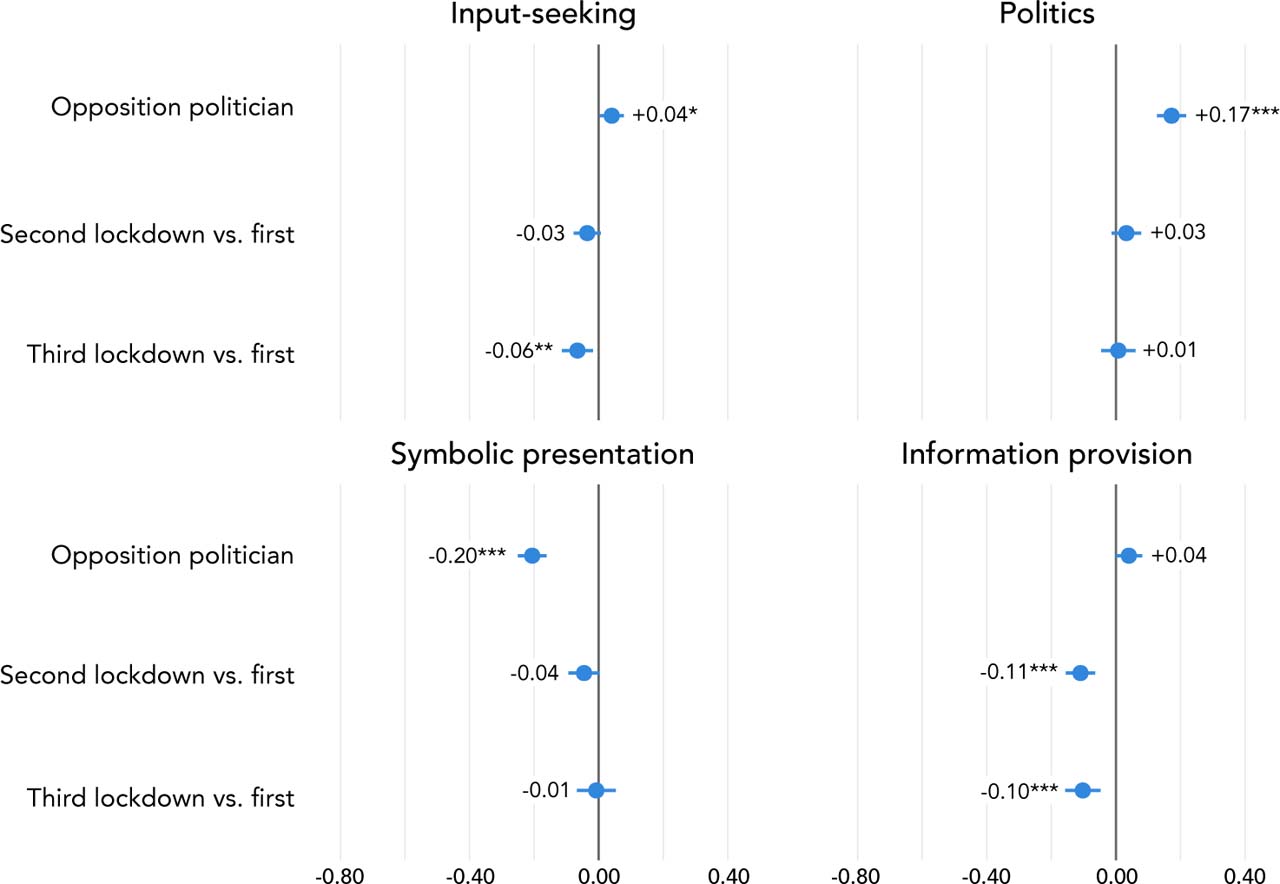
Figure 1
Facebook models for communication types across lockdown periods (Coefficient estimate)
Comments: *p < .05, **p < .01, ***p < .001. The figure shows coefficient estimates from Facebook-specific linear probability models. Outcomes are post-level binary indicators of whether each communication type appears in a post. Models include lockdown period, government or opposition status, and whether the post is Covid-19 related. Coefficients can be interpreted as percentage-point differences relative to the relevant reference categories: posts by party leaders from governing parties, posts from the first lockdown, and posts not coded as Covid-19 related. Robust standard errors are clustered by party leader. Blue points indicate coefficient estimates, and horizontal bars represent 95 per cent confidence intervals.
Figure 1 shows that the clearest temporal pattern on Facebook concerns input-seeking. Compared with the first lockdown, input-seeking declined in the second lockdown and further declined in the third, supporting H6. Rather than expanding participatory communication as the crisis developed, Facebook communication became less likely to invite questions, feedback, or participation.
The remaining temporal hypotheses receive weaker support on Facebook. Information provision declined during the second lockdown, but the estimate for the third lockdown is weaker, providing only partial support for H5. Politics remained comparatively stable, which does not support H7. Symbolic presentation also did not increase over time, meaning H8 is not supported. The Facebook models therefore suggest continuity rather than a simple shift from early information provision toward later politicisation or symbolic presentation.
The Facebook models also show role-based differences. Opposition leaders were more likely than governing leaders to use politics and information provision, but less likely to use symbolic presentation. Although government or opposition status is not treated as a formal research question, this pattern suggests that opposition leaders used Facebook for both political positioning and informational accountability work.
Platform-specific change on Instagram
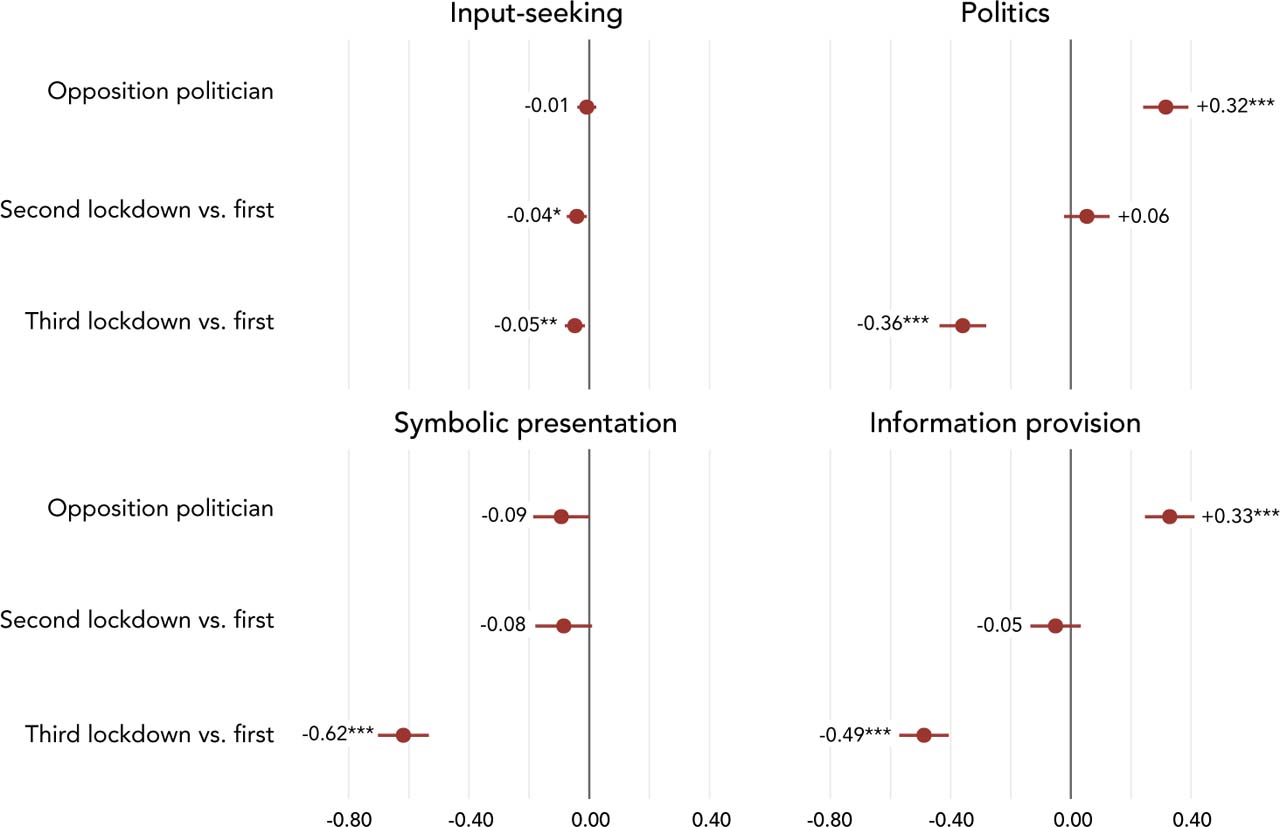
Figure 2
Instagram models for communication types across lockdown periods (Coefficient estimate)
Comments: *p < .05, **p < .01, ***p < .001. The figure shows coefficient estimates from Instagram-specific linear probability models. Outcomes are post-level binary indicators of whether each communication type appears in a post. Models include lockdown period, government or opposition status, and whether the post is Covid-19 related. Coefficients can be interpreted as percentage-point differences relative to the relevant reference categories: posts by party leaders from governing parties, posts from the first lockdown, and posts not coded as Covid-19 related. Robust standard errors are clustered by party leader. Red points indicate coefficient estimates, and horizontal bars represent 95 per cent confidence intervals.
Figure 2 shows a more selective and less stable pattern on Instagram. Input-seeking was rare and remained limited across the lockdown periods. More importantly, politics, information provision, and symbolic presentation declined markedly by the third lockdown. This indicates that Instagram became less central for several forms of party leader communication as the pandemic moved into later phases.
This finding matters for the platform hypotheses. Instagram was expected to be particularly conducive to symbolic presentation due to its visual and self-presentational affordances. The results do not support this expectation. Symbolic presentation was not more common on Instagram than on Facebook descriptively, and it did not increase on Instagram over time. Instead, it declined sharply by the third lockdown. Instagram’s visual affordances, therefore, did not produce a sustained increase in symbolic crisis communication across the lockdown phases studied here.
As on Facebook, opposition leaders were more likely than governing leaders to use politics and to provide information. This reinforces the interpretation that opposition leaders used social media platforms to remain visible, provide alternative framing, and position themselves in relation to crisis governance.
Platform-specific change over time
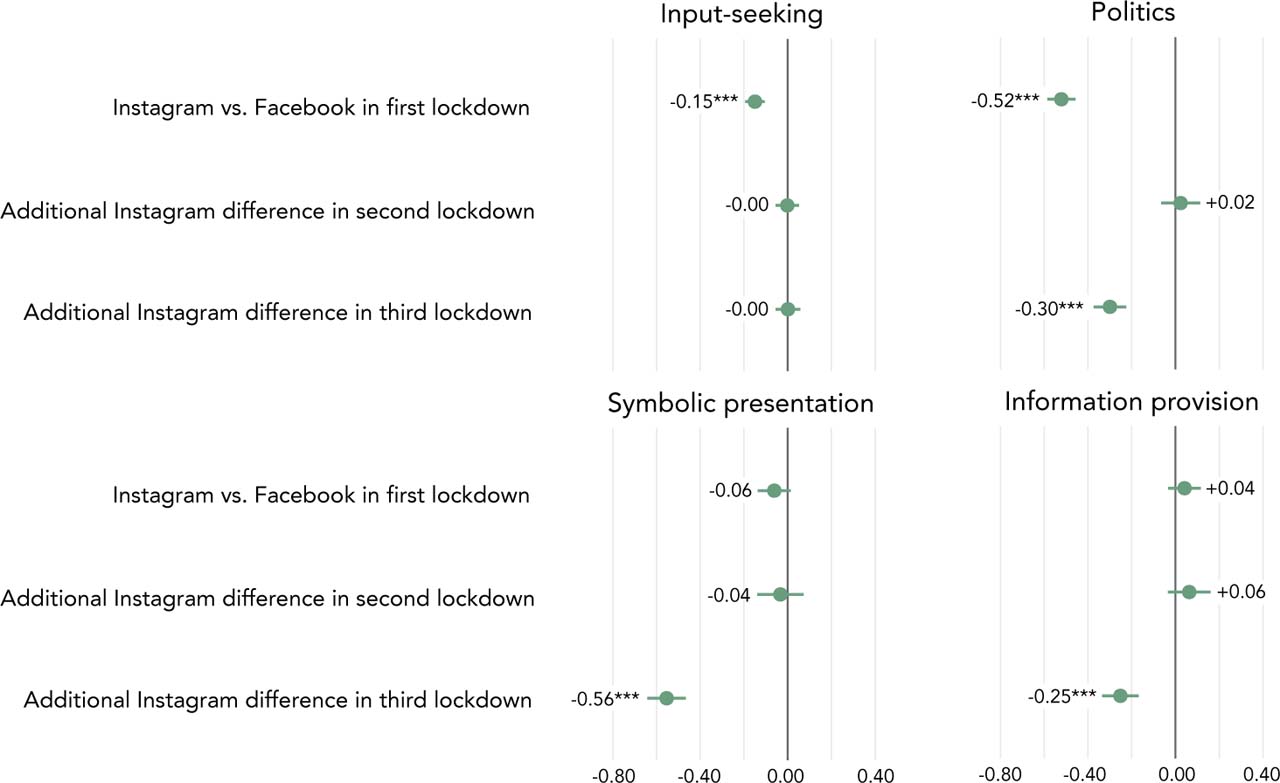
Figure 3
Interaction effects for platform and lockdown period (Interaction coefficient)
Comments: *p < .05, **p < .01, ***p < .001. The figure shows coefficient estimates from linear probability models with platform-by-lockdown interaction terms. Outcomes are post-level binary indicators of whether each communication type appears in a post. Models include lockdown period, platform, government or opposition status, whether the post is Covid-19 related, and platform-by-lockdown interactions. Coefficients can be interpreted as percentage-point differences. The Instagram coefficient estimates the conditional difference between Instagram and Facebook during the first lockdown. The interaction terms estimate whether this Instagram– Facebook difference changed in the second or third lockdown relative to the first lockdown. Robust standard errors are clustered by party leader. Point estimates are shown with horizontal bars representing 95 per cent confidence intervals.
Figure 3 addresses whether lockdown-related changes differed between Facebook and Instagram. It also clarifies why descriptive and model-based platform statements must be separated. Some platform (Instagram) coefficients are positive or close to zero in the interaction models. These coefficients do not mean that Instagram was the primary arena for those communication types overall. Table 2 shows that Facebook carried far more posts and that input-seeking and politics were much more common as shares of Facebook posts. The platform (Instagram) coefficient in Figure 3 is, instead, a conditional contrast for the first lockdown, while the interaction terms indicate whether this contrast changed in subsequent lockdowns.
Read in this way, the interaction models point to platform-specific recalibration rather than a general Instagram advantage. Input-seeking declined over time, with no evidence that Instagram compensated for this decline. Politics and information provision declined more on Instagram than on Facebook by the third lockdown. Symbolic presentation also became less prominent on Instagram over time. The results therefore provide clearer support for the platform expectations than for the temporal expectations. Facebook was the more frequently used platform and supported a broader communication repertoire, aligning with expectations for input-seeking and politics. By contrast, the expectation that symbolic presentation would be more common on Instagram is not supported. The strongest temporal finding is the decline in input-seeking; the expected later increases in politics and symbolic presentation are not found. Appendix D in the supplementary material provides a hypothesis-by-hypothesis summary of the support assessment and the key empirical result for each expectation.
Discussion and conclusion
In this article I have examined how Norwegian party leaders used Facebook and Instagram for different types of communication during three Covid-19 lockdowns, and whether these communication patterns changed as the pandemic developed. The findings point to one central conclusion: Platform affordances explain communication patterns more consistently than a simple crisis-stage logic. Facebook carried the larger communication volume and a broader mix of communication types, while Instagram was used more selectively. The clearest temporal change was the decline in input-seeking. The expected later-phase increases in politics and symbolic presentation were not supported.
Platform affordances and communication density
The clearest contribution concerns platform differentiation. Facebook did not simply function as another venue for the same communication that appeared on Instagram. It carried more posts and a broader communication repertoire. This supports the broader claim that social media platforms should not be treated as interchangeable channels. Platform architecture matters for what kinds of political crisis communication are easier to perform and sustain.
One implication is that platform differences are not only about where leaders post but also about how many communicative tasks a post can carry. Facebook’s text-forward and multi-format architecture appears to support more category-dense communication. A single Facebook post can combine information provision, political positioning, input-seeking, and symbolic presentation. This helps explain why Facebook is associated with a broader communication repertoire. It is not only more frequently used; it is also better suited to posts that layer explanation, justification, mobilisation, and leader presentation.
Instagram’s image-led logic creates a different communication environment. In theory, it should support symbolic presentation, personalisation, and visual leadership performance. Yet symbolic presentation was not more common on Instagram than on Facebook, and it declined there during the third lockdown. This suggests a boundary condition in the Instagram-as-symbolic-arena argument. Curated images may perform symbolic work effectively in campaigns or bounded events (Hase et al., 2023; Peng, 2021; Pineda et al., 2022), but prolonged crises require repeated guidance, justification, and accountability across changing urgency levels and policy disputes. Under these conditions, Instagram may support discrete moments of presence, but Facebook’s text-forward architecture appears better suited to sustaining a broader crisis communication repertoire.
Crisis temporality and controlled communication
The strongest temporal finding is the decline in input-seeking. This finding matters because social media platforms are often associated with participation, responsiveness, and direct interaction between political actors and citizens. During the Covid-19 pandemic, however, Norwegian party leaders became less likely to invite questions, feedback, or participation as the crisis developed.
This pattern is consistent with a prolonged-crisis interpretation. In the acute phase, leaders may have incentives to answer questions, signal openness, and help citizens make sense of new restrictions. As the crisis continues, those incentives change. Repeated restrictions, fatigue, public criticism, and accumulated policy costs make open-ended interaction harder to manage. Leaders may therefore shift toward more controlled communication, where the priority is to explain decisions, maintain clarity, and avoid unpredictable comment dynamics.
The temporal findings also qualify a simple politicisation argument. Politics and symbolic presentation did not become more common in later lockdowns. Instead, politics was already a regular part of communication on Facebook, while Instagram became more selective. This suggests that prolonged crises do not necessarily produce a linear movement from information provision to politicisation and performance. Crisis communication and routine political communication can coexist from the beginning, but their balance is shaped by platform-specific conditions.
Opposition communication and accountability
Government or opposition status was included as a control rather than as a formal research question, but the results show a consistent role-based pattern. Opposition leaders were more likely than governing leaders to use information provision and politics. This suggests that information provision is not only a governmental or administrative communication function. During crisis governance, opposition leaders may also use informational posts to claim visibility, signal responsibility, and frame government decisions from an alternative perspective.
This role-based pattern shows that accountability work during crises does not only take the form of overt criticism. In countries with high levels of trust in the government, such as Norway (OECD, 2023), political contestation may be more restrained, but it does not disappear. Opposition actors can contest crisis governance through informational framing, alternative interpretations, and selective emphasis on responsibility or policy consequences.
Limitations and future research
Several limitations should be noted. First, the study examines party leaders’ posts, not how citizens interpreted or responded to them. The analysis therefore addresses the supply side of political crisis communication. Future research could combine content analysis with survey data, interviews, comment analysis, or engagement metrics to examine whether different communication types affect citizen perceptions, trust, compliance, or political behaviour.
Second, the article uses linear probability models with cluster-robust standard errors at the leader level. This approach provides interpretable percentage-point estimates and accounts for repeated posts by the same leaders. However, posts are nested within leaders and parties, and a multilevel design could in principle model these dependencies more explicitly. Given the relatively small number of higher-level units, such models may produce unstable estimates. Future research with larger cross-national or cross-party datasets could examine whether the same patterns hold across more actors and contexts.
Third, the four communication types are broad. They make cross-platform comparison possible, but they do not capture all crisis-specific strategies. Reassurance, empathy, justification, uncertainty management, blame attribution, and competence signalling may overlap across information provision, politics, and symbolic presentation. This is especially relevant for Instagram, where meaning is often carried by images, staging, tone, and implied context. Future research could develop more crisis-specific and multimodal coding schemes.
Conclusion
This article shows that Norwegian party leaders’ social media communication during the Covid-19 lockdowns was shaped more consistently by platform affordances than by a simple crisis-stage logic. Facebook functioned as the broader and more durable arena for crisis-political communication. It carried more posts, supported more category-dense communication, and sustained a wider mix of information provision, input-seeking, politics, and symbolic presentation. Instagram was used more selectively, and several communication types declined there by the third lockdown.
The most consistent temporal change was the decline in input-seeking. Rather than becoming more participatory as the crisis persisted, party leaders became less likely to invite questions, feedback, or visible public input. The article therefore contributes to research on political communication, crisis communication, and platform affordances by showing that prolonged crisis communication is not only a question of what leaders need to say as a crisis develops. It is also a question of where those communicative tasks can be performed and sustained.
Acknowledgements
I wish to thank the research group at Kristiania University of Applied Sciences for helpful comments and discussions on earlier versions of this article, and the research assistant who contributed to the content coding. Proofreading and language editing of the article was done with the help of ChatGPT 5 thinking model, the Grammarly app online, and a round of language editing of a previous version using Scribendi.