

Introduction
Populism and extremism are on the rise in Europe. A crystallisation point of this political development, which was observed with concern from many sides, was the 2024 European Parliament (EP) elections. Though far-right parties performed below expectations, concerns remain about threats to core European values such as open society, rule of law, cultural diversity, and environmental sustainability. These challenges come not only from emerging parties but also from established actors, and in some countries, even from governments seeking to undermine liberal democracy (Maaten et al., 2024).
Social media platforms have become fertile ground for populist and extremist messaging. Algorithms and user-generated content amplify politically charged narratives, reinforcing group identities and challenging societal norms (Rothut et al., 2024). While actors across the spectrum use populist communication on social media (Bene et al., 2023; Lilleker & Balaban, 2021), the platforms have become particularly crucial in populist parties’ communication strategies (Engesser et al., 2017) since they allow them to bypass traditional media and engage users directly (Chadwick, 2017). Many scholars thus link the rise of populist parties to the growing influence of social media in many Western countries over the past decade (Maurer, 2022). There are indications that this applies similarly to the rise of extremist actors, with digital platforms enabling their narratives to spread across both fringe and mainstream spaces (Collins, 2023; Zhang & Davis, 2022).
Populism and extremism are related but distinct phenomena (Hardy, 2023); however, they are often conflated in public and academic discourse, making nuanced analysis difficult. To enable a more differentiated analysis, we treat them as distinct communicative strategies – populist communication and extremist narratives – within a shared analytical framework. Our contribution lies in extending the communicative approach from populism research (Reinemann et al., 2016) to extremism, allowing us to differentiate both phenomena and empirically examine both the presence and overlap of these strategies in campaign communication. While it is expected that extremist actors use populist communication and extremist narratives, it is particularly concerning when centrist parties adopt such strategies – especially in the consensus-oriented Nordic countries. Our approach enables us to measure potential reasons for concern systematically. We apply it in a standardised manual content analysis of 2,700 Facebook posts from 24 political parties and their leaders in Denmark, Finland, and Sweden during the 2024 European Parliament (EP) election campaign. Recognising extremist narratives as more radical than populist communication, our overarching research questions are the following:
RQ1. How did the use of populist communication and extremist narratives vary across countries and parties?
RQ2. To what extent did their prevalence overlap?
Since far-right parties are politically more influential than far-left parties in the countries we investigated, and therefore have better chances to spread their narratives, our analysis focuses on measuring how right-wing extremist narratives were used by political parties, independent of ideology. Despite close historical ties and many shared characteristics, Sweden differs markedly in this respect (most similar systems design): Radical-right populism rose later, the Sweden Democrats have more extreme roots than their Danish and Finnish counterparts, and while Finland and Denmark gradually integrated populist-right parties into governance, Sweden upheld a cordon sanitaire until 2022, leading to sharper political polarisation. We find that populist communication, and particularly extremist narratives, were not very prevalent, but they were more common in Sweden, suggesting a contagion effect (Sebastião, 2024) from the radical-right Sweden Democrats to the Swedish mainstream parties and against a uniform “Nordic pattern” of populist communication and extremist narratives. Our analysis demonstrates the value of a communicative approach to studying populist communication and extremist narratives.
Conceptual framework
During election campaigns, voters face an overload of information, making it hard for political actors to get their messages across. They must use strategic communication to stand out and capture voter attention. Social media platforms’ popularity bias demands highly engaging content for visibility. Among various engagement-boosting strategies like negativity (Balaban et al., 2024), emotions (Bene, 2017), and personalisation (Metz et al., 2020), we focus on populist communication and extremist narratives, which share a focus on more radical views. We understand both as communicative phenomena used in a strategic way to generate user engagement, and we consider them particularly relevant given their potential to undermine democracy.
Populist style elements (Bene et al., 2023 Bozdağ et al., 2024) and extremist content – for example, xenophobic messaging (Schwemmer, 2021) or memes embedding far-right humour (Schmid et al., 2024) – have been shown to effectively trigger user engagement, populist style elements even more effectively than populist ideology (Bracciale et al., 2021; Hameleers et al., 2020). While populism and extremism are related, both remain distinct phenomena (Hardy, 2023) and should be treated as such in empirical research. However, previous research has not yet sufficiently addressed their differences and interconnections, and some authors even understand populism as an element of extremism (e.g., Masalha & Baş, 2023). Our study takes a communicative approach to both phenomena that allows us to measure their appearance as populist communication and extremist narratives distinctly. We are interested in how widespread the use of these communication strategies is among Nordic parties and to what extent the two are intertwined.
Populist political communication
Populism is an ambivalent term that lacks a consensual definition. The literature often links it to certain political ideologies, both on the right (e.g., nationalism, fascism) and the left (e.g., socialism, communism) side of the political spectrum. In such actor-based approaches, political actors are pre-defined as populist or not populist (Mudde, 2004), often assuming that only populist actors use populist communication. Such a rather static definition of populism, however, makes it difficult to map dynamic developments in the political landscape. Over time, political actors can become more populist or renounce populism. When investigating social media platforms whose algorithms are often assumed to reward the use of populism since it generates user engagement, we consider it more appropriate to treat populism as a discursive style. We thus position our study within the communicative approach to populism (Aalberg et al., 2016; Jagers & Walgrave, 2007; Moffitt, 2016) that is frequently used to investigate populist communication on social media (e.g., Bene et al., 2023; Magin et al., 2024). By focusing on the extent of populist elements in political messages, this approach enables nuanced measurement of different types and degrees of populist communication, allowing empirical identification of populist actors based on their messaging – regardless of ideology (de Vreese et al., 2018). We apply Reinemann and colleagues’ (2016) three-dimensional conceptualisation of populist political communication, which is based on Jagers and Walgrave’s (2007) work. These dimensions – people-centrism, anti-elitism, and out-groups – can appear individually or together in political messaging (see also Aalberg et al., 2016).
People-centrism is the core element of populist communication (de Vreese et al., 2018). Populists claim to speak for “the people” – an imagined, ostensibly homogeneous subset of the population (Mudde, 2004) – and promise to restore their lost power (Canovan, 1999; Gerbaudo, 2018). Who exactly “the people” refers to varies (Canovan, 1999), and vague definitions help populist messages maintain broad appeal (Maurer, 2022). While people-centrism can stand alone, it is frequently contrasted with the two other dimensions of populist communication; often, it is only this contrast which helps define “the people” more clearly (Reinemann et al., 2016).
Anti-elitism targets elites as being located above the people in the social hierarchy and opposing the people’s will (Reinemann et al, 2016), and it can boost populist vote intentions (Hameleers et al., 2018). The targeted elites vary – political, media, economic, cultural, and so on (Hellström, 2023) – and the focus shifts by ideology: Left-wing populism often criticises economic elites, while right-wing populism targets political, media, or scientific elites (Maurer, 2022).
Out-groups are portrayed in populist communication as threats to be excluded; this “othering” reinforces the identity of “the people” as in-group through contrast. Out-groups – such as immigrants or minorities – are seen as unfairly favoured by elites despite being socially positioned beside or below the people. The definition of out-groups varies by political ideology (Hellström, 2023; Reinemann et al., 2016).
Engesser, Fawzi, and Larsson (2017) have viewed populist communication – especially on social media platforms – as a mobilising communicative strategy that taps into public discontent. Assumingly, this becomes even more pertinent in times of (perceived) economic, cultural, or political crises, like the ones we are currently living in (Haßler et al., 2025), particularly when following Moffitt (2015), who has defined triggering and “performing” crisis as a key element of populism. The actor-centric and the communicative approach to populism have been shown to be empirically related: Actors with populist ideologies tend to use both the dimensions of populist communication (Haßler et al., 2025) as well as negativity, character attacks, and fear messages (Nai, 2021) more often than non-populist actors. Yet, many mainstream parties also adopt populist communication to some extent (Lilleker & Balaban, 2021), which speaks to our focus on the communicative approach when analysing the communication of parties across the political spectrum.
Extremist narratives
In the literature, extremism is, like populism, often treated as an ideology, and actors are binarily classified as being extremist or non-extremist. However, we argue that just like populism, extremism can be used as a communicative strategy, taking the form of extremist narratives: the stories, frames, and rhetorical devices through which extremist ideas are communicated, for example, on social media platforms, and may appear and be spread and contested by a variety of political actors. By extending the communicative approach to extremism, we understand extremist narratives as communicative frames or storylines that reject the core principles of liberal democracy (e.g., pluralism, rule of law, minority rights, and equality) and promote exclusionary or authoritarian alternatives (Bjørgo & Ravndal, 2022: 3).
Empirical work on radicalisation and the prevention of violent extremism already uses narrative analysis to detect the presence of extremist messages, recruitment into terrorist networks, or the design of counter-narratives (Braddock, 2020; Carthy, 2021). By applying a similar narrative lens to parties’ campaign posts on Facebook, we make a novel contribution, both methodologically (by operationalising extremist narrative indicators) and theoretically (by decoupling narrative use and actor type). This kind of interdisciplinary approach to extremism and radicalisation is beginning to take shape (Abbas, 2024) with sociology, political science, and international relations becoming more aware of the needed connections across fields. To this debate, we bring the communication contribution, which has the benefit of allowing us to track how extremist narratives enter and circulate in campaign communication. It also allows for capturing variation in how “extremist content” may be used by fringe or more mainstream actors, showing that the boundaries between mainstream and fringe communication may be porous.
Extremist narratives can take both explicit and implicit forms. Explicit narratives openly reject liberal-democratic principles, for instance, by attacking human rights, rejecting the rule of law, and calling for the exclusion of minorities. Implicit narratives, by contrast, use coded language or allusions, such as references to “protecting traditional families” or “defending borders”, which signal similar anti-liberal ideas without naming them directly. By analysing extremist narratives as communicative strategies, we can capture both overt and more subtle instances of extremist content in mainstream campaign discourse.
In the EP election context, extremism cannot be fully understood without reference to the EU itself. Opposition to the EU is sometimes linked to extremism because it can overlap with the rejection of liberal-democratic principles. However, Euroscepticism and extremism are not equivalent. Euroscepticism describes “a range of critical positions on European integration, as well as outright opposition” to “its policies, its institutions, or its principles” (Hooghe & Marks, 2007: 120), which can take both soft and hard forms (Taggart & Szczerbiak, 2004). Soft Euroscepticism reflects legitimate critique of EU integration or policies, whereas hard Euroscepticism may converge with extremism when articulated in explicit rejections of the EU’s foundational values of democracy, pluralism, and fundamental rights. In this sense, hard Euroscepticism can serve as a bridge between populism and extremism, linking a populist “people vs Brussels” frame to a more radical rejection of liberal-democratic norms.
This view is consistent with van Kessel’s (2025) review of recent scholarship, which stresses that the relationship between populism, the far right, and Euroscepticism is more complex than is often assumed. Populist radical-right parties, while among the fiercest critics of the EU, are rarely fully “anti-European”. Rather, they adopt ambivalent positions that portray “Europe” as both a cultural identity worth defending and an elite-driven project undermining national sovereignty (see also Lorimer, 2024; Heinisch et al., 2021). These insights underline the importance of treating populism, Euroscepticism, and extremism as analytically distinct: populism as a communicative style, Euroscepticism as a substantive critique of integration ranging from soft to hard, and extremism as even more radical discourse that rejects liberal-democratic values. It is where these positions intersect that extremist narratives can emerge, linking populist frames with rejection of EU principles.
The relationship between populist communication and extremist narratives
Similar to populist communication, extremist narratives show a clear connection with social media (Hellström, 2023) that facilitate the diffusion of exclusionary frames, whether employed by actors on the far right, far left, or other political outsiders (Hardy, 2023; Scrivens et al., 2023). Social media platforms provide opportunities for “facilitating support networks and propagating extremist narratives” (Hutchinson et al., 2023: 215). While existing research has largely focused on the social media communication of groups with explicit extremist ideologies (e.g., Hardy, 2023; Hutchinson et al., 2023; Ghasiya et al., 2023), our approach highlights that such narratives, similarly to populist communication, may also be adopted by non-extremist actors, blurring the line between fringe and mainstream discourse. Studies of extremist parties using populist rhetoric (Charalambous & Christoforou, 2018) indicate that explicit rejection of liberal democratic principles is often intertwined with core populist frames. The contradiction that populist communication creates – between “the people” on the one hand and elites or “dangerous others” on the other – aligns closely with the in-group/out-group dynamics of extremist groups. Berger (2018) defined both in-groups and out-groups as collectives whose identities are defined by shared beliefs, traits, and past, present, and future practices. The perceived identity of the out-group is constructed through assumptions and attributions made by the in-group, which exhibits strong hostility toward the out-group (Berger, 2018: 51–57).
These overlaps between both concepts underline why it is useful to distinguish between different narrative types: Populism challenges elites and representative institutions but typically operates within democratic systems (Gerbaudo, 2018; Müller, 2016). Extremism, by contrast, involves the rejection of liberal-democratic principles such as pluralism, the rule of law, and minority rights, often aiming to delegitimise or dismantle democratic institutions (Bjørgo & Ravndal, 2022: 3; for a comparison with populism, see also de Vreese, 2018; Ernst et al., 2017).
Defined this way, populism and extremism become analytically distinct yet, at least occasionally, intersecting phenomena. While populist communication is not inherently extremist, its binary “people vs elite/out-groups” framing can facilitate the adoption of extremist narratives, particularly in polarised contexts (Štětka & Mihelj, 2024). Our communication-centred approach enables us to compare them directly within the same framework: By treating both as discursive phenomena, we can assess to what extent parties draw on elements of populist communication, extremist narratives, or both in their campaign discourse. Since previous research on the relationship between populist communication and extremist narratives is lacking so far, we did not derive any hypotheses on this relationship, but rather the open RQ2 (see introduction) that addresses the extent to which prevalence of both strategies intersected in Danish, Finnish, and Swedish parties’ campaign communication.
However, since campaign strategies strongly differ between parties, it is very likely that various parties will make use of political communication and extremist narratives to different degrees. Previous research has shown that fringe parties typically use a higher degree of populist communication than centrist parties (Maurer, 2022). We assume that this applies just as much, if not more, to extremist narratives, which are even more extreme than populist communication. Therefore, we hypothesise:
H1. Fringe parties used a higher degree of populist communication (H1a) and extremist narratives (H1b) on their Facebook pages than centrist parties.
Case selection
Our study focuses on the three Nordic EU member states: Denmark, Finland, and Sweden. The sample does not include the Nordic countries Iceland and Norway, which are not EU members and did not participate in the 2024 EP elections. The Nordic countries share a strong social democratic tradition, often referred to as the “Nordic welfare state”. Built with a transformative agenda, this system aims not just to reduce class and status differences, but to include everyone in universal welfare provisions that promote citizen participation in political and cultural life (Syvertsen et al., 2014). The countries also share a strong focus on digitalisation, with nearly all citizens online (99% in Denmark; 94% in Finland; 97% in Sweden) (Newman et al., 2024). Social media platforms are widely used, making them fertile ground for campaign communication. Facebook stands out as the most used platform for both general and news purposes (Denmark: 70%/32%; Finland: 65%/28%; Sweden: 66%/25%) (Newman et al., 2024) and for campaign communication (in Finland, WhatsApp is slightly more common than use for “any purpose” (72%) but as a messenger service, WhatsApp is not directly comparable to social platforms such as Facebook). That all parties in our sample had official Facebook accounts (contrary to other platforms) highlights its central role in political discourse in the Nordic region. Therefore, our study focuses on Facebook.
Also, the political systems are similar: All use proportional representation, with 8–10 parties in parliament (Bengtsson et al., 2013). Political parties, rather than individual candidates, are the primary actors, which is why our analysis centres on them. A tradition of consensus, coalition-building, and cross-party cooperation exists across all three countries (Bergman et al., 2021). Each also has far-left and far-right parties (Rooduijn et al., 2017), with the latter in general being politically more successful. Though the countries share close historical ties and similar characteristics, a key difference stands out (most similar systems design): Radical-right populism emerged much later as a major political force in parliament in Sweden (Rydgren 2002; Wennerhag & Elgenius, 2018). With their far-right roots, the Sweden Democrats have a more extreme political origin (Wennerhag & Elgenius, 2018) than the Danish People’s Party as successor of the ultra-liberalistic, partly pro EU (EC) Progress Party and the Finns Party as successor of the primarily agrarian Finnish Rural Party. As these parties became more institutionalised (Johansson et al., 2024), they were gradually integrated into the mainstream – though to varying degrees: In Finland, populist-right parties joined government coalitions; in Denmark, the Danish People’s Party supported minority governments, narrowing the gap between populist and traditional actors (Jungar & Jupskås, 2014). Sweden, by contrast, maintained a cordon sanitaire against the Sweden Democrats until their inclusion via the 2022 Tidö agreement, which intensified political rivalry and led to higher levels of affective polarisation compared to Denmark and Finland (Oscarsson et al., 2021; Ryan, 2023).
This initial situation suggests the likely presence of populist and extremist narratives in our data, even though Nordic far-right parties are less extreme than far-right parties in many other countries. Previous studies on Nordic parties’ social platform campaigns showed a rather low degree of populist communication (e.g., Magin et al., 2024), which may be explained by the focus on consensus and integration in the countries. At the same time, Schwartz and colleagues (2023) found that Facebook was the most successful platform for right-wing populist communication across all Nordic countries, with those in Sweden occupying the strongest position overall, which might be explained by the fact that participation in government tends to have a moderating effect on political parties’ communication: Assumingly, the Sweden Democrats made greater use of populist communication and extremist narratives over a longer period of time. Prior research has suggested a “contagion effect” of radical-right parties, leading to mainstream parties adopting right-wing political stances (Sebastião, 2024). Taken together, this discussion suggests that a uniform “Nordic pattern” of populist communication and extremist narratives may not hold, but rather that these communication strategies are more widespread in Sweden than in the neighbouring countries. Therefore, we hypothesise:
H2. Danish and Finnish political parties used populist communication (H2a) and extremist narratives (H2b) to a similar extent on their Facebook pages.
H3. Swedish political parties used populist communication (H3a) and extremist narratives (H3b) more often on their Facebook pages than Danish and Finnish political parties.
The 2024 EP elections offer a strong basis for cross-country comparison, as campaigns occurred simultaneously under similar conditions. In Denmark (turnout: 58%) ten parliamentary parties ran with domestic issues dominating the agenda. Defence and security replaced the green agenda that was dominant in the 2019 EP elections, driven by instability following the war in Ukraine. Unlike previous elections, EU scepticism was minimal, with even critical parties softening their stance post-Brexit; the People’s Movement against the EU no longer ran for office. The Socialist People’s Party became the largest party, surpassing the Social Democrats, and three parties – the newly founded Moderates (centre), the Liberal Alliance (centre-right), and the newly founded Denmark Democrats (populist-right) – won EP seats for the first time.
In Finland (turnout: 50.7%), the Left Party, whose party leader was about to step down, saw surprise success, with a record vote (13.7%) and winning three seats. The National Coalition Party, winner of the 2023 national election, maintained its lead, while the Finns Party dropped sharply, likely due to voter disengagement in the EP elections and dissatisfaction with the party leader’s budget policies. The campaign unfolded amid national unrest, including strikes and budget cuts. Left-wing opposition parties emphasised welfare, human rights, Ukraine, and Gaza, and warned of rising far-right influence, while the Finns Party focused on anti-immigration and open EU politics. Social platform regulation (e.g., the European regulation with Meta and banning of TikTok) also emerged as a key issue.
The EP race in Sweden (turnout: 53.4%) was highly competitive, with over 100 parties registered, though only eight parties won seats. The only changes in seats compared to the 2019 EP elections were that the Left Party gained one seat, while the Christian Democrats lost one. The Social Democrats led with 24.7 per cent, followed by the Moderates (17.5%). The Greens and the Sweden Democrats received similar results. The latter reflects the shift from earlier discussions of “Swedish exceptionalism” in radical-right voting (Rydgren & van der Meiden 2019; Wennerhag & Elgenius 2018; for more information about the election outcomes, see European Parliament, 2024).
As mentioned, in this context, it is useful to examine far-right parties’ affiliations in EP groups. After the 2024 EP elections, the Denmark Democrats, Finns Party, and Sweden Democrats joined the more moderate Eurosceptic European Conservatives and Reformists (ECR), while the Danish People’s Party joined the far-right Patriots for Europe (PfE).
Methods
Sample
To answer our research questions and test our hypotheses, we conducted a manual, standardised content analysis of all posts published on the official Facebook pages of parties that received at least 5 per cent of the vote in Denmark (10 parties), Finland (7), and Sweden (7), as well as the official pages of their lead candidates within four weeks before and on election day (9 June 2024). To reflect both the parties’ strategic decisions when creating posts and the way that “average users” use and perceive parties’ Facebook posts (namely as a unit), we took a holistic approach when coding the posts. As a unit of analysis, we defined the entire Facebook post, including post text (caption), images, videos (including text embedded in images/videos), profile names, geo tags, and mentions. To keep the amount of content manageable, we limited the coding of visuals to the first image and the first minute of the first video in each post, reflecting the fleeting way many users engage with Facebook content. The posts were collected by means of CrowdTangle (a public insight tool that allowed access to public content on Facebook pages, groups, and verified profiles until August 2024). The posts were coded using the joint codebook of the project Campaigning for Strasbourg (CamforS), ensuring cross-country comparability. The sample consists of 2,700 Facebook posts (979 from Denmark; 918 from Finland; 803 from Sweden). This comparative design allows us to examine both overall levels of populist communication and extremist narratives communication and variation across countries and parties.
Figure 1 shows the breakdown of posts per country and each party/lead candidate. Table A1 in the Appendix gives an overview of all political actors included, their political ideologies, and whether they are classified as populist parties according to the PopuList (Rooduijn et al., 2017). Reflecting that parties and their candidates in the Nordic countries do not run independent campaigns, but rather closely linked and centrally controlled ones, all subsequent analyses collapse both into one category per party (henceforth political actors).
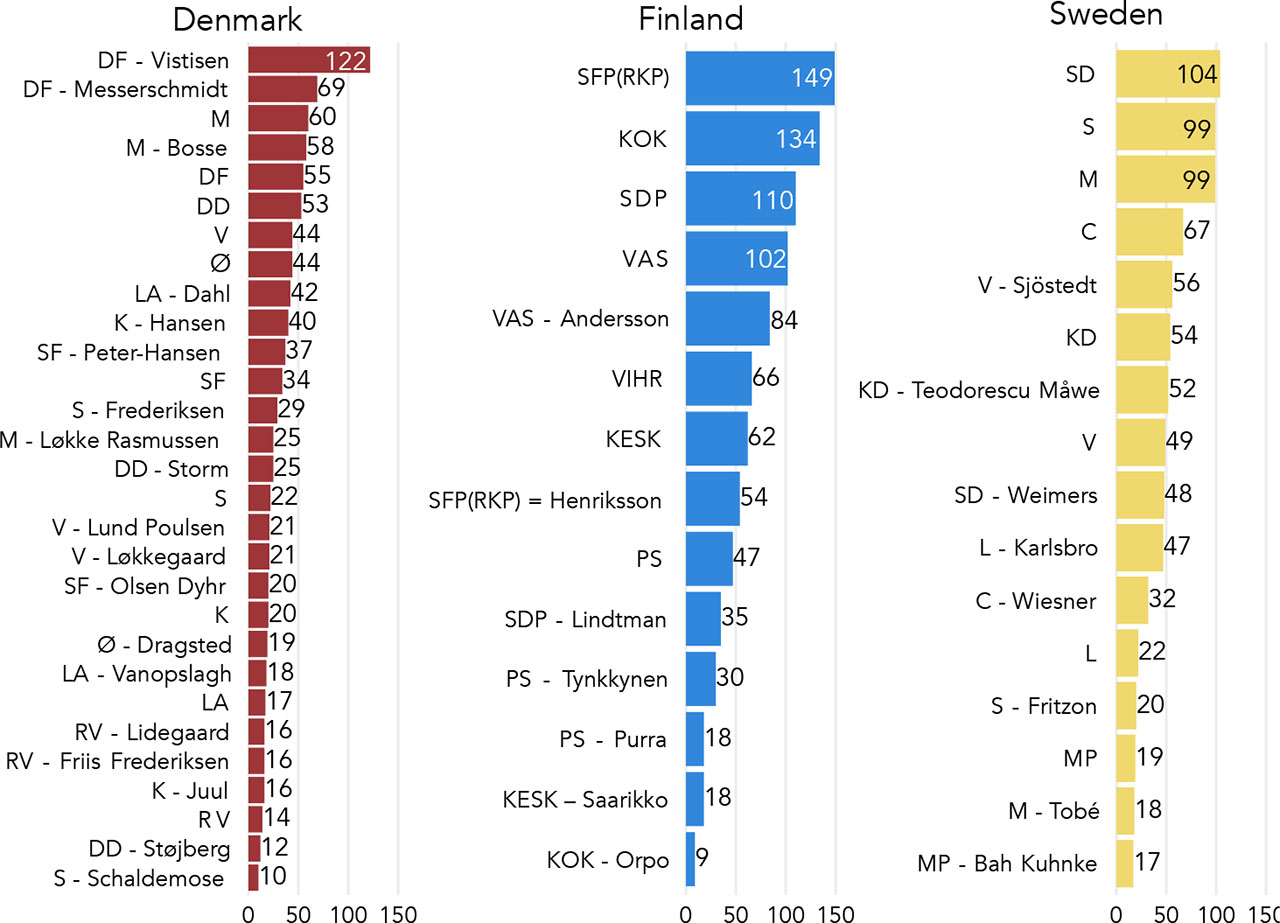
Figure 1
Number of posts per political actor by country
Comments: Løkke Rasmussen (M) in Denmark refers to Lars Løkke Rasmussen, not Bergur Løkke Rasmussen.
Measurements
Each post was coded for the presence of populist communication and/or extremist narratives. Populist communication was assessed using Reinemann and colleagues’ (2016) framework, identifying three elements – references to the people, anti-elitism, and exclusion of out-groups (measured by two sub-categories: ethnic/cultural “others” and political “others”). Each element was coded separately as present (1) or absent (0).
Extremist narratives were defined as communication explicitly rejecting 10 liberal-democratic principles outlined in Article 3 of the Treaty on European Union. Each of these was separately coded as present (1) or absent (0). While our codebook includes more principles, our analyses focus on those used to investigate right-wing extremism in previous content analyses (Masalha & Baş, 2023; Scrivens et al., 2023; Zhang & Davis, 2022): protection of national values, attacks or infringement on the rule of law (including human rights), anti-immigration, anti-feminism, anti-LGBTQ+ equality, anti-environmentalism, countering academic freedom, attacking/arguing against cultural and linguistic diversity, against minorities, and against open borders/upholding national borders (for category descriptions, see Table A2 in the Appendix). Posts expressing Euroscepticism were only coded as extremist if they went beyond criticism of EU integration and promoted the rejection of core democratic values. This distinction ensures that not all Eurosceptic content is classified as extremist, but only those rejecting liberal democracy.
Based on these categories, we calculated two indices (inspired by Koc-Michalska et al., 2016; Larsson et al., 2025) – the Populist Communication Index (PCI) and the Extremist Narratives Index (ENI) – by averaging the values of four and ten respective underlying variables, both ranging from 0 to 1 to reflect the degree of populist communication or extremist narratives in the posts.
Reliability
Coding was conducted by three coders in Denmark, two in Finland, and two in Sweden. To test cross-country reliability, all coders coded 97 randomly selected English-language posts by European parties (equal to 10% of the material in Denmark, 11% in Finland, and 12% in Sweden) whose coding did not require any specific background knowledge. We calculated Brennan and Prediger’s kappa, which is chance-corrected and more robust than Krippendorff’s alpha regarding variables like ours with a skewed distribution (Quarfoot & Levine, 2016), and we also report the “raw” agreement levels (% agreement). Reliability was sufficient for all categories (see Table A2 in the Appendix).
Results
Below, to answer RQ1, we first compare the use of populist communication and extremist narratives across countries (H2 & H3) and political actors (H1). Afterwards, we analyse the correlation of both strategies in Facebook posts, answering RQ2.
Populist communication across countries
Country means in Figure 2 were compared using a Kruskal-Wallis test, which showed significant differences (p < .001). Dunn’s post-hoc of the PCIs revealed that Swedish political actors used significantly more populist communication than those in Finland and Denmark (p < .001 for both comparisons), who did not differ from each other (p > .05), supporting H3a and H2a. However, on a scale from 0 to 1 for the highest possible degree of populist communication, even Sweden’s PCI score indicates a low overall use of populist communication.
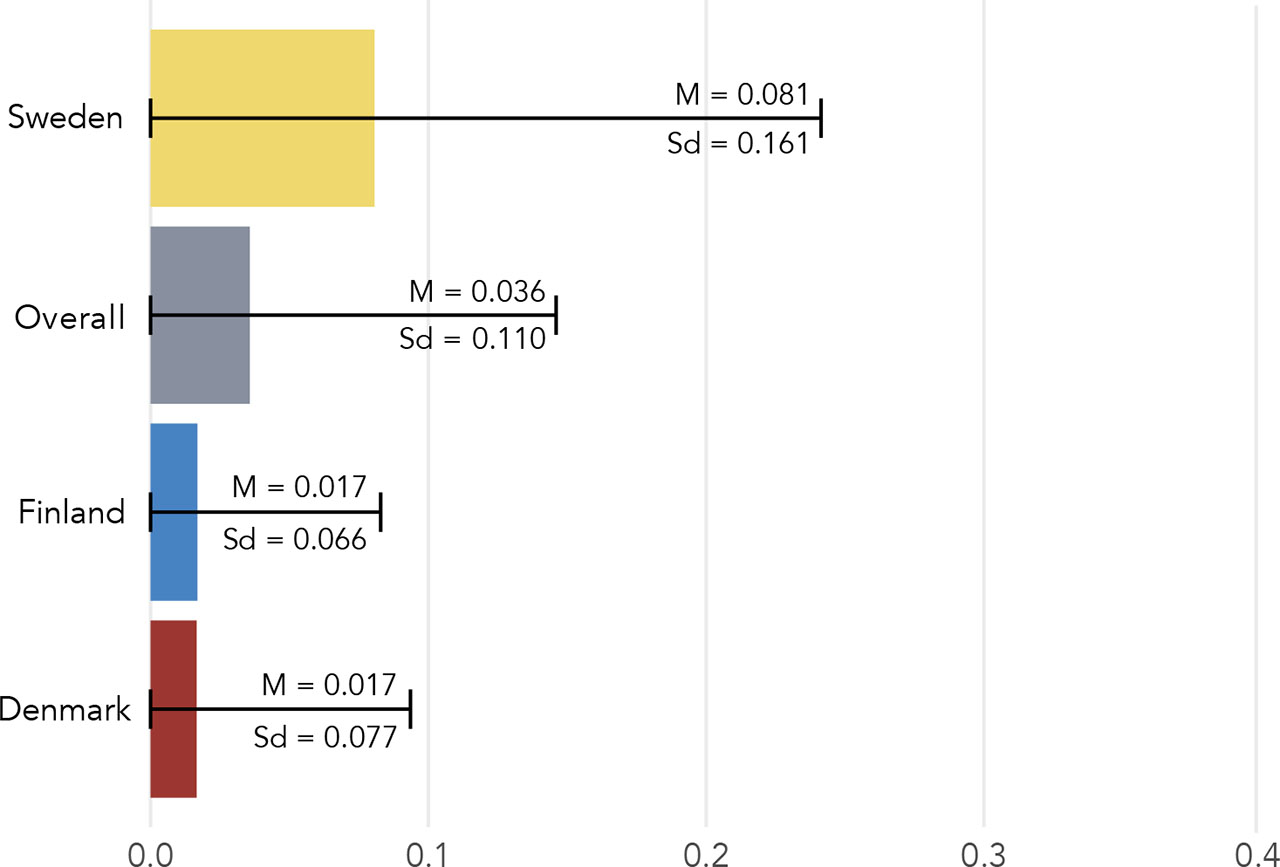
Figure 2
Means and standard deviations of PCI by country and overall
Populist communication across political actors
As Figure 3 shows, in Denmark, a Kruskal-Wallis test showed significant differences (p < .01). Dunn’s post-hoc test revealed that the right-wing Danish People’s Party (DF) used significantly more populist communication than all other Danish actors (p < .05). No other significant differences were found between any political actors (p > .05). In Finland, a similar pattern emerged. The Kruskal-Wallis test was significant (p < .01), and Dunn’s test showed that the right-wing Finns Party (PS) and the left-wing Left Alliance (VAS) used significantly more populist communication than all other Finnish parties. However, the difference between PS and VAS was not significant (p > .05).
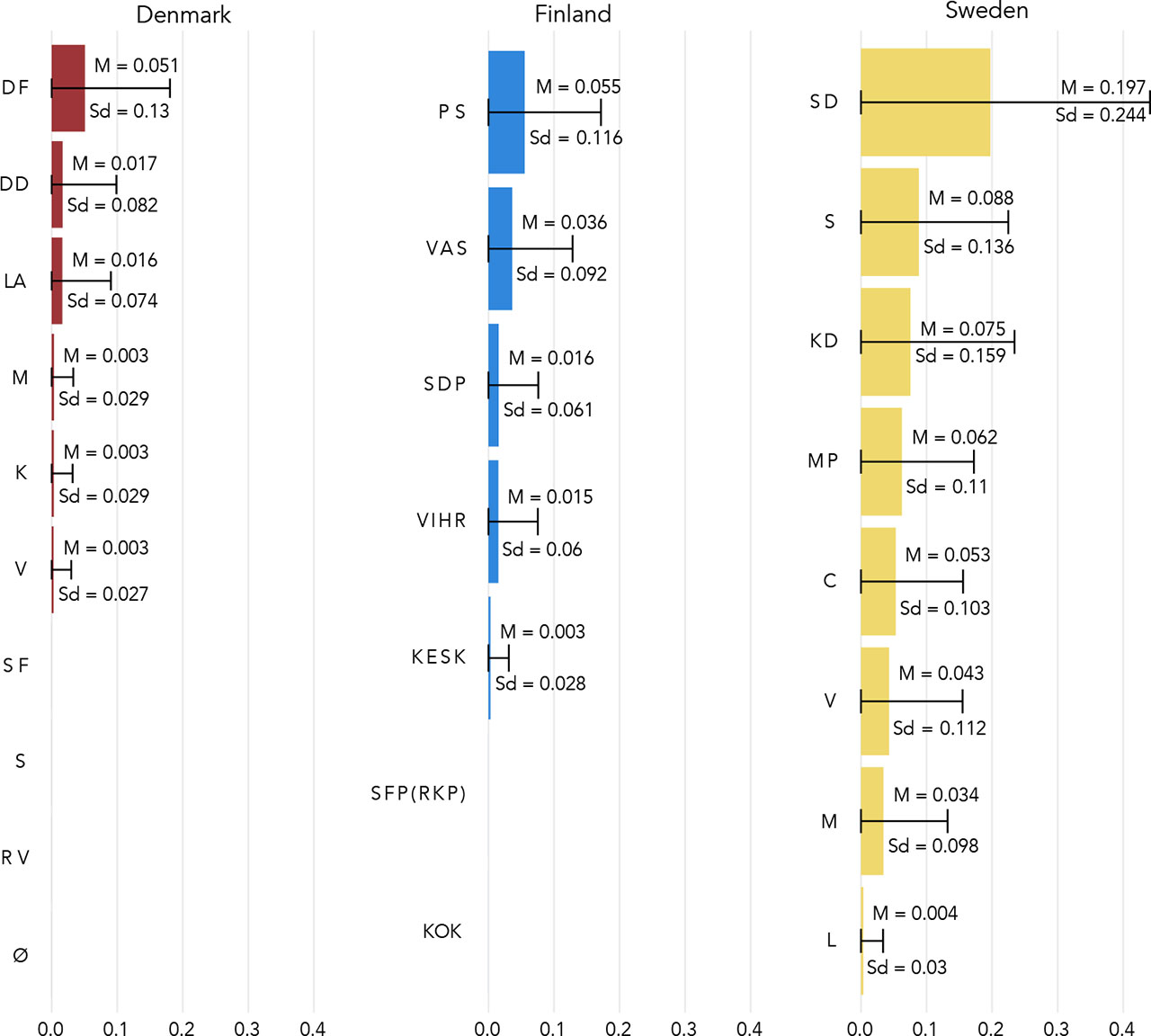
Figure 3
Means and standard deviations of PCI for political actors by country
In Sweden, the pattern mirrored Denmark: The right-wing Sweden Democrats (SD) used significantly more populist communication than all other parties, who did not differ from each other (Kruskal-Wallis: p < .01; Dunn’s test: p < .05 for all SD comparisons). In sum, while right-wing parties led in populist communication in Denmark and Sweden, Finland showed a different pattern, with both a right- and a left-wing party as top users. Overall, these findings support H1a: Fringe political actors used more populist communication than centrist ones.
Extremist narratives across countries
The ENI means for the countries in Figure 4 are low – even lower than those for the PCI – indicating a very limited use of extremist narratives in all three countries. A Kruskal-Wallis test confirmed significant differences between countries (p < .001). Dunn’s post-hoc test showed no significant difference between Sweden and Denmark (p = .477), but Finland’s mean was significantly lower than both, indicating that extremist narratives were least used in Finland (H2b & H3b rejected).
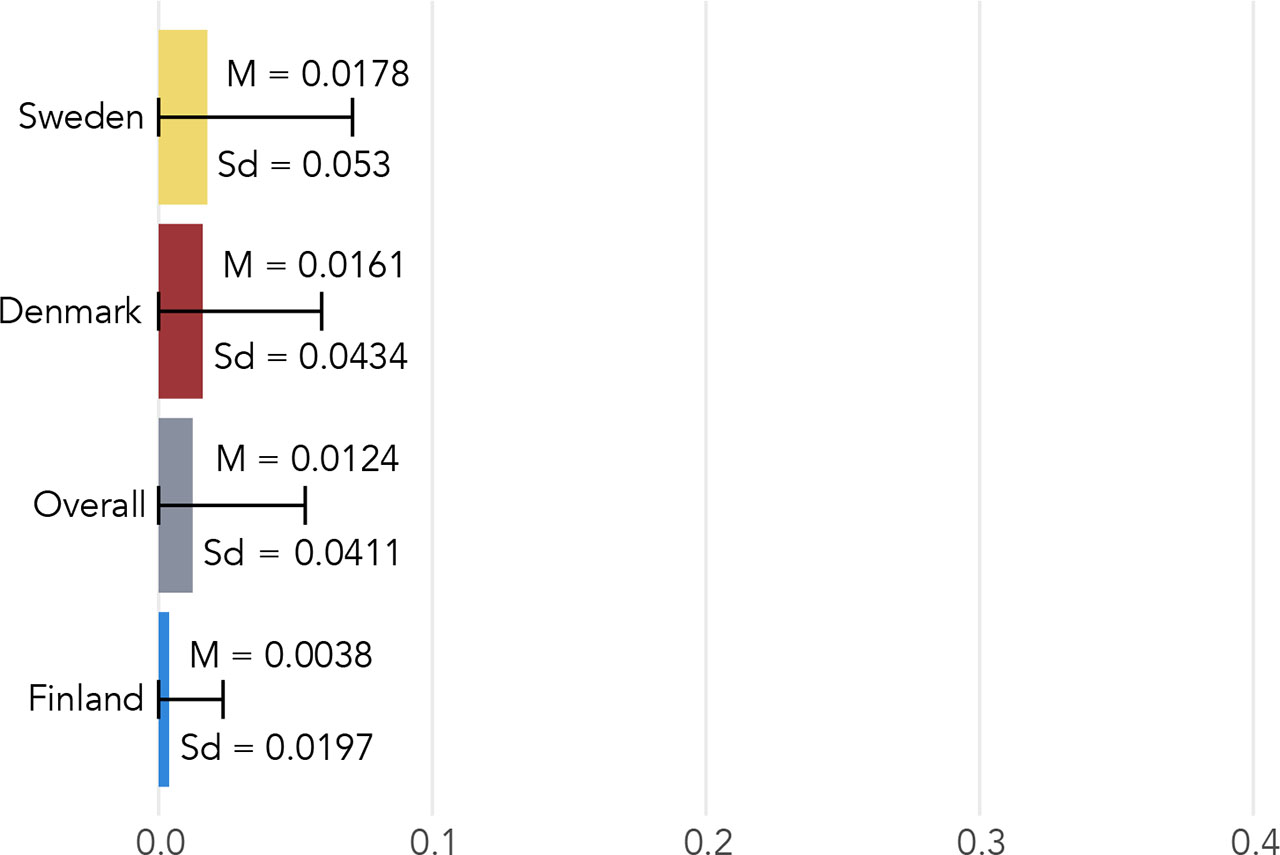
Figure 4
Means and standard deviations of ENI by country and overall
Extremist narratives across political actors
Figure 5 shows that many political actors across countries did not or hardly used any extremist narratives. The ones using it most were the right-wing fringe political actors. In Denmark, the Danish People’s Party (DF) and the Denmark Democrats (DD) – both right-wing – showed similar ENI means, with no significant differences (Kruskal-Wallis: p = .464). In Finland, the Finns Party (PS) stood out, with a significantly higher ENI mean than all other Finnish political actors (Kruskal-Wallis: p < .05; Dunn’s test: p < .001), while no other differences were significant between any Finnish political actors, including the left-wing fringe Left Alliance (VAS). In Sweden, the Kruskal-Wallis test indicated significant differences (p < .05). Dunn’s post-hoc test confirmed that the Sweden Democrats (SD) used extremist narratives more often than all other Swedish political actors (p < .05), while no other differences were significant, similar to the results in Finland. Since H1b postulated a higher use of extremist narratives for fringe parties in general, but we could confirm this only for right-wing fringe parties, H1b is rejected. Overall, however, it should be noted that ENI means were even lower than PCI means, indicating that extremist narratives around the rejection of EU values were used only minimally – even by fringe actors.
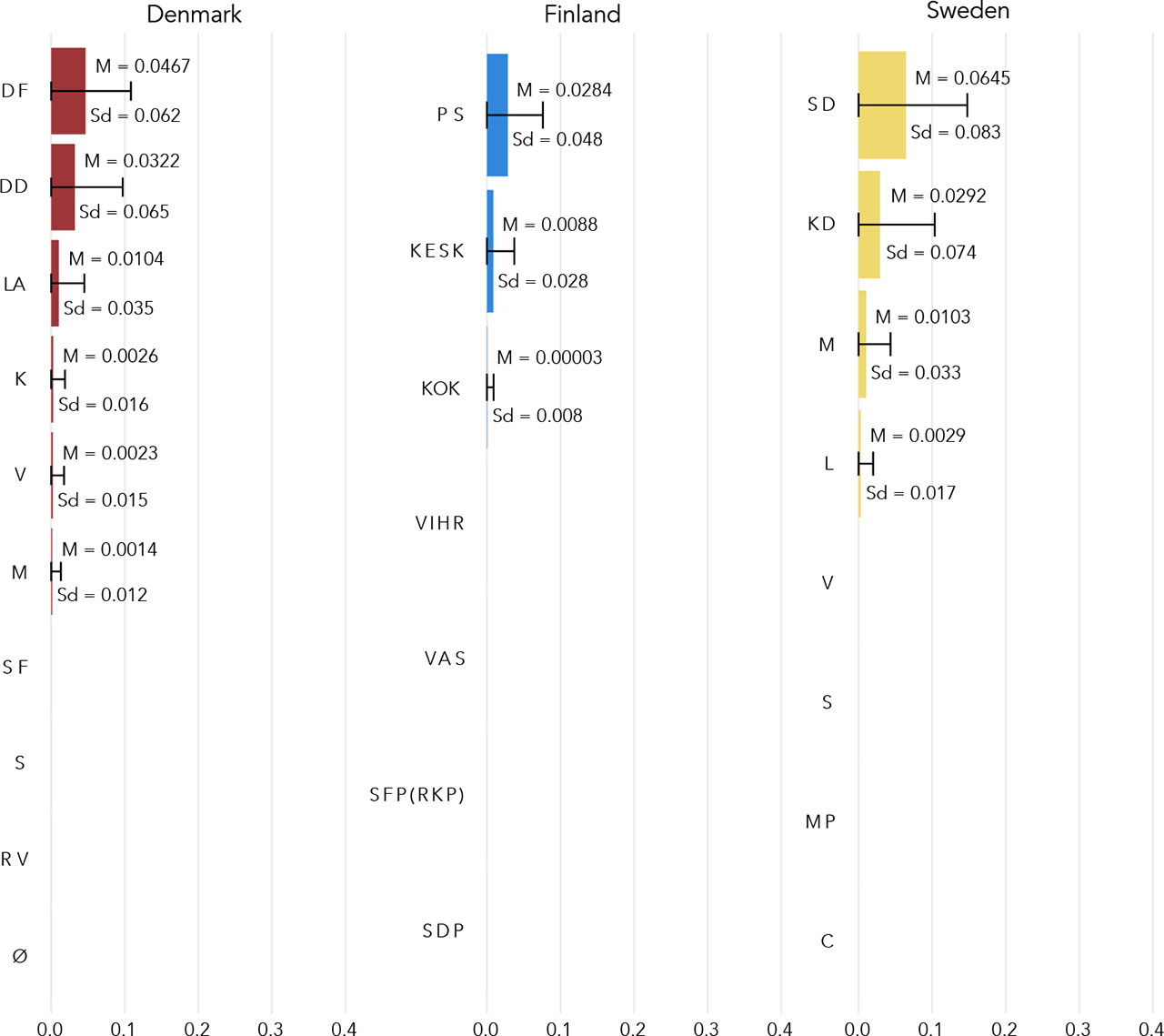
Figure 5
Means and standard deviations of ENI for political actors by country
Overlaps between populist communication and extremist narratives
To finally examine the overlap between populist communication and extremist narratives on Facebook (RQ1), we calculated Spearman’s rho correlations between PCI and ENI – both overall and by country. The overall correlation is significant but modest (ρ = .37, p = .00). The country comparison shows stronger correlation in Sweden (ρ = .53) than in Denmark (ρ = .30) and Finland (ρ = .23). These differences may reflect the higher number of posts combining both elements in Sweden (n = 81; 10.1%) compared to Denmark (n = 29; 3%) and Finland (n = 12; 1.3%). We did not calculate correlations for individual political actors due to limited data.
Discussion
In this study we have addressed two research questions: How did the use of populist communication and extremist narratives vary across political actors in Denmark, Finland, and Sweden during the 2024 EP election campaign on Facebook (RQ1)? And to what extent did these two strategies co-occur (RQ2)? To answer these research questions, we extended the communication-centred approach to populism (Reinemann et al., 2016) by introducing extremist narratives as a distinct communicative strategy – broadening the analytical lens of political communication research to include extremist content and making both concepts measurable in a distinct, nuanced way. Below, we discuss our results in light of our hypotheses and research questions, drawing on existing literature.
Our findings support H1a: Fringe parties – right-wing (SD, PS, DF) and left-wing (VAS) – used more populist communication than centrist parties. This finding confirms earlier research showing that populist styles can be adopted across the ideological spectrum, though with different targets and framings (Engesser et al., 2017; Lilleker & Balaban, 2021; Magin et al., 2024). H1b must be rejected, however: Only right-wing, not left-wing, fringe actors used more extremist narratives. This difference is likely due to the focus of our measures on right-wing extremist content. However, this also shows how important it is to distinguish populism and extremism, which are often conflated in the literature (e.g., Masalha & Baş, 2023), as analytically distinct phenomena (Hardy, 2023). Extremist narratives involve rejecting core democratic values, making them less appealing to centrist parties (Bjørgo & Ravndal, 2022), which likely explains their overall lower use compared to populist communication. By theoretically and analytically distinguishing between them, our study contributes to a more differentiated understanding of these communicative strategies. The communicative approach offers the methodological tools to identify and compare them both independently and in combination.
Our cross-country comparisons and analysis of the overlap between populist communication and extremist narratives underscore the value of measuring these strategies separately to draw a more nuanced picture of their use: Populist communication and extremist narratives were related to some degree, but even in Sweden, where an overlap was most common, the relationship was not very strong (RQ2). Supporting H2a and H3a, populist communication was similarly used in Denmark and Finland, but was more widespread in Sweden. In contrast, H2b and H3b were not supported: Extremist narratives were similarly present in Sweden and Denmark, but significantly lower in Finland. These findings may reflect a more polarised political climate in Sweden, aligning with research on slightly declining consensus (Oscarsson et al., 2021; Ryan, 2023) and broader European trends. They also suggest a contagion effect (Sebastião, 2024), with the Sweden Democrats influencing other parties. Unlike their Danish and Finnish counterparts – whose government roles may have moderated their rhetoric – the Sweden Democrats were kept at a distance by a cordon sanitaire until 2022.
Compared to other European contexts where populist communication and extremist narratives are more prominent (Štětka & Mihelj, 2024), our findings show that Nordic countries still exhibit relative restraint in adopting such strategies, particularly the fringe parties. This conclusion aligns with the idea that consensus-based political cultures and institutional structures help mitigate polarisation and extremism (Bengtsson et al., 2013; Bergman et al., 2021). It also resonates with research on the Nordic governance model, which emphasises broad coalitions, institutional trust, and welfare orientation, creating structural barriers to widespread extremist rhetoric (Herkman & Jungar, 2021). However, as the Swedish case shows, even within similar political cultures, country-specific factors – such as party competition, coalition dynamics, and media environments – shape campaign communication in distinct ways.
Like any study, ours has limitations. We studied the official Facebook pages of parliamentary parties – channels typically more controlled and less likely to feature radical messaging. This approach excludes non-parliamentary actors, who may use more extreme rhetoric. Future research should include these other voices to provide a more comprehensive picture of populist and extremist communication in the Nordic region. This should also include a differentiated analysis of individual candidate accounts, ads, closed groups, or unofficial channels which might yield a more nuanced picture. The communication-centred approach we applied offers a promising framework for such analyses.
Moreover, since our study focused on three Nordic countries during a European election campaign, the degree to which our findings apply to other regions or election types (e.g., national elections) may be limited. Nonetheless, it offers a valuable starting point for future comparative research across different contexts. Our focus on Facebook is another limitation. Future social media platform comparisons (e.g., Larsson et al., 2025) should explore how platform-specific features shape populist communication and extremist narratives, and whether patterns found on Facebook extend to other platforms like TikTok or alternative sites with lower moderation. However, given Meta’s announced changes to Facebook’s content moderation model, the analysis of this platform will continue to be relevant. In general, we need long-term comparisons to better understand the rise of digital platforms as spaces for ideological mobilisation (Gerbaudo, 2018; Hutchinson et al., 2023), to which even the Nordic countries are not immune.
Finally, while this study focused on party communication, future research should explore how messages resonate with the public – especially how engagement and algorithms might amplify populist content and shape voter attitudes – to contribute to a more comprehensive understanding of the interplay between elite discourse and public opinion in the digital age.
Acknowledgements
This publication is part of the project “Campaigning for Strasbourg (CamforS)”. We would like to thank all collaboration partners who contributed to the infrastructure of the project, the coding scheme, and the creation of the dataset used in this publication. A list of all collaborators can be found on the project website (https://digidemo.ifkw.lmu.de/camfors/). We further wish to thank the Digital Democracy Centre (DDC) at the University of Southern Denmark for its financial support for conducting this research
Appendices
Appendix
Table A1
Overview of parties in the sample
| Country | Party | Ideology | EP Group (2024) | Populist |
|---|---|---|---|---|
| Denmark | V Venstre, Danmarks Liberale Parti | Center Liberal | Renew Europe | No |
| RV (B) Radikale Venstre | Center Liberal | Renew Europe | No | |
| M Moderaterne | Center Liberal | Renew Europe | No | |
| S (A) Socialdemokratiet | Social Democratic | S&D Socialists and Democrats | No | |
| SF (F) Socialistisk Folkeparti | Socialist | Greens/EFA Group of the Greens/European Free Alliance | No | |
| KF (C) Det Konservative Folkeparti | Conservative | EPP European People's Party (Christian Democrats) | No | |
| LA (I) Liberal Alliance | Liberal | EPP European People's Party (Christian Democrats) | No | |
| DD (Æ) Danmarksdemokraterne - Inger Støjberg | Right-wing nationalist | ECR European Conservatives and Reformists Group | Yes | |
| EL (Ø) Enhedslisten - De Rød-Grønne | Left wing | The Left group in the European Parliament - GUE/NGL | No | |
| DF (O) Dansk Folkeparti | Right-wing nationalist | PfE Patriots for Europe | Yes | |
| Finland | KOK Kansallinen Kokoomus/Samlingspartiet | Conservative | EPP European People's Party (Christian Democrats) | No |
| KESK Suomen Keskusta/Centern i Finland | Center Liberals | Renew Europe | No | |
| SFP/RKP Svenska folkpartiet i Finland/Suomen ruotsalainen kansanpuolue | Liberal | Renew Europe | No | |
| VAS Vasemmistoliitto/Vänsterförbundet | Socialist | The Left group in the European Parliament - GUE/NGL | Yes | |
| SDP Suomen Sosialidemokraattinen Puolue/Finlands Socialdemokratiska Parti | Social Democrat | S&D Socialists and Democrats | No | |
| VIHR Vihreä liitto/Gröna Förbundet | Environmentalist | VIHR Vihreä liitto/Gröna Förbundet | No | |
| PS Perussuomalaiset/Sannfinländarna | Right-wing nationalist | ECR European Conservatives and Reformists Group | Yes | |
| Sweden | M Moderaterna | Conservative | EPP European People's Party (Christian Democrats) | No |
| KD Kristdemokraterna | Christian Democrat | EPP European People's Party (Christian Democrats) | No | |
| S Socialdemokraterna | Social Democratic | S&D Socialists and Democrats | No | |
| SD Sverigedemokraterna | Right-wing nationalist | ECR European Conservatives and Reformists Group | Yes | |
| C Centerpartiet | Center Liberal | Renew Europe | No | |
| L Liberalerna | Center Liberal | Renew Europe | No | |
| MP Miljöpartiet de gröna | Environmentalist | Greens/EFA Group of the Greens/European Free Alliance | No | |
| V Vänsterpartiet | Socialist | The Left group in the European Parliament - GUE/NGL | No |
Table A2
Category description and reliability
| Category | Description | BP kappa | Pairwise agreement |
|---|---|---|---|
| criticism | Blaming the elite (from any sector) as a group in general for problems and grievances that the people suffer. This category applies when elites are held responsible for anything undesirable from the people’s perspective. | 0.93 | 0.93 |
| Questioning the legitimacy of the decision-making power exercised by the elite and asking for direct democracy (e.g., referenda; “A change of government can’t be a Tory stitch-up, the people must decide!”) | |||
| Calling for resistance against the elite call for resistance against the ideas/ideology of the establishment | |||
| Accusing the elite of betraying the people or acting against the people’s interest, accusing the elite of being corrupt, (e.g., “The media are the enemy of the people”, “The media are dishonest, and journalists are liars”) | |||
| people | References to “We, the people” included | 0.90 | 0.90 |
| danger11 | Ethnic or cultural “others” are addressed (e.g., “Islam is not part of Germany”, “Gypsies don’t belong here”, “The foreigners are stealing our women”). | 0.99 | 0.99 |
| danger12 | Political “others” (holding allegedly dangerous opinions/ideologies) are addressed (e.g., “The Greens are a danger for our future”, “The President is selling our country”, “Feminism wants to put an end to our traditions”). | 0.85 | 0.86 |
| extr_peace | (Anti-)Militarism. Belief or ideology that emphasizes the importance of military power, strength, and preparedness, often glorifying war and the military as essential elements of a society or state. In some cases there is a thin line between arguing for and against militarism (e.g., arms supplies to Ukraine). In such cases, this category is to be coded as present. | 0.98 | 0.98 |
| extr_mig | Anti-immigration. Xenophobia, the scarcity of welfare, illegal immigration, immigration as an economic burden. | NaN | 1.00 |
| extr_borders | Against open borders within Europe. The post argues that national borders should and/or will be reestablished within the EU. Arguments for national borders are brought forward. | NaN | 1.00 |
| extr_market | Against competitive market and/or against globalization. Arguments are brought forward that the competitive social market economy as proposed by the EU is to be abolished. European regulations such as the free movement of workers, uniform product standards or tax rules are rejected in the post. Alternatives, like planned economy or more libertarian unregulated forms of markets, could be proposed in posts. | NaN | 1.00 |
| anti-euro | Positioning against the euro | NaN | 1.00 |
| extr_envir | Anti-environmentalism. Denial of environmental problems, resistance to environmental regulations, criticizing environmental activism, skepticism of environmental science, lack of environmental awareness. | NaN | 1.00 |
| extr_science | Countering academic freedom. Actions or policies that restrict or undermine the principles of academic freedom and the pursuit of scientific inquiry. This can take various forms, such as government censorship, systematically not funding research in certain areas, suppression of research findings, intimidation of scientists, or interference with the dissemination of knowledge. | NaN | 1.00 |
| extr_age | Ageism. Ageism is discrimination or prejudice against individuals or groups based on their age, typically directed towards older adults. It can manifest in various ways, such as assumptions about abilities, stereotypes, or discriminatory practices in employment, healthcare, and social interactions. | NaN | 1.00 |
| extr_culture | Attacking or arguing against cultural and linguistic diversity. | 0.99 | 0.99 |
| extr_fem | Anti-feminism. Male supremacy ideologies, advocating for the subjugation of women, men possessing women, men are higher in the social hierarchy than women, hostility for modern liberal feminism. | 0.99 | 0.99 |
| extr_lgbtq | Anti-LGBTQ+-Equality. Arguing against equality between hetero- and “cis”- people and lesbian, gay, bi, trans, queer… people. | 0.99 | 0.99 |