

Introduction
The terms greenhouse effect, global warming, and climate change are often used interchangeably. For most people, they refer to the same phenomenon, described by the United Nations Framework Convention on Climate Change (UNFCCC) as “a change of climate which is attributed directly or indirectly to human activity that alters the composition of the global atmosphere” (UN, 1992: Article 1, para. 2). Each term, however, is associated with different aspects of this reality. The greenhouse effect refers to the causes of climate change, global warming concerns the impact of changes in the global atmosphere, and climate change describes the overall variability of the climate.
Thus, the three terms carry their own sets of meanings and connotations; yet, how these differences play out in public communication has rarely been studied in media research and environmental communication. Due to their interchangeability, the terms have been primarily considered synonymous or used as keywords in data retrieval (Hase et al., 2021). As such, they have been treated as shorthand for anthropogenic climate change, resulting in unquestioned sampling strategies. However, by treating them as interchangeable, we fail to grasp the historical patterns, semantic nuances, and communicative implications that lie behind the shifting popularity of climate change keywords.
The current study investigates how the three terms have changed over 30 years of public climate change reporting in Denmark. We explore how news media (newspapers and public service broadcasters) have employed different terms from both a longitudinal and a semantic perspective. More specifically, we use computational methods (Grimmer et al., 2022) to map and analyse evolving patterns in how public communication discusses anthropogenic climate change through the terms for the greenhouse effect, global warming, and climate change. The main research question is: How have the prevalence and meanings of the greenhouse effect, global warming, and climate change developed in public climate change communication?
Keywords related to environmental issues are crucial for several reasons. In epistemological terms, semantic variations indicate how the public’s understanding of climate science is continually revised and negotiated. These variations are also vital in the context of information and misinformation, as keywords like global warming have been used as vehicles for denialism or alarmism regarding climate change (Oreskes & Conway, 2010; The Heartland Institute, 2020). Politically, the prominence of specific keywords reveals how discussions and responses to climate change are framed. Lastly, semantic shifts demonstrate how perceived truths and established concepts are regularly challenged by new, seemingly more appropriate terms. Recently, we have observed how ideas such as “climate crisis” or “climate emergency” (Ripple et al., 2019) have entered the public discourse.
While this study is based on Danish data, our findings reflect a recognisable pattern. First, global climate change reporting tends to follow similar patterns (Boykoff et al., 2023). Second, it has become a standard sampling strategy to include all three keywords in research on public climate communication (Hase et al., 2021). Finally, Danish media share several cultural and institutional traits with other Nordic and northern European media systems (Hallin & Mancini, 2004).
We begin by examining the semantic shifts in climate change keywords through a review of the relatively limited literature on this topic. We then proceed to a methodological section explaining our use of computational techniques and automated content analysis. We subsequently present our findings, followed by a discussion of the analytical implications and methodological limitations of our study.
From the greenhouse effect to climate change
Although the three terms for climate change are interconnected and partly synonymous, they possess a complex history. There are various historical accounts of their early use in physics and atmospheric sciences (Giddens, 2009: 17; Hulme, 2009: 42; Sörlin & Wormbs, 2018; Urry, 2011: 18). Regarding contemporary usage, we mainly encounter narratives of a linear progression, from greenhouse effect to global warming to climate change (Gardiner, 2004; Hulme, 2009: 234). However, the overall picture is not always so straightforward. A book published in 1989 combines these keywords to pose a rhetorical question: “Global warming: are we entering the greenhouse century?” A few years later, the title of the UN’s Framework Convention on Climate Change refers to climate change, rather than greenhouse effect or global warming. The resolution contains 64 references to climate, 34 to greenhouse (gas or effect), and only one to “warming of the Earth’s surface” (UN, 1992: para. 2).
Generally, however, the terms greenhouse effect and greenhouse gas dominate early discussions on climate change. This is logical, as these terms explain this relatively recent phenomenon. The concept of the greenhouse effect refers to the fundamental physical processes that drive climate change. By continuously emitting greenhouse gases, primarily carbon dioxide (CO2), human activity traps heat in the atmosphere. This is likely to trigger positive feedback loops by adding more energy to the Earth system, which exacerbates the problem.
The greenhouse effect is, however, an imprecise term. It covers both a natural process and a human-induced problem. Without the greenhouse effect, Earth would probably be uninhabitable for humans. Therefore, “it is not the greenhouse effect in isolation which causes the climate problem” (Gardiner, 2004: 558). Instead, it is the anthropogenic greenhouse effects that destabilise the Earth system.
The concept of the greenhouse effect refers to what Chakrabarty (2015) describes as the convergence of three different histories: the Earth’s history, the history of life, and the history of industrial civilisation (or capitalism). The greenhouse effect is intertwined with all three histories: It is an essential part of the Earth system; it must stay within certain limits to sustain life; and it results from industrialism, especially the so-called Great Acceleration (Steffen et al., 2015). For these reasons, the term greenhouse effect is only partly adequate for describing climate change.
Global warming
In the history of keywords related to climate change, global warming has gradually replaced the greenhouse effect. This development also follows a certain logic. As the causes of climate change become more established in public discourse, attention shifts to the consequences of the greenhouse effect and the rise in global temperatures, hence the term global warming. However, this “more evocative” term (Hulme, 2009: 234) also has its limitations, as pointed out by Gardiner (2004).
First, “it highlights a specific effect, higher temperatures, and thus suggests a one-dimensional problem” (Gardiner, 2004: 558). However, the Earth system is more complex, consisting of interconnected phenomena and non-linear processes, which the notion of global warming does not adequately convey.
Second, linking climate change to global warming suggests a shift towards a new balance, where the Earth transitions from a colder to a warmer state; however, this is a misconception. Climate change is caused by an increase in energy entering the atmosphere, resulting in reduced atmospheric stability. Recent studies on the Earth’s energy imbalance indicate an increasing imbalance in the Earth’s system (Von Schuckmann et al., 2023), which the concept of global warming does not encompass.
Finally, climate change does not only cause global warming but can also lead to regional cooling effects. A recent study predicts a collapse of the Atlantic Meridional Overturning Circulation around mid-century (Ditlevsen & Ditlevsen, 2023). Such a scenario could result in cooling in northwestern Europe (Scandinavia, UK) and Canada, while the southern hemisphere would warm due to a southward shift in the thermal equator (Rahmstorf, 2006).
Climate change
Some shortcomings of the concept of global warming may explain why the term climate change gradually replaced it during the 2000s. Scientific inadequacy might not be the only reason, however. A key moment in the semantic shift from global warming to climate change has been attributed to a memo by a conservative strategist in 2002 (Lakoff, 2010: 71; Boykoff, 2011: 8; Kolbert, 2015: 165). Here, the American political consultant Frank Luntz wrote that the environment is a policy area where Republicans are “most vulnerable”, consequently recommending a new communication strategy that would endear the public to “the conservative, free market approach to the environment” (Luntz, 2002: 132). This included a new vocabulary: “It’s time for us to start talking about ‘climate change’ instead of global warming […] ‘Climate change’ is less frightening than ‘global warming’” (Luntz, 2002: 142).
However, political motives and strategic considerations are only part of the story. Climate change has also been the preferred term in the scientific community, as evidenced by the Convention Framework on Climate Change. Philosophically, climate change is further regarded as a more appropriate term, because it “captures the fact that it is interference in the climate system itself which is the crucial issue, not what the particular effects […] turn out to be” (Gardiner, 2004: 559). By altering the climate, humans effectively determine the fate of other lifeforms on the planet.
Finally, climate change is a more generic concept compared with both the greenhouse effect and global warming. It refers to “any change in climate over time, whether due to natural variability or as a result of human activity” as defined by the Intergovernmental Panel on Climate Change (IPCC, 2007), all of which may explain why climate change has become the preferred term (for the time being).
Terminological controversies
Although climate change now appears to dominate most public spaces (media, politics, science), the debate over terminology has never ceased (Beder, 2014; Bruine de Bruin et al., 2024). Disputes sometimes flare up again, especially on social media. While American conservative strategists recommended shifting from global warming to the “less emotional” climate change in the early 2000s, some climate deniers and sceptics have taken a different route.
Christian fundamentalists have seized on the so-called sunspot theory, which claims that changes in solar radiation, caused by the Sun’s magnetic cycles, can explain climate change. Writing in 2009, they attributed a cooling trend to reduced solar activity. Based on this assessment, they argued that environmentalists were ignoring scientific facts: “That nature is not cooperating by cooling instead of warming has forced the environmental movement cynically to change its focus from ‘global warming’ to ‘climate change’” (Ritenbaugh, 2009: 9)
Climate deniers consequently believe that the shift in terminology from global warming to climate change is driven by environmentalists who are “pushing the global warming agenda […] to wrest political control” (Ritenbaugh, 2009: 9). Since evidence for global warming is lacking, environmentalists are allegedly more likely to discuss climate change rather than global warming.
Given that the scientific community states that solar activity “cannot be the main force driving the changes in Earth’s climate we are currently seeing” (NASA, n.d.), this kind of communication is similar to false or inaccurate information – in other words, misinformation.
Donald Trump has propagated similar misinformation. Between 2013 and 2015, he tweeted an almost identical message that claims the shift from global warming to climate change is a cover-up: “They changed the name from ‘global warming’ to ‘climate change’ after the term global warming just wasn’t working (it was too cold)” (Anderson, 2016)
A similar line of argument has recently been advanced by the young German climate sceptic Naomi Seibt. At a meeting organised by the conservative think tank The Heartland Institute, she argued: “All the predictions that the IPCC […] has published since 1990 have not been supported by the empirical evidence […] so they are now calling it ‘Climate Change’ instead of ‘Global Warming’” (The Heartland Institute, 2020).
Interestingly, these allegations suggest that it is climate change believers who have changed the discourse to hide that global warming is not taking place. At first glance, it appears to contradict recommendations from conservative strategists. They find a discursive focus on climate change to be “less frightening” than global warming, and hence more conducive to a conservative agenda (Luntz, 2002). On a deeper level, however, conflicting messages only add to the confusion and uncertainty surrounding climate change and thus play into a well-established strategy among climate change deniers (Oreskes & Conway, 2010; Supran & Oreskes, 2021)
These examples demonstrate that terms related to climate change are constantly debated in public discourse (Penz, 2018). Our language about climate change is a blend of scientific terminology, expressions of public concerns and anxieties, and ideologically motivated rhetoric. Therefore, the three keywords examined in this article have, from the outset, been accompanied by alternative terms and suggestions such as “catastrophic climate” (Hulme, 2009: 234), “climate variability” (Beder, 2014), and more recently “Hothouse Earth” (McGuire, 2022; Steffen et al., 2018).
Effects of climate change terminology
There is a considerable body of research on the effects of climate change terminology on public perceptions. However, as indicated above, previous studies only distinguish between global warming and climate change and do not consider the semantic implications of the greenhouse effect. While an earlier study found that most people have no preference regarding climate change terminology (Akerlof & Maibach, 2011), other studies find that global warming is a more polarising term (Benjamin et al., 2017).
Some studies suggest that the framing effect of using global warming or climate change is moderated by political orientation (Schuldt et al., 2017). Other studies argue that these observations have mostly been made in an American context and may not be generalised (Stefkovics & Zenovitz, 2023). Nevertheless, all studies find that the wording of climate change matters in terms of eliciting responses, although differences may not always be predicted on ideological lines. Recent studies suggest that notions such as “climate crisis” or “climate urgency” do not lead to an increased perception of urgency, although they may have a negative effect on perceived news credibility (Bruine de Bruin et al., 2024; Feldman & Hart, 2021).
Keywords as sampling strategy
While numerous studies on climate change communication have utilised keywords such as the greenhouse effect, global warming, or climate change for search purposes (either alone or in combination), few have examined the semantic relationships between these keywords (Schäfer et al., 2023). The main exceptions are studies that contrast the use of global warming and climate change (Liu & Huang, 2022), or studies on misinformation and climate denialism (Corsi, 2020). Additionally, research on ideological differences surrounding climate change (Soutter & Mõttus, 2020) reveals that the terms for global warming and climate change carry distinct ideological connotations. Some studies also note variations in keyword usage to exemplify claims-making processes in climate change communication (Boykoff, 2011) or to support the idea of “rebranding” climate change (Rogers, 2019).
Finally, there have been some methodological discussions about using keywords in automated content analysis and topic modelling. The question raised is whether data quality improves by sampling keywords that occur more than once. Some studies recommend this approach, claiming it provides more accurate and focused data (Hase et al., 2021). Other studies argue that excluding secondary news items results in a skewed view, overlooking how climate change is integrated into a wide range of news genres and media content (Meier & Eskjær, 2024). However, none of these methodological considerations address semantic variations among keywords, only sampling techniques and procedures. This illustrates how the somewhat indiscriminate use of keywords continues to influence most sampling strategies.
Our study
We have aimed to examine the semantic differences and longitudinal developments related to three distinct notions of climate change, analysing how this evolution has unfolded in public communication and shaped the news discourse on climate change. By news discourse, we refer to the everyday expression of climate change in the national press, following the routinised and standardised practices of modern news culture (Allan, 2010: 76). We have considered three decades (1990–2021) of climate change reporting in the Danish press, represented by national dailies and public service broadcasters.
Historical accounts suggest a linear development in the popularity of the three keywords, leading to our first research question:
RQ1. What are the dominant keywords in public climate change communication over the past three decades?
We further assumed that keywords are used differently over time and possess their own distinct characteristics, leading to our second research question:
RQ2. Which words are most similar in meaning and have the strongest paradigmatic relationships with each keyword, and how do these evolve over time?
The research literature highlights terminological disputes surrounding global warming and climate change, including which of the two carries more alarming connotations. To investigate whether these debates have influenced news coverage, we asked:
RQ3. What, if any, are the differences in linguistic sentiments associated with greenhouse effect, global warming, and climate change?
Data and methods
We have addressed the research questions by examining the national press in Denmark. The sample frame includes print and digital news from national dailies currently in print circulation (n = 7) as well as online news from national broadcast organisations (n = 2). Data were collected automatically via API access to a digital media archive (Infomedia), and it encompasses all published news stories from 1990 to 2021 that include at least one of three keywords related to climate change (Greenhouse effect [drivhuseffekt] OR Global warming [global opvarmning] OR Climate change [klimaforandring]). Duplicates and news items shorter than 100 words were removed, resulting in a corpus of 46,462 articles. Figure 1 displays the yearly distribution, which closely follows a similar pattern seen in global climate change reporting (Boykoff et al., 2024).
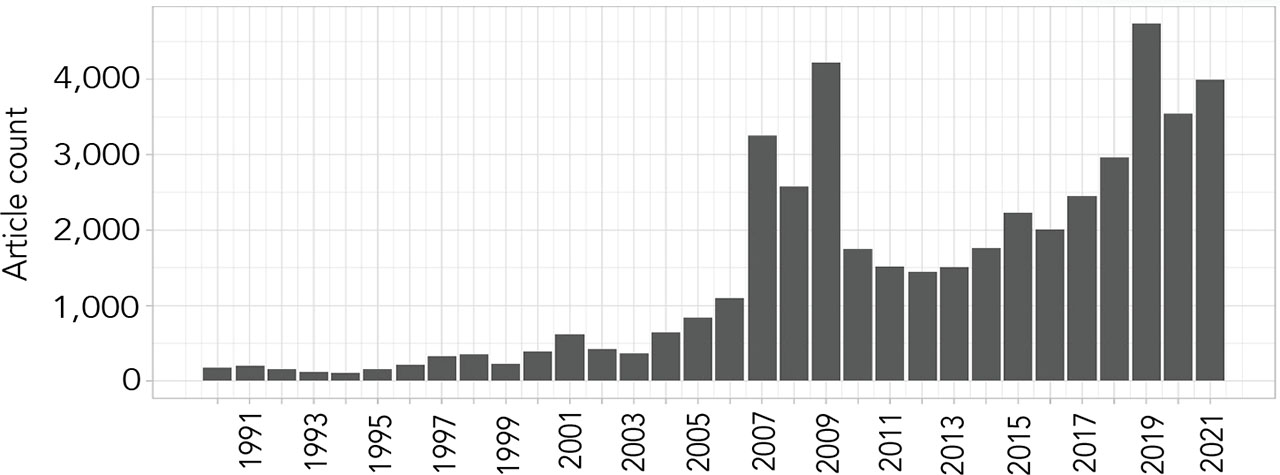
Figure 1
Yearly distribution of climate change news
Methods
This investigation adopted a text-as-data approach – that is, words are represented as high-dimensional vectors of numbers, capturing their semantics and paradigmatic use by considering the context around each word. A vector space representation of words is commonly known as word embedding. Word embeddings have been successfully used to analyse shifts in political concepts (Rodman, 2020) or to identify latent ideas in parliamentary speeches (Rheault & Cochrane, 2020).
Common methods for creating vector representations include the random indexing approach (Sahlgren, 2005), Word2Vec (Mikolov et al., 2013), or GloVe (Pennington et al., 2014). Pre-trained models are available for many languages, including Danish; however, since our data consists exclusively of one literary genre – Danish newspaper articles – we follow Moody’s (2017) word-vector approach, which builds on word frequencies and matrix factorisation. The approach is presented in a step-by-step guide by Hvitfeldt and Silge (2021: 77–81): using R code,
stem all words, remove infrequent ones (n < 50) and count the occurrence of the remaining words;
calculate PMI (pointwise mutual information) for each word within a context window of size 10 to understand their co-occurrence patterns, capturing more information about the domain or topic of each word, rather than functional similarity, which would be the focus of smaller window sizes (3–4) (Hvitfeldt & Silge, 2021, p 78);
reduce the PMI matrix to 100 dimensions using SVD (singular value decomposition), transforming each word into a 100-element vector;
for diachronic analysis, build three models for different periods (see Table 1) and use cosine similarity to identify the top 20 similar words for each keyword.
Table 1
Three phases of sampling period
| 1. (1990–2000) | 2. (2001–2010) | 3. (2011–2021) | ||||||
|---|---|---|---|---|---|---|---|---|
|
|
| ||||||
| GE | GW | CC | GE | GW | CC | GE | GW | CC |
|
|
|
|
|
|
|
|
|
[i] Comments: The table shows the three phases for the three central keywords and the terms (translated from Danish stemmed words/compound words) most similar to them, ranked by cosine similarity in the vector space. Words can appear multiple times due to spelling variations (e.g., drivhuseffekt vs drivhus-effekt). Terms unique to a keyword and period are highlighted.
Keyword analysis across time
Detecting semantic similarities and differences across publishing periods is not feasible via cosine similarity, given the word vector method we chose. Instead, we have used the Jaccard index, a measure of similarity and diversity of sample sets. We identified the 50 most closely associated terms within each period (using cosine similarity) and examined the overlap between keywords and publishing periods. Put simply, we addressed questions such as, for example, what proportion of words related to climate change in phase 1 are identical to words related to the greenhouse effect in phase 2. The greater the overlap in words, the higher the Jaccard index (see Figure 3).
Sentiment analysis
To determine the emotional tone associated with each keyword, we employed a lexicon-based sentiment analysis approach called SENTIDA (Lauridsen et al., 2019), which is specifically designed for the Danish language. SENTIDA is superior to previous sentiment lexicons because it considers not only the polarity of sentiment words but also valence shifters (e.g., “not”) and other grammatical properties and modifiers that can reverse sentiment. For each sentence in our corpus that contains a climate change keyword, we calculated a numerical sentiment score. A manual validation of SENTIDA sentiment scores was conducted by randomly sampling 50 sentences per keyword (n = 150) to assess whether the texts confirmed the sentiment score (1) or not (0). While the percentage agreement was high for climate change and global warming (both at 82%), the agreement was lower for greenhouse gases (at 70%). This can be explained by the limited context sensitivity of lexicon-based approaches, despite recent improvements. For instance, news reports on “increases” (e.g., in temperature or gases) are generally associated with positive sentiments regardless of their impact on the climate.
Findings
Temporal development of keywords
To investigate RQ1, we compared the yearly distribution of the keywords greenhouse effect (GE), global warming (GW), and climate change (CC). Figure 2 shows the average number of times a keyword was mentioned in an article per year. Thus, in 1990, articles on climate change referred to GE around 1.5 times (on average), with almost no articles mentioning GW or CC.
The figure illustrates the overall development of each keyword’s popularity. Discussions of GE dominated the 1990s, but 20 years later, the term has almost disappeared from public discourse. The 2000s mark a transition period in public climate change communication: GW is the dominant term in the middle of this period, as the popularity of GE and CC move in opposite directions. By the end of the decade, GE had largely been replaced by the notion of CC. Even GW was on the decline: By the end of the 2010s, GW was mentioned only 0.3 times per article, as CC became the primary term of the decade. In the early 2020s, we are observing the emergence of climate crisis as a new concept. It first appeared around 2015, but its frequency has gradually increased. Whether we are witnessing the emergence of a new keyword is still too early to predict.
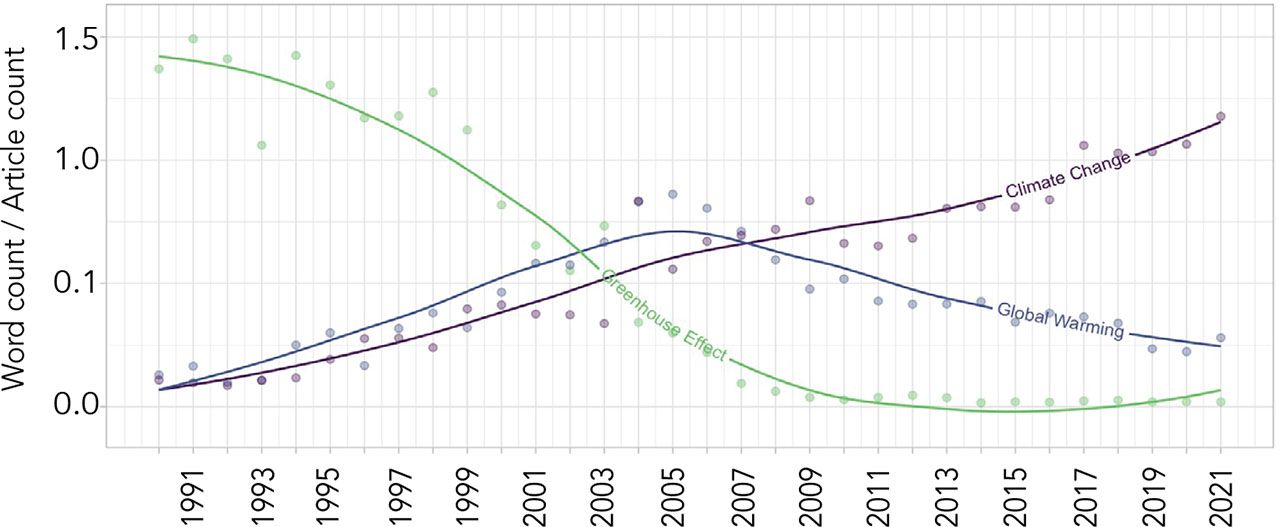
Figure 2
Yearly distribution of “climate change”, “global warming”, and “greenhouse effect”
The figure indicates that the development in the Danish press has been less linear than sometimes depicted in more theoretical literature (Gardiner, 2004). While GW appears to have been a temporary term, it never became the dominant term in the 2000s, unlike how GE dominated the 1990s and CC dominated the 2010s. In fact, GW and CC moved together until around 1999, and GW was the most popular term between 2002 and 2007. This highlights how the 2000s were a transitional decade and how ideas about climate change remained highly debated in the public sphere.
Word vectors
We addressed RQ2 by dividing the entire sampling period into three phases corresponding to three decades, as shown in Table 1. While other periodisations are possible (Hulme et al., 2018), this approach offers three phases that roughly correspond to three stages in Danish climate change news (see Figure 1): the emergence of the climate agenda (1990–2000), the rise and peak of climate reporting (2001–2010), decline followed by renewed attention (2011–2021). In each phase, we identified the 20 most similar words associated with the three keywords. The table indicates a significant level of interchangeability, as the most similar words linked to each keyword are often other keywords; this is particularly true for GW and CC. In each phase, CC is the most frequently associated word with GW (and vice versa). Additionally, the term “man-made” features prominently across all nine columns, suggesting that each keyword has been discussed and presented in relation to anthropogenic climate change. However, there are notable variations, implying that the keywords are associated with different scientific and social discourses.
Of the three keywords, GE is most clearly linked to scientific and technical terms such as carbon dioxide, acid rain, methane, or feedback mechanisms. It is also the most consistent keyword in terms of repetitions across the three phases and internal coherence. There is simply less semantic range and variation associated with GE. Compared with the other two keywords, the term GE has become more technical over time. As GW and later CC began to dominate climate change communication, GE has become predominantly linked to meteorology and atmospheric chemistry.
During the first phase (1990–2001), GE is the only key term linked to doubt, indicating media focus on scientific uncertainty. This shifted in the second phase (2001–2010), when scientific uncertainty primarily becomes associated with GW (denial and lie). Previous research has shown that media coverage of climate scepticism peaked around 2003–2004. In the early 2000s, Bjørn Lomborg, author of The Sceptical Environmentalist (2001), was at the height of his fame as a divisive public figure; still, he also faced an investigation into scientific dishonesty, drawing significant public attention. This period also coincides with media coverage of the so-called sunspot theory, which suggests that natural variations in solar radiation can partly explain climate change. Proponents of this theory repeatedly questioned the significance of anthropogenic climate change and the science underpinning the greenhouse effect. However, it is only in the third phase that one of the scientists linked to this theory (Svensmark) appears among the words related to GE.
GW follows a different trajectory. In its initial phase, it was a relatively technical concept concerned with causes (warming, pollution), consequences (rising temperatures), and broader implications (climate catastrophe, runaway effects). In the final phase, the scope of the concept has expanded significantly, now including consequences such as desertification and ice loss, as well as terms like climate crisis, unavoidable, and adverse effects.
CC is the most diverse concept, allowing for a broader semantic range. In the initial stage, CC remained somewhat technical, similar to GW but more specific about consequences such as desertification, flooding, and erosion. In the subsequent two stages, the implications related to climate change expanded considerably. The second stage covered various natural and societal impacts, including natural disasters, environmental issues, national security threats, terrorism, and destabilisation. In the third stage, CC became more closely associated with terms that emphasise the severity of the crisis, mentioning climate catastrophe, environmental damage, and negative impacts like desertification, soil degradation, and migration. Additionally, some related terms depict a bleak outlook, involving over-population, climate disaster, population explosion, resource scarcity, and an influx of refugees.
In the third phase, ideas about weather events and phenomena were linked to GW and CC, thus, specific beginning to connect (weather) events to climate change, something previously regarded as scientifically unsound, almost taboo, in earlier stages, because climate change was mainly considered a future stochastic risk. The clear connection between actual events and climate change further highlights how a rising sense of urgency has accompanied the semantic shift from GE to CC.
Similarities and differences in keywords
Another method to explore semantic differences among the three keywords is shown in Figure 3. Here, the overlap of the 50 most similar words for each keyword per publishing period is measured using the Jaccard index, where a value of 1 indicates complete similarity (full word overlap) and a value of 0 indicates complete dissimilarity (no shared words). An index of .35 suggests that 35 per cent of words linked to a given keyword are the same.
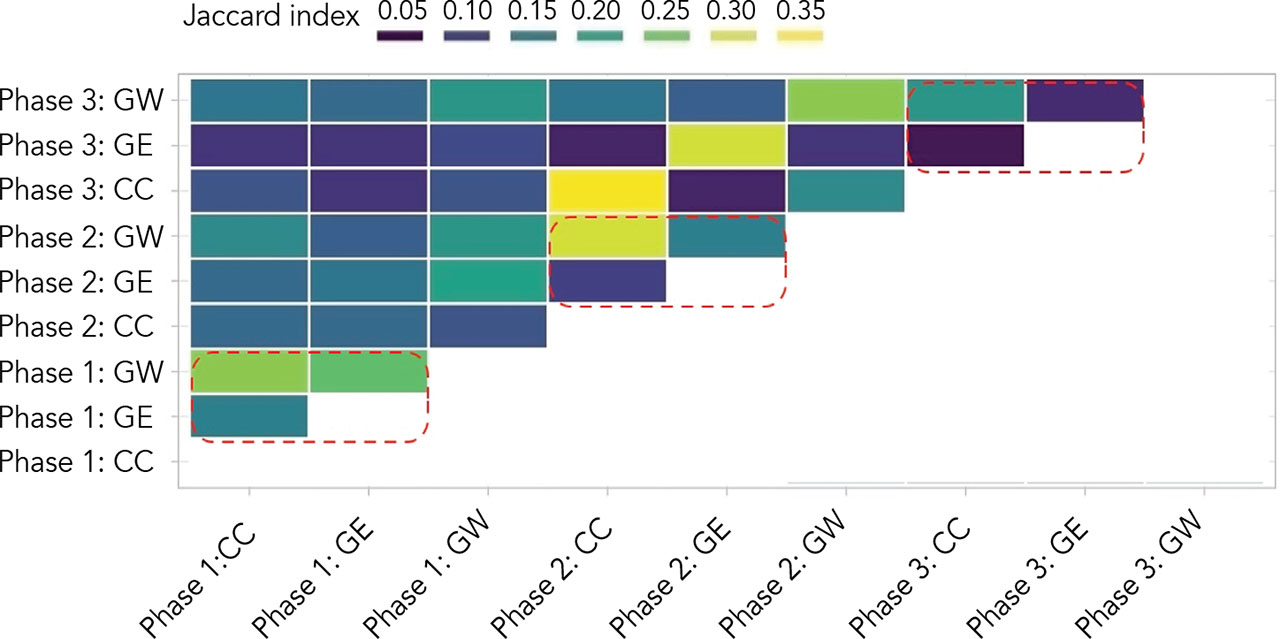
Figure 3
Similarities and differences among top 50 words of each keyword and phase
Comments: Being a mirrored heatmap, the figure shows only the upper triangle.
The visualisation offers both synchronic and diachronic insights. When analysing each phase separately (stippled boxes along the mirror line), we see that phase one is characterised by some semantic overlap among the three keywords (ranging from 0.15 to 0.25). In phase two, the overlap increases between GW and CC (0.30) but decreases between GE and CC (0.10). In phase three, only GW and CC show some semantic similarity, while GE has almost no overlap with the other two keywords. Consequently, cells with the lowest index scores (dark cells approaching zero) are located in phase three. This suggests an increasing conceptual specialisation, or division of labour, among the keywords. While early media coverage of climate change often involves some confusion of related terms, over time, each keyword gains its own distinct connotations and meanings. This is especially true for GE, which is linked to technical vocabulary. As mentioned earlier, GE becomes highly scientific in phase three, where it is associated with nearly generic terms related to anthropogenic climate change and atmospheric chemistry (thermal radiation, CO2, methane, water vapour).
The index indicates that GW is the keyword with the greatest degree of semantic overlap. It shows how GW functions as a mediating term between GE and CC. It links the semantic division of labour related to these two terms in public discourse. GE encompasses scientific and atmospheric aspects, while the increasingly prominent concept of CC relates to impacts on ecosystems and social systems. Thus, as a transitional term, GW is marked by a linear increase/decrease in popularity, associated with both technical and scientific explanations (GE) and environmental and social consequences (CC).
Sentiment analysis
To complement our word vector analysis, we conducted sentiment analysis to determine if the emotional tone associated with each keyword has evolved over time (see Figure 4). The fluctuations in the confidence intervals reflect the prominence of the keywords. As the popularity of keywords fluctuates in terms of frequency, confidence intervals expand or contract accordingly.
Overall, Figure 4 confirms our interpretations of the changing semantics of climate change reporting while introducing nuances to the analysis. As a predominantly technical term, GE is presented in relatively “neutral” terms. This indicates that GE is associated with technical terms that tend to be regarded as neither positive nor negative. If anything, there is a slight positive trend in the second half of our period, which could suggest that GE is becoming an even more scientific term. As discussed in the methods section, this trend appears to reflect a linguistic limitation of lexicon-based sentiment analysis. News reports on (scientific) increases, whether in temperature, methane, CO2, or other greenhouse gases, tend to be associated with positive sentiments and connotations. This likely explains the rise in positive sentiments during the latter half of the investigation period.
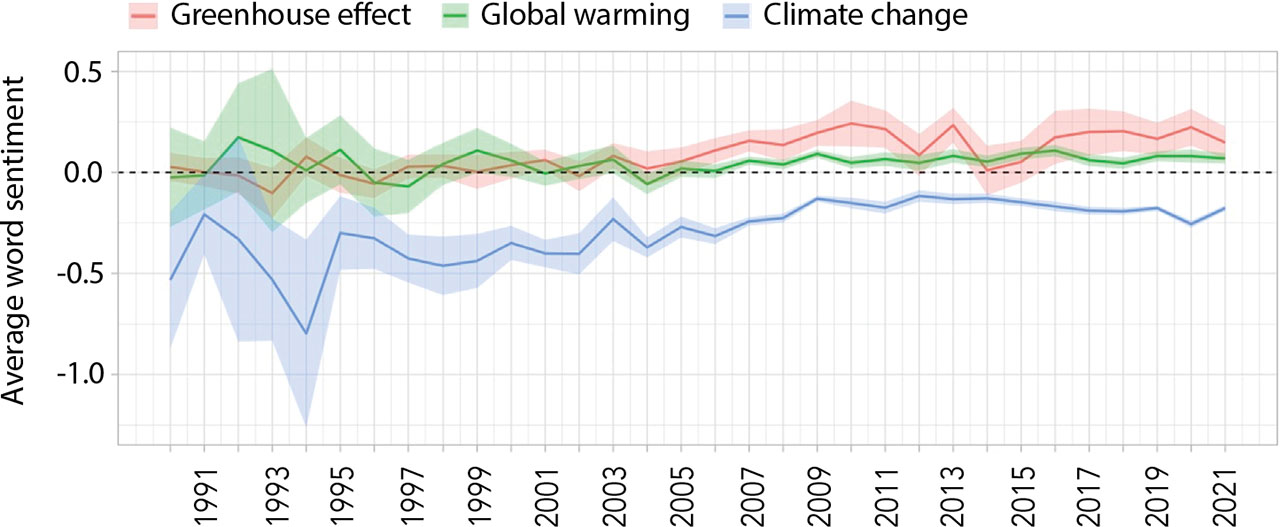
Figure 4
Sentiment analysis of keywords
Notably, Figure 4 shows that GW is the most neutral of the three keywords. However, as our analysis suggests, GW also covers a semantic middle ground. As a transitional term, it includes elements of the scientific discourse linked to GE, while also conveying sentiments about the negative impacts of CC. In media discourse on GW, these internal differences are levelled out, resulting in a relatively neutral word combination.
The figure supports the word vector analysis, which shows that CC is linked to the impacts of climate change. Natural events, such as flooding, erosion, and desertification (CC first phase) clearly have negative implications. The same is true for social risks, such as terrorism, overpopulation, destabilisation (CC second phase), or climate disaster, an influx of refugees, and population explosion (CC third phase).
The negative sentiment associated with CC answers RQ3 negatively. There is no evidence supporting the hypothesis that CC is linked to less negative sentiments than GW. Our findings suggest the opposite. Among the three keywords, CC is the most negatively charged term: It emphasises the impacts of climate change rather than its causes, and it highlights a broader range of unforeseen consequences and feedback mechanisms. CC thus goes beyond the simpler concept of GW, indicating that climate change disrupts the entire Earth system with unpredictable challenges and knock-on effects. If anything, CC appears to have expanded public discussions about the meaning and impact of climate change, rather than limiting the debate to “less emotional” topics.
Discussion
Numerous studies have examined the development of climate change reporting in the media. Based on cross-sectional observations, some research has focused on semantic shifts from alarm to alarmism (Risbey, 2007) or to a new understanding of climate feedback loops (Antilla, 2010). Another approach, mainly relying on content analysis (Mahl & Guenther, 2023; Metag, 2016), includes agenda-setting and longitudinal studies (Barkemeyer et al., 2018; Brossard et al., 2004; Painter & Schäfer, 2018; Schäfer & Schlichting, 2014). These studies track changes in climate change coverage over time, noting shifts in terminology, related terms (e.g., sustainability), and framing, which reflect the evolving scientific understanding and public perceptions of climate change.
More recent approaches use computational methods to identify long-term patterns (Bohr, 2020; Hase et al., 2021; Song et al., 2022) that are hard to detect through manual coding (Grimmer et al., 2022: 32). Our study follows this methodological shift. Based on a census of climate news in the national press (n = 46,462), we have examined how keywords related to climate change have evolved over three decades of news reporting. We conclude by discussing three implications of our study regarding 1) the dynamics of climate change discourse in the news, 2) efforts to manage or influence the climate agenda, and 3) methodological implications for sampling procedures.
The dynamics of science reporting
This study has examined how climate change reporting has evolved, revealing both stability and change. Unlike cyclical attention patterns (Shanahan, 2017), we found that keywords shift around a core vocabulary related to scientific, atmospheric, and concept-specific aspects. As the keywords evolved, so did the discourse, moving from scientific causes (GE) to consequences (GW) and societal impacts (CC). A transitional period (2000–2010) saw all three keywords coexist. This period coincided with major climate events like “An Inconvenient Truth”, climate-gate, and COP15 failures, as well as increased media focus on climate scepticism, as indicated by the words “lie” and “denial” (see Table 1), which are unique to phase two. This reflects a decade of diverse and complex public climate communication, as scientific meanings were still being negotiated.
What is missing from this semantic arc are more recent developments. We are surprised that there are no references to health issues or intergenerational justice among the most prevalent words associated with CC, as both topics have received considerable media attention in recent years (Weathers & Kendall, 2016). More surprisingly, concepts related to climate change adaptation are absent. Unlike GE and, to some extent, GW, CC has been concerned with impacts and, therefore, questions of how to adapt to the consequences of climate change.
Two explanations appear plausible. First, although the investigation was divided into phases, recent developments are still obscured by more generalised ideas. Second, words and topics like adaptation, health, and intergenerational justice are embedded in broad concepts such as climate challenges and their consequences. A more detailed timeline and word vector analysis would be necessary to record such semantic developments.
Managing sentiments
Climate contrarians assumed that a shift from GW to CC (confirmed) would lead to less catastrophic climate change news (disproved). While the global fossil fuel industry might have succeeded in casting doubt on the science behind GW and CC (Klein, 2015; Oreskes & Conway, 2010), there is little evidence that it has influenced sentiment toward climate change reporting in a more positive way. Arguably, it shows that no single actor can orchestrate a large-scale shift in public climate semantics.
The gradual replacement of GW with CC has, nevertheless, influenced public climate change communication. Common words linked to GW include pollution (phase 1), superheating, greenhouse gas, (phase 2), and emission (all three phases); these relate to the causes and culprits of global warming. CC, however, is less focused on the how and who (of global warming) and more on the what (of climate change); it indicates a shift from causes to effects. Such a reorientation risks prioritising technical solutions for adaptation (symptom treatment) rather than addressing the root mechanisms of our “high carbon life” (Urry, 2011), which require profound (systemic) changes.
Methodological challenges and limitations
Previous research has highlighted the limitations of fear-based climate change communication (Feldman & Hart, 2021). Although negative sentiments linked to CC emphasise the growing urgency of climate change, they may also reduce their effectiveness. It also highlights the interpretability constraints of sentiment analysis. While our study documents differences in linguistic sentiments associated with each keyword, the broader semantic implications are more difficult to infer.
Since 2011, GE has almost disappeared from public climate change communication, and GW is heading in the same direction. CC has become the broadest term covering most aspects of climate change reporting. The question is whether this trend will continue. As climate change affects every aspect of modern life, it is reported in various forms across news media. Indicators show that new keywords, such as “climate crisis” or “Hothouse Earth”, are emerging (Schäfer et al., 2023). As our study suggests, such shifts in keywords may have significant semantic implications for the broader news discourse on climate change.
Another methodological challenge is that subfields have been shortened into compound terms such as climate action or climate politics. It makes search efforts difficult because “climate” (as a standalone term) creates semantic noise (e.g., economic climate, indoor climate). Additionally, new terms such as net zero, carbon offsetting, and green transition have become synonymous with climate change initiatives. In specialised areas, like carbon capture use and storage (CCUS), traditional keywords such as global warming or climate change might not be mentioned at all. This development may already have influenced the sample size of present study.
Consequently, future sampling strategies may require more specialised search terms and database queries. Research on climate change communication will probably start to mirror other areas of scientific communication. Research on media coverage of biodiversity or environmental justice already involves complex search strategies since there are no universal keywords, only a variety of related terms and concepts (Legagneux et al., 2018). Whether this signals the end of traditional sampling methods is too early to tell; nonetheless, it highlights the need for research on climate change reporting to adapt to the increasing semantic complexities of public climate change discussions.