

Table 1
Descriptive statistics
| Denmark (n = 1,958) | Norway (n = 2,009) | Sweden (n = 1,991) | |||||
|---|---|---|---|---|---|---|---|
| Mean | SD | Mean | SD | Mean | SD | ||
| Daily/weekly right-wing alternative media use | 0.05 | - | 0.08 | - | 0.14 | - | |
| Party affiliation (party groups) | Far left | 0.15 | - | 0.13 | - | 0.12 | - |
| Left | 0.28 | - | 0.16 | - | 0.26 | - | |
| Centre | 0.07 | - | 0.13 | - | 0.14 | - | |
| Right | 0.20 | - | 0.17 | - | 0.18 | - | |
| Far right | 0.11 | - | 0.10 | - | 0.13 | - | |
| No party/NA | 0.19 | - | 0.20 | - | 0.17 | - | |
| Continuous variables | Support far-right ideas | 0.38 | 0.18 | 0.34 | 0.18 | 0.35 | 0.20 |
| Political trust | 0.70 | 0.21 | 0.71 | 0.21 | 0.63 | 0.24 | |
| Media trust | 0.69 | 0.19 | 0.72 | 0.19 | 0.68 | 0.23 | |
| Social trust | 0.69 | 0.26 | 0.67 | 0.26 | 0.62 | 0.26 | |
| Control variables | Gender (women = 1) | 0.50 | - | 0.49 | - | 0.47 | - |
| < 30 years | 0.10 | - | 0.10 | - | 0.14 | - | |
| 30–44 years | 0.14 | - | 0.21 | - | 0.28 | - | |
| 45–59 years | 0.27 | - | 0.33 | - | 0.28 | - | |
| 60+ years | 0.49 | - | 0.35 | - | 0.30 | - | |
| Education (university/college = 1) | 0.33 | - | 0.41 | - | 0.56 | - | |
[ii] Party categories (Manifesto Project):
Far left: Enhedslisten, Socialistisk Folkeparti, Alternativet, Veganerpartiet, Frie Grønne (DK); Rødt, SV (NO); Vänsterpartiet, Feministiskt initiativ (SE).
Left: Socialdemokratiet, (DK); Ap (NO); Socialdemokraterna, Miljöpartiet de gröna (SE).
Centre: Radikale Venstre, Kristendemokraterne (DK); Senterpartiet, Venstre, Krf, MDG (NO), Centerpartiet, Liberalerna, Kristdemokraterna (SE).
Right: Venstre, Det Konservative Folkeparti, Borgerlisten, Liberal Alliance (DK); De kristne, Høyre (NO), Moderaterna (SE).
Far right: Nye Borgerlige, Dansk Folkeparti, Stram Kurs (DK); Fremskrittspartiet, Demokratene, Alliansen, Selvstendighetspartiet (NO); Sverigedemokraterna, Alternativ för Sverige, Nordiska motståndsrörelsen (SE).
Other parties/no party omitted.
Table 2
Daily/weekly use of right-wing alternative media by gender, age, and education
| Denmark | Norway | Sweden | ||
|---|---|---|---|---|
| Total | 0.050 [0.040–0.060] | 0.079 [0.067–0.090] | 0.144 [0.127–0.160] | |
| Gender | Men | 0.062 [0.047–0.078] | 0.106 [0.087–0.125] | 0.190 [0.166–0.215] |
| Women | 0.038 [0.025–0.050] | 0.049 [0.035–0.062] | 0.093 [0.074–0.113] | |
| Age | < 30 years | 0.044 [0.014–0.073] | 0.066 [0.030–0.102] | 0.097 [0.062–0.132] |
| 30–44yrs | 0.051 [0.025–0.077] | 0.080 [0.054–0.106] | 0.133 [0.105–0.161] | |
| 45–59 yrs | 0.053 [0.034–0.072] | 0.077 [0.057–0.097] | 0.145 [0.116–0.174] | |
| 60+ yrs | 0.050 [0.036–0.064] | 0.083 [0.062–0.103] | 0.161 [0.132–0.191] | |
| Highest level of education | Basic/High school | 0.053 [0.040–0.065] | 0.084 [0.068–0.100] | 0.145 [0.122–0.168] |
| University/college | 0.047 [0.031–0.064] | 0.071 [0.052–0.090] | 0.142 [0.121–0.162] |
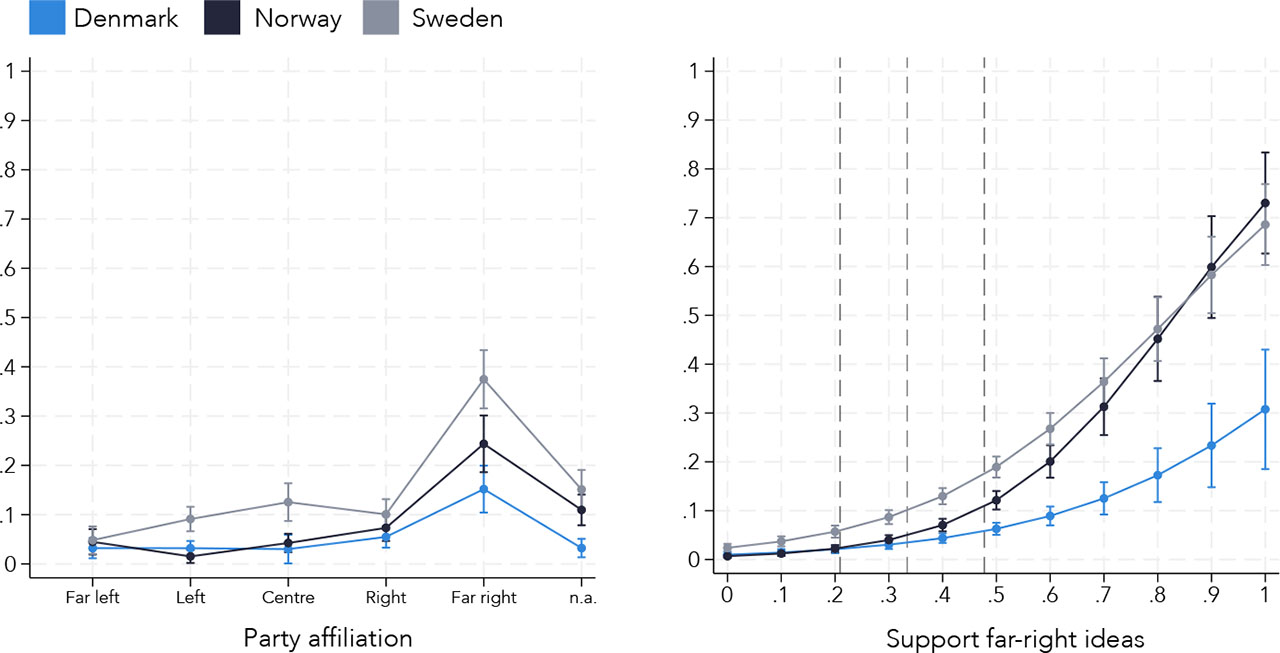
Figure 1
Predicted probability of daily/weekly use of alternative media, by party affiliation and support for far-right ideas
Comments: Predicted probabilities from binary logistic regression models, controlling for gender, age, education. Dashed vertical lines mark the interquartile range of observations.
Alternative media (examples given): Den Korte Avis, Trykkefrihed.dk, Document.no, Resett.no, Nyheter Idag, Samhällsnytt. Control variables included (at their observed value): gender, age, education.
Party categories (Manifesto Project):
Far left: Enhedslisten, Socialistisk Folkeparti, Alternativet, Veganerpartiet, Frie Grønne (DK); Rødt, SV (NO); Vänsterpartiet, Feministiskt initiative (SE).
Left: Socialdemokratiet, (DK); Ap (NO); Socialdemokraterna, Miljöpartiet de gröna (SE).
Centre: Radikale Venstre, Kristendemokraterne (DK); Senterpartiet, Venstre, Krf, MDG (NO), Centerpartiet, Liberalerna, Kristdemokraterna (SE);
Right: Venstre, Det Konservative Folkeparti, Borgerlisten, Liberal Alliance (DK); De kristne, Høyre (NO), Moderaterna (SE).
Far right: Nye Borgerlige, Dansk Folkeparti, Stram Kurs (DK); Fremskrittspartiet, Demokratene, Alliansen, Selvstendighetspartiet (NO); Sverigedemokraterna, Alternativ för Sverige, Nordiska motståndsrörelsen (SE).
Other parties/no party omitted.
Far-right ideas: composite index, 12 items (see Table A3 in the Appendix).
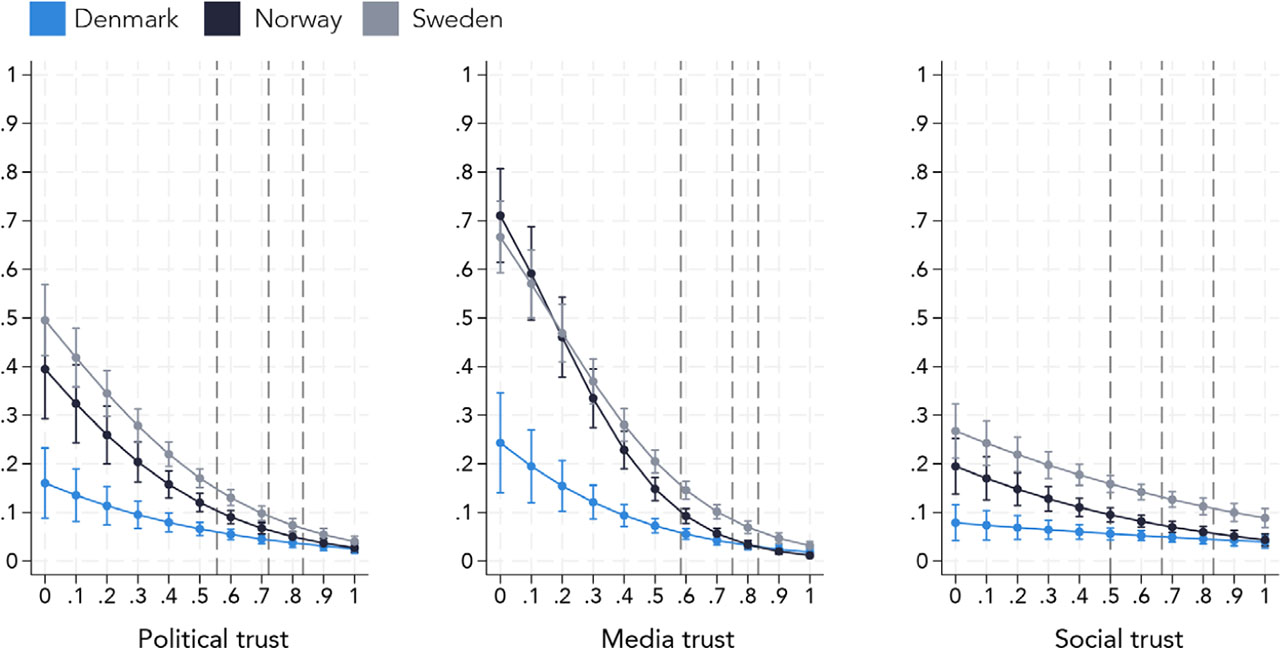
Figure 2
Predicted probability of daily/weekly use of alternative media by political, media, and social trust
Comments: Predicted probabilities from binary logistic regression models, controlling for gender, age, education. Dashed vertical lines mark the interquartile range of observations.
Alternative media (examples given): Den Korte Avis, Trykkefrihed.dk, Document.no, Resett.no, Nyheter Idag, Samhällsnytt.
Political trust: Trust in government, parliament, courts. Control variables included (at their observed value): gender, age, education.
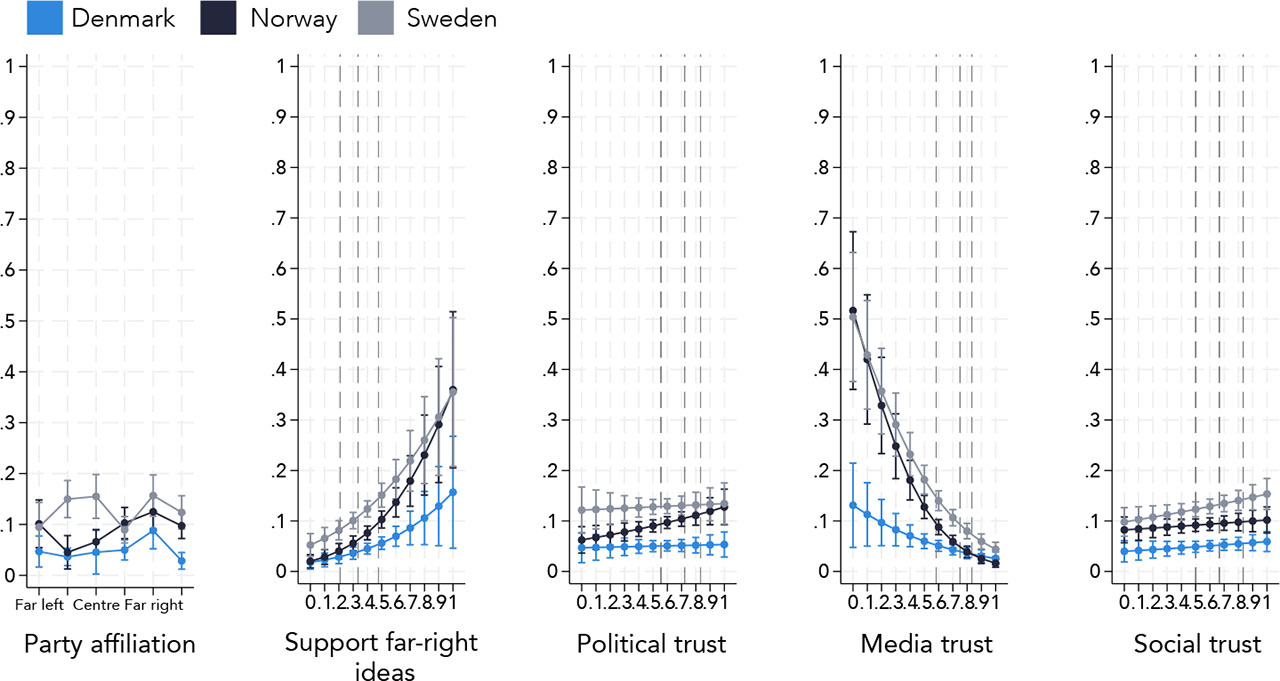
Figure 3
Predicted probability of daily/weekly use of alternative media
Comments: Predicted probabilities from binary logistic regression models, all variables included simultaneously. Dashed vertical lines mark the interquartile range of observations.
Table A1
Consumption of news from different media sources (per cent)
| Media | Country | Daily or almost daily | A few times a week | More rarely | Never | Don’t know/NA |
|---|---|---|---|---|---|---|
| Alternative media | DK | 1.94 | 3.12 | 19.25 | 72.78 | 2.91 |
| NO | 3.24 | 4.63 | 21.2 | 69.59 | 1.35 | |
| SE | 5.73 | 8.44 | 27.93 | 55.7 | 2.21 | |
| Tabloid newspapers | DK | 21.76 | 12.61 | 29.93 | 31.26 | 4.45 |
| NO | 46.79 | 21.11 | 21.35 | 8.36 | 2.39 | |
| SE | 34 | 16.42 | 27.88 | 18.03 | 3.67 | |
| National newspapers | DK | 24.87 | 14.15 | 32.74 | 27.43 | 0.81 |
| NO | 11.2 | 16.63 | 41.91 | 29.62 | 0.65 | |
| SE | 25.77 | 16.32 | 38.07 | 19.34 | 0.5 | |
| Local newspapers | DK | 10.78 | 42.44 | 32.58 | 13.02 | 1.17 |
| NO | 44.25 | 26.43 | 23.15 | 5.72 | 0.45 | |
| SE | 27.57 | 25.57 | 36.87 | 9.64 | 0.35 | |
| National Broadcasters | DK | 82.53 | 9.4 | 5.82 | 1.69 | 0.56 |
| NO | 82.68 | 11.9 | 3.93 | 1.24 | 0.25 | |
| SE | 65.6 | 18.78 | 11.85 | 3.57 | 0.2 |
[i] Comments: Research question: “How often do you usually read, watch, or listen to news from the following sources?”
[ii] Alternative media (e.g., Den Korte Avis, Trykkefrihed.no (DK); Document.no, Resett.no (NO); Nyheter I dag, Samhällsnytt (SE))
[iii] Tabloid newspapers (e.g., EkstraBladet, BT (DK); VG, Dagbladet (NO); Expressen, Aftonbladet (SE))
Table A2
Indices of far-right attitudes (principal factors analysis)
| Items | Factor1 | Factor2 | Factor3 | Factor4 | Factor5 |
|---|---|---|---|---|---|
| We should make it easier for immigrants to gain access to [Norway/Sweden/Denmark] (reversed). | 0.613 | −0.033 | −0.370 | −0.001 | −0.012 |
| Immigration is a serious threat to our national character. | 0.768 | −0.156 | −0.220 | 0.062 | −0.034 |
| Violence between different ethnic, racial, or religious groups is largely inevitable. | 0.548 | −0.203 | 0.016 | 0.025 | 0.043 |
| Only people with white skin color should be allowed to live in [Denmark/Norway/Sweden]. | 0.519 | −0.209 | 0.142 | −0.093 | −0.045 |
| It is okay to use violence to defend [Danish/Norwegian/Swedish] culture. | 0.570 | −0.138 | 0.158 | −0.119 | −0.012 |
| We should reinstate the death penalty for certain criminal offenses. | 0.575 | −0.078 | 0.078 | −0.030 | 0.013 |
| [Norway/Denmark/Sweden] is a lawless society. | 0.723 | 0.109 | −0.051 | −0.050 | 0.034 |
| Having a strong leader in government is good for [Norway/Sweden/Denmark], even if the leader bends the rules to get things done. | 0.424 | −0.294 | 0.083 | 0.055 | 0.050 |
| The people, not the politicians, must make the final decisions on law and politics. | 0.423 | 0.142 | 0.220 | 0.116 | −0.020 |
| The [Danish/Norwegian/Swedish] democracy works well (reversed). | 0.518 | 0.474 | 0.039 | −0.027 | 0.011 |
| Politicians in [Denmark/Norway/Sweden] act in accordance with the will of the people (reversed). | 0.460 | 0.491 | −0.009 | −0.011 | 0.003 |
| Men are oppressed in today’s [Denmark/Norway/Sweden]. | 0.495 | −0.005 | 0.144 | 0.109 | −0.024 |
| Eigenvalue | 3.796 | 0.720 | 0.317 | 0.060 | 0.010 |
Table A3
Use of right-wing alternative media, traditional newspapers, and national broadcasters by gender, age, and education.
| Right-wing alternative media | Traditional newspapers | National broadcasters | Right-wing alternative media | Traditional newspapers | National broadcasters | Right-wing alternative media | Traditional newspapers | National broadcasters | |||||||||||
|---|---|---|---|---|---|---|---|---|---|---|---|---|---|---|---|---|---|---|---|
| More rarely | Daily/weekly | More rarely | Daily/weekly | More rarely | Daily/weekly | More rarely | Daily/weekly | More rarely | Daily/weekly | More rarely | Daily/weekly | More rarely | Daily/weekly | More rarely | Daily/weekly | More rarely | Daily/weekly | ||
| Total | 0.21 | 0.05 | 0.19 | 0.77 | 0.07 | 0.91 | 0.21 | 0.08 | 0.07 | 0.92 | 0.04 | 0.95 | 0.28 | 0.14 | 0.11 | 0.86 | 0.1 | 0.87 | |
| Gender | Men | 0.22 | 0.06 | 0.17 | 0.77 | 0.07 | 0.9 | 0.25 | 0.11 | 0.06 | 0.93 | 0.04 | 0.94 | 0.28 | 0.19 | 0.11 | 0.86 | 0.12 | 0.84 |
| Women | 0.2 | 0.04 | 0.2 | 0.76 | 0.07 | 0.92 | 0.17 | 0.05 | 0.08 | 0.91 | 0.04 | 0.95 | 0.28 | 0.09 | 0.12 | 0.86 | 0.08 | 0.89 | |
| Age | <30 years | 0.26 | 0.04 | 0.32 | 0.57 | 0.16 | 0.78 | 0.22 | 0.07 | 0.11 | 0.87 | 0.06 | 0.86 | 0.29 | 0.1 | 0.21 | 0.74 | 0.23 | 0.7 |
| 30–44yrs | 0.25 | 0.05 | 0.27 | 0.67 | 0.13 | 0.85 | 0.22 | 0.08 | 0.1 | 0.89 | 0.1 | 0.87 | 0.26 | 0.13 | 0.17 | 0.81 | 0.2 | 0.75 | |
| 45–59 yrs | 0.24 | 0.05 | 0.21 | 0.73 | 0.05 | 0.93 | 0.25 | 0.08 | 0.06 | 0.93 | 0.03 | 0.97 | 0.27 | 0.15 | 0.11 | 0.88 | 0.08 | 0.88 | |
| 60+ yrs | 0.15 | 0.05 | 0.08 | 0.9 | 0.02 | 0.96 | 0.17 | 0.08 | 0.05 | 0.94 | 0.01 | 0.99 | 0.29 | 0.16 | 0.06 | 0.92 | 0.02 | 0.96 | |
| Highest level of education | High school | 0.18 | 0.05 | 0.2 | 0.74 | 0.07 | 0.91 | 0.19 | 0.08 | 0.09 | 0.9 | 0.04 | 0.94 | 0.27 | 0.15 | 0.11 | 0.87 | 0.1 | 0.87 |
| University/college | 0.24 | 0.05 | 0.17 | 0.8 | 0.07 | 0.91 | 0.24 | 0.07 | 0.04 | 0.95 | 0.04 | 0.95 | 0.29 | 0.14 | 0.12 | 0.86 | 0.1 | 0.86 | |
Table A4
Daily/weekly use of right-wing alternative media (binary logistic regression models)
| (m1) Party affiliation | (m2) Support far-right ideas | (m3) Political trust | (m4) Media trust | (m5) Social trust | (m6) Full model (DK) | (m7) Full model (NO) | (m8) Full model (SE) | (m9) Full model | ||
|---|---|---|---|---|---|---|---|---|---|---|
| Gender (ref=men) | Women | −0.61*** (0.10) | −0.41*** (0.10) | −0.64*** (0.10) | −0.44*** (0.11) | −0.75*** (0.10) | −0.26 (0.22) | −0.22 (0.21) | −0.24 (0.16) | −0.23* (0.03) |
| Age (ref=less than 30 yrs) | 30–44 yrs | 0.14 (0.19) | 0.09 (0.19) | 0.16 (0.19) | 0.21 (0.20) | 0.27 (0.18) | 0.04 (0.47) | −0.11 (0.39) | 0.19 (0.27) | 0.08 (0.68) |
| 45–59 yrs | 0.17 (0.18) | 0.10 (0.19) | 0.37* (0.18) | 0.40* (0.19) | 0.40* (0.18) | −0.08 (0.43) | −0.14 (0.37) | 0.37 (0.27) | 0.16 (0.41) | |
| 60+ yrs | 0.29 (0.18) | 0.19 (0.18) | 0.60*** (0.18) | 0.57** (0.19) | 0.51** (0.17) | −0.07 (0.41) | −0.13 (0.37) | 0.69** (0.27) | 0.3 (0.13) | |
| Education (ref=basic/high school) | University/college education | 0.06 (0.10) | 0.19† (0.10) | 0.05 (0.10) | 0.10 (0.10) | −0.01 (0.10) | 0.25 (0.25) | 0.49* (0.21) | 0.07 (0.15) | 0.23* (0.04) |
| Country (ref=DK) | *NO | 0.35 (0.46) | −0.37 (0.39) | 1.26*** (0.36) | 2.08*** (0.37) | 1.06*** (0.32) | 1.26 (0.18) | |||
| *SE | 0.43 (0.46) | 0.90** (0.34) | 1.69*** (0.32) | 1.87*** (0.34) | 1.48*** (0.30) | 1.48† (0.09) | ||||
| Party affiliation (ref=Far left, DK) | Left | −0.00 (0.42) | −0.24 (0.44) | −1.01† (0.57) | 0.57 (0.36) | −0.28 (0.53) | ||||
| *NO | −1.11 (0.69) | −0.83 (0.25) | ||||||||
| *SE | 0.69 (0.54) | 0.88 (0.12) | ||||||||
| Centre | −0.07 (0.61) | −0.05 (0.61) | −0.59 (0.42) | 0.64† (0.37) | −0.03 (0.96) | |||||
| *NO | 0.01 (0.72) | −0.57 (0.44) | ||||||||
| *SE | 1.11 (0.71) | 0.69 (0.34) | ||||||||
| Right | 0.57 (0.40) | 0.08 (0.43) | 0.06 (0.40) | −0.09 (0.38) | 0.07 (0.87) | |||||
| *NO | −0.04 (0.54) | −0.05 (0.94) | ||||||||
| *SE | 0.23 (0.54) | −0.14 (0.81) | ||||||||
| Far right | 1.70*** (0.39) | 0.71 (0.47) | 0.38 (0.42) | 0.63 (0.40) | 0.71 (0.13) | |||||
| *NO | 0.24 (0.52) | −0.4 (0.52) | ||||||||
| *SE | 0.80 (0.51) | −0.04 (0.95) | ||||||||
| NA | 0.01 (0.46) | −0.56 (0.48) | −0.04 (0.40) | 0.34 (0.37) | −0.53 (0.27) | |||||
| *NO | 0.96† (0.58) | 0.48 (0.45) | ||||||||
| *SE | 1.26* (0.57) | 0.88 (0.15) | ||||||||
| Support far-right ideas (ref=DK) | 3.81*** (0.55) | 2.52** (0.8) | 4.09*** (0.69) | 2.39*** (0.56) | 2.39** (0.00) | |||||
| *NO | 2.20** (0.73) | 1.43 (0.17) | ||||||||
| *SE | 0.71 (0.64) | 0.13 (0.90) | ||||||||
| Political trust (ref=DK) | −2.02*** (0.42) | 0.26 (0.61) | 1.22* (0.59) | 0.06 (0.46) | 0.15 (0.81) | |||||
| *NO | −1.20* (0.55) | 1.03 (0.22) | ||||||||
| *SE | −1.21* (0.50) | −0.01 (0.99) | ||||||||
| Media trust (ref=DK) | −2.86*** (0.46) | −1.87** (0.61) | −4.64*** (0.55) | −3.32*** (0.40) | −1.82** (0.00) | |||||
| *NO | −2.53*** (0.60) | −2.76*** (0.00) | ||||||||
| *SE | −1.32* (0.53) | −1.44* (0.05) | ||||||||
| Social trust (ref=DK) | −0.74* (0.37) | 0.51 (0.46) | 0.43 (0.41) | 0.57† (0.31) | 0.46 (0.31) | |||||
| *NO | −0.96* (0.48) | −0.13 (0.83) | ||||||||
| *SE | −0.61 (0.44) | 0.17 (0.76) | ||||||||
| Constant | −3.377 | −4.632 | −1.792 | −1.368 | −2.532 | −3.271 | −2.146 | −1.855 | −3.4 | |
| r2 (pseudo) | 0.124 | 0.161 | 0.118 | 0.186 | 0.068 | 0.103 | 0.278 | 0.214 | 0.229 | |
| n | 5958 | 5958 | 5958 | 5958 | 5958 | 1958 | 2009 | 1991 | 5958 |
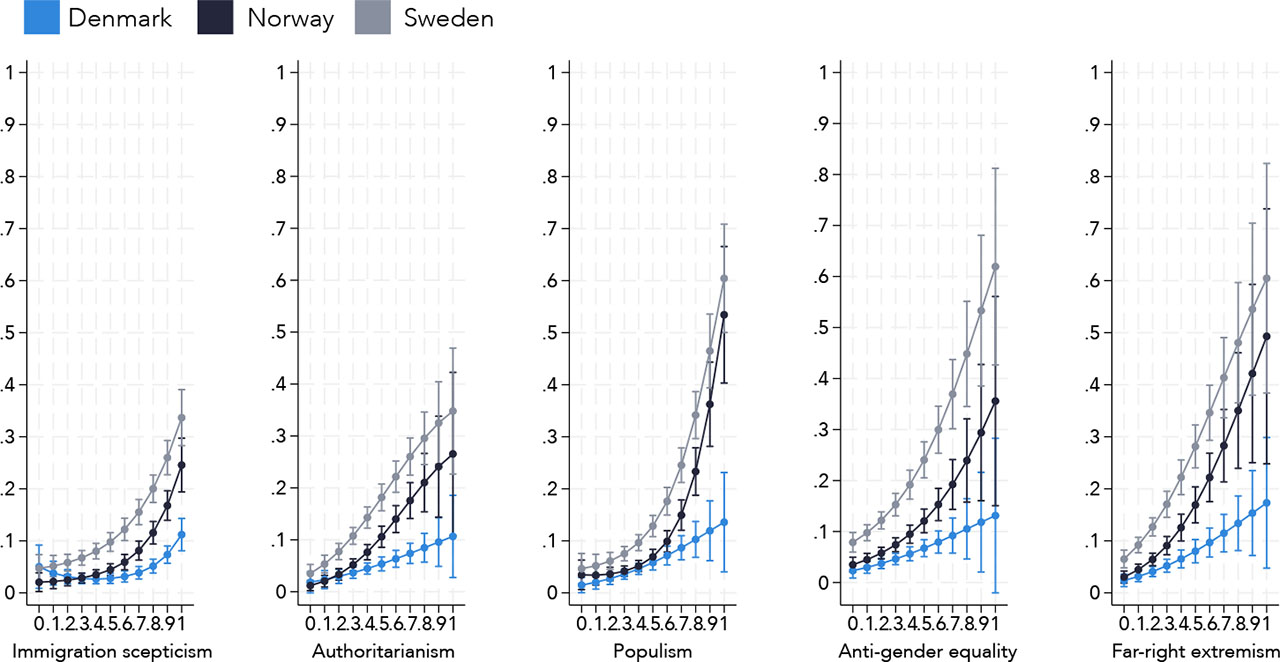
Figure A1
Predicted probability of daily/weekly use of alternative media by support for different dimensions of far-right ideas
Comments: Predicted probabilities from binary logistic regression models, controlling for gender, age, education.
Composite indices:
Immigration scepticism: We should make it easier for immigrants to gain access to [Norway/Sweden/Denmark] (reversed); Immigration is a serious threat to our national character.
Authoritarianism: We should reinstate the death penalty for certain criminal offenses; The most important thing that children should learn is respect for authorities; [Norway/Denmark/Sweden] is a lawless society; Having a strong leader in government is good for [Norway/Sweden/Denmark], even if the leader bends the rules to get things done.
Populism: The people, not the politicians, must make the final decisions on law and politics; The [Danish/Norwegian/Swedish] democracy works well (reversed); Politicians in [Denmark/Norway/Sweden] act in accordance with the will of the people (reversed).
Anti-gender equliaty: Men are oppressed in today’s [Denmark/Norway/Sweden]; Conditions should be created to achieve more equality between women and men (reversed).
Far-right extremism: It is okay to use violence to defend [Danish/Norwegian/Swedish] culture; Violence between different ethnic, racial, or religious groups is largely inevitable; Only people with white skin color should be allowed to live in [Denmark/Norway/Sweden].
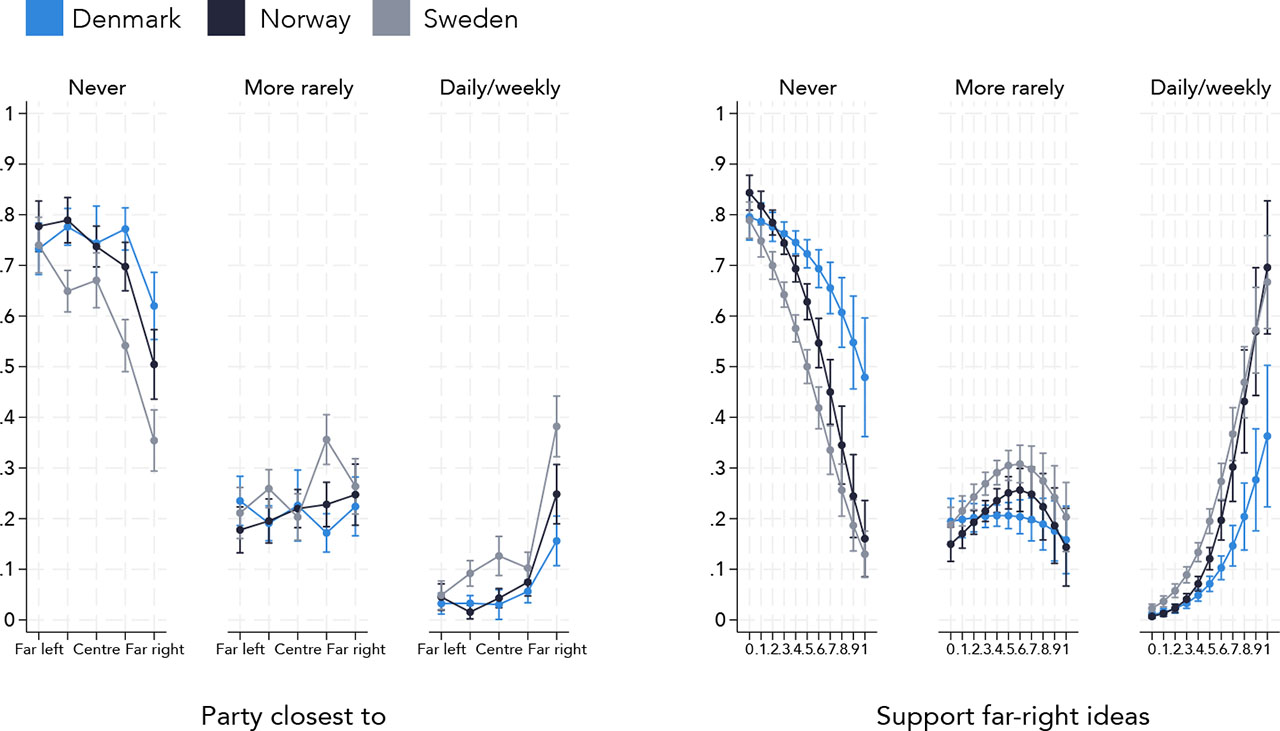
Figure A2
Predicted probability of use of alternative media by party affiliation and support for far-right ideas
Comments: Predicted probabilities from multinomial logistic regression models, controlling for gender, age, education.
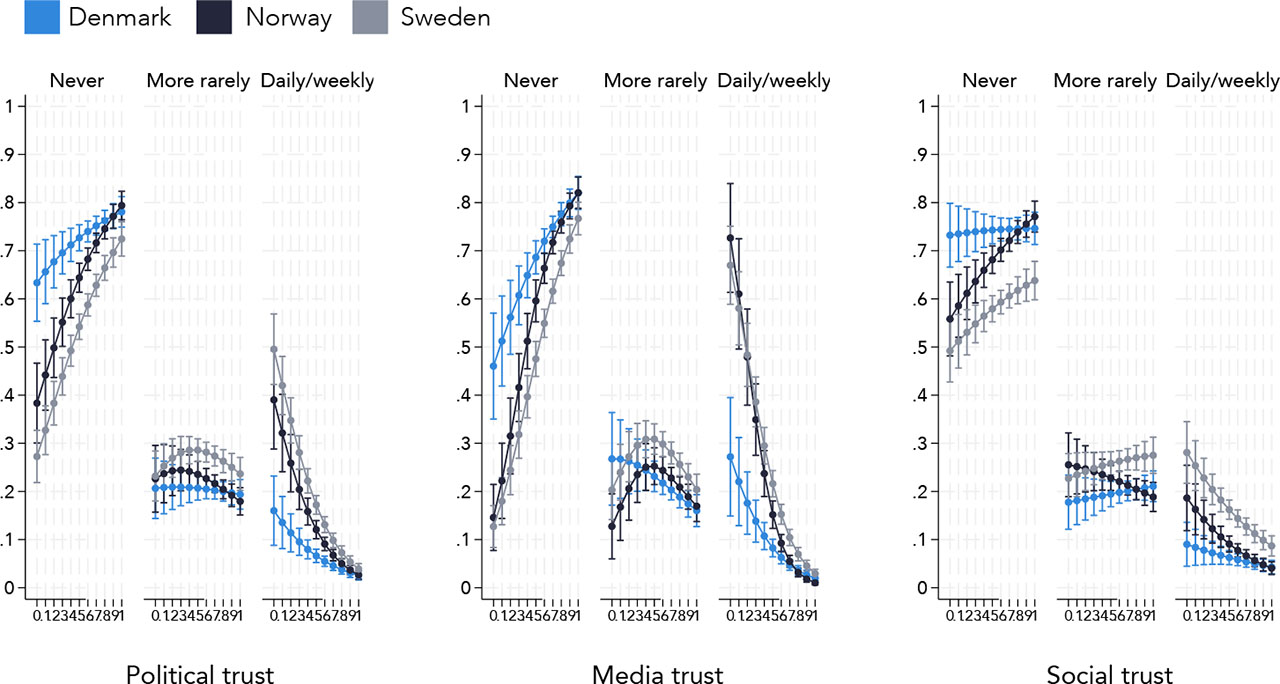
Figure A3
Predicted probability of use of alternative media by political, media, and social trust
Comments: Predicted probabilities from multinomial logistic regression models, controlling for gender, age, education.
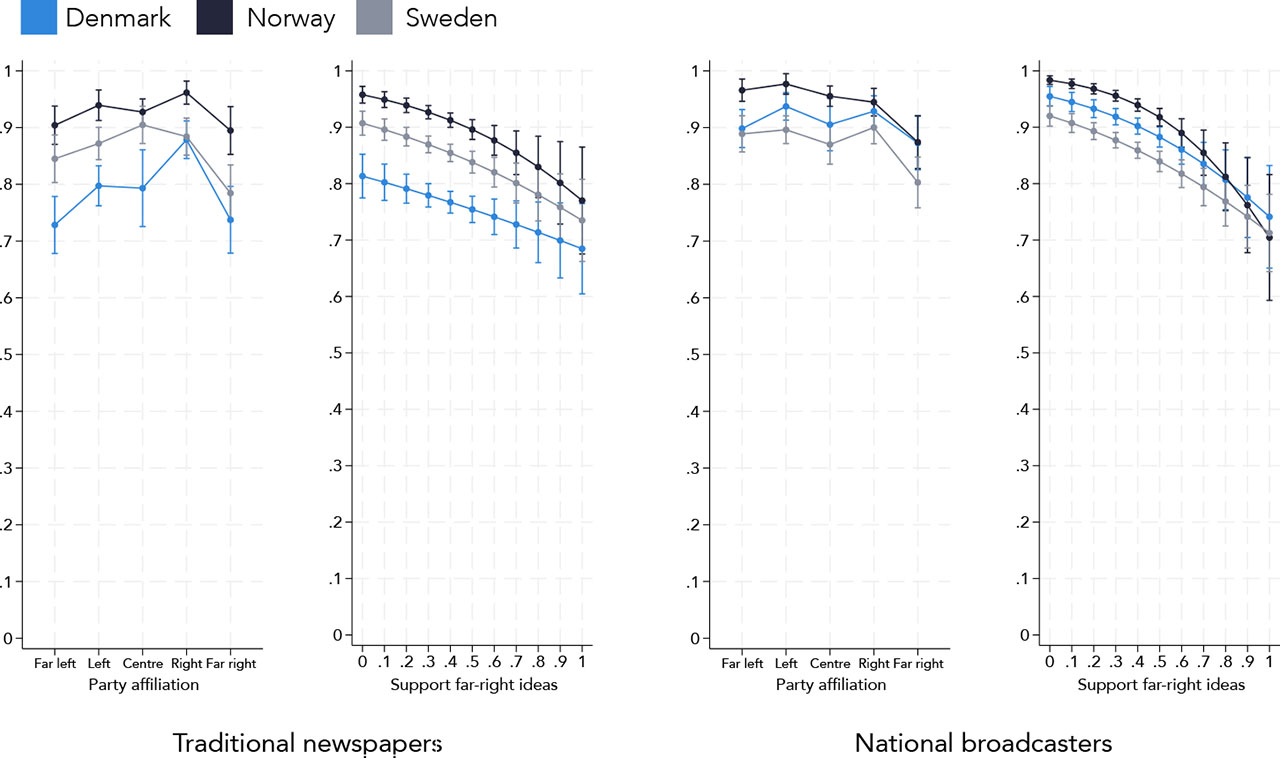
Figure A4
Predicted probability of daily/weekly use of traditional newspapers and national broadcasters by party affiliation and support for far-right ideas
Comments: Predicted probabilities from logistic regression models, controlling for gender, age, education.
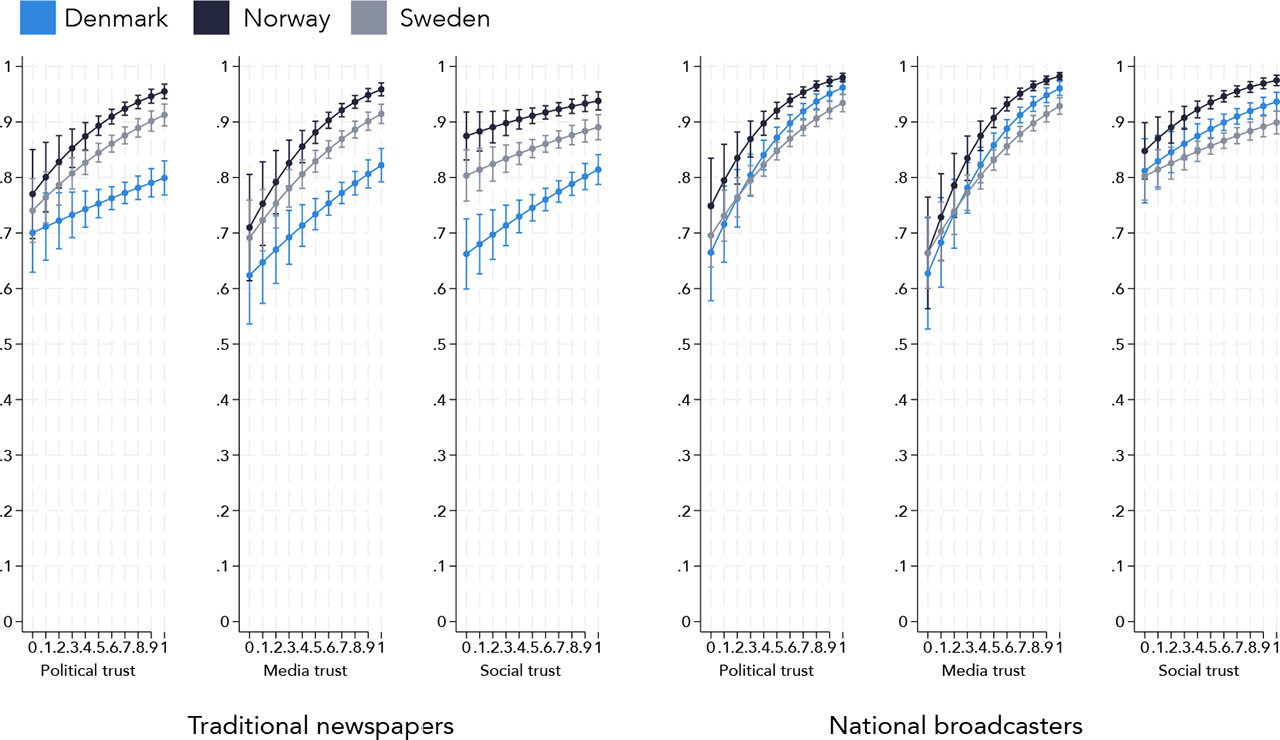
Figure A5
Predicted probability of daily/weekly use of traditional newspapers and national broadcasters by political, media, and social trust
Comments: Predicted probabilities from logistic regression models, controlling for gender, age, education.